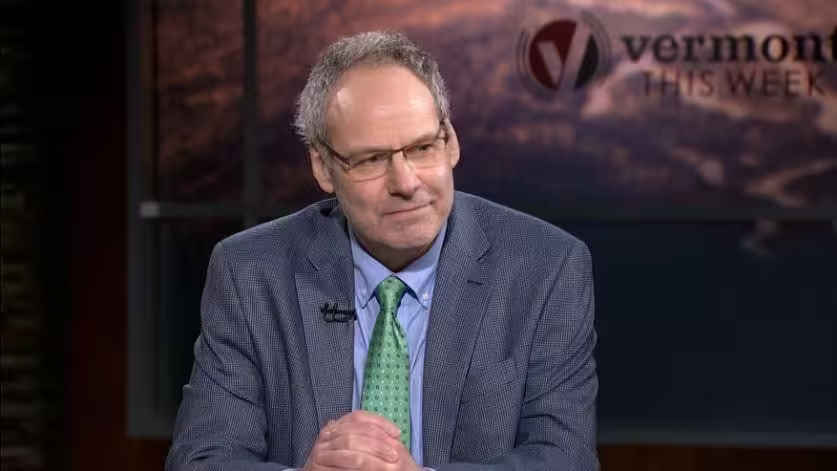
Vermont This Week
February 13, 2026
2/13/2026 | 26m 46sVideo has Closed Captions
Act 250 overhaul takes shape | New federal rules could impact farmworkers in Vermont
Act 250 overhaul takes shape | New federal rules could impact farmworkers in Vermont | State policing panel won’t restrict high-speed chases | Moderator - Mitch Wertlieb; Carly Berlin - Vermont Public/VTDigger; Derek Brouwer - Vermont Public; Austyn Gaffney - VTDigger.
Problems playing video? | Closed Captioning Feedback
Problems playing video? | Closed Captioning Feedback
Vermont This Week is a local public television program presented by Vermont Public
Sponsored in part by Lintilhac Foundation and Milne Travel.
Support provided by:


Vermont This Week
February 13, 2026
2/13/2026 | 26m 46sVideo has Closed Captions
Act 250 overhaul takes shape | New federal rules could impact farmworkers in Vermont | State policing panel won’t restrict high-speed chases | Moderator - Mitch Wertlieb; Carly Berlin - Vermont Public/VTDigger; Derek Brouwer - Vermont Public; Austyn Gaffney - VTDigger.
Problems playing video? | Closed Captioning Feedback
How to Watch Vermont This Week
Vermont This Week is available to stream on pbs.org and the free PBS App, available on iPhone, Apple TV, Android TV, Android smartphones, Amazon Fire TV, Amazon Fire Tablet, Roku, Samsung Smart TV, and Vizio.
Support the crew
Help Mitch keep the conversations going as a member of Vermont Public. Join us today and support independent journalism.Providing Support for PBS.org
Learn Moreabout PBS online sponsorshipAs act 250 overhaul takes shape, some question whether it strikes the right balance.
Plus, new federal rules could impact farm workers in Vermont, and a state policing panel abandons plans to impose more consistent rules for high speed chases.
All that and more ahead on Vermont This Week.
From the Vermont Public studio in Winooski.
This is Vermont This Week, made possible in part by the Lintilhac Foundation and Milne Travel.
Here's moderator Mitch Wertlieb.
Thanks so much for joining us.
I'm Mitch Wertlieb.
It's Friday, February 13th, and with us on the panel today, we have Carly Berlin from Vermont Public and VTDigger, Derek Brouwer from Vermont Public and Austyn Gaffney from VTDigger.
Thanks all to you so much for being here today.
And Carly Berlin, I want to start with you, because we're going to get into act 250, which, you know, can be a little difficult to explain, but it's really super important.
It deals with housing and changing rules.
This is starting to come into focus now after kind of a two year overhaul effort.
Take us back a little bit and then to where we are today.
That's right.
Mitch.
So in 2024, there was this bill that reformed how act 250, that Vermont state wide land use review law works the way act 250 had worked in the past was that it would get triggered based on broadly how large a development was, what this reform effort did two years ago is, say, let's trigger the law based on where development is happening.
So a new statewide land use map is currently getting drafted.
We have drafts of it right now.
To be clear, it's not finalized yet.
So we're starting to get insight into where there are going to be exemptions for housing from act 250 and where there are going to be increased conservation rules.
So there are three tiers, as I understand it, of areas of interest that that folks are looking at here.
Can you briefly describe what those tears are going to entail?
Exactly.
So tier one is where we're going to have exemptions for housing.
And there are actually even two layers of tiers within tier one.
This is all very likely to match, some areas, you know, larger downtowns will have full exemptions for act 251 going through an application process.
Other, you know, village centers will have exceptions, up to 50 units of housing.
Then I'm going to jump to tier three.
Tier three is where we're going to see those increased conservation rules.
So where the the barrier to get into act 50 is lower, where we want to be protecting important natural resources.
Tier two is everything in between.
So when you think about it though, it is a lot.
It is a lot.
And these tier one and tier three areas ultimately are going to be fairly small areas of land that we're starting to see where they're going to be.
Tier two is everything else.
And those areas generally act 250 is going to work as it does now, though there are some new rules based around if you want to build a new private road over a certain length, that would get you into act 250.
Okay, let's, draft off that a little bit.
Roads.
I know the governor, Phil Scott, was making some mention of this.
He was using an example of his own driveway, he said, which was 800ft long.
And his point was, look, I've got this 800ft, piece of pavement here, but it's not affecting wildlife.
Where I live.
He sees all sorts of animals and stuff going around there.
What's the point the government is trying to make there?
Exactly.
So the governor wants to repeal this road rule that would kick in.
If you want to build a private road over 800ft.
The idea behind this rule is to prevent the fragmentation of forests to keep building closer to the roads.
When I asked the governor about wanting to repeal this a couple weeks ago, he said, I see all this wildlife crossing my road.
I don't see the point of what this is trying to do.
So, you know, again, the devil's in the details here.
And as you say, these are draft maps right now, nothing is set in stone.
But what are some of the concerns already that you're hearing from people who say, hey, wait a minute, maybe, maybe pump the brakes a little bit on some of this activity change?
Exactly.
I'm hearing a lot of criticism that, you know, this this reform effort was framed as this grand bargain between increasing housing and boosting environmental conservation rolls.
Right.
I am hearing this concern that in the reform effort, as it's taking shape, we're skewing more towards the conservation piece and not enough towards the housing piece.
You know, part of that is, is just how these maps are taking shape.
So far, I'm hearing criticism that those tier three boosted conservation areas are too extensive.
There are some towns writing into the state saying this is really going to hamper where we want to be building housing locally, to have this new layer of state level review.
On the other hand, on the tier, those tier one areas we talked about, we're seeing some municipalities, especially in, you know, Chittenden County, our population center in Vermont who have not opted into getting some of these housing exemptions, who have at least signaled at this stage that they want to keep up to 50.
You know, the way it works now is another layer of review for development.
So there are a lot of levers here.
And we're hearing, you know, the governor like we talked about and also rural lawmakers in particular, saying let's pump the brakes on this process.
Let's bump these timelines out for some of these things like the road rule and like these tier three increase conservation areas to just give more time for this mapping to play out and get some feedback.
What is the next step then for the draft maps?
It depends on which map we're talking about.
So the on the tier one level regional planning commissions are drafting those maps with a lot of input from municipalities.
The state then reviews those and approves them.
That's going to be happening throughout the course of this year.
The tier three maps are being drafted by the state, and we're expecting to see a new draft map of that, you know, any day now, really this month.
Well, I appreciate you explaining this in a way that I can understand it because it really can be very complex.
One thing that does seem promising, Carly, is this this new catalog I'm hearing about, that, is about pre vetted home designs.
What is that designed to do?
So the state has started this new program.
It's called 802 homes.
And the idea of it is to basically revive the the old Sears catalog idea right from a century ago where you would get a mail order blueprint for a house, you'd get all your parts shipped and build it.
This is going to work a little differently, but the vision is that we'd have this set of ten home designs that are pre-approved, and then you would get a fast track through local zoning.
If you build one of these, the stage this is that now there are three municipalities who are piloting this project with the state.
So they're doing these review workshops of the designs as they're drafted now, and then they're going to work with the state to figure out how this kind of streamlined local zoning approach could work.
Those are Hartford Essex Junction in Manchester.
So we're kind of in the middle of that process now.
I went to one of these workshops last weekend.
But the state, the governor's administration really wants to expand this to the entire state.
But the pre-approved are you said those who approves the pre-approved rules?
Yeah, I know exactly.
So the idea is that the municipality would have some buy in the local zoning level.
There would be, you know, division of fire safety approval kind of happening at the state level ahead of time to.
So that's the idea here.
Okay.
We're going to keep a close eye on that because that could be promising.
Again there's three towns you said that are piloting this.
Exactly okay.
Great.
Thank you Carly.
Austyn Gaffney I want to move on to you here.
Interesting.
New federal rules could really impact farm workers in Vermont and farmers as well.
Can you explain what these new rules entail?
Why farmers in Vermont may be interested, but also may be a bit wary.
Yeah, exactly.
So there are new farm worker rules that have been set out by the federal government and they're state by state.
So when you look at Vermont, it looks like Vermont is cutting the hourly wage for workers by more than $4 in some cases.
And then in other cases actually increasing the wage slightly.
So there it's creating a wide berth that farmers have to work with when they pay their employees.
These employees are not just farm workers in Vermont, but farm workers who come on a specialized federal visa for up to ten months at a time.
Most of them are from Jamaica, Mexico, Guatemala.
And they're folks that have been coming to Vermont, into the US for decades that farmers really depend on for their workforce.
Yeah.
In reading your article, I was really taken that a lot of farmers are saying, you know, I could pay these workers less because of this new federal law, but I always I don't want to because it could hurt morale.
It could maybe even prevent them from working my farm.
Right.
Yeah.
Exactly.
So again, farmers have been depending on these folks for decades.
And they told me that, you know, without these workers coming over, they wouldn't be able to have their farms anymore.
And this is anything from like a turkey farm to a maple sirup operation.
So it's really quite a breadth, and basically they are now paying at least 70% according to the state Labor Department, either at the wage of last year or above the wage of last year, instead of falling in line with these cut federal wages.
So they are trying to maintain their workforce by actually paying more, than they have to.
There's a housing component to this too, as well.
What can you tell us about that?
Yeah.
So there is a wage deduction of $1.61 per hour for folks to live on employer housing in the past.
So through since 1986 of this program, housing has been provided at no cost.
So it's free to these employees who virtually all of them require housing.
But now they could potentially see this wage deduction from, what they used to make in the past.
And you say that at least 70% of farmers have sort of opted to keep things stable or even increase wages a little bit, but that other 30%, they may be taking advantage of this, right?
Yeah.
Exactly.
So that's according to, very recent numbers by the state Labor Department.
These visas, come through and seasonally.
So we haven't even seen all the visa listings that we will for the year yet.
So this is a very small number so far.
But yeah, there is a potentially 30% of farm workers who will be returning to the state of Vermont at a cut wage from what they were paid prior.
This is all, of course, complicated, too, by the immigration question, which we're not getting into in this particular story, but we'll be talking about a little bit later in the show.
Thanks for that update, Austyn.
I appreciate that.
Derek, let me turn to you now.
We've been hearing for so long now about Vermont's aging population.
Now, it turns out we don't have just that problem, but the population is declining in Vermont.
What kind of numbers are we talking about here?
Yeah.
We have the steepest decline of any state in the country last year.
That's according to us census estimates.
These are one year estimates.
You know, we do the the full census once every ten years.
So they're not precise.
But these are the best numbers that we have on a year to year basis.
And it shows that we lost, you know, a little bit shy of 2000 people last year.
Which is, you know, worrisome for, for the state's economy.
This is obviously, as you mentioned, our demographics don't favor us in this realm.
We we had a boost during the pandemic where we were getting some more people from other states.
We've also been able to mitigate our, our, poor demographics, through international migration.
And, what we saw this year is, is that we had drops in all fronts.
So more people are still are dying in Vermont than are being born.
We had we actually lost people to moving out of Vermont to other states last year.
And then the number of people immigrating into Vermont from other countries was actually about half as many as it had been the previous year.
That is, that mirrors a national trend that is likely linked to, changes in federal policies around refugee resettlement programs and deportations, things like that.
And again, you're saying Vermont led the nation in this decline?
Yeah.
In terms of homelessness, right?
Yeah.
In terms of a percent of our population.
And there were only a handful of states in the first place that had declining populations.
So this is we're very much an outlier, in this in this realm.
And, you know, you can speculate about all of the reasons why this this is the case.
Certainly.
I've heard many, explanations from from readers and listeners on that.
But, you know, people who are worried about Vermont's economy, think we really need to be moving the needle and starting to grow our population in order to to solve our tax base issues and our workforce issues.
This connects with the housing thing, too, right?
Absolutely.
I mean, I just a follow up to that.
I mean, there's you hear a lot of conversation around needing to build more to be able to keep young people in Vermont, to be able to have homes for people who are interested in moving here for jobs, too.
Yeah, that's that's, those are sobering numbers for sure.
Derek, let me stick with you here because, there was a state policing panel that recently took a look at the, issue of high speed chases.
In Vermont.
There have been some, you know, really difficult stories connected to this.
The panel, voted to say that they will not restrict high speed chases.
What's going on.
Here?
Yeah, yeah.
So this has been in the spotlight because we have had a number of, fatal police chases in Vermont, most notably, one in Rutland a few years ago in which, 19 year old police trainee was killed.
There have been people within law enforcement pushing to have more restrictive chase policies for years.
I mean, it is it is known as one of the more dangerous maneuvers that, that a police officer can, can undergo.
And it's true on a national level, too.
Exactly.
Yeah, exactly.
And and it's dangerous to everybody.
Right?
I mean, it's it's it's a risk to the officer.
It's a risk to the suspect.
And it's a risk to by standards.
So the so this the there was an effort led at a state advisory panel called the Law Enforcement Advisory Board.
This was pushed by the former chair, Sean Burke, who is now the interim police chief in Burlington.
And it kind of sat on the back burner for, for a year.
The board actually had trouble even having enough people show up to its meetings to conduct business.
But when I spoke with them, late last year, they had indicated that they were planning to actually take this up.
And they told the legislature they're planning to take this up this year.
That's all the backstory for how in January they met and very quickly decided this actually is not something they want to, to pursue any longer.
What what, they told me is that, you know, police chiefs have different opinions on this, and, they each department has its own assessment of its needs.
Rural versus urban areas, for instance, may not want a uniform policy that applies to both.
And there are also different philosophies.
There are some, police chiefs who are more cautious about these these types of pursuits.
And there are others who think it sends the wrong message to suspects that if you fly us, we're not going to chase.
Okay.
Thank you for the update on that story.
I appreciate that.
We're going to move on to another story.
Now, that, has to do with some protests.
And folks may be aware of these happening in Vermont.
Vermont State Police arrested 11 people and cited two others on trespassing charges on Monday, after the group declined to leave a Williston building that houses an Immigration and Customs Enforcement office.
Here are two of the protesters speaking to an NBC five reporter about why they chose to take the action.
The point of getting arrested is to increase the information out there about what Ice is doing.
I've never been arrested before, but I feel really compelled with, with what's happening now to do everything I can to speak out.
Austyn Gaffney, this is just the latest instance of protests targeting the surveillance facility.
We just heard from those who protested on Monday that their goal is to really ways raise awareness here.
A lot of people expressed the fact that they would be back.
What is the end goal here for advocates?
I think there's two goals here for advocates.
The first goal is to bring attention to, the presence of ice in Vermont.
And that's not only, through detentions and deportations, but also just the presence of facilities that do things like, host a national tip line or do digital surveillance here in Vermont.
I would say the other thing they're trying to do is to end the leases or to have, managers and owners of these buildings where the facilities are to cancel those leases.
So far, managers and owners have said they don't intend to cancel these leases they've been in the works for, in some cases, like 16 years.
It's not a new thing for Vermont.
Yeah.
I got to say, this is not even just a David and Goliath thing.
It just seems like an effort that even the protesters themselves realize probably won't come to fruition.
But when you see the visuals of some of those folks out there who, you know, many were elderly, some were walking with walkers and canes willing to be arrested.
I mean, I think that is sort of the image they want to have.
Get out there, right?
Yeah.
I think you've really seen a push among activists in Vermont to at least, show their presence in their, refusal to kind of follow up fall in line with Ice and with federal policy around Ice.
So we've seen that in marches.
We've seen it in noise demonstrations, banner drops, and then these most recent arrests.
Yeah.
And, you know, it's really something because, we have not seen the major surge in ice presence here in Vermont yet, as we've seen in some other states and Minnesota and Maine.
But certainly the presence is there.
And again, this this is this data facility in Williston.
They're too data collecting, right?
Yeah, they do data collecting.
We have seen, though not the same surge that we've seen in like Maine and Massachusetts in terms of apprehensions.
But there has been according to Migrant Justice, which is a local advocacy group, a tenfold increase in the amount of people detained, or apprehended in Vermont, in 2025 as compared to 2024.
Wow.
Tenfold.
Yeah, that's pretty striking.
Well, that leads me to this next question about the Department of Corrections.
And Vermont has apparently been publishing immigrant detainee data.
Where are they publishing this?
Why are they publishing this?
So it's actually, very publicly accessible dashboard just on their web page.
They started publishing it last week.
It is updated every Wednesday, and it's been in the works for about six months now.
Reporter.
Who is that?
Vtdigger reported in July that it was due to a push from advocates who wanted to see more data transparency.
Now advocates are saying they want to take that a step further.
They want more from the state than just data transparency.
And this is what to what end?
Why do they want this information to be public?
Because so far there hasn't been, publicly accessible information about how many people are detained in Vermont.
So these aren't necessarily people who have been apprehended in the state of Vermont, but people who pass through Vermont's jail systems.
The whole New England region is an area in which people detained by, customs and immigration enforcement groups are kind of like moved between different jails.
But there's not a lot of like, transparency around who moves where and when and why.
Interesting.
Okay.
From one vulnerable population of people to another.
Carley Berlin I have to ask about, you know, at the time we're talking here on today's show, temperatures in Vermont, it's been a very cold winter.
They've they've gone up about, you know, 30 degrees feels like 60 after some of the cold stuff we were through, earlier.
But it's been a real issue, I would imagine, for a large homeless population, with some of those incredibly cold temperatures earlier.
What, are folks doing to prevent Vermonters basically from freezing to death?
So the state this winter has expanded this program to open extreme cold weather shelters around the state.
These are triggered when temperatures are below 0 or -10.
In some cases, it varies a little bit based on location.
And because there's this really strict weather dependent criteria to get state reimbursement, these shelters will open when they hit their criteria and then close again once it gets a little bit warmer.
I tagged along in Burlington as they popped up the shelter last month, and just I wanted to see what went into this huge undertaking.
And it is that it's a huge undertaking.
This is, you know, not surprisingly, the largest one of these shelters of the six in the state.
But, it requires, you know, transforming a whole gymnasium into a shelter and getting food for, you know, 60, 70 people who are staying there when it opens and getting all of those blankets and cots and everything ready.
And then outreach workers go and drive around the Burlington area late at night to get people to the shelter itself.
So I tagged along on that shuttle ride as, Sarah Russell with CVO was getting calls from strangers saying, hey, I see someone who's sleeping outside.
The price drop around Shelburne Road, come pick them up.
And it's just a massive amount of work.
That's that's a striking image that you just said there that that right along must have been fascinating.
But also very scary and kind of sobering.
You said 60, maybe 70 people sometimes are put in these shelters.
Yeah, exactly.
In the Burlington, one per night.
This obviously varies a lot around the state.
The other is in more, you know, rural areas, smaller towns are more like ten, 20, 30 beds.
But yes, the Burlington mine is about 60, 70.
That's how many people they've been seeing.
And it's an all volunteer effort to find these folks who are out there not or is it?
It varies a bit.
The Burlington one is really more professional and it's it's all professional staff who's working, you know, overtime hours to have this operation open.
In other parts of the state, it is more volunteer driven.
And Vermont still has a serious homelessness problem.
Right.
Last time we checked.
Second, I think in the nation per capita.
Yeah.
Fourth last year, but, you know, holding really steady from this big spike in homelessness that we saw during the pandemic.
Okay.
Thank you very much for that update.
I appreciate that, and I hope folks can find places to stay warm.
We have an update on a story about, a purchase of Smuggler's Notch.
The owners of Burke Mountain are buying Smuggler's Notch Resort for an undisclosed price.
The companies announced this on Wednesday.
Bear Den Partners will have the majority ownership interest in the Jeffersonville ski resort, and the family, who have owned Smuggler's Notch for nearly 30 years, will continue to have a minority ownership stake, bear Den Partners CEO John Schaefer said they don't have immediate plans for any major changes, to Smuggler's Knots.
So an update on that story there.
And I want to turn to you, Derek Brewer, about a story about, we just said the Super Bowl, you know, happened and lots of wagering on the Super Bowl, everything from the coin toss to, you know, how many yards the Patriots are not going to get in that game.
But also, it turns out that a lot of Vermonters are now betting on more obscure sports, apparently.
What can you tell us about that?
Yeah, this was one of the more interesting things that I found when I looked at the data for, 2025, in the state sports wagering program.
Now, this was the second year of the program.
And and so I guess I sort of assumed we would see kind of a consistent, gradual increase as more people, you know, learn of it and, and start to become, more accustomed to the idea of sports betting.
But what we saw actually, is that the, the increase in and the amount wagered, last year was, was really not in the main sports like football and basketball.
It but rather we saw pretty notable increases in the number of smaller sports.
Now, I called them obscure.
My story had some people point out that, table tennis is in fact, globally, one of the more popular sports.
That's because of the new movie with Timothy Shalom, Marty Supreme saying.
Yeah, yeah, well, suffice it to say, it's it's probably not, you know, a top five sport for Vermonters to watch at home on TV.
But but many months out of the year, it actually, or at least for several months out of the year, it actually was one of the top five sports that Vermonters were wagering on, as well as a sport that I am less familiar in as well.
Which is E basketball.
You may know, you may know, you may not know, but you can also wager on various video games as well, including, video game, basketball.
And so we're seeing millions wagered on those sports as well.
Now, I thought this was intriguing for one other reason, which is, that, you know, one of the signs of problem gambling can be, a tendency to start wagering on sporting events that, you know, care about or, you know, very little about.
Interesting.
So I thought it was striking that we saw, the growth in the industry appear to be more directed toward some of these other types of sports, rather than, the sports with perhaps the largest fan following, in Vermont.
Yeah.
Again, if you're going to bet, please do so responsibly.
I know it's the message they're trying to get out there now that it's legal in Vermont, but it doesn't always translate well.
It's hard.
I mean, if you, you mentioned the Super Bowl.
I mean, you're just inundated with ads for, promoting sports wagering.
It's it's pretty inescapable if you're a fan.
They is pretty much as well.
From obscure sports to sports that folks do want to watch, on television, it's really been incredible for Vermont athletes at the Winter Olympics to this point.
Ben Ogden took home the first U.S.
medal for a man, in the U.S.
in cross-country skiing in the sprint.
First time in 50 years that a U.S.
male athlete has won a medal in this.
And it's so full circle because the last one to do it was also a Vermonter, Bill Koch, who set that, guy to medal a silver, just as Ben did it back in 1976.
We also have Ryan Cochran-Siegle picking up a silver in the super-G, and Paula moltzan, who was a UVM standout, skier and an NCAA champ.
She won a bronze in the Alpine Combine, which was really kind of shocking because a lot of people expected Mikaela Shiffrin to be on the podium there, and she was not so really, congratulations to all those athletes.
And I do want to make sure that, I mentioned you should tune in to The Sports Rapport, our new show that's all about, sports in Vermont.
And beyond on Monday, because we're going to feature the interview that we did with Ben Ogden.
As we talked to him about his incredible win, a wonderful young man who really, put it all into focus about how important it was for him to have that win and have it come back to Bill.
Coach, who is family, by the way, has been very close with for years.
They grew up skiing together.
It's just a wonderful story.
So on the Sports Report on Monday we will have that interview with Ben.
I hope you can tune in for that.
That's all we are at the time for today.
Thank you so much to our panel.
Carly Berlin from Vermont Public and VTDigger, Derek Brouwer from Vermont Public and Austyn Gaffney from VTDigger.
I'm Mitch Wertlieb.
Appreciate you watching so very much.
And join us next Friday for Vermont This Week.

- News and Public Affairs

Top journalists deliver compelling original analysis of the hour's headlines.

- News and Public Affairs

FRONTLINE is investigative journalism that questions, explains and changes our world.












Support for PBS provided by:
Vermont This Week is a local public television program presented by Vermont Public
Sponsored in part by Lintilhac Foundation and Milne Travel.