Vermont This Week
February 2, 2024
2/2/2024 | 26m 45sVideo has Closed Captions
School Budgets and Property Taxes | Lawmakers Consider Change to Cannabis Cultivation Laws
School Budgets and Property Taxes | Lawmakers Consider Change to Cannabis Cultivation Laws | Gov, Legislature at Odds Over Vermont Strong “Bundles” | Panel: Sarah Mearhoff - Moderator, VTDigger; Mark Johnson - WCAX; Alison Novak - Seven Days; Stephen Biddix - NBC5.
Problems playing video? | Closed Captioning Feedback
Problems playing video? | Closed Captioning Feedback
Vermont This Week is a local public television program presented by Vermont Public
Sponsored in part by Lintilhac Foundation and Milne Travel.
Support provided by:


Vermont This Week
February 2, 2024
2/2/2024 | 26m 45sVideo has Closed Captions
School Budgets and Property Taxes | Lawmakers Consider Change to Cannabis Cultivation Laws | Gov, Legislature at Odds Over Vermont Strong “Bundles” | Panel: Sarah Mearhoff - Moderator, VTDigger; Mark Johnson - WCAX; Alison Novak - Seven Days; Stephen Biddix - NBC5.
Problems playing video? | Closed Captioning Feedback
How to Watch Vermont This Week
Vermont This Week is available to stream on pbs.org and the free PBS App, available on iPhone, Apple TV, Android TV, Android smartphones, Amazon Fire TV, Amazon Fire Tablet, Roku, Samsung Smart TV, and Vizio.
Support the crew
Help Mitch keep the conversations going as a member of Vermont Public. Join us today and support independent journalism.Providing Support for PBS.org
Learn Moreabout PBS online sponsorshipThe debate over how to address looming double digit property tax hikes continues as state leaders consider the best path forward.
I think it's time for us to take a look at make sure that we address the issue before we just start throwing more money at raising taxes.
But I don't think I don't think Vermonters have the capacity to talk.
And legislators contemplate changes to state cannabis cultivation laws.
Plus the political and constitutional tug of war continues between the governor and the legislature over flood recovery bundles.
Ahead on Vermont this week from the Vermont Public Studio in Winooski, this is Vermont this week made possible in part by the lintel foundation and Milne travel.
Thanks for joining us for Vermont this Week.
It is Friday, February 2nd.
I am Sarah Meaerhoff.
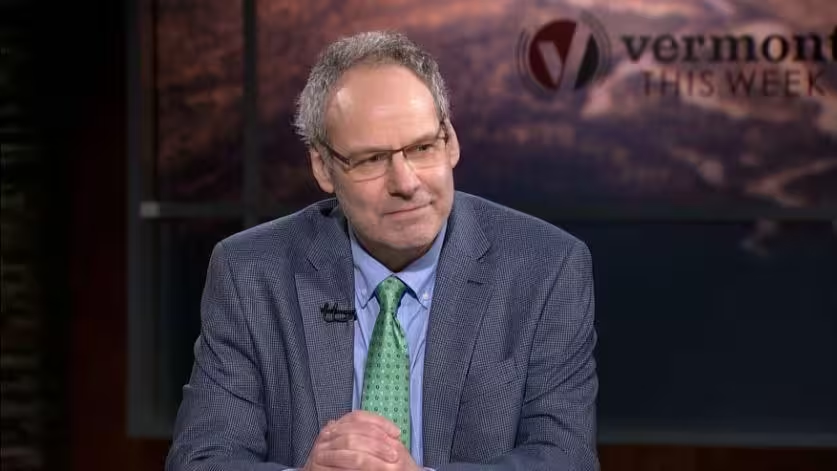
Joining me on the panel today, Mark Johnson with WCAX, Stephen Bendix with NBC Five and Alison Novak with Seven Days.
Thank you all for being here.
It's been a massive week for political news in Vermont, both in and outside of Montpelier.
We've got a great panel of journalists to really run through all the news of the week with us.
Alison, I want to start with you.
And among the probably the wackiest and the most in-depth conversations and the predominant debates happening in Montpelier this week is over education funding.
Walk us through what's going on.
Why is this such a big deal to Vermonters right now?
Okay, sure.
So just a little disclaimer or months education funding system is very, very complicated.
And this year there are a number of things that are making it more complicated.
So first, school spending is up, budgets are up because of a number of factors that are largely outside of school districts control.
So that includes the Federal Esser funding going away.
That includes inflation and that includes big increases in health insurance costs for educators.
On top of that, this is the first year that Act 127, which is the pupil weighting law, rolls out.
And so that law, just as a reminder, was meant to enable historically disadvantaged districts to increase services without raising taxes.
And the way that they would do that is by giving more weight in the ED funding formula to to students who are English language learners, to students who are low income, and to those in rural areas.
But the legislature knew that this was going to be difficult for those districts that didn't have as many of those students.
And so what they did is they put a provision in Act 127 that essentially said for those districts that were going to maybe lose taxing capacity from act one of 27, that as long as they did not increase per pupil spending by more than 10% from year to year, their property tax rate would be capped at a 5% increase.
And so essentially that was and that's before common level appraisals applied, which is another input that goes into the education funding formula that is meant to ensure that each town is paying their fair share.
And so I think it might be easiest to kind of demonstrate how this is working with a specific example.
And in the article I wrote this week for seven days, I talked about South Burlington.
So South Burlington is one of those districts that is slated to kind of be disadvantaged by Act 127.
And so they said, okay, we're going to craft our budget not exceeding this 10% per pupil spending so that our tax rate before Celia is applied will be capped at 5%.
So they crafted their budget.
With that in mind, the clay numbers came in and their budget increase jumped to 18.3%.
But what they realized is we can actually put an extra $2 million into our budget for much needed capital improvements.
So improvements to school buildings, which we know like tons of schools, are in disrepair right now and it will not affect our tax rate.
So whether or not we add this 2 million, we're still going to have a 18.3% tax rate increase.
And so they did that.
And South Burlington is not the only district that did that.
A lot of districts did that.
So they put this kind of extra spending in knowing that they could take advantage of this cap.
Now, it's reasonable that districts would do this because they have all this deferred maintenance.
But as Emily Kornheiser, the chair of the House Ways and Means Committee, explained to me, if you have 50 districts that are all adding $2 million to their budgets, that's $100 million that has to come from that education fund, and that has to be made up in some way.
And so what ended up happening is those districts that were supposed to benefit from Act 127.
So when you ski, for example, North Country in Newport, they are at risk now of not being able to increase services without raising taxes because of this kind of excess spending or padded spending from other districts.
So it's kind of subverting the very goals of Act 127.
I'm glad you brought up State Representative Emily Kornheiser.
We have a clip of her and what she has to say about this exact debate in Montpelier.
I would encourage us, when we're thinking through these things, to not think about whether we want more taxes or less taxes, but instead think, is this better or worse than an increase in the property tax?
Stephen, you're in the state house on a daily basis.
What are you hearing about this?
Yes, I just heard Representative Kornheiser talk about it a little bit, obviously, for the governor.
So we don't want to continue raising taxes on Vermonters.
But she's at the point where what's the lesser of two evils, people having to pay these property taxes or maybe raising other taxes to help kind of make up for it and I know, Sarah, you were there maybe late fall or early winter with the fair share tax where 3% goes to Vermonters that make over $500,000 a year.
They predict that would bring in roughly 100 million extra dollars in revenue.
That's one potential thing I've heard thrown out there, maybe to help fill that gap because that gap is going to be there.
But sitting in committee watching the House Ways and Means Committee, the amount of sweaty palms, face palms, readjusting to get more comfortable just seeing these numbers and just watching these lawmakers really try to grasp their head in their hands around this debate is just it's pretty fascinating to watch.
Well, you know, one of the other things, too, that just stepping back, Vermont is one of the states that most heavily relies on property taxes in order to fund education.
And, you know, there have been so many education funding laws in this state in the past 30 years.
I mean, they seem to sort of have a life span.
Then everybody kind of blows it up.
They've restarted again.
And, you know, one of the other big factors is how popular Vermont is.
And everybody wanted to move here.
So the Selah, the common level of appraisal that you mentioned is just going kind of wacko because every community I mean, I think it's half to two thirds of the communities in Vermont need to readjust the values of homes because they're just going up so much as people want to want to move here after the pandemic.
Well, and there seems to me to be kind of like two dueling goals here.
Everyone wants the best education for the kids.
But also, I mean, we know we've talked on the show so often about how the cost of living in Vermont is really crippling some folks and property taxes are frankly part of that.
Alison, what are you hearing on the ground from stakeholders about these kind of dueling realities?
Yeah, and talking to superintendents and school district administrators, it's clear they understand this.
They know that this is a really big ask to taxpayers and they know that they're their constituents.
The taxpayers can't afford this.
But they also know that, like, they need to offer the services to students that are needed.
And this is a time when students are experiencing very challenging mental health issues.
Schools are acting as de facto social service agencies, in many cases, for students.
And so I think there's this real struggle.
It's not that school districts want to do this, that they are trying to put this burden on taxpayers, but they kind of are seeing no other choice right now.
And there's a lot of things that are outside of their control, which I think is important, that, you know, there's inflation, things like that.
They can't control that.
So the only thing they can really control is services and staff.
And so they're very worried that if budgets fail, they're going to have to make some pretty big cuts in terms of these like programs and services and staff members that are really integral to running a school district.
You know, the thing that I thought was your story was fantastic and actually explain is something that it's incredibly complex.
But what was really concerning is that if these budgets get turned down and there's a whole mechanism that you can only spend a certain amount if that happens, you know, the taxes don't seem to go down an awful lot.
Yeah.
Yeah.
So, for example, in South Burlington, even if they had to go back to their current budget and that would be, you know, I think 10 million of cuts, something like that, the tax rate increase would still be 13 point something percent.
So it's not even you know, it's not even saving townspeople that much money.
So, yeah, I feel like we could talk about this unbelievable conundrum for an entire show.
But I do want to move to our next topic.
Lawmakers are just a couple of years after Vermont legalized cannabis cultivation, possession and ingestion.
Lawmakers are revisiting this topic.
And like so many great debates in Montpelier, it all started with some good old fashioned neighborhood drama.
Stephen, you've been there the entire way covering the story.
Tell us how this happened in Essex.
Yeah.
So his name is Jason Struthers.
His family is own this home for over 40 years in Essex Junction.
And so he's a tier one license to legally grow cannabis.
And he uses his ducks as a source of fertilization for his plants, while his neighbors have been getting more and more vocal.
And the ducks and the noise, that's an ongoing litigation and a completely separate one.
But with the marijuana, they're complaining about the smell now.
They can't enjoy their pools, their backyards, their porches.
But it's also being raised now that a lot of the neighborhoods in Essex, Junction's, back up two schools, his house included.
And so to Essex Junction, State representatives Laurie Huffman and Erin Dolan have introduced a bill where any minutes of penalties that have over 500 people per square mile or a municipality that uses city water and sewer could no longer grow marijuana, as Jason Struthers does right now, because their argument is it's just not correct in all places and this is just something that may have just kind of gotten lost throughout the process.
And something to look back on while Struthers is more frustrated.
It's kind of like the ultimate Not in my backyard, where his neighbors are like, Well, we don't want this in our backyard.
And he was like, Well, my family's owned this house for over 40 years.
Like, this is my backyard.
Like I should be able to do this.
He's also told me it's Vermont.
At the end of the day, agriculture is one of the big aspects of this state, and he will actually be at the House Government Operations Committee on February 6th, Tuesday of next week, to give his side of the story.
You know, it's interesting because this really brings also this conflict between state and local law, as you've got this state which is granted him permission to farm.
And you've got the local community that is trying to impose its its own rules.
You know, one of the things that really struck me in listening to your story is I went and actually looked because he's got a half an acre.
A half an acre is not an awful lot of land.
A half an acre is if it's a square 150 feet by 150 feet.
And that's not an awful lot of room for 30 ducks, up to 100 plants.
His home in ar1 residential neighborhood.
Mm hmm.
Yeah.
We have a video clip of Jason Struthers talking about his predicament.
We don't create laws to address one problem.
I'm not trying to be a nuisance to the neighbors.
But at the same time, my rights don't end where the sensitivities of others begin.
The concerning thing to me is that it's going to affect outdoor cultivation across the entire state.
And this is based on one municipalities bias.
I want to be clear, Essex Junction is not anti cannabis, but there is a real conflict between dense housing and outdoor cultivation, basically where you're asking for a reckoning and recognition that outdoor cannabis may not be appropriate in all locations.
Stephen What do you think this will mean for the entire state if this goes through?
If it goes through?
Do you think this bill has legs?
So I've talked to some lawmakers that completely understand how frustrating this must be for neighbors.
But I've also talked to lawmakers just pondering the idea with them, because it is kind of a quirky story of are we going to create a bill that all we know of right now is meant for just one person in the entire state?
I mean, what Vermont has over 650,000 people at this point.
And some lawmakers have argued we have way bigger things to worry about than someone growing marijuana in their backyard.
So it'll be interesting.
Struthers will be at the State House on Tuesday, as I said earlier, to give his side.
But it will be interesting to see how many more lawmakers want to seriously pursue this rather than okay, it's just about one person.
We have so many other statewide issues to worry about and I think it's really about the marijuana or the ducks.
I think it's about the marijuana because the ducks are not in this bill at all.
It is a purely marijuana bill.
So the ducks are another issue that is in the local courts.
But but he seems to think that they're trying to get at that through the cannabis laws.
I mean, yeah, you can argue that they are taking that angle.
And he also told me he is attempting to move.
He is not trying to stick around and stay there forever.
But, you know, it takes a process, as we've talked about before, to find housing here and things along those lines.
So he's not planning to stay at that home forever, but it's a very interesting story going forward to see how it plays out.
Those poor ducks caught in the crossfire also in Montpelier this week.
Quite the blow up over, of all things, license plates and socks.
It all started this summer in the wake of our catastrophic flooding of the state faced Governor Scott issued an executive order allowing for the sale of commemorative Vermont strong license plates and darn tough manufactured socks branded with Vermont's strong.
The proceeds of these sock and plate bundles benefit flood recovery in the state.
But this is somehow become quite a fierce battle in the state house.
Marc, can you kind of tell us how this happened?
Well, I think that the tug of war here seems to be over turf and question of does the legislature have exclusive authority about how deciding how money gets spent?
I mean, I think everybody is very sympathetic to the cause of this.
Flooding was devastating.
This is no recall, the second incarnation of the Vermont strong license plate.
This came out after Tropical Storm Irene.
But the difference is it was not bundled with another product, with the with the socks.
And for $70, you can now get a license plate and get this pair of socks.
And then the money goes directly to flood relief.
And I think the legislature has sort of gotten its nose bent out of joint because they don't have a have a say in this.
I think there's a legitimate concern that people have of whether or not you have a commercial enterprise also being bundled into this effort and whether or not it's it's fair that this private company somehow gets a benefit.
Now, my understanding is that all the money that's being raised is going into flood relief.
So and, you know, darn tough, it sort of fits in with the whole Vermont strong motif.
You know, there have been other organizations, including a media outlet, that were trying to raise money to help flood relief and keeping some of that money for themselves.
That is totally inappropriate.
So I think this is really more, you know, a turf battle between the legislature and the executive branch.
You know, we're talking about $1,000,000.
And, you know, getting back to your story, Alison, which is we're talking about a lot more money than that.
It seems a little bit of a little bit petty by comparison.
Stephen, having a front row seat to the dynamics in Montpelier on a daily basis.
I mean, do you think that this gets at a larger kind of rift between the Scott administration and the Democratic controlled legislature?
Oh, 100%.
The line was drawn in the sand so much quicker than it was last year in my opinion.
I mean, just from the jump, from the first day to the state of the state to the budget address and now to this, I mean, you can argue on one side that, you know, it was pushed to the very bottom of the, what, almost 100 page Budget Adjustment Act.
And maybe not many people are going to read that all the way through and see everything.
And the administration maybe would have like to see some more transparency when it came to that change, where Democratic leadership says, well, we don't know what the administration's communications and relationship is like with darn tough.
We're not really privy to any of that.
And they're getting a lot of free promo compared to, say, Ben Jerry's is also a Vermont native company and born and bred in Vermont.
Like, why can't we help out?
Maybe some other Vermont companies instead of just darn tough and felt that it wasn't really giving everybody a fair chance?
Back to your coverage, Alison, on education issues, do you also think that this is getting politicized along party lines or do you think it's it's different than that?
I mean, in terms of the governor's messaging around this, he was very clear when this projected tax property tax increase was announced that this was something that was unacceptable.
And in December, he called on school boards to tighten their belts.
And I think that when you think about that now and about like what I've talked about, about how many factors were outside of school district control, I think that was a little bit of an unfair ask because how could school districts tighten their belt when all of these things are outside of their control?
And I think I mean, there's there's possibly going to be the showdown now that the legislature is looking for other revenue sources to make up for the the end fund deficit.
You know, the governor, I think, yesterday tweeted that he is not in support of finding any other ways to raise additional revenue.
And, you know, I noted that, and I. I think that could set up somewhat of a showdown.
Yeah.
Yeah.
I also know that the governor has said that, you know, I gave a bunch of ideas to the legislature on how to rein in school spending years ago dating back to, I think, 2017.
They didn't take me up on that.
And now the ball is kind of in their court.
Stephen, are you also picking up on that dynamic?
Yeah, and I think that's a sentiment with a lot of policy in the state House right now is even with other issues where the legislature said after his state of the state budget address, you were hoping to hear more tangible plans, but we're just not in the administration, which fair to their point, say they have a supermajority, they override our vetoes.
I mean, listen us in the past.
So, yeah, I'm definitely hearing the same thing.
You know, another thing that's weird, though, is that we talked about this on the program a couple of weeks ago.
This 18% number that came out at the beginning was not that big a surprise to people.
And in the past, they would the legislature would somehow find money to kind of buy down that rate.
And that doesn't seem to be happening this year.
Yeah.
Yeah.
And that's that was a point made by one of the tax officials as to what we're seeing with the property tax rate increase that for the past couple of years that it was bought down.
And so now we have to kind of climb out of this trough.
Yeah, I believe the cost.
213 million or 200 million?
Yeah.
To buy us out.
You know, and you touched on this in your story, but the other, like big elephant in the room is all this school construction and rebuilding.
I mean, in Burlington, there's $165 million bond that's above and beyond everything that you're talking about with just basic education.
I mean, and a lot of these schools are built at about the same time, so.
Wow.
Yeah.
Not to mention the PCB testing.
Right.
You know.
Yeah.
Big issue as well.
Yeah.
And political news outside of Montpelier this week.
Some incredible developments with Addison County.
State's attorney Eva Viscose has been arrested for driving under the influence.
Stephen, can you catch us up on what exactly happened here?
It's a pretty fascinating story.
So the Addison County state's attorney, Eva Viscose, was going to what was a suspicious death at the time in Bridgeport.
She showed up and troopers on scene said she was slurring her words.
They smelled some alcohol on her breath and they approached her for a sobriety test.
She refused everything.
So she was then arrested for DUI refusal taken to the New Haven barracks process there.
Once again, uncooperative or not, take a mug shot, have her fingerprints done.
And so then obviously that all played out.
I reached out to her the next day to try to get comment.
She was very unwilling to give comment on the phone, and that was an interesting conversation in its own way.
But then roughly about a week later, she sent an email out to all of the kind of law enforcement within Addison County, local, state, saying these new guidelines, saying she doesn't feel safe around law enforcement anymore.
And our station talked to the Addison County sheriff and he was saying we've never had guidelines like this before.
This is all pretty unpleasant and sad and very unprofessional because at one point when she said she was scared of law enforcement, it wouldn't be showing up to chief's meetings anymore.
She said part of her was kind of upset because then she could no longer teach them grammar and show them her picture books with dragons, to which they all responded.
This is extremely unprofessional.
At the end of the email chain, she did eventually apologize and it was, but still just an absolutely wild situation.
Yeah.
And lawmakers are debating a constitutional amendment which would establish some parameters for county level elected officials like Misty Coast Lake Franklin County Sheriff John Griz Moore, who we've talked about on the show so many times, that proposal proposal one is still working its way through the legislative process and is undergoing some intense debate.
But I want to end the show today by talking about someone who was a master of covering hardball political news.
Vermont lost a giant in journalism this week.
Jon Margolis cut his teeth, reporting on politics for The Chicago Tribune for 23 years.
He wound up in Vermont, where he was a longtime contributor for my newsroom vtdigger as well as Alison's seven days.
And Mark, I know you worked with Jon for a long time.
Can you tell us about some of your memories with him?
Jon was a real pro.
I mean, not only did he work at the Chicago Tribune, he worked at the Bergen County Record.
He worked at the Miami Herald.
I mean, these are really prestigious newspapers covered for presidential elections.
What what I think I and many of my colleagues really appreciated about Jon was he was a big deal in his humility in working with us.
I mean, he would go around the newsroom and try to get input from people who were covering stories and say, can you add anything to what I'm writing?
He was not presumptuous.
He wasn't a know it all in any way.
He was just a very down to earth guy.
I thought he made this comment in his last column where he talked about leaving the job and that, you know, him leaving wasn't going to make all the big difference in the world and everybody's replaceable.
And I thought I was really struck by that.
And it reminded me of advice that my dear mother in law gave me, that, you know, you want to leave the party when you're when you're having a good time.
And I think I think Jon went out with a lot of class.
Yeah.
Jon was also a regular contributor on this very show.
And long time host Stewart Ledbetter said, quote, We were fortunate to get Jon Margolis on Vermont this week roundtable for several years after he and Sally relocated to Vermont.
Jon's years covering the rough and tumble of national politics at the Chicago Tribune gave him a different perspective on state politics.
We are going to miss John very much, but that's all we have time for on our show today.
I want to thank our panel very much for joining us.
Mark Johnson with WCAX, Stephen Bendix, NBC Five, and Alison Novak with Seven Days.
Thank you all for tuning in tonight.
Vermont and come back next week.
Thank you.

- News and Public Affairs

Top journalists deliver compelling original analysis of the hour's headlines.

- News and Public Affairs

FRONTLINE is investigative journalism that questions, explains and changes our world.












Support for PBS provided by:
Vermont This Week is a local public television program presented by Vermont Public
Sponsored in part by Lintilhac Foundation and Milne Travel.