
February 20, 2026
2/20/2026 | 55m 48sVideo has Closed Captions
Serhii Plokhy; Billy Crudup; Denise Gough; Emily Galvin Almanza
Serhii Plokhy explores the last four years of war between Russia and Ukraine in his new book "David and Goliath." Actors Billy Crudup and Denise Gough discuss their new stage adaptation of the Hollywood western "High Noon." Former public defender Emily Galvin Almanza analyzes the state of the American criminal justice system in her book “The Price of Mercy.”
Problems playing video? | Closed Captioning Feedback
Problems playing video? | Closed Captioning Feedback
February 20, 2026
2/20/2026 | 55m 48sVideo has Closed Captions
Serhii Plokhy explores the last four years of war between Russia and Ukraine in his new book "David and Goliath." Actors Billy Crudup and Denise Gough discuss their new stage adaptation of the Hollywood western "High Noon." Former public defender Emily Galvin Almanza analyzes the state of the American criminal justice system in her book “The Price of Mercy.”
Problems playing video? | Closed Captioning Feedback
How to Watch Amanpour and Company
Amanpour and Company is available to stream on pbs.org and the free PBS App, available on iPhone, Apple TV, Android TV, Android smartphones, Amazon Fire TV, Amazon Fire Tablet, Roku, Samsung Smart TV, and Vizio.
Watch Amanpour and Company on PBS
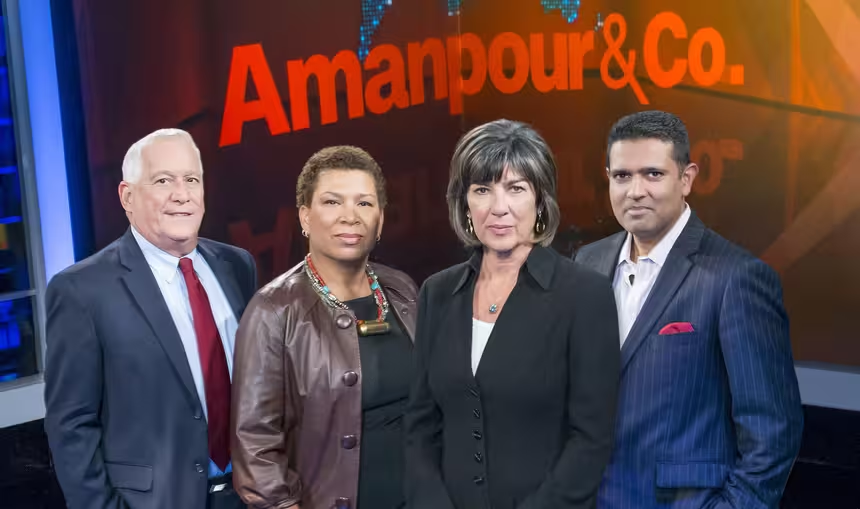
PBS and WNET, in collaboration with CNN, launched Amanpour and Company in September 2018. The series features wide-ranging, in-depth conversations with global thought leaders and cultural influencers on issues impacting the world each day, from politics, business, technology and arts, to science and sports.Providing Support for PBS.org
Learn Moreabout PBS online sponsorship(dramatic music) - Hello everyone and welcome to Amanpour & Co.
Here's what's coming up.
- We are ready to move quickly toward a just agreement to end the war.
The only question is for the Russians.
What do they want?
- Ukraine is about to enter its fifth year of full-scale war with Russia.
Ukrainian historian Serhii Plokhi joins me on his new book, "David and Goliath" and why he says staving off the Russian invasion is a defining test of all of our democracies.
Then... What happens when you get a very powerful person who's interested in vengeance first?
A classic western for a divided age, a new stage adaptation of "High Noon" revisits fear, silence and moral courage in polarized times.
and Denise Goff explain why the story feels so urgent right now.
Also ahead... How do we get to a point where public officials have the audacity to lie or to hurt civilians?
Well, because in this court system, that's been happening with essentially no negative consequences for generations.
A warning about America's justice system, former public defender Emily Galvin Almanza tells Michelle Martin why due process failures in lower cords have been normalized for years.
♪♪ >> "Amanpour & Co."
is made possible by... ...and by contributions to your PBS station from viewers like you.
Thank you.
Welcome to the program, everyone.
I'm Christiane Amanpour in London.
In a few days, Ukraine will mark a violent, aggressive anniversary, four years since Russia's full-scale invasion.
Negotiators from Kiev and Moscow met in Geneva this week for another round of U.S.
brokered talks, even as expectations remain low.
The toughest issues, from territorial concessions to long-term security guarantees, remain unresolved.
The war has already reshaped Europe's security order, strained Western unity, and tested the limits of diplomacy.
It's a conflict that historian Serhii Plokhi explores in his new book, David and Goliath, casting the war as a stark struggle between a smaller democracy and a far larger would-be empire, and also as a test not just for Ukraine's survival, but for the future of democracy itself.
He joined me from the United States, where he is a professor at Harvard.
Serhii Plokhi, welcome to the program.
It's a pleasure to be on the program.
Okay, so we're talking about, obviously, the Ukraine-Russia situation, but your book, David & Goliath, which is essentially on, and commentaries on this war.
Tell me why you have called it David & Goliath, and more to the point, who's David, who's Goliath?
Well, David clearly is Ukraine under the circumstances, and Goliath is Russia, the Russian Federation.
And the title is there very much informed by the, really, the first reaction to the war during the very beginning of the all-out Russian aggression against Ukraine where no one, literally no one expected Ukraine to last for more than three or four days or maybe a couple of weeks.
And we are now entering or close to the beginning of the fifth year of the war.
Ukraine is still standing.
That's where the idea for the title of the book comes from.
- You know, this time last year, as you say, exactly as it was, nobody expected Ukraine to stand and to last 'cause everybody just assumed that Russia would cut through like butter, you know, like a knife through butter.
But about a month or more after the start, you remember, and I went, early April, late March, early April, the Ukrainian forces started to push back the Russians in key areas.
They liberated the encirclement of Kiev.
They pushed, you know, further into the Budzha area.
They pushed back the Russian forces in Kharkiv and were very much on the front foot.
And the Russians had absolutely -- They were amazed.
They couldn't believe it, and they were flat-footed for a while.
Back then, it looked like David could beat Goliath.
And I'm wondering whether you think that stands now.
- Well, in 2022, after the original shock of the invasion, of course, Ukrainians, as you just described, pushed back.
And in the fall of 2022, the front lines, Russian front lines, started to crumble.
What they did at that time, they put their Minister of Defense, Mr.
Shoigu, on the phone with the Ministers of Defense of NATO countries.
He started to tell them that Ukrainians are preparing a false flag operation of using a dirty bomb or some sort of nuclear devices and then blaming Russians for that.
So the message was that the Russians were preparing to use tactical nuclear weapons in Ukraine.
And that really, in my opinion, changed the course of the war, in a sense that the US and other countries applied, of course, pressure on Russia.
But also the delivery of the weapons and other things slowed down.
So the Ukrainian counteroffensive next year in 2023 lacked resources.
We now know about that from what we hear from the commander of the Ukrainian forces at that time, General Zaluzhny.
He just stated that.
So the question was not David being strong enough or believing enough in victory.
The question was the allies that certainly reconsidered the way how they were supplying and supporting Ukraine.
And that story continues still today.
I'm sure that if the Russian blackmail, nuclear blackmail, wouldn't work back in the fall of 2022, by now we would have this war over and reconstruction of Ukraine's underway.
- You know, you bring up a very important point and one that is often not discussed on a daily basis when we're trying to cover this.
'Cause we heard, you know, in the Biden administration, which, yes, threw a lot of support towards Ukraine, but was slowed down by this Russian nuclear dangle that Putin kept doing.
And I heard this year, so on the eve of the fifth, you know, year of this war, at Munich, Republican senators admitting that, and other senators admitting that they had been, you know, freaked out, for want of a better word, by the Russian nuclear threat, and that did slow down the attempt to, you know, to really make Ukraine able to keep pushing forward.
So now, all these years later, that threat still dangles.
As you've laid out, the United States, particularly in the Trump administration, have really massively slowed down aid and military, and yet Russia still hasn't won and is not winning.
To what do you attribute that?
- Well, what we know for sure in the last year, year 2025, Ukraine received less support, military support in particular, than it was the previous year.
What was supplied was supplied with the help of the Europeans, Germany in particular.
Ukraine is still there, still fighting because of that spirit that, going back to the title of the book, David and Goliath, the belief in themselves, the belief in victory, and this is certainly the most difficult winter for Ukraine since the start of the war, especially for the civilians in the rear, because Russians really now got a chance to destroy the Ukrainian infrastructure, energy infrastructure.
So it is a miracle.
It is a miracle of the sort that happened with David and Goliath.
What is not, probably can be attributed to miracle, is that the Ukrainians, like David, are using new technology.
In the Ukrainian case, these are the drones.
It's a drone warfare.
Artificial intelligence is a big part of this war.
The Ukrainian Minister of Defense now is the specialist in IT.
- So that's going beyond miracles and something that we can't explain or we don't know about.
That would be also one of the reasons why Ukrainians are not just fighting, but so successful in holding the line.
- And yet President Trump, and I asked President Zelensky this at the Munich Security Conference, keeps pressurizing him rather than Putin.
And Zelensky admitted it and he keeps admitting it and he keeps saying it's unfair that we get all this pressure and the Russians do not.
So given that you're a historian and there's a lot of history that Russia likes to try to lecture everybody on, whether it's the US, whether it's in these trilateral peace negotiations, as you know, Vladimir Medinsky is so-called a historian and they keep delivering long lectures about so-called root causes, never moving on a ceasefire or anything.
They're maximalists, maximalists, demands are still there.
When you think about Putin, what historical narrative is playing through his head?
- This war is quite unique in a sense that it started, or at least the full-scale invasion, started a few months after Putin published under his name an essay, sort of historical essay on history, on Russians and Ukrainians, where the argument is that Russians and Ukrainians are one and the same people.
And when he said that, he didn't mean that Russians don't exist and that Russians are Ukrainians.
that Ukrainians don't exist or shouldn't exist, they're really Russians.
And in that sense, again, I can't remember any other war where history or misreading of history, misuse of history would be so important.
So the root causes of this war for him is the existence of Ukraine, of Ukrainian independent state, but even more Ukrainian nation.
And I'm personally convinced that he means what he says or what he writes that this are the real root causes of the war.
NATO is an excuse.
If NATO would be really a deciding factor in starting this war, one would expect after Finland joined NATO, at least half of the Russian army being withdrawn from Ukraine and put on the border with Finland to defend Russia from NATO.
Not one soldier was withdrawn.
So that's how at least I read the situation on the ground and how I understand the root causes.
Okay, so that's really important to point out because quite a lot of the world takes the Russian argument, even the Trumpies have taken the Russian argument to an extent that, yeah, it's NATO and they were aggressive and shouldn't have been like that and this and that.
But just a quick historical, another historical question, and in your book, you basically link the Russian war in Ukraine to the fall of the Russian empire.
Tell me about that.
- This is in many ways a classic war of disintegration of empire.
If you look at the map, you can't miss a place on that map or on the globe that is called Russia.
It's territorially the largest country in the world today.
You don't acquire territories like that unless you are an empire.
And that's empire that Russia is trying to save by waging war on Ukraine.
The story really doesn't even start with the fall of the Soviet Union in '91.
The story starts with the disintegration of Russian Empire during World War I or after World War I, like it happened to the Ottoman Empire, to Austria-Hungary, so the empires in the neighborhood.
The Bolsheviks stitched together the former Russian Empire, called it the Soviet Union, and still it fell in '91.
And it was dissolved, the Soviet Union was dissolved one week after Ukrainian referendum for independence.
So because Ukraine is and was the largest Soviet, post-Soviet country or republic after Russia.
So the fall of the Soviet Union really depended on referendum for independence in Ukraine.
And now the fate of the post-Soviet space, post-imperial space, depends also on how the war in Ukraine will go.
That's why we have this big war in Ukraine, but not another place in Georgia, let's say, or in Baltics or in Central Asia.
- Again, a really crucial historical point.
- So also, let's go back then to the fall of the Soviet Union.
Ukraine at the time had the third largest nuclear arsenal in the world.
It was part of the Soviet arsenal, and they gave it back in response to security assurances, so-called security guarantees from the United States, Russia, the UK, et cetera.
Clearly, Putin broke that guarantee when he first annexed Crimea and invaded Eastern Ukraine.
I want to play this little bit, because I challenged President Clinton on having given back the weapons and having presided over the so-called Budapest Memorandum.
Here's what he said to me in 2023.
- So cake and eat it too.
I regret what happened, but I don't regret, you know, thinking that it was lead to a more stable world.
Should they have been more skeptical?
- Well, absolutely.
- Well, absolutely, but for being more skeptical, and that for me means more realistic, you have to understand the region.
You have to understand history.
It sounds a little bit self-serving when coming from a historian, but certainly the leaders of Poland, Valencia at that time, and Havel of Czechoslovakia, who were convincing Clinton to open the door for those countries to join NATO, they knew what was going on.
They knew what would happen.
But that sort of understanding was really absent either in Europe, outside of Eastern Europe, or in the United States.
And what happened with the Budapest Memorandum in 1994, that's where Clinton signed documents with then President of Ukraine, Leonid Kuchma, and weapons went to Russia out of all places.
What happened was that the nuclear deterrent that Ukraine had at that time, and Russia was already making claims on the Crimea, that nuclear deterrent disappeared.
Ukraine was left with a piece of paper where the assurances were spelled out, but a vacuum, a security vacuum was left in the center of Europe.
And security vacuums are not good.
Whoever is the president, whatever happens in the world, it attracts aggression.
That's what happened in Ukraine.
That's what no one really on the American side, West European side, thought about back in the 1990s.
So you can't leave a country that is unprotected and remove deterrent and then hope that everything will turn out fine and okay and later regret that it didn't turn out that way.
Finally, because Ukraine is still fighting and says that it's fighting for all of our security and it is the most proficient army in Europe and frankly in the NATO system right now, even though it's not part of NATO.
But you grew up, I believe, in Zaporizhia, which has one of the world's largest nuclear power plants.
Just tell me what it was like growing up there, what you recall, just what does this all mean to you personally?
- Well, it's a disbelief.
I look now at the map, these are the areas where my family comes from, where I was spending parts of summer.
it's disbelief, it's anger, it's really overwhelming emotions.
And on the other hand, I also understand that Russia, despite all its aggression and things like that, it got into the war that it can't win.
I grew up in Zaporizhia, that's the nuclear power plant, the largest nuclear power plant in Europe in that region located, not in the city of Zaporizhia, but in that region, now under Russian occupation.
And the biggest danger of the war going nuclear for me is not about the use of the nuclear weapons, because you can be kept responsible one way or another for doing that.
But it's a so-called accident at the nuclear power plant, like Chernobyl.
Chernobyl was occupied, now is a Polynesia.
So that is the biggest concern for me.
And my feeling is that the public in general, the policymaker, don't fully realize when they think about nuclear threats, that the most immediate threat comes from the Russian control of the nuclear power plant, which now has no access to sufficient water after the Kokhovka Dam was blown up and so on and so forth.
So that's the emotional side of what I think, but then what I think as a historian and a scholar also of nuclear age.
- Well, thank you.
As we approach the fifth year of this terrible war, thank you so much for your perspective and your historical look back.
- Thank you very much, Christiane.
It was a pleasure.
- Now, as the United States heads into a midterm election season, marked by sharp polarization, battles over immigration and growing fears about democratic norms, an old Hollywood Western is suddenly feeling strikingly modern.
A new stage adaptation of High Noon here in London's West End.
When it was first produced in 1952, it was seen as a parable of McCarthy era blacklisting and public cowardice.
And it confronts those same tensions today head on.
While Bruce Springsteen's music underscores the drama.
Actors Billy Crudup and Denise Goff join me here in the studio to talk about it.
Denise Goff, Billy Crudup, welcome to the programme.
So I've seen High Noon, I saw the stage play, and it was really very, very effective.
It sort of rolled into today and just grabbed us all with the relevance for today.
But how difficult was it to put what everybody knows as a movie onto the stage, particularly in the UK, premiering here to the Brits?
Well, we did a workshop of it first so that we could get an idea of how to make it work.
But I think you should speak to that more, because as an American, I'm used to doing theatre here a lot, but doing a very specific American play, American story... It's a unique play in several regards, not the least of which that it's a beloved Western film.
It feels like a part of the Americana culture.
And Eric Roth is a screenwriter.
He hadn't had the idea.
With unbelievable success.
Incredibly successful over many, many decades.
Still producing.
He was inspired by what was happening in the world.
And that movie, it turns out, was written by a man who was blacklisted.
And there's a correspondence... In 1952.
In 1952.
And there's a correspondence between living during a time that feels lawless and where people are having difficult-- a difficult time agreeing on what the rules and what the laws are and how we can all live collectively in a civilized environment.
And so, the Wild West is a perfect metaphor for that.
That land was being developed by people who were coming in from all over the place.
And there was quite a bit of dis-ease because the Civil War had just ended.
People were heavily armed.
They were still at each other's throats.
And they hadn't agreed upon how to collectively live a civil society.
So there was a lot of rage.
And I think that's one of the things that was inspiring Eric.
He wanted to bring it to the stage in a visceral way.
Well, the first draft that I read had an eagle flying in, as I recall.
And he was testing out any kind of theatrical vocabulary that he could imagine.
So when Thea and Denise were involved, Thea being the director.
Thea Sherrick, they're high-level theater professionals who not only understand dramaturgically how to shape a piece of material like this, because it was probably an hour longer, the text was.
Talking about the timing, you have a clock on the stage.
And it counts down to high noon.
In real time.
In real time.
It's a great device.
It is.
It really is.
Let's just establish you are Will Kane, the sheriff, who wants to put down his... Marshall.
Marshall.
I'm so sorry.
You're right.
Who wants to put down his weapons finally and swan off into the sunset with you, Amy, his new bride, etc.
You're a Quaker.
You hate violence and war.
And this is fundamental that your soon-to-be husband does not pick up his gun again.
But first I want to ask you, because you've been talking so much about the film, was there pressure to step into Grace Kelly's shoes or to Gary Cooper's shoes?
I mean, he won an Oscar.
How did you feel?
So for me, when I watched the film, I thought... Well, when I first read the script, I thought, "I'm not sure this is for me."
And then we did the workshop on it, and I realised that what Eric was looking to do with the Grace Kelly part was to flesh it out a little, because in the film, she's Grace Kelly, and I'm not Grace Kelly.
I'm 25 years older than Grace Kelly, for one thing.
And so I didn't really think of the pressure of being compared to her, but I wanted to make sure that doing a play like this, that I brought a woman of now somehow.
And so being able and encouraged to flesher out in the way that I was was part of the reason why I wanted to do it.
And working with Billy, who wanted that too, I don't think you wanted, Grace Kelly, maybe you do now, but after working with me for a while... So, when it was first written in 1952, and you said that the writer was blacklisted, this was during the McCarthy era, where Senator McCarthy was essentially going after, it was the Redskay, he was destroying people's lives, all this nonsense about this person's a communist, there's a communist under every bed, or a red under every bed, and all the rest of it.
Why is that relevant today?
How does it become relevant today?
Because it is about cowardice, and a lack of willing by the general population there, to confront, you know, an evil who's coming back into town.
And then it's left up to you, the Marshal, to do that, much to your chagrin.
But it's also, to me, about community and what we're willing to do to protect our communities.
And so I think the relevance of it now... Like, I think great writing reflects the time that it's written in, but then great writing is also timeless, so whatever... The blacklist and communism of the time of the film, now I feel like this idea of community, what we're willing to do for the people that we love, and also the greater community, the global community, we're seeing this stuff everywhere.
And we're living in a time now where artists are even saying things like art shouldn't be political and all of this.
People are censoring themselves out of fear.
And so, to me, doing this play, certainly, and certainly playing a woman who I see as a non-violent activist, essentially, and a woman at the beginning of the idea of feminism and seeing what she has to go through, I think I believe that art, theatre, all of that has the capacity to ask an audience, "What would you do if you were in this situation?"
So, you know, somebody once told me that fiction, reading fiction, is like an empathy gym.
And so, for me, theatre is like sitting in community, empathising, and as artists, we are able to elicit empathy for imaginary characters.
And so there is something to... If I could add to that, because that is speaking more to the point that, with respect to the communists and blacklisting and stuff, High Noon, when viewed from a certain vantage point, the movie itself, isn't about courage, it isn't about one man standing, it's about capricious, cowardice, and people capitulating in the face of a violent threat.
And so those are some of the themes that we started to see, particularly in America, which felt both very familiar and also terrifying that the things that we thought that we had sort of graduated from in some ways had returned with such a vehemence.
And there's some portions of the play that are about what happens when politics and retribution get hand-in-hand.
What happens when you get a very powerful person who's interested in vengeance first and employs people around them?
And that was what was happening in the '50s as well.
And people were closing up their stores.
They were turning on their neighbors.
They were adding to the lists.
And so I think those sorts of correlations are important.
- So then let's go straight to the denouement, and that is that in this case, the retribution was going to be enacted on you by this guy Frank.
- Correct.
- Who you as marshal had jailed, convicted, all the rest of it.
And he had been expelled from the town and then he was gonna come back.
So you felt, because nobody else was gonna help you, that you had to prevent him taking retribution, right?
- Well, he had essentially incarcerated him first based upon the law.
He was a law enforcement officer.
So, he was a person who was devoted to the rule of law.
That's important today.
He fought in the Civil War.
He was a veteran.
It's an important part to understand too.
Many of the marshals of that territory, they were hired because they were really good with weapons.
And the people who owned the towns, who were the sort of town fathers, they wanted people to enforce the laws that they made, so they would hire a marshal who would enforce the laws that they made.
So Will is devoted to the rule of laws he sees it in America and uses his capacity as an agent of law enforcement that is to say he can get tactical awareness he can negotiate a situation and if he has to he can fight and those are the crucial parts of law and enforcement.
But he's going to use the law all the time.
So this guy Frank Miller Lawless.
Criminal.
Lawless.
Doesn't think laws apply to him.
And Will's like, "You can't live in this territory and behave that way."
And eventually he comes for his deputy.
This isn't in our story.
But he kills Will's deputy and Will has to go after him.
Then a jury convicts him of his crime.
Again, part of the rule of law.
And he is sentenced to hang.
The politicians up north free him for reasons that we don't understand.
So all of these sorts of events feel like they have a modern correlation.
- For sure, I mean for sure.
And if we didn't hear it once, we'll hear it again.
Rule of law, it's under threat right now in the United States, certainly.
But so that's what the sheriff, the marshal does.
But you, as the wife, and you've just been married, you are really struggling.
You're prepared to give up your new husband for this principle until you're not.
I think, for me, because she so clearly, all the way through, has her belief system, but then she sees Frank Miller and sees in his eyes what's... Because he tries to tell her about vengeance and what vengeance means.
And she has a deep belief that we make these choices.
And it's not natural.
But then she's faced with the reality of when you stand in front of someone that you know is going to tear a community apart.
Not just him, a community, a whole world, a world that I've seen, that Amy has seen Will build.
At the beginning, there's a whole speech about what he's done for 17 years and the pride she has in him for that, but understands that you can't commit to your whole life doing that.
And she sees throughout the play all these people abandoning him.
And then she sees, she meets Frank Miller, and in that moment, she has to make the biggest decision.
And I always feel at the end of the play, it's kind of devastating.
It's not, it's devastating what this woman has to give up.
And some people cheer, the nights that they cheer, I think, don't cheer at this bit.
It's so sad.
- Okay, so listen, you just talked about politics and how some believe that creatives shouldn't bring their politics to the public.
Obviously you've seen at the Berlinale Film Festival big debate, rather bitter debate about politics and talking about and using your platform.
Do you shy away from espousing your politics as an actress?
- Listen, it goes to what I've said about it's a transference of skills.
My job and what I'm skillful at is getting people to empathise with imaginary characters.
So if I can transfer those skills to things that have meaning for me, and I have deep meaning and connections to certain things that are happening in the world, that I feel, you know, I'm not just my job, I'm a person, and I don't think about things as being political or not political, it's about who am I as a human, and I can't say nothing.
It's not my fault that I'm given platforms, that I'm here.
This is... I find it sad that artists that I really respect and admire find themselves not able to speak up because of what might happen.
I find that really frightening.
So that is frightening.
Now, just to say, you... One of your great public things has been Andor.
You've been in Andor, which is so famous.
You've been in The Morning Show, you've been in Jay Kelly, you've done tons and tons of theatre, but you're both very front and center in today's creative environment.
So I just want to ask you, lastly, because of your role as, you know, the head of this news organization, you probably saw what the FCC, Brandon Carr, tried to do to CBS and Stephen Colbert, try to prevent them from interviewing a Texas state senator for whatever reason.
Anyway, Colbert basically called them out.
He said, "Listen, I don't care.
I'm out of here in May.
Anyway, you've already fired me."
And he went against his own company, CBS, the company.
Corey Ellison, what do you make of that?
Or as Billy Crudup?
Well, I'll tell you, to Denise's point before, it's true.
I'm just a dancing monkey, of course.
That's part of being a performer.
But I am also a citizen.
And I'm a grown person and a parent.
And I try to participate in my civic life as much as I do in my work life.
So, if I'm given an opportunity then to speak about the correlation between my work and my life, I'm inclined in my personal ideology to join in that conversation.
I don't think I'm necessarily right or brilliant or everybody should listen to me.
But the conversation is happening between us right now.
So, I don't believe that there's any particular reason, other than you might not agree with me, that I should shut up.
So, that's how I sort of feel.
When I feel impassioned about a point of view and what's happening in my neighborhood or what's happening to my community or what's happening to my child's future, those sorts of things ignite me.
And I'm given an opportunity to talk about it.
I want to talk about it.
Corey is going to have a fascinating time because Corey loves a challenge.
And if Corey has to try to navigate his own capability to produce as a capitalist under the threat of a wannabe dictator, that'll be exciting for him.
- So this is for another season of "The Morning Show"?
- I'm just suggesting how Corey might think about that.
- But there is another season coming?
- There is another season coming.
I will, I'm sure, suggest this, but they don't really listen to my suggestions.
But I think he's the kind of person who would find it rather fascinating, not daunted by it.
But he has his own personal sense of a moral ethical center.
And he does not believe in inherited privilege.
The last season it was exposed that he was the inheritor of privilege.
So it's going to be interesting to see how he confronts his own reality with what he believes is his ethical centre.
Because if you do believe that America is the land of opportunity and everybody should have a chance to thrive, it's kind of ridiculous if you're keeping people down.
And free speech, by the way.
Yeah.
And Corey is one of those who wants the level playing field so he can prove that he's the best.
That's the reason why.
That kind of level playing field.
That's exactly right.
In the years to come, Stephen Colbert will go down in history as being somebody who spoke up.
Denise Gough, Billy Crudup, thank you so much indeed.
Hi, Neil.
Thank you.
Now, a different and sobering look at America's justice system.
Concerns over due process make headlines every day, from immigration, detention, and deportation, to executive branch overreach.
But these have long been normalized in lower criminal courts.
That's what former public defender, Emily Galvin Almanza, argues in her new book, "The Price of Mercy."
She says a plea-driven system often lets misconduct go unpunished and can even increase crime.
And she's joining Michelle Martin to discuss what she thinks has to change.
- Thanks, Christiane.
Emily Galvin Almanza, thanks so much for talking with us.
- Thank you so much for having me.
- You've written a book.
It's part a memoir, but it's partly a policy book about the way the criminal justice system works.
You're a former public defender.
You worked both in California and New York.
It's not exactly new news that the criminal justice system is kind of heavily weighted against people who don't have resources.
Sometimes that tracks with race.
So what do you think is different about what you have to say?
- Well, usually when we encounter news about the criminal legal system, it's in the form of either a very scary story about a crime or a systemic narrative about a system that is hopelessly inequitable and violent and harmful.
And one of the things I wanted to bring into this sort of public ambit is, as a public defender, I have a really different lens on the system.
I've been inside it for many, many, many years.
My lens is kind of dual because I've been both a defender and also a kid who needed to be defended.
And also in my current work, you know, building enhancements for public defense around the country, I've seen so many amazing interventions that are data proven, that are actionable, that are really, really feasible to implement right now.
So my hope was to bring a perspective that gives people the case against our current system and a really solid case against it.
This book is heavily researched and then also spent half the book on solutions that are not pie in the sky.
We don't have to like invent a warp engine.
So here's the thing that's interesting about the book.
It's your own story, but it's just the way you describe how at just about every turn and every sort of point in the system, there are things that could be different that would yield different outcomes.
Here's one of the things that you say in the book.
You said, "I've represented a lot of people who were innocent.
A fact that I have noticed often surprises lay people because television tells us that most people who get arrested are guilty, while in real life, most people who get arrested are poor and may or may not be guilty."
Give us one example of how that works.
I represented someone who I talk about in the book.
Her name's Janelle, so I want to be clear that I'm sharing this story in collaboration with her.
She had worked for the Department of Education in New York City, and she was really struggling.
So when her car disappeared one morning, she assumed it had been repossessed.
And she spent ages calling tow companies, calling the repo people, calling the bank, trying to figure out where her car was.
At one point she was told that it was in a lot called Phantom Towing, but it turned out the car wasn't there.
So then she starts calling the police, trying to get them to help her figure out where this car is, and the police are not responding.
She finally gets someone on the phone, a car-related person, not a police-related person, and they said, "If the police aren't taking your request for help, just give them the date of loss as today, and that'll make them take it seriously."
So she said, "Okay," and she did.
And that worked.
The police began investigating, but what they found was that the car had been discovered burned out in Baltimore several days prior.
So for a person of means, first of all, they never would have been in this position in the first place, dealing with debt, repossession.
And if she were calling from the Upper East Side of Manhattan, she would have gotten a police response on the first call.
But she's calling from a neighborhood in the Bronx where police are not even taking this seriously.
And in order to get their attention, she did something which they interpreted not as an error of a lay person struggling to get help.
They assumed that she was orchestrating an insurance fraud.
Oh no.
And charged her with a felony.
That cost her her job, her livelihood.
She had to go through this case which ground on for years, literally years, trying to prove to the court system that instead of being some sort of mastermind, she was just a person who made a mistake.
Even though we were able to get her charges fully dismissed after years of trying to prove that she was not someone who this system should criminalize, the arrest still appears on her record.
That's an example I give because we've all heard the examples of the person, you know, arrested for failure to pay their fare on the bus, who's a person I've also defended many times, or on the train.
Kids who go into buildings to see if their friend is home, but then when their friend isn't home to verify their presence, they get charged with trespassing.
We've had those cases.
The desperation of people selling water without a license or selling fruit in the subway.
Our system is really, really clogged with badly investigated cases like Janelle's that never should have happened in the first place.
And also junk cases, which while technically, yeah, the kid might be trespassing in a building, we don't need to be filling our system and using our court time with this type of enforcement.
What's another example of a junk case that you think even somebody who's a strict law and order person would argue, "This is dumb"?
Another example might be a little girl who punched a bully at school because the bully was beating up on her sister who had special needs.
In my world, that would be a reason to give a kid detention and a talking to, absolutely.
Maybe, maybe if you were going to be really strict, it could qualify as a misdemeanor arrest, but I think arresting children is really bad for them, and that's actually backed up by data showing that police contact causes children to disengage from school as rapidly as the next day.
This little girl was charged with a felony, specifically assault with intent to cause great bodily injury and assault with a deadly weapon because she was wearing a little kid's ring.
Now, the reason that happened is because it gave the prosecutor more leverage.
The prosecutor wanted to change the calculus of that girl's family's decision.
If you charge her with a misdemeanor, then a reasonable person might say, "Well, can't we just give this kid detention at school or, you know, some kind of talking to and be done with it?"
But if the upper end is a serious, violent felony where she's risking transfer to the adult system or having an adult criminal record and a real period of confinement, suddenly pleading guilty to the misdemeanor, which otherwise she never would have considered, starts to look really attractive.
- So what's your theory about why it's that way?
Why the bias seems to be toward the most draconian response to things that maybe reasonable people would think could be worked out in a different way?
- Yeah, it's really the incentives that we've allowed in this system.
So as long as we have prosecutors who are incentivized to maximize the number of convictions they can get because they know they're gonna be promoted or rewarded professionally with opportunities because they have a high conviction rate, you are going to see prosecutors who focus on convictions over justice.
Wait, wait, wait, hold on a second.
I mean, convictions could be, you know, for good cases, right?
I mean, a conviction rate is not the same as a prosecution rate.
I mean, you've never been a prosecutor.
So what convinces you that that's their incentive?
It's talking with prosecutors.
And I actually interviewed a prosecutor who I had been up against in the Bronx to get his perspective.
He was a prosecutor who had left that work, and I wanted to know why he left.
And he described to me a system in which any time he wanted to offer something restorative, or he saw that there was a root cause driving someone in the system, he thought he could address that root cause and make a real difference.
He was shut down by his superiors.
And at times he even described to me sending white colleagues into the room to ask for these offers because he would be told, "You just want to give that guy a deal because you're black and he's black."
Literally told that in his place of work.
No wonder he left that job.
And when I say prioritizing convictions, I don't always mean getting five out of five good solid cases.
I mean maximizing numbers.
Why did you only convict five people this year?
And I'm very concerned about that.
If we allow incentives like that in how we elect prosecutors, in how we elect judges, in how we elect sheriffs, in what we expect culturally from our legal system, we are going to keep getting rampant miscarriages of justice that are often rendered invisible by how difficult the system is to scrutinize.
You talk about plea deals, for example, which you describe as one of the most powerful and least understood forces shaping outcomes in our criminal court.
Say more about that.
So the vast majority of cases end in a negotiated disposition of some kind.
More than 90% of cases never go to trial, which is, of course, contrary to how most people imagine the system.
They imagine jury trials.
Law & Order and, like, Jack McCoy bringing his prosecutions.
But, in fact, most people are not ending their cases that way.
What people also don't have visibility into is that the process of getting to a disposition is, in many ways, designed to pressure people into taking a guilty plea, whether they are guilty or not.
If you look at the numbers on wrongful convictions, you'll see that a startling number of them were guilty pleas, where someone pleaded guilty to a horrifying crime they did not commit.
Why would somebody do that?
It's because often the system is so punishing, the pretrial process is so punishing, that people will do extreme things just to end it.
And I describe the process in detail in the book.
If you're out of custody, you're already in a better position than somebody who's in.
But even if you're out, you're coming back to court again and again and again for months and months and months.
It's not like you have four court dates and it's done.
This may drag on for years like it did for Janelle.
And every time you're taking a day off from work, risking your job, making everyone angry at your workplace that you're not there, finding childcare, finding transportation, paying for parking at the courthouse, coming into the room only to be treated like a criminal and have nothing move forward in your criminal case.
Or waiting around all day.
Or waiting around all day because whenever they're dealing with whatever else they want to deal with because... Yeah.
Yeah, just... And not being allowed to look at your phone or read a book or read the newspaper or step outside because if you're not there when your case is called, it'll be treated as an intentional act on your part rather than, "I stepped out to use the bathroom."
So that's the good version.
Many people, the people who are much more likely to be ground down faster are the people who are fighting their case from inside a jail.
70% of people in jails are not yet convicted They are just awaiting trial and too poor to buy their freedom back from the government.
So for those people, they've lost whatever job they had.
God knows if they can keep their housing.
They've been separated from their family.
Many people don't know that when you're admitted to a jail, they cut off your existing medications, if you're on any medications.
And you have to wait to get re-diagnosed and re-prescribed.
There have been people who have died from, for example, not having access to an anti-rejection medication post-organ transplant, not to mention mental health medications that people are cut off from.
So you're in an environment where 80% of people experience or witness violence daily, and your life outside has long since unraveled.
If somebody comes to you and say, "Hey, if you just plead guilty to this, you can go home in a few weeks instead of waiting this out for another few years, or facing a 20-year top end.
That's irresistible to many, many people.
- Let's talk about some of the solutions that you talk about, 'cause you point to smaller things that people don't necessarily think about.
And one of those things that you talked about, you wrote about actually in a New York Times piece recently, is free bus fare.
Why would that be a good criminal justice reform?
Yeah, so transit is, I think, a really, really under-considered driver of criminal court system population levels.
Here's what I mean.
We as defenders see an enormous number of people coming through the system for failure to pay for transit.
This is in a system where 80% of what's stuffing the courts is misdemeanors.
This is a huge chunk of those misdemeanors.
And the effect of arresting people for failure to pay is dual.
One, you're using a ton of police time and prosecutor time and jail resources and court resources and you're paying a public defender like me to deal with a lost $3 fare.
And at the same time, you're forcing people into positions of desperation with regard to transit access because courts are constantly ordering people to go places and do things.
Judges order people to check in with probation, to go to a program, to find a job, to receive treatment.
And if you can't afford to get on transit, you can't do those things you've been ordered to do, which results in a subsequent wave of arrests for failure to follow the court's orders.
When we remove the cost of enforcement, and we also receive the benefit of low-income people being able to freely make it to job interviews, to medical appointments, to childcare, we receive a lot of benefits to public safety in the form of indirectly people having access to jobs and healthcare and therapy lowers crime, but also directly.
I mean, the study that I cite in the article showed free buses resulting in a 39% drop in assaults on bus operators, because bus operators are no longer having to be the gatekeepers of access to desperately needed transit.
One can go into how transit impacts ability to engage the court system more broadly or ability to remain connected to the community post-prison.
But this is what I mean about looking to the little things, because if you're not a defender, you might not, or if you're not system impacted, you might not realize the degree to which something as small as a $3 fare can be life-altering.
What are some other things that seem small but would actually have a huge impact?
- So after-school programs.
After-school programs for kids result in about a 50% drop in youth involvement in crime.
And it's really intuitive.
Giving kids something good to do after school keeps them out of trouble.
We all, like as parents, I think, as parents and previously bad children, we can understand this.
But too few jurisdictions are looking at afterschool programs as a safety intervention.
Another thing I talk about a lot in the book is environmental design.
So there are all sorts of things that make our neighborhoods more livable, more beautiful, more valuable, and also lower crime.
It takes about 17 new police officers to eliminate one homicide.
But the city of Philadelphia found that when they painted sidewalks, added street lighting, fixed up neighborhoods that were run down, they saw about a 75% drop in youth homicide in the neighborhoods that they'd worked on.
I'm just sort of wondering, as a person who's worked in this area for some time now, why do you think it is that the kinds of things you talk about don't seem to penetrate into the broader conversation?
I think that this broader conversation hasn't been sufficiently linked to people's everyday needs and everyday pressures.
And I also think that we've created a false binary of tough on crime versus, you could call it soft on crime or smart on crime.
I think we need to break out of the binary.
If people had better information about what was available to them, they would choose the better things.
I'm confident in voters as generally fairly rational actors.
So for example, on bail, the binary of we hold people in on cash bail or we let everybody go and hope for the best, that's not really the choice that people have.
The choice is between having liberty be conditioned on wealth and continuing to be a country in which people are asked to buy their liberty back from the government, or having judges decide whether somebody is safe to be released and likely to return to court and not conditioning it on their ability to pay.
You know, when we look at studies on what makes people come back to court and meet their obligations, a huge factor is reminders, phone calls and text messages.
So, before we let you go, what would you say to people who'd say, "That's all really interesting.
This has nothing to do with me"?
What would you say to that?
So, first of all, there's the whole point that I've been making about how knowing what makes you safe and what causes safety is highly relevant for all of us.
Like, anybody who doesn't want their car broken into and their stuff stolen out of their car or who doesn't want to have to put their keys between their fingers when they're walking down the street alone, like I often have had to in my life.
Like, anybody who's interested in that should care about making sure our government is doing the things that actually lead towards safety, as opposed to the things that seem to be exacerbating the problem.
But additionally, we're living in a country where half of us have had a loved one locked up.
So if you're existing in a society, you're encountering people who have been directly impacted by this system.
And a lot of people don't talk about it.
And it's, I mean, obviously not the first thing that most people bring up in polite conversation.
But understanding the details of how our government is impacting literally half of those of us living in this country, I think has broad relevance.
And the third and final thing I'd say is, for people watching what's happening right now with our federal government, in terms of overreach, in terms of mass detention, in terms of violence towards civilians, in terms of accusations of perjury by public officials.
None of this is new to those of us who've been working in our criminal courts.
You ask, how do we get to a point where public officials have the audacity to lie or to hurt civilians?
Well, because in this court system, that's been happening with essentially no negative consequences for generations.
And so, understanding how we got here is a really good way of understanding what we need to do to get out of here.
And that's a good reason to read the book as well.
- Emily Galvin Almanza, thanks so much for talking with us.
- Thank you so much for having me.
- And finally, people around the world are ushering in Lunar New Year this week.
2026 is the year of the fire horse, according to the Chinese zodiac.
Anyone born on or after February 17th of this year would fall under that sign of the horse, as would people born on that same date, 1966, 1978, 1990, 2002, and 2014.
None of those are the years of my birth, but people who were born then and in the year of the horse are said to be self-confident and animated, also active and energetic and elegant, as well as independent and hardworking.
Some famous horses include Nelson Mandela, Paul McCartney and Jackie Chan, each embodying in their own way the spirit of the horse.
And that's it for our program tonight.
If you want to find out what's coming up every night, sign up for our newsletter at pbs.org/amanpour.
Thanks for watching and goodbye from London.
♪♪
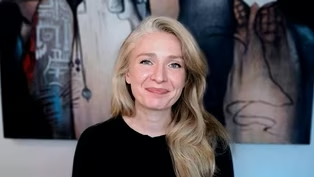
Could Free Bus Fare Help Reform Criminal Justice?
Video has Closed Captions
Clip: 2/20/2026 | 18m 3s | Emily Galvin Almanza discusses her book “The Price of Mercy.” (18m 3s)
Providing Support for PBS.org
Learn Moreabout PBS online sponsorship
- News and Public Affairs

Top journalists deliver compelling original analysis of the hour's headlines.

- News and Public Affairs

FRONTLINE is investigative journalism that questions, explains and changes our world.












Support for PBS provided by: