Compass
February 2021 Edition
Season 5 Episode 5 | 27m 47sVideo has Closed Captions
The Murdock mayor on the AFA, an outdoor running fundraiser for cancer research and more.
A special interview with Mayor Craig Kavanagh on the Asatru Folk Assembly in Murdock and a professor from the Mitchell Hamline School of Law on the First Amendment; a woman's outdoor running fundraiser for the cancer research; a joyous pumpkin patch in Appleton; and Opie Day on the Undowanpi (We Sing) series.
Problems playing video? | Closed Captioning Feedback
Problems playing video? | Closed Captioning Feedback
Compass is a local public television program presented by Pioneer PBS
Compass
February 2021 Edition
Season 5 Episode 5 | 27m 47sVideo has Closed Captions
A special interview with Mayor Craig Kavanagh on the Asatru Folk Assembly in Murdock and a professor from the Mitchell Hamline School of Law on the First Amendment; a woman's outdoor running fundraiser for the cancer research; a joyous pumpkin patch in Appleton; and Opie Day on the Undowanpi (We Sing) series.
Problems playing video? | Closed Captioning Feedback
How to Watch Compass
Compass is available to stream on pbs.org and the free PBS App, available on iPhone, Apple TV, Android TV, Android smartphones, Amazon Fire TV, Amazon Fire Tablet, Roku, Samsung Smart TV, and Vizio.
Minnesota’s Alt-Meat Revolution
“Minnesota’s Alt-Meat Revolution" is a year-long video and print journalism collaboration project, looking into the roots and impact of the plant-protein phenomenon that’s exploding across the globe.Providing Support for PBS.org
Learn Moreabout PBS online sponsorship(soft music) - [Announcer] Funding for Compass is provided in part by the Otto Bremer Trust, the McKnight Foundation and members of Pioneer PBS, thank you.
- Hi, I'm Amanda Anderson.
Welcome to the February edition of Compass, the regional public affairs show on Pioneer PBS.
A quick reminder about this new Compass format.
All of these stories you're about to watch have already been posted on Compass's website and social pages.
We encourage audience interaction and feedback, so have your devices at the ready so you can comment and tell us what you think of each story as you watch.
First Columbus took another trip to Murdoch to interview mayor Craig kavanah about the city council's decision to grant a conditional use permit to the Asatru Folx Assembly.
The AFA, a white supremacist religious organization purchased a former Lutheran church located in a residential zone in town and needed this permit to hold religious related events and gatherings there.
Mayor Cavanaugh helped us understand how the city determined to grant the permit.
Before our interview with Murdock mayor Craig Kavanaugh I was scrolling through the city of Murdoch's Facebook page almost all of the 11 most recent posts at the time were informing people that the city was without water because of a broken water main.
They were helping people get water if needed.
To me this represented the Murdoch city council's position in issuing a conditional use permit to the Asatru Folx Assembly and the purposefulness of the AFA in moving to Murdoch.
- We did ask for a second opinions.
So Don Wilcox went through that, you know, with other legal advisors and everybody gave pretty much the same advice that if we would have denied the permit we would have lost in court.
It felt like we had no choice just because of legal aspects.
And I don't know if that's what this group's intentions were when they came knowing that we couldn't deny the permit.
It just felt like something was wrong and that we were attacking, you know, they came to a small town for a reason.
- The AFS other two hops are also in small towns, one in Brownsville, California, and the other in Linden North Carolina, Asatru is a pre-Christian European religion intended for all who want to subscribe to that belief system.
The Asatru Folx Assembly is a pre-Christian European religion plus they hold a whites only standard for their membership with the mission of preserving whiteness.
The AFA needed the conditional use permit in Murdoch because they were planning on holding religious gatherings in this facility, which is located in a residential zone.
When the city council heard the AFA had bought the building they held a public hearing and started weighing their options.
Don Wilcox is the city's attorney - At the same time.
This was an also a good time for me to get Don Wilcox at our November meeting and have him explain the legal ramification if we didn't approve this permit.
I wanted more people, you know, we had 50 people here in October.
We had, we had our November meeting.
I was hoping more people would show up, we had three.
This decision and nothing to do with the city's beliefs nothing to do with the council's beliefs.
It was strictly legal advised.
- What do you say to people that are calling you and calling the town racist.
- First of all I say, they don't know who we are.
If they came to Murdoch and understood our community we have one of the best school districts in the world as far as I'm concerned.
We have many, you know, a lot of diversity in those schools.
We have zero trouble, so if people think that we're racist, they're wrong.
They don't know city of Murdoch, the way I do, I don't think a small group moving into town can change anything.
I think we're pretty tight knit community.
I think people stick together.
And I think if we stand together, we can beat this group one way or another.
You know, like I said before, I don't think anybody in this community is gonna welcome them with open arms and I think they know that.
- Mayor Cavanaugh noted that granting the permitter or not the AFA owns the building.
The Murdoch's city council tried to buy the church from the AFA.
But mayor Cavanaugh said, the AFA refused their offer saying the group would likely face this issue no matter where they went.
So they thought they would handle it now.
- Let's say we deny the permit, we go to court, we ended up losing which is what we were told was gonna happen.
This group still in town they just might have more money in their pocket.
You know, we have other churches in town.
How many restrictions can you drive, you know, you gotta do it for both of your doing it for one.
You know, I can tell you that I have not had an attorney call me.
That said, they'd be willing to take the case, you know so that just tells me something right there.
Cause this news is out there and nobody's contacted me.
- Professor Raleigh Levine, a professor of law at the Mitchell Hamlin school of law said that the city's case would have been much stronger if they were consistent and only allowing residential uses in residential zones.
But like mayor kavanah mentioned there are other churches in town.
The city has a practicing Catholic church also in a residential zone.
- If, for example, they had allowed other churches or other religious entities or any other non-residential user, the kind of permit that this group wanted, they would have been on shake your ground to deny it to this church.
- The main issue mayor Cavanaugh said it time and again is white supremacist religion are not the Astru Folx Assembly is protected under the first amendment.
- So by saying this group can't use it as a church becomes a violation of their because their religious group becomes a violation of their rights is what I was told.
- So now let's talk about the first amendment I'm talking Civics 101.
- The point of the first amendment when it comes to speech and religion is essentially to keep the government from censoring views and beliefs with which it doesn't agree.
And so we don't really need the first amendment to protect, Minnesota nice speech that would fly anyway, right.
What we need it for it's speech and viewpoints that are offensive to a lot of people and that otherwise would go unheard.
And so the reason that we have a first amendment in many ways is to allow for the airing of offensive and upsetting opinions and beliefs so that we as a society can evaluate their truth and evolve over time.
If we're never exposed to things that discomfort us that make us unhappy or upset we never questioned our own assumptions and we don't move forward.
- There's also something called the fighting words doctrine in 1942, the Supreme court ruled that words which by their very utterance, inflict injury or tend to incite an immediate breach of the peace don't receive full protection under the first amendment.
On their website the AFA follows something called the warrior principle which says, we believe that our members should strive to be ready for the challenge to defend our folk, gods and goddesses with both cunning and physical skill when needed, are these fighting words?
- It is really difficult to prove that words on a website, they aren't directed at a mob and that aren't likely to provoke immediate illegal action are gonna fall within the definition of incitement.
And so the call to be prepared to defend white people with physical skill when needed probably lacks the immediacy necessary to fall into the incitement category.
And so even though this speech kind of skirts the edges of both fighting words and incitement it probably doesn't fall squarely within either.
And probably the Supreme court would deem it to be fully protected under the first amendment.
- The key here is that the speech needs to be directed at a specific individual for it to be deemed fighting words.
- The court has really moved away from the fighting words doctrine, especially the part that includes words that cause emotional pain but the court has found time and again, that racist speech is protected by the first amendment.
So it has consistently overturned fighting words convictions on a number of grounds, including that the speech was not an insulting epithet or slur directed at another person and, or was not likely to provoke somebody to retaliate with violence.
There's a distinction between belief and thought and speech on the one hand and action on the other.
And until speech or belief crosses the line into action it's fully protected by the first amendment.
Even if it is odious, even if it is offensive, even if it is traumatic.
And even if most of us think that it's just absolutely wrong and abominable.
- So I wondered because odious offensive, traumatic harassing speech is protected.
Is it time to reassess the first amendment - I'm talking as a first amendment advocate.
I have, you know, in my career I have had to stand up for the rights of people with whom I disagree vehemently, right.
I mean, that's because I am trying to stand up for a principle and not a particular person.
In many ways although the entire constitution was founded on a system of slavery and is indeed reflective of a racist society that was aimed at protecting the property rights of rich white property owning males.
The first amendment is actually one provision of the constitution that really from the beginning has been meant to protect the rights of minorities.
And that should be that continues to be a value whether any of us at any time is in the majority or in the minority.
We should all be grateful that when we are in the minority that we will be able to speak our mind and convince other people of the value of what we have to say.
- Professor Levine also briefly talked about how the first amendment relates to the second impeachment trial of former president Trump, that's been taking place at the Capitol this week.
- There's another category of speech that also doesn't receive full protection under the first amendment.
And that is speech that incites illegal activity.
So this speech is defined a speech that is both intended and likely to cause imminent illegal actions, such as violent or arm for fighting.
It's this type of speech that former president Trump and our Rudy Giuliani are accused of engaging in before the Capitol riots, right.
That what they said was meant to and was likely to cause the rioters to storm the Capitol and engage in violent.
- Next Chuck Tatge and Sandy Tatge are experts at bringing people joy.
Joy through discovery by paying attention and by giving kids something of their own in a field of pumpkins.
(electronic music) - I'm Chuck Tatge and this is my wife, Sandy and we have a pretty large pumpkin patch.
One of the fun things we do every year is as the pumpkin turns orange I carve names into the shell.
Well, my dad was the first gardener and when he was gardening, I don't have to do anything except go to his place and say, oh, this is nice, I'll take some.
So he scratched the names in with a nail when my kids were one or two years old and then he got too crippled in his hands and I took over and I wanted to keep that tradition for my kids.
And then I took over all his other grandkids.
And pretty soon I'm doing it for friends and neighbors and the list just keeps going bigger and bigger.
- A lot of what I do is listen to Chuck about the pumpkin patch and it is daily and it is a really, really his project.
I'm kind of here to help water, help weed.
I love it too, but not probably the same passion as Chuck has but it's a good project for both of us.
(tractor engine roiling) - Well, in the spring, I take my tractor and dig her out here and dig up the ground.
And then I step off how many rolls I'm gonna have and how many hills in each row soil is warm you'll get down on your knees and plant it and hopefully all pop through the ground.
And then it's weeding and watering and getting excited even to see the first one on a vine.
Well, I have a manila folder with about six seven columns of names.
And when they come out, I tell them row one is over by the trees and... Four?
- Hill six.
- Hill six well, why don't you come around the end.
(mumbles) They'll be right over there on that side.
- It's fun to have your family get excited.
And it's not work for us.
It's more of like, we enjoy even coming out here to weed.
- I don't know if I trained you with that whole but you can push and pull.
- Like two years ago what was it, like.
- My friend's family lives in Alaska and they visited this summer and last summer.
And they're eager to get out here and be a little part of it.
If you put in them to work day after day I might not have the same eagerness.
Will you go up and turn the water on for a few minutes?
Right now we have a pumpkin down the row behind us that says, will you marry me?
Our granddaughter's boyfriend called us up and asked if he could propose to her in the pumpkin patch.
So we've got that on a pumpkin.
And then I took the option of the next pumpkin over I carved in, yes.
And she doesn't get a choice.
She can only say, yes.
I suppose the longest one I did was I put a U then I put an R, the wind beneath my wings.
- Most of what he gives back is community people that have lived here a long time.
I got a text yesterday and somebody said how much do you charge to put a name on a pumpkin?
And Chuck will not charge anybody.
This is his gift back to children.
That's how much he loves the project.
And it's all about giving, it's not about money.
I think people are wanting to be a part of community.
And I feel like we're part of a community by having a pumpkin patch - Maria Isabel Mera excepted the 100 mile new year challenge from the American Cancer Society and added a challenge herself, no running indoors in the month of January.
Maria who works at Jennie-O and is the chair of Iglesia Paz y esperanza in Willmar finished her 100 miles in 22 days and actually kept running for the entire month of January racking up 134 miles.
Iglesia Paz y esperanza help her raise over $1,000 for the American Cancer Society.
(soft music) (Maria speaking in foreign language) - I do in the challenger your 100 miles of the the month of January for the American Cancer Society.
I feel so glad to do this for all those people who fight for the cancer.
(Maria speaking in foreign language) - I am Andres Albertson I am the pastor here at Iglesia Paz y Esperanza.
We are a Latino Lutheran church.
Maria Isabel is a member of the church and she likes to run she does it nearly every day.
And I thought immediately that we should support her as a church.
We start up following the instructions of the American Cancer Society, fundraiser on Facebook in the name of the church, supporting the Cancer Society, as Maria Isabel run.
So far, we have raised a six hundred and fifty dollars already above our initial expectations.
So we are glad with the support of friends and community members to this effort.
(Maria speaking in foreign language) - And well, this is not only a person running but an immigrant running.
And this is also another thing we want to call the attention to that immigrants are and yeah, integrated members of our society who have positive contributions to make us everybody else, yes.
(Maria speaking in foreign language) - [Woman] How does it feel to be done?
- Good.
- Yeah.
(laughing) - I feel so glad to do this, my goal was to running no side is just outside in this month.
So I feel so glad to do it this.
(Maria speaking in foreign language) - Tanner Peterson worked on a video project highlighting what traditional song and drum mean to four different native artists.
We aired his first video on this program last month and we'll continue showing his videos for the next three months.
If you missed it, head over to our website to watch the next installment features Opie Day a lead singer from the group, midnight express - Take care of that drum you take care of drum and the drum will take care of you.
I am living proof of that.
(drum music) One of my passions is singing.
I love to sing.
I sing all the time.
We're here with my family or with my drum group.
I also love to make songs that's one of the things I am most proud of.
I have been singing since I've been nine, 10 years old so 34 years, I would like to give this credit due to my mother Charlene Day.
She has been my main support since I was a child.
She is a singer herself and the not just wanting to make her proud and follow in her footsteps.
It has helped mold me into the singer that I am today.
My very first experience came when I was a little bitty boy at the Red School House.
We used to have this thing every end of the day called assembly, where we would get together the whole school we pull out the drum and we would sing and dance.
And that's how the day would end.
There was a bigger boy who took my spot on the drum.
He kind of kicked me out of the way.
And there was a man that was sitting there at the drum by the name of Dave Wanahi Walker.
And he stopped the drum.
He stopped the song and he stopped the assembly.
And he said, the day that there is no room for this little boy at this drum is the day there's no room for me.
(drum music) I look back at that moment and think, you know what if he wouldn't have taken the time to, you know just show me that respect, that love to, you know and I might not be the singer I am today.
So for that moment, you know and that reason I will be forever grateful to Wanahi rest in peace.
I try my best to do as much as I can.
You know, back home in the Twin Cities area, there was seems like there was always, you know, somewhere to go sing at whether we were being asked to go sing for birthdays or graduations or protest services we were always, you know, called upon.
I've also had the privilege of having a lot of younger singers sing with us and you know just kind of, you know, show them pointers here and there teach them things here and there, show them, you know the ways of the drum, you know and a lot of them have, you know went on to become a really successful, awesome singer.
So that is something I hold very, very prideful to me.
when we're singing, it's hard to describe in words, you know for that three ,four minutes that we're singing a song we're caught up in the moment.
You know, we're jamming away, we're sweating, eyes are closed.
You don't care what we look like.
Those are the moments that I live for.
You know what I mean.
At that time, we not only heal ourselves because we forget at that moment, everything that's going on in our lives, you know, we could, the rent could be due the car payments due, you know, cell phone battery get turned out all that doesn't matter at that moment in time, because we're so focused on that drum that grandfather sitting in front of us we're so focused on the song we're singing, you know, and if we can make anybody standing around us watching feel that or anybody out in the dance arena, dancing feel that to feel even come close to what we feel then that's what being a singer is truly about.
That's the beauty of it, you know, looking out in the arena and seeing all the different colors meshing together, all the people dancing, feathers going every direction you can just feel the vibes.
It gives me goosebumps that makes me smile, sometimes it makes me cry because it's such an awesome feeling.
And you know, I don't ever take this drum for granted anymore.
You know, I talked to my drums.
I pray to them.
I sing on them as much as possible because I want them to know how much they are appreciated.
The one thing I would like for people to understand that is that the appreciation of what we do, you know, the time, the effort everything that goes into it, you know ,it may just appear.
We're just beating on beating on a drum and hollering around and that couldn't be any farther from the truth.
You know, there's emotions, there's prayers, there's healings, there's blessings all those things going to that song that we sing.
And I would like, you know, my one wish is for everyone to be able to feel what we feel.
- Thank you for watching this February edition of Compass.
We encourage audience interaction feedback, so head over to our social pages and website and let us know what you think and what we should be covering.
And heads up the March edition of Compass will air on March 11th, see you then.
- [Announcer] Funding for compass is provided in part by the Otto Bremmer Trust the McKnight Foundation and members of Pioneer PBS, thank you.
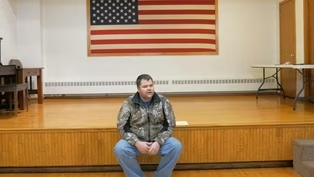
The Murdock mayor, the AFA and the First Amendment
Clip: S5 Ep5 | 9m 5s | The Mayor of Murdock on granting the CUP to the AFA and a look at the First Amendment. (9m 5s)
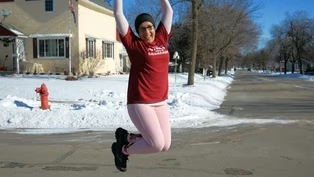
Running (outside in January) for a reason!
Clip: S5 Ep5 | 3m 45s | Maria Mera accepted the 100 Mile New Year Challenge from the American Cancer Society. (3m 45s)
Providing Support for PBS.org
Learn Moreabout PBS online sponsorship
- News and Public Affairs

Top journalists deliver compelling original analysis of the hour's headlines.

- News and Public Affairs

FRONTLINE is investigative journalism that questions, explains and changes our world.












Support for PBS provided by:
Compass is a local public television program presented by Pioneer PBS