
February 2021: The Sarasota Polo Club
Season 2021 Episode 2 | 26m 29sVideo has Closed Captions
Experience the culture and excitement of polo games with the Sarasota Polo Club.
Celebrating its 30th season, the Sarasota Polo Club has deep roots in the area and a history that dates back to 1922. Learn about the legacy, the "sport of kings," and the grandeur of this Lakewood Ranch institution.
Problems playing video? | Closed Captioning Feedback
Problems playing video? | Closed Captioning Feedback
Up Close With Cathy Unruh is a local public television program presented by WEDU
February 2021: The Sarasota Polo Club
Season 2021 Episode 2 | 26m 29sVideo has Closed Captions
Celebrating its 30th season, the Sarasota Polo Club has deep roots in the area and a history that dates back to 1922. Learn about the legacy, the "sport of kings," and the grandeur of this Lakewood Ranch institution.
Problems playing video? | Closed Captioning Feedback
How to Watch Up Close With Cathy Unruh
Up Close With Cathy Unruh is available to stream on pbs.org and the free PBS App, available on iPhone, Apple TV, Android TV, Android smartphones, Amazon Fire TV, Amazon Fire Tablet, Roku, Samsung Smart TV, and Vizio.
Providing Support for PBS.org
Learn Moreabout PBS online sponsorship(bright music) - [Announcer] This is a production of WEDU PBS, Tampa, St. Petersburg, Sarasota.
- [Cathy] Four players, six chukkers, 60 ponies.
It's known as a sport of kings and we call it polo.
Learn about this sport and its rich history through one of the largest polo communities in the world, the Sarasota Polo Club, coming up next.
(bright music) The history of the Sarasota Polo Club dates back to 1922, when the property was a 28,000 acre timber ranch, back then the Cowboys who work the ranch, played knock around polo games in their free time.
Now the Sarasota Polo Club has become one of the largest, most dedicated polo communities in the world.
Spanning 130 manicured acres, with 42 private equestrian estates, seven polo fields, on-site stabling for 300 horses and many other amenities.
This year, the Sarasota Polo Club celebrates its 30th anniversary season, and expects an estimated 45,000 polo spectators to be on hand during the 2021 season.
Today, we learned about this community in Lakewood Ranch and the sport known as the fastest game on four feet.
Welcome to "Up close', I'm Cathy Unruh.
Today we're joined by Mason Wroe, who is Director of Polo at the Sarasota Polo Club and the polo player.
Also with us is James Miller, he is owner of the Sarasota Polo Club and a polo player as well.
Thanks for both of you joining us virtually today.
We appreciate it.
- Sure, good to be here.
- Let's start back where it all began.
Tell us a little bit about those Cowboys?
- The ranch was a working ranch.
It started as a timber ranch, then they also added cattle.
And so, the cattleman would just play some pickup polo because some of the owners of the ranch actually played polo.
There's a lot of history of polo in the Uihlein family.
And so, it became a hobby sport on the ranch and then ultimately developed into an actual polo club.
- And you mentioned that Uihlein family, which was the owner at that time?
- Correct, Uihlein family out of Milwaukee, Wisconsin.
- And then in 1991, the Sarasota Polo Club began.
How did that happen?
- Well, it actually the Sarasota Polo Club became the first development in what is now known as Lakewood Ranch Community.
Lakewood Ranch, just for example, in the coming years is adding 9,000 new homes, just in direct vicinity of the polo club.
But the polo club became the first development.
There is about 42 home sites in the club.
The entire club in comes is about five or 600 acres.
And it was the only thing here.
It's spread about three miles East of I-75.
And when they first developed the club, you got off at I-75, it didn't go South to Miami, and you got to a cattle gate and you had to get through a cattle gate and drive a railroad back to the development.
So, Lakewood Ranch is now one of the largest most successful plant communities in the United States.
And, all of the growth has come around the clubs.
So we probably have eight golf courses just within two to three miles of the club.
And there's more golf courses and clubs going in as we speak.
It's just a tremendous development full of young families and professionals that have decided to make Florida their home.
- Yeah, it's virtually a city in itself.
Tell us how you and your wife, Misdee, came to be the owners of the polo club?
- Well, I'm about little under three years ago because SMR was breaking ground on these brand new developments.
They decided that it was time to get out of the polo club business.
One of the senior members of the Uihlein family was a player and was helping manage the club.
And he decided that he was, his time was up, he'd been doing it for so many years and SMR put the club on the market.
And there were several developers interested but as community, people living in the community, having property in the community, we wanted to keep it a polo club, keep it equestrian, because it is quite unique to have an equestrian facility in the middle of development.
So Misdee and I agreed with SMR to purchase the club and to keep it going.
- And Mason, you are the Director of Polo, also the polo player.
Tell us about you?
- Yes, ma'am.
This is my second full year directing and polo here.
I've grown up in a horse family, in a polo family from Texas, and I've been playing polo around horses all my life.
- You are described as a four goaler on your bio.
What's a four goaler?
- In the sport or polo players are given handicaps, from a minus one up to 10 based on their skill level.
And then as you mentioned in the intro, there are four players per team that participate in a match based on your handicap level, those totals of each player add up to the level of polo of that tournament.
So myself, I'm a four goal player.
We play in with other people around the club.
There were five goaler, three goaler.
So basically it's kind of like in golf, it's called our handicap and it's just based on your skill level and what you're expected to do on the field as far as the shots that you can make and take.
- Okay, and James, you're an experienced player yourself?
- Correct, I've been playing I think out of my 21st season in bull.
- Okay, and you've traveled Europe, Barbados.
You've played in lots of locations.
- Yes, Barbados there's about four really nice clubs in Barbados, which most people wouldn't expect.
But polo is a family sport.
So if families want to place a club where they happen to live then that's usually what happens.
And the same thing in Europe, I've had great opportunity to play in Saint-Tropez, in France, the South of France, which is has a beautiful club right near the coast.
And I've played quite a bit in Germany, I've played in Berlin in the Maifeld Cup, which is the German National Championship.
And that is the last field where they've played polo as an Olympic Sport.
- Polo is not familiar to everyone.
I think everybody sort of has an image of it but what's it really about.
So talk a little bit about the game, the terminology, the history.
It's believed to date back to the sixth century BC, but at the modern game was founded in 1859.
I believe by British military officers in India.
And then the game came to the US in 1879, when James Gordon Bennett, who was publisher of the New York Herald, had seen the game in England and brought it back to New York.
Sound good, sound like the right history of polo as we know it today?
- Yes ma'am.
- So tell us about the game.
First of all, it's sorta seen as highbrow.
It's the sport of kings?
Is that a correct perception?
- No, and we're trying to change out here at the Sarasota Polo Club as James mentioned earlier.
It's a family friendly sport.
It's a sport where, I think the reason that's seen as highbrow, a sport of kings is because it takes a lot of horses to play polo at the higher levels.
Some of the lower levels, it does not take a lot of horses and you can also rent horses, which we have that ability here at the Sarasota Polo Club to offer rental horses for people.
But I think just because of the amount of horses it takes, people view it as a highbrow expensive sport, but it's a sport that, it's a very generational.
So when one family gets in, one generation, it seems to pass on down the line to the children and the grandchildren.
And so, it really is a family sport and it's a lifestyle.
It's not something, people don't come in and leave it.
You get into it and you build your life around it, and you have friends in it.
And it's a unique way of living.
- And you mentioned the horses, we call them polo ponies or they're called polo ponies, but they're actually small horses, yes?
- Yes, ma'am.
Yeah, so originally the term polo ponies was established because in the original, when polo first came about, they weren't allowed to have horses over 14, a certain measure of 14 two hands, that named the term polo ponies, but now people play horses of all shapes and sizes.
Obviously, being that you have to hit a little ball running down the field with a polo mallet, the smaller the horse makes a little easier, a little more agile.
You're a little closer to the ground.
So people prefer a smaller handier horse, but everybody has different preferences and styles.
So, the polo pony is just a term has been passed down.
- [Cathy] And the horses, where do they come from?
How are they treated?
How susceptible are they to injury?
What happens when they can't play polo anymore?
- Polo ponies can come from all walks of life.
Predominantly here in the United States you see a lot of thoroughbreds that are polo ponies.
You also see a few Quarter Horses here and there, Argentina, which is one of the leading polo countries in the world.
They kinda have their own breed of polo ponies, which is a thoroughbred cross with an Argentine Criollo, which is very similar to our American Quarter Horse.
As far as the care, we as polo players, this is our livelihood and this is how a lot of professional polo players make a living, or a lot of sponsors this is what they do with their free time.
So, the care for the horses is utmost important to us.
And I mean, they probably get cared for better than some people's kids possibly.
(chuckles) - [Cathy] And when they're playing life is over?
- Well, they're playing life is over a lot of people they retire them down, a lot of people have farms, or people have farms where they'll take retired horses.
They do a lot for us on and off the field.
And so we do right by them, and we try to retire them and let them live out their lives in the happy healthy state.
- And James, walk us through the rules of the game.
How does it happen?
- Well, the book is probably two inches thick, so sort of walk through the rules.
But the rules are a bit adapted as well.
Every season, the umpire, the official umpires that are managed by the United States Polo Association.
We have a governing body, The USPA.
Every year they'll make some adjustments because players are savvy.
They're no different than an NFL player, who might figure out a better way or trick your way to tackle someone.
And then they have to protect everyone based on safety.
- But you got take us through the basic?
- Exactly.
- How is the game played?
- So the basics are first, all the rules are based on safety of horse and human.
So, any play that is dangerous is going to be considered a foul, but the general principle of polo is, there's an imaginary line that's created by the direction of the ball.
So if the ball gets hit forward, there's an imaginary line that travels beyond that ball.
And it also travels behind the ball, and it's very linear.
And what that imaginary line does, it creates a side of the line of the ball that each player is allowed to be on.
If you're offensive or if you're defensive.
So, you can hit the ball from any side of your horse but you can only use your right hand.
And that's what creates the offside is the right hand side.
The near side is the left hand side of the horse.
So there's probably six or eight types of shots you can hit on either side of the horse.
But the goal is to carry the ball forward, carry it to your goal and put it between the two uprights that are about 10 yards.
- [Cathy] And there's four players in a team, correct?
- [James] Correct.
- And is it true that up to 60 of the horses are used during the course of one match?
- Well, like Mason had mentioned, there are different levels of polo.
So there are four chukkers level of polo as well.
But if you come to a higher rate of tournament, that's six chukkers, it's best to have nine to 10 horses with you because again, we're trying to keep the life of our horses longer, meaning we're trying not to overplay them.
So, we try not to use a horse for an entire, seven and half minute chukker.
We try to rotate substitutes in and out.
So it's very, it's quite dynamic, cause we have to do that much like ice hockey, we have to change on our own time.
- And you've said chukker about three times, I think.
And I'm just wondering how many people are out there going what in the heck is a chukker?
- A chukker is simply a period.
It's a polo term for a period.
- Yeah, so there's what six periods in the game?
- Correct.
- And chukker actually originates from India and the Sanskrit language.
So it's been around for a long time and you preserve the name instead of calling it a period.
It's a chukkers.
(chuckles) And then there's this lovely halftime tradition called, divot stomping.
Tell us about that?
- So divot stomping is most a lot of the viewers would probably say, they recognize polo with the movie, Pretty Woman.
Where they'd go out and half-time and they'd divot stomp.
It's just kind of a, it's a polo tradition, all clubs do things a little differently.
Here at the Sarasota Polo Club, we have a 20 minute intermission, where we have divot stomping, and we also have, like this past weekend was Superhero Sunday.
So we had the costume contest during halftime.
So it's just a chance for spectators to stretch your legs, get out on the field, walk around and help the help put the field back together.
And by that, I mean, stopping divots.
So when the horses are running 30 miles an hour up and down the field stopping and turning on a dime, the polo field, the grass, the footing, it tears up a little bit, which it should, you want it to tear up in a healthy way so it's safe for the horses.
So the spectators can come out and by putting the divots back and flattening the field out, it makes for a smoother and better second half of the game.
- And it's just really fun.
I'm sure to get out there and stomp around?
- Yes, ma'am.
- Now, let's talk about the teams and the players, and where they come from and how many they are, and who do you play?
Where do the players come from?
Does everybody live there?
- Right now with our season, we have a four to five month season here in Sarasota.
So predominantly majority of the players live here during the winter time, some kind of commute in and out, but polo is kind of a sport where it's very seasonal.
So people will travel for their winter seasons, for their summer seasons and spring and fall seasons.
So we kind of travel around when it's cooler weather like in the wintertime, people travel into the warmer parts of the country.
And when it's the summer, people travel to the cooler parts of this country.
So right now with us having our winter season here in Sarasota, everybody's down here, living here, their organizations as in, all their horses, the people that care for their horses, everything is down here for this season.
- But who makes up a team?
Are the same four people always on the same team?
How does the tournament gets slated?
How does that work?
- It kind of depends on the level of polo, which we go back to were we talking about the handicaps and how the handicaps add up, but whatever level of polo that is participating in, that's how they choose their players.
So that's what you see on the field, is the four players with the various handicaps that add up to that level of polo.
Behind the scenes, when we talk about a full team, the people that don't get the credit, much like off a football team, the trainers and the athletics staff behind the scenes.
We have those as well.
We have what we call grooms.
Grooms are people that care for the horses on a daily basis.
They're there sun up to sun down caring for the horses.
They know every bump, nick, hair on the horses.
So they're the ones that really make it all work.
We also have vet veterinarians and farriers, which are essential for the health and the safety and the care of the horses.
- And at the end of the season, is there any kind of trophy or championship?
- In our season here, we have tournaments, we have the season broken down into segments of different levels of tournaments.
Tournaments usually span two weeks.
So teams can, every team has a chance to win different tournaments throughout the season.
And as our season progresses, we have bigger and better tournaments, and more prestigious tournaments.
So our season, we're leading up to, we'll culminate the season in April with a 14 gold tournament, which is the highest level that we've had here in a while.
And we're offering a 25,000 dollar purse, which is something you don't see a lot in the sport of polo.
Most of the time when you win, it's just kind of bragging rights and trophies.
So this is kind of a unique opportunity that we're offering to polo players around the country and around the State of Florida , to come and participate and try to win some prize money.
So it should be a fun two weeks of polo.
- That raises the question of where the prize money comes from and how your finance?
- It's like, I mean, we're like any business.
We ha we have budgets and we have revenues and we have expenses.
So, that's that's what I do as owner of the club, is I set those budgets and manage those expenses, and try to work with the staff to determine, what we think will motivate more people to come and try our club and participate in our sport.
So, that's like any business, we just have to make those choices and decisions.
- And as you know, we went to Sunday polo to check out the game for ourselves.
(bright music) - We moved to Lakewood Ranch in 2003, and we started coming to polo because we knew it was a great way to spend a Sunday afternoon.
What an awesome way to be outdoors.
Bring friends, tailgate, have some fun on a Sunday afternoon, right here in our backyard, in Lakewood Ranch.
- This is our first time as a family at a polo match.
And it's been wonderful being able to pull right next to your tailgating spot and experience a new game outside with everything going on in today's world with COVID.
It's been very nice and relaxing.
The gameplay I'm trying to follow it a little bit, it's new to me, but the whole environment with the kids playing it's laid back, it's very rewarding to be out here outside especially.
(chuckles) - [Shari] Well, it's all about watching the horses but being with friends and having a great afternoon.
- Yeah, that's what's nice about it.
I didn't think we would be sitting right on the sidelines, close to the match when they said we were gonna be tailgating, I thought it was just like bleacher style.
So sitting, but at some points of the match they come right up to the sidelines where you're sitting.
So you get a full front of the horses in action and what's going on with the game.
- It's just so cool.
I was telling my friends that I brought today, who actually it's their first time at polo that we have so much here in Lakewood Ranch and polo is one of the unique things that we don't have in many other places.
(bright music) - So polo, as we've mentioned, is kind of complicated, Do all of the spectators understand it do you think?
- I don't think so.
I think that most people come to polo to have a nice afternoon outside in the sun.
And it's an excuse to get together and gather with the group of family members or friends and have a picnic.
Pretty much predominantly all of our spectators are in a reserved spot.
They tend to be the size of a parking spot, a little bit bigger, 10 feet wide, and they preserve, and they're welcome to bring a picnic, and they can bring their dogs as long as they keep them on a leash and they can bring their children as well.
So it's a family outing and they do their best to try to follow the game.
We do have announcers, and the announcers are continually educating the crowd on what they're seeing, but it is a tough sport to follow.
But, once a group of horses come galloping by you and you get the feel of the power that's what a lot of people really like to experience.
Just being that close to the horses that are in action.
- As a player, how much does the crowd contribute to the game for you, for the players?
- It's exciting.
It definitely amps it up to another level.
We have very loyal spectators here and people that really get into it.
And we were laughing the other day, we had a match and we had a penalty shot, and we could hear hecklers on the sidelines kinda yelling out.
And so, it's fun.
And it's fun for them to get involved in it.
And it's fun for us to have them there and they're never cheering us on.
And it just, it provides another aspect to it.
And you can relate to how the NFL was this year with no fans and a few fans now, just having people it changes the dynamic and it just makes it more fun.
- How is it different for you and for the sport of polo, where you are at the club during this pandemic here?
How is it different in terms of spectators and how they participate at all?
- Well, we liked it to shut down last March when pretty much every sports facility decided it was time to just pause to reassess COVID.
I believe that was the weekend of March 13th.
And so, it had a big impact, cause obviously anytime you shut a business down it will impact your bottom line, and coming into this season of course, it was at that time, six seven months later after COVID it hit.
And, this fall, there's been quite a bit of uncertainty, which continues to happen, but we relied on our governor and the State of Florida to provide us guidance and education, and to let us know what we should and should not do.
And we've gone to a pretty much a strictly pre-reservation system.
Whereas before you could just show up day of and get a spot.
We've really tried to narrow it down to keep everybody in a safe environment.
And, as any business, if somebody doesn't feel safe coming to your place of business then they should just not come.
They should stay home.
That's the safest thing to do.
- And we're going to give you a website address later but if you want to attend, that's the place to go to, what's your website?
- The website is a great place to start.
We also have a Facebook page and our tickets are available on Eventbrite which there's a link on the Facebook page to Eventbrite.
So you can go online on Eventbrite and you can see where the actual seat locations would be on the field.
And, so there should be enough information on that of the website or Facebook.
- Okay, so we've talked about the place of the club within the larger, huge community of Lakewood Ranch.
And you do things besides polo, things like Ranch Night Concerts, Sunset Polo, Happy Hour, the Wolf Minster Dog Show.
Tell us about these events, particularly the dog show.
- So, yeah, the Wolf Minister Dog Show is just a theme for a particular day of polo week.
We run this year we're running 20 weeks of polo.
So each Sunday we try to have kind of something fun to do for the spectators and to get more involved in the day of activities.
So the Wolf Minister Dog Show is just a fun little mockery of the actual professional dog show, but people bring their dogs and there's a judging and there's a winner.
(chuckles) So, a lot of people have fun bringing their dogs out for the day.
- And would you say the people who come are primarily Lakewood Ranch residents, or from outside the community?
- There's no question that because of proximity, the families that are here in Lakewood Ranch, it's easiest for them to come.
But of course we, Sarasota, which is probably about seven miles due West from Lakewood Ranch.
That's not that far to travel.
And so we get people from Sarasota, but also we had people up from Naples last weekend.
People come in from the Tampa St. Pete area.
We're only about 50 miles from Tampa St. Pete.
And we're three miles off of our I-75.
- Let's get down to real basics about if I want to attend a match and it's my first time, what do I wear?
What do I expect?
What do I bring?
I know I'm gonna tailgate now, what else?
-_ We encourage people to come comfortably, in Florida, as you know, our weather dictates how we dress.
So, but a nice summer hat to cover your face, that's fashionable, is not a bad idea.
We have people that come in sun dresses.
We have people who come in shorts.
So it's Florida, so pretty much Florida, it seems like anything goes fashionably.
- And that cost of admission?
- It just varies based on the ticket location, the type of ticket.
But anywhere from 15 dollars up to probably 50 dollars, depending on what your amenities are and so forth.
- And Mason, we're almost out of time.
So any tips from you, on what we should do if we want to attend?
- No, like James said, comfort the main thing, come out, enjoy yourselves.
We want a family friendly atmosphere.
We're known as the green beach here, and it's a fun thing.
We encourage people to come out.
I guess my only tip was just, if you stopped divots, make sure you don't stop the steaming green ones.
(chuckles) - That's really a good tip.
Thank you.
And maybe just Google, how polo works.
Find out what a chukker is and that sort of thing before you come along.
Thanks guys.
We appreciate you being here with us today.
And as we've mentioned, you can learn more on Facebook at the Sarasota Polo Club.
And for more information about the sport and the community you can visit, sarasotapolo.com.
This episode of "Up Close" may be viewed in its entirety on wedu.org.
I'm Cathy Unruh.
Thanks for joining us.
And I'll see you next time on "Up Close".
(bright music)
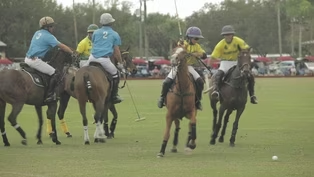
Preview: S2021 Ep2 | 29s | On the next Up Close with Cathy Unruh, The Sarasota Polo Club (29s)
Providing Support for PBS.org
Learn Moreabout PBS online sponsorship













Support for PBS provided by:
Up Close With Cathy Unruh is a local public television program presented by WEDU