Northwest Profiles
February 2022
Season 35 Episode 3503 | 28mVideo has Closed Captions
Nez Perce items returned, artists Jeff Weir & Tanden Launder, Science students tackle PCBs
They may differ in style, but Coeur d' Alene artists Jeff Weir and Tanden Launder share a lifelong friendship that makes their artistry even more special. High school scientists at North Central in Spokane are on a mission to get harmful toxins out of our soil. Finally, the amazing journey of a Nez Perce collection that has returned home – but not without controversy.
Problems playing video? | Closed Captioning Feedback
Problems playing video? | Closed Captioning Feedback
Northwest Profiles is a local public television program presented by KSPS PBS
Funding for Northwest Profiles is provided by Idaho Central Credit Union, with additional funding from the Friends of KSPS.
Support provided by:

Northwest Profiles
February 2022
Season 35 Episode 3503 | 28mVideo has Closed Captions
They may differ in style, but Coeur d' Alene artists Jeff Weir and Tanden Launder share a lifelong friendship that makes their artistry even more special. High school scientists at North Central in Spokane are on a mission to get harmful toxins out of our soil. Finally, the amazing journey of a Nez Perce collection that has returned home – but not without controversy.
Problems playing video? | Closed Captioning Feedback
How to Watch Northwest Profiles
Northwest Profiles is available to stream on pbs.org and the free PBS App, available on iPhone, Apple TV, Android TV, Android smartphones, Amazon Fire TV, Amazon Fire Tablet, Roku, Samsung Smart TV, and Vizio.
Providing Support for PBS.org
Learn Moreabout PBS online sponsorship♪ Hello and welcome to this edition of Northwest Profiles.
I'm your host Lynn Veltrie.
This is our first show of the new year and it's a wonderful mix of stories that focus on the people, places and events that make the Inland Northwest and western Canada a great place to live.
Our stories will lead us into the local art scene with two artists who share bonds of friendship and creativity, take us into a classroom to meet some students who are using science to make a difference in our world, and finally share with us a historical tale of lost and found.
So, with all that teed up and ready for primetime let's give it a go shall we?
For our first story, we head to the Idaho panhandle to meet two artists who share something much deeper than just their passion for creating western art.
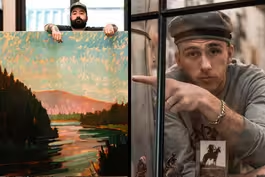
Jeff Weir and Tanden Launder are pals who ironically have many things in common, with art being central to what binds them together.
Boyhood friends that share a love for North Idaho and the lure of the outdoors, wildlife and history, so much so, they recently shared some space in the Northwest Museum of Arts in Culture in Spokane in an exhibit called the Idahoans.
Jeff Weir: I've known Tandon since middle school, and he's just awesome met as teenagers and just living rough, rowdy north Idaho lifestyle Tanden Launder: So, Jeff has been a buddy of mine since grade school, or junior high and we kind of hit it off in a little bit of a renegade radical high school kid way.
We've known each other since we were like.
Oh, boy, we were like 14, 15, maybe.
Jeff: He's just a different guy and always had the crazy ideas of let's go hide in dumpsters and scare the people that walk by.
And I was just so game for that kind of life.
Tanden: It's the blessing of a small town.
You can kind of just stay in touch with people.
It's the kind of the special part that we have in the northwest.
Jeff: He builds a cool community is what he does.
This is his building, and he said, I want to make a place for artists where they can create and he's super community oriented, where he has good vision of what Coeur d'Alene could be.
>>Both artists... based in the Rockford Building in Coeur d'Alene, a building that Tanden bought in 2018, and converted into an art space for working artists...produce their chosen brand of art that they create passionately.
Jeff: Painting is what I've always wanted to do, and I just really love North Idaho and the idea of the West and kind of just the adventure and wildlife and lifestyle of a day gone by, and I kind of wish that I lived back then, but by painting, I can imagine and kind of be there and create it.
>>Armed with no formal training and a special old book, Jeff has taken to create wonderful large paintings that explore the world of the west in his images and colors.
Jeff: I got a book from my great grandmother that is like her life study of mixing all the different colors together.
I took those colors and made my own color palette out of all my favorite colors.
And I just kind of painted and made a lot of bad paintings and just worked at it and found something that's unique.
And now I'm glad that I didn't have traditional training because I've made something that's really just me.
I grew up reading Louis Lamour books, there's a day that life was grander, and risks were bigger, there's so much structure now that That kind of adventure is gone for the regular man, but you can go find it if you really want to work for it.
For me, painting is really about making a feeling more than it is like making an image.
I love the time spent at the easel.
Pulling a piece together and making it work the time pushing the paint and mixing it and seeing what you can do with transparent and opaque layers and just seeing the feeling that you can create.
>>With Jeff's view of the west with his oil paintings, Tanden's art takes advantage of images and text to create collages that speak truth to his chosen subject.
Tanden: My art is mixed media Americana.
So it's telling the stories of really anybody but I'm focusing on Native Americans, cowboys kind of the West And that's kind of grown out of a love for that culture, since a boy.
I read a ton of biographies growing up.
I mean, I just read and read and read all kinds of individuals.
And then the art kind of transpired in a way towards these visual biographies.
Pieces are heavily collage based with layers.
These are heavily collaged based, some have up to five or six different layers in them and mediums that range from colored pencil to chalk to crayons.
You have resin in there, tinted glues the process is just really smashed together >>Tanden's work is weighted heavily toward procuring visual materials for his works, with always having an eye open for something unique and special for his chosen subject.
Tanden: You might capture an old Indian chief, and you do topo maps of the territory and then you get into content of how that tribe lived and how and some of his accomplishments or battles.
And you kind of get into like this narrative of what was his life.
It's all done in reverence and respect, so it's always done in a framework and a mindset that how are we telling these guys' as real stories?
I want specifically that original content to who that that character was, some of it's like balancing the sacredness of the of the content you're using in the media you're using.
But it really comes out in art because art is really like a story of someone's life.
So I know it's made for is made for a lot of education for myself, and I really enjoy it.
>>The friendship between Jeff and Tanden may traverse many years of their lives, but the mutual respect they have for each other is indomitable.
Tanden: It's been cool to kind of mature as a career artist alongside somebody you've known for a long time and have a symbiotic relationship that kind of says, like, Yeah, this is what he does, and this is what I do.
And it balances because it's not it's not too closely tied together so we can kind of build off each other.
Jeff: Just want to tell people that there's more to life than paying the bill.
And if you're passionate about something, don't just go for like the instant gratification Spend the time.
If there's something you love, just go at it all the time.
I think life's about loving the people that you love and doing what you love to do.
Jeff and Tanden are both well known in Coeur d'Alene and they welcome folks to stop by their studios in the Rockford building, which are conveniently located just across the hallway from each other.
Up next we transition from those who inspire with art to those seeking solutions through science.
And for that we head to Spokane's north central high school, where student scientists are learning about real world solutions to environmental problems.
But more than that, they're putting those lessons into practice.
The beauty of our region is unmistakable.
Though sometimes the forests and rivers can conceal serious problems, like an unwelcome companion, PCBs, a poisonous, manmade substance in our soil, water and air.
And the issue with PCBs is that if they get into the water of Spokane, they can bioaccumulate or collect in the fish.
And if the fish are then eaten it can cause health risks.
PCB contaminated soil can't be used for anything.
And so oftentimes it's shipped down to a toxic, toxic waste facility where it's burned up at which point the PCBs are then just thrown up into the air to rain down everywhere else.
So, again, it's not the problem isn't necessarily taken care of.
It's just moved somewhere else.
So I've been trying to figure out ways to bioremediate or degrade PCBs in soil At North Central High School in Spokane, biology teacher Dan Shay has been working with students in a multi -year project that uses nature to reduce and perhaps even remove PCBs from the soil.
My role in the project is really trying to get the kids going and get them connected with the people that they need to.
Finding supplies and being a mentor in terms of the types of procedures that they want to do.
The project began in 2017 and has since been passed along to students like Hanna Faught, who along with North Central graduate Meilin Scott won first prize for their PCB presentation at the Washington State Science and Technology Fair.
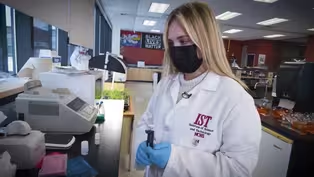
My soil is collected out of storm drains out of Spokane and then we bring the soil into the lab and then I can run my tests on it.
I have soil in containers and I add fertilizer to them at the start and then I aerate them or mix the soil every day, which helps the bacteria thrive.
Then I just leave it alone and the bacteria and fungi that is naturally in the soil will degrade the PCBs out of the soil.
We want our students to know that they can make a difference in the problems that are plaguing their place.
We discovered that we were able to take very high levels of PCB contaminated soil and degrade the PCBs down to non detectable levels, just using the native fungi and bacteria within the soil.
Hanna's project and this PCB project is one research strand among many that our students conduct.
In Hanna's project, she checks PCB levels by extracting DNA from soil in the lab So it's just a series of steps that I run the soil through a filter, and then eventually I just keep washing the soil and washing the soil until only the DNA so I can figure out what species of bacteria and fungi it is.
It's not one organism that can do it all that can break it all down It's a it's an assembly line.
It's a factory in there.
That one organism breaks down this part of it, and one organism breaks down this part of it.
And this part until then, it becomes carbon dioxide that just flows out into the air.
I've always been very interested in microbiology and the small stuff in science.
Through this project actually decided that I want to major in microbiology and go into research as a career after high school.
This individual project that I've been running and that has been run by many other students throughout the year has shown me that I am capable of doing high level research, and it just has given me confidence to go into that as a career choice.
It's a massive job field, especially with the focus on COVID and the testing and all of the research that's going into that.
Biotechnology, even before this, was one of the fastest growing fields out there.
And so we're really hoping that we're training that next generation of students to take on those jobs and solve those problems.
I knew I loved science, but this program has really taught me to be individual and confident in my own research where I can take my science questions and how I can answer them just through research and through data and analyzing the data.
Projects like this are possible because of collaborations.
Dan Shay is continuing the work of his mentor, former NC teacher Randy James, whose early efforts helped create North Central's Institute of Science and Technology, a 9000 square foot classroom and lab facility opened in 2014.
Over the years, science students have been working together and upon graduation, hand off their projects to the next generation.
The PCB project is prospering because of cooperation among the classes, as well as partnerships and consulting with outside individuals and organizations.
My favorite part is just seeing them grow from young freshmen into, you know, really confident, college bound seniors.
I come in every day.
I just get to work it's individual.
I do my lab work, I do my data analysis, I write my papers, and it's all on my timeline.
So it's really teaching me how to lead myself and how to complete research on my own.
And it's just really encouraging to see promising results out of this project.
And it shows me that I am prepared for research at the next level.
After graduation, I'm going to go to Washington State University, and I'm going to major in microbiology and hopefully complete a lot of undergrad and graduate level research there.
The research community in Spokane takes our students seriously.
The environmental protection agency is moving forward with plans to remove PCBs from the Spokane river.
Removing them from soil is quite different than from water.
N.C. students will continue their work on soil remediation.
For our next story, we shift our focus from the field of science to the pages of history.
During America's westward expansion and the exploitation of indigenous people, taking cultural items from Native American tribes was a common practice.
When a missionary took precious heirlooms from the Nez Perce people and told them to forget their ways, they believed those items taken would never be theirs again.
And that was the case for over a century.
This story which began long ago is filled with twists and turns of all kinds, both unfortunate and unforeseen.
(traditional music) -[Nakia] It's the most provenance collection of that time period.
There's nothing else from this part of the U.S that exists out there in any collection, public or private.
(traditional music) - [Trevor] It's the largest, it's the best documented, it's the oldest, it's the most intact collection of material culture from the plateau region.
- [Nakia] They weren't simply garments, there were expressions of that deep relationship that we held with the land and with one an other, and the way that we memorialize our past elders.
- This is one of the most important collections anywhere in the world.
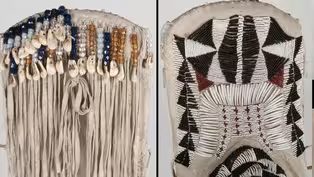
(traditional music) The Spalding-Allen Collection is a collection of 21 items that survive now.
Spalding was the first missionary to the Nez Perce or Nimiipuu Tribe.
He gathered up this collection that survives today.
He packed them into two barrels and then he shipped them down the Columbia River, out to Hawaii, down around the Cape of South America to Boston and then inland to a friend named Dr. Dudley Allen in Ohio.
He sent them to his friend Allen in Ohio because Allen was a supporter of the Presbyterian missions.
And Allen sent Spalding in return, cloth that he could trade for labor.
He sent him tools that he could use in his mission.
And so this bartering was an exchange mechanism.
We don't know exactly how Spalding got the items.
He wrote a very long detailed letter about the collection in which he gave an approximation of what he considered the value.
It could be that Spalding got some of the pieces because he had told his followers among the Nez Perce that they needed to give up their traditional buckskin clothing.
They needed to stop speaking Nimipuutimt and switch to English.
They needed to stop their seasonal round and become farmers.
He did do some positive things.
He brought the potato to Idaho.
He brought a printing press.
He established that survive today, but there's also this other aspect of suppressing indigenous culture that makes him a controversial figure - Was no doubt was a hostile act against our people.
We changed it over the years from the leadership of past people, our elders, and the people even live it to now, and to change it to a bad story, into something that maybe was hurtful to people and changed it into a good story and created relationships in the process.
(upbeat music) - The collection then went to Allen, Allen passed it on his son who was also a Dr. Allen.
That son donated it to Oberlin Collage in 1893.
And then we hear about it again in the late 1920s Robert Fletcher a historian read the letter that Spalding had sent to Allen.
He said he assembled most of the collection he could find not all of it.
And then he put on a display on the Oberlin Campus but unbeknownst to many people on the Oberlin Campus the collection in 1942 was transferred for care at the Ohio Historical Society in Columbus.
Nobody at Oberlin knew about it anymore.
And then when Nez Perce tribal members when curators rediscovered the collection in the 70's and arranged to have it loan to the Nez Perce National Historic Park the Ohio Historical Society went back to Oberlin and said we have this request to loan this collection.
You need to sign this paperwork to give us ownership of the collection.
And then from about 1980 to 1992 it was on regular display in the visitor center at Spalding, Idaho.
(traditional music) But then along the way, several appraisals had happened.
One, the collection was reappraised at evaluation of over a hundred thousand dollars but then in 1993 Paul Raczka did an updated appraisal and appraised the collection at the time up to $593,000.
So the monetary value of this collection became well known to the Ohio people.
(cash register dinging) When this request to return the collection back to Ohio happened there was panic really in the Northwest the National Park Service pleaded for more time 'cause they had to redesign the exhibits, the Nez Perce Tribe who along the way had been working to have the collection reassigned, traded, given back to the tribe intensified those efforts to keep it in the Northwest.
The Ohio Historical Society recognized the monetary value of this collection.
And there were rumors at the time that they were planning to sell it to private collectors.
And that's what compelled the Nez Perce Tribe to make their offer of the fully appraised value of the collection.
After a great deal of negotiation the Ohio Historical Society agreed to sell the collection at its full appraised value, 608,100 for the collection.
(cash register dinging) And to only have six months to raise the money.
(bright music) It was late 1995 that this agreement was reached and a major fundraising campaign took off, the media picked up the story there were articles in the Washington Post in New York Times, Seattle Times, the Lewiston Paper ran all kinds of stories about it.
Kids in Idaho in fourth grade learning about native American history, heard about the plight of the Nez Perce and their fundraising campaign and got involved.
There was a real moment where the nation knew what was going on was wrong, knew it was wrong that the Nez Perce Tribe needed to buy back their own cultural heritage and they responded by contributing, in the end there were more than 2000 contributions and the tribe was able to raise the full 608,100 the day before the deadline.
(bright music) It's been a fascinating tale so far, but it's not over!
When the Nez Perce finally received true ownership of the Spaulding-Allen collection they knew it's renaming was necessary to reflect its well-travelled history.
But the name wasn't the only thing that changed.
(traditional music) - These are very important items.
Many of these items would've been worn during ceremonial activities.
Symbolize not only the transfer of this material item, this visual item but also the knowledge and the responsibility that those items represent in the community and within the broader culture.
(traditional music) - [Trevor] These are sources of connecting with ancestors.
They're also inspiration for members of the Nez Perce Tribe who continue to make dresses, who continue to do bead work, continue to do quill work, these are living models of inspiration for the future.
(traditional music) - The collections that are collected in a private sector as well as in museum collections take on kind of a colonial sort of nature in terms of their names, the culture isn't as important definitely the families, the community are de-emphasized and the collector is emphasized.
And so we understood that that was not appropriate especially for this collection, which we wanted to bring- Obviously we were bringing back home.
(traditional music) Renaming is really important aspect in Nez Perce culture because it solidifies our relationship not only to our kinsfolk, our community but also to the land and the resources as we know it itself, we wanted to bring that to a close as a way to finalize that whole part of our history.
(traditional music) - The series of events culminated in June with a formal renaming ceremony that reflected the types of ceremonies the Nimiipuu people had been doing for centuries.
The tribe invited representatives from the Ohio Historical Society which had been renamed the Ohio History Connection.
When they found out about it nobody on the board, the president, nobody had ever heard of the sale and they were shocked.
- It was never meant to ever come back to our community.
It was meant to always be separated from our community.
And so the name wet Wetxuuwiitin' means something that is taken away, far away, but returns back.
We felt that it was an appropri that told the story and the important journey, the long journey that this collection went on but we also went along with it.
And it's very true that they acknowledge what has happened.
Not that we need to relitigate or relive that but that acknowledgement is a part of the healing that our community needs to move forward.
There was a portion in the program where we had the Presbyterian come down and they gave a formal apology but there was a lot of very good words spoken.
And so there was a lot of talk about things wouldn't have been done the way they were if they were done now.
And I was thinking about all these words and I couldn't help, but miss the moment.
And I will say to carry your message back to the powers that be at the Ohio Historical Society that we also take refunds too so just keep that in the- (audience clapping) And everybody got a chuckle about that and every they laughed and that was that.
- Ohio History Connection, realized that they needed to do something more than words they needed to act.
- We thought that was the end of the story we thought by naming it, okay, now we can move on.
So the summer had kind of come to an end October and I received a call from Brian friend who's chief of the (indistinct) nation, but is also on the board of the Ohio Connection.
And he let me know that they intended to return the funds back to the tribe.
(traditional music) That showed me that they were more than just words that they were speaking that institution had truly changed from this kind of paternalistic institution that wants to hold a certain amount of control over aspects of our way of understanding our culture to somebody that understood that the relationships are more important and that there were things that could be done to recognize what had done in the past, even though we can always change what was done in the past, there's ways to recognize and shine a light on things that weren't done correctly.
And there are ways to move and progress us all forward as a society.
And I think that's what the Nez Perce Tribe is interested in doing.
(traditional music) So, now you have the rest of the story.
But as Nakia made clear, this collection of 21 items, will help forge new working relationships with the Ohio group, and will continue to impact a new generation of Native American artists.
And on that note, we've reached the end of tonight's show with the promise of more to come on the next Northwest Profiles.
Until then this is Lynn Veltrie saying so long and keep in mind there is always much to see and do here in the Inland Northwest and western Canada you just have to be looking for it.
So, get out there and when you do, take time to enjoy the view.
♪
Video has Closed Captions
Clip: S35 Ep3503 | 6m 7s | North Central high school science students are working on real world solutions. (6m 7s)
Preview: S35 Ep3503 | 1m 46s | Nez Perce items returned, artists Jeff Weir & Tanden Launder, Science students tackle PCBs (1m 46s)
Video has Closed Captions
Clip: S35 Ep3503 | 7m 1s | Northern Idaho artists Jeff Weir and Tanden Launder (7m 1s)
Video has Closed Captions
Clip: S35 Ep3503 | 11m 39s | A collection of historic items created by Nez Perce artisans finally return home. (11m 39s)
Providing Support for PBS.org
Learn Moreabout PBS online sponsorship













Support for PBS provided by:
Northwest Profiles is a local public television program presented by KSPS PBS
Funding for Northwest Profiles is provided by Idaho Central Credit Union, with additional funding from the Friends of KSPS.