
February 2022: Darryl Shaw
Season 2022 Episode 2 | 26m 29sVideo has Closed Captions
Darryl Shaw, CEO of Blue Pearl Veterinary Partners, and developer of Gas Worx
Twenty-five years ago, two brothers, Darryl and Neil Shaw, teamed up and started a specialty veterinary practice in Tampa that has now grown to more than 100 veterinary hospitals across the U.S. Darryl Shaw is now turning his energy and creativity to launching a major master planned community that will transform Tampa’s Ybor City and surrounding neighborhoods.
Problems playing video? | Closed Captioning Feedback
Problems playing video? | Closed Captioning Feedback
Suncoast Business Forum is a local public television program presented by WEDU
This program sponsored by Raymond James Financial
February 2022: Darryl Shaw
Season 2022 Episode 2 | 26m 29sVideo has Closed Captions
Twenty-five years ago, two brothers, Darryl and Neil Shaw, teamed up and started a specialty veterinary practice in Tampa that has now grown to more than 100 veterinary hospitals across the U.S. Darryl Shaw is now turning his energy and creativity to launching a major master planned community that will transform Tampa’s Ybor City and surrounding neighborhoods.
Problems playing video? | Closed Captioning Feedback
How to Watch Suncoast Business Forum
Suncoast Business Forum is available to stream on pbs.org and the free PBS App, available on iPhone, Apple TV, Android TV, Android smartphones, Amazon Fire TV, Amazon Fire Tablet, Roku, Samsung Smart TV, and Vizio.
Providing Support for PBS.org
Learn Moreabout PBS online sponsorship- [Announcer] This is a production of WEDU PBS, Tampa, St. Petersburg, Sarasota.
- Being in the right place at the right time, you can call it luck or serendipity, but for successful entrepreneurs, it's more than that.
It's realizing a window of opportunity that others don't see, and having what it takes to capitalize on it.
You're about to meet a Tampa Bay entrepreneur who, along with his brother, developed a nationwide, specialized, emergency veterinary hospital business, and is now transforming one of Tampa's most iconic historic neighborhoods, next, on the Suncoast Business Forum.
- [Announcer] Suncoast Business Forum, brought to you by the financial services firm of Raymond James, offering personalized wealth management advice, and banking and capital markets expertise, all with a commitment to putting clients' financial wellbeing first.
More information is available at raymondjames.com.
(whoosh) (upbeat music) (whoosh) (upbeat music) - Building a successful nationwide business once in your career is a great account accomplishment.
Then there are those rare entrepreneurs who can switch gears and apply their skills and passion to a brand new challenge.
Back in 1996, brothers Darryl and Neil Shaw started a new veterinary practice in Tampa.
Over the next 25 years, they built their company, BluePearl, into more than 100 specialty veterinary hospitals across the US.
As it turns out, that was just the opening act for Darryl Shaw, who's now developing a new, 50-acre, master plan community called Gas Worx in Tampa's historic Ybor City.
Darryl, welcome to the Suncoast Business Forum.
- It's good to be here, Jeff.
- In January, 2022, the Tampa city council gave you the green light to begin the first phase of Gas Worx, a big project, 50 acres.
Now, it's adjacent to the port.
It's near the Channel District, it's near downtown.
What is the vision for Gas Worx?
- It starts with a vision for Ybor city, the historic district which used to be one of the most amazing neighborhoods in the United States, and we hope that one day it will return to be one of the most amazing neighborhoods in the United States.
Gas Worx is and will be, by far, the largest project in the historic district that we do.
It will be somewhere between five and 6 million square feet, four to 5,000 apartment units, so it very significant, and will sit in what's now a somewhat of a nomads land between Ybor, Channelside, Water Street, the commercial business district, and the Heights.
There will be more, and there's a lot more to Ybor than just Gas Worx, and we are beginning to think through the district, which from a land mass perspective is actually as large as downtown, Channelside, and Water Street combined.
And so we're beginning to think through how to break the district down into sub-districts, and think through what does it take to create an amazing neighborhood?
Things like public space, and green space, so how do we identify where public parks can go?
How do we look at connectivity between the different sub-districts, as well as connectivity into Channelside, Water Street, over into the Heights?
Creating this connectivity, multiple interconnected neighborhoods, that's truly the vision for Ybor.
It has an amazing architecture, a grid structure, a proximity to the urban core.
It's bounded by highways and interstates, so it's easy to get to.
And we are looking to bring that back to life in a way where people can live, work, and play.
There's roughly 2,500 people living in the historic district today.
We believe it's going to take over 10,000 people living in the district to have a vibrant, 24/7 culture, not just an entertainment district, but truly a place where people live, and can spend their time without having to travel elsewhere if they don't want to.
- Along the west coast of Florida, the revitalization of the downtown of the cities along the west coast is really kind of historic at this point.
You have billions of dollars being spent just in the proximity of Tampa.
You have billions of dollars being spent on Water Street with Jeff Fenech and Bill Gates.
You have the Channel District being developed.
You have Tampa Heights being redeveloped, and now Gas Worx.
What is it about this moment in time?
- It's happening universally.
It's not just Florida.
It's not just United States.
We're seeing the return to the urban core around the world, people moving back, wanting to free up time, not spend as much time in cars, greater sense of community, a sense of place, and we're seeing that in Tampa as well, and this is a absolutely transformative time for Tampa and in Tampa's history.
A lot is changing before our eyes.
- You began buying parcels of land in Ybor City back in 2014, and since then have acquired in excess of a 100 parcels.
At the same time, you were running a fast-growing veterinary practice with veterinary hospitals all across the United States.
How did you manage to balance these two?
- BluePearl was my day job, and Ybor was nights and weekends.
So we've got a small team, but a good team in Ybor, and we weren't doing as much development.
It was more acquisition of properties.
Of late, it's inverted, so BluePearl has become nights and weekends, and Ybor is becoming the day job.
I'll be retiring from BluePearl in April, and look forward to focusing full time on Ybor City.
- You started BluePearl in 1996 with your brother, Neil.
He had a veterinary degree, a brand new veterinary degree, am I right?
- [Darryl] Yes.
- What was the genesis of BluePearl?
What was your vision?
- Our father's a veterinarian.
We grew up working in an animal hospital.
My brother would ask questions about the patients, and what medication is this dog on, and why is it on it?
I would ask questions like, do you offer free, you know, Sunday discharge for convenience?
You know, do you have a three-day minimum stay over the holiday weekends?
So he was focused on veterinary medicine.
I was focused on business, and that was the genesis way back then.
- How did the two of you decide in 1996 to create BluePearl?
- I had graduated from business school.
In business school had written two papers for entrepreneur class, a class on entrepreneurship.
One was developing a network of veterinary hospitals.
The other was revitalization of a historic district.
And so I convinced my father to hire me as a practice manager in his animal hospital, and began to explore how to grow the practice.
It wasn't easy.
I did that for two years.
We didn't open any new locations.
My brother was graduating from veterinary school with a degree in veterinary internal medicine.
He was looking to go into practice.
I was still looking to grow a business, and so we decided to open a small practice.
- The first 10 years at BluePearl, you had one location.
It was you and your brother, and one hospital.
The second 10 years was a period of rapid growth.
Tell us about going from that first 10 into the second 10.
- We opened in 1996.
In 2006, so 10 years later, we had an opportunity to open a hospital in New York City in Manhattan between Times Square and Columbus Circle, and we took a huge leap of faith.
Somebody was looking at doing it, asked if we would like to do it with them.
They then decided to not move forward, and I asked my brother, "What do you wanna do?"
He said, "What the heck, let's do it," very scientific.
My brother had spent months beforehand visiting every veterinarian in the five boroughs, and he called every evening and said, "Oh my God, there's a demand, there's a demand."
And so we hired two surgeons, and two internists, and two oncologists, and two dermatologists, and so we opened, and there was, it was dead quiet.
Day two was dead quiet.
Day three, when the doctors came in, I already had maps drawn up and said.
"Let's go out and build the relationships with the community."
Somebody went to the Upper East side, some to the Lower West side, some over to Brooklyn, some to Queens, and we built the relationships with the veterinarians in the community, and built their trust, and by the end of month three, we were breaking even, and the practice grew very quickly.
That was in 2006.
2008, we took the New York hospital, the Tampa hospital, and a hospital that friends had in Kansas City, and put the three together to form the nucleus of BluePearl.
- And BluePearl didn't necessarily invite people in with their pets.
You specialized in working with veterinarians.
Am I right?
- Our primary client is the veterinarian, and we work hard to keep their clients and their pets well-treated and well-communicated with.
So we specialize, yes.
We, just as if you would, your family practitioner would refer you to a surgeon, an oncologist, a neurologist, an emergency after hours, that's what we do, but all in one facility.
And the treatments these days are unbelievable what we can do for pets.
We're doing lens implants for cataracts.
We're doing total hip replacements.
We're doing radiation therapy for cancer.
It's truly unbelievable what we can do, very similar to what we're doing for people.
- In 2015, you and Neil sold BluePearl to the Mars Company.
You stayed on, you continued growing the company.
Tell us about that period going forward, and and growing BluePearl to what it is today.
- In 2015, I received a call from Valerie Mars, one of the Mars family members, and she asked that my brother and I would come and meet with her in New York city, which we did.
And she described a vision for Mars, and for the organization that was a little counterintuitive, but very appealing to us.
And it was one in which they have a true passion for pets, and want to create a place where people can come and work for a lifetime if they so choose.
So she actually said, "Darryl, we're not looking to maximize profits.
We're trying to identify a reasonable profit margin, and if you can exceed that, and we want you to exceed that, we want you to take that, and put that back into compensation, and benefits, and training as quick as you can."
And so it's truly, for us, BluePearl was our baby, and it resonated really well as a long-term home for the people in the organization, and so, yes, 2015, we decided to join the Mars family.
- So when you sold BluePearl in 2015, how many hospitals and clinics did you have, and how many are there today?
- We had 30 something, 34, 35 in 2015, and now we have close to 110 around the country with 7,000 people in the organization.
- Let's talk about your formative years.
Let's talk about growing up with your family.
- I grew up in South Africa.
My parents lived there.
They were born there.
My grandparents were born there.
My great grandparents had immigrated from Eastern Europe around the turn of the century.
My parents, my father was a veterinarian.
They did not agree with apartheid, and they did not know what the future of the country would bring, and whether or not there would be a transition, or if so, a violent transition, and so in '75, they decided to immigrate to Tampa.
My father's brother lived in Tampa, and so that's why we moved here up in Carrollwood, and they made that decision to move.
And at eight years old, it was actually a pretty easy transition.
They didn't tell us long in advance.
They didn't want us talking at school, and one day it was, "The bags are packed, we're moving," and we moved here.
There was television.
We never had TV in South Africa, so we spent that first summer just glued to the TV.
It was great.
- After high school, you went to Brown University.
What did you study, and did you know what you might do after college?
- Was always interested in business.
Not exactly sure why I chose Brown, 'cause they have no business classes, so I spent my four years looking for as close approximate as we could find, political science, economics, created some classes, but a good, solid liberal arts education.
- After you graduated from college, you moved back to Tampa, and you became an entrepreneur.
What was your first entrepreneurial adventure?
- I had visited Ybor City over winter break of my senior year, and fell in love with Ybor.
I convinced a roommate of mine who had grown up working construction to move down to start a real estate company.
We moved to Ybor City.
We lived above what was then West of the Moon Studios, the corner of 8th Avenue and 15th Street.
Today it's Rock Brothers Brewery.
So we lived upstairs, and we bought a building on 7th Avenue from Booky Buchman at the corner of 7th Avenue and 17th Street.
We were going to renovate the building into professional office space.
It was Guavaween.
I invited my entire family to come and join, so my parents and my grandparents, and we stood out on the balcony and watched the parade.
We went home, and two Sundays later, 14 days later, I got a call at 5:00 AM from the police that said, "Do you own the building on 7th and 17th?"
Said, "Yes."
They said, "Well, you better come down here, 'cause it's lying in the middle of the street."
So a five-inch thick concrete balcony, which we were going to remove and replace with a wrought iron balcony, collapsed.
It pulled down the facade of the building.
This is the balcony we were standing on.
We didn't know, because it was a Sunday morning, and there were a lot of people on Saturday nights.
We didn't know if anyone else, anyone was underneath the rubble, so we spent the day removing the brick from 7th Avenue.
Thank God nobody was underneath.
The city condemned the building, and the real estate career ended.
- In 1988, you're living in Ybor City.
Your real estate project is in shambles.
What'd you do next?
- I spent a few months trying to think of a business to start.
I could not think of anything, so I went back to school, and I took accounting classes at USF, then went to work for a couple years in public accounting, went to business school, and then afterwards, joined my father at the veterinary practice.
I spent two years doing that, and then my brother graduated from veterinary school, and we decided to start a specialty practice.
So I, yeah, I enjoyed it.
I enjoyed working with him.
It was good to spend some time.
My mother used to be the practice manager.
She was able to retire when I joined.
We were in the right place at the right time.
We brought a knowledge of veterinary medicine and the veterinary ethos, and then also a knowledge of good organizational management, fiscal discipline, marketing, culture-building.
And that combination, right place, right time, right skill sets, I think we were very fortunate, and it allowed us to grow quickly.
- Did you envision the consolidation that has occurred in the veterinary care business, but that's going on throughout the United States now?
- Not at all.
I, we didn't envision the growth of specialty medicine.
At that time, we didn't know.
It was brand new.
No one else was doing it.
There was no one in Tampa doing it.
It was a different model.
It was a referral model, and so we had no idea where the business would go, nor where the industry would go.
- People might not associate Mars, which is a candy company, with the veterinary business, but it is a very significant player in veterinary business, isn't it?
- Mars got into the pet food business in the 1930s in England, and over time, became the largest manufacturer of pet food in the world, with the 30% plus market, global market share.
They have consciously acknowledged that sugar, which is candy bars, gum, is not gonna be a high-growth engine in the future, and have focused on veterinary medicine, so health, nutrition, and diagnostics, as a future for the organization, essentially taking profits from sugar, investing in veterinary medicine.
It's high growth.
The family's passionate about the industry, passionate about pets, and believes that they can make a difference around the world.
- After 25 years of BluePearl, you're now focused on Gas Worx, but this project has evolved.
It didn't come out in 2014 when you started buying property as the Gas Worx project.
This is something that's really evolved over time.
Am I right?
- It is.
With regard to Gas Worx itself, began to purchase a few parcels of property.
This was several years ago.
The Rays began looking for a ballpark site.
We identified a potential location for them, but they were still a number of parcels to assemble, and so I had said, "Well, I'm happy to give it a shot, and if I do, and baseball comes to Ybor, that would be amazing, and if baseball doesn't come, then we can still move forward with a large, thoughtful development."
And so if you're familiar with the history, the talks fell through, and we moved forward with the plans for Gas Worx.
We've also partnered with a group called Kettler out of Washington, DC, a large, well-respected multifamily developer.
And we are still in the process of master planning the Gas Worx development.
The grid structure's there, the connectivity is planned, but exactly what will go where, multifamily, office, hotel, retail, we're still working through.
We're giving a lot of thought to the pedestrian experience, being thoughtful to the historic district, and not overpowering that in the use of height in the use of materials, the look and feel, but also blending down to Channelside, and the commercial business district, in which the look and feel is different, and you have a lot more density.
And so we're working with multiple folks, multiple teams on the planning process.
We want to plan it well up front, so that once we move forward with execution and construction, the finished product is something to be proud of, and something that people can enjoy.
- I know you're also considering things that other urban cores are considering, affordable housing.
Ybor City was renowned also as an arts district, so this is housing and workspace for artists.
As you mentioned, baseball is on everybody's mind as well.
How do you factor all these things in?
- So they all come together.
Both are important around the country.
They're important in Tampa.
Given the rapid increase in rents, they become more important, and so we are actually looking at both, and gonna factor both affordable and workforce housing within the boundaries of the Gas Worx development, and outside of the boundary with, you know, within the area.
So I think that's important to us, and it's important that we do so early in the development.
I think many developers will do that very late in the game, because it's not economically rational.
We wanna be pro, we would like to be proactive, and make a statement, and move forward early.
And part of creating an amazing district, we recognize that we need a diversity of population, and a diversity of economic engine, and so the arts is one component of that.
There's a creativity there.
It creates an interest.
It creates a different type of individual who is there, and so we are looking at both bringing artists to Ybor, and then thinking through public art in Ybor.
From an artist perspective, we are actually in the process of designing an artist affordable work studio in an old warehouse building.
We believe we can get 50 plus affordable studios.
And then we're also contemplating, and haven't committed quite yet, but contemplating a facility called an artist live-work studio, where the studios might be residential studios, a little bit larger than the norm, maybe a hundred to 150 square foot larger, to accommodate the work area for the artists.
- The question on a lot of people's minds is is baseball destined for Ybor City?
- I certainly hope so.
I would love to see the Rays there.
I know we've had two rounds at it.
We're still actively talking with them, and working with them.
I know they would love to be there, Geoff.
They'd sincerely like to be there.
There's a history of baseball in Ybor City, the Ybor City baseball leagues.
It is proximate to the urban core, so you might, you don't have to build fields of surface parking.
You can park in garages downtown.
After work, people can take public transit, or walk to a game.
It allows for a rich fabric, where you have entertainment, either before and after the ballpark, if you've think through Wrigley Field or Fenway Park, places where you can go and eat beforehand, walk around, go to the game.
There's about 1.2 million people living in a 30-minute drive radius of Ybor, so a lot more than there might currently be where they're at a tropicana field.
So there's a lot of reasons to be there.
They'd like to be there, and we would love for them to be there.
- Why is the transformation of Ybor City something you are passionate about?
- It's my next step, something I can focus on and enjoy.
I think for the Tampa Bay area, Ybor is iconic, and it has an opportunity to truly help transform Tampa, and you started out with the question about, you know, is Tampa not in a transformational situation right now?
And Ybor has the opportunity to do, to really be iconic within Tampa, a place that people come to visit, not just locally, but from elsewhere, tourists come to visit, and so it's an opportunity to make a difference in a good way.
- Well, Darryl, I'd like to thank you so much for being our guest today.
- You're very welcome.
I enjoyed it.
- If you'd like to see this interview again, or any of the CEO profiles in our Suncoast Business Forum archive, you can find them on the web at wedu.org/sbf.
Thanks for joining us for the Suncoast Business Forum.
(upbeat music)
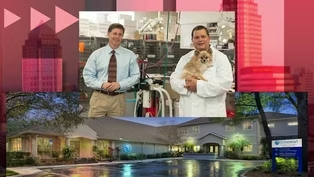
Preview: S2022 Ep2 | 30s | Darryl Shaw, CEO of Blue Pearl Veterinary Partners, and developer of Gas Worx (30s)
Providing Support for PBS.org
Learn Moreabout PBS online sponsorship
- News and Public Affairs

Top journalists deliver compelling original analysis of the hour's headlines.

- News and Public Affairs

FRONTLINE is investigative journalism that questions, explains and changes our world.












Support for PBS provided by:
Suncoast Business Forum is a local public television program presented by WEDU
This program sponsored by Raymond James Financial