Compass
February 2022 Edition
Season 6 Episode 2 | 28m 45sVideo has Closed Captions
A computer refurbishing program, a USDA lawsuit and a heartfelt farewell.
The February 2022 edition of Compass features an interview with CherryRoad Media CEO, a computer refurbishing program in Marshall, a USDA lawsuit and a local sheriff’s deputy who wrote his own obituary.
Problems playing video? | Closed Captioning Feedback
Problems playing video? | Closed Captioning Feedback
Compass is a local public television program presented by Pioneer PBS
Compass
February 2022 Edition
Season 6 Episode 2 | 28m 45sVideo has Closed Captions
The February 2022 edition of Compass features an interview with CherryRoad Media CEO, a computer refurbishing program in Marshall, a USDA lawsuit and a local sheriff’s deputy who wrote his own obituary.
Problems playing video? | Closed Captioning Feedback
How to Watch Compass
Compass is available to stream on pbs.org and the free PBS App, available on iPhone, Apple TV, Android TV, Android smartphones, Amazon Fire TV, Amazon Fire Tablet, Roku, Samsung Smart TV, and Vizio.
Minnesota’s Alt-Meat Revolution
“Minnesota’s Alt-Meat Revolution" is a year-long video and print journalism collaboration project, looking into the roots and impact of the plant-protein phenomenon that’s exploding across the globe.Providing Support for PBS.org
Learn Moreabout PBS online sponsorship(upbeat ambient music) - Funding for Compass is provided in part by the McNight Foundation and members of Pioneer PBS.
Thank you.
Hi, I'm Amanda Anderson, and welcome to the February edition of Compass, the regional public affairs show on Pioneer PBS.
Tonight on Compass, we'll learn about CherryRoad Media's acquisition of a number of Minnesota newspapers.
Take a trip to the ResQ Zone in Marshall, hear about a farming lawsuit and learn about one man's heartfelt final farewell to his family.
Stick around.
(tranquil ambient music) On the first of the year, Precipitin New Jersey based CherryRoad Media, the media division of CherryRoad technologies purchased seven Minnesota newspapers.
CherryRoad Media also owns papers in Arkansas, Alabama, Kansas, Nebraska, Iowa, Missouri, and Colorado.
I spoke with CherryRoad Media CEO, Jeremy Gulban earlier this week.
Hello, Jeremy Gulban, welcome to Compass and thanks so much for taking the time.
Can you please start by explaining what CherryRoad Media is and how it fits into the larger CherryRroad technologies?
- Sure.
Well, thank you so much, Amanda, for having me on and taking an interest in what we're trying to do here.
So this kind of all began back in the summer of 2020 or spring, summer 2020 during the pandemic.
And as a technology company, we really wanted to do something to help.
And so we looked at ways we could help and local newspapers came to mind.
2020 was a really tough year for local newspapers, a lot closed down throughout the pandemic.
And so, one night I went out on a website and looked for newspapers that were for sale and found a great little newspaper out in Grand Marais, Minnesota, and placed a call to the broker and things kind of went from there and we purchased just it.
What we're really trying to do here is bring technology into small town America, into small town newspapers in America, and use it as a force for good, rather than a force of competition.
- Why should people trust you?
- It's a great question.
And I think, in America, 2022, there should always be a lot of skepticism of what big companies are saying, and I could understand why everybody would ask, why is this tech guy from New Jersey buying our newspapers?
You know, it isn't totally logical to me.
I guess I'll just say, we're investing in the community.
If we weren't looking to be here for the long term, we wouldn't have started two newspapers that had already closed, right?
So we're showing that this means a lot to us, that we're committed to this.
As I mentioned in Redwood Falls, after a year and a half of there being no one there, we've added a new reporter.
So it's not like we're cutting costs trying to suck profits out of the newspapers, we're actually doing the opposite, we're investing money into them.
And I think people will see changes coming that I hope they'll embrace them and continue to support the newspapers.
- Great.
Well, it's been great to chat with you, I appreciate you taking the time and I have enjoyed hearing about all your ideas.
- Great, well, thank you so much for having me and for making your viewers aware of what we're doing.
- The ResQ Zone based in Marshall was designed to solve two challenges, and both of those challenges involve e-waste.
We took a trip to the Lyon County administrative office, which is the ResQ Zone to learn more about the program.
(ominous ambient music) The challenge is really two sides of the same computer disc.
On one side, there's been an identified need for affordable computers in Lyon County.
On the other side, Lyon County as a landfill county is trying to figure out how to lessen their e-waste footprint.
- We've been diverting electronic waste from landfilling for many years.
- [Amanda] Roger Schrader is the environmental administrator for Lyon County.
Electronic waste, or e-waste includes things like VCRs, DVDs, TVs and computers.
Schrader said that the county has been a collection point for e-waste since 2009, because in 2006, Minnesota law required that anything with a cathode-ray tube like televisions and computer monitors be recycled.
Years ago, Schrader was approached by an individual who wanted to start an e-waste recycling program.
- We weren't in a position to do that.
- [Amanda] Obstacles like personal data and program costs were first on Schrader mind.
- And that's where the county board stepped in, and commissioner Sanow said, you know, this is maybe not something that's going to make us money, but it's the right thing to do.
- I thought, what if we fixed up the old computers and gave it to the people that had a need for their kids.
The kids would have computers, this guy would have work, we'd get the stuff out of the landfill, we wouldn't have to pay for it, getting processed somewhere else.
- The obstacles that I saw that prevented us from allowing computers to be recycled, the county board was supportive of trying to overcome those obstacles.
And all of a sudden we were refurbishing computers and getting them back out into the community.
- [Amanda] And in 2018 ResQ Zone was up and running.
(upbeat ambient music) ResQ Zone is a partnership between Lyon County and Advanced Opportunities.
The county contracts with Advance also located in Marshall to provide the staff person who does the refurbishing.
Advance covers things like insurance, workman's comp, job coaching, whatever support the worker may need.
- Advance is a place for people with disabilities, but I like to think of them as people with unique abilities.
And what we do on a daily basis is look for ways that we can find the right niche for a person to meet their skills and abilities and desires with the perfect job or the best job that they like.
Advance got started with the ResQ Zone as a support for the person who started the ResQ Zone, the brains behind the hole, the project.
- I'm Jason Redepenning, I'm the computer guy here.
One of the people who were helping me, they asked me what I would wanna do, one of those little dream things, what would you wanna do for the rest of your life for work?
And I told 'em I wanted to just fix computers and give 'em to people.
- [Amanda] Redepenning who has Autism and ADHD is someone who thrives working amongst the servers and screens, and has always had innate drive to help people.
ResQ Zone is a safe place to do both of those things.
Redepenning works three days per week and gets paid through the county, which gets some money from reselling higher end computers and tablets.
Kylie Peterson works for Advance and is Redepenning direct support professional.
- So I just help out with whatever he needs while he is out here.
- Their refurbushing process goes something like this, the product is donated sometimes one item at a time, and.
- Sometimes companies will come in and they'll just give the whole pallet of them.
You know, a big pile of 'em and then we'll have to go through 'em, like Turkey Valley gave us some, and we're going through 'em now, find the ones that have like too many Turkey feathers in 'em.
We throw those way, (chuckles) the parts that are in 'em, you know, if they're good or bad.
Kelly gets kind of grossed out with the Turkey feather ones.
- Who wouldn't?
(chuckles) - [Amanda] Then Redepenning and Peterson take inventory and clean the products, Turkey feathers and all.
- And then I start going through it and see that all the parts are there.
And then we wipe it.
- [Amanda] Removing all personal data, then the computer gets imaged.
- The red and black computer back there, that's a server.
Server's basically a dedicated computer.
This dedicated computer does one job and one job only, and it holds these files called images on it.
Those images are not like pictures, like photos, these are like full computers already done in one little file.
And what that computer does is when we hook up other computers to the network, we can spit out Windows 10 or whatever to all those computers.
- Our local computer, tech service computers, and beyond, they've been helping us with some of the higher end issues that we've come into.
They helped Jason create a server so that he can get multiple machines uploaded with the right software at one time.
- [Amanda] And then it goes on the shelf ready for its new life of web surfing and computing.
Between 2014 and 2018, Lyon County dropped from 17,692 pounds of e-waste recycling to 2,132.
Schrader said that awareness of ResQ Zone has increased the total volume of electronics they receive about half of which are old systems that ResQ Zone can't use.
In the past three years, ResQ Zone has gotten 420 computer systems back out into public use.
And half of those were given out in the past year as Lyon County identified more need in area schools, especially with COVID-19.
- We set up the structure so that it's needs based, working through initially United Community Action and Southwest Center for Independent Living and some of those other service organizations.
And then when the pandemic hit, we thought, well, we need to expand this to schools.
If they have a need, we don't wanna know people's financial information.
- Yeah.
- And so what we set it up as, if you have a child that gets free and reduced lunches, if you're a veteran, if you're someone who receives services from one of these other organizations that is income based, then we do just need approval that you're receiving those services, and that qualifies you.
So that way we're not asking for detailed personal information on anybody, because that's already being done by another organization.
(ominous ambient music) - While this project took some extra human bandwidth, Roger Schrader thinks that now that they've worked through the bugs, this could be a plug and play operation.
- And as long as you can find the right staff person that's able to refurbish the machine, it can work, our space, our footprint is very small.
We're already collecting the machines.
So I think it would be easy to replicate throughout the state.
- The USDA is being sued over a provision within the Biden administration's American Rescue Plan aimed at helping farmers of color.
It's a class action lawsuit that could go all the way to the United States Supreme Court.
Nestled inside of the Biden administration's American Rescue Plan was a promise of debt relief for socially disadvantaged farmers.
Up to 120% forgiveness to BiPap farmers who had USDA approved loans.
The USDA is now facing a class action lawsuit.
And in July of 2021, seven white farmers from Minnesota and North Dakota joined in.
James Dickey is a lawyer representing the Minnesotan and North Dakota and farmers.
Compass hasn't been able to reach any of the plaintiffs for comment.
- The Biden administration passed, secretary of Vilsack in particular passed a rule that essentially allows for total debt forgiveness for socially disadvantaged, historically socially disadvantaged farmers that I believe the phrase is in the law.
And, but it specifically excludes white farmers from that relief.
- [Amanda] The USDA has broadly defined the Term, socially disadvantaged farmer or rancher as those who identify as one or more of the following, black, American Indian, Alaskan native, Hispanic, Asian, and Hawaiian Pacific Islander.
- From our client's perspective, that is essentially present discrimination that is intended to remedy past discrimination and the 14th Amendment's Equal Protection clause doesn't allow that to kind of roll.
- [Amanda] The Law that's taking precedence in this class action case was filed in Texas in April, 2021, by Sid Miller, the Texas Agriculture Commissioner.
The case was sponsored by America First Legal Foundation, a group co-founded by Steven Miller, a former advisor to Donald Trump.
The suit alleges that the USDA proposed program discriminates against white farmers and ranchers, who would otherwise be able to receive this relief if they weren't white.
Miller says he's bringing the lawsuit as a private citizen and not in his capacity as agriculture commissioner, Stephen Carpenter is a lawyer for Farmers Legal Action Group.
- What happens first of all, is just, an extremely quick background.
The United States Department of Agriculture has a lot of resources, does loan programs, spends a lot of money to help farmers.
And historically that assistance has very much targeted white farmers.
And part of that is not surprising because it's a very old department, it was founded during the Lincoln administration.
So the reality is that would've been a department that really did focus its attention on white people.
That continued for a very long time.
And even after it was no longer legal to do that, the everyday implementation of US Department of Agriculture programs was often discriminatory based on race.
And we have excellent records and histories and documentation of that going back many decades and continuing to the very recent times and the present.
- Patrice Bailey is the Assistant Commissioner of the Minnesota Department of Agriculture.
He said that out of Minnesota, 26 million acres of farmland.
- 24 Million of those acres are owned by white farmers.
So that lies a disparity that goes between black indigenous people of color, and those with disabilities and veterans to sort of have the other piece that's left.
- Assistant Commissioner Bailey said that when he was appointed in 2019, he was asked to do listening sessions throughout the state to learn about the barriers that exclude people from getting involved in agriculture.
- So what came out of that listening session, all of them actually was that many of the barriers beyond the land and finances, school loans, mental health, insurance, you know, there was also barriers of being overlooked, not being seen.
You know, these are barriers that continue to happen in underrepresented communities because of maybe you don't have that relationship with a lender.
The lender does have a lot of power to say yes or no.
And we have to also understand that this is a design, this is a system that was built so that there would be profitability in one direction.
You know, so, it's a complete slave mentality, but not in the same way, you're not shackled anymore, but you're still ostracized in a way because you don't have the info, you don't have the equity and you don't have the, you know, frankly the right skin color in order to actually be in the same spaces.
- [Amanda] In fiscal year, 2021, the USDA received 1,921 applications from Minnesotan farmers and approved 1000432 of them.
Out of those approved applications, 92 were for socially disadvantage farmers representing $13,531,635.
One of those farmers, Moses Momanyi farms in Cambridge, Minnesota.
He came to the United States from Kenya in 2004, and began farming.
After a short period, he realized he needed to grow in a larger space.
Not knowing how else to acquire land, he just drove around and asked to land owners if he could rent from them.
- Eventually I didn't succeed in getting that, but in the process, I ended up at farm trainings, kind of an incubator program in Stillwater, Minnesota, I right away enrolled and took a two year course.
Remember I needed to learn how to grow in a different climate, but also very important reason why I went there was because I felt going there was my first and only hope of getting to land.
- [Amanda] Even after completing the first two years of incubator training, Momanyi said that because he was new to the country, he didn't have acceptable credit history or the farming records to apply for a loan.
- [Momanyi] It was almost like every year I was rented from somebody else.
- [Amanda] During this time, Momanyi worked a job at a nursing home in Hopkins at night, and at the farming incubator in Stillwater during the day.
In 2014, he was able to go back to the USDA to get approved for his loan.
Recognizing the importance that the farming incubator had on him, he wanted to help others similarly.
Last year, he and his wife started subleasing pieces of their land to friends from the community.
- We thought we were gonna start with four.
We did end up with 13 last year, 'cause this last year we started, this year we have 19.
When I started, I let the USDA know I am subleasing this land because the farmers are paying me only a $100 to get that space.
I give them water, I (indistinct) for them, I do everything.
But the USDA told me, you can only sub lease for three years, no more than that.
Is that a structure or barrier?
It is.
Even if I got a loan from the USDA and it would subsidized, it's public assistance, that to me defeats the purpose of trying to help me, if you just help me and not me as a whole, 'cause I'm a whole if I'm a community and I feel like I belong to a community.
And the community I belong to is both the community in my neighborhood here, you know, the community in Minnesota, but also the immigrant community.
I always think of it this way, if you grew up on a farm and let'' say your father or your uncle, whatever, or your neighbor, they had a good relationship with the bank and you could go in there, you could get a loan easily because they know you come from a farming family and all that.
So they know you are like, they can believe you.
That is not easy for those who are cut off.
It's hard for them to even just walk into the bank and get that.
Even me, it might be difficult still to go to the bank and say, hey, give me 400,000 so I can buy a combine, all right.
I still struggle with things, finances.
I got this land, but I still was using a 1950 tractor.
If we have children growing here.
And we know every culture identifies with what they grow and the land, what will happen to our culture?
We will lose part of our identity and our children will not have that connection.
I grew up with a strong connection to land.
And I'm just feeling like if there's that generation here, justice means apart from us working hard, you know, we need to be also given that opportunity to be on land and live on the land like everybody else.
- Tim Yerigan, was a man of many words.
And when he died in November of 2021, he left a special farewell for his family and community.
(tranquil ambient music) Tim Yerigan was 57 years old when he died on November 14th, 2021 from mesothelioma.
- It's a cancer that you get by breathing asbestos.
This was just last winter.
He got my Jeep stuck.
(chuckles) Like he was 16, he thought that was pretty funny.
- [Amanda] When we visited Tanya Yerigan, Tim's Wife and their kids in mid-December, the Yerigan household was briming with holiday decorations, Christmas presents and photos from Tim's recent celebration of life service.
Their dog Sigmund helped sort them.
Tanya said, Sigmund could sense Tim's missing presence.
Tanya and Tim met in the late 80s, started dating in 2000 and got married in 2003.
Tanya said that medical experts believed that Tim was exposed to asbestos in his late teens working and commercial construction projects with his dad.
According to mesothelioma.com, mesotheliomas latency period, or the time between exposure and when symptoms occur is long, typically 20 years, which is directly related to the diseases poor prognosis.
The website also notes that there have been reports of mesothelioma developing anywhere between 10 and 70 years after initial asbestos exposure.
Tim was a Sheriff's deputy for Yellow Medicine County for almost 30 years.
- Each of the grandkids will get one of these for Christmas.
Yeah, these are actually his pants, they put pin stripes.
- [Amanda] He retired in February of 2019.
Bill Flaten has been the Yellow Medicine County sheriff since 2007.
- I worked with Tim for 25 years.
He worked here when I first started and one of my first, well, my first night that I rode around in Yellow Medicine County was with Tim.
And I mean, it was classic Tim.
If I had to guess, that's what I think Tim's favorite part of this job was, was just being a respected person that people could get help from and ask questions to, and just a friendly face.
(upbeat ambient music) - Tim was an avid sportsman going hunting, fishing, and spending time at the family cabin in new London.
(chuckles) - That's a funny thing.
We didn't really like hunting with him.
He was very into hunting.
So when we would first go with him and he would try to teach us, you know, you need to be very quiet.
I mean, he was the type of guy who you can't move a muscle, you can't make a noise.
I mean, if his nose was running, you know, he's not the one to, (inhales sharply) I mean, he just lets it go.
(chuckles) And he'll wipe it later.
- [Amanda] One favorite memory of the Yerigan's youngest child, Brianna Ahrenholz was fishing in Canada.
- Of course he's with his family and he's fishing.
I mean, he loves it.
- Yeah.
- He never had time to fish because there was five of us kids in the boat.
(chuckles) There's strings getting through, or lines getting stuck, getting tangled, getting fish off, getting a fish like unhooked.
He was just like, never had time, but he enjoyed it.
He always went, he was always good sport about it.
- [Amanda] But everyone said that above all, Tim Yerigan was a family man.
- He was wild when we were younger, you know, there was five less kids packed into this house and it was loud, it was noisy.
- It was fun though.
- It was a lot of fun.
- A lot of fun.
- [Amanda] Garrett McCoss is the Yerigan's second youngest child.
He also went into law enforcement and attended this same school as his dad, Alexandria Community and Technical College.
- I admired what he did and I never would tell it to him, you know, 'cause that's how his son is.
But I looked up to him.
I can't explain how much I looked up to him.
At Al Tech, they have a big blue line.
Everybody that graduates get to sign their name in the year they graduated.
Well, they just kind of got this room done when I graduated.
So me and him got sign our names next to each other.
- [Amanda] Kayla Yerigan is the Yerigan's second oldest child.
- Dad has always been about family.
Him and mom, they both.
They were the greatest love story.
- [Amanda] And yes, Tim's wife Tanya was truly the love of his life.
- What makes it extra hard is, we were everything to each other, we were husband and wife, but we were, were best friends, we were confidants, we were business partners, we were parents together, there wasn't anything we weren't to each other's.
- [Amanda] After Family, the other thing people agreed on was that Tim was a talker.
- I'd like to say we are very private.
We're not very public people.
He loved talking to people.
He was the talker.
He would walk into a store and gosh, it's like the Minnesota goodbye.
I mean, it would be half hour later.
Is dad coming?
(chuckles) Oh, he's still talking.
- Yeah.
- [Amanda] Tim even acknowledged as much in his final farewell, he wrote his own obituary or final love letter to his family and community, which opened, "My life has been quite a journey.
Like in life, I've got a lot to say.
You all know I was never without words."
- Dad's Minnesota goodbye, like that's him.
- [Amanda] Tanya and Tim's Inspiration to write their own obituaries, their own final goodbye letters stemmed from another tragic family incident involving their son Clint.
- For years we talked about it because when our son passed away in 2006, we sat at a table for hours with friends and family trying to write an obituary.
And it was beautiful.
But it wasn't something that we ever wanted our kids to have to do for us because it was painful.
And we thought, you know what better way to honor them than to give them the gift of a goodbye letter.
- [Amanda] And their kids had no idea.
- I'm glad he did that, 'cause I didn't know he did.
And it's special because years down the road, I can go back and I can read it whenever I want.
- [Amanda] Tim's love letter concludes, "Remember me active.
Remember my laugh, my smile and the sparkle in my eyes.
When they shut for the last time, which they must have by now, I can't wait to be greeted at the gates by God.
I will ask him to allow me to continue to watch over Tan, our kids and our grandkids.
Once God and I are done, I will mess up Clint's hair and give him the biggest hug.
Until we meet again, see you later."
Thank you for watching the February edition of Compass.
We encourage audience interaction and feedback.
So head over to our social pages and website and interact with us.
And check out the freelance opportunity we have posted on our website.
Thanks for watching Compass and see you online.
Funding for Compass is provided in part by the McKnight Foundation and members of Pioneer PBS.
Thank you.
(tranquil ambient music)
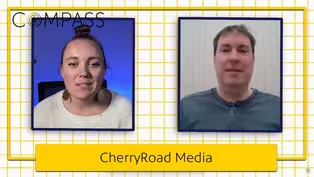
Clip: S6 Ep2 | 12m 4s | New Jersey-based CherryRoad Media recently purchased seven Minnesota newspapers. (12m 4s)
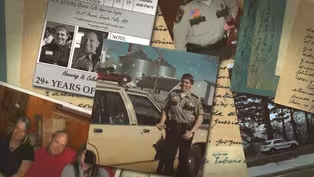
A personal final farewell from a sheriff's deputy
Clip: S6 Ep2 | 6m 36s | Tim Yerigan wrote his own obituary, or final goodbye letter, to his family and community. (6m 36s)
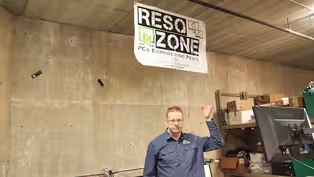
Clip: S6 Ep2 | 7m 10s | ResQZone refurbishes recycled electronics & distributes them based on income-based needs. (7m 10s)
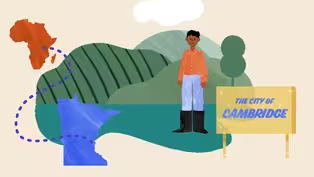
Clip: S6 Ep2 | 12m 58s | White farmers are suing the USDA, claiming debt relief for BIPOC farmers is racist. (12m 58s)
Providing Support for PBS.org
Learn Moreabout PBS online sponsorship
- News and Public Affairs

Top journalists deliver compelling original analysis of the hour's headlines.

- News and Public Affairs

FRONTLINE is investigative journalism that questions, explains and changes our world.












Support for PBS provided by:
Compass is a local public television program presented by Pioneer PBS