
Carolina Impact: February 22, 2022
Season 9 Episode 18 | 26m 10sVideo has Closed Captions
Inflation, Henry Frye, The Charlotte Brown Hawkins Center, Humane Society
A look at Inflation, NC Supreme Court Justice Henry Frye, The Charlotte Brown Hawkins Center, A larger facility for the Humane Society
Problems playing video? | Closed Captioning Feedback
Problems playing video? | Closed Captioning Feedback
Carolina Impact is a local public television program presented by PBS Charlotte
Carolina Impact: February 22, 2022
Season 9 Episode 18 | 26m 10sVideo has Closed Captions
A look at Inflation, NC Supreme Court Justice Henry Frye, The Charlotte Brown Hawkins Center, A larger facility for the Humane Society
Problems playing video? | Closed Captioning Feedback
How to Watch Carolina Impact
Carolina Impact is available to stream on pbs.org and the free PBS App, available on iPhone, Apple TV, Android TV, Android smartphones, Amazon Fire TV, Amazon Fire Tablet, Roku, Samsung Smart TV, and Vizio.

Introducing PBS Charlotte Passport
Now you can stream more of your favorite PBS shows including Masterpiece, NOVA, Nature, Great British Baking Show and many more — online and in the PBS Video app.Providing Support for PBS.org
Learn Moreabout PBS online sponsorship- [Narrator] Wells Fargo is proud to support diversity, equity and inclusion in our employees, our customers and the communities we serve, as well as through content on Carolina Impact.
- [Narrator] This is a production of PBS Charlotte.
- Just ahead on Carolina Impact.
- [Jeff] Gas and groceries getting more expensive for everybody.
I'm Jeff Sonier, talking with experts and families about how to balance the budget when you still have to pay for that $40 fill up.
- [Amy] Plus, our celebration of black history month continues with a look back at the contributions of North Carolina's first black Supreme Court justice, and looking for a pet?
The humane society trades in it's cramped quarters for a larger facility.
We'll take you on a tour.
Carolina Impact starts right now.
- [Narrator] Carolina Impact, covering the issues, people, and places that impact you.
This is Carolina Impact.
- Good evening, thanks so much for joining us.
I'm Amy Burkett.
Inflation is one of those issues that hits us all where it hurts, in the wallet.
At the gas pump, the grocery store, paying those inflated prices we're all seeing now is just the beginning.
When the credit card bills are due, what can you do when your budget is already stretched as far as it can go?
Carolina Impact's Jeff Sonier takes a closer look this week at the latest version of an old problem that many of us are dealing with for the first time in a long time.
- Yeah, it's been a long time since prices have gone up so fast and so high on just about everything that we buy, even the everyday basics, like gas and groceries.
You know, $3 per gallon adds up fast and that means our wages don't last as long or go as far, especially if you drive a car.
♪ I got bills I gotta pay - [Jeff] Yep, whether it's that $40 fill up that leaves your wallet on empty.
♪ I got mouths I gotta feed - [Jeff] Or that cart full at the grocery store that just costs more than it did before.
♪ I got bills - [Chiante] Yes, so it has started to surface with my clients.
- [Jeff] Chiante Jones is a financial coach who says every trip to the grocery store or the gas station, chances are, you're feeling inflation, paying more or getting less, and then figuring out how to make ends meet at the end of the month and that's where she comes in.
- [Chiante] And so that has been a conversation about whether we need to make adjustments to the amount they have allocated for their day to day spending to account for just a higher cost of living right now.
♪ I got bills I gotta pay - [Chiante] And the main area is coming up, is into, in their day to day spending, particularly their groceries.
♪ I got mouths I gotta feed - [Chiante] So, I think everybody's seeing a larger grocery bill right now.
♪ I got bills - [Jeff] And it's not just here in Charlotte.
It's the same story everywhere.
National grocery prices, up 6.5% compared to a year ago, national gas prices, up 49.6% over the past year.
Plus there's our local problem of affordable housing.
Zillow says rent in Charlotte is up 18.5% in a year and if you're buying instead of renting, well, home values are up 26%.
♪ I got bills I gotta pay - It floors me.
I'm a senior citizen now.
- [Jeff] For Judith Alvarez Miller, the bills meant losing her home and moving into public housing.
- [Judith] Oh, I just got tired of agonizing, my home phone constantly ringing, bill collectors, and I hated going to the mailbox because I would have a slew of disconnects, or you know, we're gonna take you court if you didn't pay this and it just got overwhelming.
- [Carmen] You know, everything is going up, so.
- [Jeff] Same sad song, different verse for Carmen Smith Williams, who's a working mom with two teenagers at home.
- [Carmen] When I go into the grocery store, I can spend a hundred dollars or more and I look, I only have like three bags.
I'm like, what did I just spend my money on?
Because I have nothing and my kid's like, well, you just went to the store.
I mean, where's the food at?
Like well, this is what we can get for what, you know, I have right now, so that has been, you know, a big change for us.
- [Judith] I have to do meal planning.
I have to do budgeting and I had to make those hard decisions, I have to pay rent.
- [Carmen] Before, I may spend maybe like $36 to fill my car up, but now it's close to 50.
More is going out than coming in to where I couldn't actually save.
- [Judith] One day, I just sat at my kitchen table and I looked at all my bills and I said, I can't do this on my own, I need some help.
- [Jeff] That help for Judith came from Tonia Frazier, a financial advisor with Commonwealth Charlotte, which manages the city's free financial navigator program.
- [Tonia] We're all in the same boat.
Many of us are a half a paycheck away from homelessness and so now just with all of this and inflation too, you know, clients are at a panic, but let's look at your spending plan, make this a part of your way of life and, and let's see what makes it comfortable for you.
- [Judith] Like one week, I'll go to Harris Tee, another week, Food Lion, another week, Aldi, and now I'm couponing now.
- [Jeff] Judith, who's retired and on a fixed income, adds that shopping and spending smarter now helps her pay the bills, but it also means fewer trips to the beauty salon.
- I'm not embarrassed to say it because this is my reality.
- Just being more mindful of the things that we're spending our money on, like.
- [Jeff] And for Carmen, who also gets advice from Commonwealth Charlotte, well, it means more asking why before she buys.
- [Carmen] You know, do you really need it?
Or just little things that you don't think about at the time that do add up, that's taking money away.
- It's just choice after choice after higher choice.
That's, that's really what everyone's kind of facing right now, I suppose.
- This is it, nothing else, you know, it helps a lot.
- [Jeff] Yeah, inflation, here at the gas station or at the grocery store, is what the money experts call regressive, which means it hurts the worst those who can afford it the least.
Amy.
- Thanks so much, Jeff.
Here are some tips from financial coach, Chiante Jones, to help you free up some money in your budget.
Try planning and meal prepping at home, look for free and creative events around town, cancel those unused or unwanted subscriptions you might have and make sure to set your own financial priorities at the beginning of each and every month.
Also check out our website, PBScharlotte.org.
We'll link you to free help from Commonwealth Charlotte and the city's financial navigator program, which won't cost you a dime and could help you gain some financial stability.
Well, we continue to celebrate black history month on Carolina Impact with a tribute to the common contributions and sacrifices of African Americans.
Reporter Steve Crump joins us in the studio with a look into the life of a North Carolina Supreme Court justice known for a series of groundbreaking political moments.
Steve.
- Henry Frye has been called the Jackie Robinson of politics in North Carolina.
He made history as a law school student and his voice resonated loudly across two branches of state government.
- Y'all to come down, this has expanded.
- [Steve] Working a room or delivering present day insights.
- As you know, the Civil Rights Act of 1964 did not end racial discrimination.
- [Steve] Adds to the popularity of Henry L. Frye.
He's one of the Tar Hill State's political pioneers in understanding his reach means comprehending simple beginnings in the rural town of Ellerbe, North Carolina.
Today, just over 970 residents call the Richmond County community home.
Henry Frye grew up in these humble surroundings until he enrolled in Greensboro's North Carolina Agricultural and Technical College.
After receiving a degree in chemistry, Frye joined the US Air Force during the Korean conflict in 1953.
One of the graduates' last stateside assignments meant coming to Montgomery Alabama's Maxwell Air Force Base, which led to an unexpected church meeting impacting his life.
- [Henry] Right across the street from the state capital and the pastor at that time was Reverend Martin Luther King Junior and I went to church one Sunday while he was there, so the time that I saw him was at church on that Sunday, Sunday morning, and I got to talk with him.
- [Steve] Returning to Greensboro meant it was by back to the books for Henry Frye, while North Carolina A and T provided a productive environment that was key to a successful undergraduate career, his next academic steps would be taken in chapel hill at the University of North Carolina Law School.
- The seed was planted when I was in the military.
- [Shirley] His GI supported his funding of law school and I paid the bills and the night after graduation, he said to me, Shirley, you have no idea.
I was eight months pregnant at that time too.
He said, Shirley, you have no idea how much I appreciate all that you've done to make sure that I had success in, in law school.
- [Steve] Groundbreaking accomplishments often define the very existence of Henry L. Frye.
First of his race to win a seat in the state legislature during the 20th century and the first person of color to sit on North Carolina Supreme Court in 1983, when he was named an associate justice and in 1999, Frye was sworn in as a state's chief justice.
Both judicial appointments were made by governor Jim Hunt.
- On my mind is to whether I should I, whether I should leave the private practice of law, which is what I wanted to do.
- [Steve] Hashing along in interest in the field of law meant nurturing his son, Henry Junior, who served as the circuit court judge in Greensboro and inspiring the family's third generation attorney, his granddaughter, Whitney Frye.
Reflections of cherished memories created during life's formative years in Ellerbe, North Carolina unleashes a torrent of powerful flashbacks.
Ride to and from Ellerbe along highway 7374 in Richmond County, and a prominent sign comes into view.
It recognizes a revered individual in the place of his birth.
The Chief Justice Henry Frye Bridge pays tribute to the hometown hero.
- He is a bridge builder.
- [Steve] Governor Roy Cooper was among the dignitaries applauding such a groundbreaking legacy.
(applause) The town's firehouse provided the platform for the ceremonial unveiling.
His gratitude is expressed by acknowledging a community for planting the early seeds of success.
- Thank you for all of what you've done.
Thank you for being positive.
Thank you for planning and trying to do things the right way.
Thank you for bringing sunshine.
Well, sometimes it's very dark and I know that many of you have done that.
- [Steve] Plowing through the darkness hasn't always been an easy ride.
It has met succeeding against the realities of Jim Crow and enduring political loss.
Finding the light came through devotion to Shirley, service to his nation in the Air Force, faithfulness to his beloved North Carolina A and T, along with dedication to his native state, from the halls of the legislature to the courts.
- We've had some progress and I hope it continues.
- Now, Justice Frye has been and continues to be a mentor and advisor to a number of judges and elected officials.
One other groundbreaking moment he still takes pride in is the fact that was one of the first students of color to serve as an associate editor of the prestigious Carolina Law Review.
- Thank you, Steve.
Frye served in the house for 12 years and two years in the Senate before being appointed to the North Carolina Supreme Court.
If you're interested in learning more about black history across our state, then you may wanna visit the Charlotte Hawkins Brown Historic Site.
Founded by a woman far ahead of her time, the site was once a school for African Americans in the early 1900's.
Carolina Impact's Jason Terzis and photo journalist, John Branscomb, take us on this one tank trip, just east of Greensboro.
- [Jason] Each of the 27 historic sites in North Carolina offers a unique snapshot of the state's past.
Just east of Greensboro, there's a one of a kind site that tells a unique story of a woman on a mission to change the world through education.
- [Michelle] Dr. Brown, what she did just at the turn of the 20th century, at a time when racial terror was certainly at one of it's heights, historically, she created an oasis space.
It's quite a miracle that she was able to do this as a black person, but certainly as a black woman and a black Southern woman in a Southern community during an era of intense and legal segregation.
- [Jason] But exactly who was this pioneering woman.
- [Michelle] Dr. Charlotte Hawkins Brown was born in Henderson, North Carolina and with one of the great migration stories north, her family did end up making home in Cambridge, Massachusetts and one moment of inspiration resulted in her coming back south to work, to educate young people here in what is now Sedalia, North Carolina.
- [Jason] This is where Dr. Brown founded a school to educate young African Americans.
- [Michelle] Here at the Charlotte Hawkins Brown Museum, we are telling several stories.
One of the stories that we're telling is of historic Palmer Memorial Institute, which was a college preparatory boarding school for African Americans.
- [Jason] The Palmer Memorial Institute, named after former Wellesley college president, Alice Freeman Palmer, opened its doors in 1902.
It operated as a boarding school with students and some faculty living on campus.
- [Michelle] This was a place that was extremely vibrant.
We had students from all over the world.
- [Jason] According to Lanier, the education received at the institute was world class, with many of its students going off to do great things.
- [Michelle] We had students that certainly went on to become educators, just like Dr. Charlotte Hawkins Brown.
Some students went into medicine.
Some students went into military careers, some went into music careers, and some went into politics.
- [Jason] But the impact of the institution went well beyond the campus.
- [Michelle] We can see the influence of Dr. Brown on, you know, black land ownership, entrepreneurship, business ownership, a sense of leadership and autonomy in determining how one lives a life and then we see that ripple effect all over the world.
- [Jason] Dr. Charlotte Hawkins Brown led the school for half a century.
During that time, she showed some hardcore determination to build a unique learning environment for students.
- [Michelle] The legacy that she built is really on par with many small colleges.
She was someone who attracted the attention of donors and artists, civic leaders, educators, politicians.
Eleanor Roosevelt visited the campus.
The poet, Langston Hughes, spent time here working with students.
Josephine Baker came here.
- [Jason] And much of that fundraising was done right here in Canary cottage, Dr. Brown's home.
- [Michelle] When you walk into the home, you will immediately get a sense of the purpose of the home.
It was a place for hosting.
It was a place for talking to donors.
It was a place where she could have her mother, maybe some students, visiting artists and dignitaries stay.
- [Jason] And at times, one particularly famous American musician would visit the house.
- [Michelle] Nat King Cole married into Dr. Brown's family and became, of course, a really beloved part of the family.
We have images of Nat King Cole playing the piano that still is right here in Canary cottage.
- [Jason] Dr. Charlotte Hawkins Brown retired in 1952 and passed away in 1961.
She's buried on campus near her beloved Canary cottage.
The school itself though, closed in 1971, but Lanier says this campus still has a place in educating those who walk these grounds.
- [Michelle] We really hope that this will also be a community anchor that connects to all of the needs that we have to walk, to move, to learn, to bring back some of the life of the school.
- [Jason] In 2021, the school received a grant of more than $480,000 from the National Park Service, with a goal of doing further restoration on the student center, known as the tea house.
The funding comes from a program specifically targeting the preservation of African American history.
With the continued investment and the hard work of the staff, the legacy of the Dr. Charlotte Hawkins Brown Museum will continue enriching the lives of visitors for years to come.
For Carolina impact, I'm Jason Terzis reporting.
- Thank you, Jason.
Palmer Memorial Institute transformed the lives of more than 2,000 African American students.
Well, since the pandemic started in 2020, one in five households added a cat or a dog, according to national statistics.
With pet adoptions up, the humane society in Charlotte soon trades its cramped quarters for a new multimillion dollar facility.
Carolina Impact's Jason Terzis takes us on a tour.
- [Jason] The scissor lifts are going up, spackle smeared on walls.
There's also drilling, electrical wires, air conditioning ducts and pipes to deal with.
It's a beehive of activity and what will soon be the humane society in Charlotte's new home.
- [Shelly] Oh my gosh.
I am just bursting at the seams to be able to be in this space when it's finished.
- You know, it brings tears to my eyes.
It's just incredible, 'cause we have just talked about this for so long.
- [Jason] The state of the art facility on Charlotte's west side broke ground a year ago and is set to open up later this spring.
- I mean, we're pumped.
We are ready to be in this building yesterday.
- So we're on target for the end of April for our certificate of occupancy and hope to be open to the public mid-May.
- [Emily] This right here will be our education court, where we can welcome in students, field trips, birthday parties.
- [Jason] For nearly 30 years, the humane society's been operating out of this center, just off I77 in Remount road.
With multiple small buildings totaling around 10,000 square feet, it's pretty cramped.
To accommodate overflow staff in recent years, it rented a house down the street for more office space.
- Over the past five to six years, it's become increasingly difficult to work out of the current facility that we've been in since the nineties.
- [Jason] The new facility is more than double the size of the old one, at 26,000 square feet.
- This is gonna be a place where you can come adopt dogs, adopt cats, but we're gonna have so many more resources available to the community, that it's, it's a resource center.
We're gonna have an education court.
We're gonna have a cat cafe, an essential wellness clinic, a spay, neuter clinic, a dog park at the back of the property, so it's really what we think of as a destination for our community.
- [Jason] With no government assistance or corporate donors, the humane society had to raise all of the money for this project through individual donations, totaling nearly 15 million dollars.
- But I've just been personally blown away by the generosity of the donors in our community.
We're over, you know, 14.7 million dollars and there's not one corporation that has given us that a contribution in there, it's all individuals.
- [Jason] The humane society is a no-kill shelter, so every animal that comes through the doors stays until it finds a new home.
- We do see some animals hang out for a few months at a time and which of course means we pull out all the stops in regards to marketing and social media.
I've even gone as far as putting a dog on Tinder before years ago, it was fantastic.
- I'm just really excited for them to get in their new building because I think that that is gonna help them do even more than they're doing now for the community.
- [Jason] The humane society is a privately funded nonprofit, but they're not the only organization in Charlotte helping pets find homes.
CMPD Animal Care and Control division does pretty much the same thing, only they're government subsidized.
- We all want the best for animals, that's the bottom line.
We all work really hard.
We just work a little differently, but then we also partner together a lot too.
- [Jason] Long gone are the days of the dog catcher and sending animal animals to the pound, which is why part of Animal Care and Control's messaging is fighting against public perception and stereotypes.
- [Melissa] I cringe when people call us the pound and I cringe when people call us the dog catchers, because we are so far beyond that.
That's not what we are.
We are an adoption center.
We are a resource center.
We're here to help animals, but mainly we're here to help the animals' people.
- [Jason] Animal Care and Control believes if an incoming animal is healthy and behaviorally sound, it deserves a chance to find a loving home.
The only time an animal is ever euthanized is if it has an untreatable or costly health issue, or behaviorally is deemed a danger to the public.
- [Melissa] 90% Of the animals coming in here are, are leaving in a positive manner.
A lot of that 10% is made up of behavior issues, which can be feral cats, and it also can be dogs that have bitten people, attacked people and the bottom line is, is that we're here to make sure that we keep Charlotte safe, but sometimes unfortunately the best thing that you can do for an animal that is truly suffering is to, to humanly euthanize it.
- [Jason] For those who might be thinking about adopting, but not fully committed to it, there are options, such as stay cations, or short term boarding and even that helps sometimes overcrowded kennels.
- [Melissa] But if you're just not sure, or you just wanna help, you're like, I can't have a dog because of my job, or I travel too much, but you wanna help make a difference, come on a Friday and check out one of our dogs for the weekend, bring it back on Monday and you have opened up a space for four days.
There's a lot that we can do with an empty kennel in four days.
- [Jason] Whether it's the humane society, Animal Care and Control, or any other pet services organization, the goal for each is the same.
- In 2021, we helped to find new loving homes for 3,431 animals, which is the most adoptions we've ever done in the history of HSC in a single year.
- [Jason] But for whatever reason, there's just something about being a pet owner that seems to enrich the lives of everyone involved.
- And just the way animals, you know, they just don't disappoint you perhaps the way people can and I think people, that's why they just have these really just amazing spots in their heart for their pets.
- [Jason] No wonder why these guys are called man's best friend.
For Caroline Impact, I'm Jason Terzis reporting.
- Thank you, Jason.
This past month, fundraising efforts on social media honoring the legacy of Betty White, a lifelong animal lover and advocate, raised nearly 13 million for shelters across the country.
Before we run out of time, I want to invite you to join us for a little March fun with the PBS Charlotte playoffs.
Each week, you can vote on some of your favorite local Carolina Impact stories.
One of the final four will air during each show in April.
So head to our website at pbscharlotte.org to cast your vote today.
That's all the time we have this evening.
Thanks so much for joining us.
We always appreciate your time and look forward to seeing you back here again next time on Carolina Impact.
Good night, my friends.
(subtle music) (subtle music) - [Narrator] A production of PBS Charlotte.
- [Narrator] Wells Fargo is proud to support diversity, equity and inclusion in our employees, our customers and the communities we serve, as well as through content on Carolina Impact.
Carolina Impact: February 22 Preview
Preview: S9 Ep18 | 30s | Inflation, Henry Frye, The Charlotte Brown Hawkins Center, Humane Society (30s)
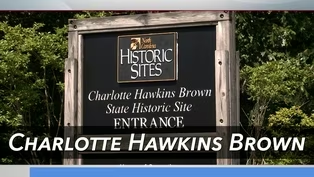
The Charlotte Brown Hawkins State Historic Site
Video has Closed Captions
Clip: S9 Ep18 | 5m 10s | The Charlotte Hawkins Brown state historic site honors the legacy of the great educator. (5m 10s)
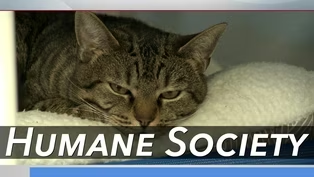
Charlotte's Humane Society's New Facility
Video has Closed Captions
Clip: S9 Ep18 | 5m 24s | Charlotte's humane society trades in its cramped quarters for a larger facility. (5m 24s)

Video has Closed Captions
Clip: S9 Ep18 | 5m 24s | Paying more at the grocery store and the gas station. How inflation affects our budgets. (5m 24s)

NC Supreme Court Justice Henry Frye
Video has Closed Captions
Clip: S9 Ep18 | 4m 58s | A look at the life of former North Carolina Supreme Court Justice Henry Frye (4m 58s)
Providing Support for PBS.org
Learn Moreabout PBS online sponsorship
- News and Public Affairs

Top journalists deliver compelling original analysis of the hour's headlines.

- News and Public Affairs

FRONTLINE is investigative journalism that questions, explains and changes our world.












Support for PBS provided by:
Carolina Impact is a local public television program presented by PBS Charlotte