Vermont This Week
February 23, 2024
2/23/2024 | 26m 45sVideo has Closed Captions
Gov Signs Bill Enabling Schools to Postpone Budget Votes
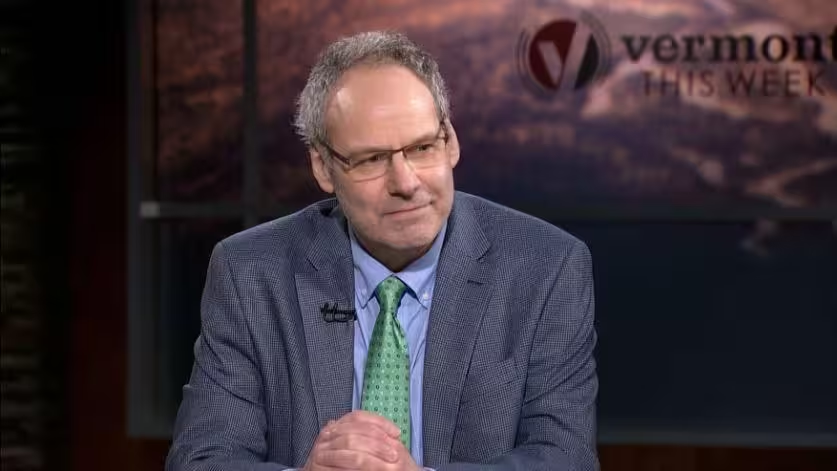
Gov Signs Bill Enabling Schools to Postpone Budget Votes | Health Dept. Accused of Blocking Funding for Overdose Prevention Centers | Lawmakers Consider Requiring Medicaid, Private Insurers to Cover GLP-1s | Panel: Mike Dougherty - Moderator, Vermont Public; Calvin Cutler - WCAX; Mikaela Lefrak - Vermont Public; Tim McQuiston - Vermont Business Magazine.
Problems playing video? | Closed Captioning Feedback
Problems playing video? | Closed Captioning Feedback
Vermont This Week is a local public television program presented by Vermont Public
Sponsored in part by Lintilhac Foundation and Milne Travel.
Support provided by:


Vermont This Week
February 23, 2024
2/23/2024 | 26m 45sVideo has Closed Captions
Gov Signs Bill Enabling Schools to Postpone Budget Votes | Health Dept. Accused of Blocking Funding for Overdose Prevention Centers | Lawmakers Consider Requiring Medicaid, Private Insurers to Cover GLP-1s | Panel: Mike Dougherty - Moderator, Vermont Public; Calvin Cutler - WCAX; Mikaela Lefrak - Vermont Public; Tim McQuiston - Vermont Business Magazine.
Problems playing video? | Closed Captioning Feedback
How to Watch Vermont This Week
Vermont This Week is available to stream on pbs.org and the free PBS App, available on iPhone, Apple TV, Android TV, Android smartphones, Amazon Fire TV, Amazon Fire Tablet, Roku, Samsung Smart TV, and Vizio.
Support the crew
Help Mitch keep the conversations going as a member of Vermont Public. Join us today and support independent journalism.Providing Support for PBS.org
Learn Moreabout PBS online sponsorshipA bill to soften the impact of recent changes to the state's education funding system has been signed by Governor Scott.
As state House leaders signaled there's still much more to be done.
This year, we're going to need a discussion about how to reduce budgets and how to reduce those long term costs in a way that is new and that is going to be groundbreaking.
Plus, the Vermont ACLU accuses the state's health department of blocking funding for overdose prevention centers.
And lawmakers consider requiring Medicaid and private insurers to cover weight loss drugs like Ozempic and Wegovy.
Ahead on Vermont this Week from the Vermont Public Studio in Winooski, this is Vermont this Week, made possible in part by the Lintilhac Foundation and Milne Travel.
Thanks for joining us for Vermont this Week.
It's Friday, February 23rd.
I'm Mike Daugherty.
Joining me on the panel today.
We have Tim Mcquiston from Vermont Business Magazine, Calvin Cutler from WCAX, and Mikaela Lefrak from Vermont Public.
Thank you all for being here.
And thanks for joining us.
This education funding bill now law.
It was absolutely fast tracked through the process.
It was introduced just a couple of weeks ago now signed into law.
Calvin, why the urgency with this law?
Yeah.
I mean, I think, you know, town meeting day is right around the corner.
There are critical decisions that have to be made on local school spending plans.
And, you know, Vermont lawmakers in both the House and the Senate are hearing from their constituents.
Just the panic, I think maybe is one way to put it, but just the really strong concern about, you know, what this is going to mean for property taxes.
You know, at the end of the year.
You know, just in the building, you know, normally at the end of the year is kind of when things, you know, get a little crunchy and tensions rise and people want to get out.
But, you know, it's we're not even a town meeting day.
And it feels that the stress is really palpable in the building.
It's better to see it to see it move this fast.
It is.
Yeah.
I mean, this is a very complex bill making changes to a very complex education funding system.
Right.
So, yeah, well, we'll see what difference, if any, though, this makes in school spending plans.
It seems like it could have huge impacts across the state.
We have a clip from Brian Harrity, the superintendent of the Lemuel South Unified Union.
Here's what he had to say.
Eliminating the 5% cap, what it does to both of our districts is it puts us in a pretty disadvantageous position.
And so it would put our tax increase at about 27%.
Right now, we have a tax system as far as education funding.
I defy you.
Any one of you, to get out and truly explain it to the voters in a town meeting that that was Randy Brock, the Senate minority leader, talking about just how complicated this system is.
Mikaela, what do we know about how this stands to impact people on the ground?
Well, we actually had a show in Vermont Edition recently about this topic and had so many people calling in very concerned about their property taxes and confused about why school budgets seem to be so high this year.
So there does seem to be that that disconnect, that communication gap between the school boards and people living in some of these communities where where they're going to be impacted pretty hard.
Now, I just spoke to the head of the Vermont School Board Association recently, and she said, you know, 80 to 90% of our budgets across the state are tied to salaries and benefits for staff.
Those are hard things to to cut down on.
So I know they're working hard to try to explain that to folks and talk through, you know, the effects of inflation and other reasons why why they need this investment.
Right.
And so even if school boards can can go back to the table and take another crack at their budgets, that that's still not going to be easy.
No, certainly not.
I think these budgets are they're big for a reason.
Sure.
Yeah.
I mean, it seems like with this issue, oftentimes the signing of a bill into law is kind of the end of it.
With this one, it feels more like the beginning of like there's still a lot of conversation to be had.
We heard from the Senate leader, Phil Bruce, up top and again from Brandi Brock here that this is a system that lawmakers are poised to take a big broad look at.
And, you know, Ruth said in particular that they're looking at groundbreaking reforms this year.
And I'm curious, Tim, what does that mean?
We're almost halfway through the session already.
What what would a groundbreaking reform look like that would actually be realistic?
Well, the biggest thing is to look at the money side of it, because you can you can raise money.
The state has ability to raise money.
That'd be the easiest thing to do to just raise property taxes, maybe push other you know, they they've already pushed the sales tax and part of the rooms and meals tax into the in the education fund to soften the blow.
But they could raise property taxes and and that would be a in the very absolutely the easiest thing to do.
It gets spread out a lot.
The impact would be a little painful to people, but but it wouldn't be huge.
The other thing, the more complicated thing they do and what sort of the the more progressive side of it would call for was income tax, adding the income tax raising, especially on the high end of the income tax.
That's really complicated to do.
I mean, fabulously complicated to do, because you have to make sure that that lower income people that get hit too hard.
Who are these high income people?
A lot of the people that you look at, really high income, it's it's a one time effect.
They've sold their business or something, but so they're not going getting that income.
Remember Bernie Sanders when he wrote his book, he became a 1%.
Right.
For one year.
And that's that happens to a lot of people.
So that'd be the what could happen is have this complicated funding system on the income tax.
The easiest thing would be the property tax.
But, you know, the way these things always play out is two things are going to happen.
They're got to make cuts on the school side and they got to find more money on the state side.
Yeah.
In terms of of this conversation about what they can do this year, Calvin, is there anything that's actually on the table right now?
Yeah.
I mean, there has been you know, they've been talking about a tax on, you know, Candy and soda potentially, you know, moving around some money potentially with universal school meals.
You know, there's been this cloud tax perennial perennially perennial, I should say cloud tax that's been, you know, floated.
I think there's a little bit more of a serious look at that this year.
So those are kind of what we have on the revenue side also.
Separately, there's this kind of evolving conversation about a wealth tax as well.
It was recently in The Wall Street Journal, New York Times.
That would be for the general fund, not for the the education fund, but of course, with the hope potentially that that could take off some of those cost pressures.
You know, to Kayla's point that we're seeing in you know, schools and mental health needs and things like that for kids.
But yeah, I mean, the question what bold, you know, changes can lawmakers make, you know, just a few.
Here we are before town meeting day.
I don't know the answer to that.
I don't think in terms of big systemic reforms that there's time.
You know, Senator Brock on the floor talked about the need for, you know, Tim's point to look relooking at our our tax system and the transparency of of budget votes.
And, you know, we have them made at the local school level coming out of the statewide education fund.
Is it time to relook at that?
I don't know if anybody has those answers right now, but there is a lot of soul searching and a lot of reflection that's happening in Montpelier.
I will say I did have the chance to call Ben Cohen of Ben and Jerry's about the wealth tax proposal.
He said he supports it very much, but would much prefer that money to go straight into education would be far less interested in paying it if it was just going right into the general fund.
So what's interesting take from from one of Vermont's wealthiest.
Yeah.
What I was mentioning before is what you could do is you just move the, you know, the funding sources around as they have done before.
So that could go into the general fund because there's there's other there's legal reasons why you might have to do that and just push something else into the education fund, which they've done.
So you'd have to move some stuff around.
It could be done.
It's going to be interesting to hear what they come up with on that front.
I'm sure we'll hear more on that soon.
In other news, the health department has been accused of blocking funding for overdose prevention centers with the Vermont ACLU basically accusing the health commissioner of violating open meeting law and unilaterally blocking this funding.
Here's what Harrison Stark from the Vermont ACLU, a staff attorney there had to say.
It's concerning from an open government perspective, but it also represents a power grab in a process that the legislature has clearly set out is meant to take advantage of a particular set of views and expertize that the legislature has not received.
They're considered judgment on them.
Tim, where is this complaint coming from?
Well, it's really bitter, frankly, Mike, and it's aimed mostly at health commissioner.
Dr. Mark Levine, who, of course, is the hero of the covered pandemic.
Vermont had by far the best COVID response and a lot of it.
He was successful at Sports Advisory Committee, laid out, and a lot of it has to do with safe injection sites.
They want to take 2.6 million, puts it into a couple of safe injection sites.
The governor is opposed to it because it's it would be these are illegal drugs, illegal in the state and federal government.
So he's been opposed to this and this advisory committee members, an advisory committee.
And this is where it gets really squishy.
And it's and it's a federal it's federal money.
So that makes it even squishier.
And so what Phil Bruce, who also sent a very trenchant letter to the governor about this, is that what the ACLU and Ruth are saying is that lobbying unilaterally took the money out of this advisory committee.
It put into this funding and said, let's use it for other things.
And he then said that it's in part the legislature is going to have to pass a bill anyway for these safe injection sites.
So you might as well just use this money for something else.
And the ACLU blasted back and two fronts.
One is that it violated the open meeting law that that he did this.
He's not a voting member, but he just took this and did it on his own, despite what the advisory committee said, and that maybe that might be the case.
And yet the other part of it is that the he apparently, Dr. Levine, went to the governor and said, you know what, we should do this money.
And of course, the governor doesn't want these safe injection sites.
So it they they were furious about this.
And the governor then blasted back that, no, this is all legal.
They don't have the purse.
There's advisory committee is advisory committee.
They don't they don't have the right that the the health commissioner is the one that proposes this money.
He's he's responsible for that.
Is the administrative thing.
So it almost sounds to me that they they're both right at the same time.
And I'm not sure how this this gets resolved.
I know Calvin's follow the opiate issue very, very heavily over the years.
And it's does it seem like they're both right and maybe both wrong at the same time?
Yeah.
I mean, this is a it's a really interesting cross-section here of politics, policy, you know, public safety, public health, the drug crisis, all of these things really are coming to a head with this this conversation.
I think you you hit the nail on the head is what's the outcome of this?
Right?
I mean, what what is going to come out of this?
And I don't know.
I mean, I don't think anybody knows.
It's I think it's all too indicative.
You know, I mentioned things are kind of intense at the state house right now.
And I think this is just one more chapter, you know, in that that book of, you know, relationships kind of heating up and, you know, tensions rising between, you know, the Democratic supermajority and the most popular governor in the U.S.. And so, you know, I think that's politically sort of where where this is.
You know, again, you mentioned the legislature also is still moving forward with their own bill, creating safe injection sites.
We'll see where that goes in the Senate.
But yeah, I mean, I think it's a it's a really interesting, interesting, you know, issue that came to a head here.
And I was surprised to that.
How bitter it really was.
And the language that both sides were using was not really, you know, typical.
Yeah.
I think part of it also speaks to like how heartbreakingly out of control the the drug crisis has gotten in the state.
You know, safe injection sites are one of the only things that we haven't tried yet.
And I think some people are desperate to try it.
And I think other folks, perhaps, including Governor Scott, are saying, you know, we can't pin all of our hopes on that, you know, popping up two or three safe injection sites in the state.
That's not going to get us out of this terrible hole that we're in.
But but the the other side of that issue, it's illegal drugs we're talking about.
But in the other side, it's like, well, people are dying.
So, you know, let's look at the big picture.
We have to do all this other stuff as well.
But, you know, one of the other things we have to do while we're doing all this other stuff is try and save people's lives.
Right.
And certainly adding to the tension around this issue.
Another health bill that's gotten a bit less attention is one that would require Medicaid and private insurers to cover weight loss drugs like it was Mpic and Wegovy.
And Michaela, you had a really fascinating Vermont addition conversation about this this week.
What folks need to know about these drugs and how they might become more accessible if this legislation moves forward.
It's really interesting stuff.
So the FDA has approved Ozempic to treat type two diabetes.
There's also a similar drug with Govee that can be used to treat weight loss.
Both are often used for for this, as you might have seen in social media, by use, by celebrities.
They can also be very expensive as they become more popular.
So oftentimes they can be covered if you're using them to treat diabetes, but not so much for weight loss.
So there are bills in both the House and Senate that would require private insurers and Medicaid in Vermont to cover the costs of these drugs.
About a quarter of Vermonters are obese, and this is seen as a way to cut health care costs down the line.
The fact, though, is that obesity doesn't always correlate with poor health.
So there are some folks who are saying, you know, we shouldn't be pushing these weight loss drugs on people who have obesity.
It's really interesting.
And there's also actually, I just want to mention briefly very similar bills to cover the costs of IVF and fertility care.
Those have not gotten as much attention.
I don't know if they're going anywhere, but with the news out of Alabama saying that, you know, frozen embryos are considered children, I do wonder if perhaps, you know, these efforts to expand access to IVF in Vermont could get a little more attention than they have.
That would be really interesting.
And it certainly seems like similar goals there.
And with those weight loss drugs, it just seems like our understanding in that conversation around them has evolved so quickly over the past year.
Like they really came in quickly.
And it seems like the effort to address that access issue seems like one that is so depressing.
Yeah.
And I guess we have everyone from Sharon Osborne to Elon Musk.
Thank for that for talking openly about their use of these drugs.
And I will say, too, I mean, it's an interesting conversation because when we talk about bringing down the cost of health care altogether, I mean, you alluded to it of, you know, you know, heart disease and obesity and some of these outcomes that, you know, come from being overweight.
You know, this is also a key to really try to help save health care costs in the long run as well.
So when we think about, you know, reforming our health care system and how we pay for health care, I think that's a really important piece of the puzzle.
One of the panelists on your show, I think it was Dr. Levine, said chronic disease is a crisis in America.
And this is, you know, something that's meant to address that.
So one other thing that is coming up way outside the state house, although the state house will be slightly, there is the total solar eclipse.
This is coming up on April eight.
Vermont is in the path of totality for this once in a lifetime event and path of totality means the moon will completely cover the sun.
And I know that might sound like, oh, must be a slow news week.
We're talking about the solar eclipse, but this is a big deal.
It seems like right now we're in this moment where folks around the state have started to realize there's going to be potentially a huge influx of tourists, a huge influx of cars.
This is going to be happening right around the time schools are letting out and that there's really active preparations that need to be made.
So, McCaleb, you had a show recently where you talked to folks in St Albans, which is right smack in the middle of the path of totality about how they're getting ready there.
What did what did we learn?
That's right.
There will be about three and a half minutes of darkness or dimness if it's cloudy on April 8th in St Albans, which would be pretty remarkable.
I talked to one local innkeeper there who said she got her first call about booking a room for the eclipse two years ago when she finally did open up her bookings for that weekend.
It sold out in 3 minutes.
Wow.
The town has ordered 5000 branded eclipse glasses.
You know, they said they're trying to keep everyone safe.
But also, what a great branding opportunity for towns across the state.
And there's going to be a big festival there.
You know, it's on a monday.
That's a day when a lot of businesses around Vermont are typically closed.
So right now, I think a lot of town leadership is trying to make sure that businesses know.
You think about opening on Monday, staying open.
You're going to be getting a lot of business that day.
Yeah, I mean, I will say, you know, I covered the Sturgis motorcycle rally in South Dakota a couple of years ago, back when I but back then I lived out in South Dakota.
And when you bring hundreds of thousands of people potentially or north of 100,000 people into a small area, there's a lot of planning and a lot of logistics, porta potties, you know, security, police, logistics, road signs, crowd control, you know, where do people get food?
You know, that that type of thing, lodging, etc., getting from point A to point B.
So there is definitely I think this is sort of that time where a lot of, you know, governments and organizations and businesses are really sort of saying this this could be pretty big.
And I think they're also trying to convince folks to have a plan for where you're going to watch the eclipse ahead of the day.
So, you know, I think there's some concerns about road safety.
People just pulling off on the side of the road to stare up at the sun for three or 4 minutes.
Clearly not your safest option to make a plan early.
Yeah.
Tim, what are you hearing about how how folks in the business community are preparing right now?
Well, there is a lot of concern, as you mentioned.
But, you know, but there's the logistics and how can people make money off of this and how can you be prepared for it in such a short period of time?
You know, you see rooms for rent and houses for $1,000 a night and front porch for them.
And so that's that's the level that we're talking about.
You know, we were talking about what are the food trucks?
You know, what are they where are they going to be part?
Do they have to be?
You know, you're saying I didn't even think about people pulling off on the side of the road and what kind of mayhem that could cause.
But the the is there is it going to be a day off from school?
The.
Well, it depends.
Different school districts have started making different plans.
We had one story in Vermont public a few weeks back about how school districts were planning, but I think a lot of it is still evolving.
Some schools are going to be closed.
Some are closing early.
Others we haven't heard yet are childcare is closed.
So our toddlers fended for herself.
Well, because some of the businesses are concerned that there won't be people to work at the businesses that need to be open in this for this short period of time.
You need a lot of people.
Yeah, there's a lot.
It's going to be fascinating, you know.
I remember a full eclipse when I was a kid.
Thought they happened all the time because, you know, when you're a kid, things just happen.
Now it's been, gosh, over 50 years, not so much.
This seems like this is really once in a lifetime for a lot of us.
So definitely, definitely a lot of planning underway right now.
Tim, one of their bit of business news this week was a big chunk of federal money for Globalfoundries.
What happened there?
Well, it's part of the whole Chip's plan.
That was passed recently in Congress and signed by the president.
And so globalfoundries and and anybody know why we're having this beat, this whole big chip thing and our new best friend, artificial intelligence is causing this this run on chips.
If they have to make it a lot more chips, they have to be a lot more sophisticated.
That could be a lot more of them.
And so Globalfoundries is benefiting 1.5 billion.
They're going to build a new plant over in Malton, New York, which is just across the lake.
And so it's going to be one they're going to get 1.5 billion in the state of New York is putting a ton of money into it as well to help it along because it's it's it's been a fabulous employer for them.
And the Essex Junction plant here at the Global Fine Plant here is going to get $125 million.
People are saying, oh, they're only getting a sliver of it's like $125 million and $25 million.
The state is going to chip in 5 million, I think, on that, to help modernize the plant here.
And the great thing about the plant here is that it's very low cost.
It basically paid for.
So it has to be modernized.
But you can do a lot of.
Was it over over 80% of of all the cell phones in the world have chips that are made here.
So, you know, it takes a lot and they're very, very tiny.
And they also are developing.
The Department of Defense last fall announced that they're they're putting tens of millions of dollars into new technologies, just this gallium nitride chips, which are replacing the silicon.
And and why do you do that?
Because these things these devices, no one really hot and they need to run a lot faster than they're doing for 5G for 60, for electric vehicles, for all this air stuff that we're going to need.
So there's a great need for it.
The federal government is putting a ton of money into it and we're going to be the beneficiaries of some of it.
Do we have any sense of how many, if any, this jobs, this this will create?
Has that been floated yet?
Well, the GLOBALFOUNDRIES is saying it's going to be something like 2000 construction workers, another 1200 or something ongoing employees.
It's not clear they're not they don't like to pass it out.
Like how many employees.
But clearly, it's going to help support this this plant.
So over here in Vermont.
But they're they're very they don't really tell you exactly how we're going to convince all those folks coming up for the eclipse to stay and work as they do.
What are you comfortable in two and a half minutes?
Well, I already have the eclipse glasses, so that's a step in the right direction.
Just about there.
Well, we are getting ready to wrap up, but before we do, we wanted to take a moment to pay tribute, somebody who is very near and dear to Vermont public, very near and dear to a lot of our audience members.
And that's Reuben Jackson.
He passed away last week and Michaela, you worked on a really, really touching remembrance of Reuben.
And I wonder if you could just tell us a little bit of what you heard from people who knew and worked with him?
Sure.
Yeah.
I think Reuben Jackson was one of those people who held held a lot of people's hearts.
He was a real emotional center of Vermont, which is fascinating because he didn't actually live here for the past couple of years of his life.
He was originally from D.C., but for what?
For college.
He went to Goddard College and was actually one of their first deejays at their radio station.
He went on to a pretty remarkable career as a deejay, as a music critic, and as a published poet.
He worked at Vermont Public, then Vermont Public Radio, as the host of its Friday night jazz program from 2012 until 2018.
And he was really appointment listening for a lot of people.
I spoke to one of our engineers after we heard about his passing, Peter English, who told me that one of his favorite parts of working with Reuben on Friday night Jazz was seen Reuben speak in some some music that he loved, that you wouldn't necessarily consider jazz, some Jimi Hendrix, some Earth, Wind and Fire.
And just hearing him talk to the people of Vermont as if they were his good friends, which many, many of them were.
He was a Burlington High School teacher for a couple of years.
He was a mentor to young writers.
And as I mentioned, he was a poet.
And you can find some of his his beautiful poetry in a new anthology of contemporary black poets, which just came out in January.
So he's a really wonderful person, a person who helped shape culture and community here in Vermont.
And and we'll really miss him.
Yeah.
The outpouring of support that we've heard since since this news came out has been huge.
And so you can really sense the connection that he had with people.
So thank you for that.
And that's where we'll have to leave it for today.
Thanks so much to our panel.
Tim Mcquiston from Vermont Business Magazine, Calvin Cutler from WCAX and Mikaela Lefrak from Vermont Public.
And thank you at home for watching and listening.
Take care.

- News and Public Affairs

Top journalists deliver compelling original analysis of the hour's headlines.

- News and Public Affairs

FRONTLINE is investigative journalism that questions, explains and changes our world.












Support for PBS provided by:
Vermont This Week is a local public television program presented by Vermont Public
Sponsored in part by Lintilhac Foundation and Milne Travel.