
February 24, 2022 - Full Show
2/24/2022 | 56m 47sVideo has Closed Captions
Watch the Feb. 24, 2022 full episode of “Chicago Tonight.”
Congressman Quigley and the local Ukrainian community on the violence in Europe. An exclusive look at the widely-used SHIELD test for COVID. And we’re in Roseland for our In Your Neighborhood series.
Problems playing video? | Closed Captioning Feedback
Problems playing video? | Closed Captioning Feedback
Chicago Tonight is a local public television program presented by WTTW
WTTW video streaming support provided by members and sponsors.
February 24, 2022 - Full Show
2/24/2022 | 56m 47sVideo has Closed Captions
Congressman Quigley and the local Ukrainian community on the violence in Europe. An exclusive look at the widely-used SHIELD test for COVID. And we’re in Roseland for our In Your Neighborhood series.
Problems playing video? | Closed Captioning Feedback
How to Watch Chicago Tonight
Chicago Tonight is available to stream on pbs.org and the free PBS App, available on iPhone, Apple TV, Android TV, Android smartphones, Amazon Fire TV, Amazon Fire Tablet, Roku, Samsung Smart TV, and Vizio.

WTTW News Explains
In this Emmy Award-winning series, WTTW News tackles your questions — big and small — about life in the Chicago area. Our video animations guide you through local government, city history, public utilities and everything in between.Providing Support for PBS.org
Learn Moreabout PBS online sponsorshipGood evening and welcome to Chicago tonight.
I'm Paris Schutz.
And I'm Brandeis Freedman on the show tonight.
A decision has been made a special military operation.
Russia launches a wide scale invasion of Ukraine from multiple points of attack as Ukrainian citizens pray for peace.
Putin chose this war.
Plus, the latest on the invasion from the co-chair of the Congressional Ukraine Caucus.
It's like very personal for me.
Also, Chicagoans with family in Ukraine want their neighbors here to pay attention and to act.
There's not a lot of people to express yourself.
So an organization is working to tackle the roots of violence.
We are live in Roseland.
Meet Andrea Kirsten, new leader of the city's Police Accountability Agency.
The beauty of the field test is that we can catch the virus sooner.
An exclusive look inside the massive COVID shield testing operation in Illinois.
Brian is in Paris.
As you mentioned, I'm enrolled in as part of our Chicago tonight in your neighborhood series.
Now locate in Chicago's South Side.
Neighborhood leaders are engaging in block to block outreach to battle gun violence.
Others are working to bring private and public investment into a corridor that was once a hub of businesses.
We'll speak with residents in some of those leaders coming out.
But first, I send it back to you.
All right.
Thank you, Joanna.
And now to some of today's top stories.
The Pentagon orders 7000 more troops to Europe after Russia's invasion of Ukraine.
But President Joe Biden says they're going to support the United States as NATO's allies.
Our forces are not and will not be engaged in a conflict with Russia in Ukraine.
Our forces are not going to Europe to fight in Ukraine, but to defend our NATO's allies and reassure those allies in the east.
As I made crystal clear, the United States will defend every inch of NATO's territory with the full force of American power.
And we'll have much more about the invasion of Ukraine throughout tonight's program.
Chicago Police Superintendent David Brown says there's no evidence of misconduct surrounding the traffic stop of a high ranking official.
Internal Affairs Chief Yolanda Talley's niece was pulled over earlier this month while driving Talley's car.
The car's passenger was arrested for heroin possession, but the car was not impounded.
Brown says he's waiting for a third party review.
Soon as we heard about the incident.
We immediately forward the circumstances to the inspector general.
There's no evidence of any misconduct by Chief Talley.
Black and Latino.
Illinois ends with cannabis dispensary licenses, call on the courts to get out of their way.
After the state awarded a round of licenses aimed at so-called social equity recipients, from communities adversely impacted by the war on drugs, other license holders sued.
Bringing this whole process to a halt.
Protesters gathered in Daly Plaza earlier today saying social equity license holders are being denied the opportunity to open a marijuana business.
Social equity was meant to be a reparations for for lack of a better word for us.
We've been adversely impacted by the war on drugs.
We've been adversely impacted by this trope.
And now there's going to be more of us that are going to be adversely impacted because we won't be able to open because we spent so much time and so many resources that we may not have.
When it's time to open.
And up next, reaction to the attack on Ukraine by Russia.
So please stay with us.
Chicago tonight is made possible in part by Alexandra and John Nichols.
The Jim and K may be family.
The Polk Brothers Foundation and the support of these donors.
President Biden today announced a new round of sanctions against Russia following that country's massive invasion of Ukraine.
The president now sanctioned Russian banks that together hold around $1 trillion in assets.
We've cut off Russia's largest bank, a bank that holds more than one third of Russia's banking assets by itself.
Cut it off the US financial system.
And today we're also blocking for more major banks.
That means every asset they have in America will be frozen.
The president echoed other world leaders condemning what he called Russian President Vladimir Putin's unprovoked action and vowed to bolster forces to protect NATO's allies in Eastern Europe.
And joining us is Congressman Mike Quigley, a Democrat from Chicago's North Side.
He is also a member of the House Permanent Select Committee on Intelligence and co-chair of the Congressional Ukraine Caucus.
We did invite all Republican members of Illinois's congressional delegation and none accepted our invitation.
Congressman Quigley, thank you for being here.
First of all, Ukrainian President Zelensky tonight says he is target number one.
He believes he's going to be deposed.
What is the latest you're hearing about the situation on the ground in Ukraine tonight?
And I believe we don't have your audio Thank you.
You know, first of all, the intelligence on this has been outstanding.
And you probably read that the administration has released much of this intelligence, including the so-called hit list to kill lists and capture list.
Obviously, as President, Zelensky would be at the top of that list.
And I think they recognize that.
Honestly, I don't know what I want to know.
Where's the landscape where President Slansky is or or where their government is?
I do not have plans to operate if necessary, outside of the Capitol.
But I think the president's right.
He is a target.
It's the reason that he was targeted by Putin in the first place.
And as you heard, the president announced his new financial sanctions today.
Is there any reasonable expectation that they could deter further action?
Well, I think they are an important component of deterrence and will have a long term impact as I assess what they did today.
You know, it was a pretty dramatic tranche, unprecedented and some concerns.
But the fact of the matter is the Russians are at complete war with Ukraine throughout the entire country.
So at this time, it makes sense to sanction all the banks sanctioned Putin himself and all of the oligarchs that are close to him.
I believe it's time for for lack of a better expression, crippling sanctions across the board, including removal of Russia from the swift banking system now will not allow them in them to communicate a necessary function to operate in the physical world.
And and that removal from the swift banking system is being blocked by some of the EU member countries.
You mentioned sanctions on Putin himself and his family.
The president has not gone there yet.
Do you believe the president should go there now?
You know, I do.
I mean, this is war and I believe Putin is.
It should be that should have been the first target.
And I don't know necessarily who's blocking the efforts there.
You know, is it safe to surmise that that's the case?
But I don't think there's time.
There's certainly it's not necessary to wait any more time for the next tranche.
You know, we have to ask ourselves, what is Putin care about?
Then you ask the question, were sanctions is enough?
Frankly, I think we have in the final analysis, what has Putin care about?
He wants to reassemble the former Soviet Union and he wants Naito out of Europe or the United States, out of Europe and naito out of Eastern Europe for sure.
I think it's time to give him the opposite.
And I think the truth, posturing and additional supplies to our Eastern Naito Allies is prudent.
And you mentioned those supplies that naito allies.
But US troops will not go to Ukraine.
Naito troops will not go into Ukraine.
Zelensky said tonight he knows that they're going it alone here.
Is there any military assistance or weapons assistance that you believe Ukraine might receive.
Well you know since 2014 they had you know, 200 million or so and you know most recently a significant amount more So I think it's still possible, it's more difficult under war conditions, but I do believe it will happen.
They'll get additional military assistance lethal and nonlethal as time goes on, both from NATO and the U.S.. How do you assess Ukraine's ability to withhold this invasion, to resist a full and complete takeover in the short term?
In the long term?
Sure.
I mean, obviously, on paper they're overmatched.
Again, when I read the intelligence on this first thing that struck me is this is a trial run like last spring.
Putin is going to go and he did.
And that this will be something like a modern day blitzkrieg modern day in the terms of the warfare is a little bit different, the cyber attacks and so forth.
But the blitzkrieg is what you're witnessed in the last 24 hours.
You know, a dramatic attack from all sources.
Air, ground and the sea.
The very tough for Ukraine to withstand this.
I believe they have the extraordinary fighting spirit.
There are a heck of a lot better armed forces than they were in 2014.
But again on paper simply overmatched not in spirit but by the full range of options including from the air that the Russians have.
And this invasion is impacting the world economy the US economy.
There have been talks of possible further cyber attacks in the US from Russia.
What do you think the fallout is for the United States right now due to this invasion.
You know, I think it's what Americans need to wake up and recognize.
We're not insulated from this in any way.
You know, I saw the polling on this, which is disturbing that Americans didn't want us to be involved at all.
The fact of the matter is you can't turn off the TV and the news and this will go away.
Putin and Russia have already attacked this country in the modern warfare with cyber attacks from the 2016 election on SolarWinds.
The Pipeline Colonial pipeline.
But that's just the beginning.
If he really wants to continue this or if anyone thinks he won't retaliate for these sanctions for U.S. involvement, you know they're mistaken.
So I think there's a real threat to our banking system, our grid system and so forth.
And Putin has also made noises and he seems to have become even more extreme about some of the old cold, Cold War threats coming back to life, putting hypersonic missiles in Cuba.
And Central America.
The economic thrust I appreciate the war itself will make the flow of energy and resources out of Ukraine and Russia very, very difficult.
There are precious resources there that are involved with the production of everything from aerospace to semiconductors.
So we have supply chain problems now.
They will almost certainly get worse.
A lot of interconnected issues here.
You know, the last 24 hours have been very unpredictable.
What do you think the next days and weeks look like?
I think, unfortunately, more of the same, you know, is Putin advances.
It's clear that his intention was a decapitation attack.
He would remove the government, put a puppet government in place and sort out the rest of it as time goes on.
You know, I think he imagines what will probably happen is he will have a quick takeover of the Ukrainian military.
That was certainly his plan then to have to deal with what would probably be an insurgency after that.
But again, I don't want to rule out the efforts of the Ukrainian military but it will be a horrible onslaught, the one that we've already started to watch, very innocent people.
Troubling, troubling time right now.
And as you mentioned, Ukrainian President Zelensky says there are already over 100 Ukrainians dead in combat, he believes, right now.
All right, Congressman Mike Quigley, thank you so much for joining us.
Thank you.
And now the brand is with how Chicago's Ukrainian community is responding to the Russian invasion.
Brandis.
For some Chicago area residents, what's happening in Ukraine is personal.
They've got relatives suddenly living in a war zone and they're trying to draw Americans attention to the Russian invasion, including with a rally this afternoon in Chicago's Ukrainian village.
Amanda Vinicky was there and joins us now with more.
Amanda, what did you see today?
Well, Brennan is among the folks that I spoke with was a man that I ran into as he was circling the area nearby.
The St Vladimir and all had church and Ukrainian village.
He was waving a large Ukrainian flag.
He says that he moved to Chicago seven years ago.
And he says a lot of Ukrainians do that because the weather's similar or it's cold both here and in Kiev.
About 30 degrees, give or take, in both cities.
He says he isn't complaining, though, about standing outside in that bitter cold for hours today.
Says unlike what his family is going through back home.
He's not worried in Chicago about bombs flying overhead.
They saw the airports were blown.
They saw the airplanes flying and missiles flying over the head.
And the kids who woke up this morning and because of the sounds of the explosion.
So when my sister called me, I was surprised and I didn't expect Putin will do this.
Putin, he is not pretty His first problem was he said, I guess if you started in 21st century that the war, the common and killing people that's not how it should be.
Not how it should be.
I obviously didn't speak with all of the couple hundred people at this afternoon's rally, but that has to be a unanimous sentiment.
They called for you after these early morning attacks by Russia.
Now, Pavlo Bandurski is a leader with the Ukrainian Congress Committee of America.
And he says that his ancestral homeland is an innocent democratic nation, a peaceful country that wants to live by the rule of law, only to be slammed by Russian rockets.
Says the country has suffered and survived atrocities for.
Ukraine's people have selected his future and they selected to live with the worst.
For centuries, Ukraine has lived under Moscow domination.
They know what it's like to live in Russia, live with a Russian oppressor.
They chose not to accept that.
They chose to live according to Western standards, democracy, freedom of speech, the rights to have a great economic life and a life for their children and family.
For attacking that, he says.
Putin should be declared a war criminal.
Ukraine, he says, will fight, but it needs help from the U.S.. You don't have to say what you're saying.
It's not what you pay.
President Biden promised hard-hitting sanctions he said crossed a red line.
Putin and we will make you pay.
How much more Ukrainian blood has to be shed to make them pay?
Now is the time.
Unleash the sanctions.
Stop the war.
Representatives from the Ukrainian consulate here in Chicago also spoke and called for Western solidarity by cutting off diplomatic ties with Russia and also to come forward with weapons, also humanitarian support.
The crowd sang the Ukrainian national anthem, prayed for peace and chanted, Stop.
Me.
It's very important how war with Europe right now because Putin asked himself as a bully and if bully get hit in the back, bully stopped.
If bully don't see any force, you don't understand any like reasons a logic.
You just understand.
Force.
Like if he can get force back, he will stop.
It until he and his wife also still have family living in Ukraine.
He says nowhere in that country right now is safe.
He says Ukrainians can and will resist.
And they're not going to make it easy on Russia from a military perspective.
But he says that it is up to the west to stand up and make it difficult for Putin diplomatically, economically and every other way possible.
People may think that it is something that happening far away and it may be not something that they should be bothered about.
I had the same feeling until 2014.
I never thought that I will have war in my home.
I never thought that I will need to worry about how to create my parents from the place where I grew up, you know?
And I can be I can say for sure that world will never be the same If, uh, western leaders and like all world will not fight back.
On Russia.
He is calling on everyday Americans to get involved by calling to pressure their members of Congress to put pressure on Russia, also to contribute to ongoing humanitarian efforts.
Now there is another rally in support of Ukrainian sovereignty scheduled for that same location at the center of a low demand church in Ukrainian village That is Sunday afternoon.
Horrendous.
Back to you.
Amanda, thank you.
There's more Chicago tonight just ahead.
So stick around.
Thousands of Puerto Ricans are taking to the streets to protest massive blackouts.
Over the years.
Mexican culture, from food to music has become woven into the city's tapestry.
Medical professionals share the latest recommendations on COVID 19 booster shots.
Recipients have been facing longer delays than normal in their status renewal.
Little Village is one of my favorite neighborhoods.
This neighborhood comes together to celebrate such an important day in our culture.
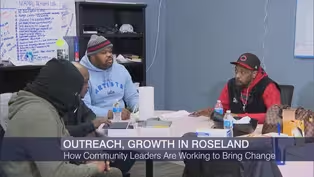
The city's outside community of Roseland was once home to steel and automotive industries.
With the collapse of jobs and revenue.
The neighborhood has dealt with decades of economic decline.
Over the years, the community has been working to turn that around.
To learn more about developments happening in the area, Chicago Tonight's Joanna Hernandez and producer Acosta Hernandez spent the day in Roseland, and Joanna joins us now.
Joanna Brandt is.
That's right.
I was told that this neighborhood was once known as the jewel of the Southside.
But as you mentioned, over the years, the neighborhood has struggled to keep the community thriving because of lack of investment and, of course, the things that are happening in this neighborhood.
But despite those challenges, there has been a big push to help the residents obtain those resources and get new opportunities.
Now, we start by meeting with the president of the Chicago State University Z Scott has been the president for four years and says her goal has remained to help minority students attend college, especially through the pandemic.
In addition to getting our students through the pandemic, but actually getting better access to college, to not any to cloud through college and to complete, for example, our freshmen can come to Chicago State for free in what we call our Rise Academy.
It's a comprehensive set of services that include technology counseling really intensive advising.
To really focus on that first you experience and getting there.
That's due to that sophomore year.
The university says its launched several programs and scholarships aimed to help African-Americans and Latinos with their education and workforce preparation.
President Scott shares, the last two years have been challenging, and despite seeing a decline in enrollment, she says they're rolling out resources to help students obtain their education.
But while we did see a decline in undergraduate enrollment, we saw an uptick in our graduate enrollment.
And that's across the nation.
We saw students who were thinking about, this is my opportunity to reskill up skill and really take myself in another direction in my career.
When it comes to change in the community.
Andrea Reid, the executive director of the Chamber of Commerce, is on the front line.
She has worked on extending the CTA's red line, helping to offer low fare rates and fighting to stop the violence that's been affecting the businesses for years.
Again, we come from decades of disinvestment We can't throw money at this situation.
It's more than just fixing up a building.
There are things there are challenges that we face that go beyond money.
There are lives involved here.
There are people who have suffered from unresolved trauma, hurting people, hurt other people.
Leaders at Chicago crowd know all too well the obstacles people face in the neighborhood.
The organization works to put an end to gun violence with face to face outreach, using their own experiences to help people in the neighborhood choose a different path.
Outreach supervisor Terrence Henderson says there's a variety of obstacles the community faces involving drug abuse, the increase of guns and emotional trauma.
One of the biggest things that I really think that's affecting the communities is that it's not a lot of it's not a lot of people to express ourselves to.
Like a lot of these individuals is holding everything that they've ever dealt with in their lifetime within themselves and you know, trauma don't stay with them.
You know, I may be having a bad day and I don't let nobody know somebody come step on my shoe, but my boiling point was at the tip.
You just stepped on my shoes.
It was harmless.
But I've been holding this regime from something that happened last week, two months ago, two years ago, and it is just erupt.
Alderman Anthony Beale of the Ninth Ward says he's creating opportunities by renovating and bringing to life new projects that will give opportunities One of those projects is so-called cop house or community oriented policing home to battle the violence it's expected to open in the summer.
It's a community house is a place where people can go read, learn computer literacy, learn computers, you name it.
You can learn whatever it's going to be.
It's going to be a safe haven for the community.
We're working with Cred, Arnie Duncan and his organization.
He's going to be working with his organization outside of the COP house.
We're going to have the city bring all their resources.
So it's going to be a huge One-Stop Shop where we have all the wraparound services.
Now we're putting it in one of the most troubling areas in the community because we're going right to the heart of the problem.
You go right to the heart of the problem.
Once you get that done, then I think you're going to see the safety kind of spill out.
Down on Michigan Avenue, a donut gem has remained open for decades.
82 year old Bert Bullock has been running his donut shop for nearly 50 years.
He works six days a week and says his shop has become a place to decompress and indulge in a moment of sweetness.
Like making people smile, you know, and they keep coming back.
They come every morning on their way to work.
On the way home.
They stop in for some more donuts and brownies.
Everyone that I spoke to walking into that donut shop had a smile on their face and a story to tell.
And I tried those donuts for the first time.
Delicious.
And coming up, we speak to Rosen Community Hospital about what they're doing to continue to provide services to the community.
But first, I send it back to you.
Which means you'll be bringing donuts back when you head back to the studio.
Joanna, thank you And now here as we toss it back to you.
Thanks, Brianna.
What began less than two years ago as a way to test students at the University of Illinois quickly turned into a major statewide operation that is now COVID testing at more than 1700 schools.
The unique saliva test invented by Shield Illinois, has been employed as a way to prevent COVID outbreaks.
And at some of those schools, the results have been nothing short of extraordinary.
We recently got an exclusive peek behind the scenes students at the Illinois Math and Science Academy in Aurora are lining up for their weekly COVID 19 test.
Follow up to a black.
Box.
But these students do not have to take a nasal swab.
It's the simple matter of drooling into a tube, either with a funnel or a straw.
So there is no swab in the nose or throat or anything like that.
It's it's very easy to do.
Typically, our patients are in and out and under 5 minutes.
The unique saliva test was developed by scientists at the University of Illinois.
And SHIELD officials say it has become an essential tool in halting the spread of COVID 19.
The beauty of the SHIELD test is that we can catch the virus sooner so we catch it before the patient is contagious.
Immersive President Evan Glazer says the school contracted with SHIELD last August when students return to in-person learning.
It is unique because we're a residential campus.
And so the students are in.
Close quarters all the time.
Not only has the school been able to stay open.
Glaser says the test positivity rate has stayed below 1%, even through the Delta and arm Macron surges out of 20.
8000 tests that we've taken this year.
We've had 56 positive cases, which is truly remarkable.
In fact, we went five straight weeks.
Without one, without any cases at all.
Although not every school has seen that level of success.
Glaser says IMSA paired the shield testing with robust contact tracing.
IMSA is one of 800 locations currently employing the test.
1700 of those are schools A team of health care workers from or contracted by SHIELD comes in and runs the entire program.
It's a massive operation built by the University of Illinois on the fly.
University of Illinois put it in the money.
They just jumped out there, started building the labs, and it was like it's like we'll just figure it out.
As we go.
Shield managing director Ronald Watkins says the test costs one third as much as the standard PCR test and schools have the entire cost reimbursed with federal cares.
Act money.
He says the University of Illinois brought together business, engineering and supply chain specialists to come up with a system that would produce PCR results.
In less than a day.
This lab in North Chicago is one of 11 operated or contracted out by Field, Illinois.
Once the specimen hits the lab it's an average of 10 hours from a rival to result.
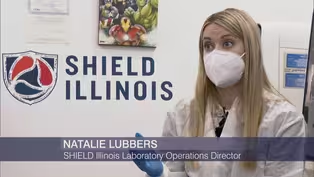
Lab director Natalie Lubbers says the facility came online in a month.
Saliva samples are sorted either manually or by robotic machines built specifically for this process.
We go through extensive review process of every single sample, not just positive to ensure that we're releasing the best.
Possible results.
Here.
The saliva is being removed from the vial and put into a solution that will convert RNA into DNA and ultimately detect the virus if it's there.
This is what a positive sample can look like.
The reason why we know it's positive is we have two genes and gene and RF one TB gene crossing the threshold.
Lubbers says that the results are sent electronically to the patient within minutes.
This process has played out more than a million times since she began.
But Watkins says the goal is to eventually dismantle the organization That means the pandemic will have passed into endemic phase.
But he says the saliva technology has limitless potential for other applications.
It's everything from being able to.
Detect a person's.
Wellness to whether or not they've had a concussion.
All sorts of different interesting uses for the saliva.
Which means spitting into a vial might one day become a regular occurrence at the doctor's office.
Indeed, I did take the field test and it came back negative Chicago Public Schools is not one of the districts that uses the shield test.
The district decided to go with a lower cost alternative that proved to have a lot of hiccups.
School officials say KPS was not eligible for the full federal reimbursement of the test because it got its own round of Cares Act funding.
And now Brand as we toss it back to you.
Parris, thank you Still to come on Chicago tonight, troops and tanks roll into Ukraine as Russian leader Vladimir Putin warns the West against any intervention in the conflict.
Mayor Lightfoot's choice to lead the city's police watchdog agency gets city council stamp of approval, but not without a fight.
And a community hospital is fighting to stay afloat on Chicago's South Side.
We're live in Roseland Community Hospital with leaders.
But first, some more of today's top stories.
Mayor Lori Lightfoot outlines details for the city's Universal Basic Income Pilot program.
5000 recipients will be chosen by a lottery system to receive $500 a month for 12 months.
Chicagoans 18 and over can apply if they've experienced hardship due to COVID 19 and earn less than 250% of the federal poverty level.
Applications are set to open in April.
Lawmakers try to address a teacher shortage in Illinois classrooms State Senate Democrats held a news conference today promoting bills aimed at easing the shortfall, which the State Board of Education says is about 4000 open positions.
The measures would make it easier for retired teachers to work as substitutes without affecting their pension.
Allow subs to work for longer periods, and it would lower the age requirement for grade school teaching assistants.
Courtney Goss works with students who have social and emotional challenges in Springfield Public Schools.
It's very difficult for me to do my actual job because I'm often having to sub for other teachers when they're gone because we don't have subs.
This was happening before COVID, but COVID made it way worse.
If we can increase the number of teachers and subs and then being able to stay longer, that would be amazing because right now we're struggling.
And hospitality workers rally in the loop, trying to get the attention of the new owners of the Thompson Center.
The state chose a private developer to overhaul the much maligned building in December.
Servers, cooks and housekeepers held a demonstration outside the Thompson Center today, calling on its future owner to guarantee high quality hospitality jobs.
The Farm My good hospitality job I would work 50 or 60 hours a week and still not be able to pay all of my bills in a month.
I don't want anyone who worked in the Thompson Center to ever, ever feel that way.
And another round of snow for northeastern Illinois.
Sorry, steady snowfall began this afternoon and is expected to last into tomorrow morning.
The National Weather Service expects two to four inches with more possible near Lake Michigan.
Freezing drizzle is in the forecast south of I-80, which could create slick sidewalks and roads.
And now to Paris for more on the foreign policy implications of the crisis in Ukraine.
Paris?
Yeah.
Ukrainian citizens woke to the sound of air raid sirens early Thursday morning as Russian forces began invading the country from the Northeast and south.
And cruise missiles rained down on strategic military targets.
The attacks began around 5 a.m. local time shortly after President Vladimir Putin announced on Russian television the launch of a, quote, special military operation in Ukraine.
Here for our ongoing coverage of the conflict actions are yohanan petrovsky stern, a professor of jewish studies and history at northwestern university with a specialty in eastern european and ukrainian history.
He signed an open letter sent by ukrainian jews to encourage germany's chancellor to take a tougher stance against russian aggression.
And Alberto call, professor of law and u.s. foreign relations at depaul university.
In the early nineties, Carl was principal deputy assistant secretary of defense in the pentagon.
Welcome, both of you here to Chicago tonight.
First of all, professor petrovsky stern, you have relatives.
You have friends in Ukraine.
What are you hearing from them right now?
Well, I'm monitoring the situation, listening to the different Ukrainian medias and of course, talking to my mom, who is in Kiev and to my mother in law who is in these central and western Ukraine.
And I talk also to my colleagues in broadcasting and other cities.
I have many friends and colleagues and I worry about them.
And what are they telling you?
They are telling me that they are calm, that they stand firm and they are ready to defend the country.
They are indignant when they talk about the unprovoked invasion of the Russian troops.
Into these sovereign Ukraine.
And they talk from different places.
Some of them are on their way to bomb shelter with some of their way.
Some of them are in a scene in a subway, also looking for cover.
Others are at home and there are people in the streets.
And we certainly hope that they stay safe.
Alberto Cole, we mentioned what the last 24 hours have been like.
What do you believe the next hours, days, weeks, months, months will look like in Ukraine?
I think President Putin has made it very clear that his goal is to cease all of Ukraine, to overthrow the legitimate, democratically elected government in fear.
And so basically what he's to do is set up a puppet government in Kiev that will respond to Russia's interests and even go further, perhaps do the equivalent of an ice loss, the same thing that Hitler did with Austria in 1939.
I think President Putin is eyeing that kind of an option for Ukraine and later on for Belarus still, which is practically occupied.
So the next it's an open question how far the Ukrainian military will be able to resist.
Definitely the Ukrainian people are going to fight very heroically.
They're going to fight very hard.
There's been a huge change in Ukraine over the last decade and just a tremendous growth in Ukrainian nationalism, Ukrainian patriotism.
And they have decided 40 or over 40 million Ukrainians have decided they wanted to be Europeans.
They did not want to live or be a part of Putin's Russia.
And so as I say, Putin told Russian state media earlier this week that his goal was not an occupation.
Clearly untrue statements there.
Here's a little bit of what he said in that broadcast.
Our plans are not to occupy Ukraine.
We do not plan to impose ourselves on anyone, anyone who tries to intervene intervene to be a threat to our country.
So people should know that Russia's response will be fast.
We're ready to use any development.
Every decision can be made.
You went on that Petrovsky Stern.
Is it your understanding that this is a broader assault on the Western world order?
On the concept of liberal democracy and an attack on on the EU and even the United States?
That clearly he clearly does not agree with with the way that our countries are run.
Let me start by saying something that I believe we have to understand.
Putin is mocking the international law, but he is mocking the security situation in Europe.
He's making fun of the attempts to stop him.
And he basically acts as a bully and as a mean dog in a pack.
He says, this is my prey.
Oh, everybody who intervenes.
I will I will bite you.
I will swallow you.
This is number one.
Number two, Ukrainians And let's not forget that this is about Ukraine.
And Ukraine is a democratic country with a democratically elected president, a multicultural country, a democratic country.
That wants to be, as Alberto nicely mentioned, to be part of of Europe, the country based on European values and democracy.
So this country is not trying to be under Putin.
This country is ready to defend itself and Ukraine will resist.
But now let's look again at what Putin is saying.
He says on the one hand that he starts and limited military operation to occupy the newly acknowledge that the newly recognized territories in southeastern Ukraine that he and only he recognizes as independent republics.
And on the other hand, he attacks Ukraine from the south east and north, and he is launching attacks against the peaceful Ukrainian population and northern Ukrainians who are 700 miles from the place that he declared to be occupied.
So we are dealing not only with the bully, we are dealing with a liar and an outward liar.
There is nothing what he says makes sense and is.
Certainly clear from his remarks on Monday that they certainly did not prove to be true.
Alberto call President Biden today mentioned that as a result of this, the ruble has fallen, the Russian economy is hurting.
The stock market there is going down.
Couple that with sanctions.
Does it have any deterrence impact at all?
No, not at all.
Not at all.
Putin is very much of a geopolitical player.
His top priority is to expand surgery.
His goal is to recreate that old imperial Russia, to recreate the Soviet Union.
And he wants to be seen as a great historical figure, as the Peter the great of the 21st century or as the Joseph Stalin leader in the 21st century.
So these measures will hurt Russia over the long term economically, but they will not alter his calculus.
His calculus is military, is political, is geopolitical particularly.
And so sadly, the sanctions will not be enough to deter him.
And I think our listeners should understand that there are people out there and Vladimir Putin is one of them.
And I think Xi Jinping in China is another one.
And probably the Iranian mullahs in Tehran are another group of people who believe that the only thing that can really stop them, the only thing that big terrorism is hard military power.
And I think this is a time for the American people and for President Biden to come clean with the American people and talk about the need for the United States and its allies to strengthen our military, to spend even more money than we're doing right now, because we're facing a world in which Beijing and Moscow working together will challenge the United States, will challenge our allies and our friends.
Watch out for what could happen to Taiwan in Asia over the next four or five years.
And certainly there have been there have been some rumblings about that as well.
Right now, perhaps some of these actors feel emboldened.
So much to talk about.
We will continue to do this in the days and weeks to come.
But for now, our thanks to Yohanan Petrovsky Stern and Alberto call thank you.
And now, Brandis, we toss it back to you.
Paris, thank you.
And now we turn to Joanna Hernandez, who spent the day in Roseland as part of our in your neighborhood series, Joanna.
Thanks.
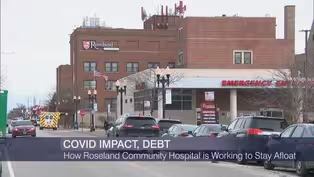
Brand is here now here with Dr. Karam Khan.
He is a chief medical officer of Rosen Community Hospital.
Thank you.
For joining us tonight.
You're welcome.
So I want to start off first as COVID cases are winding down.
What impact has COVID had on the Roseland community that has long faced with health disparities?
I think it's had a significant impact due to we get the sickest, the most common morbid patients that come in with COVID.
And I personally treated patients that have poor access to health care and the community, lack of resources, lack of primary care and education that's needed for the patients.
So we've had the sickest patients with the most co-morbidities that come into our hospital and get treated for the COVID.
And as Dr. Hardie also keep these patients spirits up.
It's it's very challenging.
But I think that the most important thing is giving them hope and letting them know that, you know, at Rosanne Hospital, we've been in front of COVID with our testing.
We've had testing since the first wave of the COVID with our vaccination and more importantly, we've had the latest treatments as the CDC, as FDA has approved on, we've been using those on our patients that come in.
And a few years ago, Roseland was struggling to stay afloat.
Where does the hospital stand now?
Well, we have funding challenges recent most recently after the last microenvironment variant, we've had issues with nursing staffing and then price gouging by the nursing agencies to where we're in debt due to mainly nursing but also, you know, limited on resources.
And we really need help from the state government and the Medicaid organizations to help fund the hospitals so we can appropriately treat our patients.
Would you say this hospital is a necessity in the community?
Absolutely.
The hospital's going to be coming up on its 100th anniversary in 20, 24.
And we see over close to 35,000 acutely ill patients coming in through our aid dollars a year.
And with the COVID, I mean, we've seen, you know, it's been lines in the E.R.
of sick people just last month in January, where I've had to, you know, literally see patients with the ventilator in the hallways.
So it's been a pretty dramatic impact.
Now, part of that effort also I want to switch gears here is to raise funds for the Rolls and medical district now.
Tell us about those efforts.
Yes, the medical district is it's sort of like I know you're familiar with the Illinois Medical District that we have and the efforts are to bring in other subspecialties and primary care into the community of rolls in.
But we cannot have a medical district without Roseland Hospital present on the table and involved in the in the plans, as Roseland has, is the hub in a medical it's basically a desert where, you know, we provide all types of care for the community.
Now, we have this is a last question.
We only have a couple of seconds left with the mask mandate.
Uplifting are you concerned about there being a surge?
Not so much a surge, but definitely it can be a pickup in cases because social distancing and masks are very important along with the vaccination and to keep our cases down.
Well, thank you, Dr. Katz, for joining us tonight.
Now, coming up, we speak with a local organization who is assisting the youngest people in the community.
Stay tuned.
Joanne, I think you will look forward to hearing to hearing about that.
And up next, one on one with the new head of the city's Police Accountability Agency.
But first, a look at the weather Chicago's police watchdog agency officially has a new leader.
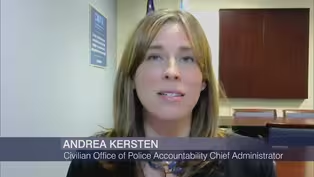
City council members yesterday confirmed Andrea Kersten, the mayor's pick to lead the Civilian Office of Police Accountability.
Kirsten has served as the interim head of Copa since last year, but her approval through council was mired by some months of controversy after her nomination in November.
20 older people had signed a letter opposing Kirsten due to a disciplinary disciplinary recommendation of a slain Chicago police officer.
And Andrea Kersten joins us now.
Congratulations, Andrea.
Did you expect your your confirmation to take this long?
Well, thank you.
First of all, I'm going to have the opportunity to be here.
You know, the work of this agency often elicits really strong responses on sort of all sides of issues surrounding police reform.
So while I certainly didn't predict that my confirmation would take the path that it did, the level of public interest and engagement and strength of opinions regarding our work is certainly nothing new to me or anyone that's engaged in this work.
At Combine.
And today is your your first day on the job, as is the official cheese administrator of COPPA.
Why did you want this job?
That's a great.
Question.
So I've actually been with the agency since September of 2016.
You know, as someone who served as a county state's attorney here in Chicago and also, as you know, an advocate kind of working in the criminal justice system on behalf of survivors of physical abuse and violence.
Previously, I've always been very committed to service in furtherance of our systems of justice.
And so, you know, when the opportunity arose to participate in sort of the rebuilding of this police accountability agency back in 2016 as it transitioned from what was then the Independent Police Review Authority to what is now called by the Civilian Office of Police Accountability.
I just I felt compelled to, you know, to really come and land my skills and expertize to these complicated issues.
I believe strongly in our systems of justice.
But I'm also not blind to the brokenness and I, I intend to continue being a part to contributing to efforts to improve the system so it's equitable and fair for everyone.
And one of those complicated issues is something that we already mentioned, the debate that was surrounding your appointment and confirmation.
It stemmed from the inclusion of the slain Chicago police officer, Ella French, keeping her name in the report that recommended discipline for the wrongful way raid on Anjanette Young's home.
That report was released after French's death.
And here's a little bit of that debate from yesterday.
We need to hold everybody accountable that goes from the madam that sits at the top of that year to the bottom person.
And so I really want you all to think about I did feel like it was insensitive when it came out because she had just died.
But I did understand that it's our responsibility and our duty.
I sometimes forget.
I sometimes think we forget who we work for.
We are paid to represent the people in our community.
And that's all the person, Jeanette Taylor, who did in the end vote in favor of your confirmation.
But what is your reaction to the critics who say that it was insensitive and to all that was being said about that report?
So first and foremost, I think it's always been really important and something that I've been making a concerted effort to do is really correct the public information on the timing of this disciplinary recommendation and the release of the report.
Of course, I think it should be widely known at this point that that recommendation was made in April, and the report was finalized with that recommendation for discipline against Officer Benson months before her tragic death in the line of duty.
And the release of the report is governed by both the timing of the release and the nature in which the report was released is governed by our ordinance.
And Loyola's as well as the consent decree.
So, you know, with respect to the emotional sentiments surrounding it, I share in that.
I mean, and I I've made lots of public comments to the extent that I am troubled by the fact that our hurt in our work in any way contributed to the further hurt of a grieving family.
However, you know, I have an obligation to, you know, when trying to fulfill our transparency obligations following the letter of the law that proscribes how we do the job that we do.
That's what took place here with the inclusion of her name in that report.
Months after her death and I'm working with city council now to revisit whether some of these rules should be or need to be changed.
And I've also, you know, made many public statements and have reached out to the police department about changing the way in which officers families are notified about something like this.
Now, Copa has spent the last five years really developing empathetic processes by which we help civilians whose lives are impacted by our transparency obligations, specifically preparing them for the release of materials, making sure they have sort of the dignity to experience what's going to be made very public about their private lives, making sure they see that information before it becomes public information.
And I want to make sure that our officers and their families, particularly a Gold Star family, has the same dignity afforded to them.
And I look forward to working with the police department and other city entities to make sure that that happens forward.
Because, for example, you have endorsed a proposed ordinance that would redact the names of slain officers from those publicly released reports.
But before we before we let you go and before we run out of time since its establishment in 2016, do you think that Copa has improved public trust in regards to accountability for police officers?
I think that by bit we're doing that.
You know, every day our work really has tried to focus on increased investigative integrity.
That was something that the Department of Justice report in 2017 was extremely critical of their predecessor agency.
So I think, you know, the level of detail and the thoroughness with which we approach this work has really improved and that that shows in the scrutiny that these reports receive over time and our ability to stand up to that scrutiny.
And then additionally I think our transparency efforts are also of paramount importance in building public trust and back a bedrock of public trust.
You know, not everyone's going to agree with an outcome, but at least providing the public with information surrounding these critical incidents, I think is the starting place and sort of a non-negotiable for us as a city as we try to build trust across our systems of public safety.
Okay.
That's where we'll have to leave it.
Andrea.
Kirstin, first day on the job as a brand new Copa chief administrator.
Thank you for joining us.
Thank you very much.
Up next, Joanna Hernandez with more from Roseland.
But first, a look at some events happening this weekend.
And now we check back in with Joanna Hernandez, who has spent the day in Roseland on the city's south side as part of our In Your Neighborhood series.
Joanna Now, thanks, Piers.
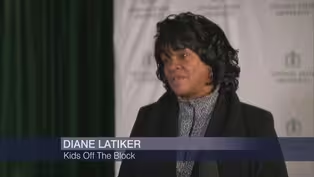
We're now here with Diane Latiker, founder of Kids Off the Block.
Thank you for joining us tonight.
Thank you for inviting me.
So I want to start off for those who don't know.
Tell us about your work through Kids Off the Block.
Kids Off the Block is a community based youth development organization.
Our primary focus, though, is giving young people a safe space We consider ourselves anti-violence, and so we try to give young people resources and tools they need to be successful because we just want them to be able to live in a community that they believe in and that they have somewhere to go that's safe.
How do you connect with these students?
How is that process like.
Wow, it's is.
Well, let me say, this is amazing.
It really is that, you know, they knock on a stranger's door and ask for help in their community.
How cool is that?
That is so cool to me.
And then we can actually help them.
You know, so I love it.
That's why you do the work.
That's why I do it.
What keeps you know, what's the passion?
What keeps you going.
Well, my faith, number one, my family and the fact that I was once a young long time ago and I needed that that support in my community and even if it is a stranger, used to quickly become friends and family through trust and care and love most of all.
And I think that's what our young people desire.
The oils, they wouldn't come to see a stranger.
It's very true.
Yeah.
We're like a second mom in some sense.
I hope so.
Now, what impact has the pandemic had on your programs?
Well, in back in 20, 20, 21 it really hit you know we organization kids physical, right.
We're right there with them.
We couldn't do it.
So we had to figure out what to do.
My husband and I said, we're not going to sit here.
So we started taking food to the young people in their families that we serve.
The next thing we know is serving the whole city.
We're traveling 300 miles a day across the city to bring PPE, hygiene products and food.
And when I tell you that people were so kind, they were so glad that somebody thought about them enough, you know?
And it really changed our programs.
It really changed us.
To tell you the truth, because they let us know the need is great.
And if you could do your part, that's a blessing just to help somebody.
And the last question I want to ask is, you wrote a book.
What would you say is the biggest lesson you've learned through these kids in the community?
You know, it's unfortunate.
There's violence that happens everywhere but some of these neighborhoods, you know, there's a lot of challenges that happen.
What's the biggest lesson that you've learned?
That we all can do something?
That's what I wrote the book for.
Want to let everybody know I was a mom in my house with eight kids?
I just wanted to do something.
How did you do that?
That's another story.
But I'm just saying, I wrote the book so everybody would know you don't need $1,000,000, a big building.
You just need a will to say, I want to help.
I want to.
What do you care about?
That's what you figure on, you know, and that's what I did.
Well, thank you for sharing your passion and being with us here tonight.
Thank you.
And now, Perez, that's a wrap for us here in Roseland.
I send it back to you.
All right.
And she certainly is inspiring.
Thank you so much.
And we're back to wrap things up right after this.
Chicago tonight is made possible in part by Alexandra and John Nichols, the Jim and K maybe family, the Polk Brothers Foundation, and the support of these donors.
And that's our show for this Thursday night.
Don't forget to stay connected with us by signing up for our daily briefing.
And you can get Chicago tonight streamed on Facebook, YouTube, and our website w t w dot com slash news.
You can also get the show via podcast and the PBS video app.
And please join us tomorrow night at seven for the week and review Now, for all of us here at Chicago tonight, I'm Brandies Friedman.
And I'm Perez Schutz.
Thank you so much for watching.
Stay healthy and safe and have a great evening.
Closed captioning is made possible by robert a clifford and clifford law offices.
A personal injury.
Law firm.
Pleased to give back to the community.
Through news, charitable initiatives.
‘Chicago Tonight’ in Your Neighborhood: Roseland
Video has Closed Captions
Chicago Tonight visits the Roseland community tonight (5m 50s)
City Council Approves Police Watchdog Agency Leader
Video has Closed Captions
Chicago's police watchdog agency officially has a new leader. (6m 34s)
Co-Chair of Congressional Ukraine Caucus on Invasion
Video has Closed Captions
Reaction to the invasion from the co-chair of the Congressional Ukraine Caucus. (8m 23s)
Inside the Massive COVID-19 SHIELD Testing Operation
Video has Closed Captions
An exclusive look inside the massive Illinois COVID-19 SHIELD testing operation. (4m 39s)
Video has Closed Captions
We speak with Diane Latiker, founder of Kids Off the Block. (3m 19s)
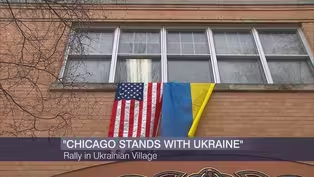
Peace Rally in Ukrainian Village
Video has Closed Captions
Chicagoans with family in Ukraine want their neighbors here to pay attention and to act. (5m 31s)
Video has Closed Captions
We speak with the chief medical officer of Roseland Community Hospital, (3m 34s)
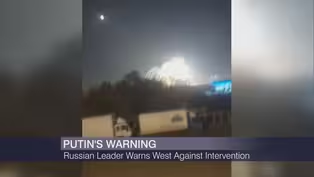
Ukrainians Wake to Sirens and Shells as Russia Attacks
Video has Closed Captions
Russia launches a widescale invasion of Ukraine from multiple points of attack. (8m 22s)
Providing Support for PBS.org
Learn Moreabout PBS online sponsorship
- News and Public Affairs

Top journalists deliver compelling original analysis of the hour's headlines.

- News and Public Affairs

FRONTLINE is investigative journalism that questions, explains and changes our world.












Support for PBS provided by:
Chicago Tonight is a local public television program presented by WTTW
WTTW video streaming support provided by members and sponsors.