
February 24, 2024 - PBS News Weekend full episode
2/24/2024 | 24m 9sVideo has Closed Captions
February 24, 2024 - PBS News Weekend full episode
Saturday on PBS News Weekend, it’s primary day for Republicans in South Carolina — how will the results affect Nikki Haley’s fight for the presidential nomination? Then, as Ukraine marks the second anniversary of the war with Russia, we look at the effect of the conflict on its people and what lies ahead. Plus, the growing problem and health consequences of social disconnection and loneliness.
Problems playing video? | Closed Captioning Feedback
Problems playing video? | Closed Captioning Feedback
Major corporate funding for the PBS News Hour is provided by BDO, BNSF, Consumer Cellular, American Cruise Lines, and Raymond James. Funding for the PBS NewsHour Weekend is provided by...
Support provided by:

February 24, 2024 - PBS News Weekend full episode
2/24/2024 | 24m 9sVideo has Closed Captions
Saturday on PBS News Weekend, it’s primary day for Republicans in South Carolina — how will the results affect Nikki Haley’s fight for the presidential nomination? Then, as Ukraine marks the second anniversary of the war with Russia, we look at the effect of the conflict on its people and what lies ahead. Plus, the growing problem and health consequences of social disconnection and loneliness.
Problems playing video? | Closed Captioning Feedback
How to Watch PBS News Hour
PBS News Hour is available to stream on pbs.org and the free PBS App, available on iPhone, Apple TV, Android TV, Android smartphones, Amazon Fire TV, Amazon Fire Tablet, Roku, Samsung Smart TV, and Vizio.
Providing Support for PBS.org
Learn Moreabout PBS online sponsorshipJOHN YANG: Tonight on PBS News Weekend, primary day for Republicans in South Carolina, how the results affect former governor Nikki Haley's fight for the nomination.
Then, the growing problem of social disconnection and loneliness and its effect on Americans health.
MAN: The same risk of premature death as smoking 15 cigarettes per day, which is wild on the mental health side.
It increases anxiety, suicidality and depression.
There's also evidence of a 50 percent increased risk of dementia.
JOHN YANG: And as Ukraine marks the second anniversary of the war with Russia, how the conflict is affecting its people, and what lies ahead.
(BREAK) JOHN YANG: Good evening.
I'm John Yang.
South Carolina voters went to the polls today in the Republican presidential primary.
Former President Donald Trump, looking for his fourth straight primary season win, and former governor Nikki Haley, trying to avoid a home state embarrassment.
After Haley voted with her family on Kiawah Island this morning, reporters pressed her on the future of her campaign.
NIKKI HALEY, Republican Presidential Candidate: So we'll keep taking it one state at a time.
That's our goal.
It's just one state at a time.
I know everybody else wants to look ahead.
That's not how I've done any of this.
In the past year we've taken it one state, one month at a time and focused on that.
That's what's gotten us to this moment.
JOHN YANG: This afternoon, Trump spoke at annual conservative conference in the Washington, DC area.
Last night in South Carolina, at an event for black conservatives, Trump likened his four criminal indictments to the historic discrimination black people have faced in the justice system.
It is, he said, a reason for his support among black voters.
Nikki Haley called the remarks disgusting, and the Biden campaign called Trump a proud poster boy for modern racism.
Several western leaders were in Kyiv today as Ukraine's war with Russia entered its third year.
Ukrainian President Volodymyr Zelenskyy signed bilateral security agreements with the prime ministers of Italy and Canada.
They also laid wreaths to honor Ukraine's war dead.
Meanwhile, the fighting persists unabated.
Ukraine's forces are on the defensive, short of both troops and ammunition.
In Russia, an aide to Alexei Navalny said the late opposition leader's body has been turned over to his mother.
Navalny's family said Russia threatened to bury him at the Arctic prison where he died unless they agreed to a secret funeral.
The Navalny aides said it's still not clear whether the government will allow a public funeral as the family wishes.
A South Carolina man has been convicted of the 2019 murder of a transgender woman known as Dime Doe.
It was the first federal gender identity based hate crime trial.
The maximum possible sentence for Daqua Ritter is life in prison without parole.
An angry, jeering farmers greeted French President Emmanuel Macron at the opening of a Paris Agriculture Fair.
The farmers forced their way through security barriers, and many clashed with police.
For months, French farmers have demanded better living conditions, simpler regulations and protection from what they say is unfair foreign competition.
Still to come on PBS News Weekend, the growing crisis of loneliness in America and Ukraine marks a somber anniversary in the war against Russia.
(BREAK) JOHN YANG: Today's South Carolina primary is a crucial test former two term governor Nikki Haley and her effort to puncture former President Donald Trump's air of inevitability.
Trump has big leads over Haley and both an average of Republican primary polls nationwide and the count that really matters, the number of delegates already allocated.
Thelisha Eaddy of South Carolina Public Radio is at Haley election night headquarters in Charleston right now.
Felicia, what was the message, the competing messages from these two candidates in this campaign?
THELISHA EADDY, South Carolina Public Radio: Yeah.
John, so, over the past few days, we've seen both candidates kind of crisscross the state, spending notable time in just about every region of the state trying to get their messages out former President Trump.
We saw his consistent message that he is the person that the party needs to elect.
He is the person that can unite the country and make America great again.
A very consistent message that we've been hearing from him since his time in the office, if I'm being frank.
For former governor and U.N. ambassador Nikki Haley, what we've been hearing from her, a little consistency, but also a little switch as well.
We've seen her sharpen her attacks against the former president, but also we've seen her make, draw parallels between her party challenger and President Biden, saying that they are both creators of chaos and that she is the person that the party needs to elect to represent them.
And she is the person who can beat President Biden later this year.
So we've seen her kind of try to differentiate herself or segue to make herself appeal to all Americans, make herself appeal to all of the residents, all of the voters, that she will person to represent the party and the best person to beat President Biden in November.
JOHN YANG: This is, of course, a state where twice elected Nikki Haley governor.
Where did the big name Republicans, the sort of the elected office holders, the Republican Party officials, where did they end up lining up in this campaign?
THELISHA EADDY: That's the interesting thing.
John.
So Nikki Haley, former governor Nikki Haley, she served as governor twice.
Born here in South Carolina.
She spent some time this week in her hometown, small rural area of Bamburg.
But even though this is her home state, she does not seem to be making traction or she has not been able to make those steady or those deep or loyal connections that former President Trump has.
So the only major party member that supports her, who has vouched for her, if you will, is Congressman Ralph Norman.
We actually spoke with him.
One of our reporters spoke with him earlier this week.
But all other senior party leaders they have endorsed, supportive, been on the campaign trail, had photo ops with former President Trump.
So South Carolina is Nikki Haley's home state.
But you often hear people say that this is Trump country.
JOHN YANG: Nikki Haley says she's going to keep going no matter what happens.
Today she's talking about pushing on at least to Super Tuesday.
She's made a big ad by on Super Tuesday states.
Does she say or does her campaign see a path to the nomination for her, or is there another rationale for staying in the race?
THELISHA EADDY: I think a little bit of both.
She's staying in the race.
She's vowing to stay in the race because she can't.
And then we also hear her say that she's not going to pull out because she wants every voter, every American to have their voice heard.
Everyone should be able to vote.
I think that's a part of a messaging to differentiate herself from former President Trump as well, not just attacking him, but trying to shift herself or shift name recognition of her name, that she is the person that can best represent the party and then best represent the country, all Americans.
She recently told Fox News that you do not shun people when you're running for president.
You don't shun people who may be different from you or may have different views from you.
So again, trying to shift a little bit in the middle, if you will, to let all residents know I may not win South Carolina tonight.
Let's get to Super Tuesday.
Let's get further down the road because I am the better candidate for the party and for the country.
JOHN YANG: Thelisha Eaddy of South Carolina public radio at Haley headquarters in Charleston, South Carolina.
Thank you very much.
THELISHA EADDY: Thank you.
JOHN YANG: It was two years ago today that Russia launched its full scale invasion of Ukraine.
Every day since then, an average of 42 Ukrainian civilians have been killed or wounded.
In addition, more than 14 million people are in need of humanitarian aid.
About 4 million have been displaced within Ukraine and more than 6 million are now living as refugees around the world.
Also since then, Nick Schifrin has made several reporting trips to Ukraine.
Nick, it's now entering the third year.
What is life like for Ukrainians?
NICK SCHIFRIN: If you are a Ukrainian soldier near the front, it is extremely difficult.
There are places in northeast Ukraine where Ukrainians are outnumbered five to one.
They're being outgunned eight to one or nine to one, even 10 to one.
If you're Ukrainian civilian living by the front, the fear of death, whether you are caught by a Russian artillery shell or some kind of Russian airstrike, remains living in Kyiv, living in Lviv in the western part of the city, Ukrainians do have normal lives.
But there is not, as you know, a part of this country or a family or a person in this country who have not been affected forever by this war, many of them for the worse.
JOHN YANG: Leading up to this anniversary, we've seen a number of U.S. officials expressing moral support, rhetorical support for the Ukrainians.
They can't give tangible monetary support because it's bottled up in Congress.
And this week, President Biden blamed that inaction on Congress on a major loss for Ukraine.
How accurate is that?
How badly do the Ukrainians need that money?
NICK SCHIFRIN: Very, very badly.
So the loss was in Avdiivka.
This is a city in the east that has been fought over between Ukraine and Russia, frankly, for a decade.
I first visited Avdiivka in 2014, and so Russia has finally captured it.
And this is one of those places, John, that were talking about before, where the outnumbering and the outgunning is shocking.
Avdiivka was at least eight to one or nine to one or even 10 to one at one point, according to Ukrainian officials.
I speak to when it comes to artillery because U.S. shipments have not arrived.
But what's key, John, is that we talk a lot about artillery up and down the front.
Air defense.
U.S. officials tell me if this supplemental does not pass, they are really worried that Ukraine will run out of the munitions it needs for air defense.
And that's not only critical for protecting Ukrainian critical infrastructure, but it also is critical because it keeps Russian jets from flying freely across Ukraine.
And if Russian jets were to be able to fly freely, Ukraine would really have a hard time even holding the ground that they have right now.
JOHN YANG: And talk about that holding that ground before this loss, Russia capturing that city, they seem to be at a stalemate on the ground.
Once we get into spring, do you expect offensives from either side?
NICK SCHIFRIN: So Ukraine is really unable to launch an offensive the entire year.
Basically, they won't say that publicly, but U.S. officials are admitting that.
And us goal is to get them enough weapons, especially air defense, but also artillery, to allow them to hold the line, allow them to go on defense for the entirety of 2024.
The strategy at that point is that there will be a lot more American artillery, a lot more European artillery, and a lot more Ukrainian weapons, from drones to artillery, online for 2025.
The question about Russia is a good one.
Russia will continue to push through the winter.
You can still fight when it's frozen.
You just can't fight when it's muddy.
So through the winter, Russia will continue to push, especially in the parts of Ukraine, in the south that Ukraine actually resized last year.
And the concern that Ukrainian officials have is that if they lose some of the territory that they won, what little territory they won, frankly, in 2023, that will be a big hit for morale.
JOHN YANG: There have been occasional suggestions and discussions of negotiations to try to end this war.
Is that something you see possible?
NICK SCHIFRIN: So from the Ukrainian side, absolutely zero.
There is no desire to negotiate when 18 percent of their territory is still occupied and when 90 percent of Ukraine defines victory not only as reseasing (ph) what they lost in the last two years, but retaking Crimea back, which they lost ten years ago.
So there is no political space for President Zelenskyy to even consider that at all.
Russia publicly say that, look, we're happy to negotiate, but U.S. officials believe that actually Putin has not changed his goal for Ukraine to actually capture Kyiv.
And so whatever Putin might say publicly, there is no belief in Kyiv or in Washington that he has a desire or interest in negotiating, even at the status quo right now.
JOHN YANG: Do you see an end to this anytime soon?
NICK SCHIFRIN: Sadly, no.
And I think that's what that reference to U.S. strategy acknowledges, in the sense that 2024 is not going to be a year where Ukraine can go on the offensive.
That's what the U.S. has already assessed.
And so the Biden administration is trying to create a way for Ukraine to be able to fight this war for a long time.
Obviously, there's a question of President Trump if he were to win.
And the Biden administration is trying to put in mechanisms where the U.S. will continue to support Ukraine.
But assuming that U.S. support, European support for Ukraine continues for the next few years, no, we could be talking about this war in two, three, four, five years, we really have no idea.
Because, again, Ukraine wants to keep fighting, wants to try and resize the territory, and there is no sign that Vladimir Putin thinks he needs to stop.
JOHN YANG: This war is just one of the friction points between the United States and Russia.
Most recently, we've had the death of Alexei Navalny.
Put this war into context of the broader U.S.-Russian relations.
NICK SCHIFRIN: It's very interesting when we think about the last few administrations in the U.S. have tried to reset relations with Russia.
The Biden administration did not.
And what this war has done, according to western officials I talked to, is made a really strategic pivot point for Washington, London, and to a certain extent, Europe.
That is that they believe that they will have to face a difficult, revisionist, aggressive Russia for a generation.
That's not something that U.S. intelligence services had or western intelligence services had been already expecting.
But the war has changed that.
And so that means that 10, 15, 20 years down the line, the U.S. and the U.K. at least expect to have to confront Russia post Putin.
And what does that mean?
That means that some of the sanctions that are being put in place today, some of the actions being put in place today, yes, they are about Ukraine in the sense that's where the front line is.
But they are about degrading Russia five years, 10 years, 15 years into the future to try and ensure that Russia can't do this, what it's done in Ukraine, elsewhere into Europe and NATO.
But that will be a generational fight, perhaps.
JOHN YANG: Nick Schifrin, thank you very much.
NICK SCHIFRIN: Thanks, John.
JOHN YANG: The American Psychiatric Association's latest monthly poll found that one in three Americans said they felt lonely at least once a week over the past year.
And younger people were more likely to report these feelings than other age groups.
Ali Rogin has more on what's causing a surge in loneliness and how communities can work to combat it.
ALI ROGIN: Last year, U.S.
Surgeon General Vivek Murthy sounded the alarm on the effect chronic loneliness can have on people's health.
A report released from his office last spring revealed that social isolation can be as deadly as smoking up to 15 cigarettes a day.
Now some local leaders are heeding the warning.
In California, San Mateo County, which includes part of Silicon Valley, became the first in the nation to declare loneliness a public health emergency.
Edward Garcia heads the Coalition to End Social Isolation and Loneliness, a nonprofit organization that partners with healthcare experts and policymakers.
Edward, thank you so much for being here.
Why are we as a country so lonely?
EDWARD GARCIA, Coalition to End Social Isolation and Loneliness: Right know, I think there are many cultural drivers that look at why we're so lonely.
But I want to take it a little step back and say that loneliness and isolation are not new occurrences.
Unfortunately, the most marginalized in our society have always been at higher risk of social isolation and loneliness, and these are communities of lower socioeconomic status, minority groups like BIPOC communities and LGBTQ youth and many others.
I think what's coming to light now is that so many of us are now starting to feel the effects of social isolation and loneliness, especially coming out of the pandemic.
Some drivers of this have really looked at hyper individualism.
So how we are looking at our differences rather than what bonds us together, really hypered, tailored media consumption online platforms like social media, they're creating these alternative universes.
And when we step out of those, it can feel like we don't belong in the real world community.
ALI ROGIN: And you mentioned that marginalized communities have always been among those experiencing the highest rates of loneliness.
But tell us a little bit more about who exactly is the most lonely right now.
Who is the most at risk of experiencing loneliness in today's world?
EDWARD GARCIA: Again, everyone's at risk of social isolation and loneliness.
But to your point, think of, like, new moms who have lack supports, veterans, older adults that are homebound, or persons with mobility issues.
We've seen a lot of research around generation Z and young adults that have exhibited the highest rates of loneliness, upward of 79 percent.
There are many other populations that we're seeing that are also at risk.
ALI ROGIN: What about for elderly people who may indeed have friends and partners who they're not able to see on a regular basis?
People perhaps are passing away.
What is the landscape like for older adults right now?
EDWARD GARCIA: The pandemic very much impacted older adults, especially those who are in long term care facilities, nursing homes, and homebound.
Fortunately, the nation has really focused on older adults over the last 15, 20 years through programs, through the administration for community living, the area agencies on aging, and the older adult's network across the country.
We are seeing the development of new technologies that are helping older adults connect with others, not just supplant in person connections, but to help foster those connections.
We're even seeing our federal government move down a path of quality improvement activities in nursing homes to help connect intergenerationally young doctors and nurses with older adults.
ALI ROGIN: It's really interesting that you mentioned that because so many resources have been focused on those groups.
Perhaps they have better safety nets in place.
But you also mentioned Gen Z.
There are some young women, especially, who seem to be trying to reach out new friends in those ways, writing even friendship applications and then posting them.
What's happening with that age group right now?
EDWARD GARCIA: What we're seeing is one of the things, the drivers that I talked about at the beginning of the segment, really this hyper individualism.
So really focusing on our differences rather than thinking of ways to find commonality with our peers and the involvement with online time.
There are studies out of Europe looking at the increased times on social media use and passive use can lead to social isolation and loneliness.
ALI ROGIN: And we're talking about a public health emergency, not just in the abstract.
We're talking about this can have serious impacts on your physical health.
How does it affect a person's physical well-being?
EDWARD GARCIA: So on the physical side, it's the same risk of premature death as smoking 15 cigarettes per day, which is wild.
I think a lot of people don't realize that on the mental health side, it increases anxiety, suicidality and depression.
There's also evidence of a 50 percent increased risk of dementia.
ALI ROGIN: Tell us about some of the strategies that have been effective in reducing loneliness.
EDWARD GARCIA: So, I also want to take a step back on this question.
We are very concerned about the stigma around loneliness.
It's been thought of as a sort of individual problem, and a lot of people have been scared to come forward to talk about that.
So we have focused, while there are absolutely paths forward for individuals to connect, such as joining clubs, finding opportunities for in person connection through shared love of music or other activities.
We really want to focus on systemic, broad based policies, systems, environmental changes that help support federal, state and national and local strategies to address social disconnection.
As part of that, we've developed an action guide for local leaders to help them support communitywide strategies that look at various assets within their community and opportunities to impact communitywide social connections.
ALI ROGIN: And this issue isn't only affecting the United States.
Certainly, as you mentioned, other countries are dealing with it as well.
Are there solutions that have worked elsewhere in the world that the United States could learn from?
EDWARD GARCIA: Yes, absolutely.
The U.K. has been a leader in this space for the last 15 years.
They've implemented a minister of loneliness at their federal level, at their national level.
Excuse me, same thing in Japan, and we're seeing the same activity in Sweden, more specifically in the U.K., they've been very successful incorporating screening and referral for social disconnection within their national healthcare system.
So we're working very similar to implement that same strategy here in the US.
ALI ROGIN: Edward Garcia with the Coalition to end Social Isolation and loneliness, thank you so much for joining us.
EDWARD GARCIA: Wonderful to be here.
JOHN YANG: And that is PBS News Weekend for this Saturday.
I'm John Yang.
For all of my colleagues, thanks for joining us.
See you tomorrow.

The growing health crisis of loneliness in America
Video has Closed Captions
How a growing crisis of loneliness is affecting Americans’ health (6m 11s)
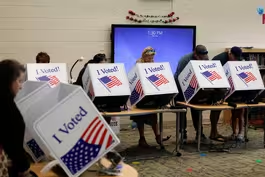
How South Carolina may affect Haley’s fight for nomination
Video has Closed Captions
How South Carolina’s GOP primary results may affect Haley’s fight for the nomination (4m 26s)

What lies ahead for Ukraine, 2 years since Russia’s invasion
Video has Closed Captions
What lies ahead as Ukraine marks somber 2-year anniversary of Russia’s invasion (7m 3s)
Providing Support for PBS.org
Learn Moreabout PBS online sponsorship
- News and Public Affairs

FRONTLINE is investigative journalism that questions, explains and changes our world.

- News and Public Affairs

Amanpour and Company features conversations with leaders and decision makers.












Support for PBS provided by:
Major corporate funding for the PBS News Hour is provided by BDO, BNSF, Consumer Cellular, American Cruise Lines, and Raymond James. Funding for the PBS NewsHour Weekend is provided by...