
February 25, 2024 - PBS News Weekend full episode
2/25/2024 | 24m 9sVideo has Closed Captions
February 25, 2024 - PBS News Weekend full episode
Sunday on PBS News Weekend, we look at the state of health care for children of low-income families in Florida, and what a federal lawsuit could mean there and the rest of the country. Then, how vaccine hesitancy and misinformation are playing into rising rates of measles and COVID. Plus, the story of a Black midwife who served the community where she had been enslaved.
Problems playing video? | Closed Captioning Feedback
Problems playing video? | Closed Captioning Feedback
Major corporate funding for the PBS News Hour is provided by BDO, BNSF, Consumer Cellular, American Cruise Lines, and Raymond James. Funding for the PBS NewsHour Weekend is provided by...
February 25, 2024 - PBS News Weekend full episode
2/25/2024 | 24m 9sVideo has Closed Captions
Sunday on PBS News Weekend, we look at the state of health care for children of low-income families in Florida, and what a federal lawsuit could mean there and the rest of the country. Then, how vaccine hesitancy and misinformation are playing into rising rates of measles and COVID. Plus, the story of a Black midwife who served the community where she had been enslaved.
Problems playing video? | Closed Captioning Feedback
How to Watch PBS News Hour
PBS News Hour is available to stream on pbs.org and the free PBS App, available on iPhone, Apple TV, Android TV, Android smartphones, Amazon Fire TV, Amazon Fire Tablet, Roku, Samsung Smart TV, LG TV, and Vizio.
Providing Support for PBS.org
Learn Moreabout PBS online sponsorshipJOHN YANG: Tonight on PBS News Weekend, the state of health care for children of low to moderate income families in Florida and what a federal lawsuit could mean there and the rest of the country.
Then, how vaccine hesitancy and misinformation are playing into rising rates of measles and COVID.
And the story of a black midwife who served the community where she'd been enslaved.
WOMAN: If somebody needed help, Granny was going black and whites alike it made no difference to her.
She was fearless.
(BREAK) JOHN YANG: Good evening, I'm John Yang.
Donald Trump's decisive victory and yesterday's South Carolina primary in Nikki Haley's home state has moved the former president that much closer to the Republican nomination.
With nearly all the votes counted, Trump leads Haley by 20 percentage points, and he's won at least 44 of the state's 50 delegates, bringing his overall total to more than 100.
Despite the loss, Haley told supporters last night that she is not giving up.
NIKKI HALEY, Republican Presidential Candidate: I'm going to count it.
I know 40 percent is not 50 percent.
But I also know 40 percent is not some tiny group.
There are huge numbers of voters in our Republican primaries who were saying they want an alternative.
JOHN YANG: The next primary is in Michigan on Tuesday.
It's the last major contest before more than a dozen states vote in March with more than 1,000 delegates up for grabs.
In Israel's war with Hamas, there are signs of slow progress toward a deal for a ceasefire and the release of both Israeli hostages and Palestinian prisoners.
And Egyptian official tells the Associated Press that the deal that's emerging from talks in Qatar would call for a six-week pause and fighting increased aid deliveries to the Gaza Strip and the release of 40 Israeli hostages and hundreds of Palestinian prisoners.
In Israel, protesters are keeping up pressure on the government for the hostages return.
On CBS's Face the Nation Israeli Prime Minister Benjamin Netanyahu said getting an agreement was up to Hamas.
BENJAMIN NETANYAHU, Israeli Prime Minister: But I can tell you that we're all working on it.
We want it.
I want it.
I can't tell you if we'll have it.
But if Hamas goes down from its delusional claims and goes down in bringing them down to earth, then we'll have the progress that we all want.
JOHN YANG: Netanyahu said a ceasefire deal with delay but not canceled and Israeli military offensive and Rafah more and more than half of Gaza is 2 million residents have taken refuge.
And a man set himself on fire outside the Israeli embassy here in Washington.
Uniform Secret Service Officers extinguish the flames and the man was taken to the hospital with life threatening injuries.
The Times of Israel reports that no embassy staff was involved.
Still to come on PBS News Weekend, how misinformation about vaccines is contributing to a rise in some preventable diseases.
And a black midwife story is told by her granddaughter to her great granddaughter.
(BREAK) JOHN YANG: The end of pandemic era protections for Medicaid participants as so far meant the end of coverage for more than 17 million low income Americans and states are still checking to see if more recipients are no longer eligible a process known as unwinding.
Now the federal government is raising questions about that process, especially when it comes to children.
In December, the Department of Health and Human Services sent letters to the nine states with the highest number of children losing coverage, telling them that they must do more to keep children in the program.
One of those states is Florida, which is considering other changes to the way it provides health insurance to children from low to moderate income families, expanding access for some limiting it for others.
Ali Rogin has more.
ALI ROGIN: Since the Medicaid unwinding began last spring, Florida has removed 420,000 children from the roles of both Medicaid and CHIP, the Children's Health Insurance Program.
CHIP ensures children from families with modest income, but that make too much money to qualify for Medicaid.
Florida is also challenging a federal law that went into effect at the beginning of this year, requiring states to provide children with 12 months of continuous Medicaid or CHIP eligibility.
But Florida also took steps to expand CHIP eligibility voting last year to increase the amount of income a family can have before they no longer qualify for children's health insurance programs.
Daniel Chang is a correspondent based in Florida for KFF Health News here to break it all down for us, Daniel, we have the Medicaid situation.
We have Florida's CHIP situation.
Can you tell us broadly, what is the state of health insurance for children in Florida right now?
And if you can, how does it compared to what's happening in other states right now.
DANIEL CHANG, Correspondent, KFF Health News: So Florida has a children's health insurance program like pretty much every other state does right now.
And last year, it had about 120,000 children in it.
It's a program for low and moderate income families.
And what Florida is doing is it's contesting the federal government's authority to essentially change the rules of how kids stay enrolled in the program.
What Florida is saying is that it should be allowed to disenroll children from the Children's Health Insurance Program if their parents don't pay premiums, they get a 30-day grace period after that.
But starting January 1, the Centers for Medicare and Medicaid Services, the federal regulator, Tory authority said that you can no longer disenrolled children for non-payment of premiums, you can only require them to pay the first month after that if their parents don't pay, you have to leave them on for at least another 11 months.
Florida says that's not fair.
We've always been able to disenroll kids from CHIP if their parents didn't pay the premiums.
We need that money to fund the program.
And it's accusing the Feds and basically not following the process that's required for creating new rules like this.
ALI ROGIN: Are there any other states who are bringing up the same concerns as Florida is are they out on their own on this one?
DANIEL CHANG: Currently, Florida is the only state that I'm aware of that has challenged the federal government's new rule, although there are 18 other states that do use the same process, meaning that they will disenroll children from chip if their parents don't pay them on the premiums.
So those 18 other states will have to decide if they want to follow the new federal rules or join Florida and its lawsuit.
ALI ROGIN: And how is the Biden administration responding right now to Florida suit?
DANIEL CHANG: Well, the Biden administration just filed its first response this week.
And essentially what the Biden administration is saying is, is that the Consolidated Appropriations Act of 2023 changed the rules in two fundamental ways.
ALI ROGIN: If I can interrupt you quickly, that is the bill that established this 12-month continuous eligibility period.
DANIEL CHANG: That's correct, Ali.
And so the new rules under that law went into effect on January 1st.
And essentially what the Biden administration is saying is that the law no longer allowed continuous eligibility to be optional.
It's now mandatory for both Medicaid and CHIP with the Biden administration is saying essentially, that states were never allowed to disenroll people from Medicaid for non-payment of premiums during a continuous eligibility period.
And now the same has to apply to kids and CHIP, they have to have that same protection.
And that's essentially what the Biden administration is arguing.
ALI ROGIN: So at the same time, this chip, stuff is happening.
Florida has also come under scrutiny from the federal government for disunrolling what the HHS says is a very high proportion of children from the Medicaid rolls.
Why is Florida coming under specific scrutiny for this?
And does it have anything to do with the fact that it's one of 10 states that did not expand Medicaid coverage during the Affordable Care Act?
DANIEL CHANG: So Florida has disenrolled a large number of children from its Medicaid program, it's up to close to 460,000 as of the report from January, and HHS Secretary Xavier Becerra sent a letter to Florida and the governors of eight others states expressing concern about that and suggesting measures strategies the states could take to help keep their kids covered.
One of them relates to just eliminating premiums in the CHIP program.
Others involve persuading states to take up what the federal government calls flexibilities for this unwinding process.
So for instance, allowing states to just determine a kid's eligibility and reenroll them in the in the program.
There's a large number of dis enrollments during Florida's Medicaid on wine that are due to procedural reasons, which is often when paperwork isn't returned, or people don't respond.
Medicaid expansion is another strategy that the Secretary cited in his letter to governors as helping to improve coverage for children because when parents have health insurance, it's a lot more likely that their kids will also be insured.
ALI ROGIN: At the same time, all of this is happening, the Florida legislature voted to raise the family income limit to qualify for Kid Care, which is basically the Children's Health Insurance Program in Florida.
So what's the status of those efforts?
And how many children would that state legislature action, potentially provide coverage to.
DANIEL CHANG: Governor DeSantis signed that expansion for CHIP into law in June.
And essentially what it did is that it raised the income eligibility level, so about another 40,000 or so children would be newly eligible once that chip expansion takes effect, but it hasn't yet because there's a complicated process for states to do this.
And it involves having state and federal public comment periods and Florida hadn't done that and now they have to.
The state wanted to start the expanded population for CHIP this year.
If they do it would have to be later, much later in the year right now, they've just started recently, the state public comment period.
ALI ROGIN: I think people hearing this might wonder to themselves why Florida is taking some measures to expand eligibility, vis-a-vis, income, but choosing other options that would effectively keep other children disenrolled.
DANIEL CHANG: Well, what Florida's claiming is that those premiums helped to fund the CHIP program, and they were counting on it to fund the coverage for the expanded population.
Florida collects about $30 million a year in CHIP premium payments, and they're estimating that the first full year of this program under the expansion would cost about 90 million.
So that remainder would be paid between the state and federal governments.
And you know, about 3000 kids in any given month are disenrolled from CHIP for their parents not paying the premium.
So part of what CMS wants to do with this new rule of continuous eligibility and continuous coverage is to reduce what's called turn, kids falling in and out of coverage, having interruptions in their coverage, which is which is never good.
ALI ROGIN: Daniel Chang for the health reporter for kFS health news.
Thank you so much for your time.
DANIEL CHANG: You're welcome.
Thank you for having me.
JOHN YANG: Vaccines have proven to be an effective weapon against many diseases.
Measles, for instance, was declared eliminated from the United States in 2000.
And more recently, vaccines have helped curb the spread of COVID.
But this year, both of those diseases are on the rise.
The Centers for Disease Control and Prevention says there's already been 35 cases of measles so far this year, compared with 58, and all of 2023.
NewsHour digital health reporter Laura Santhanam has been looking into this.
Laura, let's take the case of measles, there is an effective there has been an effective measles vaccine for decades.
Why are cases climbing?
LAURA SANTHANAM: You know, it kind of boils down to an answer that an epidemiologist gave me recently, which is a vaccine is nothing if it's not administered.
And that's what we're seeing right now.
The pandemic and misinformation have combined to sort of really see this decline in vaccines for both of these infectious diseases, thinking about, you know, just sort of the chaos that the pandemic gave us.
You know, a lot of people weren't getting, you know, check scheduled childhood vaccines for their kids, people were afraid to sit in waiting rooms, exam rooms, and, you know, we saw that and we're still sort of working our way out of that.
And then thinking about the role that misinformation has played in sort of undermining people's confidence in that we're still dealing with that mess.
JOHN YANG: Some vaccines have been with us for generations.
But looking back in history, looking at when they were first introduced, was there the same sort of misinformation then?
Or is that something a new phenomenon?
LAURA SANTHANAM: It's kind of wild to think, you know, infectious diseases have been something that humanity has been dealing with since before we were able to record history, right.
And some of these diseases are, you know, we're just kind of starting to wrap our arms around.
Take polio, for example.
The ancient Egyptians were dealing with polio, right, and it wasn't until late the 1950s.
Dr. Jonas Salk started to deploy a vaccine starting in a school in Pittsburgh, and in that campaign went around the country around the globe.
And generations later, medical school students are more likely to learn about polio in history books, and then they are in clinic here in the US.
And that's because of that work.
It didn't just go away because we wished it away.
It went away because of these vaccine campaigns.
JOHN YANG: How did all the disinformation that spread and the mistrust that spread around the COVID vaccine?
How has that affected other vaccines?
LAURA SANTHANAM: You know, we've been dealing with misinformation for quite some time when it comes to vaccines.
You know, it starting in in the late 1990s, with thinking about the measles, mumps rubella vaccine, and to this day, there are still people who, you know, withhold that vaccine from their children, because they think it might cause problems that just evidence studies conducted over so many years in so many countries.
Just it they continue to debunk that since retracted study.
But that sort of laid the groundwork for some of the misinformation campaigns we're seeing about COVID vaccine now, whether it's talking about how quickly it was deployed, and then, you know, when politics are getting involved in some of those campaigns, it makes it a message disentangle.
Time and again, when I've been talking to clinicians about this, they recommend that people ask their doctors, if you have questions about the COVID vaccine, measles vaccine, any of these vaccines that are recommended that are approved and vetted by the CDC, by the FDA, you know, have those conversations with your doctors.
But also, you know, perhaps equally importantly, doctors should be ready to have those conversations with their patients.
I had a conversation with a doctor in South Alabama who was saying, you know, physicians should be welcoming these conversations.
They should be ready to answer questions, and shouldn't discourage patients from having them in the first place.
Vaccine misinformation expert also told me that people are going to misinformation for a number of reasons.
But some of those reasons is because they weren't able to get answers when they needed them from their health care providers in the first place.
So it just be ready to have these conversations and welcome them.
JOHN YANG: One of the fears that you've heard from doctors and public health officials about this, but about diseases that we thought we had conquered but have been wiped out like measles.
LAURA SANTHANAM: In the U.S. we've seen vaccination rates among kindergarteners declined to 93 percent.
It's supposed to be 95 percent.
Right.
That's the recommended threshold to prevent community transmission and a lot of suffering and harm.
Two percentage points may not sound like a lot, but according to the CDC, that roughly translates to 250,000 kids who are left at higher risk for developing measles.
They could become deaf as a result develop encephalitis and in most tragic cases, die.
Physicians pediatricians, especially who I've talked to, in my reporting, are very concerned that will give a foothold to these diseases that we had worked so hard to contain that will give an opportunity for preventable death to rise in this country.
JOHN YANG: Laura Santhanam, our digital health reporter, thank you very much.
LAURA SANTHANAM: Thank you.
JOHN YANG: And you can read more of Laura's reporting on the rise in measles cases and the misinformation around the measles vaccine at pbs.org/newshour.
For Black History Month, our partners at StoryCorps are amplifying black voices with conversations about activism, love, joy and leadership.
Tonight the story of Mary Stepp Burnette Hayden.
She was born into slavery on a plantation in Black Mountain, North Carolina, after she was freed in 1865 when she was seven, she remained there going on to become a midwife.
At StoryCorps, Hayden's granddaughter Mary Othella Burnette told her great granddaughter Deborah Hamilton Palmer, about their family matriarch.
MARY OTHELLA BURNETTE: She probably weighed not more than 110 pounds.
She was about four feet 11 inches tall, and her hair hung well below her waist.
She had deep set eyes and a fierce look as if she were looking right through you.
DEBORAH HAMILTON PALMER: What was your relationship with her like mom?
MARY OTHELLA BURNETT: She delivered me.
She used to tell me how I started her and my dad a few minutes after I was born by opening my eyes and turning my head to look around the room.
And she said, God, look at that.
My grandmother love to talk and most of our stores are bad.
But granny's stories were real life stories.
She didn't know anything about Hansel and Gretel.
Here is this woman, a former slave walking around delivering babies and helping people.
You have to understand that back when grannies started there were no hospitals for black people to go to and poor people had no money to pay for professional medical care.
So if you had a disease that could not be treated by midwife, you died at home.
Houses could be several miles apart, and bears commonly roamed the neighborhoods.
But she walked.
If somebody needed help, Granny was going black and whites alike.
It made no difference to her.
She was fearless.
You know, you never boasted about what she did.
But she probably caught several 100 babies, if not more.
DEBORAH HAMILTON PALMER: How old was going ahead and when she stopped her practice?
MARY OTHELLA BURNETTE: She was about 90 years old.
She was a very strong little woman.
You know, when people think about slavery, they think about hundreds of years ago, not about somebody who died in 1956.
She was a pillar, not only in our family, but in our community.
And I assume she would always be there.
Like when you're a child, you assume everything's going to be there.
But I'm very proud to have descended from someone like my grandmother.
Very, very proud.
JOHN YANG: And finally, tonight, what could be the brightest known object in the universe, estimated by scientists to be emitting light, that's a mind boggling 500 trillion times more intense than the sun.
According to a paper published this past week in the journal Nature Astronomy, it's a quasar produced by a massive and voracious black hole that devoured the equivalent of one of Earth's suns every day, a cosmic Star Destroyer.
Quasars are whirlpools of matter being sucked into black holes swirling like waters circling a drain.
The light is the result of the glowing heat created by the friction of all that matter rubbing together.
The black hole at the center of this quasar is more than 17 billion times more massive than our Sun, which itself accounts for 99.8 percent of all our solar systems mass.
Christian Wolf of the Australian National University have a study's lead author says it's the most violent place in the known universe.
And it's so far, far away that the light scientists are studying now took 12 billion years to reach Earth.
And the black hole stopped growing a long time.
And that is PBS News Weekend for this Sunday.
I'm John Yang.
For all of my colleagues, thanks for joining us.
Have a good week.

How vaccine hesitancy is playing into rising measles rates
Video has Closed Captions
How vaccine hesitancy is contributing to rising rates of measles and COVID (5m 17s)

A look at what might be the brightest object in the universe
Video has Closed Captions
A mind-boggling look at what might be the brightest object in the universe (1m 9s)

The story of Granny Hayden, a Black midwife and former slave
Video has Closed Captions
The story of Granny Hayden, a Black midwife who was born into slavery (3m 5s)
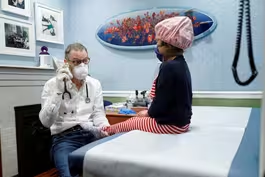
What a federal lawsuit means for kids health care in Florida
Video has Closed Captions
What a federal lawsuit filed by Florida means for low-income children’s health care (8m 20s)
Providing Support for PBS.org
Learn Moreabout PBS online sponsorship
- News and Public Affairs

Today's top journalists discuss Washington's current political events and public affairs.

- News and Public Affairs

FRONTLINE is investigative journalism that questions, explains and changes our world.











Support for PBS provided by:
Major corporate funding for the PBS News Hour is provided by BDO, BNSF, Consumer Cellular, American Cruise Lines, and Raymond James. Funding for the PBS NewsHour Weekend is provided by...