
February 27, 2028
2/27/2026 | 55m 52sVideo has Closed Captions
Jay Inslee; Werner Herzog; Steve Boyes; David Brooks
Fmr. Democratic Governor of Washington Jay Inslee discusses Pres. Trump's climate rollbacks. Director Werner Herzog discusses his new project "Ghost Elephants" alongside conservation biologist Steve Boyes. Longtime New York Times Opinion columnist David Brooks discusses his departure from the paper and what's next for the writer at The Atlantic.
Problems playing video? | Closed Captioning Feedback
Problems playing video? | Closed Captioning Feedback
February 27, 2028
2/27/2026 | 55m 52sVideo has Closed Captions
Fmr. Democratic Governor of Washington Jay Inslee discusses Pres. Trump's climate rollbacks. Director Werner Herzog discusses his new project "Ghost Elephants" alongside conservation biologist Steve Boyes. Longtime New York Times Opinion columnist David Brooks discusses his departure from the paper and what's next for the writer at The Atlantic.
Problems playing video? | Closed Captioning Feedback
How to Watch Amanpour and Company
Amanpour and Company is available to stream on pbs.org and the free PBS App, available on iPhone, Apple TV, Android TV, Android smartphones, Amazon Fire TV, Amazon Fire Tablet, Roku, Samsung Smart TV, and Vizio.
Watch Amanpour and Company on PBS
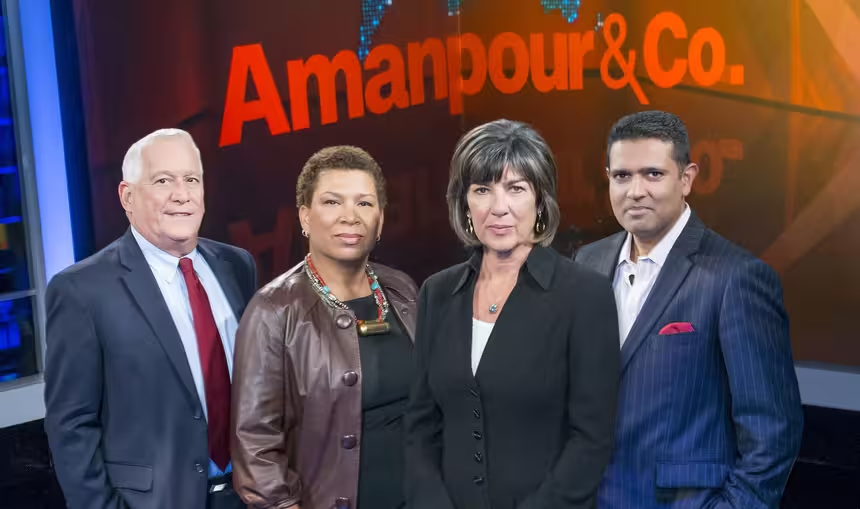
PBS and WNET, in collaboration with CNN, launched Amanpour and Company in September 2018. The series features wide-ranging, in-depth conversations with global thought leaders and cultural influencers on issues impacting the world each day, from politics, business, technology and arts, to science and sports.Providing Support for PBS.org
Learn Moreabout PBS online sponsorship(dramatic music) - Hello everyone and welcome to Amanpour & Co.
Here's what's coming up.
- This is a cataclysmic blow to Americans' health.
- The truth behind Trump's repeal of a landmark climate ruling, a move that could fill the nation's skies with pollution.
Former Washington Governor Jay Inslee tells me why despite it all, he's still hopeful.
Then.
The largest elephant ever.
Does it matter if they are a dream or a reality?
The search for a lost species.
I speak with acclaimed director Werner Herzog and explorer Steve Boies about their new documentary, Ghost Elephants.
Also ahead.
You know, and I reflect back on the times since I joined the Times in 2003.
It's there's been just a tremendous loss of faith.
Time to say goodbye.
As his 20 year tenure at The New York Times comes to an end, columnist David Brooks reflects on how America has changed during his decades at the paper.
Amanpour & Co.
is made possible by Committed to bridging cultural differences in our communities.
And by contributions to your PBS station from viewers like you.
Thank you.
>> Welcome to the program everyone.
I'm Paula Newton in New York sitting in for Christiane Amanpour.
This week President Donald Trump delivered the longest State of the Union address in history.
Near the top of his agenda, the devastating deadly flooding in Texas last year.
A disaster so severe, the president said it was one of the worst things he'd ever seen.
And yet, no mention of why the nation is seeing more extreme weather events.
Now a court will determine how much power the government really has over climate action.
Several groups have filed a lawsuit against the Environmental Protection Agency after the Trump administration moved to rescind the endangerment finding.
The finding says that greenhouse gases are not just bad for the planet, but actually harm human health.
That simple conclusion became the foundation for nearly every rule limiting pollution for the last 17 years.
Killing it could prevent future presidents from taking meaningful steps to fight climate change.
Our first guest became known as America's greenest governor.
Just last year, Jay Inslee said Trump can't stop the clean energy revolution.
But after months of major rollbacks, does he still feel the same way?
The former Democratic Governor of Washington State joined me from Portland, Oregon.
Governor Inslee, welcome to the program.
Appreciate you being here.
Good morning.
I want to talk about this concept of endangerment, right?
It can kind of seem a bit vague at times, but the stakes are quite high.
What dangers are we talking about here?
And what happens when these regulations are no longer in effect?
Well, this is a cataclysmic blow to Americans' health.
We know that the government has an obligation to protect American citizens with the air they breathe that won't give them asthma and cardiovascular problems, that won't have children choking on forest fire smoke.
And unfortunately, what President Trump has done is pull the rug out from under almost all of the ability of the federal government to protect Americans' air to breathe.
And I can't think of something as more personal and jurious to Americans, because we have been choking on pollution, and this would eliminate the federal government's action to reduce the pollution going into the air.
The endangerment finding is something that's been in place for decades.
It is clear, absolute science.
In fact, it's interesting, the administration gave up an argument that climate change is a hoax.
They've been saying that for 10 years, but they gave up that argument.
Now they've got this little loophole they want to get through, but they're not going to succeed.
And there's going to be litigation on this.
I believe it is likely the endangerment finding will be restored and the protections that Americans deserve against pollution is going to be restored.
And I'm very hopeful about that.
And we will talk about the legal claims here, but EPA Administrator Lee Zeldin, you know, they claim this is good for business, that ending this finding would save auto manufacturers, I mean, their guesstimate over the next decade, $1.3 trillion.
I do wonder where you believe they're getting those numbers from, but also if they have looked to balance the other side of the equation, because of course, there are significant costs to ending this.
So where do you think they're making the argument here?
Because you know as well as I do, they have had businesses lobbying them for this.
Well, where they get these numbers is the same place Donald Trump gets numbers, which is out of thin air.
You know, he said he's going to reduce inflation by 1000%, which of course is mathematically impossible.
He says he's eliminated inflation, which he hasn't.
In fact, he's driven up our electrical prices 12 to 13 percent nationwide.
He's cost us $92 billion of additional electricity prices.
So that's the truth.
And in fact--and this is pretty stunning.
A couple of months ago, the administration said, we're not going to consider the health of Americans when we decide whether or not to protect them or not.
That is a stunning statement.
Now look, I believe in economic growth.
I was a three-term governor.
We had some of the best economic growth in our state's history.
So I think it's important.
But you don't have a good economy if you have people who are sick and dying.
You don't have a good economy in the forest products industry if the forests are all burning up.
You don't have a good economy in the fishing industry, which we have in the state of Washington, if the fish are dying by the millions 'cause the water is getting too hot because of climate change.
You don't have a good economy if people can't afford home insurance because of these fires.
We have vast swaths of Americans now, it's almost impossible to get insurance against fire because climate change is causing so much havoc in these communities.
So this is bad for our health and bad for our economy.
That's the reality.
The most stunning thing about this endangerment finding is they argued again that this was a hoax, but they gave up that argument and they knew they could not make that argument that climate change was a hoax 'cause they get laughed out of court.
So now they're trying to argue that some ridiculous argument that the federal government can only protect us within 100 yards of a smokestack, which is just stupid.
You know, that's like saying that we couldn't protect ourselves against a terrorist who puts arsenic in the reservoir because it's miles away at the end of the pipeline.
It's a ridiculous argument.
I believe it will fail and we will again restore America's leadership in clean energy and defeating climate change.
I want to get to some of the legal basis here for this, because this is the next battleground for this.
Many have criticized the basis of the EPA's claims, as you just explained.
So, we did have a first lawsuit launched against the agency.
It was filed by environmental and health groups.
Manish Bhatna, he's president and CEO of the National Resources Defense Council, and I'm going to quote him here.
He said, "We will see them in court and we will win.
The science and the law are crystal clear and EPA is issuing a rushed, sloppy and unscientific determination that has no legal basis."
Governor Inslee, I ask you, you are an attorney, a former prosecutor.
I do want your opinion on this because some argue that the determination, the finding itself of endangerment, it needed more fundamental grounding in the law and that this could actually be a failing, that even this kind of challenge could fail in court.
What's your opinion?
Look, these people have a losing hand and they know they have a losing hand and I'll tell you why.
So the law is very clear.
Since 2007, there was a Supreme Court case out of Massachusetts.
It made very clear that the federal government has an obligation, an unalterable, non-amendable obligation to protect Americans' health and lungs against pollution that is harmful to health and welfare.
This is a legal obligation.
It's been through multiple Democratic and Republican administrations.
Now, here's the deal.
Trump has argued for 10 years, you've heard him a thousand times, saying that windmills cause cancer and that climate change is a hoax.
What happened is, is that when they actually came time to destroy the endangerment finding, they gave up that argument.
They know climate change is real.
They know they cannot make an argument.
They know this is bad for the general health and welfare of the United States.
And in a stunning retreat, they gave up this ridiculous argument.
Again, because the science is so profoundly overwhelming, and we're experiencing it with our own eyes, seeing the floods and the forest fires and the glacial retreat and the warming waters and everything else, the science is so overwhelming, it is impossible even for them to argue that these gases are not dangerous to our health and welfare.
Instead, they shifted arguments so this law doesn't apply.
Governor Inslee, we're pretty clear, right, that this is likely going to end up in the Supreme Court.
I don't have to remind you of the conservative makeup of that court.
Are you 100 percent confident that when they get to the end of the road, the Supreme Court, that this will be struck down, that they won't be able to go through with this?
No, I've never been 100 percent confident of any lawsuit I've ever been involved in.
But I have been willing, through 20 years of trial experience, to tell my clients what's highly probable.
I believe it is highly probable that Trump will lose this lawsuit.
And the reason is, is the science is so clear.
Look, you cannot repeal the laws of gravity.
You cannot repeal the laws of physics.
And you cannot repeal the law of climate change, which is the federal government has a legal, binding, statutorily, congressionally approved obligation to protect Americans against this pollution and simultaneously reduce their electrical bills.
This is something we haven't talked about.
This is going to cost Americans a lot because Trump, because of this, is trying to deny Americans access to renewable energy.
He wants to shove coal down our throats, which is more expensive than solar wind.
So the laws of physics are going to mean that you can't make an argument that this is not bad for human health.
And as I've indicated, in a stunning development, they actually gave up that argument.
So I think it is highly probable that he will lose, as he does.
We sued Donald Trump before breakfast almost every morning, and we've got about an 80% of success rate so far against him.
So yeah, we'll see him in court.
I look forward to that.
Governor Inslee, look, you've been unfailingly optimistic about the environment in terms of what is to come, and for you and others to be able to fight this with the EPA and others, but I ask you, even in the interim, even if you don't believe that this will stand, what's the loss here?
I mean, we saw what happened with the tariffs.
There's already been a lot of damage done despite the Supreme Court ruling against them.
So what are your fears in the months to come?
Well, listen, this is clear.
It does slow down our progress.
It costs us money in utility rates because he's, again, making us choke on coal-fired pollution at the same time we choke on our utility bills, which have gone up 13%.
Remember, this is a guy who ran for office saying he was going to reduce our electric costs.
He said he's going to cut them in half.
Well, they continue to go up because, again, he is in this kind of corrupt bargain with the oil and gas industry.
Look, they went to Mar-a-Lago, these executives, and he basically said, look, if you guys give me a billion dollars for my campaign, I'll come through with you and choke off your competitors, because they don't want to compete with solar and wind because it's cheaper.
So he's fulfilling that devil's bargain, and it's costing us a lot of money.
Now, here's the good news, though, and I always want to say there's some good news.
Our states have the ability to move forward to develop our clean energy economy.
There's 23 states.
We represent over 60 percent of the United States.
We're in the U.S.
Climate Alliance.
This is a group I started years ago when Trump first showed up.
And this alliance, all of these states are moving forward on clean energy.
And Donald Trump cannot stop our states doing a lot of great work here.
We have a Climate Commitment Act that now is getting cleaner air and more help for Washingtonians.
This work is going to continue in our states.
For Washingtonians and also very large states like California, Governor Gavin Newsom has promised to sue against this action.
And he says that, look, they will continue fighting climate pollution.
In terms of the strength of the states, right, do you believe this will completely supersede whatever happens on the federal regulation?
Or does it kind of leave the states still at a disadvantage?
Well, we have the ability in our own jurisdictions, it is called the United States of America, and states have their own jurisdiction and authority to control to a large degree, our own destiny.
And I'll give you an example .
We have a climate commitment act.
It's a state law.
It limits the amount of carbon pollution.
It hurts our health.
It generates about $4 billion that can help Washingtonians get access to heat pumps and electric school buses and EV chargers and the like.
The conservatives have tried to repeal this.
They went to the ballot box to try to repeal it.
We had an initiative in 2024.
We won 62 to 38, massive, massive support for this law.
And Donald Trump cannot stop the state of Washington to moving forward on that.
He cannot stop these states in their march to a clean energy future.
He can slow down some of the federal efforts, but our states still have four wheels on the road and we're moving forward, and we're making dramatic progress.
So hope is not lost.
The federal government's going to be back when the Supreme Court, I believe, gets hold of this endangerment finding and slaps down yet another Trump illegal activity, like they did on tariffs the other day.
This was a major decision that we're going to follow the law, still, and it was very heartening to many of us that the Supreme Court stood up to him.
And I believe it's likely they'll do the same thing on the endangerment finding.
In the interim, we all can do things in our states to move the needle forward.
And I'm excited to say Washington's leading that effort.
Governor Inslee, you are true to type, optimistic.
What do you say to people that are not as optimistic as you and they see the legal challenges here, but obviously see in their own communities so many of these environmental regulations being repealed because business says they can't compete unless some of this regulation is repealed?
I mean, what worries you about this?
Because as I said, there is a lapse in the interim, right?
Even if your long-term optimism holds true.
Well, you just got to look around and look at other people who have had difficult things in their life.
I always think of Nelson Mandela.
You know, when I think about, geez, Trump's doing another stupid illegal act.
We're going to have to get the Supreme Court.
It's a real pain.
But then you look like Nelson Mandela.
He was in solitary confinement for 27 years and came out and built a new country.
You look at the civil rights movement that took decades, and the suffrage movement.
This is a long slog.
We are building a clean energy economy.
You don't do that overnight.
You're going to have some ups and downs in a long struggle.
The suffragettes took a lot of struggles.
So I think taking inspiration for people who've gone before, who have a righteous cause that's going to help their fellow citizens, and you get up in the morning and you can do what you can do.
That's why I'm excited to report to you and the state of Washington that we're making big progress on this subject.
So be of good heart, continue fighting, and we'll get to the sunlit uplands, as Winston Churchill used to say.
As I said, you remain true to type.
And there are a lot of communities right now wondering about the air that they're breathing, the water that they're drinking, and they will be watching these cases quite closely because it is existential to them.
Governor Inslee, we will leave it there.
Good to see you.
You bet.
Be well.
Cheerio.
Now, from the Peruvian jungle to the Carpathian mountains to Antarctica's ice caps, acclaimed German filmmaker Werner Herzog is known for shooting in the world's most extreme corners.
His latest project, Ghost Elephants, took him to the eastern highlands of Angola to chronicle one man's search for an elusive herd of elephants believed to exist only in legend.
Here's part of the trailer.
Ghost elephants are giants living in these high altitude forests, like a temple.
They're up there in the sky.
We accompanied Steve Boyce to the Angolan highlands to find the elusive ghost elephants.
Helicopters, camera traps, hundreds of them.
Still never seen one.
We're the last trackers alive that can identify an elephant by its footprint.
And it's with them that we are going to see a giant elephant.
Part adventure, part meditation on man's search for meaning, conservation biologist Steve Boyd spent more than a decade looking for answers.
I speak with him alongside Werner Herzog about chasing their own white whale.
Thank you both for being on the program.
Really appreciate it.
Especially as you try and parse the... Is it the beginning or the end of this project?
We're not exactly sure.
I mean, Steve, I do want to start with you.
The theory of ghost elephants.
This has been a lifetime search for you.
Explain how this begins with Henry and why you were so passionate about this.
And I have to say, passionate doesn't even begin to describe you and your search for the so-called ghost elephants.
Well it began in 2015.
We crossed the entire Okavango Basin, this is across three countries, four months on the river and it was after a month in this remote part of Angola, West Africa, that I found a clearing where there was elephant dung, signs of a big bull elephant, and we never imagined to find elephants there.
And that was the beginning of the search, so it's 11 years ago.
But six months later I found out about Henry in the Smithsonian, the fact that this elephant was shot right in that area, and that we had a chance of potentially finding Henry's descendants.
Henry is the giant elephant standing in the main rotunda of the Smithsonian.
This is the largest elephant ever recorded, the largest living land animal ever recorded.
But why such an intense passion about Henry, his descendants, and trying to find what are determined to be ghost elephants?
You didn't know if they even existed?
No, I mean, in 1900 there were 10 million elephants across Africa.
There are now 400,000.
So in a sense all of the populations are ghosts.
But these specifically, it took us seven years to get the first trail cam photograph.
We had high-tech, 180 high-tech cameras out there.
They are motion sensing, heat sensing, and it takes seven years to get one photograph in black and white of an elephant like that.
That's the first evidence we have that they exist.
I've been on Fatai mountain bikes, motorbikes, hiking, camping, living out in those valleys.
You can smell and sense them.
You just don't see them.
They're ghosts.
They're described as ghosts by the local Luchazi hunters, the local people there, by the traditional leaders, the kings.
These are the ghost elephants of Lucema.
And Werner, I want you not to attempt to be modest here.
You are a giant of film, both fiction and non-fiction.
You meet Steve, Steve Boyce, an intense man on this singular purpose.
What attracted you to him and this project?
We met by a chain of coincidences.
A common friend said to me, "Oh, do we have a moment?
Come down in the restaurant in Beverly Hills."
Of all places, there's a friend or somebody whom I know, Steve Boyce, you must meet this man.
So I said, OK, I'm coming down.
So we met.
And within five minutes flat, when I knew what he was after, I said, we have to do that together.
It seemed-- it was so convincing, so easy, there was no persuasion.
In terms of the way you construct this, though, this is-- the narrative of this is really like a mystery.
And it is mesmerizing throughout.
And you do not know where it is going to land.
What in your experience of filmmaking led you to this narrative in this film?
Because it really does unfold like a mystery.
Well, the narrative comes out of the footage.
You cannot superimpose a preconceived idea in the structure and squeeze the footage into it, because we would never know would they actually find the ghost elephants.
it would have been a different film.
And my commentary would have to address it in a different way.
But it comes with ease.
I'm a storyteller.
And I want to make a film that's never not for half a second boring for everyone, for anyone.
And the linchpin of this for me was the visuals underwater of the elephants, almost like a ballet.
How did that come to you in terms of shooting it that way and how do you believe it impacts the film?
You see, the film has a title "Ghost Elephants" but it's not a wildlife film.
It's more about the dream of elephants, the ghosts, the spirits of elephants.
And there was footage, we had footage of elephants underwater.
But of course, the camera sometimes would go above the level of water and show the elephant.
Actually, the elephants are waiting almost chin-deep for a cameraman in the water.
The camera is just like on a broomstick under the water, films the legs.
Elephants feel comfortable in the water.
They do not feel threatened.
And you can approach them, you can see sometimes the camera almost touches the legs of the elephants.
And the light, the rays of the sun and the quasi-slow motion underwater has such a beautiful effect.
And I've never seen footage of such beauty.
And I said, "This has to be in the film.
If it's not in the film, we don't have a movie."
Part of the, as I said, the mystery of this movie is whether or not you are going to find your ghost elephants.
I thought it was interesting and it is riveting this one piece in the film where Werner asks you, "Does it matter if this hunt turns out to be a dream?"
and you respond, "No, it doesn't matter.
That's almost better.
Then they'll always exist."
What do you mean by that?
Well, they are still a mystery to me.
I've been back five or six times since we filmed.
I go back all the time.
I'll be going back very soon in May to search for them, to get to know them.
We can do that genetically, but much better in person, in their landscape, in their valleys, these sacred, secret valleys of the Kangala people.
So it's these places so remote, so unseen, are dreamscapes.
I say in the film, it's like living in a dream that you never had.
It's just the fact that these places are so uncreated by man, only created by elephants.
And in fact, we have a clip now of you waiting.
This is the uninhabited Angola Highlands.
So much of where you've been and where you've traveled on this mission.
We are following the tracks of Lujazi tribesmen who spend the dry season here hunting antelopes for meat and skins.
(music) A base camp is set up.
Our Namibian trackers have settled in well with the Luchasi tribesmen.
The motorcycles have to stay behind now in order not to disturb the elephants.
The next 30 miles must be on foot.
You just described a little bit what it's like to be in this environment and yet it really is a scarred landscape in so many ways.
How did you reconcile all of that?
- Well, 10 years ago, it took us six months in armored vehicles to get through active minefields to get there.
There were no roads.
We just were following cut marks in trees that indicated hunters had been there.
It's traumatized by 27 years of civil war.
The rebel leader Jonas Savimbi was born there and he was assassinated there.
But I found that that trauma brought the people together in isolating them.
They became closer to culture, language, and tradition, and in regard became closer to the elephants as sacred beings, as people to them.
That is why these elephants have been kept so secret for so many centuries, protected by the people.
Bernard, we had Carolyn Costa in terms of what Steve is speaking about.
He is a man who even as a child saw atrocities that no one should see in Angola.
He says so poignantly in the middle of this, it really almost brought me to tears.
He said, he discussed how not only was this a ravage on humans, but it was a ravage on the landscape, on the animals.
And he says that when he witnessed humans, and this has gone on for decades, not just in Africa, humans really desecrating, decimating the animals and the landscape.
He says, "Humans fighting against creation," is what he describes it.
And he adds that, "As if man is on a mission to destroy what he is part of."
Werner, how is Steve's mission here and what you've done redemptive to that?
The gigantic elephant Henry, 1955, was shot dead by a Hungarian-born big game hunter, Fenni Köfi.
It took him 19 bullets to bring this giant down, pursuing the elephant over 15 kilometers in a Land Rover, shooting, shooting, shooting until it was down.
And remarkably so, of course, the media took notice of this event, of this gigantic elephant, but it was Sports Illustrated, 1955, celebrating the world record of the hunter, the sportsman.
Thanks God our attitude is changing and has changed.
And I'm showing in the film right after Carlin Costa speaks about this terrifying slaughter.
I show excerpts of a 1965 Italian film, "Africa Adio", a very repulsive film, racist and you just name it.
But they managed to shoot footage of unspeakable terror of helicopters pushing the elephants right in front of the hunter who is waiting with his rifle.
So hunting by helicopter or the helicopter actually pushes the elephant in a good position for the hunter.
And today, today we have a different attitude, thanks God.
But it's a long process and it is not over yet.
And when I talk about it perhaps being redemptive, how was it for you in terms of the people that guided you through this mission?
And this really is the master trackers.
We want to have a look now.
Because his arrows are poisoned, Cui's bow is small.
He's one of the greatest trackers alive.
He can read tracks in the sand as we would read a newspaper.
But he reads with all his senses.
He hears a bird alarmed and this tells him a leopard might be nearby.
(speaking in foreign language) He sniffs the air for the scent of elephants.
(speaking in foreign language) He senses the ground vibrating from the hooves of fleeing Rowan antelopes.
- Tell us more about these master trackers, what they meant to you, and they really are the wise men of this entire mission in terms of me as a viewer watching it.
- Well, they will show you the birthplace of religion, the birthplace of science, experiencing a trance dance with the healers, preparing us to leave.
It was a three-year process to live in the homesteads, gain their trust, become friends, become family before we went to Angola.
Angola is a place of horror to them.
Koebis had run away as an eight-year-old child, as a refugee away from the war.
Kwee David, one of the master trackers, had been in the military.
That's where he had learnt Afrikaans.
So they knew that trauma, but these are people whose interaction with an elephant footprint is the same as ours with a human face.
So they've seen it once, they see it again, they'll recognize it, and then they'll give it a name.
And they will come up with a narrative for what happened over the last week with every single animal, whether it was hunting, whether it was sleeping, whether it was sad, whether it was happy.
I mean, it is an extraordinary connection to nature that they can show us, not just in their spiritual beliefs, but in their activity of life.
Living in the homesteads, I feel inadequate as a parent, as a partner to my wife, because of the closeness of those families.
The entire family is in constant contact with each other throughout the day.
Everything is leveled, everything is shared, everything is equal.
And great self-confidence as who we are.
The very first encounter in the film that I had was with the main tracker, Cui.
And I asked him in your language, you name yourselves the real people.
What I am, what am I then?
Am I still half an animal?
Because I have hair on my chest.
So he laughs.
And so and within within 10 seconds flat, you have a you have a rapport and with great self-confidence.
I mean how they encounter us.
It's just wonderful.
And with generosity as well.
Right.
Yeah, just the way they took you in.
Steve, I don't know if this is a rhetorical question for you now.
Do you find your ghost elephants?
It is poignant the way you've put this mission together and what it means to you now, later, when you have a chance to reflect on.
The search is never finished.
I was there just a few months ago and I followed two breeding herds and five bull elephants.
We were taking genetic samples from their dung.
I did not see them.
Then they came together and when I'd come back to camp and describe the story, it's like I was with them.
So my experience of the ghost elephants is as ghosts.
I felt like I was with that gathering.
I was one hour behind them.
It was 40 elephants greeting each other and having these stories told to me by Kui and the master trackers.
So that experience continues.
And as I say in the film, for the rest of my life I will be going back to those valleys.
Steve you're a very intense man and I do not pretend to understand you know really your passion and your mission here.
I know so much more after watching you.
I am wondering, the two of you, what did you learn from each other and how will it inform both of you going forward in any work that you do?
For me, wonderful to be in a life that is primordial, in an area that is pretty much unknown to all of us.
And you see the highlands of Angola are unpopulated.
There are no bridges, no roads, no villages, nothing.
You have to cross rivers wading through and carrying the motorcycles on your back.
And this area alone is the size of England.
It's the size of England.
And in some of these valleys, you find the ghost elephants.
That, by the way, is a very good argument against why are we pointing out where we are.
I mean, we are showing an area as wide as England.
But do we give hints to future poachers?
No, we are not.
We are dissuading them.
You cannot land a helicopter.
It's way too far out there.
You cannot fly back.
Your fuel will not be enough.
It is protected by the local people and the local king, who knows his people are related to elephants.
So it's more dissuading any hunters, illegal poachers.
So that in my mind, I had the feeling this was something I had to do.
You see, sometimes you have to do it.
I've been spending a long time telling stories, translating science with narrative and characters and meaning and truth.
And in meeting Van I found someone that I could truly be myself, reflect on how I truly feel about my experiences in wild places.
I'm a well-published scientist, I have large scientific advisory boards and 54 scientists working on my program.
But the reason I do this isn't that, and Vanna allowed me to explore that.
It will be carried into the storytelling I do in the future, the confidence with which I am able to communicate this.
I started writing two books after meeting Vanna and finding this freedom in storytelling.
And congratulations to both of you.
Thanks for being on the program.
Appreciate it.
Thank you.
Ghost Elephants premieres in select theaters today.
It airs on National Geographic on March 7th and will be available to stream the next day on Disney+ and Hulu.
Now, after 22 years, columnist David Brooks is leaving the New York Times.
His final column, "Time to Say Goodbye," is a reflection on how much America has changed in those two decades, citing diminishing trust in institutions, technology, and even in one another.
Brooks breaks down what he describes as a collective loss of faith.
He joins Hari Sreenivasan to discuss what it would take for the nation to come back together.
- Paula, thanks.
David Brooks, thanks for joining us again.
You have worked at the New York Times as a columnist for 22 years.
That is a long time in any job.
You recently wrote your last column for the Times, and we'll get to what you said in the piece in a moment, but I guess, what's the message that you wanted to leave the readers with?
- Well, I was reflecting back on my time at the Times, and of course, I came to be a moderate conservative, and I figure that moderate Republicans are now so dominant in American life that my work here is done.
So no, I'm kidding.
I've been an utter failure to persuade people around to my point of view.
But, you know, we're in a moment, you know, and I reflect back on the time since I joined the Times in 2003.
It's there's been just a tremendous loss of faith that Americans have lost faith.
They've lost faith.
The Iraq war caused us to lose faith in America's role abroad.
The financial crisis caused people to lose faith.
The idea that unregulated capitalism would produce broad prosperity.
The Internet did not bring us all together.
It brought strife.
We have declining levels of social trust.
And so there's been a sense of disillusionment and a loss of faith.
We've lost our humanistic core.
All the things that make us more human, whether it's literature or religion or history or good conversation, those all are in decline.
And so I thought, you know, I've got one more 10-year chapter in my career, probably, maybe my life.
God knows I could die any moment.
But I thought I'd want to use that last chapter to try something new.
And leaving the Times is both exhilarating and terrifying.
But I thought I should try it.
Thank God I can still stay at the NewsHour.
You know, you wrote in your piece a little bit about your evolution.
It said, "I've switched from being solidly right to vaguely centrist.
I've moved left on the death penalty, rightward on abortion, and leftward on economic policy.
In the 1980s, I thought stagnation was the core social problem, so I sided with Republicans.
By the 2000s, I concluded that inequality was the core social problem, so I sided more with Democrats.
Berlin once said he was happy to be on the rightward edge of the leftward tendency.
That's where I'm happy to be today, a conservative Democrat.
And I wonder, have your beliefs changed since starting at the Times 22 years ago?
I mean, or is this a case of, you know, I didn't leave the party, the party left me?
I would say foundationally, my beliefs have not changed too much.
My two intellectual heroes are one, Edmund Burke, who was an Irish philosopher in the 18th century.
And Edmund Burke believed in epistemological modesty, that the world is just a really complicated place, and we should be careful about how we think we should change it.
So we should do change that's incremental, but constant.
Burke said we should operate on society the way you would operate on your father, surgically.
So just be gentle.
And I still believe that.
The world is really complicated, and a lot of our plans go awry because we don't understand how complex the world is.
My second hero is Alexander Hamilton.
And Alexander Hamilton is a Puerto Rican hip-hop star from Northern Manhattan.
(laughing) And so Alexander Hamilton believed in creating a country where poor boys and girls like him could rise and succeed.
He believed in social mobility.
And so those two things are still the core of what I believe.
The problem is the Republicans are conservative in no way.
They're not Burkean gradualists and incrementalists.
They believe in radical revolution and dismantling.
So they've become not conservative, but reactionary.
And progressives, I still don't totally agree with, but I can't be a Republican these days.
So I'm happy to be a conservative Democrat if you've got to put me somewhere.
But my beliefs have partly on policy have changed, as I say, because, you know, the issues change.
What's the crucial issue of our time?
I always think it's very important to ask, what year is it?
And when I was in college in the early '80s, we really did struggling from stagnation, if anybody remembers the Carter era.
And so I thought Reagan and Thatcher were right to boost us out of that.
And then inequality, and I thought Barack Obama, and I think Joe Biden was right to redistribute money to people without college degrees.
Now I think the primary problem is social and relational and almost spiritual.
We've just become sadder and meaner as a society.
As I say, loss of faith, loss of trust.
And so to me, the core arena, if you believe that our problems are primarily spiritual, moral and relational, it's not in the realm of politics, it's in the realm of culture.
And so I want to be to play in that playground with a lot of other people who are working on the same thing.
It's interesting.
I wonder is this, if you look at a young person that's growing up today, depending on when they were born, perhaps their earliest memories might be of their parents talking about the Iraq War.
Perhaps it's about the impact the financial crisis had on their home or their life.
Or certainly this is a generation or two that have grown up now with the internet front and center that is altering their perceptions of reality.
I mean, it's almost like, can you blame them for this lack of trust?
Yeah, I spend my time around a lot of kids and a lot of young people, including my own kids, and they think you have left us a mess.
Your generation has destroyed a lot of things we believe in.
And one of the most important statistics is interpersonal trust.
People ask, "Do you trust your neighbors?"
And people in my generation, boomer Gen X, 60% say, "Yeah, I trust my neighbors."
For millennial and Gen Z, it's 19%.
And I saw a survey where they asked millennial and Gen Z, "Do you think most people are selfish enough to get you?"
And 72% said yes.
And so that's a, they've just seen a world that's become hostile and bitter and rejects them.
Whether they're trying to get into school or get a job, it's just become a lot harsher.
And their social life has no rules.
I often ask my students, "Why are you guys so high in distrust?"
And they say, "Have you seen my social life?"
I had a young woman say, "I've had four relationships in my life, and all the guys ghosted me at the end."
They didn't have the decency to have a breakup conversation.
So she said, "Of course I'm distrustful.
That's my experience.
People have been untrustworthy to me.
And so I don't blame the young people for reacting to the world they see around them."
I would only say that America goes through a process of rupture and repair.
When you ask people, "What made you the person you are?"
No one ever says, "I took this fantastic vacation in Hawaii.
That made me the person I am."
Nobody ever says that.
People talk about a hard time.
That's true in individual lives.
It's true in our national lives that we go through periods of rupture and repair where we have to tear down the old culture because it's no longer working for us.
It happened in the 1830s with Andrew Jackson populism.
It happened in the 1890s when we failed in industrialization.
It happened in the 1960s with riots and bombings and assassinations and it's happening now.
And the good news is America's been here before and through a process of rupture and repair we're going to come out of it because we are creative and the best part about America, if you ever get despairing about this country, write all the problems of America on one side of the legal pad, and then on the right side, write this sentence, "America has more talent than ever before."
And column B is more important than column A. You know, that, you're making a good case for trying to be optimistic.
Let me pose a counterpoint.
I mean, I think there are a lot of people that say, "You know, that's great, David, this history lesson, but the pace of change is so much more rapid now.
Look at what these AI tools can do.
What am I gonna come out of college?
And what kind of job am I gonna be able to do when entry-level work is going to be increasingly farmed out to Claude and Chachi P.T.?
And there's the talent that you're talking about is because of some of our immigration policies and how welcoming we are as a nation.
Some of that talent is deciding to stay elsewhere on the planet.
- Well, I'd say, first of all, think of somebody who was born in 1890 and died at age 80 in 1970.
They were born into the era of the horse and buggy, and they died at the moment of man on the moon.
That is an immense amount of social change, and frankly, more social change than we have had in our lifetime.
Industrialization was massive, two world wars, a Great Depression.
There was a lot going on, and they were able to adapt.
And so I just think we've been here before so many times.
And then if you ask me, I don't know what the future of AI is, neither does anybody else, but I do think it's gonna create a new form of intelligence and that will make us more productive and we'll have to figure out the dislocations.
But think of how poorly America used this talent until recently, recently, until say the mid 1960s, women, we were not using their talent to anything like their full capacity, black people, Jews, any ethnic group basically.
We were mining the talent of a few white WASPy guys whose family came over on the Mayflower, the man with the boat after that.
So we were squandering massive amounts of talent.
And now the situation, even despite what's happened over the last few years, just so much better.
I mean, when I do a lot of reporting on AI and I go to the research facilities, open AI and places like that, you know the hardest part about writing about AI?
It's spelling the names of the researchers 'cause they're from Ghana, they're from Indonesia, they're from all over the world.
And despite the crackdown on immigration, you look at that, or you go in any college classroom these days, it looks totally different than it did 60 years ago, but the kids are eager.
And frankly, as someone who came from an immigrant background, at least my grandfather, they've got that hustle.
They've got the same hustle.
It's weird for me to go to New York where my family really grew up on the Lower East Side, and see people who look very different from me, but they speak exactly the same as my grandfather spoke, about, "I'm going to make a difference in the world.
I'm going to do something big."
And to go back to Alexander Hamilton, he brought that spirit, and he brought that energy, and I think they do, too, today.
-You point out that that has been part of the American DNA, but we're seeing, with the election and re-election of President Trump, there's enough people in this country that have kind of a nativist streak, that want to hearken back to a time where things didn't look like the Lower East Side that you're describing today.
Right, and that is true.
There are people like that.
I don't think they're the majority of the Trump coalition.
I think there are some people who just like, "We should live in a white America."
I think the majority of the coalition took a look at the country and said, "The highly educated class is not paying attention to people like me."
That there's a chasm between those who went to college and those who didn't.
The people who went to college live 10 years longer.
They're much less likely to be obese, much less likely to die of opioid addiction, much less likely to get divorced, much less likely to say they have no friends.
And so we've opened up this chasm.
And if when you open up a chasm and generation after generation, the same families have the advantage, the rest of the country is going to flip the table.
So my problem with Trump is that, well, the good thing about Trump is he's never completely wrong.
When he attacks an institution, there's usually something that institution should have been doing to reform itself.
The problem with Trump is that he overreacts.
And so, like, he attacked the universities.
And he wasn't entirely wrong about the universities.
They got a little progressive monoculture.
They got a little too elitist.
They got a little too pre-professional.
But the problem is he goes in and he's seeking to defund them, to destroy them, to really crush their ability to do research.
My line about Trump is that he's like you go to the doctor with acne and the doctor says, "You know what will cure acne?
Decapitation.
We're going to chop your head off and that'll cure your acne."
And that's Trump.
He just destroys.
But the good news is, and let's take this example of the universities, this is the best moment for university reform of my lifetime.
That wherever I go, and this is hundreds of schools, they're doing more character education because they look at the occupant of the White House and say, "You know, we haven't been doing good enough character education."
Then there's a lot of citizenship courses that are now going on, a citizenship program.
How do we raise people to be good Democrats, in the small "d" sense of the word?
And then how to do life.
A lot of this column you also dedicate, and a lot of your recent work, you've talked about character, you've talked about moral decay.
In the case of Trump, you said, "Look, he was the effect, he's not the cause of it."
Explain where that decay is coming from.
Yeah, the main story I tell was, we all have to have something sacred as a society, and we all have to have a shared moral order.
There's a historian named George Marston who wrote of Martin Luther King, I'm going to paraphrase, that what gave King's rhetoric such force was his conviction that right and wrong were written into the fabric of the universe, that there was a natural order, and that in that order of right and wrong, which King, being a pastor, would say was God-ordained, that segregation is not just wrong and sometimes in some places, it's always wrong.
Racism is always wrong.
Rape is always wrong.
It's in the fabric of the universe.
And starting way back in the 1950s, I would say, we told people, come up with your own values, come up with your own truth, come up with your own morality.
We essentially privatized morality.
And we said, it's something you have to do for yourself as an individual.
And that was part of the individualistic move in American culture.
The problem is, if you ask everybody to come up with their own morality, their own values, most of us can't do it unless your name is Aristotle.
And so people are morally unformed.
And then there's no shared moral order.
We don't agree on what's right and wrong.
And if we don't agree on what's right and wrong, we can't trust each other because we don't know what you're going to do, what you ought to do.
And we can't settle argument because we have no shared standards.
Walter Lippman, a great columnist, said, "If what is good and evil is what each individual feels based on their emotions, then we are outside the realm of civilization."
And I think in privatizing morality, we left people naked and alone, morally naked and alone.
And they didn't even recognize that somebody with Donald Trump's character was going to lead to bad things.
What should citizens be determined to try to chart a better path forward for themselves and the policies that they want to see in the communities that they want to build?
Yeah, I mean, I think part of it is, is just being learning the skills to spread that moral ecology.
I think we all touch the people around us.
And we can either look at people as objects and treat them as objects, or we can cast what the philosopher and novelist Iris Murdoch called a just and loving attention.
That power of attention is just tremendously important of how you gaze at someone, how you do treat someone with reverence and respect.
And when you do that, you create trust.
And then the second thing that anybody could do is I started this little nonprofit years ago called Weave, the social fabric project.
And we left up people who just help people in their community.
We try to give them some financial support and we try to connect them with others and we try to lift them up in any way we can.
And some of those people are, they're very casual.
They're like, we ran into somebody who said, "I practice aggressive friendship."
Which means I'm the person on my block who invites people over for July 4th for the Super Bowl party.
I practice aggressive friendship.
It's great to do that.
And with other people who really sit with the poor, sit with people suffering PTSD, they mentor kids.
You know, I ran into a guy years ago named Pancho Aguiles who helps, lives in Houston, used to help people who suffered, paralyzed in construction accidents.
He would give them wheelchairs, he would give them the things they would need to lead a dignified life.
They'd have some training in social work so they could help people in the neighborhoods in Houston.
And I once said to Pancho, you know, you radiate holiness.
And he said to me, no, I just reflect holiness, which is the right answer.
And so these people, I'm sure everybody's listening to us, can think of people in the neighborhood.
If I walked up to them and said, who's trusted here?
There are those people in the neighborhood.
And they're leading beautiful lives.
I ran into a woman in Wilkes, North Carolina, who counsels kids who are LGBTQ.
And it's a rural part of Appalachia.
And she is so well-known in her community.
When she goes to the Walmart, if she needs to get out of there in less than an hour, before going down an aisle, she'll like peek in to make sure there's nobody she knows.
But she knows so many people in the town, a trip to the Walmart can be two hours because she's behind the friends.
And we can all do that a little more.
And my theory of cultural change is that culture changes when a small group of people find a better way to live and the rest of us copy.
And that's, you know, Christianity started with 12 guys and now there are billions of them because some people said, you know, that's an attractive way to live.
And the same thing with weavers.
If you know people in your life who are living lives of moral purpose, you're gonna say, you know, maybe I can't be as heroic to that person, but I'd like to do a little more.
And that's part of cultural repair.
I don't think our politics can repair before our culture does.
And that's something we're all participating.
>>> Former columnist at the New York Times and soon to be podcaster as well as writer again, David Brooks.
Thanks so much for joining us.
>>> Great to be with you, Ari.
>>> And that's it for now.
I want to thank you for watching and goodbye from New York.
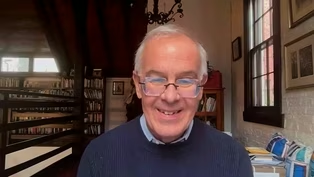
David Brooks: “I've Got One More 10-Year Chapter in My Career, Probably”
Video has Closed Captions
Longtime New York Times Opinion columnist David Brooks discusses his departure from the paper. (17m 56s)
Providing Support for PBS.org
Learn Moreabout PBS online sponsorship
- News and Public Affairs

Top journalists deliver compelling original analysis of the hour's headlines.

- News and Public Affairs

FRONTLINE is investigative journalism that questions, explains and changes our world.












Support for PBS provided by: