
February 3, 2026 | Carolina Impact
Season 13 Episode 1314 | 28mVideo has Closed Captions
Economic Impact of Sports; Spectrum Center Reimagined; Kira Michaw; & History Before Us
How Charlotte went from a pass-through town to a trusted national sports destination city; The two year Spectrum Center Reimagined renovation project is complete; Meet the principal who is determined for her school to ace their state report card; & Videographer Frederick Murphy uncovers Black history facts locally and across the nation.
Problems playing video? | Closed Captioning Feedback
Problems playing video? | Closed Captioning Feedback
Carolina Impact is a local public television program presented by PBS Charlotte
February 3, 2026 | Carolina Impact
Season 13 Episode 1314 | 28mVideo has Closed Captions
How Charlotte went from a pass-through town to a trusted national sports destination city; The two year Spectrum Center Reimagined renovation project is complete; Meet the principal who is determined for her school to ace their state report card; & Videographer Frederick Murphy uncovers Black history facts locally and across the nation.
Problems playing video? | Closed Captioning Feedback
How to Watch Carolina Impact
Carolina Impact is available to stream on pbs.org and the free PBS App, available on iPhone, Apple TV, Android TV, Android smartphones, Amazon Fire TV, Amazon Fire Tablet, Roku, Samsung Smart TV, and Vizio.

Introducing PBS Charlotte Passport
Now you can stream more of your favorite PBS shows including Masterpiece, NOVA, Nature, Great British Baking Show and many more — online and in the PBS Video app.Providing Support for PBS.org
Learn Moreabout PBS online sponsorship(uplifting music) - [Announcer] This is a production of PBS Charlotte.
(light upbeat music) - Just ahead, on "Carolina Impact," we explore the economic impact of sports here in the Carolinas.
(air whooshes) Plus, you'll meet an area principal raising the standard for excellence in our newest segment, Guiding Stars.
(air whooshes) And we kick off Black History Month by highlighting a local videographer who uncovers little-known facts.
"Carolina Impact" starts right now.
(air whooshing) (light upbeat music continues) (light upbeat music continues) (air whooshes) Good evening.
Thanks so much for joining us.
I'm Amy Burkett.
In 1988, Charlotte took a gamble.
A basketball team arrived in town, better known for banking than buzzer beaters.
Back then, uptown was a ghost town after five o'clock.
What followed wasn't just about wins and losses.
As "Carolina Impact's" Chris Clark shows us, it was the start of a transformation that would reshape how this city sees itself.
The economic impact of sports on our region proves it was a gamble worth taking.
(air whooshes) (crowd roaring) - [Chris] Before Charlotte was a destination, it was already a sports town, but nationally, it was a place people passed through, not a place they came to.
- I remember walking into my boss's office at the Miami Herald and telling him that I was going back to Charlotte and he said, "Why would you go back to the minor leagues?
You're already in the majors."
- [Chris] Even people inside the business weren't quite sure where Charlotte belonged.
- Where is Charlotte again?
Wait, I thought it was in Charlottesville, Charleston, West Virginia, Charleston, South Carolina.
- [Chris] That blur began to sharpen in 1988.
(crowd cheering) - We got the Hornets.
We felt like, oh, we're becoming that city.
We're coming a big city.
- [Chris] The Hornets gave Charlotte something it had never had before.
Permanence, a major league identity, and almost immediately, the city was tested.
- They told me, even in my job interview, I think they rolled the streets up at five o'clock in downtown.
- After five, six, it was like tumbleweeds in the desert.
There's nothing, there's nothing down here.
- [Chris] A nine-to-five city trying to host the country's biggest weekends.
It wasn't ready, but it was willing.
And that willingness showed in 1991 when the NBA All-Star game came to town, and again in '94 when the NCAA Final Four arrived.
- What they created was a makeshift, what they called, "Street of Champions."
All these pop-up bars, all these temporary locations and vacant storefronts.
- [Chris] It was improvised, temporary, but it worked.
Charlotte proved it could host even if it had to build the atmosphere from scratch.
Then came the moment that locked Charlotte onto the national map.
- Very pleased to announce that the Carolina Panthers have been unanimously selected as the- (crowd screaming) - [Chris] After one season in Clemson, the Panthers opened Bank of America Stadium and Charlotte stopped being confused with somewhere else and became a city with its name on the screen every Sunday.
- An NFL franchise changes everything for a city.
- [Chris] At first, the stadium followed the rhythm of football.
- Doing something like 17 events a year.
That's not much 'cause 10 of them are Panthers games, including the exhibitions.
- [Chris] That rhythm changed when David Tepper bought the team.
- Now they do a somewhere around 40 or 45, and that makes a big dent, and most of 'em are concerts.
- [Chris] The stadium stopped being seasonal.
- The number one economic driver day-to-day in Charlotte is an active Bank of America stadium.
- [Chris] Today, one in nine Charlotteans works in leisure and hospitality, jobs tied directly to visitors, events and nights downtown.
(whistle blowing) (crowd cheering) As Charlotte proved it could host, it started stacking something harder to earn than events, and that's trust.
- Once that one kind of domino fell, it kind of kept it going.
- [Chris] The NBA moved uptown into Spectrum Center, neutral site events followed, and Charlotte wasn't guessing anymore.
It was organizing.
(crowd roaring) In 2010, Charlotte anchored its racing heritage uptown with the NASCAR Hall of Fame, not replacing the speedway, but reinforcing it.
(crowd clamoring) The annual bowl game followed, then the ACC Football Championship, and Charlotte was a part of the national calendar every winter.
(crowd cheering) When the Charlotte Knights returned uptown, baseball became part of daily life again.
And in the years that followed, the Atlantic Coast Conference made Charlotte its home, bringing championships and major events, not just for one weekend, but repeatedly.
- When they decided to come to Charlotte as a conference, it made sense due to all the factors, the businesses, the airports, all that stuff, but also the ability to host, not only men's, women's basketball here, not only their football championship, but men's and women's lacrosse, baseball every other year, additional championships.
- [Chris] Charlotte wasn't rotating anymore, it was central.
Then came validation.
(announcers exclaiming) (crowd cheering) In 2019, the NBA All-Star game came back.
This time, nothing had to be invented.
The hotels were there, the restaurants were there.
The infrastructure was already built.
- That allows us to talk to Jordan brand and bring the Jumpman Invitational for three years, which then allowed the Dick Vitale Invitational and working with ESPN.
- [Chris] And it opened the door for something new.
In 2019, Charlotte was awarded an MLS franchise, and by 2022, Charlotte FC was filling Bank of America stadium.
- It brings people into the city, it gives people an excuse to get out of the suburbs, and let's come into the city to see a football game, to see a basketball game or a soccer game, or a concert at that.
- [Chris] By 2025, sporting events alone generated $333 million in economic impact.
- It's only now hitting the second generation of fans.
Like my kids never grew up without a sport of an NFL team here.
- [Chris] In fiscal year 2025, events tied to Charlotte generated $1.2 billion in economic impact.
33 million visitors, nearly half a million hotel room nights.
Charlotte didn't become a destination overnight, but it became one by delivering again and again.
- Charlotte's always wanted to be a world-class city, and this has gotten them closer.
I don't think they have the Democratic National Convention here without the pro sports teams.
- [Chris] Sports didn't just bring fans, they brought confidence, which is why today when Major League Baseball talks expansion, Charlotte's name comes up.
- Something that shouldn't be taken lightly.
For so long, you know, we had to bite, scratch everything to get into the conversation to be mentioned as the third possible city to host this.
And now we're being considered on the first list of things.
- [Chris] Charlotte isn't making a pitch.
It's making room.
For "Carolina Impact," I'm Chris Clark.
(engine revving) - Thanks so much, Chris.
The new question is, how much bigger can this sports town get?
For Charlotte's teams to stay competitive and continue driving economic growth, investment is key.
That means not just making money but spending it.
The Panthers are preparing for millions of dollars in stadium renovations, and the Hornets have completed updates at the Spectrum Center.
"Carolina Impact's" Jason Terzis joins me now with a look at how these major upgrades are shaping the future of sports and the city.
- The original Charlotte Hornets moved out of town after then owner George Shinn couldn't secure public funding for a new arena.
After the team went off to New Orleans in 2002, a new uptown arena was built a few years later and the city soon welcomed the Bobcats, who years later changed their name back to the Hornets.
It's a little confusing, but the Hornets are back.
But that new arena is now 20 years old.
A little too soon for a new one, but not too soon for a facelift.
(air whooshes) (exciting music) - [Participant] Three, two, one.
(crowd whooping) (exciting music continues) - [Jason] A ribbon cutting ceremony, marking not the opening of a new building, but the next generation of an existing one.
The completion of the Reimagined Spectrum Center Arena Renovation Project.
- None of this would be possible without the support of the City of Charlotte leadership, Mayor Lyles.
- This transformation wouldn't have been possible without the strong collaboration that we have in this community.
(grinder buzzing) - [Jason] Opened in 2005 at a cost of $265 million, the Arena has hosted political conventions, hockey games, bull riders, tons of concerts, and of course, the Charlotte Hornets.
- [Announcer] Leads, oh!
(crowd cheering) - And we celebrate 20 years of unforgettable moments in the heart of uptown.
Nearly 2,500 events, more than 24 million guests, and we're just getting started.
- [Jason] At 20 years old, Spectrum Center has already outlived its predecessor, the Charlotte Coliseum, which lasted just 17 years before being imploded.
(explosions popping) So after 20 years, it was time for Spectrum to get a little TLC.
(exciting music continues) - When we felt like we had a great building here, we were just trying to elevate it to the next level and transform it.
- [Jason] At a cost of 245 million, just 20 million less than the original building cost, the Hornets teamed with the city, visitors authority and local architects and construction companies, implementing a multitude of upgrades and renovations, doing so in two phases over the last two Hornets off seasons.
- A success of a job always starts before the job starts.
So all the pre-planning that you do, months and way months in advance before we actually go out and execute the work.
All of our teams are getting together to really execute the project on paper.
- Before that, months ahead of time, we are planning, we're engaging our subcontractors for bidding out the work and really laying out the success path during construction.
- [Jason] And we're talking about some major work being done here, for ripping out stairs and escalators all the way down to the dirt foundation, to removal and replacement of every single seat in the arena, along with 1400 additional new ones being put in the lower bowl.
- We looked at the amount of work that we had to do and the amount of time we had to do it, and knew that when we planned it out of those months before that, we would have to work around the clock.
(mellow music) - [Jason] As soon as fans set foot into the arena, they'll immediately start to notice the changes.
- And even the entrance that we're standing in now with the ribbon board, these columns with the lit-up lights, it's like this is the first impression as people are coming into the space now.
- [Jason] The most visible upgrades are on the main concourse.
It's brighter, wider, with more restrooms and enhanced food and beverage options, self-serve grab-and-go stations, and 360 degree bars.
And with the arena being cashless, there's less time spent in line.
- The two new 360 bars, it's access for everyone.
It's trying to provide that higher-end experience for everyone, even in the general admission seats.
- I think like 40% of our stuff is now frictionless, which I think is really important.
But we still will have what we call belly-up where a person can go to certain locations.
So I think it's the right mix, right?
But ultimately, we wanna create that experience where a person can get their stuff as quickly as possible their food and beverage, whether it be merchandise or whatever, and get to see the event that they're coming here to see.
- [Jason] The suites have also all been revamped as well as the Inner Circle and Courtside Clubs down below.
And it's also down to the details, like the new Charlotte basketball-themed artwork.
- You plan in drawings and what you think things are gonna be, but to see it right now, it's extremely, it's rewarding, it's incredible.
- [Jason] The goal of the reimagined Spectrum Center project, create the ultimate event, game day or concert fan experience.
Fans are certainly taking notice.
- It looks like a brand-new arena.
So when you're walking in, it just feels like a whole new experience.
You know, the venues are a lot better, the food options are a lot better.
It's a lot brighter.
Everything's crisp and clean.
It's maintained.
It looks really, really nice.
- For us, I think it has changed our experience a little bit because we're able to get to the food station's a lot easier.
We're able to navigate a lot easier.
So for us it's been a nicer experience.
Not that it wasn't before, but it is like the openness in the area is really nice when we come in.
- Definitely food choices, I feel like there's a lot more variety than there used to be.
I think it's a little quicker.
- We love all the new changes here, all the new eating places and, you know, restaurants and it feels more interactive.
- The one thing I love about it is we're able to talk to other Hornets fans easier and be able to stand and talk at the table.
I love the stand and talking session, so, and it helped build the fandom.
So when you're talking to other Hornets fans, it's almost like you're doing an album.
So we actually come earlier now just to be part of the Hornets family, to talk to other fans.
- [Jason] In a day and age where some professional sports teams and cities are looking to replace 20 to 30-year-old arenas and stadiums, the reimagined Spectrum Center is getting a new lease on life.
And those involved couldn't be happier.
- When you're in it, you're just trying to get to the final end, right?
But even just the walk we did today, it was just, oh, not bad.
Yeah, okay, this looks good.
It's all coming together.
And just to see it all live is just so impactful.
- You know, these projects don't come around often.
These are, I like call 'em once-in-a-lifetime projects and in many cases, you know, with the 20th anniversary of this, they don't build and renovate arenas every day of the week.
So to be able to be a part of a project like this that's a community asset like Spectrum Center, it's amazing to do that.
And to see it come to a close like this successfully, it's one of the most amazing things that you can actually experience.
- Because today isn't just about opening a building, it's imagining what we can have in the future.
It's about continuing to be a city that welcomes fans, artists, athletes, and dreamers from across the Carolinas and beyond.
We're building something here, a future where sports, entertainment, and community are so tightly woven into the fabric of what we are doing.
So thank you everyone who made this moment possible.
And here's to the next 20 years.
- [Jason] With two decades now in the books, the Spectrum Center certainly appears ready to entertain fans for the next 20 years.
- Jason, as I understand, the arena isn't the only project.
There's something else going on.
- Yeah, something else.
The Arena Project is now done and the season's underway, but the Hornets are not done with what they're building.
Well, just across the street adjacent to the Spectrum Center will be the Hornet's new practice facility, the Novant Health Performance Center.
It will feature more than 160,000 square feet of space for team training, performance, administrative offices, sports medicine, retail.
They broke ground on it in March of last year.
Facilities expected to open sometime during next season.
So we're really kind of entering this whole next wave, the Panther Stadium getting renovations.
The arenas renovations are done, they're getting a new practice facility.
We're kind of entering this next generation of sports here in Charlotte.
- So many exciting things going on.
Thanks so much for sharing, Jason.
Well, just how sports are a part of our community, so is education.
Guiding Stars is our newest "Carolina Impact" recurring segment.
We're excited to shine a light on educators throughout our region who are making an amazing impact.
Today, Education and Outreach Coordinator Sarah Woldum and Producer John Branscum introduce us to a principal determined to ace their state report card.
(air whooshes) - Hi, I'm Sarah with PBS Charlotte.
Welcome to Guiding Stars.
Today, we're shining a light on Principal Kira Michaw here at Winget Park Elementary School.
Principal Michaw is shaping students and staff alike with the culture of positivity and family-like community.
Here, she's transforming eager young pups into empowered, confident wolves.
(uplifting music) Hey, thank you for having us at your beautiful school.
- Absolutely.
- I love it.
As soon as I walked in, I was like, this is the most inviting, exciting place, I would've loved to be a student here.
- It is a very bright and wonderful place to be.
And one of the things that makes us so unique is the hand prints that are on our hallway.
Every day in every classroom, we do what's called Wolf of the Day.
When you get 10 in one year, you get your hand print in the wall.
(air whooshes) - You're not from Charlotte, you're not from North Carolina.
So tell me a little bit about how you got here and how you ended up as a principal.
- Yes.
- 'Cause I also know that you've always loved teaching, and so this role is a little different.
- Yes, so I am from a very small town between Buffalo and Rochester called Corfu, New York.
I went to Buff State University (bell dings) in Buffalo, and when I graduated, there were absolutely no jobs up north.
And so I went to a career fair and got hired by Charlotte-Mecklenburg schools.
No idea what school I was gonna be at and did not know anybody in Charlotte, but my dog and I made our way down together.
Remember, we talked about verbal and nonverbal.
- After realizing her lifelong dream of becoming a teacher, Michaw recognized moving into leadership could help her make a bigger impact on the lives of students.
So she took the leap into several different roles, including assistant principal.
(light upbeat music) What's the biggest difference between going from an assistant principal to the main principal?
- The biggest change is making sure that you have your hand on the pulse of the school, because ultimately I believe that the school culture really centers around the leadership at that building.
When you're in the role of the AP, you don't have as much ability to create the change because you're really following your leader.
But when you're in the role of a principal, you really have the ability to make change, not just in the lives of the children, which of course is the most important, but also in the lives of the adults around you.
I didn't always wanna be a principal.
I think teaching and being a teacher is the most important profession.
It is the most important person in a school.
They make the most change.
And so it's probably one of the greatest honors that I've been given to have the chance to lead teachers.
And I take that role really to heart.
- [Erika] She's just absolutely one of the best principals I've ever had.
I've been at Winget Park now going on 20 years.
- [Sarah] Special Education Teacher Erika Eiger nominated Principal Michaw for Guiding Stars.
- She keeps things positive, upbeat, she's supportive of the students, she's supportive of the teachers.
She gets her hands dirty and works one-on-one with kids too.
- [Kira] Number on page 150.
- [Sarah] One way Principal Michaw engages students is through her weekly reading group.
- Why is that moment important in our story?
- [Sarah] The kids benefit from the extra learning and Principal Michaw gets to stay connected to her educational roots.
- Ultimately, at the root of who I am is I'm a teacher, at the root of who I am.
And I think no matter what my title is and where I am, I will always be a teacher at heart.
And so getting that opportunity, even though my role has changed, to still work with children in a very meaningful and academic way, definitely fill like a gap in myself.
Because if before I started pulling a group and working with kids regularly again, if I went home, my husband would know if I were, you know, I would go through like, there'd be like a couple days there where I maybe was being a little grumpy or something and he would say to me, "When was the last time you worked with kids?"
And so he kind of was the one that helped me to be like, I probably need to make it a thing, not just a happening, not just a chance.
- Right.
- A thing that is regularly in my schedule.
Right.
Because he would go, "When was the last time you were with kids?"
Oh, you're right.
And then once I would make it an effort to pull them and do something academic with them, I would feel that happiness returns.
- [Sarah] Not only does she work with students each week, but she also leads this group of teachers with a focus of continued student achievement.
- Just like we do for reading and math, focus on your squad.
- [Sarah] It's work that's paying off at Winget Park Elementary.
When Principal Michaw stepped into the role of Lead Wolf, the school's report card was a disappointing D.
(dramatic music) Given by the North Carolina Department of Public Instruction, these school report cards are determined by end-of-year testing and academic growth.
Principal Michaw knew the school had some challenges to overcome.
(light upbeat music) - Like all schools, COVID hit hard.
- Right.
- And so, coming back from COVID, we had made our way all the way to a D school.
- Okay.
- And so when I got here, we were fighting our way back from that D.
- [Sarah] And fight back they did.
(bell dings) The school received a b on their most recent report card from the state.
But she says there's still work to do.
- Ultimately, our goal will be to be an A school.
(air whooshes) - Why do you continue to do this?
'Cause I know it's hard.
- Yeah.
This is a really great question, and ultimately, why do I keep doing it?
Why do I keep showing up every single day?
It's for the kids.
There are some things that you're just made for, I was made for this.
This is what I'm supposed to do.
And no matter what, at the end of the day, in those moments when I'm like, "I'm out."
Like I can't, I'm overwhelmed or I'm tired, or it always comes back to, but you were made for this.
And so you have to do it.
You know, you have to wake up every day and you have to do it.
- I love that.
Right.
- Yeah.
- [Sarah] There's no other option.
- [Kira] There is no other option.
- [Sarah] For "Carolina Impact," I'm Sarah Woldum.
- I'm really excited about this new segment because there's so many great educators throughout our area.
Thank you Sarah for sharing that.
And congratulations to the principal for making such great progress.
Okay, like I said, there are so many great educators and we need your help to learn about them.
If you know of someone we should spotlight on a future Guiding Stars segment, please send us an email with all the details to guidingstars@wtvi.org.
Education doesn't end when the bell rings.
It continues through the stories we tell and the history we choose to share.
As we close out tonight during Black History Month, we're highlighting a neighbor who's using storytelling to shed light on little known facts about Black History, both here in our region and across the country.
"Carolina Impact's" Dara Khaalid and Videographer Russ Hunsinger introduce us to Frederick Murphy, who uses a camera and a deep love of history to educate and inform.
(air whooshes) (mellow music) - [Dara] Bundled up in his orange beanie and cozy tan-and-white jacket, He grabs his tripod from the trunk (trunk clatters) and his camera from the front seat.
It's a cold Carolina winter morning, (zipper zipping) but film director Frederick Murphy doesn't pay any mind to the temperature as he sets up his gear because he knows the story he's here to capture will warm him up.
- So can you tell me the significance of the school to your own family history?
- Frederick is filming in front of the former Rosenwald School, the little school located in Pottstown, the historically Black community in Huntersville that was founded in 1909 by former slaves.
According to historians, the school was built in 1925, and from 1937 to 1958, children were taught first through fourth grades here.
One of those children was Stephenie Brown's mother, Mildred.
- So the significance of this school to me is this was my mother's first school, and again, she grew up right here where we're standing.
- Thank you, ma'am.
- [Dara] For almost four years, Frederick has been making connections with residents in the Potstown Heritage Group like Stephenie to uncover history that many in the Charlotte region may not know about.
- Hey, what's up folks?
Welcome back to another episode of "History Before Us."
- [Dara] Much of what Frederick discovers, he shares through his storytelling platform, "History Before Us," a project he launched in 2015 to bring forgotten and overlooked stories into the light.
His work focuses on the history, culture, and lived experiences of marginalized communities both here in our region and across the country.
At first, Frederick relied on long-form films to tell those stories, but when he shifted to shorter vlog style YouTube videos, everything changed.
The format made history feel immediate and personal, and allowed his message to reach more people, more often.
For Frederick, it turns storytelling into a daily act of education and connection.
- I wanted to churn out more stories faster.
And when you're doing a documentary-documentary, it could be years.
So many people reach out to me on social media and are like, "Hey, I have this community here.
Can you come down?"
And a lot of times, I just was like, I can't cover that story because I don't have the budget and you don't have the budget.
- [Dara] With each person Frederick interviews, it reminds him of his days as a curious young boy in Clarksville, Tennessee surrounded by his elders.
- I always had this inquisitive mind to just wander about, what were these people's journey to get to where they were old and gray?
But I just saw so much wisdom, even in their hands, like the wrinkles that were on their faces.
(mellow music) - [Dara] While history at home sparked his curiosity, Frederick didn't feel that same connection in the classroom.
- It was one of those things that when you kind of look back in hindsight, you realize how much of your cup was left unfilled.
If we're only talking about a certain number of folks during Black History Month, how do you keep the attention of a young mind that's developing?
- Frederick recalls learning about notable figures like Dr.
Martin Luther King Jr.
and Rosa Parks.
But that was about it, which left him yearning for more.
- If you're not talking about the Underground Railroad, if you're not talking about free communities of color and the only narrative that you have is one of (mellow upbeat music) pain and sorrow and non-equitable measures, then what does that do for a kid from K to 12?
- [Dara] Frederick knows he can't go back and change what he wasn't taught, but he can do something about what comes next.
Through his company, he's trying to ensure future generations learn the stories of Black History that too often go untold.
He's doing that through a growing body of work, including recent films like "The Indelible Appalachians," "Duality," a collection of Afro-Indigenous perspectives and "Echoes of the Forks of Cypress."
Frederick is taking them to audiences across the country.
- It's been such an underrepresented history, and that's something to be said when you are living in a country that is considered a salad bowl of different cultures.
And so we know the contributions that Black folks, Black Indigenous folks, et cetera, have lent to this country.
And so for me, this is an opportunity for me to highlight those efforts.
Man, it's great out here.
Great day for a hike, brother.
- [Dara] As much as Frederick enjoys the work he does, there is a heaviness that comes with covering historical topics that aren't always pleasant.
(mellow upbeat music continues) So getting outdoors is a way for him to decompress.
- Coming out here just allows me the liberation that I need to kind of think about a world with no walls.
- [Dara] For his creative director, Andrew Smith, being out in nature sparks ideas for the company.
- A project that me and Fred are actually working on right now, a lot of inspiration for the trailer came from just being outside and just chilling.
(mellow upbeat music continues) - [Dara] Like the trees that stand around him firmly rooted and reaching upward, Frederick continues to draw strength from history and love sharing it with others.
For "Carolina Impact," I'm Dara Khaalid.
- Thank you, Dara.
Next month, he's heading to the University of Tennessee at Martin to screen one of his documentaries.
Well, before I say goodnight, I wanna say thank you to the Charlotte Community Homeschoolers group who are here for a tour.
They were amazing young people with so many interesting questions and ideas.
And you know, Max in the front row is probably gonna have his own TV show one day.
Well, that's all the time we have this evening.
(light upbeat music) Thank you for joining us.
We always appreciate your time and look forward to seeing you back here again next time on "Carolina Impact."
Good night, my friends.
(air whooshing) (light upbeat music continues) (light upbeat music continues) (light upbeat music continues) (uplifting music) - [Announcer] A production of PBS Charlotte.
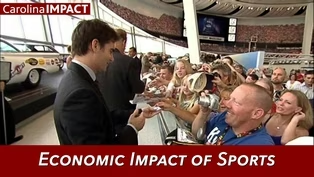
Economic Impact of Sports | Carolina Impact
Video has Closed Captions
Clip: S13 Ep1314 | 6m 19s | How Charlotte went from a pass-through town to a trusted national sports destination city. (6m 19s)

February 3, 2026 Preview | Carolina Impact
Preview: S13 Ep1314 | 30s | Economic Impact of Sports, Spectrum Center Reimagined, Guiding Stars: Kira Michaw, History Before Us (30s)
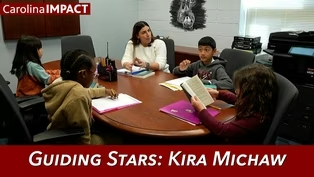
Guiding Stars: Kira Michaw | Carolina Impact
Video has Closed Captions
Clip: S13 Ep1314 | 5m 59s | Meet the principal who is determined for her school to ace their state report card. (5m 59s)
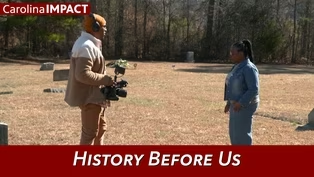
History Before Us | Carolina Impact
Video has Closed Captions
Clip: S13 Ep1314 | 5m 57s | Videographer Frederick Murphy uncovers Black history facts locally and across the nation. (5m 57s)
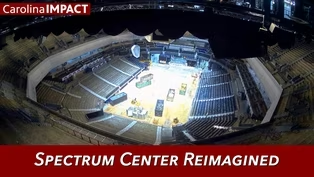
Spectrum Center Reimagined | Carolina Impact
Video has Closed Captions
Clip: S13 Ep1314 | 7m 28s | The two year Spectrum Center Reimagined renovation project is complete. (7m 28s)
Providing Support for PBS.org
Learn Moreabout PBS online sponsorship
- News and Public Affairs

Top journalists deliver compelling original analysis of the hour's headlines.

- News and Public Affairs

FRONTLINE is investigative journalism that questions, explains and changes our world.












Support for PBS provided by:
Carolina Impact is a local public television program presented by PBS Charlotte