
February 5, 2024
Season 2 Episode 177 | 27m 32sVideo has Closed Captions
A new survey of state childcare providers shows dire potential for childcare field.
A new survey of state childcare providers on impact of gap in federal funding and House spending plan, former state treasurer Jonathan Miller on new anti-semitism task force, Kentucky's failing grade on tobacco control, and Kentucky Grammy winners.
Problems playing video? | Closed Captioning Feedback
Problems playing video? | Closed Captioning Feedback
Kentucky Edition is a local public television program presented by KET
February 5, 2024
Season 2 Episode 177 | 27m 32sVideo has Closed Captions
A new survey of state childcare providers on impact of gap in federal funding and House spending plan, former state treasurer Jonathan Miller on new anti-semitism task force, Kentucky's failing grade on tobacco control, and Kentucky Grammy winners.
Problems playing video? | Closed Captioning Feedback
How to Watch Kentucky Edition
Kentucky Edition is available to stream on pbs.org and the free PBS App, available on iPhone, Apple TV, Android TV, Android smartphones, Amazon Fire TV, Amazon Fire Tablet, Roku, Samsung Smart TV, and Vizio.
Providing Support for PBS.org
Learn Moreabout PBS online sponsorship>> Those funds have either already expired.
We're going to expire by the end of September or setting up an unprecedented fiscal cliff for the entire childcare sector.
>> A new survey sets off alarm bells for some child care centers in the state.
>> Inmates on death row in Kentucky are on average there a long time.
26 years.
>> We discuss the issues and concerns surrounding the death penalty in Kentucky.
>> We've made advancements, but in the tobacco space, we have miles to go.
>> Why Kentucky isn't making the grade when it comes to preventing tobacco use.
>> Kentucky artists make a strong showing at the Grammys.
Find out who walked away with awards last night.
>> Production of Kentucky Edition is made possible in part by the KU Team Millennium Fund.
♪ ♪ Good evening and welcome to Kentucky EDITION on this Monday, February, the 5th, I'm Renee Shaw.
Thank you for kicking off your Monday night with us.
>> Today is day 24 of the 60 Day lawmaking session in Frankfort.
Last week, the House voted to approve the state's two-year spending plan.
It includes 70 million dollars in funding for reimbursements to childcare providers.
But is that enough with 330 million dollars in annual federal funding for the Commonwealth Childcare centers set to expire in September.
The Kentucky Center for Economic Policy survey.
Childcare providers on what sort of impact they expect from the gap in funding the results of the survey have dire potential for the childcare field.
>> The Congress to 4 large federal relief bill sent over a billion dollars to Kentucky's child care sector just to KET that hole during the pandemic and subsequent downturn.
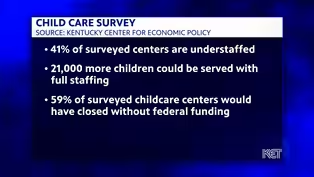
But those funds have either already expired are going to expire by the end of September or setting up an unprecedented fiscal cliff for the entire childcare sector.
We learned that 4 in 10 respondents reported being understaffed and that they're serving 21,000 fewer kids than they would if they can hire enough.
This is despite the fact that nearly 9 in 10 news, the federal funds to improve wages, which are still very low compared to other industries.
Almost 60% reported that federal funding from art but kept their senators from closing over the last couple of years.
When asked what they expected would happen once the federal funds rate.
Now the most likely scenario was that they would have to raise tuition, which half of families already find an affordable after that providers anticipated having to cut wages and actually offs an alarming 190, not roughly a quarter of all respondents reported that the likeliest or next to most likely outcome is that they would have to close their program altogether.
>> Some child care providers worry that a lack in funding will cause a negative ripple effect throughout their communities.
>> But hopes of the funds continuing.
We will not have to raise childcare tuition fees again.
But I'm a I'm afraid that I'm going to have to raise the fees again.
And I'm I'm sad to say that I will lose a lot of families just to to then not being able to afford child care and then looking at a picture is that they don't have childcare.
They cannot work.
And that's what I hear from families all the time I for childcare.
But I can't get a job and then ultimately to start our economy in Hopkinsville, Kentucky, even more.
That's so many people needing a job, meaning that, you know, they hired their own child care because I'm not full capacity, which thankfully I did not have the staff turnover because I have been able to raise their pay right and KET that pay right.
I'm sad to say if we do not, we don't have the funds continue have to raise tuition rates, which ultimately I will lose a lot of parents who say they cannot afford it so that they cannot work.
>> So that is her says all the way around.
>> The responses from the survey came from 770 childcare centers across 117 counties.
Roughly 40% of all regulated childcare providers in Kentucky.
Well, along with concerns about child care funding, some critics of the state spending plan by House Republicans believe Kentucky teachers to get a direct pay raise from lawmakers.
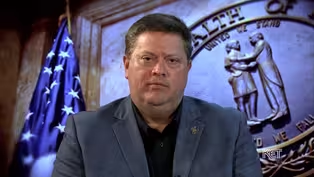
Todd County State Representative Jason Petri, the House Budget chairman says more education dollars are flowing to local school districts so that they can make those salary bumps.
>> We are trying to place focuses best we can entry level positions, not all the way up the scale.
Everyone is important.
Don't get me wrong.
But right now we have a particular concerns about movement and other states border states that would primarily affect those 0, 2, 3, 0, 5, teacher.
And that's what I'm hoping.
A lot of districts put a lot of thought and what they're doing now.
You also asked what about allocating money for teacher raises?
Continue to push money in through the same formula and other in sorrows.
So the local districts can make that decision based on local circumstances.
However, put it off to the side for a moment inside that you wanted to just designate a certain amount of money that would fulfill a certain percentage increase across the entirety of the Commonwealth.
If you try to put that through, seek.
You're going.
That was no district getting what they thought they were going to get.
Many districts would say if you give a percentage rise, they know that through seat distribution formula, they would have cut local state dollars and probably fairly substantial in order to hit the percentage rise that we might may invite.
>> So we'll take a deep dive into the education portion of the proposed two-year budget.
And we'll talk about the budget in its entirety by House Republicans with a panel of advocacy groups and a lawmaker tonight on Kentucky tonight at 8 Eastern 7 central right here on KET.
Many members of the Jewish community are growing increasingly concerned about the rise in Anti-Semitic threats, harassment and violence in Kentuckyian across the nation.
Governor Andy Beshear established a task force by executive order near the end of last year to come up with some solutions.
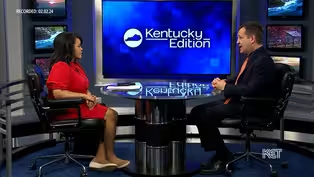
More than a dozen leaders from across the state were appointed to the board, including current and former elected officials, former state treasurer Jonathan Miller was the first Jewish Kentuckyian ever elected to statewide office.
Back in 1999.
He's on the Anti Semitism Task Force and talk to me Friday about the work the group is doing.
Jonathan Miller, thank you so much for your time.
We appreciate it.
Great to be here.
Talk to us about the anti Semitism task force.
This was a put together through executive order by Governor Andy Beshear last year.
You've had your first meeting.
What is the purpose and mission of the group?
>> This is a awfully difficult time to be a Jewish, a pier in Kentuckyian across the country.
Anti-Semitism has grown over the last few years.
Pretty significantly.
But particularly since the the terrorists to actions that Hamas took against Israel on October 7th, we've continuing a negative things in the in the public eye and it's a tough time to be on social media.
It's a tough time to be in your congregation and worried about the security.
And so Governor Andy Beshear really taken a national leadership role here, putting together our task force and our first meeting, we looked at the issue, the big issues and help to kind of figure out what her agenda is going to be in the months ahead.
>> Yeah.
What do we know about the growth of Anti-Semitism in Kentucky?
What does it look like?
>> A lot of it is online.
A lot of it is what we're seeing on TikTok in these other social media contacts.
We've seen that some on campus.
Not not to the degree.
We see it in the kind of the Ivy League schools, a lot of Jewish students are the worst of all my my daughter is teaching Sunday school here in Lexington and a few weeks ago in a bomb threat was emailed in and she had to get their kids out of class and you get the proved to be nothing.
But still, this is quite a scary time.
And so it's really important to think the governor is doing to focus on this, but that focus on solutions in focus on how we can address this in a holistic way.
>> It's not a partisan.
The issue is it now this is very bipartisan.
>> We've I've I've spoken with a number of members of the Legislature, Republicans and there's a shared desire to do something here in debt where where really comes down to a lot of it is education last year and said most areas outside of Lexington and Louisville, there aren't very many Jewish people.
That may be some counties don't have any and all.
And so so much of it is trying to get education into the school system.
What the Holocaust was, how how, how, how horrible it and that it's it's not a myth that sometimes you see on the Internet and also other about the Jewish people that continue to to circulate and I think when we start with with their kids, that's when we can.
That really helped build the basis for more understanding and the interfaith dialogue.
>> Do you view some of the actions of the Kentucky General Assembly when it comes comes to conversations about critical race theory and what should be taught when it comes to race and ethnicity and religion in schools.
Do you think that could somehow fuel some of this antisemitism d blind that in some way?
>> I don't you know that the legislature has been really good on this front to day 2018, the General pass legislation to mandate that the Holocaust education be provided.
The school systems.
There is a a pro-Israel caucus that needs pretty regularly in the legislature.
That's very concerned about these issues site.
I really do see us working together closely with Legislature with Democrats, Republicans, independents.
I think we all have a shared mission.
The number of antisemites in the state is very small.
And the just the problems of its becomes loud and gets amplified on social media and I think together working across faiths, working across party lines, we can really address this.
>> And is it an interfaith operation is?
Well, do you have Christian face and others who are also involved?
>> Yes, so glad the governor has that their task forces the Jewish folks representing a section each major organization in the Jewish community.
we do have a representative from the Muslim community.
We have a faith leaders from the Christian community it's it's a really important to the governor does to me we don't approach this in a in a a negative accusatory way, but bringing people together to have understanding, you know, a lot of the Tyson Summit of things that they're being said or are set unknowingly.
There isn't there aren't said with hate in the heart for Jews, things can be misconstrued and you see something on online repeated and you don't realize what what harm you're doing and how hurtful you're being so that's why education is really so important.
♪ ♪ >> Turning now to national politics, Kentucky's 2 U.S. senators are taking different positions on a proposed bill that pairs enforcement policies on the southern border with more aid for Ukraine and Israel.
Senate Minority Leader Mitch McConnell praised the bill saying, quote, America's sovereignty is being tested here at home.
And our credibility has been tested by embolden adversaries around the world.
But Kentucky is freshman U.S.
Senator Rand Paul called the bill quote, anti American pointing out that it provides 60 billion dollars for Ukraine.
The bill as a long shot in the U.S. house where House Speaker Mike Johnson has already says it's dead on arrival and we should say Rand Paul is the junior U.S. senator for Kentucky.
More than 440,000 Kentuckians could soon have to pay more for their internet or cancel it altogether.
If a federal subsidy program isn't renewed, those numbers are from a report by the White House which says the affordable connectivity program will run out of money by the end of April.
It allows families to save $30 a month on their Internet bills.
So far, only 43% of eligible households nationwide have signed up for the ACP subsidy.
A group of bipartisan lawmakers have proposed 7 billion dollars to extend the program through the end of the year, though it's unclear if the program will be prioritized in a divided Congress.
Big business news out of Louisville health insurance.
Giant Humana is closing its downtown headquarters building known as Humana Tower.
That's according to the Courier Journal, which says employees will transition to 2 other downtown buildings over the next 18 to 24 months.
A company spokesperson told the paper that since coming out of COVID only about 25% of you men as 10,000 Louisville based employees work from the office.
The CSA taking a consolidation.
♪ ♪ There are currently 26 inmates on death row in Kentucky.
But when or if they will ever face execution is unclear.
A recent report showed, quote, delays, disparities and costs that some say need to be evaluated our Laura Rogers has more with our G Dunlop, a reporter from Louisville Public Media's Kentucky Center for investigative reporting.
>> Our Jeanne, thank you so much for your time.
And we appreciate this excellent reporting that you dine on Kentucky's death row system.
Let's talk about the case of Karun Jean White.
He's been on death row close to 44 years for a crime he committed.
I believe when he was 20 years old and you open and close your story with him.
Let's talk about this case.
>> Well, it was a triple murder in the community of Haddix in Breathitt County.
He and 2 juveniles, one into the Fray.
People's store.
And basically bludgeon them to death.
It was a brutal murder.
And as I the bodies were in such awful shape that they were put in by.
They were they couldn't be revealed publicly at their funerals.
They had to be put in body bags.
And after Mister White's to dry was convicted of capital murder and sentenced to death.
>> All these years later again, 44 years, he is still basically languishing on death row.
So why has his capital punishment not been carried out?
>> Well, like many other there are a variety of reasons.
Most of pertaining to appeals of the conviction.
Basically anyone who says today asked Ryan's most often tries to avoid being a executed.
And that's what Mister White is doing.
He is contesting a some issues that pertain to his trial.
And he's also contesting in issues pertaining to his mental capacity to be executed.
>> So these delays that we see, it's not a uniquely Kentucky issue.
We see delays in states across the country.
But from what I understand from your report, our delays appear to be the longest.
>> Well, yes, and no inmates on death row in Kentucky have been there and average of 26 years, which is longer than for other states.
However, Kentucky also has a relatively small number of inmates on death row, which skews the number a little bit that because there are so few of them relative to some other states, which it might have several 100 inmates on death row as opposed to Kentucky's 26.
But still inmates on death row in Kentucky are on average there a long time.
26 years on average.
>> And a massive amount of taxpayer dollars goes into incarceration and people might be interested to know.
It appears to be much more expensive to sentence someone to death as opposed to giving them life in prison without parole.
>> But her depends what happens after the sentences imposed.
If the if the sentence is a death sentence and the defendant contests that through the appellate process, then yes, it can be a very prolonged process.
As in the case of Mister White and a very expensive process to as the appeals are filed.
Obviously the defendant needs attorneys and and the trials are expensive in the appeals are expensive and the cars to ration is expensive.
>> And of course, this is a very controversial topic.
And one thing I think is interesting is the fact that a lot of times in Kentucky is not drawing down party lines where people stand on.
If capital punishment is an acceptable formal sentencing in our criminal justice system.
Is that what you learned in your reporting in your interviews with legislators?
>> Well, basically, as have are we really interview a few?
But I think based on what other reporting that has been done, there appears to be a trend toward the elimination of the death penalty in Kentucky.
Clearly we're not there yet.
A bill was introduced in the last, but the trade of session last year to abolish the death penalty.
It got to traction.
There currently is a bill pending in the General Assembly to abolish the death penalty.
It too, is gotten virtually no traction.
It is only about 10 sponsors out of the 100 House members and it hasn't gotten a hearing.
It.
So the people of the legislators who might've you seem to think that's not going to happen immediately or maybe in the short term, but that it is coming to coming to an end.
>> What about the racial disparities that you uncovered?
And then when we talk about that, are we talking about the race of the perpetrator that sentenced to death.
Are we talking about the race of the victims?
>> Well, both and most of that information is not out of that comes from that very detailed study by Professor Frank Baumgartner from the University of North Carolina who didn't exhaust of study and the Kentucky death penalty published in 2022, they basically found out that >> and reported that too.
But people be they perpetrators or victims are treated differently.
Statistically, according to a study, then white people.
>> It seems the general consensus here is the system does need to be examined and potentially overhauled.
>> Well, I'm not sure if the general consensus that seems to be the opinion of some people, at public defenders who represent death penalty clients missed Doctor Baumgartner, some legislators.
But if there was a consensus to examine one might think that something would have happened by now to do that.
And I'm not aware of and the movement in that direction.
Currently.
>> We appreciate it so much.
>> Thank you for your interest in The temp re she ate you having me on.
>> RJ RG Dunlop says there have been 3 executions in Kentucky since the death penalty was reinstated.
Back in 1976, the last one was in 20 0, 8, ♪ >> Kentucky gets a failing grade from the American Lung Association when it comes to efforts to stop tobacco use.
Shannon Baker with the organization's Kentucky chapter said she's not surprised the state received an F in the annual state of Tobacco Control report.
However, she's hopeful legislation.
This session could help more people quit smoking and KET more young people from even starting.
More.
In tonight's look at medical news.
>> The fact is Kentucky has the highest lung cancer incidents, which of course means new cases of lung cancer rate in the nation as well as the highest rate of deaths due to lung cancer in the entire nation.
And we all know that smoking or the use of nicotine products is the leading cause of lung cancer in so what I would say is this discussion isn't more relevant or more important anywhere in the country than it is right here in Kentucky.
And yes, we have huge opportunities for improvement.
We a bit of improvement access to cessation services, moved from A C grade to a B grade.
And that's great news.
But we also need to get serious about funding this state, tobacco prevention and cessation program at were reasonable level.
The Lung Association and our partner organizations are calling on lawmakers to increase from the current level of 2 million dollars to 10 million dollars the funding for the state program because we know >> that prevention and cessation moves the needle.
It's evidence-based policy.
It works and we need to get there.
>> And we need to really focus on prevention as it relates to kids in Kentucky are told, run, are using nicotine products at an alarming rate.
Even though there is a law that that prohibits sales 2 people live under the age of 21.
We nevertheless have use e-cigarette use crisis in our state.
Kentucky is one of about 10 states in the union that does not have a comprehensive database, nor do we have an effective system, an optimal system for enforcing the law against underage sales we've made advancements, but in the tobacco space, we have miles to go.
And that means huge opportunities ahead of us to do the right thing.
♪ ♪ ♪ >> To Kentucky ends have added some Grammy hardware to their mantles.
Lexington native Chris Stapleton walked away with 2 Grammys at last night's show.
Stapleton won for best country solo and best country song.
He was also nominated for best country duo group Performance for We Don't Find any more with fellow Kentuckyian Carly Peers and the classical category Teddy Abrams, director of the Louisville Orchestra won best classical instrumental solo for the American Project, Kentuckyian Tyler Childers had 5 nominations but no wins.
One of the nominations was for best music video for in your Love, which was produced by another Kentuckyian writer and Kentucky.
Poet.
Extraordinary laureate Silas House.
Kentucky is home to several vice presidents.
And you may be surprised by the Kentucky connection to a popular Christmas Carol.
Our Joe Gibbs, as all of that and more in this look at this week in Kentucky history.
♪ >> The last and worst of the New Madrid earthquakes occurred on February 7th, 18, 12.
It was part of a series of earthquakes centered near New Madrid, Missouri, near Western Kentucky.
A series of quakes in 18, 11, 18, 12 so powerful people in Canada could feel the ground shake.
On February 8th 18.
37 U.S. Senate chose Richard Johnson of Kentucky to be Vice president.
>> The Senate had to act because none of the vice presidential candidates received a majority of electoral votes in the election.
The previous ball, it's the only time the Senate had to pick the VP.
Lexington native John, see Breckenridge who also served as vice president in the United States became Confederate secretary of war on February 17, 18, 65 when the war ended a couple of months later, Breckenridge fled to Cuba.
He later returned to the United States.
Miss Big Kentucky 121 to 85 on February 6, 1971.
It was the worst ever defeat for the Wildcats in Memorial Coliseum.
>> We may you may not know the name Haven Gillespie born February 6, 18 88 in Covington.
But you know his work.
He wrote the lyrics to Santa Claus is coming to town.
And if the minutes while riding a subway, it was her for the first time on radio in 1934 and was an immediate hit with people by half million copies of the sheet music.
And just 24 And those are some of the big events from this week in Kentucky history.
I'm Joe begins.
>> Thank you so much.
To be that was interesting and quick writing a song that quick.
Well, a lot more great stories coming at you tomorrow.
At 6.30, Eastern 5.30, central for Kentucky edition where we inform connect and inspire.
>> We hope you subscribe to our email newsletters and watch full episodes and clips of KET Dot Org.
You can also find us on the PBS video app and the mobile device and smart TV.
And we encourage you to send us a story idea at public affairs at KET Dot Org and make sure you follow KET on Facebook's X and Instagram to stay in the loop and to make sure you tune in tonight at 8 o'clock Eastern 7 central for Kentucky tonight.
When we talk about the state budget, your tax dollars at work, we want your questions and comments and make sure that you tune in and tell us what you think.
Thank you so much for watching tonight.
I'm Renee Shaw and I'll see you in a bit.
Taken care of.
♪ ♪ ♪ ♪ ♪ ♪ >> Chairman Peter Rhee, thank you so much for your time.
This afternoon.
We appreciate it.
Well, thank you very much.
So let's talk about the state budget.
There are actually a couple of different bills, but let's focus first on House Bill 6, if you can just kind of school, Kentucky ends on how big this budget is.
How much is general fund dollars versus what is federal dollars?
>> House Bill 6 is the operating budget and capital projects and everything regarding the executive branch.
So that is the large budget bill as far size.
You're looking at approximately 15 billion dollars a year in general fund as well as over 60 billion dollars total inclusive of fund sources so easily over 120 billion dollars over the biennium pull fund sources.
>> So when we talk about the Budget Reserve trust fund and you know, some people call it the rainy day fund.
So every now and then our referred to it as that it has what?
3.7 billion dollars, which is a record for Kentucky does HB 6 use any money from the Budget Reserve Trust Fund.
I ee're need a fun.
>> No.
Really good question, though.
House Bill 6 is designed just to deal with recurring revenues and recurring expenditures.
So that is the operating budget House Bill one would deal with the Budget Reserve Trust Fund and only deal with one-time expenditures.
So one-time money from a savings account for one-time expenditures and then on the recurring sight on House Bill recurring revenues and recurring expenditures.
>> So as House Bill, 6 crafted with the intention to read to meet the triggers that were required that were set up into law to reduce the state income tax.
Is that part of House Bill?
6?
>> Know, and that questions come from some radios as our interviews as well as in person.
It's interesting.
I would like to be able to look at things like that as we're crafting the budget.
There are several things, but we can't do that.
By the way, the mechanism in the process actually works inside the lrc.
This budget actually is built block by block, starting basically with pensions and then personnel.
And then the agency budget request and only at the end, the we actually get numbers on.
How much is expended?
How much is not expected?
So really, we're trusting our philosophy of making sure that is everything comes to us in the budget process.
Is it a legitimate purpose of limited state government to take it on?
If it is then what's the optimal amount to make sure that we have effective and efficient services rendered to constituents for that function?
We pride that throughout the process from building bought one all the way to the end and then we get our numbers back at the very end.
>> Let me now pivot to the language about the vacancies, veteran agencies.
And I think there's some confusion about what this language means.
Mister, the trees.
So if you Mister chairman and tell us what exactly is in the budget when it comes to agency's ability to still vacancies and does this language effect active employees?
It could this
Video has Closed Captions
Clip: S2 Ep177 | 5m 42s | Former state treasurer Jonathan Miller on new anti-semitism task force. (5m 42s)
Video has Closed Captions
Clip: S2 Ep177 | 3m 12s | A new survey of state childcare providers shows dire potential for childcare field. (3m 12s)
Video has Closed Captions
Clip: S2 Ep177 | 6m 16s | Report on Kentucky's death row inmates. (6m 16s)
Rep. Jason Petrie on Education Funding
Video has Closed Captions
Clip: S2 Ep177 | 1m 54s | Rep. Jason Petrie on education spending and teacher raises. (1m 54s)

Video has Closed Captions
Clip: S2 Ep177 | 2m 56s | Kentucky gets failing grade on tobacco control. (2m 56s)
Providing Support for PBS.org
Learn Moreabout PBS online sponsorship
- News and Public Affairs

Top journalists deliver compelling original analysis of the hour's headlines.

- News and Public Affairs

FRONTLINE is investigative journalism that questions, explains and changes our world.












Support for PBS provided by:
Kentucky Edition is a local public television program presented by KET