
Carolina Impact: February 9, 2021
Season 8 Episode 16 | 26m 1sVideo has Closed Captions
Shotgun houses, Village HeartBEAT, the Charlotte Dog Training Club and Stuart Watson.
Historic shotgun houses are finding a new life, Village Heart B.E.A.T. partners with local churches to promote wellness, dogs and their owners learn and compete at the Charlotte Dog Training Club and Stuart Watson started questioning his life history after being fired from his job.
Problems playing video? | Closed Captioning Feedback
Problems playing video? | Closed Captioning Feedback
Carolina Impact is a local public television program presented by PBS Charlotte
Carolina Impact: February 9, 2021
Season 8 Episode 16 | 26m 1sVideo has Closed Captions
Historic shotgun houses are finding a new life, Village Heart B.E.A.T. partners with local churches to promote wellness, dogs and their owners learn and compete at the Charlotte Dog Training Club and Stuart Watson started questioning his life history after being fired from his job.
Problems playing video? | Closed Captioning Feedback
How to Watch Carolina Impact
Carolina Impact is available to stream on pbs.org and the free PBS App, available on iPhone, Apple TV, Android TV, Android smartphones, Amazon Fire TV, Amazon Fire Tablet, Roku, Samsung Smart TV, and Vizio.

Introducing PBS Charlotte Passport
Now you can stream more of your favorite PBS shows including Masterpiece, NOVA, Nature, Great British Baking Show and many more — online and in the PBS Video app.Providing Support for PBS.org
Learn Moreabout PBS online sponsorship- [Narrator] This is a production of PBS Charlotte.
- Just ahead on "Carolina Impact."
- Charlotte's original affordable housing finds new life in a new neighborhood.
I'm Jeff Sonier, stick around, we'll tell you about the history and the future of these old shotgun houses.
- These dogs and their owners take having fun to a whole new level.
And we introduce you to some folks making a big difference in their health thanks to the church.
We'll explain.
"Carolina Impact" starts right now.
- [Narrator] "Carolina Impact," covering the issues, people and places that impact you.
This is "Carolina Impact."
(upbeat music) - Good evening, thanks so much for joining us.
I'm Amy Burkett.
Charlotte's affordable housing problems feel like a today issue, but affordable housing has a history here in Charlotte.
A history of poor working class minority neighborhoods that were moved or divided or erased.
Sometimes all of the above by developers looking to build something bigger or better.
Now low-income neighborhoods are finally getting some help to keep the affordable housing they already have.
Carolina Impact's Jeff Sonier has more on the story from Charlotte's West side.
- Well, actually this is more like two stories really.
One story about what Charlotte's affordable housing might look like for neighborhoods in the future, and one story about what it used to be like for Charlotte's long gone neighborhoods in the past.
(gentle music) - You know it was great housing for people back in the day.
- [Jeff] Diatra Fullwood talks about her old front porch neighbors.
These hundred year old shotgun houses across the street from her house (indistinct).
- It was really neat because people would still come by, look at them, there were wedding photos, just a little bit of everything.
- [Jeff] A little bit of Charlotte history.
Also part of Diatra's history for 22 years.
- You know, I'd go back and look at some of the pictures and stuff.
I guess they're call shotgun houses because you could shoot a shot gun from the front door to the back door.
That's my understanding.
And then they were brought over here just to sort of preserve that history of Charlotte and especially in the center city area, because it has changed so much.
- [Jeff] One thing that hasn't changed though, that need for affordable homes, where blue collar workers can afford to live, near their jobs, their schools, their transportation.
- Exactly, exactly.
So just being able to see how the center city has grown, and to know that those houses were a part of the center city, and then out with the old, in with the new.
- [Jeff] In this case, the new is a five-story affordable housing project.
Coming soon, more than a hundred new homes, which means these old homes have to go.
- Push.
- [Jeff] As workers carefully lift the old shotgun houses off their foundations, you can still peek inside, and see the original hardwood floors, an old church pew in front of the fireplace.
The houses themselves, nothing fancy, built to last though.
Small, but still sturdy.
- Yeah, you just gotta be careful.
But the size of them ain't no problem.
We usually do way bigger.
- Being across the street from them for the last 22 years, I knew at some point they were gonna be moved.
- [Jeff] The move itself was at night.
Workers shifting the shotgun houses onto big flatbed trailers.
Measuring the height of the house.
- (indistinct) - [Jeff] To make sure they fit under low bridges along the way.
Nailing danger signs on the back of the houses, warning drivers to keep their distance.
The houses themselves wide and hanging over the side of the trailer, with Diatra Fullwood watching from her lighted front porch across the street.
- Right turn, right turn.
- [Jeff] Watching as the truck hauling the homes slowly pulls away.
- I was very surprised when they were actually moving them, and how they pretty much like took off the roof of all of them, and then of the two, and then moved them.
'Cause I just kept thinking "Oh when they move those they're gonna fall apart "'cause they've been around for so long."
I don't know how long they date back, but they were very solid, very solid.
- [Jeff] Yep, solid houses for generations of solid working class families.
Charlotte's original affordable housing making way for Charlotte's newest affordable housing.
But even these old homes can become new homes all over again in a new neighborhood.
- You don't see that being done in too many places.
A lot of times we kind of forget history.
We kind of wanna move on.
- [Jeff] Instead of moving on, Jamall Kinnard wants people moving in.
- To bring those homes into Lakewood, preserve that history, and also use the history of those homes to make history now together, that's very significant.
- [Jeff] Kinnard is head of the Lakeview Neighborhood Alliance, where the shotgun houses are located now, off Rozzelle's Ferry Road, canard lives in a working class neighborhood, with neighbors working to make sure that their affordable housing stays affordable.
And where big changes often sneak up on unsuspecting neighbors, house by house.
You wanna get to Lakeview before the developers get to Lakeview.
- [Jamall] Without a doubt.
- When you can still afford to buy that land.
- Without a doubt.
We don't want them to get all the land.
We're gonna own some land and force them to build around us.
That way you have a diverse community.
As we say at Lakeview, strong families.
That's what we're creating here.
- [Jeff] Lakeview is part of the West side Community Land Trust which owns the property where the shotgun houses are now, raising money to buy more land, and also helping neighbors get organized.
- Just to make sure that we have a seat at the table and our voices are being heard.
- [Jeff] It's like a tide.
You can see it coming.
- Oh yes.
- If you're not prepared, if you don't see the wave coming-- - Oh man.
- You'll get washed away.
- You will get washed away, most definitely.
A lot of people not able to see the wave coming.
- So how does the land trust help prepare and protect a neighborhood like Lakeview?
- The goal of the West side Community Land Trust is to identify land, purchase land and keep it affordable permanently.
Using the shotgun homes as the model to show that this is possible, is using those homes, assets to preserve those history.
Making sure people know about the significance of those homes, while also making history now together.
- [Jeff] Do you miss your old neighbors?
Your old shotgun houses?
- You know, when I look over there, I do, I do.
But I just know that there is bigger and better to come.
It's what's needed in the city.
And so, you know, I have to be okay with that.
I think it's gonna be a win-win for everyone.
(gentle music) - Now Diatra adds that even before they knew these old shotgun houses were involved, her giving circle actually made a donation to the West side Community Land Trust.
And she says those donations are how a house with a history can become a house with a future, and how that house can also become a home again.
Amy.
- Thanks so much, Jeff.
For more information on the history of those old shotgun houses, head to our website at pbscharlotte.org.
We'll link you to the original historical landmark report written back in 1985, with pictures of the shotgun houses, what they were like inside, even who used to live there.
Plus a description of the Charlotte neighborhoods where they were built back in the 1890s.
Well, there's a special group in town that's been serving dogs and their owners for more than 60 years.
The Charlotte Dog Training Club began in 1955 and remains very active today.
As Carolina Impact's Johanne Davis tells us, while the world has changed, some relationships are timeless.
- [Johanne] If you're looking for a calm and sedate way to bond with your dog, this is not it.
- Hit it, hit it.
- [Johanne] Jim Saxon and his dog, Penny, a flat coated retriever, have been coming to the Charlotte Dog Training Club since she was just a pup.
- I became interested in dog agility, and they had classes here.
So I said "Hey, that might work for me."
- Aw, you ready to play?
- [Johanne] Lorelei Ross trains here with her golden retriever, Captain.
Her interest in dog training was sparked while watching a dog competition on television.
- And I'm like "I wanna do that.
"That looks like a lot of fun "to join a cool partnership with my dog."
- Again, go, go, go.
- [Johanne] For Liz Petko, agility training is as much about her physical fitness as it is for her (indistinct).
- In fact, I had a knee replacement six years ago, so got back out there as quickly as I could.
- [Johanne] While there reasons for joining may vary, the members of the Charlotte Dog Training Club have at least one thing in common, they are passionate about their pets, and from the looks of it the feelings are mutual.
The dogs that train at the club range from the pedigreed pure breed to the recently rescued mutt.
In their 66 years of existence, thousands of dogs and their owners have taken part in various training programs.
- So we've done all types of classes.
We do canine good citizen, which is kind of a beginner class that teaches dogs good manners so they could become useful members of society, and family dogs.
They do therapy dog sessions, so therapy dog training, which my dog is a certified therapy dog.
- [Johanne] Additional classes include rally training, where people learn to control their dogs using just hand signals, while the animal remains in the healing position.
Standard obedience training, scent work, where dogs are trained to find buried or hidden objects, as well as the fundamentals of tracking.
They practice with a decoy, which is a good thing, since the eight year old is not very keen on handling real ducks.
- It's the grossest thing in the world to touch.
- [Johanne] The third grader was inspired to do dog training by her mom, but she and Captain are building a relationship all their own.
- I like looking at him run and stuff because he's a goofball, and it makes me smile because he's happy.
- [Johanne] Kayla also does agility training.
- She has been running agility with me since before she was born.
- [Johanne] Mom, Lorelei, says she knew early on that Kayla would naturally take to dog training.
It was a sign she got after a major competitive win.
- I was actually eight months pregnant when I got my agility championship title, the mock, with our dog Brody, the Sheltie.
And you can see my belly, and what's really crazy, he put his paw right on my belly.
- [Johanne] Ross says she can sense a distinct difference in Captain's attitude depending on the type of training they're doing.
- The agility is like this is fun, this is awesome, let's go, let's go.
In the field, he's like "Where is it?
"I'm gonna get it for you mommy."
- While some people might think dog training is about control over an animal, it's not.
It's really about building the bonds between people and their pets.
- You do have to develop a relationship.
If you don't, it's not going to work.
You develop that relationship from the time they're a puppy, or the time that some people rescue dogs.
You have to build that relationship by having them get to trust you, because obviously dogs don't wanna run over a 12-inch dog walk like they do.
They have to trust you to wanna do that.
- They need to know that you value what they're doing.
They need to feel that sense of accomplishment.
- It's teamwork.
So just like in, you know, sports with people, you have to trust your teammates.
You have to trust your coach.
So trust is the primary thing.
- We use a lot of positive reinforcement, a lot of encouragement.
We try not to use any negative things going on.
We don't yell at the dogs.
We don't hit the dogs or things like that.
Everything's very positive, and very focused on being that positive force in their life.
- [Johanne] And that is important to remember, because while these dogs are very well-trained in agility, fieldwork and obedience, in the end they are still family pets.
They've just taken having fun to a whole new level.
For "Carolina Impact" I'm Johanne Davis.
- Thanks so much, Johanne.
Although COVID 19 protocols have forced the Charlotte Dog Training Club to suspend some of their classes, some outdoor trainings, as well as online resources are still available.
That story just makes me want to hug my little Maxi May.
Well, the church is an important place for many of us, so what better way to promote health than at a place of worship?
That's been the goal of The Village Heartbeat Program in Mecklenburg County, a program working through black churches to promote heart health.
What began with just seven churches has become a national model.
As Carolina Impact's Bea Thompson tells us, the program is helping thousands of residents chart a new course in life.
- [Narrator] It's "The Price Is Right."
Come on down.
- [Bea] It's the dream of a lifetime to hear your name called on "The Price Is Right."
- 20,000, 24,000, 22,000, 23.
- [Bea] But from Melvin and Sylvia Austin, the pictures from their thrill of a lifetime gave them a wake-up call.
(buzzer buzzing) - No.
- We were on "The Price Is Right," and we saw our pictures to it.
And the pictures that we saw we did not like when we looked at ourselves.
So we like "Hey, we got time to rededicate ourself "and make sure we do it right this time."
- We was doing it with the church.
And when he sees, sees something he just jumped head first.
- Other side, here.
- [Bea] For this couple, that meant renewing their efforts to get healthy through The Village Heartbeat Program, a Mecklenburg County Health Department faith-based collaborative that's aimed at increasing the health of minorities through education, nutrition and exercise.
- Good morning Village Heartbeat, how are you family?
Welcome to 2021.
We are greeting started for another great year.
- [Bea] Each year exercising and losing weight become the battle cry themes for better health.
Yet for the seniors in the Village Heartbeat program, what's a battle cry for others became daily words to live by for them.
- When I first started, I was walking on two canes, and was just about to be fitted for a Walker.
- I watch a lot of our members so heavy and so unhealthy.
You know, and I, being a deacon at the church, I was concerned.
- I was trying to find a way that the seniors at my church could deal with early deaths as a result of high blood pressure, diabetes, overweight.
- As we think about our body, as we are putting in types of processed foods, it continues to accumulate fat.
- [Bea] The numbers are alarming for minorities.
African-Americans and poor people in general die from chronic ailments such as heart disease and diabetes at twice the rate of the general population.
To fight that, these seniors stretch, walk and keep their bodies moving, something their instructor, Mitch, an exercise guru better known as Robocop says aides them in several ways.
- I've seen change in reference to coming to have a social environment to come to and participate in, physically changing, being able to feel and have confidence to walk up steps, take physical baths when they were afraid of falling, just improving their mental, spiritual and physical health.
- [Bea] On the walking track, Bishop Wade Ferguson practices what he preaches to his congregation.
They've been a part of this program from the beginning.
He points out the strength of the church community connection made the health connection a perfect fit.
- People who turn around and had issues within their health, their health now has become a wealth to them.
I wanna thank you for your continued prayers.
- [Bea] From the pulpit, ministers like Pastor Jordan Boyd at Rockwell AME Zion are telling their members the statistics bear out the changes that many of them are now seeing in their own health and their bodies.
- Get up, start coming to exercise class, losing weight, getting off their medications, blood pressure being decreased.
Their numbers start to change.
It's the vision of a visionary by the name of Cheryl Emanuel.
- Village Heartbeat, again, family is not about us competing, about being on a diet, but it is choosing the right types of food, and having the right education, the right information to pick the selection of foods that we should be eating.
- [Bea] This program has garnered national accolades and awards, and inquiries from all across the country on just how to start their own Village Heartbeat initiative.
But if you want to know how a successful health program became a life-changing beacon for many, well you just need to ask the people who have walked the walk.
- We started doing more things, weighing them, taking their blood pressures, doing workshop, man workshop.
We got involved.
- They gave us all the tools that we need, we just have to put the application in that we wouldn't do them.
Just really a mental concept.
- I was looking to lose weight, but now I've learned with Village Heartbeat, it's not just weight, everything got better.
Breathing got better.
- They were already doing what I was looking to do, so why not join them?
- It's life changing.
And it'll add not only time to your life, but quality of life.
- [Bea] Well, we all know it takes a village, and here the village keeps the heart beating.
For Carolina impact, I'm Bea Thompson reporting.
- Thanks so much Bea.
What a great program.
You can find more information on the Village Heartbeat on our website.
Well, it's something that unfortunately happens to a lot of people, spending decades in a career, doing what you love, only to one day be told that you're no longer needed.
Six years ago that happened to one longtime Charlotte television broadcaster.
As Carolina Impact's Jason Terzis shows us, it's been a process of coming to terms with his dismissal, reinventing himself, and ultimately finding himself.
- What should be done about the coal ash ponds here?
And who's looking out for our drinking water?
- [Jason] For 16 years, he was on the local news.
- But when reporters pressed him on the exact amount, he quickly got defensive.
- [Jason] Breaking high profile stories no one else in town had.
- And to be both fair and accurate, we should note that while the Department of Justice called this practice illegal, no one was charged with a crime.
- [Jason] Bringing alleged wrongdoing to life.
- My name's Stuart Watson, and I was the investigative reporter at WCNC TV from 1999 until 2015.
- [Jason] Stuart Watson made his living telling other people's stories.
- His work was pretty amazing.
- [Jason] Spending more than three decades in local television news.
- Jackson, Mississippi for two years, Toledo, Ohio for two years, Nashville, Tennessee for seven years, Raleigh, North Carolina, WREL for four years, and then 16 years here.
- [Jason] At local NBC affiliate, WCNC, Stuart served as the station's investigative reporter, spending weeks to months researching, interviewing, writing and reporting in depth segments.
- I like to think we lived through the golden era of local TV news.
We really did broadcast television, they had money, they would spend the money to really get the story.
- [Jason] Along the way he earned numerous accolades, winning multiple Emmy awards, DuPont's, Muros and Peabodies.
- Accepting the Peabody award is investigative reporter Stuart Watson from WCNC TV, Charlotte.
- [Jason] But like many industries, the media is changing, especially local television news.
There are more daily newscasts, but in many cases are being done with smaller, younger, and ultimately cheaper staffs.
- And so I got fired.
- At the time I was a manager in the newsroom, and understood how the business was changing, and how time and resources were spent.
That old way of putting months into a story just wasn't gonna fly anymore.
- That was six years ago, January 2015.
At age 55, Stuart was out of a job.
Bitter at first, he came to realize that this was an opportunity to dig deeper into his own story.
- Stuart's drinking was never, it was not like the classic alcohol, you would not have known.
I didn't recognize it.
- You know you're an addict when you don't have it, it has you.
And I didn't know I was an alcoholic until I wanted to stop.
- [Jason] His drinking became an issue during his days in Nashville.
He was eventually able to beat it, but the process is still ongoing.
- It wasn't an overnight thing where all of a sudden, oh Stuart's sober, he's a great dad now.
No, it took me a long time.
- [Jason] But it wasn't until after his termination and what Stewart did next that the issues with alcohol started making sense.
I was always curious who my biological parents were, you know, who am I?
Am I German?
Am I Scandinavian?
Am I Irish?
What's my history?
- Put up for adoption the day he was born, Stuart didn't know who his birth parents were, so he put his investigative skills to work.
- I call it the investigation of a lifetime, my lifetime.
- He talked about it for a long time before he actually started doing anything about it.
- [Jason] He discovered his biological mother was a nurse, his father studied law, but later spent time in prison, 'caused mostly by his own drinking.
- My biological father died of alcoholism.
Acute alcoholism is on his death certificate.
My full blood sister, who died last year, was addicted to alcohol and other substances.
My brother has had addiction issues, and I am a recovering alcoholic.
- [Jason] Through the process of interviewing people from his past, Stuart came to realize something.
- I'm a terrible listener, especially to women.
I would interrupt, I would argue.
- Well, he's a big talker for one.
He loves to talk.
There'll be times when he'll be on the phone, and he'll be talking for 45 minutes straight, and you wonder "What is this poor person "on the other end thinking?"
(laughing) He hasn't stopped to take a breath.
- [Jason] So we wrote a book, released last year, "What She Said and What I Heard How One Man Shut Up and Started Listening."
It's a memoir told in stories, each revealing a moment he learned something from a woman.
- I started looking through it in my kitchen, and before I knew it I had read three chapters.
- [Jason] The book has evolved into a weekly podcast called "Man Listening, with Stuart interviewing women from all walks of life, from all over the country, each with a unique story.
- I talked to a woman who taught African-American literature.
I talked to a woman who went to prison at age 18 for seven years for attempted murder.
I talked to a woman who's a documentary filmmaker.
I try to talk to the widest variety of people that I can.
- [Jason] Investigative reporter, author, podcaster, while facing his own issues, and the search for his birth parents.
It sure has been quite the ride.
- It's been a great adventure.
- And I think for him this is really, is a personal journey for him.
I mean, I think he, in his heart of hearts, whether he acknowledges it or not, feels like he has something to prove.
- [Jason] Stuart is hoping to someday turn all of his research and work into a documentary on his life.
And there's certainly more than enough content to fill it.
For "Carolina Impact, I'm Jason Terzis reporting.
- Thanks so much, Jason.
You can find a link to Stuart's podcast on our website at pbscharlotte.org.
Well that's all we have time for this evening.
We always appreciate your time, and look forward to seeing you back here again next time on "Carolina Impact."
Good night, my friends.
(upbeat music) - [Narrator] A production of PBS Charlotte.
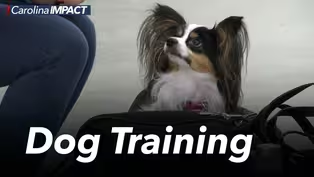
The Charlotte Dog Training Club
Video has Closed Captions
Clip: S8 Ep16 | 4m 43s | The Charlotte Dog Training Club offers lots of ways for dogs and their owners to bond. (4m 43s)
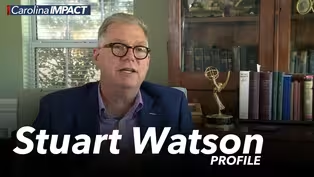
Journalist Stuart Watson Examines His History
Video has Closed Captions
Clip: S8 Ep16 | 5m 32s | A personal profile of former Charlotte television investigative journalist Stuart Watson. (5m 32s)

Village HeartBEAT: Promoting Health in Charlotte
Video has Closed Captions
Clip: S8 Ep16 | 5m 14s | Village Heart B.E.A.T., a Mecklenburg County fitness program. (5m 14s)
Providing Support for PBS.org
Learn Moreabout PBS online sponsorship
- News and Public Affairs

Top journalists deliver compelling original analysis of the hour's headlines.

- News and Public Affairs

FRONTLINE is investigative journalism that questions, explains and changes our world.












Support for PBS provided by:
Carolina Impact is a local public television program presented by PBS Charlotte