VPM News Focal Point
Feeding Virginia | November 16, 2023
Season 2 Episode 20 | 26m 46sVideo has Closed Captions
We look at food safety, scarcity, nutrition, and ways to better feed the Commonwealth.
We take a comprehensive look at where Virginians get their food and ask about food safety, food scarcity, good nutrition and ways to better feed the Commonwealth. There are well-fed Virginians and people who are chronically hungry. What’s working and what's not?
Problems playing video? | Closed Captioning Feedback
Problems playing video? | Closed Captioning Feedback
VPM News Focal Point is a local public television program presented by VPM
VPM News Focal Point
Feeding Virginia | November 16, 2023
Season 2 Episode 20 | 26m 46sVideo has Closed Captions
We take a comprehensive look at where Virginians get their food and ask about food safety, food scarcity, good nutrition and ways to better feed the Commonwealth. There are well-fed Virginians and people who are chronically hungry. What’s working and what's not?
Problems playing video? | Closed Captioning Feedback
How to Watch VPM News Focal Point
VPM News Focal Point is available to stream on pbs.org and the free PBS App, available on iPhone, Apple TV, Android TV, Android smartphones, Amazon Fire TV, Amazon Fire Tablet, Roku, Samsung Smart TV, and Vizio.
Providing Support for PBS.org
Learn Moreabout PBS online sponsorshipANGIE MILES: What are Virginians eating?
And what does it mean for our wallets, our health, and our environment?
Today, we'll look at the future of one of Virginia's best known types of seafood, consider the availability of food for all at a time when inflation outpaces wages, and highlight a movement led by Native Americans that could be the key to a healthier population and planet.
We'll also spotlight a program that's designed to make healthy eating more like good, plain fun for young people.
This is VPM News Focal Point.
Production funding for VPM News Focal Point is provided by The estate of Mrs. Ann Lee Saunders Brown.
And by... ♪ ♪ ANGIE MILES: Welcome to VPM News Focal Point.
I'm Angie Miles.
Health, history, culture, and finances all seem to intersect on our dinner tables.
What and how we are eating in Virginia is the topic of today's program.
We begin with blue crabs.
They are essential to the ecosystem of the Chesapeake Bay and a major economic driver for the state's seafood industry.
In 2022, the bay experienced a decline in blue crabs.
So where are we now?
Multimedia Reporter Keyris Manzanares has the story.
KEYRIS MANZANARES: Peter Nixon has been crabbing along the lower Chesapeake Bay area for over 50 years.
(crabs splashing) PETER NIXON: Crabs used to be thick enough when I first started crabbing that you could crab in the morning, and if it was an incoming tide, when you finished your rig, you could actually go back and fish over some of your pots again that had had enough incoming tide, 'cause the crabs feed on incoming tide.
And now, we have to let 'em sit two days.
KEYRIS MANZANARES: In 2022, the estimated number of blue crabs that lived in the bay hit a record low of 227 million.
Now, a year later, data from the Winter Dredge Survey shows a 42% increase, with 323 million blue crabs living in the bay.
Joe Grist is the Deputy Chief of Fisheries at the Virginia Marine Resources Commission.
JOE GRIST: They're kind of like the vultures of the bay, in a sense.
If something has passed away in the bay, if something is dead, some dead fish, something on the bottom, they're going to clean it up.
They're going to convert it back into energy in the bay and convert it back out to more crabs.
KEYRIS MANZANARES: Grist says the Commission is seeing a good balanced ecosystem when it comes to blue crabs.
This year, they even voted to extend the harvest season through mid-December.
JOE GRIST: For a couple of the watermen who will continue crabbing, they may see a little bit better profit margin coming in by staying in the crabbing for November, December.
And that's, you know, so we're trying to maximize both.
We see we're okay on the ecosystem side.
Can we maximize the optimum yield side of it now for this year?
So, and again, it's a balancing act.
KEYRIS MANZANARES: But Nixon says while experts say that the blue crab population is at a sustainable level, it's nothing like the abundance the Virginia crab industry saw in the early '80s and '90s.
PETER NIXON: They're thinking about a threshold of sustainability, and I'm thinking about the same thing, but it's my threshold of sustainability, and I need a few more crabs than they need to sustain the species.
KEYRIS MANZANARES: Reporting for VPM News Focal Point, I'm Keyris Manzanares.
ANGIE MILES: The Virginia Marine Resources Commission voted to extend the state's crabbing season until mid-December to allow crabbers to take advantage of better pricing during this time of year.
ANGIE MILES: We went to people of Virginia with a supply chain question.
Do most of us feel comfortable with our knowledge of where we get our food?
CHUCK TAYLOR: I would definitely not consider myself well-versed on Virginia's food supply.
It's something I've read about, have some general knowledge about, but can I answer the question knowledgeably?
No.
STEVE SALTZBERG: No, I have a reasonable good sense of it, but I don't consider myself an expert at all.
MIA GRISHAM: I feel comfortable with my county, but I would say I can't speak to all of Virginia.
MAKENNA FITZSIMMONS: I shop locally, so I go to the farmer's market, the RVA BIG market every Saturday.
And so I like meeting, you know, the farmers like directly and getting to interact with them.
But I feel confident that I know where my food is coming from because I do shop locally.
BRITTANY ROHRER: I don't feel like I know enough about it.
I don't feel like they make it readily available in the sense that they should, especially on labels.
I think it's changing, though, with places like Whole Foods and even the Kroger that I shop at for groceries.
They have an entire section of like organic and all this stuff.
So it is becoming more popular I think, to pay attention, but it's a process.
ANGIE MILES: Hunger and health are deeply intertwined.
Studies by the Centers for Disease Control and Prevention show that when people don't have enough food to eat, it takes a toll on their physical, social, and emotional health.
The lack of access to nutritious and affordable food is even more problematic for families living in rural communities with limited food options.
Multimedia Journalist Keyris Manzanares visited a food bank in King William County.
They've been working for decades to serve the community.
KEYRIS MANZANARES: Just off Route 360, this food bank has become a cornerstone for over 600 families living in King William County.
Sheila Iswariah, who's from India, has been helping run the food bank since its creation in 2000.
When she immigrated to Virginia, she was shocked to discover that one in 12 people don't have enough food to eat.
SHEILA ISWARIAH: Our perspective from outside of the country was that this is one wealthy nation and people always had enough.
But when we came here it was a complete surprise to us because of what we saw.
KEYRIS MANZANARES: Every Saturday morning, cars line up waiting for their turn to drive up and receive boxes filled with veggies, fruits, desserts, and meats.
SHEILA ISWARIAH: So when we first came here, there wasn't even a Food Lion.
There wasn't a grocery store.
We had to go all the way into Richmond for ourselves to shop.
The county next door does not have a grocery store.
KEYRIS MANZANARES: People in this area of rural Virginia struggle to find affordable and healthy foods.
They live in what's called a food desert.
SHEILA ISWARIAH: Families appreciate every little bit they get.
It does, what we've always told them is that this is a supplemental box.
KEYRIS MANZANARES: The food at CornerStone comes from federal and local donations, and partnerships with nonprofits like Feed More.
Alice Elizabeth Fortune has been coming to CornerStone for over 15 years.
ALICE ELIZABETH FORTUNE: The food is so high in the store.
And then when you, if you're on disability and fixed income, you just don't have enough.
And this place is a blessing for that.
Because even though you don't have to have it in the store, but you know you come here, you'll be taken care of.
KEYRIS MANZANARES: Eddie Oliver, with the Virginia Federation of Food Banks, says the number one driver of food insecurity is poverty.
EDDIE OLIVER: Rural areas face a lot of challenges.
Obviously, transportation is chief among them.
It could be 20, 30 miles to get to a grocery store.
And so pantries like CornerStone are often the only real lifeline for low-income families in these communities who don't have anywhere else to turn.
KEYRIS MANZANARES: In 2022, nearly 11% of Virginia's population lived below the poverty line.
And as inflation continues to affect everyone, the Virginia Federation of Food Banks expects more Virginians to be hungry.
EDDIE OLIVER: Families are facing so many higher costs.
Childcare costs are through the roof.
Grocery costs are double digit percentage increases over the last several years.
Rent has gone up quite a bit since the pandemic.
And families have to prioritize those things, or they lose them.
You have to pay your rent, or you'll get evicted.
You have to make that car payment, or you lose your car.
You have to pay for childcare, or you lose that opportunity.
Food is often the thing that gets sacrificed because of that.
KEYRIS MANZANARES: Back at CornerStone, the line continues steady.
And most will be back next Saturday for another box.
ALICE ELIZABETH FORTUNE: Different people, put it that way, comes here.
All different colors.
I mean everybody that need help, old and the young.
And I'll tell you this, CornerStone and Sheila is a blessing to the county.
KEYRIS MANZANARES: Reporting for VPM News.
I'm Keyris Manzanares.
ANGIE MILES: If you live in King William County or the surrounding area, you can register at CornerStone to attend food distribution on Saturdays.
Information on how to register is available at VPM.org/FocalPoint.
ANGIE MILES: VPM News Focal Point is interested in the points of view of Virginians.
To hear more from your Virginia neighbors, and to share your own thoughts and story ideas, find us online at vpm.org/focalpoint.
ANGIE MILES: Traditionally, autumn is a time of bounty, an opportunity to gather and to enjoy a harvest.
Last month, Nottoway Indian tribal leaders partnered with the College of William and Mary to serve an Indigenous Peoples Feast to celebrate Native agricultural practices and foods.
This first-ever event was conceived and directed by Indigenous chefs using Indigenous ingredients meant to serve the region's Indigenous communities.
News Producer Adrienne McGibbon shows us that reconnecting with this culinary culture may be a key to solving some of our biggest issues related to health and the environment.
YOUNG GIRL: I'm going to do a double knot.
WOMAN 1: Yep, tie me up, babe.
WOMAN 2: Nice to see you.
(Troy speaks Virginia Algonquian) WOMAN 3: And the other one goes here.
(Troy speaks Virginia Algonquian) TROY WIIPONGWII: That is my version of an introduction in Virginia Algonquian.
MAN 1: Yeah, well, we do this.
ADRIENNE McGIBBON: This feast was all about reclaiming what's been lost.
Organizers say what's happening here, is revolutionary.
TROY WIIPONGWII: You being here is just a part of, really a revolution, as we start to reclaim our food pathways as Indigenous people but as people who are just trying to save the planet as well.
ADRIENNE McGIBBON: Troy Wiipongwii works at William and Mary's Institute for Integrative Conservation.
He came up with the idea of a feast, hoping to spark a movement.
TROY WIIPONGWII: And it really just seemed like there was something there.
And maybe having a large feast to, kind of, direct everyone's attention to all of these diverse efforts around food sovereignty.
ADRIENNE McGIBBON: Food sovereignty is all about rejecting industrialized practices around food.
The movement encourages growing healthier food without chemicals, in a more sustainable way.
The idea is being embraced and promoted by many Indigenous communities.
TROY WIIPONGWII: We live in a very interconnected world, where something as simple as the spices we use on our table, come from thousands and thousands of miles away.
And there's just such a diversity of food that exist here.
ADRIENNE McGIBBON: Culinary educator and historian, Joe Rocchi, has spent the last decade researching foods that are native to the Americas.
JOE ROCCHI: So many things from Native American history revert back to Native American foods.
They did change the face of the planet.
Three-fifths of the world's food came from here.
Could be served hot or cold.
ADRIENNE McGIBBON: Rocchi is a Pamunkey tribal member.
He cites foods like tomatoes, potatoes and chili peppers, items more commonly associated with Italian, Irish and Asian dishes.
He says, they were all foods grown by native tribes and exported by colonizers, from the new world.
JOE ROCCHI: And it's ironic that now that we think of other cultures and we can't even separate their foods from our own.
But our foods changed everything.
ADRIENNE McGIBBON: Now, Rocchi wants to reclaim those ingredients.
JOE ROCCHI: It's rediscovery of the history that has purposely, for one reason or another, been taken away.
It's a huge part of culture that's not there.
GINGER CUSTALOW: And you get scalloped potatoes with your meat pie.
ADRIENNE McGIBBON: Lonnie Custalow and his wife, Ginger, own a Virginia business that relies on native traditions for inspiration.
They're also serving at the feast.
LONNIE CUSTALOW: Mainly the foods that I was eating as a child with my grandfather, was wild game, fresh fish.
So what we do here is, we're taking those type of foods and incorporate into a modern type of dish for people.
ADRIENNE McGIBBON: Custalow grew up on the Mattaponi Reservation in King William County, with his family.
LONNIE CUSTALOW: We fished, we hunt, we trapped.
We grew gardens, we canned our food.
We even canned meats.
ADRIENNE McGIBBON: In 1974, "National Geographic" called Chief Custalow's grandfather, “the last Virginian to live entirely off the land.
” LONNIE CUSTALOW: Well, I went with my grandfather every single morning and every spring, it was a routine of about six weeks of fishing.
Every day we would fish three tides a day, to catch the fish, not only to supply food for ourselves but also to sell for income.
ADRIENNE McGIBBON: In 2022, the Custalows opened their winery, the Mattapony Reserve.
It's one of only a few native-owned and operated businesses in Virginia, that's serving Indigenous foods.
While they don't catch and grow everything they serve, they do source much of their ingredients locally.
LONNIE CUSTALOW: We know where it comes from.
We can speak to the owners who provide the meats and things that we purchase for our foods here.
So it's just a connection.
ADRIENNE McGIBBON: Another organization that partnered to put on the feast, is all about growing local.
BENJAMIN FRITON: This is Sumac.
ADRIENNE McGIBBON: Ben Friton runs the REED Center for Ecosystem Reintegration.
It's a 160 acre parcel of land in Maryland, used for sustainable agricultural practices.
BENJAMIN FRITON: Our goals here are, growing food that grows itself.
We want to create a self-perpetuating agricultural system.
A system that, over time, only increases the amount of food that it's able to produce.
ADRIENNE McGIBBON: Instead of just growing one crop, which is a common modern agricultural practice, The REED Center explores growing multiple plants in one space.
It's a centuries old practice that Friton says, is better for the soil and for our nutrition.
BENJAMIN FRITON: What was that ecosystem and how was it able to thrive for thousands of years before we started turning it into whatever we're growing as annual crops now?
ADRIENNE McGIBBON: Friton is trying to recreate those landscapes here.
He says, rethinking how we grow our food is imperative.
In fact, he calls it, a matter of national security.
BENJAMIN FRITON: One of the most important things that I think needs to happen as a Homeland Security initiative, is to have hyperlocal sustenance infrastructure.
ADRIENNE McGIBBON: The ultimate goal is to encourage people to replicate these systems on a smaller scale, in their communities and backyards.
BENJAMIN FRITON: If we don't start thinking about food as part of our infrastructure, as part of our homeland security, the cities that currently have three or less days of food stocks, are susceptible in a globalized food system, to all kinds of very chaotic outcomes that I don't think any of us would like to witness.
ADRIENNE McGIBBON: One positive outcome from the pandemic, more Americans have begun growing their own food.
Now, more than two in five US households are cultivating their own vegetables, fruit, berries or herbs.
One Nottoway tribal leaders helping people interested in backyard gardening.
BETH ROACH: We can't all go full traditional but we can certainly weave some of our traditional foods into our current diet.
ADRIENNE McGIBBON: Beth Roach started an organization called the, Alliance of Native Seedkeepers.
It's a network of people committed to growing and sharing native seeds.
We met up with her, at her tribe's annual powwow.
BETH ROACH: The important thing, is going through the whole cycle of, picking your seed, getting your soil right, putting that seed in the ground, starting it, you know, see it grow, keep watering it.
ADRIENNE McGIBBON: Roach says, eating food you've grown, helps connect you with nature and with ancient traditions.
She says the feast celebrates both of those things.
BETH ROACH: The feast is a highlight of our cultures from long past but it also gives us an opportunity to talk about how we're still doing our food ways today.
ADRIENNE McGIBBON: Wiipongwii hopes to take advantage of that opportunity, by bringing chiefs, chefs and scientists together, for many more feasts.
With the hopes of enjoying Indigenous food, sharing knowledge and growing the food sovereignty movement.
TROY WIIPONGWII: Bringing people together to really build a coalition around one of the human activities that has the most damaging impact but the most important activity that we engage in on a day-to-day basis.
And that narrative of how we move forward, is why a feast like this is important.
ANGIE MILES: Organizers considered the Indigenous Peoples Feast a success.
Leaders from the Pamunkey, Rappahannock, and Lumbee tribes continue to work with the community to further advance the food sovereignty movement.
Several of the chefs who cooked at the feast plan to launch a mobile Indigenous food lab that will travel the Mid-Atlantic region to teach about native foods.
And to keep the momentum going, The College of William and Mary and Native leaders are preparing to host a second Indigenous Peoples Feast in the spring.
ANGIE MILES: Educators here in the Commonwealth have begun a program meant to get children excited about eating fresh, healthier foods grown by Virginia farmers.
Joining us today to talk about this new initiative is Dr. Sandra Curwood, director of Virginia's Office of School Nutrition Programs.
And welcome Dr. Curwood.
Most of us remember something about our school lunches, and maybe don't know as much as we should about school nutrition generally.
Can you talk to us about school nutrition?
The Department of Education, Office of School Nutrition Programs administers the nutrition programs for all the schools in Virginia.
All public schools are required to participate in the national School Lunch and School Breakfast programs.
And those programs are really designed to ensure that children have access to healthy meals during their school day.
And you're aiming to make food better and better for Virginia kids with the Virginia Foods For Virginia Kids program.
How does it work?
SANDY CURWOOD: The Virginia Food for Virginia Kids Initiative really started when we wanted to ensure that the children had access to better-quality food, more nutrient-dense and more locally produced.
SANDY CURWOOD: There are so many benefits to children having access to good, healthy food, right?
So it increases their health and wellness, it increases their attendance at school, which is a concern post-pandemic, as well as academic achievement, because we know that when kids are engaged at school, whether it's with their cafeteria lady or their teacher, that they're connected with a caring adult.
And so when it comes to the food, we really want to make sure that we're using those resources the best we can to benefit all children.
I'm hearing think globally, eat locally is basically what you're doing with this.
You've piloted in just a few schools so far, and plan to expand.
Explain about that.
We had eight brave volunteers that started with us, eight school divisions across Virginia, one from each of the superintendent's regions to represent the whole state.
And we did some test work with them, assessing what their capacity is with the equipment, staff training, and then one of the things that they really needed was supply-chain assistance, that's been an issue for all of us, right?
So looking at where we can get those foods from their local farms.
And we have two food hubs that have been instrumental in getting those foods directly to the schools: 4P Foods out of Northern Virginia, and ASD out of the Southwest.
So they've been fantastic partners in this work also.
Thank you so much for joining us.
Dr. Sandra Curwood talking about Virginia Foods For Virginia Kids.
(upbeat music) ANGIE MILES: You can watch the full interview on our website.
ANGIE MILES: One Richmond-based nonprofit is trying to make getting fit fun for kids, and they're doing it by turning exercise and healthy eating into a competition between friends.
Well-nourished children do better academically and have greater self-esteem.
Senior Producer Roberta Oster visited one class filled with students learning that making healthy food together is a game changer.
(blender whirring) (crowd murmuring) SAM CLAVEL: So I got all the fresh frozen fruits and veggies.
We brought it today to do an essentially, a smoothie competition with the girls.
They were super excited.
(student claps) We try to make healthy, healthy eating habits and physical activity, very fun for them, essentially.
TEACHER 1: One, two.
(students chattering) SAM CLAVEL: We encourage the girls to move their bodies in different ways and with different abilities.
You need space to move, 'cause you're going to move your bodies real quick.
(table rumbles) (students chatter) Fit4Kids is a nonprofit that was founded in 2010, by Sports Backers, so they never had a program targeting kids like we do were their first, and we target health and wellness as a whole, with these kids.
We promote physical activity and healthy eating habits through numerous different programs that we have at Fit4Kids.
JESIAH BRADBY: Fruits and vegetables help you grow and they make you stay strong and healthy.
But we just do a lot of fun stuff like activities, fun games, stuff that we haven't did before.
SAM CLAVEL: So good job.
(Sam laughs) We're going to talk about fruits and veggies and we're going to make some smoothies today.
Are we excited?
What kind of stuff do you put in your smoothies?
STUDENT 1: I like fruits and vegetables.
STUDENT 2: Green apple.
Things that are green.
SAM CLAVEL: Game On, Girl!
is a program that targets middle school aged girls to be physically active, make nutritious food choices, and then be leaders in their community.
If you're blending put it up to there.
You guys are going to be creating your own smoothie that judges are going to try.
We bring interns on from different majors.
TEACHER 2: A smoothie.
SAM CLAVEL: It means a lot to bring these types of college students here because they look up to them.
They're closer to age in them so they relate more to them.
(intern and students laughing and chattering) Title 1 Schools are schools that are in neighborhoods that are facing socioeconomic barriers and where a lot of the kids that go to these schools are getting free lunches and applying for free lunches.
They are eating foods that are easily accessible to them.
So they are eating stuff like Takis and chips and all these different things, because that's what they have access to during the school day or at home.
There is a rise to obesity and heart disease and all that stuff.
Essentially, what we're doing is we're trying to tackle that head on.
STUDENT 3: See it's tropical, STUDENT 4: But we have these different colors.
SAM CLAVEL: We try to make it very simple and very fun for them and as engaging as possible, because we don't focus on calorie counting or dieting or anything like that.
We want to make sure they are happy and healthy at any capacity and in any way, shape or form, that they can do.
Seeing what goes into these smoothies and seeing what goes into these dishes and trying just different stuff that maybe they never tried before, or they didn't have a good relationship with.
Seeing what good they could do with frozen fruit for example, 'cause frozen fruit is still cheaper than fresh fruit and it lasts longer.
Come up for judging please.
SAM CLAVEL: I hope they take all the cooking demos that they do and all the physical activities that they learn and like continue it at home and continue talking to their friends about it and talking to their families about it, and then hopefully jump starting that conversation of them wanting to try these fruits and veggies.
Like it's good for them.
CLAVEL TO STUDENTS: Well, we are going to award the game winners today.
Team Two!
JESIAH BRADBY: You just don't want to congratulate yourself, 'cause other people, they was working hard too.
They tried their best.
Even though they didn't win, it doesn't matter.
Yall tried your best at the end of the day, and yall did good.
ANGIE MILES: As we close this edition of Focal Point, we hope you have a more complete understanding of what and how Virginians are eating.
You can find more information about these and other stories on our website, VPM.org/FocalPoint.
There, you can also find the full interview with Sandy Curwood about the Virginia Foods for Virginia Kids Initiative and share your feedback and ideas with us.
We invite you to join us again next time.
Production funding for VPM News Focal Point is provided by The estate of Mrs. Ann Lee Saunders Brown.
And by... ♪ ♪
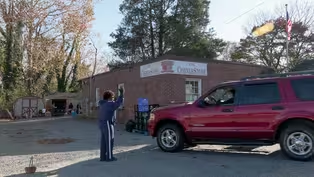
Families facing food insecurity turn to CornerStore
Video has Closed Captions
Clip: S2 Ep20 | 3m 33s | People living in Virginia rural communities find themselves in a food desert. (3m 33s)

Fit4Kids turns exercise and healthy food into a game
Video has Closed Captions
Clip: S2 Ep20 | 3m 26s | Fit4Kids promotes a healthy lifestyle for children by making nutrition and movement fun. (3m 26s)
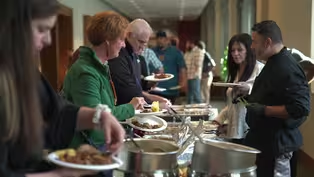
A Food Revolution led by Native Americans
Video has Closed Captions
Clip: S2 Ep20 | 7m 47s | Native Americans have begun a movement around healthier food and sustainable agriculture. (7m 47s)

Iconic Chesapeake Bay blue crabs on the rise
Video has Closed Captions
Clip: S2 Ep20 | 2m 12s | There’s an estimated 323 million crabs living in the Chesapeake Bay. (2m 12s)
What are our children eating at school?
Video has Closed Captions
Clip: S2 Ep20 | 8m 15s | Providing fresh options for Virginia’s students that’s helping local farmers and our kids. (8m 15s)
Providing Support for PBS.org
Learn Moreabout PBS online sponsorship
- News and Public Affairs

Top journalists deliver compelling original analysis of the hour's headlines.

- News and Public Affairs

FRONTLINE is investigative journalism that questions, explains and changes our world.












Support for PBS provided by:
VPM News Focal Point is a local public television program presented by VPM