Hello, Mr. Chuck!
Feelings
Season 2 Episode 12 | 28mVideo has Closed Captions
Mr. Chuck teaches kids about feelings and emotions.
Mr. Chuck teaches kids about feelings and emotions.
Problems playing video? | Closed Captioning Feedback
Problems playing video? | Closed Captioning Feedback
Hello, Mr. Chuck! is a local public television program presented by WKNO
Support for WKNO programming is made possible by viewers like you. Thank you!
Hello, Mr. Chuck!
Feelings
Season 2 Episode 12 | 28mVideo has Closed Captions
Mr. Chuck teaches kids about feelings and emotions.
Problems playing video? | Closed Captioning Feedback
How to Watch Hello, Mr. Chuck!
Hello, Mr. Chuck! is available to stream on pbs.org and the free PBS App, available on iPhone, Apple TV, Android TV, Android smartphones, Amazon Fire TV, Amazon Fire Tablet, Roku, Samsung Smart TV, and Vizio.
Providing Support for PBS.org
Learn Moreabout PBS online sponsorship[birds chirping] [doorbell ringing] (children) ♪Hello!
Hello!♪ ♪Won't you be my friend?♪ ♪Hello!
Hello!♪ ♪Let's say it again.♪ ♪Hello!
Hello!♪ ♪Won't you be my friend?♪ ♪Hello!
Hello!♪ ♪Now you are my friend.♪ ♪♪♪ ♪H-E-L-L-O♪ ♪That's a word we all should know.♪ ♪H-E-L-L-O♪ ♪You can say it.♪ ♪Just say hello.♪ ♪♪♪ Hey!
There's Mr. Chuck!
Well, hello, friend!
Hello, Mr. Chuck!
Hello, friends.
How are you today?
I'm glad you could drop by.
Today we're going to talk about feelings.
How do you feel right now?
Are you happy?
Are you sad?
Are you angry about something?
Well you know everyone has feelings.
These feelings are also called...
Yes, emotions.
Have you ever noticed you can sometimes tell how someone is feeling by looking at their face?
♪Can you make a happy face?♪ ♪A happy face like this?♪ ♪♪♪ ♪Can you make an angry face?♪ ♪An angry face like this?♪ ♪♪♪ ♪Can you make a sad face?♪ ♪A sad face like this?♪ ♪♪♪ ♪Can you make a funny face?♪ ♪A funny face like this?♪ ♪♪♪ You know, friends, we don't just show our emotions in our faces.
When we feel an emotion we show it with our whole body.
Think about it.
Let's pretend for a minute that we're sad.
You can do this, too.
Come on just stand up or even sit right where you are and pretend along with me.
Let's pretend we're sad.
How would your face look if you were sad?
How would your body look?
Can you remember a time when you were sad?
You know when you're sad your shoulders and arms might droop like this.
How would you walk when you're sad?
Slowly?
Maybe your head would drop down like this.
♪♪♪ Okay.
That's good.
Now let's pretend we're happy.
How does your face look when you're happy.
Well, you would probably be smiling.
How about your body?
How would it look?
Would you stand up straight and tall?
How do you walk when you're happy?
Let's do a happy walk.
Walk along with me.
♪♪♪ This feels so good I'm going to do it again.
♪♪♪ Oh yes.
Well, how about when you're angry?
How would your face look when you're angry?
Do you squint your eyes up?
Do your lips get tight?
How would you walk when you're angry?
Big angry steps maybe with your arms swinging and your hands made into a fist?
Let's walk like we're angry.
Let's try it.
Come on.
♪♪♪ When we feel strong emotions we show them in every part of our bodies.
People see it in our faces and hear it in our voices.
It's important when we feel strong emotions, like anger or sadness, to talk about these feelings with people who love us.
And we can do it in ways that don't hurt other people.
If you're angry you don't have to shout and you certainly shouldn't hit anyone, but you can tell someone why they made you angry.
Sometimes people make us angry, and they don't even know it.
When you're sad it can make you feel a lot better if you talk about it with someone.
Share your sad feelings.
Sometimes your mom or dad can give you a hug or a special treat and talk to you about your feelings.
Now it may not make the sad feelings go away, but it does make you feel better to talk about it.
(male #1) ♪Sometimes I laugh.♪ ♪Sometimes I cry.♪ ♪Sometimes I smile, and I don't kn ow why.♪ ♪Sometimes I'm happy♪ ♪And sometimes I'm sad.♪ ♪And sometimes I just get so mad.♪ ♪But usually I just make a funny fa ce.♪ ♪♪♪ ♪Sometimes I'm happy.♪ ♪Sometimes I'm sad.♪ ♪And sometimes I'm sleepy, and I wi sh I had a pillow.♪ ♪Sometimes I laugh.♪ ♪And sometimes I cry.♪ ♪Sometimes I smile just because it feels nice.♪ ♪Sometimes I smile and I don't know why.♪ ♪♪♪ Have you ever been confused about how you feel?
Well you know it's possible to have several different feelings all at once.
When we're sad, we don't always feel just sad.
We may be angry or jealous all at the same time.
Try to keep in mind that the sooner we talk about feelings that upset us the sooner we can leave those feelings behind.
Remember just because you're feeling sad or angry now, you won't always feel that way.
Emotions come and go, and it's possible to control your emotions in ways that won't hurt others.
Remember this.
Learn how to control your emotions.
Don't let your emotions control you.
♪♪♪ I want to be an astronaut.
I want to be a nurse.
I want to be a cheerleader.
I don't know.
Do I look different wearing a wool sweater?
Maybe you've got a cap or mittens made of wool.
Do you know where wool comes from?
It comes from sheep.
Want to see how they get wool off the sheep and into your sweater?
Let's go.
♪♪♪ (Mr. Chuck) The hair of the sheep is what gets turned into yarn.
All summer, fall, and winter the sh eep grow their woolly coats.
Then in the spring they're given a haircut.
That's called shearing.
♪♪♪ The people who are doing the shearing are professionals.
That is their job is to shear sheep.
They travel around to wherever the flocks are and they shear the sheep.
Have you ever been to a barbershop or beauty salon to have your hair cut?
Well you might say these folks are sheep barbers.
♪♪♪ Several farmers bring their sheep together to be shorn.
It's kind of like a special event.
♪♪♪ The shearing doesn't hurt the sheep.
As I said it's like a haircut.
♪♪♪ This is Jeff Barryhill.
He and his sister Jane are professional sheep shearers.
That is their job is to shear sheep.
♪♪♪ Boys and girls remember that the sheep is not a pet.
The sheep is livestock and they help make life better for all of us by providing us wool.
[clippers] (Barryhill) See a sheep is only handled approximately ten minutes during his life on the farm.
Out of that eight years only about ten or fifteen minutes do you actually touch the sheep.
(Mr. Chuck) You're talking about the ten or fifteen minutes it takes to shear the sheep.
(Barryhill) The few minutes it takes per year to shear it and to give it worm medicine or to help it have a lamb or whatever reason you have to touch it.
A lot of people would hold their pet dog or pet cat for ten minutes at a time.
[clippers] (Barryhill) Okay now we're going to let you shear a sheep.
How about it?
(Mr. Chuck) Well let's try that out.
(Barryhill) The left foot is right under her front shoulder keeping her supported keeping her feet off of the ground.
(Mr. Chuck) Do I place my left foot where yours is?
(Barryhill) Right where mine is.
Okay my right foot is right back here between her legs to keep her balanced.
(Mr. Chuck) I think we're about set now.
(Barryhill) You need to let the sheep roll into you just like that.
Here's your clippers.
You want to slide it under the wool.
Start back here on this end and shear up through there.
Don't try to push the wool out of your way.
Take you a practice stroke on the clean skin so you'll get the feel of it.
Press down into the skin.
You want to slide along like a ski run.
Now you've got it.
(Mr. Chuck) Quite smooth.
(Barryhill) I've been shearing for about twenty years.
It takes the average shearer about three years to really get good at shearing so it's something you want to practice and work at and don't give up on.
(Mr. Chuck) Practice, practice, practice.
Well maybe with enough practice I'll become a sheep shearer.
Is that the right name for it?
(Barryhill) That's right, a sheep shearer.
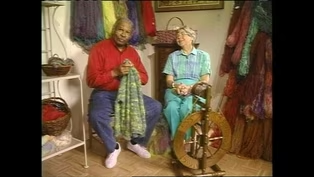
♪♪♪ (Mr. Chuck) Af ter the wool is shorn from the sh eep it's dirty so it gets washed then dyed.
Then smoothed out with a process ca lled carding.
It's kind of like when you comb yo ur hair.
Now we're ready to make yarn.
How?
Let's find out.
This is called a spinning wheel.
A spinning wheel?
Yes, you can see that one part of it goes around and around, like that.
It works from a pedal.
(Mr. Chuck) How do you use this spinning wheel to make yarn from this?
First we already have some yarn on here so we'll attach the new wool to the yarn that is already on there and wool sticks to itself very easily.
If you ever look at wool under a mi croscope you'll see lots of tiny little scales.
And those scales make the pieces of wool stick together.
See you can pull it apart and it just goes right back together.
(Mr. Chuck) You can control how thick a piece of yarn you want by the amount you feed into this.
Is that right?
Exactly.
You let it - if you want real thick like that let it go on in.
Sometimes it needs a little help and then pull it out and we're still finding occasional pieces of matter from the farm.
That was a little hay and then we just keep on until we have the bobbin full.
(Mr. Chuck) An d this is why we call it - two re asons why we call it spinning wheel.
First it has spinning wheels and th e wheels are helping us to make yarn by spinning the yarn around this sort of spindle.
And it comes out looking like this when the spindle is full.
We make it into a skein and we're ready to knit.
We've had a wonderful day.
Interesting lesson on what happens to sheep's wool.
Once the sheep is sheared it ends up into something we can all live better with.
It makes life more comfortable for us, so we can say thanks to the sheep and this very special thanks to the Remsteads who had us on their sheep farm today to tell us how yarn is made and where it comes from.
Thank you very much Mrs. Remstead.
Yes, it's mail time so let's check our box and see what we've got today.
Well here is a very nice letter from Mohammad and Elias.
Let's see - they're from Memphis, Tennessee.
Let's see what they've sent to us.
Oh!
Take a look at their picture.
There it is and they're together.
It says here in one of their letters, "My name is Mohammad, my dad is Al i and my mom is Fatima "and my brother is named Elias.
"I like your show too much.
I'm seven years old."
So I guess the taller one there mu st be Mohammad.
And of course Elias is his four ye ar old brother, you can see there.
He says the same thing - that he wa tches the show.
He says, "I love your show."
Thank you very much, but look at th e drawing here.
There are clouds there - you see th e blue clouds.
And then there's a house - it's Mr .
Chuck's house he says.
And there's a sunshine and Mr. Chuck, too.
I'll tell you, this is very nice.
Mohammad and Elias, you are very ki nd to remember us, especially with your drawing and your picture there and your nice letters.
So thank you very much.
Let's see what else we've got.
Here's one.
It's from Spencer White.
Take a look.
Very nice and colorful!
Spencer, you did a great job.
That is very nice, and I hope you'll keep on drawing and sending me your drawings, too.
Thank you very kindly.
Now, let's see what we have here.
This is from Darius Morris, and he says that this drawing is of a man who loves chocolate ic e cream with colorful sprinkles.
And he's standing in front of an ic e cream shop.
Oh, yes.
Down at the bottom there - that's the ice cream shop.
Wonderful drawings.
Thank you all so much for being so nice.
From Darius and from Spencer White, You know, I like getting drawings and photos from my friends.
So, if you'd like to send me a drawing or a photo of yourself, just send it to... Then I'll share them with our friends right here on TV.
Just remember, I can't return them so only send us the things you don't want to get back, okay?
♪♪♪ Part of our job as adults and parents is to help our children feel good about themselves and to teach them how to deal with the world and with their emotions appropriately.
It's really important.
We're very careful sometimes to teach our children words for tangible things - table, chair, dog, mom, dad.
But often we forget to teach the children words for their emotions, and they can't talk to us about their emotions if they don't have the words.
Some of the ways we as adults can help our children learn those words are through books.
Hopefully you read to your child everyday.
When you're reading talk about the feelings of the people in those books.
Talk about the feelings of the little boy who lost his dog - he looks like he's sad, why is he sad?
Talk about that.
If you're watching a video with your child or a television program, talk about the emotions you see in that.
What's going on?
What's making them feel that way?
Some of the things we can do with preschool age children is really simple.
We have all kinds of equipment in our house that we can use to help teach children words about their emotions.
I did something on construction paper, you can use paper plates, even.
You don't have to be an artist, just a mom or a dad.
You can talk about this face with your child.
How do you think this person feels?
What made him feel this way?
What would make you feel this way?
He looks pretty sad to me.
There are all kinds of emotions that we talk about.
Wow!
This person looks angry.
Ask your child, "when was the last time you felt this way?
"What did you do about it when you felt this angry?
Next time you feel this way, what's a better thing to do?"
Talk about it.
You can talk about the last time you felt angry, too.
It's important that your children know that you have the same emotions and that you deal with them in appropriate ways.
Talk about the fact that people ar e surprised by good things - like birthday presents - and not so good things - like maybe going to the doctor and getting a shot.
And talk about how they felt about the good and bad surprises and how to deal with them.
Most of us are pretty good about talking about the happy, the good, emotions.
We talk about what makes us happy.
We also need to talk about what ma kes other people feel happy, and how do we know that they're ha ppy.
We also need to let our children know that we're happy just because we have them.
Talking about words for emotions, showing our children that we feel them, and they feel them and they're okay.
Teaching them how to deal with them constructively is a very important life lesson for our children, and a good exercise for all of us.
Today we've talked about feelings.
We've learned a new word for feelings.
Do you remember what it is?
That's right.
Feelings are also called emotions.
You know it's important to learn how to express our feelings, like anger and jealousy, in ways that don't hurt others.
And it's good to talk about these feelings with people who love us.
It's also important to remember to share our good feelings.
When we're happy and we share it, we make other people happy, too.
Well, it looks like we're out of time, and I've got to go.
But remember friends, until next time, talk about your feelings and have fun.
So long.
♪♪♪
Video has Closed Captions
Clip: S2 Ep12 | 7m 39s | Mr. Chuck and guests show how wool is created and prepared. (7m 39s)
Providing Support for PBS.org
Learn Moreabout PBS online sponsorship

- Arts and Music
The Best of the Joy of Painting with Bob Ross
A pop icon, Bob Ross offers soothing words of wisdom as he paints captivating landscapes.










Support for PBS provided by:
Hello, Mr. Chuck! is a local public television program presented by WKNO
Support for WKNO programming is made possible by viewers like you. Thank you!