
Feels Like Summer
Season 4 Episode 3 | 25m 49sVideo has Closed Captions
ART inc. explores the best summer has to offer in Rhode Island.
ART inc. explores the best summer has to offer. In Newport, see how art runs in the family, and how a couple makes salt from our shores. One of Block Island’s biggest summer traditions starts at a small glass station in Wakefield, and cool down with homemade ice cream made in a barn.
Problems playing video? | Closed Captioning Feedback
Problems playing video? | Closed Captioning Feedback
Art Inc. is a local public television program presented by Ocean State Media
Feels Like Summer
Season 4 Episode 3 | 25m 49sVideo has Closed Captions
ART inc. explores the best summer has to offer. In Newport, see how art runs in the family, and how a couple makes salt from our shores. One of Block Island’s biggest summer traditions starts at a small glass station in Wakefield, and cool down with homemade ice cream made in a barn.
Problems playing video? | Closed Captioning Feedback
How to Watch Art Inc.
Art Inc. is available to stream on pbs.org and the free PBS App, available on iPhone, Apple TV, Android TV, Android smartphones, Amazon Fire TV, Amazon Fire Tablet, Roku, Samsung Smart TV, and Vizio.
Providing Support for PBS.org
Learn Moreabout PBS online sponsorship(upbeat music) - [Narrator] Coming up on "ART inc." Double Trouble: Newport Art, Block Island Glass Floats, How to Make Ice Cream, and Newport Sea Salt.
(screen crackling) - [Reporter] If you want to know what's going on.
(upbeat music) (engine roaring) (water splashing) (birds calling) (birds chirping) (audience applauds) (static hissing) (horns blaring) (upbeat music) (screen crackling) (upbeat music) (horn blares) (bird calling) (pedestrians chattering) (upbeat music) - The people here all have a story to tell, and I try to tell their story.
To me, they're all important.
(upbeat music) This is just my little time capsule of when I'm here.
This is Newport at this period of time, going through, and this is what I'm celebrating.
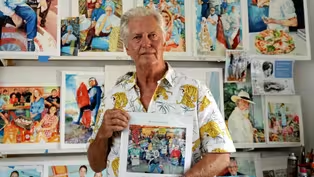
(upbeat music) When I went to RISD, I majored in the discipline of printmaking, etching, and engraving.
So after graduating from RISD, I packed my bags and went to Paris, and I lived there for two years.
The early etchings had to do with fantasy circus people, characters, but they were all made up in my imagination.
After that, I came back and RISD offered me a job, teaching and printmaking.
So I taught at RISD, I taught at Massachusetts College of Art.
But then when I got married and had kids, it started moving away from the etching thing and getting into painting and photography.
I did a lot of photography.
(upbeat music) From my early etchings to the paintings I'm doing now, I try to put a sense of humor into all my work.
And even the cover of my book "Working Newport" is everyone from Stop & Shop on strike.
So they're all holding strike signs, but it says, "Working Newport."
So I try to get a sense of humor in everything I can do because life's too serious, you know.
The book came about because the collection grew to over 450 portraits.
And it became obvious that this was kind of the "Working Newport" book of different people that are just here in Newport working.
So I've just added 12 new portraits to the book.
- [Interviewer] Do you think you'll ever be done?
- (laughs) I'm 72 now.
Yes.
So I think within the next 10 years, it'll definitely be done.
But I would like to make as many as possible.
(upbeat music) - [Interviewer] It's funny that you're not in the book "Working Newport."
- Oh yeah, no, because I am not a fan of looking at me.
Sometimes when I paint people, they're like, "Well, thank you, I guess."
It's funny, because it's something that I enjoy doing for them because I make them commit to letting me do it, but I'm not sure they would seek me out normally to have the portrait done.
In fact, I can tell you they wouldn't seek me out to have the portrait done.
(bell dings) (upbeat music) Creativity is a family value.
My oldest daughter's an artist, and she's driven like I've never seen anybody driven before.
She's been a great influence, and hopefully I've been an influence on her.
- My dad's work and my work, outside of possibly the palette, couldn't really be more different in every aspect.
I mean, like, he literally is a portrait artist, and I remove the faces from my women.
(upbeat music) (singer laughing) My dad is a really talented artist.
I don't think I would be where I'm at if it wasn't for his influence on me, even though our work couldn't be any more different.
(upbeat music) Art is a reflection of and a reaction to society as much as it is just a insight into, like, the artist's mind.
You know, because everything's subjective at the end of the day.
You know, this is my reaction to the world around me.
(upbeat music) So Kitsch was a pandemic project.
It was sort of born out of needing to stay sane.
And I have, like, no business sense.
Like, everything was going out of business, and I was like, "Hmm, sounds like a great time to, like, open a business."
So I opened Kitsch.
I didn't really have anything.
I don't even know what my thinking was when I opened it.
And it was initially meant to be temporary.
Eh, I really like it.
So for now, I'm keeping it.
My interest in art was sparked at an early age.
When I was 18, finishing high school in India, I started photographing.
Then I moved on to do media and gender studies, and then, finally, went back and went back to photography.
And it was the only degree I ended up using.
When I came out of university in New York, I opened up a photo studio called Jane Street Studios in the Meatpacking District of Manhattan.
And I had it open for a few years.
So I left the media machine, and I went to Australia and started doing work on the mining industry there.
After that, I went to New Zealand and documented the deforestation.
And then shortly after that, I was in Iceland doing a project, and I was in a motorbike accident, and the motorbike accident left me bedridden for months.
In that time, I realized A, that photography really has no connection to truth.
And that was also when I began, yeah, sourcing recycled material.
(upbeat music) Even though, like, my discipline and medium has changed quite a bit over time, the focus of my work hasn't.
Whether it be the exploitation of the natural world or the exploitation of, like, the female body, that idea just sort of continued into my collage work.
My work is very much separated from myself.
And, like, I feel like a lot of other female artists are usually the subject of their art.
And I feel like that just kind of plays into, like, the tradition of women always being the subject of art, even when they're the creator.
And now that we have the opportunity to be the creators of it, it doesn't make sense to me to still stay as the subject.
So, you know, I try to, like, break free from that and hopefully create new avenues for other young female artists to follow.
(upbeat music) (upbeat music) - My name is Jen Nauck, and I'm a glass artist and co-owner of the Glass Station.
- I'm Eben Horton.
I am a glass artist and co-owner of the Glass Station with my wife.
(uplifting music) (singer vocalizing) - [Interviewer] What's unique about glass?
- The industrial quality of glass.
You're working with heat, and it's loud and fiery and dangerous and immediate.
- Glass blowing is like playing a musical instrument.
I'm playing the guitar, Jen's playing bass, and you can just play together.
- We both have the sheet music, so we know exactly what we're playing.
And so it really does become like a dance.
You know, we never get in each other's way, and we've never burned each other, have we?
(laughs) When you understand how glass holds heat and how it wants to move at different temperatures, that's when the magic starts to happen.
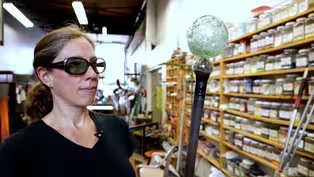
(elegant dramatic music) - All of the glass is in this furnace.
It's 2,060 degrees in there, and there's 350 pounds of glass inside this thing in a bowl.
So as I'm twisting and turning and lifting, it's like scooping honey out of a honeypot.
So now I'm gonna go into this little cast iron tool.
This cools the surface of it.
I'm gonna put a bubble in it.
So now it's hollow.
(elegant dramatic music) Squeeze it down.
Blow it up a little more.
And that makes the float's hollow part.
You see how that's all nice and round.
Tap this.
Now I'm gonna gather up some more glass, and this will be for the seal that goes on the top that has the shape of Block Island on it.
There's that.
(elegant dramatic music) (upbeat music) (horn blaring) In 2010, I started the Glass Float Project.
Every year there's 550 floats that we make, and they get hidden in small batches pretty much every day on Block Island, between the first weekend in June and Columbus Day weekend.
(upbeat music) - [Interviewer] So how do you pick your hiding spots?
- I like to say that they pick me.
I'm just looking for a certain tree that might hold a float the right way.
(upbeat music) ♪ Do, do, do, da ♪ ♪ Do, da, do, do, do, do ♪ - So where's the strangest place you've ever hidden one?
- In the mouth of a dead striped bass.
- That is totally weird.
♪ Da, do, do, do, do, do, do ♪ ♪ Da, do, da, do, do, do ♪ (upbeat music) - I started hiding glass on beaches in Rhode Island in 2010.
I chose a glass float to use because it's such a simple form.
It's one of the quicker things to make.
When I started it, I had no idea that it would become as popular as it did.
- One of the most interesting parts of the project is the community that has sprung up in the Glass Float Project Facebook page.
There's over 11,000 people at this point.
It's an interaction between an artist, a piece of art, and the public, you know?
And I think the environment is a part of that art installation as well.
- [Eben] Pablo Picasso said, "The purpose to life is finding your gift.
The secret to life is giving it away."
- And that's the nature of the gift, too.
That when you give it away, you're not allowed to tell who you've given it to how they can use it.
The gift is the giving away, and then you release, and then you back away and let that gift go.
(upbeat music) (cheery music) - Thank you.
Thank you.
Bye-bye.
- It's an amazing product in so many ways.
It's amazing that it exists.
It's kind of like a foam.
If you're looking at it from a scientific point of view, there's some liquid in it, there's some ice crystals.
There's a fat matrix.
- What's the difference between an ice cube and ice cream?
It's the whipping of the air into it that gives it that, like, lickable texture.
My name is Jocelyn Seiter.
This is my husband, Tom.
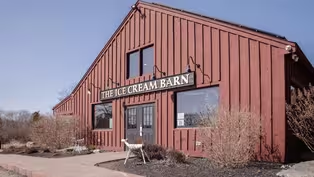
We are the owners of The Ice Cream Barn in Swansea, Massachusetts, and this is how we make ice cream.
- On a commercial scale, they have fancy machines where they're doing 1,000 gallons at a time, where they have these augers and all this other stuff.
When you're making ice cream batch by batch, which we do, you pretty much are forced to do everything by hand at that point.
(bell dings) We have a dairy processor come pick up the fresh milk from the farm when we're milking, or he picks up milk from other local farms as well.
When he pasteurized it, he adds the sugar, milk, and cream.
And then we get those in 2.5-gallon bags from him.
- We try to get as many ingredients as local as possible.
So we get local strawberries, mint, maple syrup, apples.
Today we're gonna be prepping some local mint.
(bell dings) Basically, you have a sprig of mint, and you're just plucking all the leaves off a lot of little sprigs of mint.
After you pluck, pluck, pluck, pluck, pluck all the mint off, we put it in a blender and just get it into as tiny little mint pieces as we can.
And then from there we blend that up with a stick blender so that it kind of incorporates all throughout.
And then we pour it right into the ice cream machine.
(bell dings) After the ice cream is all stirred and added chunks or ribbons or whatever we're adding to it, we just kind of put a cover on it, some wax paper, and then put it in a deep freezer for 24 hours.
And that deep freezer is, like, negative 25 degrees.
(bell dings) - [Tom] And that just solidifies everything, and it makes it the texture of ice cream that you're familiar with.
(wind whistling) - After the deep freeze, we let it temp for a little.
Oh, depending on the flavor, anywhere from 10 to maybe 20 minutes, just at room temperature.
Because when it's coming out of the deep freezer, it's negative 25 degrees, and you couldn't scoop that even if you had, like, a knife and, like, a chisel.
You could not.
Like, it's, like, rock hard.
Then we put it in our dipping cabinets.
And our dipping cabinets' scoopable temperature is anywhere from, like, 0 to 10 degrees.
(upbeat music) (bell dings) - We do sell sugar and wafer cones, the normal cones.
We also homemake our own waffle cones and waffle bowls.
We do it right in front of the customers.
I think it's something they really enjoy.
It also makes The Ice Cream Barn smell awesome.
So when you walk in, you're, like, hit with that whiff of fresh waffle cones.
After it's in the dipping cabinet.
- What flavor you want.
- Yeah.
(Tom and Jocelyn laugh) You just scoop.
That's it.
(laughs) It's ready to go.
(bell dings) (upbeat music) The place has become more than just ice cream.
It's a place where people come when they're having a bad day.
It's a place where they come when they're celebrating, like, the best day of their lives.
We've had people come here on their wedding day.
We had someone get married here.
- Married here.
- Yeah.
- [Jocelyn] They got married here 'cause it was their first date here.
(upbeat music) - It all started with just a thought of making really good ice cream, and it's become so much more than that.
That's something that I think we didn't expect when we started.
- I'm Jocelyn and this is Tom, and that is how we make ice cream.
- [Interviewer] How long you guys been married for?
- 2011.
14.
- 14?
So we've been married.
(Jocelyn and Tom laugh) We've been married for 13 years.
We've been together for 21 years.
- Almost 22.
Almost 22 years.
- Yeah, we've been together for almost 22 years.
- We're that old?
- Yeah.
(laughs) Right?
(upbeat music) (water gurgling) (gentle upbeat music) ♪ Let's take a ride ♪ ♪ I've got the perfect place in mind ♪ ♪ We've got an hour or so to hide ♪ ♪ Monte Negra love of mine ♪ - [Matt] I like to say making sea salt is like, it's like a balance.
It's like an art and science.
♪ Just one more bend ♪ ♪ Let's find a brook or stream my friend ♪ - Hi, I'm Matt Mullins.
- And I'm Tami Mullins.
- And we are the co-owners of Newport Sea Salt.
♪ Who cares if we're a little late again ♪ - I was a naval officer for 20 years.
We were stationed over in Naples, Italy.
I worked for NATO.
And while we lived in Naples, Italy, we really fell into the food culture there, which is not hard to do.
Eat what's local, eat what's fresh, eat what's in season.
So we really started learning to appreciate the use of sea salt, which we had never really done before.
So that mentality of eating local, really good ingredients, but sourced locally kind of, you know, sat with us well.
And we took that back to America with us, back to Newport.
(upbeat music) We were very surprised we couldn't find local sea salt considering we are living in Newport, which is an island.
Rhode Island is the ocean state, and nobody in the state was making sea salt.
So we kind of had this little light bulb moment.
Like, I wonder if a little sea salt company would work well here in Newport, in Rhode Island.
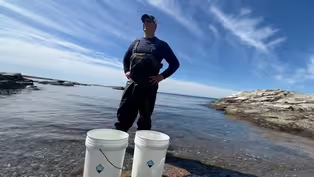
(upbeat music) We source our ocean water from Brenton Reef area because it's fast-moving ocean water.
It's just beautiful.
It's like a swimming pool out there.
(upbeat music) And then we transport it here to Hope & Main, where we spend the entire day making sea water into sea salt.
- [Interviewer] Is that easy work?
- Is it easy work?
No, it's work.
It's definitely not easy.
But it's a labor of love.
To turn, you know, 140 gallons of ocean water to sea salt can take, you know, nine hours.
(upbeat music) We like to say there's two phases.
There's a boiling phase, and then there's a slow simmer phase.
With the boiling phase we use steam kettles that bring all the water up to a boil.
During that process, it's literally the fresh water that's being evaporated.
The minerals, the sea salt, you know, remain behind.
And then there's a certain point in time that we'll shift gears and we'll transfer the water to our shallow evaporating pans.
When you're evaporating seawater, there's a certain window that we're looking for, where the actual sea salt comes out of solution.
When it starts forming on a surface, it looks like ice, and little crystals will float and dance around.
They'll eventually become denser than the water it's sitting on, and they'll just sink to the bottom.
And you let that go for many hours, and you let the salt build up.
Then that's time to scoop it out and see how we did.
(laughs) - [Tami] (laughs) Oh so sure.
Wow.
- [Interviewer] Is salt beautiful?
- Is salt beautiful?
Sure.
They're almost like snowflakes.
Each are somewhat different in a way, but more so where the salt, or, I should say, where the water is sourced from, the trace minerals will differ from location to location.
Salt is all sodium chloride.
Yes, but the trace minerals from location to location will differ, and therefore giving it a different flavor.
(upbeat music) When we're at the farmer's markets, we get a lot of return customers who take our salt if they're gonna visit someone or going to go to someone's house.
- They're traveling to Greece to go see family.
They're going to France.
- And they like to bring a bit of Rhode Island, you know, and take that with them, 'cause it truly is a flavor of, you know, Rhode Island, flavor of Newport.
(upbeat music) - You know, it's something that we work on so hard together, that to be able to bring it to a market or share it with our customers is pretty amazing.
You know, because it's ours.
You know, we made it.
We crafted it with our two hands, so.
Four hands.
(laughs) - [Matt] We're kind of honored that- - [Tami] Very honored.
- [Matt] we get that a lot, where people do take our salt.
- They're taking our sea salt, and they're sharing our story.
You know, they're that connection.
So it's really cool.
So yeah.
- [Matt] Yeah.
(laughs) - [Tami] Yeah.
- That's good.
- Are we good?
- Yeah.
- Okay.
(Matt and Tami laugh) - [Interviewer] Yup, yup.
I think that's perfect.
- [Narrator] Thanks for watching, and we'll see you next time on "ART inc." (television whining) (screen crackling) (upbeat music) (upbeat music continues) Watch more "ART inc.," a Rhode Island PBS original series, now streaming at ripbs.org/artinc.
Video has Closed Captions
Clip: S4 Ep3 | 8m 5s | Meet Recycled media artist Sam Heydt and her father, watercolor artist William Heydt. (8m 5s)
Video has Closed Captions
Clip: S4 Ep3 | 6m 11s | Glass Artists Eben Horton and Jen Nauck create glass floats and hide them on Block Island. (6m 11s)
Video has Closed Captions
Clip: S4 Ep3 | 4m 54s | The Seiters show us how they make ice cream at The Ice Cream Barn in Swansea, MA. (4m 54s)
Video has Closed Captions
Clip: S4 Ep3 | 6m 3s | Join Tami and Matt Mullins and learn how they harvest artisanal reef-to-table sea salt. (6m 3s)
Providing Support for PBS.org
Learn Moreabout PBS online sponsorship

- Arts and Music
The Best of the Joy of Painting with Bob Ross
A pop icon, Bob Ross offers soothing words of wisdom as he paints captivating landscapes.













Support for PBS provided by:
Art Inc. is a local public television program presented by Ocean State Media