
Fénix Tacos & La Reyna Bakery
Season 15 Episode 5 | 24m 47sVideo has Closed Captions
On this episode we visit Fénix Tacos in Ensenada, home of the city’s most traditional fish tacos.
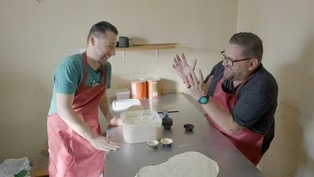
On this episode we visit Fénix Tacos in Ensenada, home of the city’s most traditional fish tacos. Next we try a sweet drink at La Michoacana. Then we stop by one of the best bakeries in town, La Reyna, where Jorge gets a hands-on lesson in creating delicious pastries and sweets.
Problems playing video? | Closed Captioning Feedback
Problems playing video? | Closed Captioning Feedback
Crossing South is a local public television program presented by KPBS
Fénix Tacos & La Reyna Bakery
Season 15 Episode 5 | 24m 47sVideo has Closed Captions
On this episode we visit Fénix Tacos in Ensenada, home of the city’s most traditional fish tacos. Next we try a sweet drink at La Michoacana. Then we stop by one of the best bakeries in town, La Reyna, where Jorge gets a hands-on lesson in creating delicious pastries and sweets.
Problems playing video? | Closed Captioning Feedback
Where to Watch Crossing South
Crossing South is available to stream on pbs.org and the PBS app.
Providing Support for PBS.org
Learn Moreabout PBS online sponsorshipJorge Meraz: Hey, folks.
On this episode of "Crossing South," we're in Ensenada tasting the city's iconic Baja-style street fish tacos, then we discover a French bakery crafting authentic European pastries the old school way.
And it's coming to you now.
♪♪♪ ♪♪♪ Jorge: You know, every city has its classic place, its nostalgic place that everyone knows, that everyone--the old-timers, everyone's gone to for a long time.
Sometimes that place is not necessarily the most tasty, right?
It's more of a nostalgia because it's been around for a while.
So we're gonna find out right now if a place like that here in Ensenada that's been around for over 5 decades is either just nostalgic and it has the reputation of being good or if it's actually good.
We're gonna try Tacos El Fenix.
It's been around since 1970 here downtown Ensenada.
Let's try it, folks.
"Crossing South."
Don't go anywhere.
Jorge: So it's gonna be one of those places--I mean, this is a crust you have to catch, right?
Street sign.
Everyone's standing.
You know, you got the music guy here, you know, waiting for tips and so on.
So it's not your sit-down restaurant.
You know, when you're in one of these crusty places in Baja, you're like--you're abroad, you know.
It's just an hour across the border and you're in a completely foreign experience, and that's how we like it.
You know, that's the charm and allure of Baja.
So you got people from, you know, old folks to young and all in between, and that's how they like it.
You know, this type of restaurant, this type of taco stand sometimes when they make it big and they open like a sit-down restaurant, you know, they go bankrupt.
It doesn't--people don't follow them.
People like this arrangement, to just be standing and ordering a taco.
Let's try one.
Let's try a couple.
Okay, so I got the lowdown from one of the cooks here.
So apparently the great-grandma came from Jalisco, which is the state where Guadalajara is at, and she brought the recipe, and it's the same recipe.
So this is the fourth generation now.
The owners--the current owners are fourth generation from that grandma who started this taco stand.
So, pretty chill.
Over 55 years it's been operating, and it's still in the family.
Still the same old recipe, and we're gonna try it right now.
Were they that far ahead of their time?
We're in 2025.
We're in the 21st century.
This recipe is still delicious?
Let's try it.
Let's find out.
This is the classic shrimp and fish taco.
This ain't Rubio's, folks.
This is homemade.
Look at how that shrimp--look at that orangey-pinkish hue on the shrimp.
Looks like a little lobster, doesn't it?
Okay?
So the classic toppings that people put is the coleslaw.
Your shredded cabbage is like a must.
I don't know who started it, but it just works.
Then the crema.
You know, I know that Americans are a lot self-conscious, health-conscious and this would be probably pretty unhealthy.
But when you're in Mexico, you forget the rules, right?
Any--no substitutions.
You do as Romans do.
Calories are counted as pesos here.
They're a lot less valuable.
Now, if you want, you can add a little bit of tomatoes in it.
I don't add too many of those.
And now the salsa.
So half of that and then half of this.
I'm not a big lime guy.
Mexicans love putting lime on their food.
To me it stops tasting, you know, as what it was and now it's just lemony matter, but I do use lime as my own personal hygiene sanitizer, okay?
Jorge: All right, I'm gonna try this one first, the green sauce on the fish taco, all right?
It's tasty.
It's tasty.
Not blow-your-socks-off good but tasty.
Let me see the--with the darker sauce.
It's all right.
Not fantastic, but it's all right, right?
That's the fish taco.
Let's see the shrimp taco.
It's a lot better.
Okay, listen.
These are very good tacos as a baseline, but they're not extraordinary.
Let me put it like this.
If you've never come to Baja and you--that's your first stop and your only reference is Rubio's stateside, then these will literally be the best tacos you've ever had.
However, having tasted what's going on across the state of Baja right now in regards to seafood preparation, seafood tacos, shrimp tacos, fish tacos, and so on, it's more nostalgia.
That's the honest assessment.
I will give it a generous eight, very subjective if you come to trust your friendly travel show host's opinion.
That's it, folks.
So, very good tacos with that caveat.
So that was Tacos El Fenix.
I think it's 80% taste, 20% nostalgia.
So within a relatively small geographical radius there's multiple fish and shrimp taco stands, and we're gonna try another one.
We're gonna try another one.
Let's just see where the tastes range and let's check it out, okay?
So follow me, find another one here on the corner.
However, on this occasion, I'm just gonna have the shrimp taco.
So I'm just gonna judge them based on their shrimp taco, all right?
So let's just check out one.
That's all you get.
Jorge: Try a little bit of that here.
I'm gonna try some habanero on the side--on the other side, and I'm gonna have the jalapeño avocado one in the middle.
So each bite should have a different taste, right?
Jorge: The difference between the last place and this one is that she prepares everything for you.
She's the one that put the cabbage.
She put the tomatoes.
She didn't ask me if I wanted any or not.
We'll forgive her for that.
Get an A for effort.
I'd rather, you know, over-enthusiasm than indifference.
Tortilla is not as cold as in Fenix.
Tortillas--at Fenix the tortilla was cold, to be honest.
This one's not hot, but it's not cold.
It's warm.
So we're gonna try the--this is the habanero, avocado in the middle, and then the chile de árbol.
He said this is the spiciest one.
So we're gonna try that one first.
Ooh, that's hot.
The batter recipe, it's a little tastier on this one, I have to say.
It's a good taste.
The one thing I will say about Ensenada shrimp tacos is that the portions are a little bit smaller than the ones in, say, Tijuana and a lot of the vegetables, I think, delude because the--you know, the cabbage is still very runny with water and it kind of dilutes the taste of the battered seafood.
I wish I could just try the batter kind of like a nugget, kind of like a chicken finger or so on.
Let me try this middle part.
It's slightly above but not by much.
8.5 is what I'll give this.
So serviceable, again, very good, but--yeah, I think compared to what's going on and the innovation in both techniques using Baja's produce these are not a relic because they have their place.
They've both been delicious, but I guess I'm comparing them to what's going on in the region as a whole.
I'm gonna do something just for you guys that I haven't done in a long time.
I don't think we've ever done a Michoacana.
You will find them across Mexico.
They're like a franchise, I guess, but--a very, very common like folksy franchise, meaning you'll find them in, you know, from--anywhere from impoverished areas to fancy areas.
Doesn't matter.
It's everywhere across Mexico.
And one of the things that they're known for on top of, like, their popsicles, their, you know, eskimos, their ice creams and so on, it's their aguas frescas, which is the--you know, it's kind of like the sugary drinks from Mexicans other than soda, right?
Mexico consumes Coca-Cola more than any country in the world, but probably within the top ten is their aguas frescas.
They go to a restaurant.
They don't want a soda.
They don't want a beer.
They ask, "Do you have any aguas frescas?"
And one of the ones that's been my favorite since I was a kid is the rompope agua fresca, which is like the eggnog flavor agua fresca, which is probably--oh my God, who knows how much sugar it has.
But I'm gonna break the rule for you guys and I'm gonna order that right now.
Let's get a rompope agua fresca, right?
Jorge: Okay, folks.
So this is it, the aguas frescas.
If you look at the lady, she's gonna order other ones.
They've got hibiscus water.
They've got horchata, which you probably know what that is obviously.
They've got cucumber flavor.
They've got piña colada.
They've got cebada.
You want a recommendation from me?
Tom Jorge sent you?
Wherever you go, either ask for the rompope or piña colada.
Now, that's if you want a milky kind of drink.
Now, if you want, you know, more of a water based, the jamaica, the hibiscus is very popular.
Bottoms up.
Cheers.
Cheers with rompope water, right?
I know it's sugary.
I don't really drink this anymore, but I'm glad I made an exception.
Thank you.
I thank you, the audience, because you--believe me, I'm not the healthiest guy you know.
You see me.
But believe it or not, I--even though I love desserts, I don't eat sugary processed foods, especially juices or drinks like that or soda.
I haven't drank soda for real, like having it in my house, for over 20 years probably.
But this is a memory, a core memory, from childhood.
So thank you for giving me an excuse to try it again.
Jorge: You know, in health I've heard doctors say that extremes are bad.
You know, extremes one way, extremes the other.
So nice little balance.
I think this treat is valuable and justified, all things considered.
Jorge: You know, as valuable as being balanced is, we're actually gonna stay on the sweet side of things.
We are moving from one side of Ensenada to another where we find a hidden spot for those who have a sweet tooth.
Charlemagne knew it, Napoleon knew it, and now you know it.
Jorge: There's a place in Ensenada that takes all the high-end French pastries to fancy restaurants.
And if you sit down at a restaurant, pastry is gonna be, let's just say, not cheap.
But if you know where the pastry shop is, the source, well, you're gonna get the same deliciousness without the price.
We found that place.
It's in Ensenada, and it's right there.
It's called La Reyna Vasquez.
"Crossing South," folks.
Jorge: So this bakery has been in Ensenada for many years.
It's a staple of the city.
All the locals know about it.
That's the founder right there, Ms.
Guadalupe Vasquez, the Reyna.
And we are going to talk not with her but with her son, who's standing right here next to me.
Daniel, how are you doing, my friend?
Daniel Reyna: Very good.
Very good, thank you.
Jorge: So that's your mom.
Daniel: That's my mom, yeah.
Jorge: Is your mom still with us?
Daniel: She passed away in 2020, unfortunately.
Yeah, on the pandemic, yeah.
Jorge: I tried your pastries--or your mom's pastries a long time ago.
I fell in love with them the first time I tried them.
Wherever I go, this is the standard that I compare any pastry to.
Daniel: She born in Jalisco on the '50s.
Jorge: Your mom born in Jalisco?
Daniel: Yeah, and they came here to Ensenada like in the '80s and in the 1990 he--she opened the bakery.
This bakery, right.
She learned the French bakery on the famous restaurant here in Ensenada.
She got, like, the recipes and she put like the--her own, yeah--you know, the style.
Jorge: Yeah, yeah.
I know for me I've driven from the border all the way over here just to get these.
Daniel: Actually, we hear that a lot.
People in San Diego, Los Angeles, Tijuana, Mexicali.
So the standard of this bakery is really high.
I mean, it's really tasty.
So the people came back for the quality of the--all the ingredients and the style.
Jorge: And for sure, folks.
I mean, I gotta tell you: if my mom finds out that I came to Ensenada and I don't come back with one of these, I'm in trouble.
I'm not kidding.
Daniel: That's the story of a lot of people actually.
I hear all the day--all day that-- Jorge: If she hears that I came to Ensenada and come back empty-handed, I am in trouble.
Just FYI.
Now, let me ask you something, man.
This is based on me when I've tasted these.
Do any of these fillings have alcohol?
Daniel: Actually, they do the-- Jorge: They do, right?
'Cause I taste a little bit of something in there.
Daniel: A little bit.
You got it, yeah, yeah.
Jorge: I tasted it, but I never knew.
Now confirmed from the source.
Daniel: Yeah, it's one of the secrets, one of the secrets of our-- Jorge: Can you show us a little bit of how you make some of these breads?
Daniel: Yeah, sure, sure.
We can go to the kitchen.
Jorge: Don't go anywhere.
"Crossing South."
We're gonna go back into the bowels of the beast.
Jorge: Okay, now making our way into the "fungeon."
Oh, boy.
Jorge: This is where the apple cobbler begins, folks.
I'm not great at this.
I'm sorry.
I'm not great at this.
It's not just apple flavor.
This is actual apples.
Daniel: All natural.
We try to be all natural, yeah.
Jorge: Is a machine like this from like the '50s or something?
Do you know-- Daniel: Yeah, a lot of our machines are really old, but it's--maybe some--the flavors that classic for that-- Jorge: Hey, I wouldn't have it any other way.
That's exactly how you should do it.
Daniel: And, of course, a lot of process for--to making like with your hands is more effective, you know.
I believe, yeah, the human hands have that-- Jorge: Irreplaceable, the touch, the touch.
So did your mom give you your touch?
Daniel: Actually, she--yeah, me and my brother, we know a lot--all of the process.
Jorge: Are you gonna teach your kids?
If your kid says, "No, dad, I don't wanna be a baker."
Daniel: We are watching to the future to this business actually can go bigger.
Jorge: Mom, you gotta contribute.
All right, well, Daniel, I wanna see a little bit of the magic.
Show me what to do.
Let's hear it.
Well, let's do this.
Let's get it done.
Daniel: So we're gonna start to put the--this-- Jorge: The dough.
The dough.
Daniel: You're just gonna cut to the half and then we're gonna pass to that machine.
Jorge: So just cut it?
Is there any technique?
Daniel: No, just like that, yeah.
And you just put some--this thing in here and down.
Jorge: Okay.
♪♪♪ Jorge: The touch, the touch.
Daniel: And then you put the-- yeah, put in the mansa riba.
Jorge: Up here?
Just drop it in there?
Daniel: Yeah.
Jorge: Oh, boy.
Daniel: Just be careful with the finger.
Jorge: Slowly.
Slowly.
Ah, my fingers!
No, I'm just kidding.
I feel like a baker, man.
Daniel: So you're gonna take it under your left hand and with your right hand you're gonna turn on, turn on with your right hand.
[imitating Italian accent] Jorge: Am I a baker here?
Daniel: And then you-- Jorge: No, it--put it?
Daniel: Yeah, yeah, sure.
And then push again.
Just with the-- and--yes, like that.
Yeah, that's it.
Jorge: Somehow I feel like I'm slaughtering this.
Like, this isn't the shape that it should be.
Daniel: Yeah, actually the--maybe for the heat.
Jorge: He's saying because of the heat, not because of my incompetence.
You're too kind.
You're too kind.
Daniel: It's too hot here in Ensenada.
You can start from the middle and then for the sides.
Jorge: Like that?
Daniel: Yeah, sure.
Jorge: Yeah, sure.
Jorge: Yeah, folks, this isn't how they make it, okay?
This is the first day on the job.
First they fired Jorge, just so you know.
If you can fix what I did, please do it, okay?
Daniel: I think that's fine.
The first part is really simple.
You just have--you have to put one by one on the--on this mold and then we put the things inside, the pending.
I mean, this is gonna--this could be the apple one or the almond, the apricot.
Basically, all the cakes is like the same process.
Daniel: Put this down and do, like, with your fingers on--to the middle.
Jorge: Oh, wow, you squeeze it in there.
Daniel: Yeah.
You don't have to rip it too much because this is, like, flexible.
So inside of the oven it, like, crash if you pull it.
Just cut it, something like that.
Jorge: Oh, wow.
Yeah, like that.
Do you press it against this or no?
Daniel: What's that?
Jorge: Do you press it against this?
Daniel: A little bit.
Yeah, a little bit.
Jorge: And then did you press like this?
Daniel: Yeah, it's--with the two hands it's better.
Jorge: Oh, wow, I see it.
I see it.
Daniel: You got it.
Jorge: I got it.
Did I do it right?
I think I did.
Okay, not perfect.
Some imperfections, but first time, first time.
Can you tell which one was made by a pro and which one by yours truly, huh?
Can you tell, can you tell, can you tell?
Jorge: I think that's a lot, right?
Daniel: Yeah, it's gonna be like three-quarters of that.
Jorge: Three-quarters.
How about that?
Daniel: Yeah, I think it's good.
Jorge: Now, how do we cover these?
Daniel: Simple.
Just put the same technique.
You put them back down just gonna--with this and then-- Jorge: Oh, okay, okay.
Same thing but without tucking it in.
Daniel: That's right.
Jorge: It's very specific.
We have to do the ritual.
I'm just kidding.
All right, all right.
Daniel: Let's try to use a lot of your hands, not just the finger.
Jorge: I feel like the gap is too big, right?
Daniel: You're not gonna get damaged with them.
Jorge: Like I'm not touching anything.
Jorge: This is the amateur... This is the pro... If you see this, folks, you know who made it, all right?
This is worth a lot of money, just so you know.
Jorge: It's quite one thing to learn how to make it, but it's quite another to learn how to taste it.
So we're gonna go try some of your stuff, okay?
"Crossing South," folks.
Don't go anywhere.
We are here behind the curtain.
Thank you, Dan, so much for you and your mom and your family's hospitality, okay?
Thank you very much.
"Crossing South," folks.
Don't go anywhere.
Jorge: You know there's a proverb that says don't muzzle the bull while it works?
I think I worked enough to earn my keep.
So no muzzle for me.
Jorge: Because I'm like a big kid, I can't eat pastries without milk.
It's just unnatural to me.
So I have this ready.
Okay, so you've got your hojaldre, and these are like crusty, flaky pastries filled with almond cream along with powdered sugar on top.
This is their new--like a chocolate tart with strawberry.
Look at that.
Look at that goodness.
Oh, man, check it, check it.
You have your almond cream one.
This is the one we made back there that Daniel allowed me to slaughter.
This is my creation.
Remember I was peeling apples?
Well, this is the cobbler.
And these two are like the flagships of this place, which is the eclair and then you have the monjita which is like little nun.
♪ The champions.
♪♪ Let's try first the cobbler, which is the apple pastry.
So--oh, let's do that.
Look at that.
Look at all that appley goodness right there.
That is so good.
I love it when a dessert has just the right amount of sweetness.
It's a balance that very few achieve.
Look at that creaminess.
I mean, look at that.
Oh, man.
Ooh, that pastry just exploded.
That's the aftermath, folks, but that's what you want, you know?
Let's crack it open, this almond cream.
He wasn't kidding.
You know, it's not the same as the cream here for the hojaldre.
This cream, if it's the almond cream that we put inside, almost becomes like a bread.
Oh, man, that's so tasty.
Okay, so moving right along, this is the tart.
I used to love those chocolate cream pies.
I don't know if I should have broken it like that, but I did.
And now that I did, we got to follow through.
It's all in the quality of the chocolate, mm.
What happened in history that made the French make such good pastries?
Let's try it.
What an elegant dessert this is.
I start hearing Baroque music.
I feel like I'm in the Palace of Versailles with, you know, Louis the XV.
And I'll tell you one thing, guys.
After trying the eclair here at La Reyna Vasquez, it becomes the baseline for me.
It becomes the standard by which I judge all other eclairs whenever I have them.
So we're gonna try the last one, which is the monjita.
I wanna open it so you can see what it is.
You gotta be careful 'cause the cream will literally explode.
So we're gonna do this carefully.
I'm gonna separate it because if you separate it you won't make that much of a mess.
This is fantastic.
I can't begin to tell you how good this is, mm.
Folks, after an extensive Ensenada culinary adventure, it's time to bid you farewell.
We'll see you on the next one, folks.
It's "Crossing South," and we'll see you next time.
Take care.
Jorge: Do you know what happens to the human body when you deprive it for 3 months from all flour and sugar?
I don't know, and I don't care.
♪♪♪ ♪♪♪ ♪♪♪ announcer: Like to know more about the places you've just seen?
Maps, videos, podcasts, and more at crossingsouth.com.
We also do Facebook, Instagram, and YouTube.
Fénix Tacos & La Reyna Bakery Preview
Video has Closed Captions
Preview: S15 Ep5 | 30s | On this episode we visit Fénix Tacos in Ensenada, home of the city’s most traditional fish tacos. (30s)
Providing Support for PBS.org
Learn Moreabout PBS online sponsorship













Support for PBS provided by:
Crossing South is a local public television program presented by KPBS