
Fight for Freedom Fund Dinner, Mental Health Awareness Month
Season 52 Episode 20 | 26m 46sVideo has Closed Captions
The Detroit NAACP Fight for Freedom Fund Dinner and May is Mental Health Awareness Month.
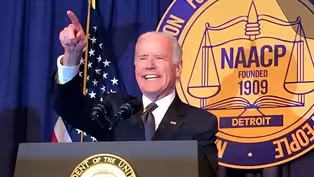
The Detroit Branch NAACP’s 69th annual Fight for Freedom Fund Dinner at Huntington Place in downtown Detroit features President Joe Biden as the keynote speaker, marking only the second time a sitting U.S. President has given the keynote. Plus, May is Mental Health Awareness Month and “American Black Journal” examines the unique challenges the Black community faces in navigating mental health issu
Problems playing video? | Closed Captioning Feedback
Problems playing video? | Closed Captioning Feedback
American Black Journal is a local public television program presented by Detroit PBS
Fight for Freedom Fund Dinner, Mental Health Awareness Month
Season 52 Episode 20 | 26m 46sVideo has Closed Captions
The Detroit Branch NAACP’s 69th annual Fight for Freedom Fund Dinner at Huntington Place in downtown Detroit features President Joe Biden as the keynote speaker, marking only the second time a sitting U.S. President has given the keynote. Plus, May is Mental Health Awareness Month and “American Black Journal” examines the unique challenges the Black community faces in navigating mental health issu
Problems playing video? | Closed Captioning Feedback
How to Watch American Black Journal
American Black Journal is available to stream on pbs.org and the free PBS App, available on iPhone, Apple TV, Android TV, Android smartphones, Amazon Fire TV, Amazon Fire Tablet, Roku, Samsung Smart TV, and Vizio.
Providing Support for PBS.org
Learn Moreabout PBS online sponsorship- Coming up on "American Black Journal," the Detroit Branch NAACP prepares to welcome the president of the United States, Joe Biden, as the keynote speaker at its annual Fight for Freedom Fund Dinner.
Plus, its Mental Health Awareness Month, we're gonna talk about the importance of protecting your mental well-being and eliminating the stigma in the African American community.
Stay right there, "American Black Journal" starts right now.
- [Announcer] From Delta faucets to Behr paint, Masco Corporation is proud to deliver products that enhance the way consumers all over the world experience and enjoy their living spaces.
Masco serving Michigan communities since 1929.
- [Announcer] Support also provided by the Cynthia & Edsel Ford Fund for Journalism at Detroit PBS.
- [Announcer] The DTE Foundation proudly supports 50 years of "American Black Journal" in covering African American history, culture, and politics.
The DTE Foundation and "American Black Journal," partners in presenting African American perspectives about our communities and in our world.
- [Announcer] Also brought to you by Nissan Foundation, and viewers like you, thank you.
(gentle upbeat music) (gentle upbeat music continues) (gentle upbeat music continues) - Welcome to "American Black Journal."
I'm Stephen Henderson.
The 69th Annual Detroit NAACP Fight for Freedom Fund Dinner is gonna take place on May 19th at Huntington Place in downtown Detroit.
Now, this year's theme is, "Preserving Sweet Liberty, Defeating Bitter Tyranny."
President Joe Biden is gonna deliver the keynote address at a time when we face critical issues in this country and abroad.
I talked with Detroit NAACP President, Reverend, Dr. Wendell Anthony, about the event, and the decision to have a sitting president deliver the main address.
The president of the United States coming to Detroit for the NAACP Freedom Fund Dinner.
I don't think it gets any bigger than that.
- It really doesn't, Stephen.
And, you know, coming to Detroit, we're the only unit, the only branch in the country, that has ever hosted a sitting or a post-president at our Freedom Fund Dinner.
I mean, that's quite a tribute to Detroit, and to the branch, and to all the people that worked so hard to put it together.
I mean, it's not an easy thing to have the president to come to your house for dinner.
That's not easy.
And when one considers all the things that's going on in the world, and for him to slice this time and to come to Detroit to be a part of the NAACP Freedom Fund Dinner is quite a tribute.
So I thank all the people that have helped, and all the volunteers, staff, everybody, that's made it happen.
He came here in 2015 as vice president, and now he comes in 2024 as president, so that's quite a coup.
- Yeah, and this is not the first time you've had a sitting president, right?
Didn't Clinton come during his presidency?
- Yes, we've been blessed.
The first vice president that we had was Al Gore.
And you might remember we had the Oklahoma bombing at that time, Timothy McVeigh.
And Al Gore was a speaker, and people were charged up to see him, and he was delayed five hours because of that bombing.
But half of the people stayed to wait.
5,000 people still stayed at the dinner at that time.
So we had Al Gore, we've had Bill Clinton twice.
We had him once as president, once as he came back post-president.
We've had Senator Barack Obama a year before he became president.
We had Kamala Harris, a year before she became vice president, Biden, and now president.
We had Hillary Clinton twice.
We've had all kind of cabinet members.
So I think we got a record, in terms of Detroit, in terms of keynote speakers.
And the interesting thing, Stephen, I have to share this with you, when I was running for president in '92, and in '93 I won, 'cause they canceled the election, you know the hell that went through that with Wendell Anthony as a potential president.
It was said, "Now if Wendell Anthony becomes president of the Detroit branch of the NAACP, who are we going to get to come to the Freedom Fund Dinner?
Who is gon' come to Detroit for the dinner if this militant, this person who did not come up the way we came, who is gonna come?"
Well, the answer is presidents.
- Two presidents, right?
That's right.
Yeah, that's really good.
- So all good, all good.
- So, you know, the president is spending more time in Michigan than he did before, and certainly more than Hillary Clinton did in 2016, because this is such a critical state.
Talk about what's at stake in this election right here in Michigan and in Detroit.
- Well, it's no secret that Michigan is a swing state, and Detroit is important, African Americans are important.
And also, Stephen, we're not going to not notice the elephant in the room, this is the highest assembly of Arab Americans outside the Middle East, right here.
Dearborn is right next door, and we know the issue of Gaza.
If anybody can understand the pain that comes out of Gaza, that our Arab brothers and sisters feel is Black people.
We know pain, we've been there.
We've had Tulsa.
We've had all the deaths, the 100 years of lynchings.
We've had the Middle Passage.
We know discrimination.
We know all the shootings randomly and un-randomly by police officers.
We know that.
So you don't have to convince us of the pain, we went through all of that, and we are still going through it.
But by the same token, we have issues on the table.
Issues of healthcare, issues of economic access and development, issues of infrastructure and jobs, issues of training and workforce development, issue of HBCUs and the reduction of loans for colleges, women's rights and their right to choose.
So all of those are issues that are on the table for us and for them too.
And if you're not careful, you may wind up getting more than you bargain for, because there's another fellow who's talking about having the largest deportation of Black and Brown people, which also will include Arabs, in the history of the nation, Project 2025, which is real.
Wanna be a dictator, "The first day that I get in office, I'm gonna change the whole context of the federal government," that's on the line.
So I think that when one looks at what's at stake, it's very important.
The NAACP, as you know, Stephen, we don't endorse politicians or partisan folk.
We have Democrats, we have Republicans, we have Independents, we have some folk who don't know what they are, that comes to our event.
That's a part of it.
We endorse policies, it's not a D, or an R, or an I, it's a P. This is what your policy is.
And so if the policies don't fit, you gotta quit.
And so it's the bottom line here for us.
- So when you think about, you know, I've had a lot of conversations with African Americans in the last couple of months about this election, and what's at stake, and what they wanna do.
There's this sense that Joe Biden hadn't done enough for Black people, and particularly for Detroit.
What do you say when you hear that?
I know you hear the same things.
What do you say to those folks?
- I hear it all the time.
You know, Kamala Harris, vice president, announced $100 million in terms of economic development, small business loans, small business training, manufacturing jobs, cybersecurity, some stuff that we ain't never had before.
The president, in terms of policies and record, has moved to reduce billions of dollars in college loan debt.
He would've done more, the Supreme Court blocked him.
The other folk don't want him to do that.
Healthcare is being expanded under this administration.
I'm simply saying that they're not trying to offer you gold gym shoes with red bottoms on them.
They're not saying, "Look at me, I'm in prison, and because I can relate to y'all, because you've been in prison, buy my T-shirt and support me."
There are real policies at stake here.
People need to look deeper and to really ask themself, are you better now?
Really, if you wanna ask that question, are you better today than you were four years ago when a million people died because of the pandemic?
When you were told to use bleach, to use it in your body to get rid of it?
When science was mitigated and said we don't wanna use science?
Are you better off today with all the banning of the books that come from education?
Or are you really going to consider people that want to enhance your education?
Our freedom and our democracy is on the line.
Are you with folk who want to expand the vote, who want to increase it?
The George Floyd Policing Act has not yet been ratified and signed into law.
The administration wants to do that, other people don't wanna do that.
The John Lewis Voting Advancement Act still has to be ratified and signed into law.
The other folk don't wanna do it, these people do wanna do it.
What the heaven do you want?
Check it out, don't take my word, look at the record.
And when you look at the record, it speaks for itself.
Don't go for the okey-doke.
You can go for somebody who's sitting in the courtroom right now trying to defend himself against fraud and the misuse of money, as he tried to hide his involvement with a porn star, as opposed to somebody who's opening up infrastructure, who's creating jobs, and who's doing the business of the presidency, rather than somebody who's theorizing about what a presidency might be under his raggedy leadership.
I'm just saying.
- So you mentioned the George Floyd Policing Act, the John Lewis Voting Advance Act.
If Biden had focused on those things in the early part of the administration when he had majorities in both houses, do you think he'd be having to make this case now to African Americans?
I mean, isn't it that we didn't get those things that has some people upset?
- I think that might be.
But, keep in mind, it's not that he didn't try to bring it to the table.
He's fighting against folk that don't wanna deal with it.
Mitch McConnell and his crew did not want to bring to the table and to support these bills, these laws.
It's just like Barack Obama tried to get Merrick Garland on the Supreme Court.
Two years prior to the election, Mitch McConnell and the Republicans blocked it.
I'm not here as a spokesperson for Joe Biden.
I'm here as a spokesperson for Wendell Anthony and the NAACP, and what we need and what we must have program wise and policy wise for our people, and that is the policies that we see emanating from this president.
Quite frankly, if the other fellow gets in, it's all off the table, because they ain't trying to expand nothing.
They ain't for voting rights.
As you recall, in 2013, Shelby v. Holder, Section 5 part of that was gutted to the degree that they support that.
They don't want to expand.
There's 400 bills all over the United States in terms of bill's potential.
Do you know, Stephen, that of the 10 poorest states in the United States of America, nine of them are so-called red states, they're in the south?
- Yes.
- Mississippi, Kentucky, Louisiana, the Dakotas, Arkansas, red states, where they're supporting this stuff, they are the poorest educationally, health wise, job wise in the country.
You mean you wanna bring that to Michigan, and New York, and D.C., and Atlanta?
Come on, y'all.
- Yeah, all right, Reverend Wendell Anthony, of course, we're out of time.
- We can't be finished.
- You don't have enough.
(laughs) - I mean, the dinner is the 19th.
We're awarding Senator Debbie Stabenow, President's Award, Freddie Haynes, Freedom and Justice.
We're awarding Spain Middle School for their winning in terms of robotics.
We're awarding the Renaissance High School for their winning in terms of being innovative and being the top high school in the nation, not just in Detroit, but in the nation, for the kinds of programs that they have.
We're bringing our students in.
Detroit is a city of winners.
We're not losers, we're winners.
And we're bringing in Claude Cummings before that, for Freedom Weekend, the first African American serving as president of the Communication Workers of America, May 17th at Fellowship Chapel.
Go to DetroitNAACP.org or call 313-871-2087 to get your table.
Don't be square, be there.
- That's right.
And we'll put all that information on our website as well.
- Thank you, Stephen.
- Congrats from me for, you know, keeping Detroit in the spotlight.
It's a big deal.
- Thank you, Stephen, I appreciate you, man.
You've been with me all this time, and so we've been here before.
Thank you, man.
- Yeah, I'm impressed.
All right, thanks for being here.
- All right, now.
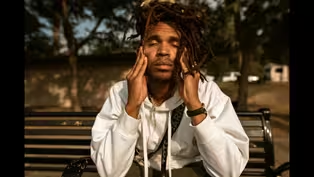
- May is Mental Health Awareness Month, and that's a time to address the challenges faced by millions of Americans who are living with mental health conditions.
These include the stigma around mental illness, a lack of knowledge about available resources, and a shortage of psychiatrists and other mental health professionals.
I talked about these concerns and more with Carlynn Nichols, who's senior director of behavioral health at CNS Healthcare.
So all of us, I think probably need to pay a little more attention to our mental health condition.
But let's talk about our community, in particular, and some of the challenges that we have that I think are not necessarily common to other populations.
And this is really about being able to face up to the problems that we have and to seek help.
- Yes, I think one of the challenges in our community is there's just a lot of stigma around mental health or mental illness.
And one of the challenges we really need to face is that mental health is as important as physical health.
They're very much interwoven, and if we want to be physically healthy, we also need to be mentally healthy.
And so being able to discern when you're not feeling well is important, both physically and mentally, and not only yourself, but also your friends and family.
Being willing to say, "Hey, Stephen, are you okay?
Is there anything I can do to support you?"
And also knowing that when it's something beyond what I can do as a friend of Stephen, to actually recommend something like going to see a doctor or a therapist, which is the same thing we would do if you weren't feeling physically healthy.
- Right, right, I wanna talk about some access issues as well.
In our community, access is about both insurance and the ability to pay for healthcare, but it's also about the availability of specialists, doctors in our community to deal with these things.
You're dealing with kind of a double whammy when you're talking about mental health there.
- Yeah, absolutely.
So, in our field, we have those who are practitioners who are therapists, so we're talking about a licensed social worker, psychologists, and counselors, as well as physicians who are psychiatrists or nurse practitioners.
And, overall, there's a shortage, there's a workforce shortage.
The same shortage we see in other industries, we have the same shortage in mental health.
We have a great shortage.
The shortage in psychiatry has been going on for a long time, and nurse practitioners have begun to fill that gap.
And when you look at the therapists, there's definitely a shortage.
And there's a lot of competition for that level of staff across organizations, across counties.
You have schools that want behavioral health professionals, you have clinics that want behavioral health professionals, and most of our community would access these services in their local communities.
And the need for those who have a desire to serve is really important.
So universities are getting involved, as well as the State of Michigan getting involved and making it an attractive choice for many.
- Yeah, a lot of your work is with children and families.
And I feel like both got challenged in ways that we wouldn't have imagined before during the pandemic.
Now that's technically sort of in the past, right?
- Yeah.
- But I feel like the effects of it aren't.
That we're still trying to sort out some of the things that happened during the pandemic, and certainly, you know, how we go forward.
Talk about the mental health picture there.
- Yeah, so we know the pandemic was a global trauma, right?
So we all had to shelter in place, and children weren't able to go to school.
They weren't able to engage with their peers.
And so much of what we learn in social skills is when we engage with other people in the classroom, learning how to get along, learning what it means to sit somewhere for an hour and learn.
At the same time, we know children are in families.
And as their parents or family members were experiencing stressors and trauma, they were also feeling those same things.
So as we're, I believe, we're like a year beyond the public health emergency, it ended at the end of April in 2023, and what we see is those children who were born during the pandemic are in preschool now.
Those children who sat in a Zoom during their formative years when they were to be in a classroom engaging with teachers and peers, now they're in the classroom and we're seeing some extremely challenging behaviors.
And they're behaviors that our educators aren't necessarily prepared for, because our educators are taught how to be educators, not how to be behavioral health professionals.
So it is important that as early as we possibly can, that we recognize the needs of our children, and we get them assessed and we get them care.
That's the good thing about our system, I will say, particularly our public mental health system, we're able to serve children pre-birth, believe it or not, through 21.
And sometimes we miss an opportunity when a child is in utero, because we don't understand the trauma that a parent or a family is experiencing at that time directly impacts those children.
So what becomes important is recognizing it, and just asking for help as soon as possible.
And even though there's challenges around workforce, organizations are really trying to pitch in and help.
- Yeah, yeah, so for Mental Health Awareness Month, what do you say to people about, "Hey, here's a couple things you could do that might give you more opportunity to think about your mental health and the mental health of the people around you?"
- Yeah, so we have this really neat program at CNS Healthcare right now called Plant Your Sign.
I planted my sign last week where you grab a sign and you put a message on it, like, "Mental health is important," or "Remember to take care of yourself," like something like that.
And it's in my yard, and it gives a message to the people around them, just a reminder.
I put it on my Facebook post every May just to encourage people, because people know me and they know this isn't something that I do.
And I think what's important is to remind people around you that, one, it's okay to not be okay and to be a listening ear.
Sometimes we're moving so fast that we may miss it.
So just being present for the people around you, listening, making sure everyone's okay.
And if they're not, encouraging them to get some extra help if they need it.
- Yeah, but what's that line between someone who just is having a hard time and somebody needs care and needs help?
- I think for the layperson in the world, just think of your functioning.
So if you're not able to get out the bed and go to work, if you're not able to get out of bed and go to school, or if you're at work and then you can't focus or do your job, or you're at school and you can't do the work, so I often say, particularly for children, it's easy to understand, at home, in school or in the community, if you're not able to function at home, in school, or in the community, you might need a little bit of extra help.
And we're not talking about anything other than getting out of bed, brushing your teeth, sitting in the classroom, listening to the teacher, getting along with your peers, like just regular.
And, for us adults, it's kind of the same thing too, at home, at work, or in school, if you're doing that too, and in the community, if you're able to function, okay, you're good.
- That's it for us this week.
You can find out more about our guests at AmericanBlackJournal.org.
Plus, you can connect with us anytime on social media.
Take care, and we'll see you next time.
(gentle upbeat music) (gentle upbeat music continues) (gentle upbeat music fades) - [Announcer] From Delta faucets to Behr paint, Masco Corporation is proud to deliver products that enhance the way consumers all over the world experience and enjoy their living spaces.
Masco serving Michigan communities since 1929.
- [Announcer] Support also provided by the Cynthia & Edsel Ford Fund for Journalism at Detroit PBS.
- [Announcer] The DTE Foundation proudly supports 50 years of "American Black Journal" in covering African American history, culture, and politics.
The DTE Foundation and "American Black Journal," partners in presenting African American perspectives about our communities and in our world.
- [Announcer] Also brought to you by Nissan Foundation, and viewers like you, thank you.
(gentle music)
Biden gives keynote at 69th Fight for Freedom Fund Dinner
Video has Closed Captions
Clip: S52 Ep20 | 14m 6s | President Joe Biden delivers the keynote at Detroit NAACP’s Fight for Freedom Fund Dinner. (14m 6s)
Mental Health Awareness Month: Black disparities, challenges
Video has Closed Captions
Clip: S52 Ep20 | 9m 46s | Learn about the unique mental health challenges faced by the African American community. (9m 46s)
Providing Support for PBS.org
Learn Moreabout PBS online sponsorship
- News and Public Affairs

Top journalists deliver compelling original analysis of the hour's headlines.

- News and Public Affairs

FRONTLINE is investigative journalism that questions, explains and changes our world.












Support for PBS provided by:
American Black Journal is a local public television program presented by Detroit PBS