Utah Insight
Fighting the Opioid Epidemic
Season 4 Episode 9 | 26m 45sVideo has Closed Captions
How can Utah fight against the opioid epidemic in positive and permanent ways?
Opioid abuse and addiction have been major problems in Utah for many years. Drug overdoses are the leading cause of injury death in Utah, outpacing deaths due to firearms, falls, and motor vehicle crashes. We discuss the dangers associated with opioids, and what is being done to reduce their use in Utah. Learn about the steps being taken that could bring positive change in Utah.
Problems playing video? | Closed Captioning Feedback
Problems playing video? | Closed Captioning Feedback
Utah Insight is a local public television program presented by PBS Utah
Utah Insight
Fighting the Opioid Epidemic
Season 4 Episode 9 | 26m 45sVideo has Closed Captions
Opioid abuse and addiction have been major problems in Utah for many years. Drug overdoses are the leading cause of injury death in Utah, outpacing deaths due to firearms, falls, and motor vehicle crashes. We discuss the dangers associated with opioids, and what is being done to reduce their use in Utah. Learn about the steps being taken that could bring positive change in Utah.
Problems playing video? | Closed Captioning Feedback
How to Watch Utah Insight
Utah Insight is available to stream on pbs.org and the free PBS App, available on iPhone, Apple TV, Android TV, Android smartphones, Amazon Fire TV, Amazon Fire Tablet, Roku, Samsung Smart TV, and Vizio.
All Episodes Now Streaming
Hosted by Jason Perry, each week’s guests feature Utah’s top journalists, lawmakers and policy experts.Providing Support for PBS.org
Learn Moreabout PBS online sponsorship(soft music) - [Announcer] Funding for Utah Insight is made possible by viewers like you.
Thank you.
- [Narrator] Next on Utah Insight, fighting the opioid epidemic.
- Because of this program, I'm alive today.
- [Narrator] Learn about the work being done to de-stigmatize treatment options.
Plus, discover new resources available for people seeking help in rural communities.
- There's people out there that are willing and able to help.
The first and the hardest thing to do is to ask.
(soft music) - Welcome to Utah Insight, I'm Liz Adeola.
It's been just over a year since the US Drug Enforcement Administration, or DEA, began hanging photos of people who died from fentanyl overdoses on this memorial wall.
Today more than 5,000 photos line the Faces of Fentanyl Wall at the DEA's headquarters.
Beneath the photos are ages, forever 40, forever 23, forever 17 months.
The DEA says we are in the most devastating drug crisis in our nation's history, with the rate of people dying from opioid overdoses increasing dramatically during the COVID 19 pandemic.
The DEA seized the equivalent of more than 386 million lethal doses of fentanyl in 2022, yet the CDC found that the number of people who died from drug overdoses surpassed 107,000 that same year, with the vast majority of those deaths linked to opioid use.
The Utah Poison Control Center released its annual report that broke down the numbers in our state.
Out of 600 confirmed overdose deaths, 75 to 80% involved in opioid.
This year, the DEA has already seized enough fentanyl to prevent 190 million more deaths.
But as we saw in 2022, the supply is large, and so much more is needed to save the lives of people who are struggling with addiction.
Here to discuss what is happening, and now to fight Utah's opioid epidemic, we have Melissa Huntington, the Executive Director at Four Corners Behavioral Health.
She's joining us on the phone from Sevier County.
Utah State Senator and founder of Utah Naloxone, Dr. Jennifer Plumb.
And Mindy Vincent, the founder and Executive Director of the Utah Harm Reduction Coalition.
Thank you all for joining us today.
- Thank you.
- For having us.
- Thank you for being here.
I wanna start with you, Dr. Plumb.
Those numbers are daunting, but I hear that here in Utah there has been some relief, and the number of deaths is dropping, finally.
- There's a light, you know, there's a light out there that's showing us some hope.
Utah has been really interestingly positioned in this crisis.
In 2012, we were fourth in the nation for overdose deaths, which I think hit a lot of folks in Utah unexpectedly.
We didn't see ourselves that way, right?
We're a clean living state.
We have lower alcohol consumption rates, lower tobacco consumption rates.
Our prescription rates are up there, but they're not top tier.
And so when that hit, there was this big kind of eyeopening.
Hey, Utah, you have a problem.
Mindy and I both, unfortunately have lost someone in our own families, her sister and my brother.
We know from it hitting us close to home, but a lot of Utah wasn't quite getting that yet.
What's happened in the decade since then, has been that Utah stepped up.
Utah said, we do have a problem.
We do need solutions.
We do need to step in.
And most recently, Utah was 42nd in the nation.
So the hope for people like us that work in this space is that okay, maybe the peak, we've hit that peak.
We still have a lot of work to do, because we're still losing folks.
But while the nation is continuing to go up in its rates, Utah has leveled off and has even decreased a bit.
- Wow, and Mindy, Utah has stepped up.
Can you share some of the things that have happened during that time period that have made a big difference?
- Well honestly, I think the thing that has made the biggest difference is Jen, and she doesn't love when I say that, but it's true, because she started Utah Naloxone.
And if it wasn't for Utah Naloxone, I don't think most people in the state would even know about Naloxone or Narcan.
But I also know for sure that people wouldn't be able to access it.
For example, my organization, the Utah Harm Reduction Coalition, we're one of the largest distributors of Naloxone in the state, and all of our naloxone comes from Jen.
So if it weren't for her, our syringe exchange, which is by far the largest syringe exchange provider in the whole state, would not be able to provide Naloxone, which is the biggest lifesaver when it comes to opioid use.
It's what gives us another day to help people to find recovery.
Again I mean, it reverses opioid overdose, so it's the beginning for so many people.
And without access, there's no beginning for anybody.
- Well, and I think that the access to it, is this key conversation starter.
You know, that's how we talk to people about, you know, here's the deal.
Fentanyl is here in Utah.
We've had it here at least for the last four or five years.
For those of us that have been working with folks who use drugs, it's been here, and we need to have a conversation about how it's stronger.
It acts much more quickly than the typical opioids, heroin pills of the past that people had.
We start these conversations about, listen, there's a substance in your life.
Now, sometimes it's a prescribed substance, sometimes it's a substance that you've acquired outside of a pharmacy, but it can absolutely take you down.
You need to know about having Naloxone in your home, either for you or for your loved ones, whoever is around you, because we want you here.
Where you are right now does not have to be where you stay.
And nobody gets better if they're dead.
We wanna keep folks here.
- Right, absolutely.
And in fact, the Utah Department of Health and Human Services created a bar graph that helps you people at home visualize that change.
You can see in 2019, it was a record year for the amount of Naloxone doses distributed.
And yet even with that data, Melissa, I wanna bring you into the conversation, you say there are still people who think that this type of treatment is just trading one drug for another.
- [Melissa] Certainly, yeah, especially in the rural areas.
I think there's a lot of stigma that we need to continue to work with around the use of naloxone to save lives.
We know that long-term addiction can look very different for every individual, and that the recovery can take multiple times.
So multiple attempts at trying to get into long-term recovery before someone is able to stay there for an amount of time.
And so we really need to just keep providing this rescue medication while they're trying to make these attempts at getting into long-term recovery.
Like Jen said, no one can get better if they're not alive.
And we need to be helping our family, our loved ones, our community members, to access this medication.
- Yeah, and medication assisted treatment as well has been an absolute game changer.
It is the data driven way that we keep people alive.
So methadone, buprenorphine, long-lasting naltrexone, these are medications that without a doubt, I feel like if my brother would've had access to it, he would've had a much stronger shot at sticking around.
And that is also part of the shift that has happened in Utah.
The access has gotten better.
There's more prescribers.
There's still stigma there.
I wish we weren't through, so much attitude about it, but it isn't, I've had some people say, like you alluded to, it's just substituting one substance for another.
It's not, it's a medication that treats a medical condition, much like insulin treats diabetes, much like chemotherapy treats cancer.
This is a medication that absolutely treats someone with substance use, opioid use disorder, keeps them alive, stops the craving, so they can work on the other parts of their lives and the other issues that are confronting them.
If you have, and you can speak to this better than probably anyone, if you're having withdrawals and cravings, you aren't focusing on much other else when that's happening.
- These people do just have to get well, and there's a couple just basic principles that I just want to point out here, and some people disagree with these.
This is why I don't read comments in the news very often, because no one deserves to die because they use drugs, and everybody deserves a shot at recovery no matter how many times that takes.
And from what we know in the science, the research, from my own personal experience, I'm a person who's recovered from a substance use disorder.
I just recently celebrated 16 years.
And what we do know is that the root of substance use usually resides in trauma.
And when you try to garner compassion for what's driving the behavior instead of the behavior itself, I think that we'd get a long way.
And I think one of the things that we've also done is we've started harm reduction programs.
When I started the syringe exchange here in Utah, Jen was right behind me with starting it.
And we took so many lashings and so many tough phone calls.
I got yelled at a lot.
But because of those programs, we're able to access a ton of people that we otherwise would not be able to access.
And the goal should be to reach people and to help 'em before they're caught up in the system.
And through these programs, we're able to do that, but we're also able to educate people about safer use, because as lovely as it would be to just say to people, well, just don't use drugs anymore.
That's just not how it works.
so educating people on how to stay safer, that there is other options.
When I first got sober, I didn't even know sobriety was a thing.
I didn't know recovery existed.
I didn't know anything about treatment, but I got sentenced to a long stay in jail, and all the girls were like, you need to go to treatment.
And then that's how I even found out about it.
And so we're able to educate people, help people stay safer.
They are able to access Naloxone a lot more through these kinds of programs.
And it does shift stigma, because over the last seven years that we have had these programs running, I know Jen and I have watched huge changes happen.
And I'm sure Melissa can attest to this 'cause Carbon County actually has one of the biggest turnarounds I've ever seen with the supportive law enforcement and harm reduction programs in that area.
- And we have a video that hopefully we're gonna be able to pull up to show you a father speaking out about how lifesaving Naloxone can be for people, speaking out even after he lost his son.
He is advocating that people carry Naloxone, whether they know someone who's an addict or not, they never know who they could come across.
So hopefully we can show that video from the Utah Department of Health.
from the Utah Department of Health.
- Naloxone I was not aware of until after Tony died.
I found out from his friends that Tony had actually been saved once by Naloxone.
I carry a kit now even though Tony's gone, because you never know when you might run upon somebody anywhere, and it's not just downtown.
So I keep it with me and I would encourage anybody with a child or other family member at risk, you gotta have a kit with you.
- And there's been a lot of education effort so that people understand that addiction is a disease.
This isn't something that people are choosing to endure and go through.
And Dr. Plumb, can you share how, and if this is finally shifting the mentality of people here in Utah?
- You know, I have felt the culture shift over the last decade or so.
There is still plenty unfortunately of talk out there about, well I guess if you just didn't use drugs, that sort of thing.
Far less than there was.
I think there has been, unfortunately as the numbers have gone up, it's pretty hard to find a family that hasn't been touched by this.
I always say it feels like families have been touched by two things, cancer and addiction.
And so there's been this, I think, realization that it's not just that person or just that family.
It's all of us.
And it's our colleagues, it's our neighbors, it's our family members.
And I think that there has been the right momentum.
We still have some ways to go because, for example, access to MAT in incarceration settings.
I think that that would be one of the ways we could absolutely help folks while they're in a situation where they've been deemed this as part of the accountability, the system has deemed that they need to have.
Let's get 'em on the right path.
Let's get that treatment course going.
That's part of that stigma shift that needs to continue.
But I'll tell you honestly, I am really proud of this state.
I did not expect that in less than a decade's time, I would see that much heartfelt change globally.
This is across political bounds.
This is across, northern, southern, rural, urban, suburban, lots of money, no money, all of it.
I have really felt that shift, and I think that compassion and that heart going forward is what it's gonna take to continue to support folks, because as you pointed out in the the monologue, there is still a supply.
And the reason there's a supply is because there's a demand.
And until we have that demand in a different situation, we're gonna continue to be at risk of losing folks.
So let's care for folks, let's educate folks, let's equip folks, let's keep them here, because right now, fentanyl is all the hype and hysteria, right?
There will be another substance after fentanyl, we know that, there's always going to be something, and there's always, Mindy alluded to it perfectly, there are always traumas in people's lives that lead them to look for a different way to cope.
And that's just the reality of kind of humaning.
- Yeah, and Melissa, are you seeing the same thing of a mentality shift in rural communities?
- [Melissa] Absolutely.
We were fortunate to be able to open the only rural opioid treatment program in the state of Utah that we're running in Carbon County right now, which is just phenomenal.
And we have steadily increased the number of individuals who have utilized that service.
That just tells us that there's people out there around the whole entire state that need to be served.
They need access to this treatment.
And you're right, it is the most successful way to help someone get into and stay in long term recovery.
- Opioid addiction was an unexpected battle for a local Air Force veteran.
RaeAnn Christensen shares how a pain management program at Salt Lake City Veterans Affairs Medical Center helped restore his hope.
- I already wanted to serve my country.
I come from a long line of military, but when I watched those towers go down, it kinda struck and it kinda struck home and I'm like, yeah, I gotta do something.
I gotta defend my country.
- [News Reporter] AJ Ethridge, an Air Force war veteran, served as a mechanic before being medically discharged due to a traumatic brain injury.
However, this was just the beginning of his challenges.
- I was living kind of recklessly and ended up screwing my back up, got stuck on the opiates with the VA. - [RaeAnn] The pills left AJ numb to his pain, but eventually led to addiction.
- The only difference between me and a heroin addict was I was too scared to shoot myself up.
So I would go to the ER 'cause I had the medical proof that I needed the drugs and I'd have them IV me.
I would purposely injure myself just to go to the ER.
And it kills me every day to think of that.
- It was to the point where the kids didn't wanna be around him.
I really didn't want to be around him either.
My kids deserve better, I deserve better.
He deserved better.
- [RaeAnn] Geneva, his wife, confronted AJ with a life-altering ultimatum.
Either quit his destructive path or risk losing her and their children forever.
- [Child] Faster, mama, faster.
- I didn't want to see a good man fall down a bad hole.
- [RaeAnn] Despite numerous attempts, AJ found himself trapped in a relentless cycle of trying to quit.
- They tried hypno, they tried acupuncture, they tried massage, they tried chiropractic, they tried everything and nothing worked.
- [RaeAnn] But just before his fourth back surgery, AJ was given an alternative option by the Salt Lake City Veteran Affairs pain management team.
- I was approached by Kim, she had this new program and she took me under her wing.
- [Kim] Hi, Good afternoon.
- Dr. Kimberlee Bayless is an acute pain service nurse practitioner, and Clinical Director of the Transitional Pain Service at the Salt Lake City VA. She says, research shows chronic opioid use nationwide is about 5 to 13%.
Here in Utah, before her program, about 10%.
- We knew that we could do better, and we knew that our veteran population, if we were at 10%, could lead to unintended consequences, opioid dependence, opioid addiction, those other things that down the road could potentially cause harm.
- Dr. Bayless played a pivotal role in spearheading a revolutionary pain management approach, the first of its kind in the nation, within the VA system.
The method adopts a whole health approach, including working with the vets before surgery.
- Patients that have surgery or that have chronic pain still have pain, but does that need to be treated with opioids?
Does that need to be treated with those types of substances?
And I'm not saying one or the other, it's just allowing us to talk with our patients and saying what matters most to you.
I'm happy to say and report today that we're at 0%.
We have eliminated new chronic opioid use here at our Salt Lake City VA. - It was a lot of individual counseling, which I do better in than groups.
And the caringness that I felt, and I felt like safe that I could reach out, what worked for me.
- [RaeAnn] AJ says the pain never goes away, but now how he manages it is different.
- Through a hip surgery, a full hip repair, later that year in June, not a single of opiate.
And because of this program, I'm alive today.
- [RaeAnn] He realizes the love he holds for his family (kids yelling and screaming) far surpasses his fear of pain.
- [AJ] My relationship with my family is a lot better.
They actually act like they love me now.
- And hopefully AJ's story will inspire someone who is watching to seek help.
But it also sheds light that some people wind up on this path with prescription of pain medication, and sometimes it's over prescription of pain medication.
Dr. Plumb, to what extent has this impacted the number of people who are addicted to opioids?
- I mean this crisis truly was brought on by Oxycontin, Purdue Pharmaceuticals and the Sackler family.
There was so much reckless prescribing and encouraging of basically reckless access to a substance that's very dependence-creating.
Seven days, as soon as seven days on one of these substances, you can have a physical dependence on it.
So as that came forward up through the late 1990s up into the 2000s, we saw this all developing, and then we saw a complete expectation from society that, oh, that's what you give me for pain.
That's the strategy for pain is the good stuff.
When I think, what they're alluding to with that VA program, is there are a ton of different strategies to look at discomfort.
And I even say, what is making you uncomfortable?
When I work with kiddos, I work in the ER.
What would make you more comfortable?
Would it be a book, would it be a stuffy, would it be a Slurpee, would it be a a story?
What would it be that would make you more comfortable?
Or we have medicines.
And when we offer to kids, I can tell you in years I've never once had a kiddo say, I'd like a medicine.
Now all the times I'll have a parent say, give them a medicine, 'cause that's kind of the shift that's happened.
But kids are, gimme a stuffy and a Slurpee, and if I could have my favorite movie up, I would be more comfortable.
We need to get back into that line of thinking, because we got in a very bad spot.
Now there has been changes and shifts in the prescribing patterns, but what I really don't want to have happen is that people who are dependent on opioids, who have been prescribed them for months, years, decades, that they just get them cut off.
Because that leads you to the desperation space.
And the desperation space leads you to finding substances outside of a pharmacy setting, which leads you to being very at risk of getting fentanyl.
So, I feel like we've got, again, the steps going the right direction, but sometimes being smart means also being actually smart, not just doing the easy thing.
Can't just cut people off opioids, gotta look at the big picture.
But I do think there's something to be said for not starting people on opioids unless they absolutely need them, because they are medically indicated for certain things, but not for all the things.
- [Liz] And Mindy, you wanted to add onto that?
- Yeah, so my sister who passed away from an opiate overdose, that's how she got on opiates in the first place was through over-prescribing.
But then that's also what led to her dying, is because they cut her off of her opiates when she didn't have skills to do something else and, there's so many components to addiction, because even when it starts out as like a pill for every ill, right?
And taking a pill.
Somebody might be just fine and then they take an opiate and they find that they felt just a little bit better, right?
And so that creates this positive reward system in the brain, while you're also getting to avoid some negative things that you maybe didn't even know that you were trying to avoid.
And so all these things play into it.
But the bottom line is my sister was cut off her medication when she wasn't ready to be off of it.
She didn't have the support to make it through that.
And my sister, the very first time she used heroin, she died.
And when we push people to seek substances in an illicit setting, those people are at significantly higher risk of their drugs being tainted, of them being poisoned, of them not knowing really what's in them or what the level of the narcotic is.
And it puts people at incredibly high risk for overdose.
And there was something else that I wanted to say as well, 'cause in that video, she said, "I gave him an ultimatum," you know?
And I just don't want people to get the idea that that's what works, because it's not.
Like if people knew something better to do, they would.
I guarantee for that gentleman, it was never about not loving his family enough.
For my sister, it was never about not wanting it enough.
I know a lot of people who wanted it bad enough who are dead today.
It's never about that.
And giving people ultimatums is not ever gonna help them.
Punishing people is not gonna help.
The drug war is the most colossal financial human failure we have had in this country, in my opinion.
And it's cost tons of money and endless amounts of lives.
There are people who are incarcerated, there are children who are growing up without parents, because of the way that our systems are set up.
And we have got to change those things.
And we can't continue to think we can punish our way out of this, because we cannot.
We will never cut off the supply.
And as long as there's a demand, like Jen said, there will always be a supply.
And as long as people like to seek pleasure, which all human beings do, there will always be substances in the world.
So the best thing that we could do is help people to not need to seek them in the first place, and to make sure if they do that they're safe while they do it, so that we can try to help 'em find their way back out.
But punishment is not the answer, it never is.
Ultimatums, withdrawing of love, that makes people sicker, it leads people to death.
And if you really love somebody, you don't just cut them out of your life.
That doesn't mean you don't set boundaries.
I'm a clinician.
Obviously, I believe in setting boundaries, right?
But it's not about ultimatums.
- Yeah, absolutely.
Well, as we wrap up, I do want you guys to take a minute or so to share some of the resources where people can turn to if they're struggling with opioid addiction or know someone who is.
Melissa, can you share a few resources for people?
- [Melissa] Yeah, I think there's multiple community coalitions and there's multiple agencies, both in urban and rural settings, that really want to be there to support people.
Everyone's kind of working towards the same goal, which is to help people get linked into services however possible.
And so you can go in, at least the counties that we're serving, you can go into your doctor, you can go into the federally qualified health services agency.
You can go into the ER and there should be hopefully someone who knows what resources are available and can connect you.
But we are certainly working to enhance people's knowledge about the resources that are available, especially in rural areas.
We're also working a lot on trying to provide transportation so people can access those resources and have it not be a barrier.
That's a huge problem in our rural areas, areas in the state of Utah, that needs to be solved.
We have a big geographic area of the state where people don't have access to public transportation in order to get the necessary resources they need for medical care, and certainly for addiction treatment.
- And Dr. Plumb, if you could take a few seconds to share some.
- Yeah, I think the big thing is that people feel empowered to reach out for that help.
Talk to your doc, talk to who it is that you trust.
It's okay to say, you know what, I wanna be more well.
I want help to be more well.
Reach out, talk to who it is that you trust.
For Naloxone access our website, you UtahNaloxone.org.
We have trainings every, we have one today at 12:30 today in fact, but we have them every two or three weeks where people can sign in virtually from across the state.
Watch the training and we'll send them kits.
- All right, well thank you for joining us, and thank you for sharing this week.
Next week on "Utah Insight," we're gonna be discussing Utah's energy future.
You can chime in and share your thoughts using the methods that you see on your screen, and you can talk about this issue or any of the other issues that we've discussed this season on "Utah Insight."
You can send us an email or respond on social media or even give us a call, and you just might see or hear your comment or question with our panelists on the next show.
Thank you so much for watching and we'll see you next week.
(soft music)
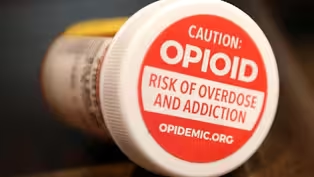
Preview: S4 Ep9 | 30s | How can Utah fight against the opioid epidemic in positive and permanent ways? (30s)

Video has Closed Captions
Clip: S4 Ep9 | 3m 51s | Learn how veterans in Utah are finding hope in the face of opioid addiction. (3m 51s)
Providing Support for PBS.org
Learn Moreabout PBS online sponsorship
- News and Public Affairs

Top journalists deliver compelling original analysis of the hour's headlines.

- News and Public Affairs

FRONTLINE is investigative journalism that questions, explains and changes our world.












Support for PBS provided by:
Utah Insight is a local public television program presented by PBS Utah