
Final Passage of Energy & Climate Bill and More
9/9/2021 | 26m 46sVideo has Closed Captions
Final passage of energy & climate bill, ethics bill, and latest on Covid-19
Host Hannah Meisel (NPR Illinois) and guests Dave Dahl (WTAX) and Amanda Vinicky (WTTW) discuss the final passage of the energy and climate bill, what's happening with the ethics bill, and the latest on COVID-19.
Problems playing video? | Closed Captioning Feedback
Problems playing video? | Closed Captioning Feedback
CapitolView is a local public television program presented by WSIU
CapitolView is a production of WSIU Public Broadcasting.
Final Passage of Energy & Climate Bill and More
9/9/2021 | 26m 46sVideo has Closed Captions
Host Hannah Meisel (NPR Illinois) and guests Dave Dahl (WTAX) and Amanda Vinicky (WTTW) discuss the final passage of the energy and climate bill, what's happening with the ethics bill, and the latest on COVID-19.
Problems playing video? | Closed Captioning Feedback
How to Watch CapitolView
CapitolView is available to stream on pbs.org and the free PBS App, available on iPhone, Apple TV, Android TV, Android smartphones, Amazon Fire TV, Amazon Fire Tablet, Roku, Samsung Smart TV, and Vizio.
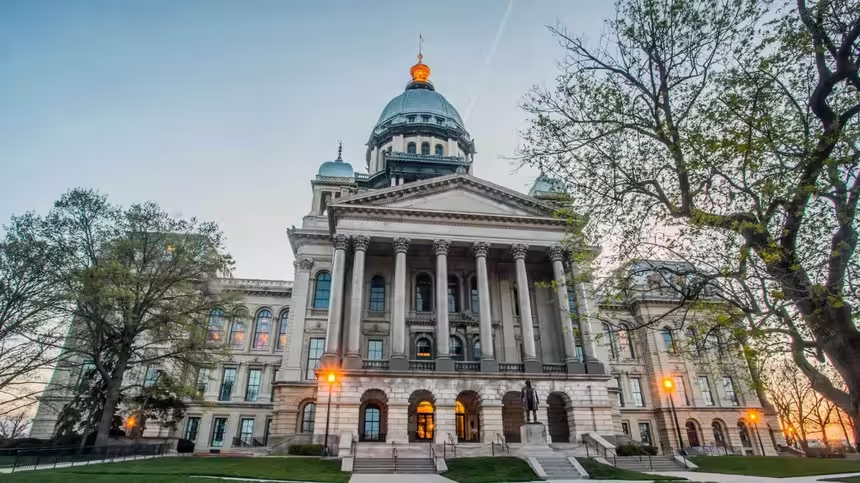
CapitolView
CapitolView is a weekly discussion of politics and government inside the Capitol, and around the state, with the Statehouse press corps. CapitolView is a production of WSIU Public Broadcasting.Providing Support for PBS.org
Learn Moreabout PBS online sponsorship(dramatic music) - Welcome to Capitol View where we discuss the latest in Illinois State government and politics.
I'm Hannah Meisel with NPR Illinois.
Joining us this week is Amanda Vinicky with television station WTTW.
Thanks for being here, Amanda.
- Glad to be with you, Hannah.
And Dave.
(laughs) - And also here is Dave Dahl from Springfield radio station WTAX.
Glad as always to have you here, Dave.
- Same here.
I'm delighted.
- Well, got another busy week in the summer that never ends, but I guess maybe after the energy bill finally passes, Springfield will have, I don't know.
But let's, let's get started.
You know, the big news of the day, we are filming early Thursday morning, but it's expected that finally, finally, after three months (chuckles) of negotiations and stalemate and more negotiations, an energy and, finally passed both the House and Senate with full support of both organized labor and environmental groups.
Amanda, how did we get to this point?
How did we get to the point where, you know, we are more than three months past May 31st and we are still debating something that couldn't pass faster than.
- Well, and let's be clear.
I mean, it has been negotiations over the summer.
Yes.
But I mean, this has literally been years.
And I think that you can kind of say, oh gosh, it felt like years.
Like in this case, it has been years that particularly the renewable energy industry has been sounding the alarm for a fix.
A fix that by the way, didn't have to be part of this omnibus energy package.
But that's part of why it took so long and so much to get to this point where there appears to have been a coalescing around a deal where because there's so much in it.
I, and that I think is intentional on the part of some of the power, if you will, players in Springfield where they didn't necessarily want there to be small nips, tucks and fixes when it came to energy here and there, because then they might have a harder time getting their element on board.
So it kind of just became this big, massive, like ball of energy policy.
And I think also it took this point in part, because this is really complex stuff.
I mean, learning about the electric grid, reliability issues, nuclear science.
I mean, this was literally, it's literally nuclear physics.
So I think that's another element of it and particularly when you have new leadership.
And then also, the general assembly is incredibly deadline-driven in this case.
I think in my reporting on this, my, I used the headline down to the wire, because that's truly what it is when you're looking at what is in the cards for Exelon, which has said September 13th is the absolute final date where they need to know if there's going to be a bill that has ratepayers sending a subsidy to that corporation in order to keep some of its nuclear plants open in particular, the Byron one again, closing on Monday, or at least starting to close if there is not a law signed, sealed, delivered by then.
And so they, the legislature took it up until that point.
Just briefly here, by the way, took it past that point for the renewable energy industry, which has already saying that again, for years this has been the case, but saying that they're losing out on jobs and development of their fledgling movement in more solar power in Illinois in already rebates going to consumers on their electric bills because legislators waited and did not get a fix for that program that they previously had passed, but it had flaws and they just didn't, don't do anything about it.
So I think there's, there's really a lot of reasons why it took it to this point.
And as we tape, we still don't know for sure whether it's going to go.
It seems like that's the past, but, and anything can happen.
- That's right.
And Dave let's remind viewers, I mean, overall, Governor JB Pritzker, this is kind of his last piece of his big first-term agenda.
He's already announced he's run for governor over the summer or his reelection for governor over the summer.
You know, this is the overall broad strokes of the goal is to get Illinois on the path to a 100% renewable energy by 2050.
But we can't just snap our fingers and do that.
It takes strategic planning.
And a lot of that includes, you know, keeping our nuclear fleet up and running.
Obviously that's something for the Northern part of the state.
In the Central and Southern part of Illinois, we are more dependent on coal-fired power plants, in more traditional fossil fuels.
Even though renewable energy emerging industry and all that.
So Dave, so it came down to the wire, even though the Exelon subsidy portion was expected to be the big debate.
And it was up until, I don't know, May 30th, May 31st.
And so it came down to these coal-fired power plants.
Now the reported solution is to kind of tap ratepayers yet again for $200 million over 10 years.
I mean $20 million each year for a decade, which for consumer might not be that much but for businesses which consume a lot of energy, it is a lot.
So, Dave, do you think that, (chuckles) I mean the final solution being tapping ratepayers yet again, when they're already being tapped for Exelon subsidy number one in 2016, Exelon subsidy number two, which will be passed in this major bill too.
I mean, do you think that ratepayers are gonna revolt against Springfield or is it too convoluted that they won't know to blame Springfield?
- All of the above.
And that's part for the course, Hannah, with these big energy bills.
You know, Exelon gets a million-dollar handshake or in this case, a zillion-dollar handshake or something, and ratepayers are paying the freight for it.
And you know, there doesn't seem to be a whole lot they can do.
And I think some of the other things that we hear about in this bill, cutting the fossil fuel emissions by almost half by 2035.
It's only, it's not even 14 full years away.
And the demand for the renewables, I'm sorry, I should say the supply for renewables, the people who questioned may be on to something.
Are the sun and wind people going to be able to get, get up to meet the demand that there'll be when there are no more fossil fuels?
I think it's a valid question.
- [Hannah] Right.
And (coughs) like I said, you can't snap your fingers together.
We need, we need the nuclear plants to be the bridge, but we also need to ramp down, you know, fossil fuels in a responsible way.
So we don't have, you know, rolling blackouts.
We'll end up like Texas or any states who have, you know, changed their energy market drastically and then ended up with an energy shortage.
So Amanda, remind us, you know, in this new solution, we're gonna, the governor had demand, the governor and environmental groups had demanded both, you know, a hard shutdown date for these coal-fired power plants.
Especially the one in Marissa Prairie State, which is said to be the seventh large, largest polluter in the nation, first largest in Illinois.
So he wanted a stark shutdown date, but he also wanted, you know, the plants to gradually, you know, tamp down its pollution over time.
So it's not just like we hit 2045 and then they can shut off while still polluting to a 100% all this time.
So I mean, that was a really hard sell for the plants and organized labor, right?
- A hard sell for the plants and organized labor because the expectation is that if there are those demands for reduced emissions in that interim period that that is going to mean a loss of jobs.
Also again, reliability concerns.
And then from the Prairie State's perspective, it is going to have to invest what, I'm told, I don't know, I've never produced carbon sequestration technology, which is frankly still evolving, but then it's pretty expensive.
It could be even a billion bucks or so.
And that if you're going to make that sort of investment and, you know, get capital for it, you want it to run for a while.
And so they will have a very difficult time reducing emissions while they are still trying to then it would be facing this what they would describe as premature closure.
So that is certainly something that was difficult to get there.
The latest proposal we are waiting to really get all of the nitty gritty details, but would give 200, send $200 million Prairie State's way.
That would be about 10 cents.
Another 10 cents, by the way, on electric bill, customers bills to go toward Prairie State that could then be used for any of those emissions reductions whatever that may be.
Carbon sequestration technology or it could perhaps take other forms.
And so this is why I think you're still getting pushback, something that's, I mean, going, I'm going to be watching is what particular, some of the legislators who represent areas, not necessarily just because there's been a lot of focus on Prairie State in the Metro East and of course the workforce there.
And these good paying jobs.
And then the belief is that the renewable energy industry, it doesn't quite have that oomph when it comes to jobs.
But also all of the communities that have contracts with Prairie State for energy.
Unlike other customers where, you know, you might get it through ComEd or one of these other alternative retail electric suppliers.
They're on the hook for buying energy from Prairie State and they're fearful that their energy rates are going to soar.
And then that will, hand it to your earlier question, potentially be something that very much ratepayers get frustrated with with our local officials for but also their state representatives and state senators.
So there's really is a lot inflection, that's where you're seeing some pushback, I think, still from the business community as well as from those 40 or so municipalities that are worried about what this is going to mean for their residents' electric bills.
- [Hannah] And Dave, Prairie State is not the only one of these.
It came down to these two municipally-owned plants.
The other one happens to be in Springfield, City Water, Light and Power, but it's just not as big as Prairie State.
You know, have you heard any pushback in the last few days about, you know, a, a ratepayer subsidy that will go toward Prairie State but then not prop up CWOP.
- Not specifically, but it's a, obviously a hot potato or a hot something around here.
What with all the jobs in the balance in the capital city?
I'd be surprised if people at the municipal center in Springfield arch talking about it with some of the local lawmakers and, you know, we'll find out soon enough what the legislature really has an appetite for.
I think in a lot of ways, it's not gonna be an easy vote and it sure won't be unanimous.
- Right.
No, it's, it's, it was never gonna be unanimous.
But you know, definitely more than FIJA, it'll come down to closer to party lines than we saw in 2016 with that massive energy overhaul vote.
But, you know, finally, finally, you know, Amanda, we've been covering this for so long.
You know, the other large narrative tends to get lost, which is that there's been a lot of federal scrutiny around energy deals in the last 10 years.
The 2011, you know, smart grid legislation, right.
And then FIJA in 2016.
And just so happens that the, you know, US attorney last summer came out with investigation, said, you know, ComEd has to pay this 200-million dollar, you know, fee because in a bribery scheme, attempting to bribe former House Speaker Mike Madigan.
And I almost feel like in the nitty gritty of the energy legislation, of course, it's really important that we have reliable energy.
You know, business groups say that's kind of Illinois' only remaining competitive advantage is that we have affordable reliable energy.
But it gets lost the corruption angle here.
So do you think that, you know, there's supposed to be a big ethics piece to this, but it's been whittled away and whittled away.
So do you think that that got lost because of the major disagreement this summer?
- Yeah.
I mean, there has been, I feel like this has been one of those things where we're so focused on is there a deal, is there a deal facing a deadline?
Let's be clear.
I am a journalist covering this, not rooting for a deal, not rooting for one, for there to not be one either.
But merely just acknowledging the deadlines that are there.
So I think, yes of course, some of that component has gotten lost.
Particularly, we thought that Exelon was going to be the difficult thing.
Will the governor perhaps wear the jacket if this does reach his desk and he signs it into law?
It was his office that really negotiated the Exelon component and legislators accepted it while they continued to negotiate over these remaining elements.
If something more comes out with ComEd and/or its parent company Exelon, which really has been able to somewhat lying away from that element of it.
And as you noted, the ethics components of this were significantly whittled down in negotiations.
And we're still waiting to see the actual language.
Don't know a 100% what is in there at this point.
But from, from what we know, it is not going to be anywhere near, as robust as was advertised.
Even as, again, I think people's eyes will be on this as continually sort of added charges are tapped on to electric bills.
Advocates of this plan would say that these are added charges paving the way toward addressing climate change.
And that some of that also includes maybe some individuals will be paying more on their electric bill, but in part, that includes energy efficiency plans as well as initiatives to help those who really can't afford not only increases but their regular energy bills.
So there is really a lot at play here.
But I, I think you have certainly touched on something in terms of what we cannot let go away.
And that is how powerful a player Exelon and ComEd have been in Springfield and while they were not perhaps intentionally I think on the part of their part in order to get it done, as well as other negotiators, not as much the leaders this time around, they still are very much advantaged by this legislation.
- [Dave] This just in, as we're speaking, the governor's office has emailed us to say that Governor Pritzker congratulates Speaker Welch and his team and that the governor looks forward to seeing the amendment advance to the House and Senate and to the governor's desk.
The governor looks forward to signing it into law.
- All right.
Well, we'll see that in the coming days, but-- - The governor must to be some seer who sees things.
- (laughs) It is interesting, Dave, you know.
I mean, just the, the, the lauding of Speaker Welch, because this was a big test for him in, he's still relatively new speaker.
And just kind of the, the interesting politics of that, because I think there, there are, we still don't know that the House onboard, with labor onboard, I am expecting that the Senate will be as well, but the Senate really had pushed this legislation.
And I know I've talked to some folks that say, hey, wait a second.
So elements of the bill that weren't okay before previously carbon sequestration technology wasn't acceptable at all.
And now not only is it okay, but now we're going to have electric customers pay for it.
That's interesting.
So there's sort of an interesting relationship dynamic at play as well.
- [Hannah] That is true.
Well, you know, I also, speaking of ethics, it, when a pretty weak watered down massive ethics package, you know, passed Springfield late May on the last day of session, the governor defended this few days later.
We'll see, you know, massive ethics in that energy bill that's coming.
And as Amanda said, been whittled down, whittled down.
But Dave, the original ethics bill is still on the table.
The governor amendatory, used his power of amendatory veto on it.
And the House took it up late last Tuesday when they were about to down.
And Republicans made a power play and pulled all their votes off the bill.
What happened?
And what will we probably see today?
- Well, it's hard to imagine, you know, some stronger pieces being added in by the Democrats.
And just earlier this week, the House Republicans, yet again, said, it's too weak, there's not enough of a buffer between your legislative career and your lobbying career.
Of course the Democrats can pass obviously whatever they want without Republican support at all.
And I don't know.
It will be interesting to take the temperature of those folks and see if they do resurrect that bill and try to override the veto or wait til October or do nothing.
I think still we have yet to truly see, especially what we've seen with the legislative inspector general and the powerlessness that that office has.
The Democrats taking a strong stance on ethics.
I'm sure the Democrats disagree, but you know, there could be a lot stronger things.
Especially that revolving door.
Especially the lawmakers lobbying other units of government while they're lawmakers.
I think those are, you know, some pretty easy things to view as what would be in a stronger ethics package.
And so far they haven't happened.
- Sure.
And you know, Amanda, that revolving door provision, I think the governor had originally wanted a year, maybe two years, but he got six months with a pretty massive loophole.
Meaning that a lawmaker can resign in December, maybe early January, when their term is about to end anyway.
Even if they've won for the next term.
And then turn around and lobby their colleagues basically in the next day, the next week, the next month.
But you know, also Pritzker says, well, you know, I didn't get what I wanted necessarily, but it's a step forward.
Do you believe that, you know, at least him coming out strongly for that provision will change the conversation going forward?
- I'm not sure that it will.
I think that you're going to have both the governor focused on his re-election, claiming victory, saying I got an ethics bill passed and Democrats saying the same.
If you really wanted to push that conversation, he had that opportunity via an amendatory veto.
It would have been a difficult thing for him to do because it would have put Democrats who clearly crafted the legislation in the first place and had reached a deal in a pickle by having, forcing them to vote up or down on stronger ethics provisions.
He did not do that.
And so, no, I don't expect that you're suddenly going to see a very tough conversation, that would have pushed a tough conversation.
This sort of, let's a tough conversation rest and allows again, both he and the majority party to claim victory in the interim.
- And the Republicans would say, it's just like the remap.
The governor talks a good game.
Then went the other way.
And you know, the, the new day, et cetera, et cetera, bipartisanship.
You know, the Republicans say all that's lacking.
That said, when are the Republicans gonna be happy?
Probably never.
You know, he walks on water and the Republicans say he can't swim.
- Yeah, no, that's a very good point, Amanda.
If he wanted to use his amendatory veto, which by the way, not a lot of governors have that power and it's a pretty strong power.
He could have, you know, used it, but he didn't.
He used it very narrowly.
But I wanna spend the last few minutes here on a little bit of a COVID update.
We've seen, obviously, the number of cases climb along with finally increased expanded testing.
Partly having to do with, you know, kids being back in school, students being back at university.
But Dave, you know, there are some looming deadlines.
Notably ASME's you know, frontline essential state workers who work in prisons and other congregate care facilities are supposed to be vaccinated by, I think October 4th.
Though ASME is still pushing against that saying it needs to be bargained.
And then of course, teachers, university students and staff, and also healthcare workers in Illinois have got to be vaccinated by, I think September 15th, a two-week push from that original September 5th date.
And, you know, are we seeing any, you know, movement on either bargaining or, you know, expansion of testing to make that September 19th deadline work?
- Yeah.
I can't tell on that one other than, you know, who's gonna argue that you shouldn't be safe.
But the argument is how do we get there and where does, you know, where does their needle meet my arm in terms of rights, et cetera.
So I, all I can say is I better polish up my crystal ball.
- (laughs) And Amanda, you know, we have seen our COVID case rates rise and then for the most fall, although, you know, it might not be super reliable to trust either case numbers or case rates anymore with the expansion of asymptomatic testing for, you know, folks, especially in the schools, colleges.
But, you know, hospitalizations continue to be up, deaths continue to be up.
But the governor, you know, does he have any more things in his back pocket that he can use?
I mean, the things that he announced in the last few weeks, a vaccine mandate for teachers, things like that, it seems like those were the only cards you can play.
- Yeah.
I mean, I think at some point he could push more mandatory vaccinations for all state employees, not just a mandate for those who work in congregate settings.
But that will depend on an outcome of negotiations and frankly, potential litigation.
We are, we could see something coming out of the feds, President Joe Biden on Thursday, making announcements where I believe he's going to be, it's been reported, announcing mandatory vaccinations for all federal employees.
So it's unclear whether any sort of elements there could filter down to the state level.
Something that I, so I guess, I don't think he has all that many quivers in his arrow left anymore.
Even the lottery for those who got vaccinated, you know, you could win a cash prize, didn't seem to be all that entirely effective for Governor Pritzker.
So at this point, something that I think is sort of interesting that Illinois hasn't done, but may have actually heard something on public radio about this.
That there are some workers who remain reluctant, not necessarily because they are opposed, but because they are fearful that they'll have to take off work if they experienced symptoms particularly from the second dose of any vaccine.
So I suppose that you could have Illinois go forward and do something where employee, requiring employers to not only give time off when individuals get the vaccine but requiring time off for any sort of recovery from it.
But I haven't heard word as to whether that's something that either Pritzker or members of the general assembly are looking seriously at at all.
- Well, we will see.
But for now, that's all the time we have on this week's edition of Capitol View.
I'd like to thank my guests, Amanda Vinicky, Dave Dahl.
I'm Hannah Meisel.
And we'll catch you again next week.
(dramatic music) (bells chiming)

- News and Public Affairs

Top journalists deliver compelling original analysis of the hour's headlines.

- News and Public Affairs

FRONTLINE is investigative journalism that questions, explains and changes our world.












Support for PBS provided by:
CapitolView is a local public television program presented by WSIU
CapitolView is a production of WSIU Public Broadcasting.