
Finding Fencing
Clip: Season 4 Episode 4 | 7m 20sVideo has Closed Captions
Shelby Jensen overcame her personal hardships and joined Team USA as a Paralympic fencer.
Shelby Jensen began fencing when she was 15-years-old. Volunteering at a wheelchair sports camp, Jensen – who had a stroke at age seven – was intrigued by the sport. When she gave it a try, she was immediately hooked. In 2017, Jensen began competing on the national and international circuit. She then went on to represent the United States at the Summer Paralympic Games in Tokyo, Japan.
Problems playing video? | Closed Captioning Feedback
Problems playing video? | Closed Captioning Feedback
This Is Utah is a local public television program presented by PBS Utah
Funding for This Is Utah is provided by the Willard L. Eccles Foundation and the Lawrence T. & Janet T. Dee Foundation, and the contributing members of PBS Utah.
Support provided by:


Finding Fencing
Clip: Season 4 Episode 4 | 7m 20sVideo has Closed Captions
Shelby Jensen began fencing when she was 15-years-old. Volunteering at a wheelchair sports camp, Jensen – who had a stroke at age seven – was intrigued by the sport. When she gave it a try, she was immediately hooked. In 2017, Jensen began competing on the national and international circuit. She then went on to represent the United States at the Summer Paralympic Games in Tokyo, Japan.
Problems playing video? | Closed Captioning Feedback
How to Watch This Is Utah
This Is Utah is available to stream on pbs.org and the free PBS App, available on iPhone, Apple TV, Android TV, Android smartphones, Amazon Fire TV, Amazon Fire Tablet, Roku, Samsung Smart TV, and Vizio.
This is Utah
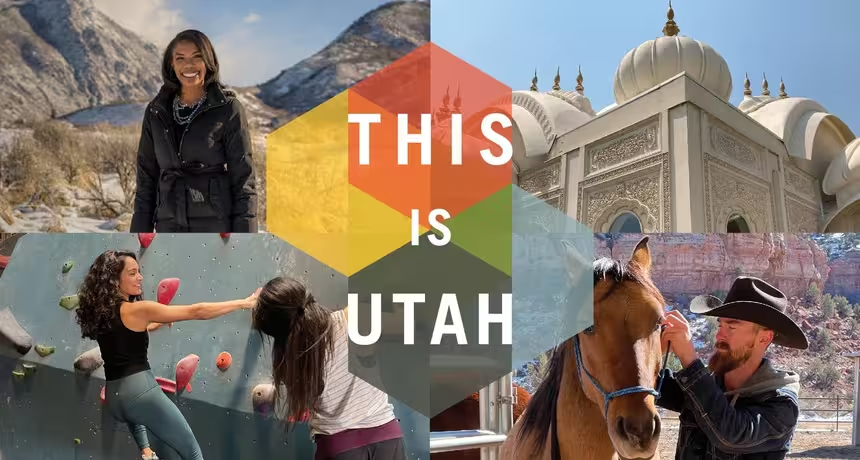
Liz Adeola travels across the state discovering new and unique experiences, landmarks, cultures, and people. We are traveling around the state to tell YOUR stories. Who knows, we might be in your community next!Providing Support for PBS.org
Learn Moreabout PBS online sponsorship- It's often described as a physical game of chess, but with a weapon.
Welcome to the world of fencing.
Where one woman shows us how the mind and body work together to beat the odds and win.
- [Referee] En garde.
Ready.
Fence.
(swords clanging against each other) - I joke with people and say I like to hit people with swords, but no, no, that's not, that's not the real reason.
(swords slicing against each other) I guess it's the mental game I really like.
Challenging your opponents subconsciously with your actions that you do.
(slow, inspiring music) - I've spent more than half my life with this disability, so it's just normal to me.
I don't think I ever realized that something bad had happened.
I think there was moments when I felt like, is this gonna be okay?
Am I gonna be okay?
When I was about 15, 16 years old, I found fencing.
Fencing has given me a sense of purpose.
My parents are a huge part of why I do what I do.
They support me and they love me.
They're amazing and I can't thank 'em enough.
- Sheri and I were married for approximately eight years, seven years before she got pregnant.
Eight years wasn't?
- Seven.
- I thought it was somewhere in there.
Shelby came into our lives and you know, it was just a wonderful experience for us.
We had, you know, a little baby.
Taking care of her, seeing her grow up.
- [Sheri] One night she was doing her homework and she couldn't write the number four.
Then she told me her memory was fuzzy and that her thoughts were gone.
- [Jed] One thing led to another and you know, then she had a stroke when she was seven years old.
- And they brought up the x-rays, the pictures and said, this is the aneurysm and this is what we have to do.
We have to go in there and operate.
There's a chance she's not gonna make it But if we don't operate, she won't make it.
They didn't realize how big the aneurysm was.
So she was really kind of a, a miracle baby.
- Then we were just kind of wondering, what do we do now?
- [Sheri] Everything was starting over.
We had a seven year old toddler, basically.
She had to learn how to walk and talk and swallow.
Everything.
- And everybody came up to us and sensed at that time, and told us is, you're gonna be surprised.
She's gonna surprise you.
Seriously, a lot of people said that to us and we had no idea.
(small crowd cheering) - [Male Referee] Fence.
Halt.
- I was volunteering for a wheelchair sports camp and I came across wheelchair fencing.
- [Male Referee] Halt.
- [Shelby] I went to my first competition about three and a half years ago.
- [Male Referee] Halt.
- [Shelby] I absolutely loved it and I decided then, that I would go internationally.
(Shelby yelling in frustration) - I put in a lot of time and effort to get where I am.
- [Brandon] Is that too tight or you good?
- [Shelby] Tighter.
- Once I got introduced the sport, it's like, oh, this is a whole different level of fencing where you can't run away, you're forced to fight and this is like a knife fight up close.
So this is close quarters combat.
(swords tapping against each other) - There's three different weapons.
Each have their own style and way to go about it.
They have different areas of points, where to target.
One's really a mental game, one's mental, physical and the other one's mental and speed.
Shelby, she's definitely accelerated her skill level and it's been really exciting to watch.
'Cause when she started it was like, oh this is awesome.
She's excited about it, she has passion for it.
Cool.
And then all of a sudden she just started building and had just started this momentum and it's been an amazing experience.
I'm just like, super stoked to be a part of it.
- I was at work, I started getting calls from my coach, my mom, my manager, and everybody's just like, look at the email.
I looked out the email and said I had made it to the Paralympics and I started sobbing with joy.
I'm like, I actually did it.
- [Crowd] USA.
U.S.A. USA.
- Just chanting, USA, USA.
That moment, it clicked.
I'm at the Paralympics, I'm representing the USA.
It just gave me chills.
It honestly is the highest achievement I've accomplished in my life so far.
In Paris, I hope to win a medal, but if I don't that's okay.
I still have at least one or two more chances after that.
(swords tapping against each other) - [Brandon] There you go, good.
I've watched every single bout frame by frame, touch by touch and just trying to get everything dialed in with body technique, tip control, everything.
There it is.
Yeah, let that come down.
Every time I watch her fence I'm like, I'm like, come on.
Right there.
It's just.
(bell ringing) - Yeah, it's nothing at all.
You just can relax.
It's really like the time and the effort and the work you put into it to get to that, that point to, to really step up.
To compete against like, the best in the world at that level is, is really a dream that I think every athlete has had.
And most never get to get there.
She's there.
- We're so, so happy and so thankful that she's still here with us.
'Cause that brain aneurysm could have taken her the other way so fast.
But we have a Paralympian in our arms, under our roof and we're so proud of her.
- I just think she's grown into the, such a beautiful person and I can't wait to see where she goes from here.
- I understand the stereotype with people with disabilities.
Perceptions and like, they need extra help but that's just not who I am.
I don't see myself as my disability.
I see myself as part of everybody else.
An independent, passionate, driven woman.
Video has Closed Captions
Clip: S4 Ep4 | 14m 5s | Meet the three leaders inspiring diversity and inclusion in the sport of bouldering. (14m 5s)
Preview: S4 Ep4 | 30s | The power of cultural traditions can unite people and spark transformative change. (30s)
Providing Support for PBS.org
Learn Moreabout PBS online sponsorship












Support for PBS provided by:
This Is Utah is a local public television program presented by PBS Utah
Funding for This Is Utah is provided by the Willard L. Eccles Foundation and the Lawrence T. & Janet T. Dee Foundation, and the contributing members of PBS Utah.