
The Stories We Tell
Discover mysteries behind the family stories of Donna Brazile, Ty Burrell and Kara Walker.
From
Finding Your Roots
The Stories We Tell
Season 3 Episode 1 | 52m 40sVideo has Closed Captions
Discover mysteries behind the family stories of Donna Brazile, Ty Burrell and Kara Walker.
Discover the unsolved mysteries behind the family stories of political organizer Donna Brazile, actor Ty Burrell and artist Kara Walker as they learn how the legacy of slavery has shaped their identities.
From
Problems playing video? | Closed Captioning Feedback
Problems playing video? | Closed Captioning Feedback
Corporate support for Season 11 of FINDING YOUR ROOTS WITH HENRY LOUIS GATES, JR. is provided by Gilead Sciences, Inc., Ancestry® and Johnson & Johnson. Major support is provided by...
Support provided by:


Finding Your Roots
The Stories We Tell
Season 3 Episode 1 | 52m 40sVideo has Closed Captions
Discover the unsolved mysteries behind the family stories of political organizer Donna Brazile, actor Ty Burrell and artist Kara Walker as they learn how the legacy of slavery has shaped their identities.
From
Problems playing video? | Closed Captioning Feedback
Where to Watch Finding Your Roots
Finding Your Roots is available to stream on pbs.org and the PBS app.
Buy Now
Explore More Finding Your Roots
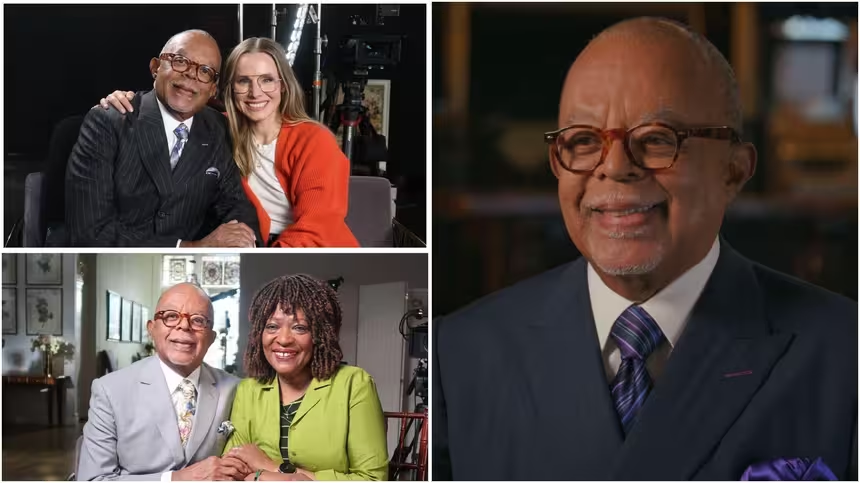
A new season of Finding Your Roots is premiering January 7th! Stream now past episodes and tune in to PBS on Tuesdays at 8/7 for all-new episodes as renowned scholar Dr. Henry Louis Gates, Jr. guides influential guests into their roots, uncovering deep secrets, hidden identities and lost ancestors.Providing Support for PBS.org
Learn Moreabout PBS online sponsorshipI'm Henry Louis Gates Jr.
Welcome to Finding Your Roots.
In this episode, we'll meet actor Ty Burrell, artist Kara Walker, and political analyst Donna Brazile.
Three people who lead very different lives, but who are tied together by stories of deep family mysteries.
I've always been curious.
I mean, I wanted to believe it was true.
There's a rumor, but you know, there was never a fact to stand on, just kind of a lot of suppositions.
I mean, I did ask my grandmother.
But she didn't want us to be burdened with that history.
To untangle these mysteries, we've used every tool available.
Genealogists scoured the paper trail.
While geneticists have drawn on the latest advances in DNA analysis to reveal secrets hundreds of years old.
And we've compiled everything into a book of life.
Oh, wow.
That's just radical.
That is crazy talk.
That is awful.
That pisses me off.
Ty, Kara and Donna wanted to investigate their family's long whispered secrets.
And in this episode, they'll learn that piecing together the lost past can profoundly shape how they see themselves today.
Ty Burrell is America's dad.
He's famous for playing Phil Dunphy in the hit TV series Modern Family.
Ty has won two Emmy Awards for his portrayal of a father navigating the surreal challenges of raising children in Los Angeles.
It's a far cry from Ty's own childhood in the small farming town of Applegate, Oregon, where he won his very first award.
Oh, boy.
"Best looking."
You were voted best looking.
That is the last time that was ever thought.
And you were a lineman on the football team.
I was.
That, that gives you an idea of how small our school was, if I was a tackle.
What kind of student were you?
Were you a good student?
No, I wasn't.
But were you a C-student?
You weren't flunking.
Well, I would've if I hadn't been cheating.
Oh, really?
Yeah.
Yeah, I would've been flunking.
Ty told me that the roots of his comedy traced back to his father, Gary Burrell, a social worker who struggled to support his family, but who always found a way to make them laugh.
We grew up in a house full of a lot of laughs.
Oh, that's good.
Yeah.
My dad was a very funny guy and, and you know, we didn't really have TV, you know, out there in the country.
We had like one channel.
And you just sit and watch your dad playing characters and going off.
And then my brother and I got very, very into it.
And my dad would laugh hysterically at us.
Ty's father died of cancer in 1989 when Ty was just 22 years old.
So Gary never got to see his son's success.
Still, Ty remembers that his father was in the audience at one of his first public performances, a high school talent show.
How in the world did you get a photo of that?
That is crazy.
Weirdly, that's the, that's the moment that I, I went back to years later and realized that I wanted to be an actor.
Really?
Yeah.
My dad who, um- Sorry, it's hard not to be a little bit emotional about it because he, after this night on stage, he said, "I think you should do this."
Really?
Yeah.
And then I, when he passed away, I, I remember, you know, this, this was a very important moment.
Yeah.
Oh, I'm sure he'd be proud of you, man.
I, I hope so.
Yeah.
Patience.
Patience.
My next guest, Kara Walker, is one of the most electrifying artists working today.
In this general area, yeah, thumb pointing at me.
She's famous for her groundbreaking series of silhouettes that explored the relationship between traditional racial stereotypes and African American identity.
In 2014, her gigantic sculpture of a sphinx-like Black female slave entitled "A Subtlety, or the Marvelous Sugar Baby" constructed from 30 tons of sugar, drew overflow crowds in New York City.
But not everyone has embraced Kara's work.
At the beginning of her career, in the late 1990s, a group of artists, including other Black artists, even waged a campaign to ban her shows from galleries and museums.
Were you shocked at the reaction?
Well, I though there would be a reaction.
I didn't know how big a reaction there would be.
How did you deal with this?
I mean, being attacked by even other artists, because you had touched a nerve obviously.
You had reached in and doing, doing, doing, doing, doing to the American psyche about the history of slavery.
Yeah.
The first thing I did was I kind of responded in, in what I though would be the appropriate way, which is to make more art.
For Kara, issues of history, power, and race are not abstract.
They are deeply personal, and they are with us today.
When she was 13 years old, Kara moved from a diverse neighborhood in Southern California to Stone Mountain, Georgia, the infamous gathering place of the Ku Klux Klan.
We moved in and the Klan had a rally and they put an American flag and a flyer about the Klan rally on every mailbox down my street.
It was very black and very white, and it was very clear what those terms meant, you know, who was a Nigger and who was a redneck.
Kara has spent her career exploring some of the most painful aspects of slavery, but she knows almost nothing about her personal connection to what was once called the peculiar institution.
Slavery is sort of unimaginable.
Mm-hmm, yes.
You know?
So I'm kind of a blank slate about this.
I have little pockets of information, but I don't have a clear sense of what we're getting into.
Fasten your seatbelt.
Mm-hmm.
Tell me!
You got to give it back, right?
My third guest, Donna Brazile, is the ultimate political insider.
She managed Al Gore's presidential bid, the first African American woman to manage a U.S.
Presidential campaign, serves as an analyst on CNN and ABC, and even had a recurring role on the political drama The Good Wife, playing herself.
I ask for your support.
For Donna, politics isn't just a job, it's a calling.
This has to be on our agenda.
One whose roots lead back to the racially divided world of Jefferson Parish, Louisiana, where she grew up in the 1960s.
Jefferson Parish was segregated.
It was very segregated.
There was no such thing as a middle ground.
It was chunks of chocolate and chunks of vanilla.
There was no fudge ripple.
Nothing.
When Donna was just eight years old, she experienced her political awakening.
On April 4th, 1968, a tragedy rattled the nation and changed her life forever.
The night Dr.
King was assassinated, that was that moment.
There's something that pulled me that night.
In fact, I disobeyed my mother.
I heard somewhere on the radio that if you put a black scarf or a black flag or something around your house, your house would not get burned down.
Yeah, you had to be in solidarity.
Sure.
And my mother was like, "Don't listen."
"Stop that, turn off that radio."
And I listened to the radio all night long and I snuck out the backyard, went around the front, and I put her black hair scarf across the door.
I got a nice whipping, but I did it.
And that was the beginning of my activism.
Donna decided to dedicate her life to fighting social injustice, and she would do so by helping elect politicians who shared her values, a seeming long shot for an eight-year-old African-American girl in small town Louisiana.
But her parents told her that she had every right to follow her dreams.
You know, I've always believed that my roots in this country go as far back as anybody else's.
And I've always, I've always stood my ground when it comes to being an American.
My mother used to tell us, "It's not what they call you.
It's what you answer to."
That's beautiful.
"It's not what they call you, it's what you answer to."
It's what you answer to.
You're an American.
Donna, Kara and Ty were shaped by their tight-knit families.
But as I began to look at their ancestry, I discovered that they were also shaped by mysterious family stories, stories that had been passed down from one generation to the next.
I wanted to solve these mysteries and reveal the truth.
Is there anything in particular you're interested in finding out about your family tree?
I started with Ty Burrell.
I don't know much about my father's line, so I'm very curious about that.
Ty told me something that I had never heard any white person say before.
He said that when he was a teenager, he heard a family story that his maternal great-great-grandmother, a woman named Susannah Weeks, was actually a Black woman.
I'm fascinated, as a student of African American history.
So you come home one day and your parents go, "There's something we have to talk about."
And you go, "Oh my God, they're getting a divorce."
Tell me what happened.
Well, it wasn't like, it wasn't a somber thing.
My mom was like, "We just found out some pretty cool stuff."
If this story turns out to be true, then that means that Ty's grandmother, Kathy Weeks, herself had a Black grandmother.
My grandmother, then, after we said, "Is this true?"
She said, "Yeah, people used to come up to me and say your grandmother is an N-word."
Wow, they did?
That is cold.
But we were like, "Well, why didn't you ever tell us that?"
But I think there was probably some shame there or something.
Yeah, somebody saying "Your grandmother's an N-word."
It's not like - She wouldn't pass that on to us.
The opposite.
But did you believe the story?
Well, I had a hard time, but I wanted to believe it was true.
To find out, we started researching Kathy's father, Ty's great-grandfather.
His name was George Weeks, and according to the family story, his mother, Susannah, was Black.
In the 1930 census, we found George living with his wife and six children in Jackson County, Oregon, a remote farming region.
Most importantly, the census listed George's race.
"Weeks, George, age 65, white."
White.
In fact, your whole family in this federal census is listed as, my father would say, white as a driven snow.
Right.
And the photograph on the left shows your great-grandfather, George.
Wow.
But he doesn't look Black.
Doesn't look like it to me, brother, and I'm always trying to recruit Black people.
This wasn't surprising to me.
Family stories are notoriously inaccurate, more often myths than historical facts.
But as I looked deeper into George Weeks' past, I discovered something that did surprise me.
Going back a decade, in the 1920 census, George wasn't listed as white.
"Weeks, George, Mu..." Do you know what M-U... Mulatto?
Mulatto.
Are you serious?
Yeah.
That is crazy.
You do have Black ancestry.
Your family story was true.
Wow.
That gives me chills.
Ty Burrell, talk about a modern family, brother.
Yeah.
I was sent here by Al Sharpton, Jesse Jackson to welcome you, welcome you to- Thank you so much.
And going back further, we found that George was actually listed in the 1900 census as a Black man.
That means that somehow, between 1900 and 1930, George's identity underwent a transformation from Black to Mulatto to white, in the eyes of census takers.
And something else caught my attention as well, George's home state.
In 1900, while more than 400,000 people lived in Oregon, only 1,000 of them were African American.
That's less than one half of 1%.
So what was Ty Burrell's Black great-grandfather doing in white, rural Oregon?
It's, it's hard to even imagine what that would be like for them.
There were no Black people there.
None.
Zero.
Right.
No, zero.
That's true.
It's like they got lost.
Harlem is 3,000 miles go east.
To understand how the Weeks family ended up in Oregon, we had to move back a generation and explore the story of George's mother, Susannah Weeks, the woman who had inspired this search in the first place.
In 1840, Susannah was a free person of color living with her mother in slave-holding Tennessee.
We couldn't find any clues about how she was emancipated, but census records revealed that over the next 20 years, Susannah traveled 2,500 miles, journeying from Tennessee all the way to Jackson County, Oregon.
We also found a record that suggests why she might have made this incredible journey.
"Susannah Weeks of Jackson County, Oregon do hereby apply to, to enter the Act of Secure Homesteads to Actual Settlers on the Public Domain.
I'll be darned.
She on her own is asking for a homestead?
She on her own applied for a homestead.
That is amazing.
That is an incredible woman.
In 1862, Abraham Lincoln signed the Homestead Act with the goal of enticing farmers to settle the newly acquired Western states.
Over the next seven decades, the federal government would give away 270 million acres of land.
That's 10% of the land in the entire country.
This program was open to any citizen over 21 years of age, ostensibly regardless of race or gender.
So homesteading offered Susannah a way to become a property owner, but applying for a homestead grant and actually getting the land were two very different things.
To receive land, an applicant had to live on their property for five years and show that they had made improvements.
Less than half of the homesteaders were able to do this.
Most never got their land, and very few Black people did.
So I was nervous as we searched to see if Susannah had been among the successful ones.
"The claim of Susan Weeks has been established and duly consummated in uniformity to law for the 160 acres."
So she pulled it off.
She did that?
That's insane.
Susannah became the legal owner of that land.
That is badass.
And there she is.
Have you ever seen that?
I've never seen that.
She looks tough.
I'm just in complete admiration.
I wish I could say I related to the toughness.
That's how your family got to Oregon.
I have a hard time going for a long walk in the cold.
What happened?
You took after the white side.
Yeah, yeah, exactly.
Wow, that is truly incredible.
So what if we kept that angle and pushed it a little bit closer to the column because you can move around it?
Like Ty, Kara Walker told me that she was interested in finally learning the truth about an ancestor who was supposedly born on the other side of the color line.
There's a rumor, you know, that my mom kind of intimated, you know, that somebody may have been white or may have been passing or may have been, you know, but there was never a fact to stand on, just a kind of a lot of suppositions.
Geneticists tell us that the average African American has 24% European ancestry, but few Black people can actually identify their white ancestors by name.
That's what we set out to do for Kara.
Our search soon focused on her great-grandfather, a man named James Thorpe.
James' death certificate indicates that he was born in Aiken, South Carolina in 1881, and that his parents were a woman named Lettie Watson and a man, also named James Thorpe.
This raised a big question.
When we looked through the South Carolina census record for 1900, we found Lettie Watson and her son James living by themselves with no trace of any James Thorpe, Sr.
in the house.
This raised all kinds of questions as I'm sure it has for you.
Yes.
Who is James Thorpe, Sr.?
Where's this Negro?
Right?
He's not there in the census.
I don't know if I'm ready for this.
The answer lies in another entry from the 1900 census.
You see the name you recognize?
Yeah, I see it.
There's James Thorpe.
And take a look at his household.
Who's living with him?
His wife is Isabelle.
John, a son, a son named Earl, a daughter named Emmy, and a son named Willie.
This means that James Thorpe, Sr.
had another family.
So we plotted his address on a map to see how far he was living from Kara's family.
You see that blue arrow?
Yeah.
In 1900, your great-great-grandmother, Lettie Watson and her son, your great-grandfather, James, lived there.
Okay.
You with me?
I am.
Now, take a look at that red arrow.
Guess who was living there?
That's very close.
That is very close.
I'm just going out for a walk, baby.
Yeah.
I can imagine myself sort of at night sneaking around the corner of the house to see if he's rendezvousing with my great-great-grandmother.
The census also revealed a key detail about James Thorpe, Sr.
One, that complicated Kara's sense of identity.
Now, this is that same census record that we just saw regarding James Thorpe.
Oh, come on!
Tell me what is inscribed- Confirming that rumor.
next to his name?
It says "James Thorpe: W."
Does W stand for wise?
It's a multiple choice.
I'm going to guess that it stands for white.
James Thorpe was a white man.
That's just radical.
Okay.
So we think we found Kara's rumored white ancestor, James Thorpe, Sr.
If so, he had fathered a child with Kara's African American great-great-grandmother following the end of the Civil War.
I suspected that it would have been impossible for this white father to have had any meaningful relationship with his Black son.
But records suggest a different story.
The 1910 census suggests that James Sr.
who owned a meat market, may have helped his African American son start a business of his own.
Can you tell me what your great-grandfather's occupation was?
James W. Thorpe was a butcher.
In 1910, your great-grandfather owned his own butcher shop.
Wow, okay.
Gotcha.
That's amazing.
It seems like your great-great-grandfather, James Thorpe, Sr.
this white man, looked out for his son.
He was involved somehow, yeah.
This likely father-son bond across the color line was very unusual for its time and raised far more questions than we could answer.
But all the evidence points to one conclusion.
The rumors that Kara had heard about her white ancestry may well have been true, yet the details were far more complicated than she ever could have imagined.
It does sort of confirm the suspicions that live in the family that there's, there's a part of the story that hasn't been told.
And I though it might have just rested in, you know, like the idea of somebody having a second family, but I didn't realize that second family would have been white and across color lines and maybe even protective.
Yeah.
You know?
That's amazing.
My third guest, Donna Brazile, has always been curious about the origin of her family's name.
She told me that growing up, she and her siblings used to make up jokes about where their ancestors came from.
Their mother's family name was Brown, which led to one kind of joke.
The Brazile name led to another.
We used to make fun of everybody.
We'd say "The Browns, they were brown because they wanted to get around."
They were Braziles because they only had one destination.
They just never got there.
I have to admit that I too was curious about the origin of Donna's last name.
I had never met a Black person named Brazile before.
We were able to trace the name back to Donna's great-grandmother, a woman named Della Brazile.
We found her in the 1870 census for Halifax County, North Carolina, and then the search took an unexpected twist.
"Della Braswell, 27 years old, Farm Laborer."
Braswell, B-r-a-s-well, Braswell.
That 27-year-old woman, Donna, is your great-grandmother, Della.
That is your original name.
Braswell.
Braswell.
Not Brazile.
No.
Oh, we made it up.
Braswell.
According to this census entry, Donna's great-grandmother, Della Braswell, was born in 1843, 18 years before the start of the Civil War, a time when slaves were listed without surnames in most public documents.
So we wondered, where did this name Braswell come from?
A former slave owner, perhaps?
We searched the records of Edgecombe County, North Carolina, and found that there were 14 owners named Braswell, and they were all descendants of one man, Robert Bracewell.
We found Robert's baptismal certificate, and it told us that he was born in England in 1611 and moved to the Commonwealth of Virginia, bringing the name Bracewell to the new world.
Bracewell Braswell, Brazile.
It's an English name.
And by 1900, the name had morphed into Brazile.
English.
English.
A long way from Rio de Janeiro.
A long way from.
God, that just takes away my theory of Brazile.
I just though my family was looking for a destination.
Moving over to Donna's mother's side of the family, we began to explore the roots of her great-grandmother, Mariah Brown.
We found Mariah's death certificate from 1957.
It revealed that her maiden name was Butler, which led us to the names of her parents, and a fascinating story.
"Maria Butler Brown, daughter of the late Dan Butler and the late Millie Butler of Jackson, Louisiana."
You're looking at your great-great-grandparents.
Oh, wow.
I never heard of Millie or Dan, Butler.
Daniel was born into slavery in 1843.
He assumed the surname Butler in 1865 when the Civil War ended, and he became a free man.
Just as we did for the Braziles, we searched for a master who shared Daniel's "Butler" surname in the county surrounding his birthplace.
We found an estate inventory from 1847 for a Thomas Butler in West Feliciana Parish, Louisiana.
It listed all of Thomas's slaves by name, including a very significant one.
"Daniel, negro boy, age eight years, was appraised at the sum of $250."
This is a complete and utter shock.
Donna had discovered the name of the man who owned her great-great-grandfather, and this information led us to photographs of the actual plantation where Daniel lived, worked, and was someone else's personal property.
That's where your family was enslaved.
Those are the slave cabins.
That's where they lived.
Wow.
You can see where your ancestors actually were bedded down for the night.
It is profoundly disturbing.
I've never been at peace with slavery.
I don't think anybody can ever be at peace with slavery.
I just never though I would see it.
That's amazing.
I wanted to see how life changed for Daniel when he became a free man.
I hoped for the best.
But while Daniel lived a full life, well into the 20th century, he never escaped the grueling poverty of the Jim Crow South.
His death certificate revealed a tragic story.
"Sole cause of death, overcome by cold.
Just an old negro alone in an open cabin.
No clothes, found dead on floor of cabin, had been dead for 48 hours.
Was found by some children passing by."
Mmm.
God bless his soul.
He was 92, and that was 1935, the height of the Great Depression.
"Just an old Negro."
He lived to be 92, died alone in a cabin, naked.
Naked.
Overcome with the cold.
From the scant records that remain, we can trace the arc of Daniel's life, a life that began in slavery and ended in deprivation.
The injustices against which Donna has fought for so much of her political career severely affected the lives of her own family members.
I think we have spent so many years trying to erase the past because we're afraid to deal with it.
We're afraid to deal with the continuing impact of slavery.
The fact that my parents were sharecroppers on my mom's side.
They had to work off the land for decades at low wages, no opportunity, and look at this.
Didn't know.
Yeah.
We had already discovered that Ty Burrell's great-great-grandmother, Susannah, was an African American, most likely born into slavery.
And we knew that she ended up free, winning a homestead grant in Oregon.
Now we wanted to understand where Susannah came from, where she was born, and who her parents were.
But this represented an enormous challenge.
I told Ty that there was a good chance that we'd never be able to get beyond his first generation of enslaved ancestors, but I was wrong.
"Full name, Susannah W. Weeks.
Birthplace, Montgomery County, North Carolina."
That's pretty incredible.
This document, Susannah's death certificate, filed in Oregon in 1909, held a crucial clue.
The name of her mother.
"Maiden Name of Mother: Nellie Mask."
And Nellie Mask is your third great-grandmother.
Wow.
That's amazing.
And think about that.
You've just met two generations of your family born in slavery.
Wow.
And most Black people, I know you're still getting used to that.
Most of us can't go back this far on their family tree, by name.
Because it's not documented.
Because it's not documented.
I understand.
That's incredible.
To learn more about Nellie, we searched for her master, whom we though might be named Mask.
And we found that there was one extended slave-owning family named Mask in North Carolina.
As luck would have it, many descendants of the Mask family are still alive today, and one has published a collection of family records, photographs, and oral histories.
In these pages, we made an extremely rare discovery.
We found a story about Ty's third great-grandmother, Nellie, and her mother, a slave named Jane.
"Jane must have been an attractive slave girl as Dudley Mask couldn't keep his hands off her."
Oh, that is terrible.
"One can only imagine the fear this young 13-year-old girl felt in 1798 while in the agony of childbirth with a baby, she named Nellie Mask, a child of Dudley Mask, her 33-year-old master."
That means that that 13-year-old slave, Jane, is the 13-year-old.
Oh my gosh.
She is your fourth great-grandmother.
That is crazy.
And that means that Dudley Mask, her owner, is your fourth great-grandfather.
Wow.
Jane was 13.
13.
And raped by my great-great-great-grandfather.
Your fourth great-grandfather.
That's sad.
That's really sad.
Ty's newly discovered African-American ancestor offers a window onto some of the painful legacies of slavery that are now part of his larger family story.
Legacies of cruelty, bondage, and sexual exploitation.
And perhaps most troubling is the fact that this act was carried out by one of his white ancestors, Dudley Mask.
It's definitely a complicated feeling because there is no way to just separate Dudley Mask from the part that I want to embrace.
No, you can't.
I want to just be with the heroines of the story.
Sure.
So that's hard.
In Kara Walker's family tree, we had already discovered a white ancestor in the Jim Crow South.
But we wanted to trace her roots back into slavery.
Some of her most provocative artwork has explored the horrors of this dreadful period in American history and its enduring legacy in our world today.
What could we find out about her Black ancestors' experiences?
Kara had told me that she had long heard rumors that some of her African-American ancestors had actually been free before the Civil War.
My mother's side of the family it was always kind of understood somehow that they were teachers, or educators, or people, you know, who did.
They were never you know, for what it's worth, it sounds a little snotty, but you know.
Yeah, right.
No, I understand.
Go ahead and say it!
They were never slaves you know.
We were never slaves.
We were never slaves.
Well, the truth is our ancestors who were African-American were slaves.
The only question is when they became free.
Right.
We wanted to see if any of Kara's ancestors were free.
So we started with census records, which list all free people by first and last name.
And in the 1861 city census for Charleston, South Carolina, we got a hit, an entry for Kara's great-great- great-grandfather, a man named Henry Fordham.
It says "Henry Fordham..." And what does it say next to his name?
Oh, F.P.C.
What's that stand for?
Is that Free Person of Color?
Free Person of Color.
No kidding.
I've never seen that.
Wow.
He was a free man.
That's fantastic.
There was, however, one significant wrinkle to this story.
In 1861, when the Civil War erupted at Fort Sumter in Charleston Harbor, Kara's ancestor found himself working as a blacksmith in a city controlled by the Confederacy.
We found an 1863 Confederate Army pay voucher that told us just what Henry had to do to survive.
Can you tell me whom the payment was made to?
It was made to H. Fordham.
And can you tell me what it's for?
"For repairing wagon."
Your third great-grandfather, Henry, was doing work for the Confederate Army.
That's what I suspected.
It's $2!
You know?
Like many free people of color, Henry Fordham found himself and his business deeply entangled in the Confederate War machine.
The reason was simple economics.
Southern states faced a major labor shortage.
Of the five million white people in the South, roughly 800,000 served in the military for some or all of the war.
So the Confederacy turned to African Americans, both slave and free, to provide the labor they needed to feed and support their troops.
Troops that were defending the institution of slavery.
It's the middle of the war.
It's 1863.
They probably made him do it.
So, you know, we can forgive him, right?
We can forgive if you want to go with that narrative or I can go with my makin' a buck narrative.
It's just like, "I repair wagons...you know.
This side, the other side."
Your own ancestors!
Rhett Butler, you know?
I'm trying to - Rhett Butler.
I'm trying to bail you out.
I know.
I know.
I'm just, I'm not afraid of looking bad on camera.
Okay.
Could you please turn the page?
Making my family look bad on camera.
Well, speaking of that, there are five more records of Confederate payments.
What name do you see repeated on those five?
H. Fordham.
H. Fordham.
H. Fordham.
H. Fordham.
Stick the knife in a little deeper.
Henry's story illustrates the precarious position of free Blacks in the slaveholding South, but of course, it was far better to be a free Black person than a slave.
What could we find out about Kara's slave ancestors?
We started with her Walker line, which we traced back to her great-great-grandfather, a man named David Walker.
We found an entry for David Walker in the 1880 census.
He's listed as a 47-year-old male living in Coweta County, Georgia.
So that means he was born around 1833.
Now, he spent the first three decades of his life, therefore as a slave.
You've met your first slave ancestor.
Oh, wow.
We next looked for a master in South Carolina with the surname Walker.
We soon found a slave schedule for a white man named Samuel Walker.
It lists his slaves by age and gender, and though it doesn't list their names, his entry contains a match for a person the same age as Kara's ancestor, David Walker.
You are looking at the listing for your great-great-grandfather, David Walker, a slave of Samuel Walker.
And now you have found the source of your surname.
I don't know how I feel about it.
I need to keep turning pages.
Kara Walker, who is celebrated worldwide for exploring how slavery continues to shape Black identity, never knew what happened to her own slave ancestors before now.
You know, I hadn't thought of this, but in all of your representations of slavery and slaves, you've never thought of one of your family members being in one of those scenes?
I've though about it, but I just didn't know how to go about understanding my own family's faces in those scenarios.
I think that the scenarios somehow are too terrible for them, you know?
Oh yeah.
Well, it's just really grossly unfair, isn't it?
That means that Kara's last name is itself a legacy of her family's bondage, a link to the man who owned her ancestors.
Donna Brazile had already discovered the origin of her last name, but she told me that she was most interested in learning the truth about one specific family legend.
It starts with her great-great-grandmother, Julia Brown, who was born a slave in Louisiana in 1849.
Donna wrote in her memoir that when Julia and her siblings were enslaved, a white slave owner named Colonel Charlie Welch tried to split them up, but they boldly refused.
What I heard was that when Colonel Welch tried to buy off one or two, the oldest would not let his sisters go.
He held them close to his arm and the story went that the, the Brown side of the family, that we, we stick together.
We searched for any record of this master, Colonel Charlie Welch, but we came up completely blank.
We did, however, find a clue in a most unlikely place, the death certificate for Donna's great-great-grandmother, Julia.
It told us that half a century after the end of the Civil War, Julia was buried on a sharecropping plantation in West Feliciana Parish, Louisiana.
With this detail in hand, we tracked down tax records that revealed that this property had been owned by a man whose name was very similar to Colonel Charlie Welch, the slave owner from Donna's family story.
"V.D.
Walsh, 1,000 acres worth $2,500."
So the owner of the Welch Plantation was not Charlie Welch, but a man named Vincent David Walsh.
Walsh.
And he, my dear, was a colonel.
So that was Colonel Welch?
That's Colonel Welch.
Okay.
Vincent Walsh's papers didn't mention any slaves who matched Donna's great-great-grandmother, Julia, but they did contain an 1856 bill of sale for Julia's sister, Perene.
She's Donna's second great-grand-aunt.
This is hard.
"For the price and sum of nine hundred and thirty dollars... to convey and deliver with a full and complete warranty of the title to the said Vincent Walsh the following negro girl, to wit Perene, age about 14 years old."
It's hard.
It's hard.
Fourteen years old.
According to this bill of sale, Colonel Walsh bought Perene for $930 when she was just 14 years old.
Though it's hard to think about the sale of a child, in reality, this was common.
In the first half of the 19th century, the New Orleans slave market, the busiest in the nation, saw more than 100,000 sales, and almost a third of these slaves were children, like Perene.
God bless their souls.
This is, this is.
I'm so sorry.
Fourteen.
Fourteen years old.
Perene's master, Colonel Vincent Walsh, was a very wealthy farmer in West Feliciana Parish, Louisiana.
He owned a vast cotton plantation and more than 75 slaves.
He was a prominent member of the community.
We even found a photograph of him.
You're looking at the man who owned your ancestors.
That's the colonel.
I know.
I don't know.
I always, maybe thought they were like the Waltons, you know.
The Waltons, with slaves!
Yeah, with slaves, but you know, nice enough to bring you some hot cornbread when it was cold outside.
Yeah, he look like a little stern.
Can you see him sending warm cornbread out to the- No, sir, I don't think that... The slave cabins?
It look like he was a colonel, like he was directing traffic, so to speak.
I never thought I would see what he looked like.
We looked closer at the bill of sale that had first led us to Colonel Walsh and found that he bought Perene from a man named Charlie Hoffman.
So it seems that in retelling the story, Donna's family had simply conflated these two masters into one person, Charlie Welch.
But was the family story true that the Browns had somehow managed to stick together, even in 19th century Louisiana?
We discovered another bill of sale that proved that Charlie Hoffman had bought Perene at an estate sale less than a year earlier.
And Perene was not the only one of Donna's ancestors sold on this day.
"Negro woman Biddy, aged 38 years, and her children, boy Nathaniel ten years, Julia, six years.
Amelia, two years, all together to Geo.
G. Williams, for the sum of $2,080."
Wow.
You are looking at the bill of sale for your great-great-grandmother, Julia.
That six-year-old is your actual ancestor.
Oh my God.
We found her.
So they were lucky that only one was sold off.
Amazing.
Amazing.
Amazing.
Like many family stories, what Donna had heard about the Browns was part true, part embellishment.
Donna's great-great-grandmother, Julia, had been lucky enough to stay with two of her siblings, but Perene had been sold off.
Another family torn apart on the auction block.
Oh, I'm trying to get my emotions together.
Again, you know, it's like as long as you don't know, you don't feel it, but I just, it just felt.
I just felt it.
I just felt it.
I'm glad I finally know, but the other part of me is the great sadness that slavery always brings to my heart and my spirit.
This is going to take me some, some time to just even put this in my system.
We had now reached the end of the paper trail, but there were still questions surrounding two of my guest family's stories.
So we turned to DNA to see if we could finally solve these mysteries.
An oral history had suggested Ty Burrell's fourth great-grandmother was a slave who was raped by her master, Dudley Mask.
Could DNA tell us if Ty was really descended from this man?
Now, obviously, in order to do that, we had to find a descendant from Dudley Mask, because we're matching DNA.
It's like an extended paternity test.
So we found a descendant of Dudley Mask and compared your mom's DNA - Wow.
To this person's.
You did?
Yeah!
If Dudley Mask did in fact father a child with Ty's enslaved ancestor, then the DNA analysis will have red segments that indicate shared sequences of DNA.
You see any red?
Yep.
Two spots.
I don't know the significance of that, but there's definitely red there.
Two red segments are exact DNA overlaps.
I'll be darned.
God, that is just incredible.
This means that you are very, very likely descended from Dudley Mask.
Wow.
So you have slaves in the family, but you have a master in the family too.
That's a lot of mixed feelings.
Yeah.
But I'm honored and privileged to know that my ancestor is, is Susannah and, and Nellie and - Yeah, and Jane.
And Jane.
Yeah.
You come from a fascinating background.
Makes me proud.
Yeah, good.
Yeah.
For Kara Walker, we wanted to see if DNA could finally prove whether her African American great-grandfather, James Thorpe, was in fact the son of a white man in the Jim Crow South.
So we located a descendant of the rumored white Thorpe ancestor and compared his DNA to Kara's mother's.
See any red?
A little bit of red.
That, dear, is a lot of red.
Okay.
There's no doubt that James Thorpe, that white man, is your great-great-grandfather.
Holy cow.
That's unreal.
This, dear, is your family tree.
This is all the ancestors we found.
The clues buried in their DNA and in the paper trail had introduced Ty, Kara and Donna to ancestors back centuries in time and on the other side of the color line.
I can't thank you enough.
I really can't.
That is a beautiful - And these discoveries have forced my guests to rethink long-held assumptions about their family's past.
And what they might mean about their ethnic identities today.
I knew I had roots, but I had no idea.
And now my roots go back as far as I can think.
It's beautiful.
Beautiful history.
Donna Brazile, thank you for allowing me to introduce you to your ancestors.
Well, thank you.
And, and let me just say on their behalf, God bless you.
Thank you, sweetie.
Thank you.
That's the end of our journey through the family trees of Ty Burrell, Kara Walker, and Donna Brazile.
Join me next time as we unearth the buried roots of three new guests on Finding Your Roots.
[music]
- History
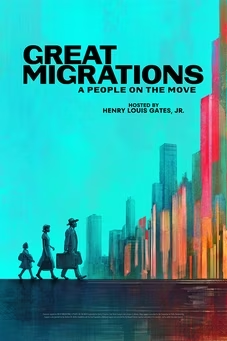
Great Migrations: A People on The Move
Great Migrations explores how a series of Black migrations have shaped America.


Support for PBS provided by:
Corporate support for Season 11 of FINDING YOUR ROOTS WITH HENRY LOUIS GATES, JR. is provided by Gilead Sciences, Inc., Ancestry® and Johnson & Johnson. Major support is provided by...