One-on-One
First Lady of NJ Combats Maternal Health Inequities
Clip: Season 2023 Episode 2625 | 11m 11sVideo has Closed Captions
First Lady of NJ Combats Maternal Health Inequities
Steve Adubato sits down with New Jersey’s First Lady, Tammy Murphy, to discuss systemic racial inequalities, maternal health, and her mission to make New Jersey the safest and most equitable place to raise a child.
Problems playing video? | Closed Captioning Feedback
Problems playing video? | Closed Captioning Feedback
One-on-One is a local public television program presented by NJ PBS
One-on-One
First Lady of NJ Combats Maternal Health Inequities
Clip: Season 2023 Episode 2625 | 11m 11sVideo has Closed Captions
Steve Adubato sits down with New Jersey’s First Lady, Tammy Murphy, to discuss systemic racial inequalities, maternal health, and her mission to make New Jersey the safest and most equitable place to raise a child.
Problems playing video? | Closed Captioning Feedback
How to Watch One-on-One
One-on-One is available to stream on pbs.org and the free PBS App, available on iPhone, Apple TV, Android TV, Android smartphones, Amazon Fire TV, Amazon Fire Tablet, Roku, Samsung Smart TV, and Vizio.
Providing Support for PBS.org
Learn Moreabout PBS online sponsorship(upbeat music) - Hi everyone, I'm Steve Adubato.
You recognize the leader we have on camera.
She's the First Lady of the great state of New Jersey, Tammy Murphy.
Good to see you Tammy.
- And you Steve, thanks for having me.
- As always.
In just a little bit we're gonna throw to a panel discussion as part of our Russ Berrie Making a Difference group of honorees that are making a real difference, leaders who are involved in maternal and women's health.
But the First Lady has joined us many times to talk about this.
If you could tell us exactly where we are with the Nurture NJ Initiative, what it is, remind people, we'll put the website up, because there's, you've been making a tremendous amount of progress with your colleagues on this.
- Thank you.
So Nurture NJ is an initiative that we unveiled in 2019.
- Right.
- The purpose of Nurture NJ is, is not only to raise awareness of the problems that we have here in New Jersey with respect to infant maternal health.
For those who do not know, we are 47th in the country in terms of maternal mortality rates.
And when you dig down you find that if you are a person of color, your chances of either dying or having challenges from maternity related complications are significantly greater.
In fact, they are over six times greater than that of a white woman.
And for a baby of color, a black baby is three times more likely than a white baby to die before his or her first birthday.
So one cannot, being a mom as I am, one cannot possibly know those statistics and not feel a need to fix our challenges here in New Jersey.
Nurture NJ, the, the goal of Nurture NJ is to both reduce our maternal mortality rates by 50% over five years, and to eliminate the inequities in birth outcomes.
And we are, we're pretty determined to, to address both of those.
We have, you know I'm not sure how in depth you want me to go but we, we have been working at this we've got thousands of stakeholders with us these days.
We have, we host everything from, we just, we hosted our fifth annual black infant and maternal health summit just in, just in November.
We also, throughout the year we've re-upped our family festival series.
We have now had 16 family festivals which is essentially a combination of a, of a job fair, and a block party where we bring all sorts of resources under one roof.
So we've started those again.
We continue with an ask, ask our expert series on social media, and we, you know have interdepartmental meetings.
We're working with the legislation, legislature on a number of policy areas.
So there's a lot going on.
- There's a lot of progress.
And as we continue to have the Nurture NJ website up so people can find out more about the initiative and also how they can access some of the services that you're talking about.
But one of the things that really struck me, and all the times we've had you on, I don't, I don't, I picked this up in the notes in getting ready for today, and I've never asked you this.
Is it true that most of the deaths, most of the maternal deaths disproportionately among black and brown women, absolutely preventable?
- 100%, yes they are preventable.
They are preventable.
So, so we've done a lot of things in New Jersey to address some of these things.
For example, you know we no longer reimburse through Medicaid for early elective C-sections unless there is a medical need.
And I will tell you this is one of my favorite examples as to where you have good people who are trying to do the right thing, but the outcomes are terrible.
If you are a, a doctor and you say I'm gonna donate my time to a very impoverished area and I'm gonna give them, you know the third Friday of every month, then the clinic where they might go is going to naturally say this is great.
We've got this fabulous doctor coming in, so let's just line up all these women to get C-sections so that we can make sure they get the best possible care.
And that's major surgery.
And this mom may go home and either have an infection and not go see the doctor.
She may go home to a home where she has other children and she doesn't rest.
She may go back to work.
So there's all sorts of things that have happened and it's not because either the clinic was trying to do something bad or the doctor was, but it's just, it's just understanding what the needs are of the community.
So that's just a small example.
Another one is, is going into the.
- That's not a small, one second, I'm sorry for interrupting you Tammy.
A, that you know that clearly it's not a small example but also as you said many of those deaths are preventable.
But it takes a totally different approach instead of let's just do a C-section.
- Right, right.
- And sorry I interrupted you, you were gonna bring up another point.
- I was just gonna say a lot of these things are just common sense.
So, you know, if you, we now have a scenario where if a woman presents in an ER room, in the emergency room and they are feeling unwell, they may not look as though they're unwell.
And you could have someone come in with, you know, a broken arm or something.
And if it's obvious, we now require that when a woman presents in the ER, that the, one of the first questions that they are asked is have you delivered a baby in the last year?
That's a, that question can take you to the front of the line.
And that's a very, it's a very simple thing to do.
It's just making sure that people understand the importance of doing things like that.
Tammy, I know that the March of Dimes just released some information which is really important that talks about New Jersey standing out in this regard.
Go ahead.
- Yeah so, so the March of Dimes released their 2022 report card on infant and maternal health.
They go into in-depth analysis across 53 states and territories.
Of the 53 states and territories, 47 declined year on year in the United States.
One remained the same and four states improved.
And thankfully I can tell you that New Jersey is one of the four and we improved across all areas of their study which are, we, we have better outcomes for preterm births.
We have lower cesarean section rates which we were just discussing.
We have lower infant mortality and we have better prenatal care.
So I'm really proud of us.
I know that we're, we are onto something now and you know, we're bucking the trend across the United States so we'll keep at it.
- And, and lemme ask you this Tammy, and the only reason I call the First Lady Tammy is because she asked me to do that several years ago.
I wanna follow up on this.
We, the panelists we have coming up after this, they're all leaders of not-for-profit organizations committed to dealing with the challenges that you've raised right now around maternal and women's health.
What is the role in your view of the not-for-profit community and not-for-profit leaders in this fight?
- Listen, Steve, we have stakeholders across every area in our state.
And it is going to take every single person coming together and working on this space in order for us to have the transformational change that is required.
And that is not-for-profit sector, it's academia, it's our legislators.
It's, it's people like you who are helping us get the word out so that there's awareness.
It's truly, it's, it's everybody.
The not-for-profit sector is there.
Many people in the not-for-profit sector are, are huge allies of ours and have been real change makers.
And we are grateful for every person who shows up and leans in.
But they, they are highly needed.
- Before I let you go, you've been taking a national role with the National Governor's Association and you're a National Governor's chair the initiative on maternal and infant health.
And I know that the governor, and Governor Murphy has been very involved with the National Governor's Association as well.
Could you give us a, a minute on that?
- Sure.
So, so, so Phil is now the chair of the National Governor's Association.
- He sure is.
- His capacity as chair, he has the ability to pursue an initiative for this upcoming year across, across the entire country.
And I as his spouse also have the ability to pursue an initiative.
His is, is tackling youth mental health.
Mine is addressing obviously the disparities in infant maternal health.
We have already had one convening.
We had it in Salt Lake City.
We have another one that's coming up in short order in January.
And essentially what we are doing is we are working across party lines.
We are bringing in experts, we're bringing in people to give lived experiences and share those experiences so that legislators and governors and their staff can hear.
We're sharing best practices, we are learning from one another.
And at the end of the year our goal, Phil and I are going to release a playbook that will enable any other state to see what best practices we've gleaned over the course of the year.
We will share the work we've done.
Phil's signed 43 pieces of legislature in this area since he came into office.
So there's a lot that we can share and there's a lot we're gonna learn.
And thank goodness moms and babies are beloved by all.
So it doesn't matter what side, what party you're in or anything else.
Everybody is leaning in on both of these topics.
- You've been listening to and watching the First Lady of the great state of New Jersey, Tammy Murphy, fighting this fight with a lot of other colleagues because it's just too important to ignore and it has nothing to do with politics.
I'm off my soapbox.
Thank you Tammy Murphy, First Lady of of New Jersey.
We appreciate it.
- Thanks Steve, thanks so much.
- You got it.
Stay with us, we'll be right back.
- [Narrator] One-On-One with Steve Adubato has been a production of the Caucus Educational Corporation.
Funding has been provided by The Russell Berrie Foundation.
The New Jersey Economic Development Authority.
The Turrell Fund, supporting Reimagine Childcare.
RWJBarnabas Health.
Let'’s be healthy together.
Kean University.
The Healthcare Foundation of New Jersey.
Horizon Blue Cross Blue Shield of New Jersey.
New Jersey Sharing Network.
And by Robert Wood Johnson Foundation.
Promotional support provided by NJ.Com.
And by ROI-NJ.
- I am alive today thanks to my kidney donor.
I am traveling and more active than ever before.
- I'm alive today thanks to my heart donor.
I'm full of energy and back singing in my church choir.
- I'm alive today thanks to my lung donor.
I'm breathing easy and I'm enjoying life'’s precious moments.
- They are about 4,000 people in New Jersey waiting for a life-saving transplant.
- Donation needs diversity!
- For more information or to become an organ and tissue donor, visit NJSharingNetwork.org.
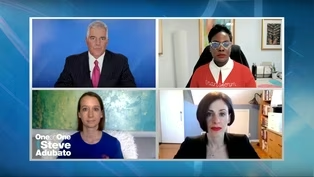
Making a Difference: Women’s and Maternal Health
Video has Closed Captions
Clip: S2023 Ep2625 | 16m 27s | Making a Difference: Women’s and Maternal Health (16m 27s)
Providing Support for PBS.org
Learn Moreabout PBS online sponsorship
- News and Public Affairs

Top journalists deliver compelling original analysis of the hour's headlines.

- News and Public Affairs

FRONTLINE is investigative journalism that questions, explains and changes our world.












Support for PBS provided by:
One-on-One is a local public television program presented by NJ PBS