
Flint Charges/Leonia Lloyd
Season 49 Episode 4 | 26m 46sVideo has Closed Captions
Flint Charges/Leonia Lloyd | Episode 4904
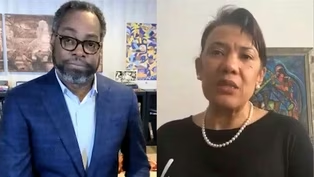
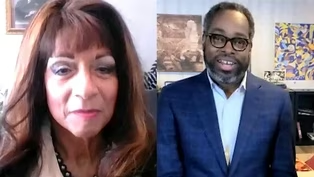
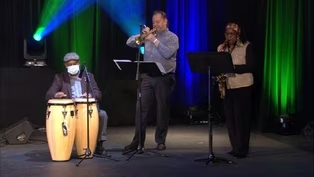
Former Flint mayor Karen Weaver offers her thoughts on the charges against governor Rick Snyder in the Flint water crisis. Plus, retired Detroit judge Leonia Lloyd talks about her struggles with racism and sexism in her new memoir. And, a musical performance by a Detroit favorite, Ron English. Episode 4904
Problems playing video? | Closed Captioning Feedback
Problems playing video? | Closed Captioning Feedback
American Black Journal is a local public television program presented by Detroit PBS
Flint Charges/Leonia Lloyd
Season 49 Episode 4 | 26m 46sVideo has Closed Captions
Former Flint mayor Karen Weaver offers her thoughts on the charges against governor Rick Snyder in the Flint water crisis. Plus, retired Detroit judge Leonia Lloyd talks about her struggles with racism and sexism in her new memoir. And, a musical performance by a Detroit favorite, Ron English. Episode 4904
Problems playing video? | Closed Captioning Feedback
How to Watch American Black Journal
American Black Journal is available to stream on pbs.org and the free PBS App, available on iPhone, Apple TV, Android TV, Android smartphones, Amazon Fire TV, Amazon Fire Tablet, Roku, Samsung Smart TV, and Vizio.
Providing Support for PBS.org
Learn Moreabout PBS online sponsorship♪♪ Coming up next on "American Black Journal," we've got a really special show for you this week.
We're gonna talk with Karen Weaver, the former Mayor of Flint, about the charges that have been filed against former Governor Rick Snyder for his part in the Flint water crisis.
We're also gonna talk with retired Detroit Judge Leonia Lloyd.
In her new memoir, she talks about the racism and sexism that she had to face during her career.
And we'll have a special performance by a Detroit favorite, Ron English.
Stay right there, "American Black Journal" starts now.
Announcer 1: From Delta faucets to Behr paint, Masco Corporation is proud to deliver products that enhance the way consumers all over the world experience and enjoy their living spaces.
Masco, serving Michigan communities since 1929.
Announcer 2: Support also provided by the Cynthia & Edsel Ford Fund for Journalism at Detroit Public TV.
Announcer 1: The DTE Foundation proudly supports 50 years of "American Black Journal" in covering African American history, culture, and politics.
The DTE foundation and "American Black Journal," partners in presenting African American perspectives about our communities, and in our world.
Announcer 2: Also brought to you by Nissan Foundation, Ally, UAW, solidarity forever, Impact at Home, and viewers like you.
Thank you.
♪♪ Welcome to "American Black Journal."
I'm Stephen Henderson, and I'm glad you've joined us.
The search for justice in the Flint water crisis has led prosecutors to charge former Governor Rick Snyder with two misdemeanor counts of willful neglect of duty.
There are also eight other officials who have been charged in the crisis, which exposed the residents of Flint to water that was contaminated with lead.
I spoke with former Mayor Karen Weaver about the latest developments in the city, in the crisis, and the things that went on during her time as mayor.
The attorney general announced recently that Rick Snyder, the former governor of the state of Michigan, the person who installed the emergency managers in Flint, and oversaw the water switch, and the failure to add the chemicals that would stop the water from the Flint River from causing lead to leach out of the pipes, is going to be charged with two misdemeanors for neglect, (Karen laughs) willful neglect of duty.
I see you're laughing already about that- And believe me, it's not laughing, you know, funny, ha ha.
It's just like this has gotta be a joke.
Yeah, so let's start there, your reaction to those charges.
You know, it was funny, because you hear that criminal charges are coming, and you're very excited about that, because that's one of the things we've been waiting for, and hoping for, and you think, okay, justice is coming as far as, you know, wanting to hold someone, and more than just one person, but hold people, but the governor as well, criminally responsible for what happened.
And so, you get happy, you get hopeful, and then the next day you hear just what you talked about, willful neglect, a misdemeanor, up to a year.
So we know that means no time, or $1,000.
It's absolutely ridiculous.
It's a bad joke.
And you know, one of the things I've always said is this is a slap in the face to the residents of the city of Flint.
It really is.
Give me a sense of what you think he could have been charged with, or should have been charged with, or is guilty of.
What is it about the interaction that you had with him, which was a lot of interaction while this was happening, while it was trying to be fixed, what was it that he was doing that in your mind rose to the level of criminality?
Well, actually, you know, the death of so many people in the city of Flint, and he played a big hand in that.
He had the biggest hand in contributing to that.
And that's what, you know, it's like, okay, we had people die.
I thought, and I know many of the residents of this city thought that he would get slapped with, you know, manslaughter.
You know, that's what we were looking for.
That's what we expected.
And it's interesting that you see others charged with manslaughter that reported to him, and that were under him, but he doesn't get manslaughter, and how does that not happen?
Because so many people died at his hand, and by decisions he made, and by information that he did not share with this public.
You know, when you were working with him, I can remember, on trying to fix all of this, and trying to get him to be more vigilant about fixing it, I can remember you telling me that you were frustrated about the pace of things.
You were frustrated about the kind of attention he was paying.
You felt during that time that not just the decision to switch the water, but the decisions that were made after about trying to help the people of Flint- And really, those were not, I mean, he ended up being responsible helping to make those things happen, but he didn't make those decisions.
You know, that's one of the things I was letting people know is the things we were able to make happen, he didn't just volunteer and say, "Hey, you know, let's get some money for new pipes.
"Hey, let's open up these water stations.
"Hey, you know, let's do these things."
We have to fight for those things, you know?
And that was what I spent a lot of my time doing when we were in meetings was fighting for what I know we deserve.
So it was frustrating and it was difficult, but I wanted to continue to try and get anything and everything that I knew Flint needed, and not only needed, that we did deserve as a result of what happened.
So, yeah, it was frustrating, and it's still frustrating when you see what is going on with these charges, as far as Snyder goes, or lack thereof.
I just don't know how that happens.
And then for him to come to Flint, and try to get it dismissed, I mean, he tried to get it dismissed, you know, saying he was in, was it Shiawassee County, when this happened.
Well, the crime happened in Flint, so they're saying we're putting it in the wrong venue.
No, this is where it took place, and you need to come here.
This happened in Genesee County, and he wants it either moved or dismissed.
And I thought, you know, once again, here we go, trying to dismiss what happened, trying to dismiss the severity of what happened, the tragedy of what happened, and make it in a place where he can be more comfortable.
It's always about him, and we can't let that happen.
I certainly hope that nothing like that happens, but I thought, wow, how much nerve is that?
So catch us up on where we are in Flint with the repair to the massive damage that was done- You know, that's a really good question, and you don't hear much about it.
One of the things we know is the service line replacement has not been completed, and why?
That's a very good question- That was supposed to be completed by the end of last year, is that right?
And exactly, and you know, we were ahead of schedule, so that has not happened.
One of the other things we had always talked about was keeping the water pods open until that process was not only completed, but until we had consistent test results that we, the residents, were comfortable with, and that the people we have looking out for us as far as public health, medical, scientific community, saying, okay, you know, we're satisfied.
And so, you know, that's something that hasn't happened.
Really, hearing what's going on with Flint in that area has been removed, because we used to have something that was in place that was a committee, an inter-agency committee, that the governor put in place to have meetings about this.
And while the meetings weren't open to the public to come in, they were livestreamed.
So people could hear us fussing and fighting and trying to figure things out and holding people accountable.
And so, you know, all of that has been stripped.
We've asked for, and this was a conversation you and I had when I was coming on before, as far as addressing the in-home plumbing, and fixtures, and appliances.
If I have new pipes in the front of my house, and my water test's good, but my in-home plumbing, and appliances, and fixtures are damaged, I still don't have access to clean water.
So there's a lot that's going on that we're not hearing about anymore that has just, you know, stopped.
And that's not fair to the residents, and not only is it not fair to the residents, you know, one of the things I've always said is, "Pay attention to Flint," because, you know, there are so many other places that have water issues, and that have aging, damaged infrastructure.
And so, people were learning from Flint as well.
And so, a lot of that has gone by the wayside because you're not hearing about it.
And, but we also know that Flint wasn't about just water and infrastructure.
It was really just the symptom of racism, and the systematic racism that's been put into place.
So those are some of the things.
You know, there's going to be something tomorrow with Judge Levy as far as the settlement that's going on.
And that's something else that we're saying is just not fair.
It's not just based on the crime that took place here.
So you know, they slap us in the face with this settlement, and it should be more, it should be much more, and the distribution should be different.
They slap us in the face while, you know, we're, yeah, those, the charges other people got, they seem to fit what happened.
But then you look at the person that was, you know, leading the charge, getting a slap on the wrist.
So it's, that's what's going on in Flint, and I'm gonna be watching how this plays out with these charges.
Snyder needs to be charged, and not charged with a misdemeanor, and we want to see not only charges, we want convictions.
We want it to be a different ending this time.
We want convictions.
So listening to you talk about those things quite passionately reminds me that you have a new platform to talk passionately- Yes.
(Stephen laughs) Yes, you are going to be a radio host- I started yesterday.
I started yesterday, and it's funny because people are, they really wanna hear what's going on in Flint, and they wanna hear the up-close and personal story about what was going on, and you know, all of that, because there's a lot that took place that people don't know, or, and it's an opportunity to have those kinds of conversations.
So I'm really looking forward to that, I really am, on 910 AM.
Yes, okay, Karen Weaver- 8:00, it's 8:00 to 9:00, 8:00 to 9:00.
So you know, we'll be talking about Flint, and having some good conversation about that.
Yeah, okay, Karen Weaver, former Mayor of the city of Flint.
It's always great to see you and to talk with you.
Thank you so much for joining us on "American Black Journal"- Thank you for having me, I appreciate it.
Longtime Detroit Judge Leonia Lloyd has written a new memoir, and in it she details the racism and sexism she faced during her career, the way she reached out to drug offenders and those charged with prostitution, and the really incredible bond she had with her twin sister, who was also a judge on the 36th District Court.
The book is titled "Your Honor, Your Honor: "A Journey Through Grief to Restorative Justice."
I talked with the now retired judge about the challenges that she faced in her career and in her life.
So this is a really great week to be talking about your memoir I feel, because this week we saw the first woman who happens to also be a woman of color inaugurated as the vice president of our country, a huge milestone, a huge shattering of yet another glass ceiling.
Your book, your memoir is about your journey in that way, in so many different ways, in terms of not just gender, but also race, and other obstacles you had to overcome.
Right, right.
That's true, that's very true.
Today, when I was looking at her get sworn in, and I said, "This is not only historical, "it was inspiring, it was groundbreaking," it was all those things, you know?
And I even have my little pearls on today, representing female strength, but it was empowering, and what was even more important to me is that little girls out there are gonna look at her, and they're gonna see a reflection of the worlds of possibility that they have now.
I mean, they've had some, you know, different roads have been opened up, but this really opens up the road for them to say, "Why not be this, or why not be that?"
I know growing up when I grew up, I didn't hear anybody talking about little girls becoming a lawyer, little girls becoming, but as I got into the Black Power movement at that time, you know, in college, all those roads started opening up, looking at the fact of the Black Power movement and the struggle that we were going through, and wanting to be part of helping with the solution.
And Leona and I looked at that and said, "We wanna become lawyers."
It didn't even cross our mind, what, you're a female, you're supposed to be that.
Of course, the guy I dated was saying, "Well, Leonia, you can't be a lawyer, "because that's a male profession."
I said, "No, it's not," and boy, did we get into arguments.
And then when I went to Washington for a conference on it, he was there with me, 'cause he wanted to be a lawyer, and they welcomed the women that they saw.
Wow.
They said, "We're welcoming you."
I nudged him, I nudged him, but now the possibilities are unlimited.
It's like looking at this country, and saying you have a real possibility now of change.
And once you decided that the law was gonna be the place that you were gonna make your mark, you still encountered real resistance because of your gender and race, and you talk about that in the book.
Yes, you know, when, you would think that (laughs) the racism that I dealt with as a kid in high school and in college was gonna be gone when, you know, when I got into the field of law, and that was not the case.
When I appeared in front of white judges, and I was treated differently than the white attorneys, and we could be asking for the same thing for their client that I was asking for mine, but I would have to fight.
I would have to fight extremely hard.
I'd even have different people that white lawyers represented, but they were black, come up to me afterwards, and say, you know, "What you asked for your client "my attorney did too.
"It took him five minutes to get me everything.
"You were up there, you know, "fighting for her tooth and nail."
I said, "That was my job," and I wasn't gonna let that judge not give me what I wanted, but it wasn't fair.
And I said to myself, you know, they need to have judges who are fair, not sit up there, and not be fair, and when you walked into a courtroom, and you heard a lawyer say, "Hey, Bob, how you doing?
"You know, we're going to the game this weekend," already, already, you know (laughs) it's, is this a done deal here, you know?
But, and then when I became a judge, he said, "Oh, well, you got a robe on now."
That's supposed to end all of that, right?
But I saw lawyers, white lawyers, coming into my courtroom, and I'd call the case, and they would say, "Okay, judge, well, you know, "simply just give us a trial date, and we'll come back, "and if we haven't resolved this, you know, "we'll just have a trial."
And I looked at them, I said, "My, last time I thought I'm wearing the robe, not you.
"It's my courtroom."
I get to decide that, actually.
Right, I run this, okay, not you.
And I said, "You're being passed a form right now.
"You will look at that form.
"It has dates on it.
"It has things that you have to do by those dates."
I said, "And you have to sign that form.
"My signature will make that form an order.
"Violate it, and I will come after you "with monetary sanctions.
"This is the way I run."
I said, "Then when everything is done on there," I said, "only then will I give you a trial date.
"Then I know you're ready.
"That's the way I run my courtroom."
And then they looked at me.
Now, why should I have had to do that?
If they were in front of a white judge in a predominantly white court, none of that would've taken place.
They would have taken that little form, they would have done what they were supposed to do, and said, "Thank you, judge," not tell that judge how he was gonna run his courtroom.
Right, right- So you know, it, more people of color take seats on the bench, a lot of that's gonna stop.
But I have heard things when lawyers had their guards down, and because I believe in being fair to all lawyers, and they know that, but I heard one say, my sister was running for judge at the time, and I heard him, court was over.
I was still there on the bench.
My staff was clearing, getting things together, and he's just talking, running off at the mouth.
And he says, "Well, anybody can run for judge at this court.
"Any monkey can."
I stopped, I looked at him, and everybody froze.
"I mean, I mean, I mean," I'm like, "My sister's running.
"What's that supposed to make her?"
Right.
I can't help it that you know the rules are that you have to be a person living here in the city of Detroit to be at this court, so you can't run for this, 'cause you all are out in the suburbs, and so you're angry.
But then you wanna categorize our court.
So yeah, racism was alive and well and kicking, yeah.
You took on, you know, a role of of trying to help people move forward in their lives, especially drug offenders, and people accused of prostitution.
Talk about how important that was to be doing.
That was the most important thing I think I ever did on the bench, and I did that portion for 14 years out of the 24, that I sat, and when you have people coming in, and it was right at the time after my sister died that I took this position, and you see within the first week how broken all these people are, and that the substances they take in their system, it's not simple about just put the drug down.
It doesn't work that way.
It doesn't work that way.
When you understand how drugs really work, the psychology of what's behind it, and even the physiological aspects of drug-taking, and that it was as much as they may really, really, really, really want to, they can't, then you form a team.
You form a process that they go through to give them that guarantee that they can do it.
You have checks and balances, et cetera, but you make them pay back their debt to society.
At the same token, you help them restore and transform their lives, so they can become productive citizens, so they don't go back and re-offend.
You want a person who wants to pay taxes out here, has a job, goes back.
I can't even tell you how many certificates I got for programs that they completed, certifications for jobs.
When they finished my two-year program, I get invited to their graduation for college.
This one is becoming a practical nurse, a registered nurse, a counselor, you know?
I'm proud of them, you know, when they, one girl's, when I got on Facebook, after I retired, she said, "Judge, if I invite you, will you come?
"I'm getting my master's degree."
Wow.
It was the same young lady who when they brought her off the streets, 'cause I did, had the raids done at 2:00 in the morning, bringing you off the streets, if you have past warrants, et cetera, and she looked at me, and said, "Oh, no, no!"
She couldn't even get through of the door.
She said, "Take me to any other judge, "but not her, not her, no!"
I looked up, I was doing a case, and I said, "Do I know you?"
And she said, "No, but I know who you are."
I said, "Put her in the jury box."
So as she's going across the courtroom fussing, getting over there, and sitting down, I looked at her, I said, "I'm gonna tell you like my mama told me.
"I haven't given you anything to holler about yet."
Yet.
I said, "But keep it up."
And then she got, you know, panicked.
She'd already heard about me.
Word was already out, and the thing about it, the program was such a positive program even some dope houses turned down some of my folks that would run, and then I'd have the sheriff's department go find them, bring them back, and they said, "Judge, even the dope houses won't sell to us "when they know we're in your program."
And I said, "Oh, well, that's a good thing."
I said, "Well, okay."
And they said, "Everybody knows you."
I said, "Everybody doesn't know me."
"Yeah, they do, yeah, they do."
But the bottom line is they knew what I was trying to do, and when you see how people change, I watched God perform miracles in my courtroom all the time because these people would be with me for two years.
So I got a chance to see them change from one thing to the next, and to see them two years later, you know, all of a sudden everything you lost not only do you have it again, not only do you have a new person in your life, someone who's really supporting what you're doing, everything has changed.
So it was one thing after the next, story after story, best time on the bench ever.
That is gonna do it for us this week.
Thanks for joining.
You can find out more about our guests at americanblackjournal.org, and as always, you can connect with us on Facebook and on Twitter.
We're gonna leave you now with Ron English and the Marygrove Jazz Ensemble performing "Song for My Father."
Enjoy, and we'll see you next time.
♪♪ ♪ If there was ever a man ♪ Who was generous, gracious and good ♪ ♪ That was my dad ♪ The man ♪ A human being so true ♪ He could live like a king ♪ 'Cause he knew ♪ The real pleasures ♪ In life ♪ To be devoted to ♪ And always stand by me ♪ So I'd be unafraid ♪ And free ♪♪ Announcer 1: From Delta faucets to Behr paint, Masco Corporation is proud to deliver products that enhance the way consumers all over the world experience and enjoy their living spaces.
Masco, serving Michigan communities since 1929.
Announcer 2: Support also provided by the Cynthia & Edsel Ford Fund for Journalism at Detroit Public TV.
Announcer 1: The DTE Foundation proudly supports 50 years of "American Black Journal" in covering African American history, culture and politics.
The DTE Foundation and "American Black Journal," partners in presenting African American perspectives about our communities, and in our world.
Announcer 2: Also brought to you by Nissan Foundation, Ally, UAW, solidarity forever, Impact at Home, and viewers like you.
Thank you.
♪♪
Video has Closed Captions
Clip: S49 Ep4 | 9m 44s | Flint Charges | Episode 4904 (9m 44s)
Video has Closed Captions
Clip: S49 Ep4 | 10m 28s | Leonia Lloyd | Episode 4904/Segment 2 (10m 28s)
Ron English and the Marygrove Jazz Ensemble
Video has Closed Captions
Clip: S49 Ep4 | 1m 58s | Ron English and the Marygrove Jazz Ensemble | Episode 4904/Segment 3 (1m 58s)
Providing Support for PBS.org
Learn Moreabout PBS online sponsorship
- News and Public Affairs

Top journalists deliver compelling original analysis of the hour's headlines.

- News and Public Affairs

FRONTLINE is investigative journalism that questions, explains and changes our world.












Support for PBS provided by:
American Black Journal is a local public television program presented by Detroit PBS