
Florida Communities Clean Up After Helene Flooding
10/4/2024 | 26m 46sVideo has Closed Captions
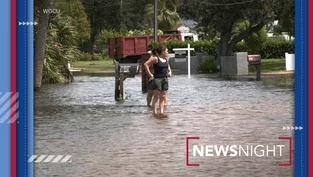
Hurricane Helene leaves widespread damage on Florida’s Gulf coast and beyond.
This week on NewsNight, as Gulf coast communities clean up after Hurricane Helene, some residents in Central Florida worry about the ability of our region’s infrastructure to deal with flooding events. Plus, a new state ban on sleeping in public places comes into effect. The panel looks at whether local governments are ready.
Problems playing video? | Closed Captioning Feedback
Problems playing video? | Closed Captioning Feedback
NewsNight is a local public television program presented by WUCF
Florida Communities Clean Up After Helene Flooding
10/4/2024 | 26m 46sVideo has Closed Captions
This week on NewsNight, as Gulf coast communities clean up after Hurricane Helene, some residents in Central Florida worry about the ability of our region’s infrastructure to deal with flooding events. Plus, a new state ban on sleeping in public places comes into effect. The panel looks at whether local governments are ready.
Problems playing video? | Closed Captioning Feedback
How to Watch NewsNight
NewsNight is available to stream on pbs.org and the free PBS App, available on iPhone, Apple TV, Android TV, Android smartphones, Amazon Fire TV, Amazon Fire Tablet, Roku, Samsung Smart TV, and Vizio.
Providing Support for PBS.org
Learn Moreabout PBS online sponsorship>>This week on NewsNigh as Gulf Coast communities clean up after Hurricane Helene, some residents in Centra Florida worry about the ability of our region's infrastructur to deal with flooding events.
Plus, a new state ban on sleeping in public place comes into effect.
NewsNight starts now.
[MUSIC] Hello, I'm Steve Mort, welcome to NewsNigh where we take an in-depth look at the top storie and issues in Central Florida and how they shap our community.
First, tonight, the widespread destruction wrought by Hurricane Helene.
President Biden visited the state this week as the situation in many communities along Florida's Gulf Coast provides a star reminder of the flooding issues that many parts of our state face on a regular basis.
These are the scene in Southwest Florida this week after Helene passed by o its way to a Big Bend landfall.
Entire neighborhoods submerged.
Residents salvaging wha they can from the destruction.
Some moving out.
>>I've already made the decisio to live in another house.
Just because I' my mom's caretaker.
And like I said, she's 86 years old, and I can't put her throug this.
>>Lori Davis experienced flooding following Hurricane Ian in 2022 and on several other occasions, she's once again picking up the pieces.
>>It's like again and agai we have to keep buying stuff, just buying new clothe and just being able to survive.
>>Look how many times I've covered them.
>>It's harrowing reminder of the perils faced by many communities around the state.
Central Florida, of course is no stranger to rising water.
For some parts of central Florida, the potential for flooding rains is scarier than for others.
Take, for example, Wadeview Park, just south of downtown Orlando near Sodo.
Extensive drainage works in this area, according to some residents, are responsible for significant flooding from heavy rainstorms.
That means it's not just hurricanes and the bands of rain that often lash our region, that people who live here say are a menace when it comes to flooding.
Residents recently took their concerns to an Orlando City Council meeting, expressing their frustration at what some claimed was mismanagement of the projects, including blocked drainpipes.
The city says it found no evidence of that, and it blames a large amount o rain in a short amount of time.
Earlier this year, Orland officials gave the green light to an increase in resident fees to pay for improvements to the city's stormwater infrastructure, which has been underfunded over past years.
Well, let's bring in our panel now to break it all down.
Joining us in the studio this week, Lilian Hernandez Caraballo from Central Florida Public Media covers housing and homelessness.
So with that thanks for being here, Lillian.
Appreciate it.
Ryan Gillespie covers city government for the Orlando Sentinel.
Good to see you Ryan.
And Alexa Lorenzo, favorit of the show from WFTV Channel 9.
Thanks for being here.
Alexa, good to see you.
Let me just start with you Alexa and a quick overvie of the situation after Helene.
What are state officials saying about the recovery effort as it is right now?
>>Right now the recovery efforts are focused in the Big Bend are and a lot along the Gulf Coast.
Tampa, Clearwater, Saint Pete got heavy, heavy impacts with wind and the outer bands and the storm surge.
And then Keaton Beach, Perry Cedar Key, they saw more impacts from the eye of the stor at this point across six states.
So we're talking Georgia South Carolina, North Carolina, Florida, 191 people have died from this storm.
It's 19 so far as of Thursday in Florida, across the board at this point, estimated insurance losses are approaching $700 million.
And this is just the beginning.
Assessments are still happening.
Parts of Keaton Beach about 90% of homes are gone, just flattened acros some of those communities.
So it's going to be a lot of manpower needed to rebuild if if that's even possible for some neighborhoods.
>>Let's talk about some of those local infrastructure issues.
What are people in neighborhoods around particularly Wadeview Park that you have covered?
What are they worried about and what do they say is making the flooding worse there?
>>Yeah.
So the issues in Wadeview Park and date back to even Pre-Helene.
We had kind of a bizarre star to September in Central Florida, where parts of tow got one inch of rain over two weeks and Wadeview Park got 14 inches of rain.
And four an hour and that da where they got four in an hour.
A lot of that ended up flooding into homes and backyards and whatnot.
Neighbor there were critical of the city.
There's a couple of road projects right around there.
One is a city project.
One is a D.O.T.
project out on Orange Avenue.
Which which they contend the contractors there maybe didn' adequately prepare for, for the the rush of rain that came.
>>City planners say that this drainage work is needed to prevent flooding similar to the flooding that we saw after Hurricane Ian and in this instance, after just a summer storm.
What how does the city respon to claims that the work itself may be contributing to those drainage problems?
>>Right after the storm they sent crews out to examine the drainage system.
The storm drains there on Astor Street and some of the streets around and Wadeview Park, and they did not find any blockages when they went to look.
That does not mean that during the storm when there was actual flooding, that there wasn't a blockage that cleared itself due to all the water.
But eve even if there was no road work, what they say is there's not a storm stormwater system really that exists that could have dealt with four inches of rain in one hour.
They don't build to that standard.
They're starting to examine if they need to start doing that, given some of the rain we've seen lately.
But but as of today, it's just not built to withstand that.
>>Well, I was going to say, I mean, is that in the plans the city is has historically, as you've written, been behind on on drainage improvements.
I mean, what is the extent of that funding problem and what does the city say about going forward?
>>So when you think about when Orlando really developed a hundred years ago you know, the 1920s, the 1930s, in a lot of cases, the stormwater systems that were put in place, those same pipes are underground today that move the rainwater from the streets to the lakes, and theoretically keep neighborhoods from flooding.
So 100 years ago, those pipes now decay.
They break.
They're expensive to repair.
And also they're just not, quite frankly, not big enough to deal with the amount of rain that we see today.
So for city residents on your tax bill, you pay something called a stormwater fee.
Right now it's it depends on the size of your house and whatnot, but generally they're about $9.99 a month.
That fee has not been updated since 2008.
So that's funded to 2008 levels.
So what happened today or for the last couple of years is the stormwater department has had to go to market and borrow money to make ends meet.
So now you're going to see a more expensive, tax bill moving forward.
It's going to go up something like $3.50 per month per year for the next four years, until you're paying something like $22.0 a month for stormwater.
They say that funding will help them upgrade these systems and move some of this work along.
That's much needed.
>>An that is something we're seeing in municipalities elsewher in our region, out of the state.
And it's not just communitie in Orange County and in Orlando that are trying to figure out what's causing these flooding issues.
You've been reporting on other places too Lillian.
>>Yeah, I actually focus this year in Volusia County because they've seen some crazy floods out there.
They're having a lot of problems with it.
There's a lady who's had to gut her house like, five different times.
Just inside and ou because it keeps happening.
They've had these massive like, hundreds of people showing up to assemblies just asking the cities.
the count for some help with the flooding.
They have really, really strict requirements for stormwater management.
Usually more most places will have that.
The standard is like the 25 year storm right there.
Volusia goes by the 100 year storm, which is not a storm.
Every once every 100 years, it's a 1% chance of the storm happening as opposed to a 25% of us, a chance of a storm happening.
They go by the 25 chance of a bad storm happening.
But, in Volusia, they go by 1 chance of a bad storm happening.
We can go a whole lot more than that.
However, it's just it seems to not be working out something about this.
The people complain that it's the development, that it is overdevelopment that's doing it.
The wa one of the residents said it is, if you keep building, they'r building a thousand more homes.
You're going to keep changing the landscape, changing the terrain, you're going to keep bringing more water usage.
And then storms are coming.
Where's all that water supposed to go?
And they think it's going into their homes.
It's going into the streets.
They're getting locked in their homes.
>>Well, that development issue is something we're going to talk about a little later in the program.
After Hurricane Ian, we saw a lot of flooding in some underserved communities in Orange County.
And particularly thinking about all of Orlo Vista, the local governments in Central Florida have said that they've been on it.
They've been trying to fix the drainage issues.
How is that work going?
Do we know?
>>Yeah, a lot of work has been done as of late.
I mean, I remember seeing that initial call for the water rescue, and when I'm tracking it, I see this in the middle of an intersection in a neighborhood.
There's no lake like what's happening.
And it was just those images from the flooding from Ian were unbelievable, what those families had to go through so very quickly.
The county knew they needed t address it and address it fast.
And progress has been made.
At this point, the project is about 95% complete.
But it's probably going to b done in the spring of next year.
That next 5%, it's going to be very focused on electrical.
So they have already, as in regards to the flood mitigation project, they've made three ponds deeper by 12ft.
All of the ponds are now connected by pipe, but that electrical work is a big lift.
And right now they're facing some timing issues with supply chain backups.
So that's kind of putting a little rift in the project.
But they are very hopeful that they'll get it done by spring of next year.
>>Certainly a priority for many places for sure.
And I'm sure you guys will keep across the story.
We wanted to let you know tha as we get close to Election Day, WUCF has partnered with public media outlets around the stat to put together a voter guide.
You can find informatio on state and federal candidates and their positions on the issues at our website, wucf.org/vote.
All right.
We recently discussed on the show how the issue of annexation is playing out in the district five Orange County Commission race.
Well, last week Orlando City Commissioners talked about it too.
They gave their initial endorsement to a controversial petition from a subsidiary of the Mormon Church for the city to annex some 50,000 acres of its Deseret Ranch's land.
That would expand Orlando's footprint by about 60% out to the Osceola and Brevard County lines nearly.
The area is the focus of a heated debate over sprawling development plans east of the current Orlando urban area.
Here's part of the Orlando City Council meeting.
>>We urg you to slow this train down.
There is no hurry.
We can do better.
And we must.
>>Please make this decision with a no vote, so that this counci can be remembered as strategic and preservin the negotiating power and resources of Central Florida taxpayers.
Thank you.
>>You know, I've heard the concerns.
We've all heard them and a lot of them are valid, in all the different areas They're valid.
They need to be dealt with.
And I think the assuranc I would give you, I think the mayor's giving in this council would give you is tha those will all be very public.
Again, there's no approvals in place as they come in with a plan that staff evaluates and and applies that to our policies our procedures, our, our code.
There'll be public hearings.
And so we'll get to weigh i on those throughout the process.
>>All right, Ryan, this is a pretty big issue for our community.
What exactly are the church's plan for that Deseret Ranch's land, and why does it want to be part of Orlando instead of unincorporated Orange County?
I mean, is it just about wh is more lenient on development?
Yeah, it's hard to get into exactly what their plans are because to be honest with you, we don't really know.
I think it's important to to put in the scale, the size of property we're talking about.
Yeah, it's 81 square mile, which is something like the size of Miami and Manhattan combined.
I think it's a it' a lot of property.
>>--of space.
>>Yeah, it's it's big.
And I think also it's important to consider when they eventually development develop it, more people are probably going to live 25 miles southeast of Orlando of City Hall than in downtown proper.
And the places that we consider to be Orlando today.
But but to be honest with you, they have they deal in long timelines.
This is a subsidiary of the Mormon Church.
They've owned this land since the 50s.
It's mainly ranching land right now.
They're not talking about having this totally built out until 2080.
You know, I don't know if I will be here in 2080.
>>We'll all be very lucky to be.
>>Yeah, but but what we know is if this annexation goes through, they have agreed not to begin building until 2040.
So there's going to be a 15 year runway at minimum to kind of try to figure out what that is.
They intend across their ranches, which is three counties, par of Osceola, Orange and Brevard, that something like 800,00 people are going to live there.
I don't know how many of that will be here in Orange County, but a lot of them.
>>How do Orange County leaders feel about this whole annexation issue?
>>Yeah.
At the heart of the issue is who owns the land, right?
>>Yeah.
>>At this point, Orange County commissioners voted unanimously to pass a conflict resolution procedure, which essentially tells the city of Orlando, we want to talk this out and discuss a path forward.
Orange county's biggest thing is, do we have the police, the fire, the ability the leaders to be able to handle what this growth infrastructure would bring?
Do we have the manpower to do that?
Because as you said, right now, it's farmland.
It's nothing.
>>Yeah.
>>If you put something in there again, I know we're talking 2080 population is going to continue to boom.
But do we have the resources to support the growth that they foresee there?
>>Your colleague Molly Duerig has been talking to opponents of this annexation move.
What do they say about why they think the Deseret Ranches should remain within the county's realm?
>>The opponents are actually very concerned about environmental issues as well.
Within the next year, I believe the central water, the Central Florida water system, the water aquifers, will provides most of the water in centra Florida, in Florida in general.
But in central Florida, it's really feeling the pressure of population booms when it comes to this water supply.
Within the next year, we could start seeing a shortage of water.
So, if we develop these lands, how much more green land can we afford to lose?
Or is it worth to just preserve these spaces as they are?
>>Water is such a big issue around the country.
We certainly see that out west as well.
It's become an election issue in places like Arizona and Colorado.
I mean, there were protests outside this this council meeting, Ryan in Orlando, last week.
What have you been hearing from environmental groups about their concerns?
>>At some level, their concerns or that this could be a move to essentially silence voters in November on your ballot in Orange County, there's a charter amendment that would theoretically make this annexation much more difficult to do after November 5th.
Number nine is something called a rural boundary.
Yeah, there's something like that in Seminole County- >>We talked about on the show.
Yeah.
>>Right.
So there's this huge swath of land essentially east of UC all the way out to the Brevard County line, including Deseret Ranches.
>>Yeah.
>>And then some other lands on the very western edge of the county that it would make it would require a supermajority vote.
So a majority plus one of the county commission to approve, like large scale development and zoning and denser development in those areas.
If this annexation goes through, it takes a gigantic bite out of that rural boundary, a 52,000 acre bite on the east side.
So that's one.
And then amendment ten, which is the last one on your ballot, is involving annexations like this.
It would essentially give the board of county commissioner a veto on voluntary annexations.
So it would fall in line with this amendment.
And so it would require a majority plus one.
And in the view of a lot of property owners, like the, subsidiary of the church, is that they probably wouldn't be able to do this in the future.
Therefore, this decision neede to happen before November 5th.
>>And as Ryan mentioned, this is a very long term prospect.
So we're likely to see that kind of development continue all the way through the century for sure.
Be sure to visit us on social media.
We're at WUCFTV on Facebook and Instagram.
You also find us on X as well.
We're @NewsNightWUCF there.
Okay, finally tonight Florida's law barring homeless people from sleeping outside came into force.
This week, local government and law enforcement agencies needed to begi complying on Tuesday, as the ban on campin in public places took effect.
But it's reportedly proving to be an uphill task for those responsible for providing shelter for the thousands of homeless people in Central Florida.
Earlier this year, Florida lawmakers passed legislation to ban homeless people from camping on city streets, sidewalk and parks.
>>From a statewide perspective we're not going to let any, city, turn into a San Francisco not on our watch.
We're not going to le that happen.
>>We'll talk more about the specifics of the law in a moment.
In June, the US Supreme Court ruled that cities around the country could enforce ban like the one passed in Florida, which have drawn criticism from advocates for homeless people.
>>It's hard for me to be supportive of legislation like that.
I, I personally would lik to see maybe some data on how that is an effective wa in helping to end homelessness.
>>The largest number of homeless people are in Orange County, particularl to the west of downtown Orlando.
And finding shelters to help comply with the incoming law is proving tough.
This building is one example.
The city of Orlando had hoped to use this site in West Lakes a an emergency overnight shelter, but a barrage of local opposition forced the city to shelve its plans to spend $7.5 million to buy the unused warehouse.
But even had the plans been well received, there still wouldn't have been enough beds to meet demand.
Orange County recentl added $10 million to its budget to fund homeless agencies, but a Sentinel investigation shows efforts across the region are lagging well behind, with counties and cities unlikely to have enough facilitie in place to comply with the law.
>>All right, Lillian, first off, remind us exactly what the law passed earlier this year aims to prevent and what it requires from local agencies.
>>Cities and counties are no longer allowed to let people just sleep in public and their cars can't.
In little camps, tents of the woods anything that is public space.
The state says, no, you guy are not allowed to leave, that you let that happen anymore.
If you are going to let people camp somewhere, it has to be a designated zone.
You are allowed to give them designated zones to camp i and or sleep in if you want to.
But if you do that, then the state gives them a bit of a litany of-- >>Requirements, right?
>>Yes.
Standards and mandates that they must follow, including security.
They have to have drug rehab mental health resources, running water, which can be interprete in a number of ways, restrooms and so on.
>>Al of those sanitation facilities.
The Supreme Court did weig in on, on these kinds of bans, earlier this year on, you know, homeless people sleeping in public places.
What did the Supreme Court have to say about that?
Whether it was okay for local governments to punish peopl if they had nowhere else to go?
>>Yeah.
This was a decision that was highly anticipated.
People across the country were awaiting this.
And in the opinion it was pretty cut and dry.
They found that findin and arresting does not violate, the amendmen for cruel and unusual punishment, allowing Florid the green light to move forward with this.
And this decision, I believe was in the summer.
So it gave them a few months to try to find their footing before this law took effect October 1st.
But I'll tell you, the morning of October 1st, we were reporting on this, and there were dozens upon dozens of people still sleeping in public.
There are right now this is not being at this point enforce because it's so fresh, so new.
There are so many question marks.
>>Well, that brings me to your reporting, Ryan, and how the implementation of this is, is going.
It sounds from what Alexa' saying, not particularly well.
You've been trying to get answers from local authorities about how their preparations are going.
What have you been finding?
>>So on the law enforcement side, I don't think I have come acros a law enforcement agency that's excite about the prospect of arresting peopl for sleeping outside.
You know, they don't see it, and really nobody sees it as an overly productive way to solve the problem.
All you're really doing is giving somebody the most expensive shelter bed that our society can offer for a couple of days, and then they're back out on the street in the same position they were, but now they have fines and fees associated with it.
So what everybody expected would happen when this bill was passed and signed is it would start a conversation on the need for more shelter beds.
Where can we send people that is not jail.
And that conversation is very much in its infancy.
And in a lot of cases, I would say not happening.
We surveyed many of our citie and counties across the region very recently, and, and everybody was generally pointing the finger at each other of like, hey, we're waiting for Seminole County to come up with a plan or, hey, we'd like we'd like Osceola to be the leader down there where we've seen a little bit of progress, though nothing substantive, the city of Orlando brought forward a plan for a shelter a month or two ago.
It died on the vine very quickly due to neighborhood feedback.
The city is is actively looking for place that would not be in paramour, where the rest of our region's shelter beds are for bed.
Orange County has set aside some funding as well for some places in East and West Orange but nobody has found a site yet.
>>People in certain sections o Orlando, particularly Paramore, you know, have have said that they feel overburdened not only with homeless people, but also all the services that go along with that.
What did you hear in opposition to that, to that shelter from your reporting?
>>Certain place generationally have had a number of poverty and social service needs.
So a lot of social services have been focused on these parts.
They've been built there.
And frankly, as things improve and they grow economically and they grow in development, frankly, the people there are really tired of seeing the social services just land there, because the more social services you build there than people who need the social services end up migrating to that area, creating, visibly larger problem of people who are displaced, who are living in poverty and who are in need.
And yeah people are frankly tired of it.
They're like, why can't you just build a shelter somewhere else?
And to their point, to be honest, East Orlando doesn't have a single shelter.
East Orlando has only.
In fact, there's on Drop-In center for the homeless.
And this information is coming from the Samaritan Resource Center.
So as these laws, especially because Orlando just passed this law against, you can't sit on the site, we can't hang around the sidewalk, can sleep around, as they criminalize these things and try to deal with them.
And people keep pushing them out of the West and in the downtown area, people are moving to the fringes.
So now we're seeing more people experiencing homelessnes kind of hanging out in the East Orlando in the East Orange County area, and there's not a whole lot of help for them there.
So to their credit, maybe there should be a little bit of something done over there.
>>Yeah.
Well, Lillian actually, alluded that to the ordinance in Orlando.
I mean, even though local governments are sort of kind of scrambling to comply with the state mandate, plenty of cities and counties have applie their own ordinances that could have implications for homeless people.
>>Yeah, almost every city and county, they either already had banne camping prior to the state law, or they have done so since i passed, or they intend to do so.
So by and large, and I mean, the state la essentially took care of that.
Anyway, it will be illegal everywhere in the state.
>>So I wonder why they were so ill prepared for this law.
If a lot of these places have been passing their own ordinances to make it tough.
>>Well, it's - building shelter is very difficult.
>>Yeah.
>>Even if so, let's just use the example that the city, the one the city brought forward on West Washington.
Yeah.
That was in their view, of 20 sites they reviewed.
It was perfect.
It was besides the location of it.
They didn't love the location, but it had the bones of a perfect shelter.
It was going to need the smallest amount of work.
All of this stuff, there's not a there's zero chance it would have been opened by January 1st.
When they can get sued, it probably would not have been open until the end of next year or in 2026.
So even if even if this shelte conversation was further along the way this law was signed and passed.
There wasn't enough of a runway to actually be prepared, to be adequately prepared.
>>Can we just I mean, taking a 50,000ft view here, do we get a good idea about the extent of the homelessness issue in in our community?
Can we take a point in time and say what the situation looks like at the moment?
>>At this point, the best reporting we have is that within the past year homelessness in Orange, Seminole and Osceola County has increased by about 105%, which is an unbelievable number.
And surveys show that on a single night in those three counties, you have almost 3,000 people who are unsheltered.
>>Well, it's certainly a bi issue that faces our community.
And obviously with the growth comes more affordability and more homelessness issues.
But I appreciate you guys comin in and talking about it today.
You can find a link on our website to the text of the legislation on homelessness.
Visit us online at wucf.org/news igh along the bottom of your screen.
But that is all the time we hav for this week.
My thanks to Lilian Hernandez Caraballo Ryan Gillespie and Alexa Lorenzo.
Thank you guys so much for coming in.
Really appreciate it.
We'll see you next Friday night at 8:30 here on WUCF.
From all of us here at NewsNight take care and have a great week.
Florida Communities Clean Up After Helene Flooding | Preview
Preview: 10/2/2024 | 20s | Hurricane Helene leaves widespread damage on Florida’s Gulf coast and beyond. (20s)
Providing Support for PBS.org
Learn Moreabout PBS online sponsorship
- News and Public Affairs

Top journalists deliver compelling original analysis of the hour's headlines.

- News and Public Affairs

FRONTLINE is investigative journalism that questions, explains and changes our world.












Support for PBS provided by:
NewsNight is a local public television program presented by WUCF