
Florine Mark, Homeless Support, Wigilia, One Detroit Weekend
Season 8 Episode 24 | 26m 46sVideo has Closed Captions
The legacy of Florine Mark, helping Detroit’s homeless, Polish Wigilia and weekend events.
Florine Mark's daughter Sheri Mark reflects her mother’s accomplishments and legacy. Two Detroit nonprofits provide help and hope to the city’s homeless during the holidays and beyond. The history of Wigilia, a Christmas Eve dinner tradition celebrated by Detroit’s Polish community. Plus, check out some of the holiday events and other activities coming up around town on “One Detroit Weekend.”
Problems playing video? | Closed Captioning Feedback
Problems playing video? | Closed Captioning Feedback
One Detroit is a local public television program presented by Detroit PBS
Florine Mark, Homeless Support, Wigilia, One Detroit Weekend
Season 8 Episode 24 | 26m 46sVideo has Closed Captions
Florine Mark's daughter Sheri Mark reflects her mother’s accomplishments and legacy. Two Detroit nonprofits provide help and hope to the city’s homeless during the holidays and beyond. The history of Wigilia, a Christmas Eve dinner tradition celebrated by Detroit’s Polish community. Plus, check out some of the holiday events and other activities coming up around town on “One Detroit Weekend.”
Problems playing video? | Closed Captioning Feedback
How to Watch One Detroit
One Detroit is available to stream on pbs.org and the free PBS App, available on iPhone, Apple TV, Android TV, Android smartphones, Amazon Fire TV, Amazon Fire Tablet, Roku, Samsung Smart TV, and Vizio.
Providing Support for PBS.org
Learn Moreabout PBS online sponsorship- [Narrator] Coming up on "One Detroit."
- [Narrator] The daughter of trailblazing businesswoman Florine Mark, shares memories of her late mother's professional and personal achievements.
Plus, we'll talk about two Detroit non-profits providing help and hope for the homeless this holiday season.
Also ahead, we'll take you to a Polish Christmas Eve dinner tradition.
And, we'll have some ideas on how to spend the weekend in metro Detroit.
It's all coming up next on "One Detroit."
- [Narrator] From Delta Faucets to Behr Paint, Masco Corporation is proud to deliver products that enhance the way consumers all over the world experience and enjoy their living spaces.
Masco, serving Michigan communities since 1929.
Support for this program is provided by the Cynthia and Edsel Ford Fund for Journalism at Detroit Public TV.
- [Narrator] The DTE Foundation is a proud sponsor of Detroit Public TV.
Among the state's largest foundations committed to Michigan-focused giving, we support organizations that are doing exceptional work in our state.
Visit DTEFoundation.com to learn more.
- [Announcer] Nissan Foundation.
And, viewers like you.
(upbeat music) - [Narrator] Just ahead on this week's "One Detroit," the CEOs of two non-profits talk about the plight of the homeless and disadvantaged during the holiday season.
Plus, we'll show you a Polish holiday tradition that promotes family history and culture.
And, Cecelia Sharpe of 90.9 WRCJ tells about some events and activities to check out over the holidays.
But first up, we're reflecting on the life and legacy of the late Florine Mark, who passed away in October.
As the former president and CEO of Weight Watchers Group, she blazed a path for future women entrepreneurs.
The Detroit native was committed to serving the community, and she was devoted to her family.
"One Detroit" contributor, Cecelia Sharpe of 99.9 WRCJ, sat down with Florine's daughter, Sherry Mark, to talk about her mother's many contributions and accomplishments.
(gentle music) - Commercial science.
- Commercial science.
With honors, too.
She had (indistinct) with honors.
- Yes, ma'am.
- My guest today is Sherry Mark, daughter of the business maven, Florine Mark.
Who had the highest amount of franchisees of Weight Watchers, in the Weight Watcher history.
And we are here to talk about the legacy of your mother.
You're the eldest- - Yes.
- Of five.
- Yep.
- And she was going back and forth to New York to a program called Weight Watchers.
- Yes.
- And after being a part of the program, she lost 50 pounds.
What moved your mother, Florine Mark, to start the Michigan franchise of Weight Watchers?
- That was a time when women, maybe you worked at the shoe store selling pantyhose.
'Cause I know that women weren't allowed to sell shows.
And but, she saw this opportunity, because there was nothing like it.
And she was a very good speaker, she always loved to be on.
And do things in the community.
And luckily had the foresight and the entrepreneurial foresight to say "I'm gonna start this here, I'm gonna do this franchise."
It was just starting in New York.
She started at a little synagogue on Seven Mile.
And my mother was the lecturer.
At that time it was called the lecturer, the leader.
So it started with one class.
And it really grew.
My mom was a very dynamic speaker.
And so, a very good motivator.
And people would come.
And it really was a good program.
I don't like to call it a diet, she never like to call it a diet.
It was a very good program.
And it's also, it's a support group.
You would come once a week, or more if you needed it.
And you would be with other people, so everybody was supporting each other.
And my mom loved that.
She loved to put all these people together.
And so, it grew very quickly from that first class to many, many, many classes.
- What inspired her to continue championing for women in leadership?
- She was a leader and a businesswomen, a business leader, at a time when women weren't allowed to.
She tried to borrow $5,000 to start the business here.
And nobody, no bank would give her a loan because she was a woman.
I think she just always felt that as a champion for women, she always told us, as did my grandparents, that you can do anything you wanna do if you try.
- And she did so much, not only with Weight Watchers.
Not only with advocating for women, but she served on numerous boards.
Where did she have the time to do it, and give so much?
- She always told me, and I'm sure my siblings, that you make time for what's important to you.
I always learned that if I got up in the morning, and I was healthy, I had to give back in some manner.
And that's where I think all of her charitableness and chairing boards, and making a difference.
She wanted to make a difference.
And as a leader, when you're on these boards, you make a difference.
You're setting policy, and you're doing great things, and I think that's where it all came from.
- Were you encouraged, or your siblings encouraged to follow in her footsteps?
Or, to follow your own passions and purposes?
- Everybody worked in the business.
My siblings all worked in it one way or the other.
Some of us, we all started at the bottom, we swept out centers, you know, Weight Watcher centers.
We set up chairs.
My grandmother was behind the scale.
So everybody, the whole family, which was wonderful.
It was wonderful.
It provided like a really nice family business for everybody.
We all took a part in decisions of it and things.
Even if you weren't working in there on a daily basis.
My grandparents didn't have a lot of money.
And so, she didn't go to college, and she married young.
So this was her way of giving back, and taking care of everybody.
She now has, I think, six degrees from Wayne and Oakland, and U of D, and Lawrence Tech, and it's beautiful.
She loved it.
We would go with her.
She was so honored to get those degrees.
But she encouraged us, college was always a given.
You went to college.
So my one brother is a doctor.
I'm a nurse and an attorney.
And my sister and her husband worked in the business.
My other brother is an attorney.
She encouraged us to go out and do, and be successful in things that we felt were important to us.
- How do you want the world to remember Florine Mark?
- Oh, I want the world to remember her as a person with a really good heart.
A motivator for not only women, but especially women, but women, men, children.
Motivating people to go out and make a difference.
And to love your family every day.
Her signature was love, love, love.
To fight for peace, and to be kind for people.
And good sense of community, and give back.
You know, you don't have to be really wealthy to make a difference in the world.
You really don't.
Whether you give a sandwich to a homeless person, or whether you volunteer at a Forgotten Harvest, or something.
I think her greatest accomplishment was her family.
And she would tell you that.
She loved having her family around.
Her other, equally as important, greatest accomplishment, is being a woman entrepreneur.
And being that role model for women.
The world and us, I think my mother considered everybody her family.
- [Announcer] And, you can see a documentary about Florine Mark titled "Bravo!
Florine Mark," here on Detroit Public Television, this Sunday, December 17th at 7 p.m.
Although the holiday season is a joyful time for many, it can be difficult for others.
Such as the homeless and disadvantaged.
An increasing number of people are seeking shelter, or facing food insecurity due to the pandemic, inflation, job losses, and other factors.
"American Black Journal" host, and "One Detroit" contributor, Steven Henderson, spoke with the CEOs of two Detroit non-profits that are helping those in need during the holidays and beyond.
(gentle music) - This is a really bright time of year for so many of us, and we look forward to it all year.
But for a lot folks, it produces a lot of anxiety about really basic needs.
I just wanna start with having each of you talk about what kind of landscape we're looking at here in Detroit with regard to homelessness, and the disadvantaged this time of year.
And the kind of challenges that they are likely to encounter.
Linda, I'll start with you.
- Well first, Stephen, I wanna say thank you for bringing light to this matter right now.
Because you're absolutely right.
And with the pandemic, we saw a lot of heads of households that were affected by COVID-19, who are no longer with us.
And so, what we've seen at NSO, is a lot of those families are really struggling to make ends meet, and meet those basic needs for their family.
We're seeing a tremendous increase in homelessness of women and children.
I've had some conversations with city and other providers in our community about what we can do right now, we at NSO can do right now.
And we are starting a Housing First Fund.
Thanks to United Healthcare, Huntington Bank, and Meridian Health Plan, we're able to put some dollars in a pool for all those calls that we get to help people stay in their homes.
That eviction moratorium is now lifted, and people just aren't able to pay that back rent.
So we wanna keep people housed.
They're in this cold season.
We offer a full continuum of homeless solutions.
But let's first keep people housed.
Let's try to keep people in their current homes.
So that's what our Housing First Program is gonna do.
- Chad, I wanna hear from you, as well, about what you feel like we're confronting in this community and what it looks like.
- Well, unfortunately this time of the year has not been what we expected.
We have been working diligently with a lot of other organizations in the city to make sure the homeless individual's numbers will be less.
But unfortunately right now, it is way higher as Linda was talking, especially for women and children.
And also, for men as well, the number is not decreasing at all.
As a matter of fact, the latest report showed that there was about 7% increase over the last year of homelessness.
And those are due to many, many factors.
Linda had shed light on the COVID-19 impact, but also the economy.
The inflation is a big part of it.
We see also there is a lot of people are not able to get food on their tables.
The increase for the requesting of food.
So, food insecurity becoming a very big issue.
And right now, we are in discussion that we would have to open another 600 bed for the City of Detroit.
As we speak right now, there is a lot of talks about how can we come up with 600 beds.
Which we are already working (indistinct).
We're providing probably about 400 so far.
And I know NSO is gonna be working, and a lot of other organization gathering together.
The good things about Detroit, is that we have a good organizations and good people with good heart, that they will do what needs to be done.
But the fact remain, we have an issue with homelessness, and it is growing.
It's not going down.
- Yeah, we do.
- We have issues with substance abuse.
We have issues of mental health that created a big impact on affecting the number of homelessness.
So, I wish today I would of been able to say the numbers are going down.
Unfortunately, the numbers are not going down.
And we need to do way more work.
And the bottom line, we need more housing, which is, there's not enough stock in Detroit, anyway.
And this is a major thing that we would have to work on.
Where do we take the people off the shelter, and the warming center, after we bring them in?
And how are we going to work with them, so they can get back on their feet?
So they will get off of homelessness.
- I wanna have each of you talk a little about what people can do to help this population during the holidays?
Linda, I'll start with you this time.
What should people be thinking about?
- So first of all if you're homeless, if you're suffering any type of housing instability right now, it's cold outside.
Get ahead of it.
Call our Coordinated Assessment Model, the CAM is also known.
313-305-0311 And let them know, see what you can, what you're eligible for.
If you're an inner cell client, give us a call at our 888-360-WELL number.
And we can help try to keep you in your housing.
But if you are a concerned citizen of Detroit, which I know we have so many citizens who care about all our entire community, donate.
Donate to organizations like Detroit Rescue Mission, like NSO, so that we can help people collectively, and have collective impact.
It's great to help people on the street.
I have a lot of friends who give goodie bags, and clothes, socks to people on the street.
That's fantastic.
But we have to donate to organizations like NSO, Detroit Rescue Mission, so that we can have collective impact.
And you can do that by going to our website at www.nso-mi.org - Yeah, yeah.
Chad, what would you recommend for people?
- You know the first thing, people when they look, sometimes they get confused between people who are homeless, and people who are panhandlers.
It gives the perception, the panhandler give the perception of homelessness, but they're not really homeless.
The people who are homeless are people who are like me, and like everyone else.
They're not a second-class citizen.
They're a good human being.
But they're just going through some harsh times.
And they come to organizations like NSO, or DRMM to get help.
And therefore, we encourage people instead of helping a person to stay on the street, to help organization, take them off the street, and find a solution to their situation, so they can put them into a, not no longer in harm way, but to be in a peaceful situation.
So I urge people to understand that homelessness is not a panhandling situation.
And to support organizations like NSO, like DRMM.
And they can do so, and if they see anybody on the street, and they really need help, they can always call CAM, or they can call directly.
Our number is at 313-993-4700.
And for help, they can also go to our website at drmm.org.
And, we will be very thankful, like we've always been to the generosity of Detroiters.
- [Narrator] Turning now to a holiday tradition that some say is bigger than Christmas Day itself.
The Polish Christmas Eve dinner celebration, known as Wigilia, has been around for centuries.
It features 12 different polish foods including perogies.
When Detroit was invited to the Wayne State University Polish Club's Wigilia Celebration, at Hamtramck Polish Village Cafe, a few years ago.
To learn more about the tradition's history and cultural significance.
(gentle music) A December weekend in Hamtramck, the Polish Village Cafe, where there's a Wigilia celebration about to begin.
(excited chatter) - Okay, we'll figure it out.
- [Narrator] Alina Kline hosts the gathering.
- [Alina] The Wigilia, the word comes from the Latin, which means to watch.
So, it's waiting for, watching out, waiting for Christ to be born, which we celebrate of course, on Christmas Day.
- [Narrator] Kline came from Poland 30 years ago.
Now, she teaches Polish history and culture at Wayne State University.
- [Alina] It is the most traditional, the most celebrated of all Polish holidays.
So, anywhere, and I think this will be- - [Narrator] While Christmas Day is big in Polish homes, Wigilia is bigger.
Held on Christmas Eve.
- Wigilia is one of the most important Polish traditions that we have.
And so, I found it very important to be here today.
To support Wayne State, and to promote, and to keep these traditions alive.
- [Narrator] Gillian Demeter studies Polish at Wayne State.
- I thought it would be fun.
So, I invited my family, as well.
- This is my sister.
- I'm second-generation Polish.
I grew up knowing bits and pieces.
But, studying the language and getting a degree in that language, has given me so much more.
And I've been able to now reconnect with my cousins, who live in Poland.
My family of Polish roots.
So, it's exciting to be able to be a part of that.
- On Christmas Eve, we want to be with our families and friends.
And we also want to be on our best behavior to ensure that the next year will bring us health and prosperity.
- [Narrator] In Poland, the run up to Wigilia means fasting.
But not too much.
- They try to eat very lightly, a little bit throughout the day.
Maybe two little meals, and then they would sit down to this very sumptuous, however meatless dinner.
And this meatlessness of this dinner is because it's still fast before Christmas.
It's not Christmas yet.
- [Narrator] Some might think of Hamtramck as far as local Polish history goes.
Many Poles came to work at the Chrysler assembly plant.
The massive Dodge main complex that closed in 1980, but the Polish story in Detroit starts even before that.
- The Polish women, at the beginning of the 20th century, a lot of them worked in cigar industry.
And not many people know then, before Detroit had that automotive industry, which is Detroit so famous of, cigar industry of which Detroit was famous of.
- [Narrator] Poles came not just to Hamtramck in the East Side, they established parishes on the West Side, along Michigan Avenue.
Laurie Gomulka documents the Polish American experience there.
- With me, my interest really peaked when my dad passed away.
My dad was a Polish American musician.
He was quite famous in the Detroit area.
His name was Ted Gomulka, he was a trumpeter.
- [Narrator] Polish American jazz musicians created polka music.
Popular in Detroit.
Ted Gomulka appeared regularly on radio and television.
He was a Decca Records recording star.
- He had his own polka band for many, many years.
And when he passed away in 1998, he had this sort of sense, this feeling that nobody was going to care.
Nobody was going to remember anything that he had accomplished in his life.
- [Narrator] Preserving history can be a challenge.
In the century past, Polish immigrants weren't treated so well.
In part, because many did not speak English.
- They were also Catholics.
That was a time when Catholics were not really looked at very favorably.
(accordion music) - [Narrator] Many also despised and ridiculed Polish Catholics, fearing their alliance was to the Pope, and not their new country.
- We really didn't celebrate Wigilia when I was growing up.
When I was very little, we lived in the attic of my grandfather's house not far from here.
I grew up in a Polish-speaking household.
And I'm now fairly fluent in Polish, but I was forbidden to speak Polish.
Because my father's family back in the 50s, didn't want anyone to know that we were Polish.
- [Narrator] Back in the kitchen, Marta Birowka and (indistinct) coordinate the delivery of the delicacies.
- We don't microwave anything.
We don't even have a microwave.
Now it just gotta be freshly baked, or fried.
Traditional Wigilia is 12 dishes.
12 is the limit, you can't have any more.
You're not able to eat any more.
(chuckling) - [Narrator] First there's (speaking in Polish language).
That's plural for (speaking in Polish language).
A thin, rectangular wafer.
- My most favorite tradition is the (speaking in Polish language).
Where you share the Christmas wafer before the meal, and you go around the room with a wafer.
You break off a piece of theirs, they break a piece of yours, and you reconcile any differences you may have had throughout that year.
And wish peace and happiness, and all the prosperity for the new year to come.
So everyone starts on a fresh slate.
(people cheering in Polish language) - [Narrator] While the traditional Wigilia meal doesn't have meat, fish is included.
Starting with (speaking in Polish language), pickled herring in a cream sauce.
- The (speaking in Polish language) reminds us also of the fact that it is still fast, it is not Christmas yet.
- [Narrator] Another Wigilia requirement, soup.
Here it's Borscht, made from beets.
The, there's perogie.
Sweet and savory-filled dumplings.
- We host our Wigilia at our house every year.
And yes, we have gluten-free perogie.
And everybody loves them, nobody knows the difference.
- [Narrator] Here, the Bemiss family tells their own Wigilia perogie story.
Alicia's son, Wayne State student, Charles, he can't eat gluten.
- We got to the point when he was diagnosed at the age of 12, he said "Oh my gosh, mom, "I'm never gonna have perogie again."
He said, "Find a way to make them gluten free."
- [Narrator] Alicia did.
Not the Bemisses run a gluten-free perogie factory in Saint Claire Shores.
Their perogies are available in stores across southeastern Michigan.
- This is our busiest time of the year.
- [Narrator] Wigilia's main course includes potatoes, sauerkraut, and more fish.
In Poland, it might be Carp filet.
But here, Cod is served.
- For desert, we will have for sure, poppy seed roll.
Because poppy seed is one of these magical components in Wigilia.
It goes way back to assure prosperity next year.
You need to eat some poppy seeds every year.
(singing in Polish language) - [Narrator] This Wigilia event has been going on for decades.
And now, Wayne State alumni, Jessica Wendt, sees more interest in the old traditions, thanks to new technology.
- We have social media.
So social media helps to really kind of promote and educate friends, spark interest and questions.
And then people are really kind of reaching back to the roots of where they came from.
(accordion music) - [Narrator] If you're looking to take a break from all the holiday shopping and planning, there are a lot events in the metro area that will provide a festive distraction.
Here's Cecelia Sharpe from 90.9 WRCJ with today's "One Detroit" weekend.
- Hey everyone, I'm Cecelia Sharpe with 90.9 WRCJ.
And as we all know, it is the holiday season.
And Detroit is not disappointing with all the events taking place this weekend.
First up, through December 16th, theatre lovers can head to The Farmington Players, where they're putting on "A Nice Family Christmas."
The play is about a newspaper reporter, who's job hangs on a story about his own family's Christmas.
Also, on December 16th, Philadelphia punk band, The Menzingers are coming to the Royal Oak Music Theatre.
On Sunday, it's a holiday classic.
The Mannheim Steamroller is stopping by the Fox Theatre for its Christmas tour.
If you're looking for an interesting exhibition, look no further than the Charles H. Wright Museum of African American History.
Where "D. Tree Studio: The Past, Present, and Future of Detroit Trees" is up through December 17th.
The exhibit is in partnership with the College for Creative Studies.
And delves into a five year journey of building a new relationship with the city's trees.
Then, if you want to up your culinary skills before hosting your holiday party, got to Marrow Butcher Shop and Restaurant, for Holiday Charcuterie Building with Chef Sarah Welch, on Wednesday, December 20th.
Plus, there's so much more to do and around Detroit.
So here are a few more events.
Have a wonderful weekend.
(gentle music) (gentle electronic music) - [Announcer] That'll do it for this week's "One Detroit."
Thanks for watching.
Head to the "One Detroit" website for all the stories we're working on.
Follow us on social media, and sign up for our weekly newsletter.
(gentle music) - [Announcer] From Delta Faucets, to Behr Paint.
Masco Corporation is proud to deliver products that enhance the way consumers all over the world experience and enjoy their living spaces.
Masco, serving Michigan communities since 1929.
Support for this program is provided by the Cynthia and Edsel Ford Fund for Journalism at Detroit Public TV.
- [Announcer] The DTE Foundation is a proud sponsor of Detroit Public TV.
Among the state's largest foundations committed to Michigan-focused giving, we support organizations that are doing exceptional work in our state.
Visit DTEFoundation.com to learn more.
- [Announcer] Nissan Foundation.
And, viewers like you.
(gentle music) (gentle music continues) (bright musical tag)
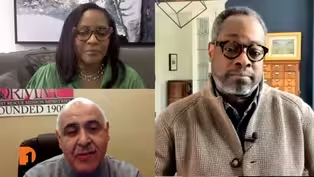
Detroit nonprofits help the homeless during the holidays
Video has Closed Captions
Clip: S8 Ep24 | 7m 43s | Two Detroit nonprofits provide resources for the homeless during the holidays and beyond. (7m 43s)
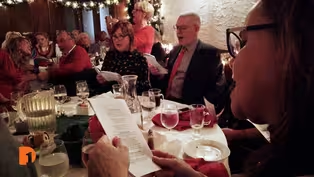
The history of Wigilia: A Polish Christmas Eve tradition
Video has Closed Captions
Clip: S8 Ep24 | 7m 1s | Detroit’s Polish community celebrates Wigilia, a Polish Christmas Eve dinner tradition. (7m 1s)
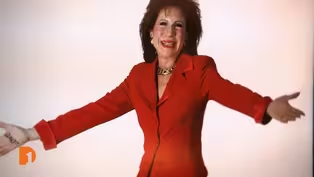
The legacy of prominent Detroit Jewish leader Florine Mark
Video has Closed Captions
Clip: S8 Ep24 | 5m 25s | Florine Mark's daughter Sheri Mark reflects on her mother’s accomplishments and legacy. (5m 25s)

One Detroit Weekend: December 15, 2023
Video has Closed Captions
Clip: S8 Ep24 | 1m 50s | Check out the holiday events coming up around metro Detroit on “One Detroit Weekend.” (1m 50s)
Providing Support for PBS.org
Learn Moreabout PBS online sponsorship
- News and Public Affairs

Top journalists deliver compelling original analysis of the hour's headlines.

- News and Public Affairs

FRONTLINE is investigative journalism that questions, explains and changes our world.












Support for PBS provided by:
One Detroit is a local public television program presented by Detroit PBS