
Focusing On Food Equity
Clip: Season 1 Episode 186 | 3m 42sVideo has Closed Captions
The Dare to Care Food Bank in Louisville is focusing on food equity
One in seven people in Kentucky suffers from hunger. The Dare to Care Food Bank in Louisville wants to change that. This Black History Month, they are particularly focusing on food equity across all communities.
Problems playing video? | Closed Captioning Feedback
Problems playing video? | Closed Captioning Feedback
Kentucky Edition is a local public television program presented by KET
Focusing On Food Equity
Clip: Season 1 Episode 186 | 3m 42sVideo has Closed Captions
One in seven people in Kentucky suffers from hunger. The Dare to Care Food Bank in Louisville wants to change that. This Black History Month, they are particularly focusing on food equity across all communities.
Problems playing video? | Closed Captioning Feedback
How to Watch Kentucky Edition
Kentucky Edition is available to stream on pbs.org and the free PBS App, available on iPhone, Apple TV, Android TV, Android smartphones, Amazon Fire TV, Amazon Fire Tablet, Roku, Samsung Smart TV, and Vizio.
Providing Support for PBS.org
Learn Moreabout PBS online sponsorshipYou know, one in seven people in Kentucky suffers from hunger.
The Dare to Care Food Bank in Louisville wants to change that.
This Black History Month, their particular focusing on food equity across all communities.
Kentucky addictions.
Kelsey Starr sat down with Dare to Care's president to find out more about the disparity.
Vincent James has been a champion in the black community, serving as local Metro's chief of community building and continuing to serve as a faith leader at Elm Baptist Church.
Now he's the CEO of Dare to Care Food Bank, where he's focused on providing a more equitable future for those facing food insecurity.
Thank you so much for being here.
Thank you for having me.
So explain to us first how hunger and this issue of equity is really tied together.
It's really tied together in an interesting way in terms of when we think about food insecurity in general.
We live in the wealthiest country in the world, but yet we have people who are going without food every day.
One in six child in in Kentucky now is considered food insecure as well as one in eight Seniors are considered food insecure.
And so that's a problem.
And one of the things we see is an opportunity to be able to really work to solve that problem.
And that is one way by thinking about how we distribute food in the community.
And we want to do it in a fair and equitable way.
And so as we think about that, this is why you can actually live in one zip code and have a 12 year life span difference.
Then when if you were to live in another zip code because there's not an equitable distribution of resources and so one of the things we're doing with food is making sure that every neighbor in need, no matter what zip code you live in, no matter what background you come from, you will have equitable access to fresh and healthy food.
And that's in a way, in terms of how we looking at equity and how we are applying it to be able to really address some of those social determinants of health, those root causes as to why we see these food diseases in community to begin with.
Mm hmm.
And of course, because it is Black History Month, which.
A closer look at how this is really affecting the black community and what are some factors that contribute to that inequity, particularly in the black community.
I think one of the things we've seen in particular during the pandemic, the disparities became really known to the community in terms of seeing just the various health inequities that we've seen in communities of color.
And when we recognize that we've seen in terms of the vaccinations and testing and all those things, it became real apparent.
Well, those inequities have been in the black and brown communities for a long time.
This just heightened the awareness and exacerbated the situation.
So one of the things that we recognize that there is a disproportionate number of folks who are being impacted with food insecurity and therefore, when in black and brown communities and when that happens, you have less health outcomes coming out the way that you desire.
You have more challenges around health issues such as diabetes and heart issues and all the things that we know that can be prevented and preventable diseases.
But yet still people are suffering from them at a disproportionate rate.
We appreciate you so much being here.
Thank you so much.
And we're excited to share soon a $1.84 million grant to dare to care.
And that is from a national foundation.
So stay tuned to hear more about that.
Back to you.
Thank you, Kelsey.
Dare to Care serves 13 counties in Kentucky and southern Indiana.
In the past year, they have provided 21.7 million meals to those in need.
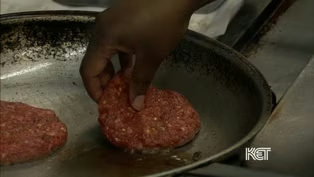
Bringing Uncommon Skills To The Table
Video has Closed Captions
Clip: S1 Ep186 | 3m 28s | Common Table program is providing job training in the field of culinary arts. (3m 28s)
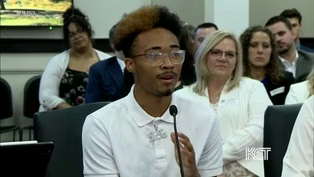
Video has Closed Captions
Clip: S1 Ep186 | 3m 13s | Backers of the CROWN Act want protection from hair-based discrimination. (3m 13s)
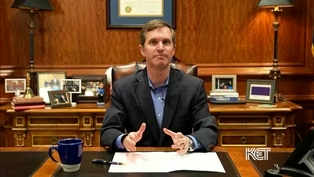
Video has Closed Captions
Clip: S1 Ep186 | 1m 16s | Governor Andy Beshear has signed House Bill One. (1m 16s)
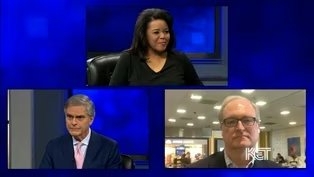
Inside Kentucky Politics February 17, 2023
Video has Closed Captions
Clip: S1 Ep186 | 7m 35s | Review of Kentucky politics with Bob Babbage and Trey Grayson. (7m 35s)

Service Is A Family Thing: Military Kids Day
Video has Closed Captions
Clip: S1 Ep186 | 2m 5s | Children of servicemen and women visited the state capitol on Military Kids Day. (2m 5s)
Providing Support for PBS.org
Learn Moreabout PBS online sponsorship
- News and Public Affairs

Top journalists deliver compelling original analysis of the hour's headlines.

- News and Public Affairs

FRONTLINE is investigative journalism that questions, explains and changes our world.












Support for PBS provided by:
Kentucky Edition is a local public television program presented by KET