
Episode 114: FOID Cards, Juneteenth, State Statues, and More
4/16/2021 | 26m 46sVideo has Closed Captions
Discussion on FOID card wait times, Juneteenth state holiday, statues, and more.
Host Bruce Rushton (Illinois Times) and guests Jerry Nowicki (Capitol News Illinois) and Sarah Mansur (Capitol News Illinois) discuss the new proposal to do away with long waiting times for FOID cards, a bill to make Juneteenth a state holiday, the House task force on statues on state grounds, COVID-19 safeguards at the statehouse, and the proposal to decriminalize HIV.
Problems playing video? | Closed Captioning Feedback
Problems playing video? | Closed Captioning Feedback
CapitolView is a local public television program presented by WSIU
CapitolView is a production of WSIU Public Broadcasting.
Episode 114: FOID Cards, Juneteenth, State Statues, and More
4/16/2021 | 26m 46sVideo has Closed Captions
Host Bruce Rushton (Illinois Times) and guests Jerry Nowicki (Capitol News Illinois) and Sarah Mansur (Capitol News Illinois) discuss the new proposal to do away with long waiting times for FOID cards, a bill to make Juneteenth a state holiday, the House task force on statues on state grounds, COVID-19 safeguards at the statehouse, and the proposal to decriminalize HIV.
Problems playing video? | Closed Captioning Feedback
How to Watch CapitolView
CapitolView is available to stream on pbs.org and the free PBS App, available on iPhone, Apple TV, Android TV, Android smartphones, Amazon Fire TV, Amazon Fire Tablet, Roku, Samsung Smart TV, and Vizio.
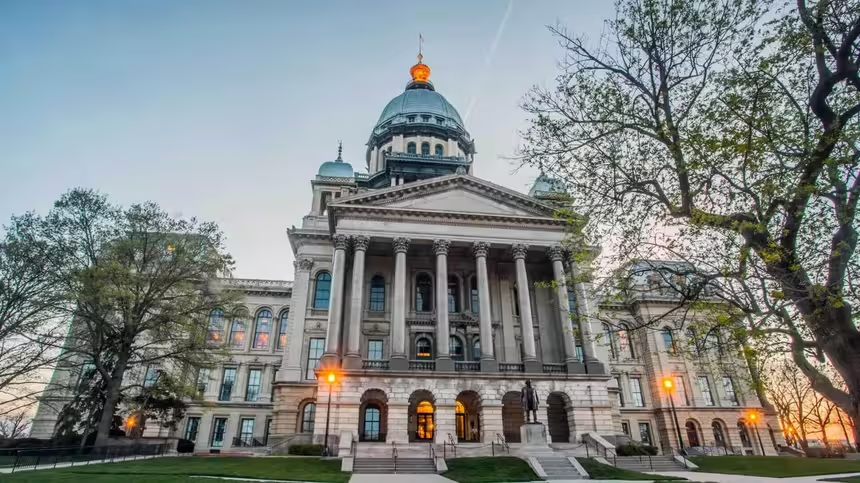
CapitolView
CapitolView is a weekly discussion of politics and government inside the Capitol, and around the state, with the Statehouse press corps. CapitolView is a production of WSIU Public Broadcasting.Providing Support for PBS.org
Learn Moreabout PBS online sponsorship(thrilling music) - Welcome to Capitol View, the weekly program where we talk about state politics and government and how it might just affect you.
Joining me this week on Capitol View is Sarah Mansur, writer for Capitol News Illinois.
Welcome Sarah.
- Hi Bruce.
- Also, Jerry Nowicki from Capitol News Illinois.
I feel ganged up upon.
Welcome Jerry.
- Thanks for having us, Bruce.
- Oh, terrific.
Thanks for coming, or staying where you're at.
We're still being cautious and, and, and broadcasting remotely.
Let's talk about guns first.
There is now a proposal before the legislature that has gotten the endorsement of Illinois State Police that is designed to do away with long waiting times for a far, firearm owner identification cards, commonly called Floyd cards, as well as change the way the state handles concealed weapons permits.
The lines, the waits have been stretched into weeks, even months way beyond what anybody believes to be reasonable.
One thing they're going to do under this proposal, should it now pass into law is that they've come up with the idea of instead of one card for concealed weapons and another for a Floyd card, you'd get one card.
Is anybody seriously opposed to that idea?
What do you think, Jerry?
- Well, the interesting thing about that news conference yesterday is the amount of Republican support it had.
I think there are, there were at least five Republican co-sponsors last I checked, one of them being Dan Caulkins, who is a pretty very conservative guy, calls himself a member of the Eastern Bloc, which is a conservative voting block in the, in the Illinois House.
He's from Decatur and he, he stood out there to support that bill so it's really about mainlining the sort of process, taking some of the pressure off the Illinois State Police, which is in charge of sort of seeing that the background checks are completed and that all of that can be accomplished quickly and whatever and people can get their Floyd renewals and make sure they're legally still owning their guns.
In the meantime, there's been sort of extensions for people who are awaiting renewal as long as they can prove they've applied for renewal.
If they're expired, the Floyd cards would still be good in Illinois, but the other thing is the Illinois State Police support this bill.
It's one of their initiatives and what's, what's got some of the Republicans on board is it, it doesn't ask for changes to the fee structure.
It doesn't ask for more money to be shelled out.
It just makes it easier for the Illinois State Police to do their job, really, that's been more difficult for them to do in recent years, not the least of which is because they had extended far more Floyd applications in recent years, but also because in the rounder years, the funds used to administer these programs were often swept to put, be put towards the general revenue fund, and they've just sort of, they've shrunk the size of that department.
So they've been working to build up the number of staff administering these programs and this program, this law would sort of limit the amount of work they have to do, make even less work to do the way I understand it.
- Yeah, I think, you know, maybe it's just me, but I'm wondering how much Brendan Kelly in that position is helping, if at all with this.
I mean, he's a downstate prosecutor.
He's not, doesn't have a history of running a police department before but he's now in charge of Illinois State Police, and he has, I think for some time made this, if not a priority certainly an issue.
I mean, I think it was late last year, was is not, where he had a press conference or an event saying the system is broken, it needs to get fixed.
I, I'm hoping, wondering, whether that helps at least make things go more smoothly, that you've got a, a Democrat who I think also has some street cred downstate.
- I think that's been helpful, and the other thing about the whole Floyd situation is that some of the gun advocacy, not gun advocacy, gun safety groups are against the measure of saying it doesn't go far enough.
So maybe some of the more liberal Democrats might not be too happy with it, but you know, it's one of those issues that you're always going to have somebody staunchly standing against whatever you try to do.
- Yeah, and I think that there are some impetus to fix this given the tragedy in Aurora that happened a couple, three years back now where a gentlemen who wasn't supposed to have a gun nonetheless got one.
He got a Floyd card and he shouldn't have had a Floyd card.
Caught when, they caught it when he got a concealed weapons permit and he was fingerprinted, then a felony conviction shows up but they didn't do anything about that.
They didn't go take his gun from him, didn't, no real follow up and I think you're right, Jerry.
I mean the next time there's a unanimous vote on anything having to do with guns in the legislature, we should all go buy lottery tickets or something because it's a once, it would be a once in a lifetime event.
The fingerprinting issue, how important, that seems to be really important here for the gun rights crowd.
I mean, how's this going to be handled?
As I, as I'm looking at this, you have the option of getting fingerprinted if you want, but you don't have to.
A reasonable compromise, how's that flying?
- Yeah, the gun safety groups don't view that as a compromise at all.
They view that as just a complete concession where they're giving it away without, without getting anything in return.
I guess they're saying the reason you would submit your fingerprints is you'd be eligible for automatic renewals, I guess, under the, under the new bill, so, you know, you think, "oh, maybe I'll just do this.
"I don't have anything to hide with my fingerprints.
"So as long as I don't have to go through this process "every 10 years, whatever it is, "this is a good thing for me to do."
So compromise, I don't know about compromise but it's an interesting proposal.
- Sure, no.
There is, speaking of compromises and strange bedfellows to some extent, there's a bill now that's been co-sponsored by House Representative Tim Butler and House Representative La Shawn Ford, one a Chicago Democrat, another a Springfield Republican to make Juneteenth a state holiday.
That's, you don't see these, two folks like that co-sponsoring much legislation.
Given that that does have bipartisan support, is this going to go anywhere, and if it does, do we subtract another state holiday to make room for it?
What do you think, Sarah?
- Yeah, I think just based on the discussion that's happened already and the fact that it's, there's bipartisan support that it, that it's likely to pass.
I remember when Senator Lightford introduced it in a committee, there was discussion about taking out another holiday and also somehow combining or doing something with July 4th, but Senator Lightford was making a point that this is sort of a separate independence day obviously for black people and so it, it should be entirely separate from July 4th but I think that, you know, Tim Butler has been outspoken on, on these issues.
I think he's talked about, like his family's connections to his, his ancestors or generations in the past in Springfield where they, they had some connection to maybe groups that were associated with the Confederacy maybe and obviously there were race riots in Springfield.
So there's that sort of unfortunate stain on Springfield's history with that.
So I think it's, it's sort of overdue in some ways or at least like the black caucus would argue that, that this type of holiday being recognized is overdue in Illinois, and I think the black caucus is probably going to try and make it a priority.
- Yeah, so what do we just have add one more state holiday?
Do we take something out and, and, and if so, what, and I, I'm embarrassed to admit this and, and, and, and I'm caught kind of slap-footed.
Our Polish American friends are a fine people.
Do we need the, what is the name of that gentleman up in the, the, the, that we have, Sarah, can you recall?
- Casimir Pulaski.
- Bruce, Bruce, you're killing me as a Nowicki.
- Oh, Nowicki, of course you would know this.
- Casimir Pulaski, the commander of the horse.
- Thank you, Pulaski.
I am so sorry.
- We're not getting rid of, no, don't get rid of Casimir Pulaski.
- No, nope, Casimir Pulaski.
- No, no, we need our, we need our day.
No, he was, of course the, the cavalry commander of the American Revolution.
- But was he ever in Illinois?
- No, but there's of course Pulaski Avenue up in the Chicago area.
Chicago has the per capita largest amount of Poles outside of Warsaw, Poland, but no, back to Juneteenth it's definitely something to put on, on the calendar.
It strikes me that, you know, in my education they didn't really teach you about that date in schools really too much at all, either.
So, you know, the level of awareness for that, I, I think it's long overdue, as Sarah said, to sort of put that on the radar to just, just celebrate that and culturally be aware of it.
- [Bruce] Sure.
- As far as replacing another holiday, I'm not sure how that would work, but there's of course quite a few state holidays that state workers enjoy in the Springfield area, but you know, it's not necessarily, you don't have to give the state holidays off if you're an employer.
So it affects state workers for the most part.
- Yeah.
I mean, I, and, and not that we have this necessarily every place, but I think of stuff like Juneteenth.
That, that I think is, is, memorializes a really important event in our history that affects everybody, you know, and then I look at something like say, President's Day, and it's like, well, you know, that means that we're honoring Warren Harding and Donald Trump and, and Millard Fillmore along with Washington and Lincoln all the, and all the rest, and so there's, we've had some scoundrels for presidents.
So I, you know, I guess on a personal note, give me, it's nice to celebrate a movement or some movement forward as th, that happened as a nation that affected everybody as opposed to, you know, you've, you've got to take the good with the bad if you're, if you're gonna celebrate something like President's Day.
Speaking of celebrating folks, and on remembering our past, there has, the House has now formed a task force on statues on state grounds.
This was announced, I think just yesterday or the day before.
They seem to, I mean this apparently will be affecting, we, we've already taken a look, at least the former Speaker Madigan had asked that the Capitol grounds be looked out for possibilities.
This goes beyond that.
How are these two going to work together, because frankly, I haven't heard much that's come out of the study of the Capitol artwork.
I mean, we've seen Stephen Douglas come down, we've seen the, the, the Menard's statue there, the, the, the kneeling Native American come.
You know, that, that was jolting to say the least to see that, but we haven't seen other stuff, I don't think, that's happened at the Capitol.
Have they finished that job yet, and if they haven't, does it work to expand it everywhere?
You have two sets of eyes and two separate standards to look at the Capitol versus everything else.
- Yeah.
I, I haven't heard much either from, from that proposal that Madigan introduced and also there hasn't been much discussion.
He sort of talked about Stephen Douglas and the other, Menard, but other than that, I mean, it just sort of, it seemed like a unilateral thing rather than like, like this task force seems to be proposing like, public sessions to talk about what should, what statues and monuments should be, should be taken down or across the state.
So I don't think that really happened with, with what Madigan had proposed and it'll be interesting.
I remember, I think it was last summer when the Christopher Columbus statue in Chicago, there was some protests around that, and I think it did, I think Mayor Lightfoot did take it down, but there was a lot of like violence surrounding that, and so if there is a way, maybe Speaker Welsh feels like this is a way to sort of tamp down the, the emotions surrounding these, these types of fears because people have some feelings about certain people, and so, you know, this can hopefully be like, a thoughtful discussion and, and not just emotional where people take to the streets and are violent.
- Yeah, well, I mean, there, there, that, that, that hasn't happened at least yet with artwork, excuse me.
This can get sticky.
It can get difficult, you know, where it's happened elsewhere, because one person's hero is another person's villain and I believe it was in California where they've renamed, I think, I believe a school said, no, we can't have that named after Abraham Lincoln because of what happened to Native Americans while he was, while he was President and so, and that's the legitimate, you know, I can, I can understand that point and no, nobody's perfect.
Yeah, hearings, I think might, might be a good idea.
I think that, that, that if you can talk about statues and artwork in civil, you know, responsible ways without folks giving accusatory, angry, that would be a good thing.
Is it likely to happen, Jerry?
Can we get along at least when, when we, when we talk about something like history and, and artwork like this?
- There'll be, there'll certainly be people upset no matter what you do.
The announcement from the Speaker's office said this will be a bi-partisan task force, and he announced all the Democrats that would be on the committee at this time, and it will be chaired by Mary Flowers, who's from Chicago, a long time lawmaker, the longest serving black lawmaker in the general assembly who herself could be worthy of a statue at some point, but anyway, I think it'll be up to leader Durkin assumably, I haven't checked on that, but he would appoint the Republican members.
So it'll be interesting to see what that makeup is.
I think Tim Butler, as we discussed, would probably be a good member to discuss that type of thing.
So I'm interested to see how the conversations go.
I know the board of the architect of the Capitol then met to discuss this stuff at some point.
They, their conversations were interesting about just the general, just of statehouse artwork and it probably needs some sort of review.
I mean, it definitely needs some sort of review and I'm interested to see how those conversations go.
- Yeah, I mean, here locally in Springfield, this is a number of years ago now, but not that many years ago, the prior director of the Abraham Lincoln presidential library museum took the statue of the wax figure, the rubber figure, whatever it's made out of, of John Wilkes Booth out of the atrium and put it in a closet somewhere, and even that was controversial, and, you know, he, he reasoned this out and it was a, it seemed logical to me, perhaps about, you know, it was just in bad taste to have the assassin be, you know, Lincoln's assassin.
This is Mary Todd, this is, you know, Lincoln.
They were big happy family, and there's, there's his assassin looking in the background, and so, but that was controversial then, and I remember some folks saying, "well, wait a minute, that's historically accurate "because John Wilkes Booth was present "at Lincoln's second inaugural address.
"He was there."
So if, if John Wilkes Booth could be controversial, it should be interesting to see what else might prove controversial.
There's been something else coming out of the Speaker's office lately, a case of COVID.
This was announced just yesterday or the day before.
Are we taking enough precautions, do you think, to keep the General Assembly in business that, that we've had now Senator Lightford has, has announced that you know, she, she's gotten sick.
We have an unnamed person from the Speaker's office.
We've had somebody from the Governor's office and this is just all, all, it's, it's, talk about a surge.
What's going on here?
What, what, what could they be doing?
Are they doing everything, or could they be doing more?
- Yeah, so I'm down here in the Capitol press room right now.
Everyone's wearing masks here, and if we want to have any contact with lawmakers, we as members of the press we have to get the U of I shield saliva test, which they do over at the Stratton building next door.
We have to get it, I think it's twice a week, whatever it is just to be able to go into a committee room to have a meeting with a Senator or for those who are credentialed, to have access to the Senate floor.
I don't think they're requiring that level in the House.
There are different requirements.
I don't think there's requirements of House members to be tested although they did have access to the vaccine.
I think Sarah might know more.
Maybe Senator Lightford had not been vaccinated yet for one reason or another, but there, there are levels of protection here.
Whether we're doing good enough, you know, I don't know how you could do enough aside from building that herd, herd immunity through vaccination, and I get my second dose tomorrow which will be a relief for me in that regard.
- How, how challenging is it, Jerry to, to, to report and do your business with these kinds of, of safeguards in place?
I don't want to call them restrictions.
They're there, they're there for a reason.
I mean, has it, has it materially changed the way you, you do your job and if so, how?
- Unfortunately, Bruce, it's been determined that Capitol News Illinois isn't, isn't going to be credentialed.
So it hasn't changed us too much.
We don't have access to the House or Senate floor at this time because they've made a determination about our, our affiliation with the Illinois Press Association which is of course the parent organization.
The Illinois Press Foundation oversees Capitol News Illinois and because the Press Association has a lobbying affiliation, they don't allow us credentials.
So it hasn't affected us as much as it has some other news organizations that are accustomed to that level of access in the state.
- Yeah, our guys are in the same penalty box with Center Square again, so to speak.
- Yeah, for one reason or another.
- For one reason or another.
Okay, well, apologies on that.
On the other hand, you, you don't have to be on the floor, so there's, you know, there's, there's also that.
The, I, you know, Lightford hadn't gotten her shot and I, you know, I'm not to boast, but I've, I'm almost a month out.
I've, I've been immune or at least in theory, I've got, I've got a card to prove it.
Has there been any talk that you've heard, either one of you folks about, okay, if you've been vaccinated, that's your, you don't have to, you don't have to do as many of these things, these tests.
Is there been any contemplation on that, that vaccination changes your status?
- I think that might be what, just sort of anecdotally from talking to people, what is maybe contributing to these cases in the Statehouse and just sort of generally in Illinois, cases are increasing and so I think maybe people feel like this, the increase in vaccinations is, is making it so that they don't have to follow all of the precautions that they are, they'll be safe.
They don't have to mask.
They don't have to social distance and so people are kind of letting their guard down in that sense, and, you know, the, it's becoming more visible like, with the Governor getting vaccinated and all of this, and so I think people are sort of ready to move on and so these, the, the whole movement towards becoming vaccinated is, is kind of encouraging that.
I don't, I don't have like a ton of direct evidence to prove that but I just think based on conversations and in Illinois, vaccinations are moving ahead more so than other states, and so, and then there's the proximity to like Michigan, where there's a lot of cases and a lot of hotspots, and so I don't know to what extent travel between borders is also contributing to the increase in cases, and I think it's just also very, like, it depends state by state, I think a lot like attitudes are very different in different parts of the country, and, and so that, that kind of contributes as well.
- We're, we're, we're got just a couple minutes left before we run out of time.
I'd like to chat about a, in fact we got got one minute left.
Let's talk about quickly, if we can, the proposal to decriminalize HIV.
where is that at, where is it headed?
Why is it important?
- Yeah, that passed the committee this week, and one of the arguments that sponsor Carol Ammons of Ubana made was, you know, we're not going to put a penalty right now for people who refuse to get a COVID test and walk around without a mask.
So, you know, HIV is the only sexually transmitted disease infection right now that's criminalized in this way that you could face a criminal penalty for the transmission of it.
It received unanimous support in committee after some questioning by Republicans, but basically what the bill would do is repeal existing law allowing law enforcement and state's attorneys access to HIV status of an individual and then removed criminal statutes for the transmission.
- Well, you know, one thing that I think, you know, that I wonder about, it doesn't appear that this is, has been enforced all that much but that shouldn't make a difference.
It could be, we have laws for reasons and we also have clocks for reasons and we are running out of time, and so thanks everybody for joining us this week on Capitol View and we'll see you again soon.
(thrilling music) (soothing music)

- News and Public Affairs

Top journalists deliver compelling original analysis of the hour's headlines.

- News and Public Affairs

FRONTLINE is investigative journalism that questions, explains and changes our world.












Support for PBS provided by:
CapitolView is a local public television program presented by WSIU
CapitolView is a production of WSIU Public Broadcasting.