
Food + Farm Exploration Center
Season 12 Episode 10 | 26m 48sVideo has Closed Captions
Learn about agriculture in our state at Farm + Food Exploration Center in Plover.
Marvel at the largest potato masher in the world at the Farm + Food Exploration Center in Plover. Angela Fitzgerald learns about farming, innovation and sustainability with exhibits and hands-on activities. Then, dig into the world of agricultural journalism with a local newspaper publisher and visit a nonprofit recycling trophies.
Problems playing video? | Closed Captioning Feedback
Problems playing video? | Closed Captioning Feedback
Wisconsin Life is a local public television program presented by PBS Wisconsin
Funding for Wisconsin Life is provided by the Wooden Nickel Fund, Mary and Lowell Peterson, A.C.V. and Mary Elston Family, Leon Price & Lily Postel, Stanley J. Cottrill Fund, UW...
Food + Farm Exploration Center
Season 12 Episode 10 | 26m 48sVideo has Closed Captions
Marvel at the largest potato masher in the world at the Farm + Food Exploration Center in Plover. Angela Fitzgerald learns about farming, innovation and sustainability with exhibits and hands-on activities. Then, dig into the world of agricultural journalism with a local newspaper publisher and visit a nonprofit recycling trophies.
Problems playing video? | Closed Captioning Feedback
How to Watch Wisconsin Life
Wisconsin Life is available to stream on pbs.org and the free PBS App, available on iPhone, Apple TV, Android TV, Android smartphones, Amazon Fire TV, Amazon Fire Tablet, Roku, Samsung Smart TV, and Vizio.
Providing Support for PBS.org
Learn Moreabout PBS online sponsorship- Announcer: The following program is a PBS Wisconsin original production.
- Angela Fitzgerald: Coming up on Wisconsin Life: Check out a Madison program giving trophies a second life, [laughter] a newspaperman in Brodhead reporting on the moo-vings of the dairy industry, an interactive plant pathway incorporating Menominee language and culture, and a Pulaski teen building his own guitars.
[strums guitar] That's all ahead on Wisconsin Life.
[bright music] - Announcer: Funding for Wisconsin Life is provided by: the Wooden Nickel Fund, Mary and Lowell Peterson, the A.C.V.
and Mary Elston Family, the Stanley J. Cottrill Fund, UW Health, donors to the Focus Fund for Wisconsin Programs, and Friends of PBS Wisconsin.
[gentle music] - Hay there!
Welcome to Wisconsin Life.
I'm your host, Angela Fitzgerald.
Where can you learn about agriculture and foodways while seeing the largest potato masher in the world?
Right here, at Food and Farm Exploration Center.
Just off Interstate 39 in Plover, the center welcomes visitors with interactive exhibits, exploring how we grow the food we eat.
It all supports the center's mission to educate about agricultural innovation and sustainability, while having fun!
[pop] - Instructor: Whoa!
- Angela: Visitors can ride a tractor through a virtual field, travel through a canning time machine, shop at a miniature grocery store, or play pinball while learning about supply and demand.
The Ag Maker Space is another way for families to get hands-on and creative.
If visitors get hungry, the on-site café offers a menu with locally-sourced ingredients.
In the warmer months, the center grows food in their demonstration field, where agriculture practices come to life.
We'll check out more here later on, but before we do, let's dig into our first story.
As we moo-ve on over to join a newspaper publisher reporting on an industry that's legen-dairy in Wisconsin.
[gentle music] - Pete Hardin: Hey, Bertie, I like you.
[kiss sound] Come on.
I'm currently 75 years old.
I could've retired a long time ago.
Who wants some green stuff?
But I love what I do, and I'd like to keep doing it a few more years.
I'm Pete Hardin.
I'm editor/publisher of The Milkweed, which is a monthly dairy economics report.
The Milkweed is a 12-page publication.
The intended primary reader is the dairy farmer.
I love the industry.
I love many of the people in it.
I love the animals.
It's not work.
When I was born, my home county in New Jersey had over 4,000 dairy farms.
Everybody in my family was either a dairy farmer or an agribusiness person.
I spent a lot of time on the farm.
In the mid '70s, I pursued a master's degree in agricultural journalism from the University of Wisconsin-Madison.
I founded The Milkweed in June of 1979.
Been at it 45 and a half years.
In terms of what gets me up in the morning, just, hey, it's another day, there's another month's issue looking at us.
Hey, Ed.
We're gonna make that two columns wide, crop it as shown.
For the first half of this year, it's like, cottage cheese, yogurt, ice cream, even fluid milk sales are up.
I've developed my nucleus of hundreds of sources in the industry over the years.
It's a lot of, you know, sustaining and continuing personal relationships.
Is your dad still up here?
- Person on phone: Uh, yes.
- Say hi to him for me.
I'm getting a lot of my info from real people.
I may go to Arena Cheese or other cheese plants, and get the straight scoop from the owners and the employees.
- Bill Hanson: This is the cheese curd crew.
So, they're... - Okay, they're busy today.
- Bill: They're busy today.
- We milk about 200 cows, 220.
- Pete: And I also talk to a lot of farmers.
All I can say is, showing a bias, Jerseys are my favorite, and these are beautiful.
Beautiful heifers.
There are several kinds of good stories.
There's the nice stories, and we got tough stories.
There's the feature story about a successful cheese factory or a successful dairy farm.
Then there are investigative stories where I like to, I like to kick butt.
There's virtually zero investigative reporting in the dairy press.
How do these higher cheese prices affect operations like yours?
- Well, the only... - Pete: I'm a reporter at heart with a lot of activist at heart also.
You gotta get your boots dirty in this business.
You know, as a monthly publication, I have a monthly cycle.
The weeks get progressively more difficult leading up to the week before printing, when it's pretty hectic.
The Register Print Center in Brodhead becomes my home away from home the few days leading up to finishing the paper each month.
And try to make the flame as prominent as we can.
The pages, when completed, are transferred to the printer up in Madison.
[printing press runs] Within two hours from the printer receiving the electronic pages, the paper's done.
We also have email subscribers, but my principal audience is the dairy farm family.
They'd rather be able to spill coffee in the morning on their reading material.
It's an art more than a science, what I do.
You know, I view the dairy industry as having a wonderful story to tell.
It is literally the principal economic lifeblood of Wisconsin.
It's got pulses.
The pulse of milk production, the pulse of consumer demand, the pulses of the farmer and his or her cows, raising the animal and then milking it through its productive lifetime.
It's really intriguing and complex.
I just think we have a lot more good story to tell.
I'm not ready to go out to pasture.
[gentle music] - Angela: Now, we unbox the story of a nonprofit program in Madison awarding trophies a second chance at winning.
[playful music] - Janet L. Gray: I wanna say that only fun people can work here.
You gotta laugh.
We have a lot of fun.
If you're too serious, I'm sorry.
Trophies, that's not for you.
[chuckles] Hi, I'm Janet L. Gray.
I am a volunteer at the Nationwide Trophy Recycling Program.
My family owns Total Awards and Promotions, and we've been in business for almost 50 years.
[groovy music] I proposed the idea that we should be recycling for everyone.
Because we have been doing this for over 40 years, where people would bring in their trophy and say, "Hey, I don't know what to do with this."
We would take it and give it to another nonprofit or another people who needed it.
[metal clanks] So, we did launch the program, and by 2017, we went nationwide.
That allowed anyone in the country to send us their trophies to be recycled.
We knew that nonprofits needed the help.
Nonprofits don't have the money to thank their volunteers, to give out awards.
And so, this was an easy connection.
We could then work with the nonprofits and give them free trophies for their events.
We gave out over $1 million in plaques over those decades.
This program really exploded during COVID because everybody was home.
They had a chance to clean their attics and basements, clean every corner, and they found the trophies, and they sent 'em to us.
Everyone was thinking the same thing because we got over 55,000 trophies during the years of COVID.
In 2021, we had to become a nonprofit because our business was completely filled.
From the floor to ceiling, every hallway, every office was completely filled with boxes.
- Jay Koritzinsky: My name is Jay Koritzinsky.
In my real life, I'm an attorney here in Madison.
And I'm also a volunteer.
And I help in unpacking boxes and sorting and recycling the trophies that people send in to us.
And then, I became addicted to starting to unpack boxes that folks send into us, and participate in the recycling process.
[volunteers exclaim] - Janet: I love it!
- I challenged myself one week to see how many boxes I could do.
And I ended up opening 50 boxes one day.
They actually built a trophy for me for that week of work.
Look at this!
It has a clock!
I love it because as I'm opening boxes, I'm realizing that every trophy is a memory for somebody.
Lots of people do have trophies.
Historically, what happened with all these trophies is they would go in the landfill.
As you can imagine, a marble base on a trophy will never disintegrate, and we can repurpose it.
- If a trophy comes in and it has any part of it that can't just be perfect, we have to take it apart.
And then, we're able to make new trophies out of those parts.
- Jay: And we separate the figures, we separate the columns, we separate the bases.
That all of those figures, all of those columns are sorted.
The columns by color and size, the figures by whatever it is.
[saw buzzes] We have every sport available that I could possibly think of.
But then, we have other things, like folks who got trophies for a horse judging competition or a go-kart race, or a derby race, and other figures of just awards that people got for participating in an organization.
If someone comes in and says, "Can you build me a trophy?"
for whatever they need, I'd say nine out of ten times, we can create that trophy for them.
And that's really fun.
- We have restaurants that contact us for trophies.
We also had Hollywood find us.
So, Chicago PD, Chicago Fire, Chicago emergency shows.
We've created a showroom that allows the general public to come in and purchase those funny joke trophies for their family games.
When a nonprofit applies for trophies, they are telling us, they're requesting the type of sport, how many they need, male or female, what color.
And then we go to our stock, and we try and accommodate to fit exactly with the request.
It's very important that we see what it is we're donating to, so all the volunteers can get behind it, get excited, and be proud of what we're doing to help them.
[volunteers laugh] Our volunteers are at every age, and it doesn't matter.
We all bond together over trophies.
- It's just a wonderful mission that we can just come in here, focus on, spend our time, and then there's always a sense of accomplishment, whether it's how many boxes did we open, how many trophies did we build, whatever the case might be.
- I think it's a place to come to feel great, and to volunteer to put that time in makes you feel good too.
- I'm at Food and Farm Exploration Center in Plover, discovering how technology is advancing how we grow the food we eat.
Executive Director Alexandria Behrend shares what's being cultivated here.
- Alexandria Behrend: So, the mission of Food and Farm Exploration Center is to teach current and future generations about agriculture, where their food is grown, and those who grow it, and just connect those dots of appreciation.
- I love that.
And how does that connect to collaborations within the community?
- Alexandria: Central Sands of Wisconsin is where we're located right now, which is a beautiful place to grow many of our focus crops.
So, the soil is exactly right to grow potatoes, peas, corn, cabbage, a couple others.
And so, we're just really bringing homage to those family farms in the area.
- And what makes Food and Farm Exploration Center so unique, and what do you want people to take away from their time here?
- We have probably one of the coolest experiences that families can have.
We have 60 interactive exhibits that are available for people from age 2 to age 92.
You get to get in and simulate driving a tractor in a potato field or a carrot field, and we have four demonstration fields right out our back door.
But what we do is we really introduce students at young ages, really take them through the whole process of farm to food.
- Absolutely.
'Cause you hear terms like "farm to table," but we don't always know what that means, especially at a large scale.
So, I appreciate you all breaking that down and hoping that that has a long-term impact in how these young people think about kind of food and where it comes from, and what it means for them.
- Yeah, thank you.
- Angela: I was off to explore the Ag Lab, starting from the ground up.
- Brittany Marquard: We're gonna look at different soil types and why those soils are so important to production agriculture in Wisconsin.
- Angela: We tested each soil... - But with a sandy type of a soil, once we get it wet, it's really not gonna hold much together.
- Angela: ...Observing their differences.
It's going to adhere more to the water.
- And now, if you tried to kind of bounce this one, you should be able to get a little bounce out of it without it completely falling apart.
- Yes, it has better integrity.
- Exactly.
- Angela: And how it all connects back to the food we grow in our state.
- Brittany: So, in Wisconsin, our state soil is the Antigo silt loam, and so, silty soil, loamy type soil has the best properties of sand, silt, and clay components in it that make it ideal for growing.
- What are some of the reactions you see from the youth or others that engage in this activity?
- So, this activity is one of my favorite activities, especially with the littles because one of the things, like, we all are exposed to soil at some point in time.
And we always joke, dirt's a dirty word around here.
We don't use dirt.
We're talking soil.
This is soil, this has a purpose, this has a plan.
But they love that component of getting their hands dirty, feeling it, and really putting that to knowledge.
- Angela: We moved on from dirt-- or should I say, soil-- to creating culinary concoctions in the Kitchen Lab.
So we get to taste-test?
- Brittany: You bet we do.
- It's good.
- Awesome.
- Angela: Whether it's getting creative in a lab or playing to learn, Food and Farm Innovation Center connects us to the food we grow and the farmers who grow it.
[bright music] Next up, we head to Keshena to check out a learning plant pathway that is offering an interactive way to explore the growing world.
When viewed from outer space, the borders of the Menominee Reservation stand out as a patch of deep green.
It's a place that attracts visitors from around the world who come to learn how its forests are managed.
- These are 180-year-old trees.
And it's time for them to regenerate.
- Angela: The thick woods have been kept healthy and full, even while supplying the lumber mill that helps sustain the tribe.
- Take a little walk in here.
As a part of the treatment, we got butternut in here as well.
- Angela: While many have sought the tribe's know-how, more and more visitors are being introduced to Menominee ways of knowing.
- We hear a lot now about traditional ecological knowledge.
- Jennifer Gauthier: Most of us, maybe all of us grew up with the Western ways of knowledge, Western ways of knowing.
And what we are doing here is introducing awareness of our Indigenous ways.
- We're looking at the insights of the agriculture of the Menominee ancestors for, like, the past 800 years.
- Angela: Indigenous ways of knowing have been passed generation to generation, in a culture whose measure of time is also its own.
- We follow a 13-moon calendar, and each of those moons has their own name.
They provide environmental cues.
- Angela: Environmental cues seen by visitors on an autumn tour during Falling Leaves Moon.
They would see very different things on a summer stroll during Raspberry Moon.
Those changes are what's explored along the phenology learning path at the Sustainable Development Institute on the campus of the College of the Menominee.
- Rebecca Edler: As you study phenology, you would want to come and observe from when the plant emerges in the spring until the plant dies back in the fall.
- Angela: Phenology is the study of life cycles through seasons.
It's an established method of science and a traditional practice of Native people.
The phenology trail brings the two together.
- And we work really hard to make sure that we're braiding all of those ways together.
They have to work together in this modern world.
- Angela: Braiding together science and traditional knowledge is seen in the signs that dot the winding trail.
- It includes the scientific name, the common name, what we call them in our Menominee language.
- And the plants that we specifically identified to observe are plants that have meaning to the Menominee people.
The Menominee meaning for this tree is "Grandmother's lung."
- Angela: The inclusion of Menominee names helps add a dimension to understanding.
- Our language is a way to see the world the way that our ancestors saw the world.
It's a way to connect with things around us.
- Angela: Kohkomaehsah Naehpan, or the name "Grandmother's lung," draws in meaning shaken off by the English name "quaking aspen."
- Rebecca: The quaking aspen root system lives for thousands of generations.
It's a key indicator for the health of Grandmother Earth.
- There's a deeper connection and a deeper understanding associated with all of these things we have around us.
- Angela: A deeper connection because the phenology trail helps illustrate the interconnection between all living things.
- Jennifer: That's a whole life change, to start viewing the world that way.
- Rebecca: It gives you purpose to come out and to form those relationships with those plants.
- Nothing lives in this world by itself.
I hope that people start looking at the world around them a little bit differently.
[wind blowing] - Angela: For our last story, we rock out with a Pulaski teen to visit the workshop where guitars are built by hand.
[hammering] Pass by this home in Pulaski and the sound of a hammer is a familiar tune.
Whether it's hammering wood... [zipping] ...or hammering out a tune on his guitar, Ian Vanveen has a fascination with both.
[gentle electric guitar music] - Ian Vanveen: I would describe the sound of an electric guitar to be very twangy, but also very warm and just unique.
I really want to connect with the instrument a lot more.
- Angela: For Ian, his connection to the guitar is a family thing.
- This one was actually my first guitar.
This was my dad's old band guitar.
[hard rock music] It made me feel like the coolest rock star of all time.
Like, carried it real low, took a basic, like, power cord, and I just, like, strummed it, volume all the way up.
It was amazing.
[laughs] - Angela: That amazing spark propelled Ian to explore the mechanics of music.
- It's such an interesting instrument.
It's so cool because it's a blend of a lot of physical vibrations and electronics, and it's so beautiful how they work together.
[power sander buzzes] - Angela: Out of curiosity, he decided to actually make electric guitars from scratch, self-taught as a teenager.
- If I want the perfect guitar, exactly what I want, I might as well just make one.
I put a bunch of wood together with my woodworking skills, and I loosely knew how to put it together.
- Angela: This is the result of Ian's hard work and determination.
- This is the first guitar I made where I actually put a lot of thought and energy into it.
But this one, I really had a lot of fun with.
I made it into the thinnest guitar I could possibly make without it warping over time.
I really like the look of this one being all rough and used 'cause it is very heavily used.
This one will always be very deep in my heart.
- Anglea: Along the way, Ian is improvising and revolutionizing the way guitars are made.
- I really like the idea of customizing.
The switches, I like to actually put 'em on the side of my guitars.
'Cause I find that to be more comfortable and you won't hit 'em when you're playing.
I don't wanna make the most basic guitar.
I wanna make it modern.
- Angela: Ian's interest in this instrument at a young age is forging his future.
- Ian: I'm going into electrical engineering next year so I can really dig deep into the circuitry of guitars, and then I can make really nice, unique guitars.
[hammering] - Angela: His perspective on success is also unique.
I used to measure success in just objects, like money, cars, and stuff.
But now, I just measure success in how content you are with your life.
If you have the job that you want, if you have the people that you want, and if you're happy about it.
What I get out of this is, just genuinely a really fun thing to do.
[gentle electric guitar music] - We've planted ourselves in the world of agriculture at Food and Farm Exploration Center while hearing from folks around the state.
To dig into more, visit WisconsinLife.org or connect with us on social media or by emailing stories@wisconsinlife.org.
'Til our next adventure, I'm your host, Angela Fitzgerald, and this is our Wisconsin Life.
Bye!
[bright music] - Announcer: Funding for Wisconsin Life is provided by: the Wooden Nickel Fund, Mary and Lowell Peterson, the A.C.V.
and Mary Elston Family, the Stanley J. Cottrill Fund, UW Health, donors to the Focus Fund for Wisconsin Programs, and Friends of PBS Wisconsin.
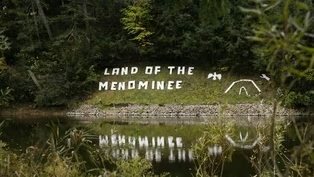
Nature trail weaves Indigenous knowledge with Western science
Video has Closed Captions
Clip: S12 Ep10 | 4m 16s | A Menominee "phenology" trail labels plants in three languages. (4m 16s)

Preview: Food + Farm Exploration Center
Preview: S12 Ep10 | 30s | Learn about agriculture in our state at Farm + Food Exploration Center in Plover. (30s)
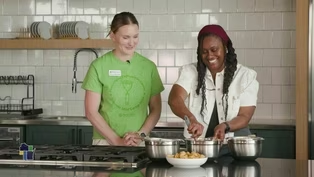
Teaching agriculture through hands-on learning
Video has Closed Captions
Clip: S12 Ep10 | 3m 37s | Inside Plover's ag learning center where families explore where their food comes from. (3m 37s)
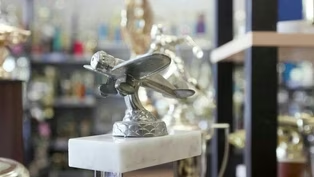
Upcycling accolades in Madison
Video has Closed Captions
Clip: S12 Ep10 | 5m 18s | The National Trophy Recycling Program repurposes trophies to make new ones for nonprofits. (5m 18s)
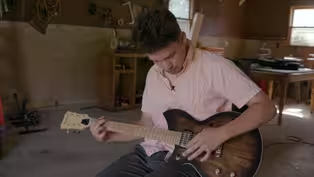
Teen builds custom guitars from scratch
Video has Closed Captions
Clip: S12 Ep10 | 4m 4s | Pulaski teen Ian Vanveen taught himself how to build electric guitars. (4m 4s)
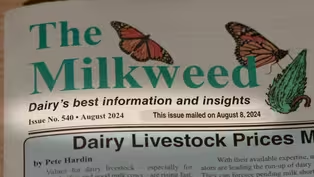
45 years covering Wisconsin's dairy industry for The Milkweed
Video has Closed Captions
Clip: S12 Ep10 | 5m 12s | Pete Hardin is one of the last true originals in the world of agricultural journalism. (5m 12s)
Providing Support for PBS.org
Learn Moreabout PBS online sponsorship













Support for PBS provided by:
Wisconsin Life is a local public television program presented by PBS Wisconsin
Funding for Wisconsin Life is provided by the Wooden Nickel Fund, Mary and Lowell Peterson, A.C.V. and Mary Elston Family, Leon Price & Lily Postel, Stanley J. Cottrill Fund, UW...