
For Your Information
Season 2 Episode 6 | 21m 46sVideo has Closed Captions
Meet the next generation of video journalists and documentary filmmakers.
Meet the next generation of video journalists and documentary filmmakers, sharing stories that connect us with each other, and history.
Problems playing video? | Closed Captioning Feedback
Problems playing video? | Closed Captioning Feedback
Young Creators Studio is a local public television program presented by WHYY
For Your Information
Season 2 Episode 6 | 21m 46sVideo has Closed Captions
Meet the next generation of video journalists and documentary filmmakers, sharing stories that connect us with each other, and history.
Problems playing video? | Closed Captioning Feedback
How to Watch Young Creators Studio
Young Creators Studio is available to stream on pbs.org and the free PBS App, available on iPhone, Apple TV, Android TV, Android smartphones, Amazon Fire TV, Amazon Fire Tablet, Roku, Samsung Smart TV, LG TV, and Vizio.
Providing Support for PBS.org
Learn Moreabout PBS online sponsorship- Funding for this program has been provided by... (upbeat rock music) - Hi, I'm Olivia and this is Young Creators Studio.
All across our region, young creators are using video, not only for social media platforms, but to tell stories that deserve to be seen and heard.
Whether they're self-taught, learning in classrooms, or art programs, we are giving them the space to share their creative and informative films.
So kick back and grab a snack.
This is Young Creators Studio.
- American journalism thrived in late 19th and early 20th centuries.
And such was born, the golden age of the press.
- I've decided to get involved with the live streams because I needed to step up what I was already doing.
- We left the room, and quietly shut the door and cry.
There was a real chance that this wasn't going to happen.
- We really value movies that have artistic quality and are the literature equivalent of the film world.
Film history is really important to us, film education is really important to us- (upbeat music continues) - Welcome to Young Creators Studio.
In a year where misinformation has led to clashes in both health and politics, the need for fact-based reporting is more important than ever.
Today, we'll meet the next generation of journalists and documentary filmmakers, sharing stories that connect us with each other and with history, check it out.
(scribbling) - Start the presses.
(upbeat rock music) - The free and open press is a universal form of communication.
News travels thousands of miles to newspapers, magazines, and devices in order to influence inform everyday consumers and voters.
Today, there is a large awareness of fake news and the bias and manipulation of facts that comes with a largely politicized press.
But this comes only after a generation of iconic, trustworthy news of which Americans were proud.
The reality is that the press has taken many terms since the American forefathers guaranteed freedom of speech and a free press in the first amendment.
Historically, the press was biased in manipulative, often missing the basis of fact.
The press we recognize today was born in the 19th century as a by-product of capitalistic necessity that brought together multiple news sources into collaboration toward the common goal of public communication.
Journalistic objectivity, the cornerstone to public communication, has often been overlooked by monopolistic, power hungry, news outlets.
Through social, financial, and technological pressures, the birth of the associated press led to sharing of reporters, the modularization of fact-based news, and the forging of bonds between newspapers that depended on a new foundation of journalistic objectivity.
Before the rise to free press in colonial America, much of the press was controlled by agenda oriented governments.
Even in colonial America, though the press was free, the articles were mainly political, such as Thomas Paine's famous manuscript, Common Sense.
After the American revolution, the ideology of free press in the bill of rights continued to support biased press and many penny papers rung up in response.
Anyone with an opinion could now state their mind, never before had the press been so diverse and opinionated, for national news, New York city was generally accepted as the capital of American press in the early new United States.
Perhaps the most influential paper in the mid 19th century was the highly read New York Sun, a penny paper.
Even with the tiny amount of consumers, the New York Sun was close to bankruptcy due to its low prices.
Then in 1846, the country entered the Mexican-American war and increased demand of news from afar.
The war was an opportunity for the New York Sun to dig themselves out of debt.
One obstacle appeared.
The financially burden newspaper could not afford to send a reporter to the front lines or fund the required telegraphs.
So in 1846, the New York Sun constructed what would become a revolutionary leap in the history of the press.
The first partnership between newspapers.
Founded by the New York Sun, six New York newspapers joined together in order to pay for a single reporter to send back telegraphs, containing information about the Mexican American war.
This group was the first associated press.
For this to work, it was crucial that the information, this lone reporter sent, was unbiased and as factual as possible.
So each newspaper could synthesize their own account of the war.
American journalism thrived in late 19th and early 20th centuries, and such was born the golden age of the press.
In addition to Joseph Pulitzer, owner of the New York World, other media giants arose.
Such as William Randolph Hearst, the San Francisco examiner, and Joseph Medell of the Chicago Tribune.
These tycoons crowded the stage in monopolies of information for the benefit of the American people.
Yet the undoing of this golden age was the growing practice of yellow journalism, which emphasized sensationalism in the need to grab attention and outsell the other newsrooms.
William Randolph Hearst bought the New York Journal, posing a direct threat to Joseph Pulitzer in the New York World, which was a long-time competitor of the Journal.
Throughout the early 20th century.
Joseph Pulitzer and William Randolph Hearst battled for complete control of the press in New York, fighting to control the associated press.
This period was marked with exaggerated headlines, biases and fake news portrayed as facts.
Practically, anything to rope in new viewers in order to seek and maintain a monopoly in the press.
Professor Jeremy Littau, Professor of Journalism at Lehigh University, gives insight.
- The era that was largely marked by intense competition without really any ethical compass.
No conception of what the audience needed, what society needed, what some of the social effects of what they were creating would be.
The history of newspapers in the United States is littered with dirty tricksterism.
- The key to the success in journalism, lies in journalistic objectivity.
Journalistic objectivity is often thought of as news without bias.
This is not true.
Originally coined by Walter Lippmann in 1919, journalistic objectivity means that in journalism, there should be "No prejudgment in information being shared" Professor Littau explains.
- Journalistic objectivity activity was driven by the nationalization and standardization of media.
You can look at objectivity is kind of like a stamp of approval on a story's process.
- A reporter will always be biased and have prejudgments on the topic being covered, but to have journalistic objectivity, the reporter takes responsibility to support and validate the facts reported.
The creation of the associated press was revolutionary on many levels.
The leap to sharing resources was radical because before this, newspapers could not trust each other.
Each newspaper was concerned with its own opinion and spin they put on the event.
And therefore, no trust or alliances could be formed.
With the freedom from government control, guaranteed on the first amendment, it was perhaps inevitable that a self-governing body in the press would arise and unite the press to a higher standard of reporting.
- I look at it as inevitable, like something like the AP was going to exist, because one of the things that the Telegraph did was revealed language differences and understanding differences that existed in these people in different places.
- Facts and truth at the foundation of reporting was necessary for the information being shared.
This was the first step towards journalistic objectivity, forged by the trust and partnership between newspapers and then extended to serving the public.
Reporters were newly valued by the accuracy of their objective information and newspapers collaborated through passing this trusted information among their partners.
In many ways, it was the formation of the associated press and the need for journalistic objectivity.
That was more important than the development of any individual technologies that helped to revolutionize the press.
The Pony Express, the Telegraph, the phone, and eventually TV broadcasting are all dependent on a chain of trust within any news organization that did not exist before the coming of the associated press in the beginning of journalistic objectivity.
While journalistic objectivity remains the highest standard, it has been challenged by the newest of technologies, social media.
When anyone can contribute to the new cycle, commitment towards journalistic objectivity is lost in an ever-growing ocean of information.
The balance of an individual's freedom of speech, and the need for journalistic objectivity, and disseminating fact-based news will forever remain in conflict.
Perhaps as our forefathers intended in writing the first amendment.
(scribbling) (calm r&b music) - My name is Q Hanley.
I decided to get involved with the live streams because, I was in the BV course and I felt like I needed to do more.
Like I needed to step up what I was already doing.
And... Schwam had set out... a Google form saying like, "Oh, we are live streaming."
And so I was like, this is a way I can contribute and start chipping in more.
- Previous background in theater, Q Hanley joined the CCHS media club livestream team.
- I thought that live streaming sounded like it would be a lot of fun, a lot of pressure, but also, I think that it would be... something that could be... more fun than what I was doing.
- Q works behind the cameras as executive producer.
Changing titles, graphics, and camera angles.
- I tell people where to point their cameras, and I choose what shots are broadcast.
- Even with a role as high as Q's, live streaming continues to bring different challenges every stream.
- I think that the live streams can be difficult and stressful at times.
Like, when you're setting up the stream and the wire cast and it's not working, or when you're trying to tell people what to do with their cameras and, they don't know what you're talking about.
But overall, out of all of the stress, I think it's worth it.
- Though Hanley enjoys live streaming, they have plans for the future outside of broadcast and video production.
- Well I don't think I'll be doing something like this as a career in the future.
I think that the skills that I learned from doing this can get me far and wherever I go in, whatever field I go to.
- Though the live streams provide real world experience for students, Q Hanley and the rest of the live stream team have produced entertainment for over 15,000 viewers.
- It feels good knowing that we can provide this, such like a concrete thing in high school culture, and still provide it in times like these to whoever wants to watch.
Not just the football games either, every other sport too.
And I know how important that can be for hundreds of people.
You know?
(calm r&b music) (calm music) - I had always wanted to have children.
Naturally I always wanted to do it either through foster or through adoption.
I never wanted to have my own natural children anyway.
- We would have a conversation every January about having a kid.
And if... that was... if that was the year that we wanted to do it, then great.
If the answer was no though, put it on a shelf and we wouldn't really talk about it until the next January.
- Elliot has talked about being a father and having children since he was a child.
So, I knew that he had always wanted a child.
- And we weren't having two incomes into our household.
And we were playing pretty hard and doing things that we wanted to do.
But there comes a point where it's like, "Well, what's all this for?
What's the deeper meaning?"
And for us, the meaning was being able to nurture and give back to another life became really clear.
So, kind of check off, look at all the boxes and all the boxes were being checked.
And that, yeah.
You know what?
We are in a position that we can be good providers without being distracted by a lot of life's other stressors.
- And then in 2016, we said, "Maybe, yeah.
Maybe we should look into this."
- Yeah.
That may be quickly turned into our research.
Like what agency, what's it going to cost?
How are we going to plan?
What's the budget?
- We have families who could be waiting for six months or could be waiting for a year.
- There was a match within two months, we were matched.
So, birth mom, they have to outline that pretty detailed birth plan.
That includes how they want the adoptive parents to be included.
And in what way.
- And it talks about, what, who would you like in the room with you during labor?
Who is your support person?
Sometimes it's me.
And then during the birth, who would you like to be there?
- She had told them she wanted them to be in the delivery room with them.
- That changed over time.
We came to learn, it was one of... a series of... quote unquote, red flags that shook the confidence that this plan was gonna be fully executed.
This adoption was gonna fully occur.
- Alice Catherine, I think was three weeks early.
- And I get the call from the Caseworker, that says, "Allie went into the hospital last night.
You guys need to get over to Reddit."
Red flag number two.
She notified no one.
That evening she went into the hospital That she was delivering.
- She didn't tell anyone.
- So, we go running straight to the hospital.
And I mean, immediately, it was red flag number three, that the Caseworker told us, cause we didn't get to go right now.
She's not ready for it.
- "She's not ready to see you" - She's not ready, yeah, that's right.
So we do finally get in a room.
But when we were in the room, we were- - We were treated as intruders.
- Yeah, and then we were told to leave and that Ally did not want us in their room.
And so we left the room, and quietly shut the door, and leaned against the wall, and just kind of slid down the wall, and cry.
And we both knew in that moment that their first real chance that this wasn't going to happen.
- Allie, sometime during the night realized that babies are a whole lot of work when they don't go to sleep.
And they, and she called for backup.
- Like after two days, She's... doesn't want.
- Unwilling or incapable.
- Unwilling to take care of the infant.
Then she wants us to take care of, take us on.
It's like you start to feel a little bit better.
- I think that was the turning point for all three of them.
- As much... As much torment as those first few hours and day was for us emotionally, it ended up exactly the way they're supposed to.
- This weekend, Alice Catherine is turning three and she wanted a Frozen 2 cake.
And Elliot spent the entire day, on Saturday, learning how to make fondant.
And he made her beautiful Frozen cake.
But to know that this is the guy that ran in the Ironman Triathlon three months ago, and now he's making a Frozen cake for his daughter.
I just love it.
- I cannot wait to see her... make the world what she wants of it, - And have the world be better because of her.
Even in a small way.
(scribbling) - When you're walking down main street, it has a significant physical presence in the middle of town.
We have a ton of opportunities for people to rent out the space.
We work with the rest of the community, whenever there's any sort of big event that comes along.
We have an Oscar party that's coming up in February, and that draws in everybody from the Ambler era, even people outside of Ambler.
We have local businesses that are catering that event.
It's really the centerpiece of Ambler.
- The theater opened in the late 20's as a Warner Brother's theater, which mean that Warner owned the theater and they only played Warner Brother's titles.
And then since then it kind of went through a bunch of different renovations.
So it was originally a 1200 seat auditorium that kind of fell into disrepair after the 1970's, until that Christian Cinema took over and ran it, and showed mostly older films.
And then, it was kind of left abandoned for a few years until we moved in, and renovated the theater and turned it into three auditoriums.
- There's a lot of work that was done to bring it back to its original grandeur of the beautiful movie palace feel that you feel now.
And also to make the theater work in the modern environment, we carved it into three screens so that we could show three movies at the same time.
Instead of just one.
- We prefer to play more independent art house fair, which you can't really find in Ambler, PA.
Otherwise, we would be just like the AMC down the street.
So our theater is more focused on foreign language films and independent filmmakers.
- We can see mainstream movies at other theaters.
I mean, we do watch mainstream movies and I don't think we need to get one more theater to...
There's plenty of theaters to see mainstream movies.
I think it's important that theaters like these, that show independent movies and show movies that may have subtitles or other movies that don't get to see mass circulation, it's important that there's like these exist to show this type of movies.
- If you're a member here that you're a member, we have this thing called our House Convergence.
So if you're a member here, that counts as being a member at all different other theaters across the country.
So I think that's pretty dope.
- We really value movies that have artistic quality and, or the literature equivalent of the film world.
Film history is really important to us, film education is really important to us, and as a nonprofit, we have members and donors that allow us to take these risks and show programs that aren't just based on money, but movies that are the higher artistic quality.
- It's impacted me in some pretty good ways for as obviously I started making money, being able to provide for myself, but also, I was brought into an environment where I can be expressive about my love for film and explore different films, and I think that's been the biggest impact of it all is just being able to share that love of film with, old people, young people, all kinds of people themselves.
- Membership is the lifeblood of the theater.
And as a nonprofit, we would not be open without the support of our members.
That is the key right there of membership is that it actually is the basis of what allows us to run our over 90 year old theater than just the knowledge that they're supporting an artistic organization and being part of the community.
Members also get, some memberships are tax deductible, but members get reduced or free admission to all of our movies.
A lot of our special events with speakers are free for members, and there's a lot of really great programming that is open.
- I would say that the customer service is great.
There's a great bunch of people that work here.
You know, some (mic cuts off) and the banner itself is immaculate.
People that work here are great and the movies that they show are driven.
(scribbling) (upbeat rock music) - I want to thank our young creators for sharing their stories with us today and give a big shout out to all of the teachers and instructors who inspire these talented storytellers.
Thanks for watching Young Creators Studio.
To watch past episodes, head to our website.
I'm Olivia and I'll see you next time.
(upbeat rock music continues)
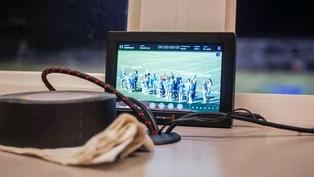
Preview: S2 Ep6 | 30s | Meet the next generation of video journalists and documentary filmmakers. (30s)
Providing Support for PBS.org
Learn Moreabout PBS online sponsorship




Support for PBS provided by:
Young Creators Studio is a local public television program presented by WHYY