RTP180
Forensic Science | October 2022
10/27/2022 | 1h 4m 14sVideo has Closed Captions
Experts dig deeper into forensic anthropology, forensic toxicology, thanatology & more.
Expanding on forensic science, our experts dig deeper into forensic anthropology, forensic toxicology, thanatology and more.
Problems playing video? | Closed Captioning Feedback
Problems playing video? | Closed Captioning Feedback
RTP180 is a local public television program presented by PBS NC
RTP180
Forensic Science | October 2022
10/27/2022 | 1h 4m 14sVideo has Closed Captions
Expanding on forensic science, our experts dig deeper into forensic anthropology, forensic toxicology, thanatology and more.
Problems playing video? | Closed Captioning Feedback
How to Watch RTP180
RTP180 is available to stream on pbs.org and the free PBS App, available on iPhone, Apple TV, Android TV, Android smartphones, Amazon Fire TV, Amazon Fire Tablet, Roku, Samsung Smart TV, and Vizio.
Providing Support for PBS.org
Learn Moreabout PBS online sponsorship- [Film Narrator] We stand on the threshold of a great new age of exploration, its ultimate destination, the furthest reaches of the universe.
- [Announcer] Three, two, one.
[upbeat music] ♪ Now, my name is Wade Minter, I'm your MC for this event.
Hopefully you've been enjoying the dulcet tones of Clean Pop Hits 2022, which I saw Alicia playing back there.
But we are here for RTP 180, our monthly talk series here at the Frontier.
Big thank you to our presenting sponsor, RTI International, making this thing happen for like a decade or so.
They're here every single month.
It's amazing.
Should go check them out, if you need your research triangles internationalized, I don't actually know what they do.
It's probably something important.
So what we've got here, normally we have five speakers, but for you, we have four.
We got four speakers tonight.
They'll each speak for approximately five minutes, followed by approximately five minutes of Q&A from you, the audience.
And if you wanna connect with us socially during the show, you can come shake my hand, or you can tweet at us, @frontiertp.
You can use the hashtag, #RTP180.
We are live streaming on UNC TV.
And we'll be getting questions from social media as well as from you in the audience.
Now normally, if you're in this space during the day, it looks a lot like this, minus the dog butts.
But this is the region's only free, pause for dramatic effect, co-working facility.
So if you're here in the heart of RTP, or at the very least the liver, stop by the Frontier, post up.
You can co-work here at your leisure.
We have all sorts of cool stuff outside.
We've got yoga, we've got bees, we've got a box yard that way.
That's pretty cool, you should go check that out as well.
All of that happening here at the Frontier.
Now we got good crowd here tonight.
If you have your friends here and you wanna have a nice conversation, that's awesome!
Do it elsewhere.
Shows up here, y'all.
Second of all, I feel like I need to ask this tonight.
How many people in the audience listen to more than one "True Crime" podcast?
Just so we know we're dealing with, all right, we're doing this folks!
Fun fact about me, I grew up in a very small town in rural Southern Virginia.
I had one hobby in that very small town, when I was in high school, and it was forensics, which is not this, it's a public speaking competition.
I don't know why they have the same name.
People are like, "Oh, you did crime scene investigation?"
I'm like, "No, I talked to people."
But this is forensic science, and you're gonna hear from four experts in the field on that.
Everybody ready for a little forensic science tonight?
[audience cheers] You are my people, awesome!
One other question, one other question for you before we get started.
How many people need a jaunty pair of "Harry Potter" glasses?
It's a weird question.
We are giving these blue light filtering glasses away to everyone who asks a question during our Q&A period tonight.
They are Frontier branded.
They are blue light, they get rid of blue light, which means I actually can't see any of the chairs right now, fun fact.
That's also forensic science for those of you who care.
All right, I think I've covered all the pertinent information.
So it's now time to meet our first speaker of the evening.
He's a Professor and Graduate Program Coordinator for the Department of Chemistry and Biochemistry, right down the road at North Carolina Central University.
Please welcome to the stage, Dr. Fei Yan.
[audience applauds] Okay, all ready to go?
- Hello everyone, and thanks for coming.
All right, so again, today will be my first presentation for this evening, and the topic, as you can see, is talking about how we can estimate the time of death for submerged bodies.
So I just wanna quickly talk about the place I'm working right now.
It's the Department of Chemistry and Biochemistry at Central.
We do have three degree programs.
The first one of is a bachelor's degree in chemistry, including forensic science.
And the next one we do have a standalone master program.
We are also part of the PhD program, so called Integrated Bioscience.
A quick question for the audience.
There's supposed to be a sound right now.
["The X-Files" theme plays] All right, everybody knows.
All right, good, excellent.
So I guess most people grew up watching those crime shows?
So for the last 20, 30 years, right, you can see all kinds of crime shows going on.
This actually, very popularized this field of forensic science.
This inspired a lot of young people go into this field, so-called forensic science, right?
So this is happening in the last 20, 30 years.
There's something called CSI Effect.
[audience laughs] All right?
So today we are a little bit technical here.
We are trying to look into this particular topic, most importantly for the investigation involving deaths, right?
See the body, and then what are we gonna do?
So most importantly, we need to find out when this body was actually dead, right?
So the time since death is one of the crucial tasks for the forensic investigation, and it turns out there's two purposes for this.
First of all, we need to find out to estimate the timeframe, right, for this particular event.
And secondly, we may be able to limit the number of suspects, in the criminal cases.
As you can see, when the body dies, following the death, the body undergoes a series of chemical and physical changes.
For example, temperature drops, the muscles stiffen, and some of the chemical, in terms of potassium, the sodium, glucose level actually either decrease or increase.
In the case of potassium, the potassium level actually increases once the body ceases the normal activities.
As you can see, we have done many kind of research about this but unfortunately there's still a big gap, right?
There's still, at this point, there's no single method allow us to really be able to detect that.
So there's still a lot of challenge on that, but today, the case becomes even more complex.
Talking about body finding in the water, there's the chemical reaction would be very different from what happened on land.
And as you look at the statistics, the global health organization, the number third, the leading cause for the unintended, unintentional injury was caused by drowning.
And in the United States alone, almost like 3,000 people died of drowning.
So it is a big problem right there.
So again, I don't want too much of the context.
As you can see, our focus, this particular research, which I did, during my PhD period, but it's talking about, we are trying to emphasize, look at the, this so-called adipocere formation.
As you can see, our body fat undergoes couple of chemical changes, talking about breakdowns.
The fat will breakdown into those two components.
And basically there's a glycerol component and there's another piece which would be made of all this long chain, so-called fatty acids.
There's two types of fatty acids.
One is so-called saturated.
As you can see, the difference between saturated and unsaturated is the double bond, right?
So the second one doesn't, not really fully covered with hydrogen.
So again, I wanna move on with my topic here.
We don't have the human body to really study.
So we work with the calibration with the regional crime lab.
We use the pig cadavers as as a human model, and we decide to put into three different types of water, right?
So you see what happens.
As you can see, we get sample every two weeks up to 10 weeks.
So we study that using one of the techniques, so called HPOC.
Anybody here, chemist?
HPOC, right?
Yes.
Yes, that's one of the most powerful technique separation, right?
You can separate stuff very nicely, even though they're very much the same as you can see.
Those are the fatty acids which come is part of the adipocere.
You can see the number of carbons very close, right?
18 carbons, none of the hydrogens.
So they're structurally very similar.
The only difference is maybe just little less carbon.
Some of them has the double bond.
So HPOC gonna allow us to do just that.
So when we started, as you can see quickly, we will be able to identify, when you look at those particularly, look in second hour, the sample was immersed in the water.
This is one type of sample, as you can see, we will appear to see those peaks.
One of the peak is very obvious to us is oleic acid, right?
That's one of the thing we're talking about.
As you noticed, there's double bond in oleic acid.
And we also notice that there's a disappearance of that particular peak, not disappearance.
The peak height decreases while there's something else is gonna appear.
So there seems to be a correlation between those two things.
So we did our complete study with those three different types of samples.
So as you can see, there is a very nice trend.
As you notice, look at those three different types of waters in the DI water.
As you look at the ratio, we look at the numbers, right?
Look at HPOC, we check the intensity of this so-called 10 hydroxy stearic acid, and use that, divide by the amount of oleic acid.
There's a general trend, this number that did increase over time.
This happens with the DI water.
However, with the salt water is a different case, right?
Different story.
The chlorinated water also happens differently.
So the explanation we have is that, as you people already noticed, that the transition from one of the fatty acid, in this case, all this oleic acid to the other fatty acid is all due to the bacteria actions.
So the amount of bacteria in the water is gonna make a huge difference.
So as you can see, we actually be able to, for the first time, be able to come up with a semi-quantitative approach.
So we can really tie this to this particular number, right?
You can, you can kind of match out.
You can kind of give good estimate if this body is immersed in the water.
But in any case, this only works for this pig.
As you remember, each sample dot is average of six data points.
It's not just the one data.
So statistically this trend really happens when we have this particular, pig cadaver samples put in the water, this will happen.
You know, fatty acid switch from one type to another.
So this is one of the first study using this quantitative approach to really trying to tie to the-- We have much better idea now if you can-- Of course this has to be done with human cadavers to make sure it really can be used for the investigation.
But in any case, this was published couple years ago, there's some citations so far.
So this seems to be a one of the approach we can probably pursue for the future.
So again, I guess I just wanna kind of encourage everybody in the audience to really think outside the box.
Can we come up with a novel solution to some of the old problems, right?
Everybody has old problems.
So this is one way.
I just wanna make sure I get this particular example to show that this is possible right?
To look at the problem at new perspective.
With that, I think I do have some, I think this is all I have for today.
I'm not sure about timing I used.
I think it run pretty quickly.
- All right, whoop.
Hey, there I am.
- Thank you very much.
- All right, give it up for Dr. Fei Yan!
[applause] And if any of you have gray wax on the bingo card we passed out when you came in, please mark that down.
There will be a prize.
Now question and answer about Dr. Yan's research.
We've got one coming right here, right up front.
Here we go.
What is your question?
- I was just curious if like, after the two week mark do pigs change any more drastically, like let's say you're to you pull a sample at like 16 weeks, would it look significantly different than at the two weeks?
- Yeah, that started again, we were quite limited by the sample we were provided.
So originally we designed, yeah, this could be very different.
Maybe continue, maybe kind of, maybe richer point, which no more changes.
So this mostly like it gonna happen, but like, in fact, this particular decomposition takes some time, could be take years.
So this could be most cases, some of the body found in waters for so long.
In fact, it was actually preserved because of the formation of adipocere, right?
It's like a gray wax.
So it actually changed this profile.
So the composition becomes again, it's not like in the land.
So in fact, if the study can continue with more than 12 weeks, we could anticipate a continued increase of the numbers, but at some point this should reach a plateau.
- [Wade] All right.
Next question.
Right front and center as well.
- Thanks for the talk.
What's the current resolution for identifying time of death using methods like this?
And is there a variance between different freshwater sources for that sensitivity?
- I didn't quite catch the, yeah, what's the question again?
Can you repeat that?
Just wanna make sure I got the-- - So how much confidence can you place in the time of death using methods like this?
So can you say it's two days ago, two weeks ago, four weeks ago?
- Yeah.
This one, for this particular indicator, we may need to do some-- This is for the long, for the advanced state of decomposition.
We cannot do like two days, four days, this has to, the more the body was immersed in the water, the more accurate because it does take time for the bacteria to work.
So yeah, I think we are not gonna work for the early stage of decomposition.
I'm not sure anybody knows after death there's roughly, how many stages of decomposition?
Anybody knows the answer?
A body die... - [Wade] I bet you do.
- [laughs] I mean, the textbook says maybe eight, that they could be up to 10, different phases, right?
Talking about the temperature drops that maybe the first phase, right?
And then other stuff happening.
- [Wade] All right, we've got another question right here.
- You said there was a potassium buildup in the body, is that because of a mismatch between the metabolism and the breakdown of the molecules?
Or what was the reason of that?
- Yeah, the reason I just, yeah, we had specifically looking at the potassium level, at the vitreous humor of the eyes.
So the study shows that, when body stop functioning, the sodium, the chloride, the level will drop.
That had to be from the vitreous, from the, from the humor of the eyes, only from the vitreous fluid of the humors.
So the potassium, it's level increases.
I think I have to check this morning, why this increases?
Yeah, there's influx of potassium from other places, but it's in a very predictive way.
So the change is very much predictable.
So this is common knowledge in the forensic science field.
You can actually use the potassium level in the vitreous, humor of the eyes to kind of similarly to the same correlation.
There is a correlation has been established.
This of course is only for the body found on land not gonna be happening for the body in the submerged.
That would be a different chemistry.
But yeah, there's a well-known idea.
The potassium level does increase if the body stop working.
- All right, our last question will come from the gentlemen in the UNC hat here.
- So I'm not a scientist but, so you drown pigs.
Are these live pigs when they're drowned and are they anesthetized first or are they already dead and they drowned or, I mean, how?
- Yeah, this-- - And then I have another question, which is there's a difference in the water and how the decomposition happens because of bacteria.
Can you tell us more about what bacteria we're talking about?
- Yeah, this is beyond me, what are the bacteria?
But the first question is the, this pig samples was provided to us by one of the regional labs.
I didn't really know how they actually do the thing or not, whether they kill the pig or whatever.
Yeah, I'm not sure about that detail.
We are just getting sample every two weeks from them.
So at that time, this collaboration, I just didn't know about this specific detail.
But in terms of the bacteria, it is also a well known in the field of this fatty acid, this adipocere field.
I don't know the name of the enzyme again, not the particular, the field, the biology, the field.
But there is a enzyme which actually yet-- Which actually specific enzyme will be able to turn this oleic acid to this particular one, this hydroxy stearic acid.
So I just didn't know the-- Because I didn't really pay-- Yeah, I know that I saw the paper, but I didn't remember the name.
But there's a particular enzyme which works with that particular transformation.
- [Wade] All right folks, give up for Dr. Fei Yan!
- Thank you very much.
[applause] - [Wade] All right.
Thanks for all those great questions.
I'm gonna need an escort back to my car tonight.
Y'all are scaring me.
Okay, we are moving on to our second speaker of the evening.
She's a principal scientist within RTI Internationals applied justice research division.
Please welcome to the stage, Dr. Jeri Ropero-Miller!
[applause] - Thank you everyone.
This is probably as close to being a standup comic that I ever wanna get in my life.
So I am a forensic toxicologist by trade and what I'm here to talk to you about today is the opioid epidemic.
We know how it has been a tragedy for our families and our society and our communities.
We know how it affects justice and law enforcement and hospitals, but I doubt many of us know how it is affecting forensic sciences.
So that's what I hope to convey to you in the next five minutes.
So if any of you have not seen headlines like this even in the last week or two in the newspaper or a blog, then I need to come check your pulse because they are out there.
And I would say that this is just 2016 to 2022 that I've grabbed a few, but this has been going on for decades.
And how to show this is something that CDC did is looking at how what they had described as the waves of the opioid epidemic.
So back when I was at the medical examiner's office, beginning in 1998, we were dealing with the first wave of the opioids.
We were dealing with the prescription drugs, the oxycodone, the hydrocodones and everything that the pharmaceutical companies were creating to deal with pain management.
And so that went on.
And then in 2010 is about the time that wave 2 started and wave 2 was when heroin, which was still going on in the background, it really started to take a jump.
So you still had prescription drugs going on, heroin was starting to jump up and you can see the lines there.
And then in 2013 we moved on to wave 3, which is when the synthetic opioids like the fentanyls and the fentanyl analogs came on board.
And so all of these are just continuing to go and each of them are increasing and some of them, as you can see, are increasing exponentially.
And what I've defined here is wave 4.
It hasn't really been identified by CDC, but I think in the next few months you'll start seeing what they're calling wave 4 'cause we're already seeing it where we are dealing with the mixtures on the street where they're putting your synthetic opioids, your fentanyls in with stimulants.
And I don't have time to go into why, but there's a good, very good reason for why that is happening.
And this has been starting to be reported in 2020.
So this particular graph is, I think the New York Times first came out with it in 2014 and they continue to give it to us every year.
And if you go back and look at 2014 and the latest one I'll get to in a few slides for 2021.
But it's incredible how you see that curve taking place.
And actually I didn't change the number there, but for 2017 you see that the opioid epidemic and the number of opioid deaths had actually gotten to 63,000, not 42,000.
That was the original one.
And you can see up there at the top where the opioid overdoses have led to death that that's more than firearms, it's more than deaths caused by HIV, even more than deaths caused by car crashes in the United States.
So keep that in mind.
I'm not gonna go into all of this, but this just is a opioids epidemics by the numbers.
What you can see is we're in millions now for many things like, approaching 2 million of people that are misusing not only the prescription drugs but the newer drugs.
And that in 2020 when this was put out, that 745,000 people were using heroin and 50,000 of them were using it for the very first time.
So these numbers are just crazy and they continue to increase.
When you think about forensic science and medical legal death investigation and trying to figure out why somebody died, medical examiners and coroners, which are the two components that make up medical legal death investigation offices are trying to solve or figure out two things: One is the cause of death or what is the medical opinion that is given by a forensic pathologist or another medical doctor to determine what is the disease or the injury that has contributed or resulted in that person's death?
The other thing that they're trying to figure out is the manner of death.
Now luckily there's only five manners of death that they have to concentrate on, but that would be accident, homicide, natural, suicide, and undetermined.
So about of those five manners of death, how many would you think you could attribute to an overdose?
I'll just tell you that four of those you could contribute to an overdose depending on the investigation.
The only one that you should not attribute an overdose to is natural.
Okay?
So I wanted to set the stage for some of our research, but in 2004, 2007, the reason I wanted to give you these is prior to a study that we did in 2018.
We were looking at census data that was coming for death investigation that either had not been done or were done in 2004 and then we didn't get an update for 15 years.
So I don't know why that is, but hopefully we will start seeing that they're looking at death investigation statistics a little bit more closely and a little bit faster.
But prior to 2017 we saw that the overdoses were already tripling and that there were 21,000 deaths and 1 in 20 investigations that were done by a medical examiner, coroner's office was happening.
You pump that up or look at it just three years later and that number had already doubled in overdoses and you are looking at 36,000 deaths and 1 in 12 that were going to the medical examiner coroner's offices was an overdose that needed to be investigated.
Fast forward to 2017 and the data that my co-authors and I put out looking at the estimated death toll using 2017 US population and age, adjusted death rates.
If you look at that top number in 2017, there were 2.4 million total deaths in the United States.
And of that only 450,000 get investigated by medical examiner coroner's office because if they don't have, they're not unnatural or you don't have a reason for somebody to be dead, then they would go to Medical Examiner coroner.
So that's 450,000.
Of that 70,000 were already overdose deaths.
So you looking at 1 in 34 deaths happening in the United States in 2017 were overdoses.
And that was 1 in 6 deaths needing to be investigated by medical examiner coroner's offices.
'Cause that's the other thing is, so many of them don't go to the medical examiner's coroner's office like they should.
Now 2021, I will just say that the numbers are still rising.
We are at three and a half million for total deaths.
The 450,000 we don't have yet because we're not getting our census except for every five years.
But that's gonna be the minimum it is.
And you're already looking at 1 in 4 investigated deaths.
There's a lot here.
But that's just to say that if you added up all the pieces of the pie here, you're gonna get less than 11,000 employees or staff that work in medical examiner coroner's office to do all that work.
In comparison in law enforcement, we have 1.1 million staff that work in these agencies and if you look at the autopsy pathologists, that's less than 1,000 of them doing the work that they need to do to do the autopsies.
In comparison to other specialties like radiology, surgeon, oncology that is 2 to 10 times less than what those specialties are.
So this is all about workforce pipeline and something we don't have and we keep having more and more of these types of deaths happening.
So remember the first one I showed you with the New York Times, this is the last one that they put out in 2020 showing that we were already up to 93,331.
They haven't put up their new one, but the last number that we had in 2021 was actually 109,000 deaths due to opioid overdose.
But you can see we're far beating the firearms, HIV, and car crashes.
So with that, that's what I have to give you tonight.
Thank you.
[applause] - Excellent.
Now it's Q&A time, you've got your questions for Dr. Jeri Ropero-Miller about the opioid epidemic and its effects on forensic science.
Oh look, you're right over here.
I'll just go here right now 'cause I don't have to walk as far.
- So right at the end you were talking about how there's not enough staff to deal with this and how there's so much in criminal justice.
What do you think like incentivizes people to go in that direction rather than in the medical direction?
- So, well that could be a very long conversation, but when you look at just the medical profession of a forensic pathologist or a medical student looking at going into forensic pathology compared to any other discipline that they could go in, the bottom line is it takes an additional two years for them to get through and get trained to be a forensic pathologist and then they have to be board certified for it and their paycheck is so much less because most of these offices are state-run agencies and the money's just not there.
- All right, next question.
Same spot.
- So also, I noticed that there is like this five types of things that are investigated and only one of them is homicide I guess?
How often is opioids being used in homicides or is it just not common?
Is it usually normally an accident?
- I don't have the exact number, but it's unfortunately, it's probably more often than you think just because it is being used for different reasons.
I mean, it could be a reason where somebody does a homicide to for other crimes that they're trying to commit and for whatever reason they're using an opioid to slow them down.
Also in many states, somebody who sells drugs can be charged with that as a homicide if somebody dies as a result and they can tie it back to 'em.
So there's many reasons that a homicide could be attributed to an opioid death.
Those are just two.
- All right, gentleman back here had the hand up first.
I'm gonna go back that way.
- I'd like to first thank you for speaking today, but you mentioned the total number of deaths being in the millions and the investigated being a couple hundred thousand.
And I hate to ask you an unknown, but if you were to give an estimated or educated guess, how many more deaths do you think there would be from opioids if every death were investigated?
- Oh, I think it would easily, it would easily double, triple, probably even more than that.
I know that I just read an article out there where they were using some type of predictive analysis to look at opioid deaths out to 2032.
And they were predicting that on the, I'm gonna say this back on the optimistic side, it would only be a half a million, on the pessimistic side of that predictive thing it was gonna be over a million.
And that's when the number's going, starting to go down in 2025.
So yeah, it'd be more.
- All right, last question.
Coming right here in front.
- Hi.
I'm wondering, as the numbers of overdoses are increasing over time, can you talk about the proportion of those that are first-time users and has that changed over time?
- I can't talk exact numbers.
What I can tell you that there is a trend out there for the risk associated with drug use is just not considered by those that are taking drugs as easily.
I'll tell you when I was in high school, which is just a few years ago, we would never, think about putting a needle in our arm, let alone doing it for the first time we've ever experienced a drug beyond alcohol.
Nowadays you see that trend happening and that's again, just one example.
But I think that those risks seeking behaviors and the being afraid of drugs is just not in our society as much as it was.
And then, just being able to get access to it.
I mean, it's everywhere.
- [Wade] All right folks, give it up for Dr. Jeri Ropero-Miller!
[applause] Now I know there were some questions we didn't get to after the show.
When the bar opens back up, many, if not all of our panelists will be sticking around for a little bit.
You can feel free to go up, talk to 'em, ask 'em your questions then unless you've terrified them, in which case they'll be running for the exits.
Please do not chase them.
[laughter] Just felt like I need to say that.
All right, we're moving on to our third speaker of the evening.
She's worked intensely, intensively, that's a word I know, with law enforcement in international efforts to identify victims of war crimes and political murders.
Y'all are gonna get excited for this one, I know.
Please welcome from North Carolina State University, Dr. Ann Ross!
[applause] - Hello everyone.
Good evening.
Thanks for having me here today.
One of the things I'm gonna address today is the issue of our unidentified human remains crises.
Nobody likes to talk about the deceased, but unfortunately we have a mass disaster in our own country that is silent.
We have approximately 4,400 UIDs that are recovered each year.
600,000 people go missing.
However, these numbers are old and they're outdated about 20 years, so I'm sure it's a lot more than that now.
In North Carolina we have 138 unidentified decedents that we know of.
And that means they don't have a name, there's no way to give them a name.
I put down a national missing and unidentified person system.
It's NamUs, it's our national system where law enforcement includes or updates, adds the missing individuals and forensic pathologists include the unidentified people and a shout-out to RTI for working on this project.
And all of these individuals that are in there are cross-matched or cross-checked with the missing and the unidentifieds.
However, we have approximately 40,000 to 50,000 unidentified human remains in the United States.
The NCIC records only about 8,000.
So they're obviously under-reporting and the National Crime Information Center only accounts for 2.4% of those individuals.
Most of the individuals are foreign born, meaning they're undocumented or also documented.
We have a huge crisis on the US-Mexico border.
We have unique challenges that the system that we use is based on the FBI for CODIS or DNA.
However, that is tailored to American citizens.
If you're not in CODIS, your chances of getting identified are pretty slim.
The demographics are unidentified, are predominantly male, foreign born, adult, black, indigenous, people of color.
We have individuals that are at risk such as drug addiction, prostitution, substance abuse, the mentally ills and the marginalized.
So the individuals that we see that are unidentified were those that were marginalized in life and then become marginalized in death as well.
Why do we have unidentifieds?
Well, you have so many active cases, even you turn on the news every day, all the mass shootings, other deaths that those become cold very rapidly if you cannot solve that case.
Law enforcement are understaffed, they're underfunded.
There's also a lack of inter-agency communication and as well as Dr. Ropero-Miller mentioned that all areas of forensic sciences including medical examiners or coroners were understaffed and underfunded and underpaid.
So the normal timeframe is believed that if a case is not solved within 72 hours, it is perceived as unlikely to ever being solved.
Again, it's a lack of cooperation with agencies such as law enforcement, medical examiners, and also the United States compared to other countries, it's an entire continent, right?
And all of our states and a lot of the individuals that we have here, they're very transitory in nature.
So you may have been born in Florida, but you moved for a job to the West Coast and we have a lot of transient individuals, especially the triangle as well.
Another thing that we deal with a lot is also the media has a role to play in this.
We actually have a missing white women's syndrome.
And a lot of the, as I'm sure you remember the Gabby Petito case, it was on the news 24/7.
We don't, individuals of color or bipoc individuals do not get that same kind of coverage as these other individuals.
So why do we care, right?
Why do we care about this?
Because the right to a personal identity is a basic human right.
It is recognized by various international declarations and conventions including the United Nations, and we are well behind our European colleagues in actually trying to make these identifications and trying to put the money into returning individuals' personhood back.
Again, they are the marginalized in life then after death.
They're individuals that are seen or deemed as social deviants by society.
So for example, in Raleigh we have 296 unauthorized migrants here now.
Most of them are from Mexico, Central America, South America, Caribbean, Asian, India, and Africa.
So how are we gonna get an identification if we need a familiar DNA sample, how are we gonna contact embassies?
How are we gonna even establish where the country or geographic origin of these individuals are?
So in 2019, there's a law that started in North Carolina that all law enforcement has to enter deceased and missing if they have been missing for over 30 days.
And this includes missing children and missing and unidentified people.
So at least North Carolina we have this law in place now, which is great.
So one of the things that we have established here in North Carolina is the North Carolina Unidentified Project.
And this is a multi-agency, multi-disciplinary project that involves all agencies 'cause that's part of the communications that you need, which involves local law enforcement as well as state, such as the state Bureau of Investigation, medical examiner's office, forensic anthropology.
And if we can, and it's deemed appropriate forensic genetic genealogy.
So we have started including these, but again, there are only funds, state and federal funds for unidentifieds if they're homicides, if you're a suicide or undetermined death, there is no funding.
And the FGG is very costly up in the wards of $7,000 per case to get this done.
Obstacles: African Americans are not well represented in these big popular databases, neither are Hispanics 'cause of distrust of the system, issues of systemic racism.
But we are making a tiny dent here in North Carolina.
We have this past year we have identified six individuals, the unidentified state back to 1976.
So we have cases in North Carolina that actually date back to the 1950s.
So we're trying to kind of close all of those out as well.
So thank you.
[applause] - All right, Q&A time with Dr. Ross.
We've got questions coming from our audience.
One coming right here down the center aisle.
- So if so many of these people are unidentified, how do we know that they're foreign born if we don't know who they are?
- That's a good question.
We don't at first, right?
So we, as a forensic anthropologist, my job, if the person is unrecognizable, we develop at what we call a biological profile or provide you with the demographics of what that person look like when they were alive.
And so we can get some clues that way.
And we have some software, for example, you can digitize the skull and it will tell you, let's say if the individual is likely South American, Southeastern European.
And that kind of takes us down one route.
And we also use heavy isotopes and light isotopes.
You literally are what you eat.
So it depends on those isotopic values.
We can actually find out from your teeth where you grew up as a child and from other bones such as a rib or something else where you spent the last few years of your life.
So we put all of this together and kind of paint you a picture.
- Fascinating stuff.
All right, we've got a question back in the corner.
I'm coming, I got little legs.
Hold on.
All right.
All the way in the back.
Your question.
- I'm very curious, do you have any ideas about what it would take to get publicity for the marginalized, for the not pretty white people that make the news, that get all the publicity, get all the attention, and yet you have all these people, who are ignored?
And as a older white male, it concerns me that this stereotype continues.
It continues on certain, TV networks where you want to put on beauty queens, to talk to old white men, older white men.
And it's that same old stereotype, what can we do to break away or to improve this situation?
Because so many of the people, like you said, are the marginalized, they're not pretty, they're not beauty queens, they're not white.
What can we do as just average citizens?
Does anybody have ideas about that?
- That's a really good point and I wish I had the answer for that question.
I don't.
- Okay, good times.
All right, so we've got our final question coming right here.
- Thank you for the talk, but can you speak to the cost that went into those six cases that you've cleared and how, how does that affect, I mean, how does the cost affect this process?
- It's highly prohibitive.
So the reason why we triage those cases is to deem which cases would be the easiest to solve first.
And then we work on some of the other cases, yeah.
And those are working these cold cases in between your active cases.
Right?
So again, it's a time issue as well.
- All right.
I think we actually do have time for one more question.
I saw, you're way too eager, sir.
My god!
All right, last question.
- Sorry.
And I know this isn't even like necessarily the area that you were speaking on, but I couldn't help but think of the rape kits that have been in the news in North Carolina, there being a great backlog of unprocessed rape kits.
Are there correlations between kind of those, like the same bottlenecks facing that sort of pathways as there are to this?
- I'm not sure if it's the same pathways, 'cause those are usually submitted by law enforcement.
And I think in general the DNA labs are backlogged.
So we can't just send it to any old DNA lab.
They have to be as cloud accredited to do forensic work.
And there are not that many in the United States, and I think that's part of it.
- All right folks, big hand for Dr. Ann Ross!
[applause] And now we've moved on to our final speaker of the evening.
He's a leading scholar of criminal justice outcomes from Duke University.
Please welcome Brandon Garrett!
[applause] - Great, thank you.
It's great to be here.
So I'm not a scientist of any kind.
I'm a lawyer and a law professor at Duke.
I do work on a number of different aspects of the criminal system.
I teach evidence, right?
I'm teaching evidence right now.
And forensic evidence certainly comes up quite a bit when you teach the rules of evidence.
I, oh, there's me.
I wrote a book called Autopsy of a Crime Lab, which came out a little over a year ago.
And the idea was to dig into the issues that face crime lab work, the types of forensics that we use in court in criminal cases.
And so somewhat distinct from some of the things we've been hearing about tonight where you're trying to identify why did someone die?
Who is that person?
The questions become more pointed when you're in a courtroom and the stakes involve life and liberty for a defendant.
And there are public safety concerns obviously, you wanna bring the correct person to justice.
I do other work, I do a lot of work tracking data on plea bargaining.
We're doing these pilots around the country trying to document the plea bargaining process.
So most cases don't go to trial.
In most cases you're not going to have an expert on the stand explaining what they did in the crime lab.
Instead, the parties are gonna look at some documents and plead a case out that happens, in 90 plus percent of felony cases in this country.
And so it makes it all the more important that we know that the evidence is reliable because most cases won't actually be looked at that carefully.
They will not see much light in a courtroom.
They will be negotiated in the hallways through the kind of sausage making of the plea bargaining process.
I also do a lot of work on bail reform.
I'm the court monitor in a misdemeanor bail reform consent decree in Houston.
A lot of people spend a lot of time in jail before they are proven guilty.
People are innocent until proven guilty, but that doesn't mean you won't be put in jail pretrial.
And so there the criminal system is complicated.
The focus tonight is on forensic evidence.
Just an example of a case I wanted to highlight for you was a case that came across my desk when I was researching cases of people who were later freed by post-conviction DNA testing.
So we later learned that they were innocent and I was asked by the national academies to report to them on these DNA exoneree cases.
And although they were freed by DNA, often at the time of their original trial in the 1980s, they were convicted based on forensics too often, more traditional forensics, whether it was hair comparisons or blood typing or fingerprints later DNA set them free.
But traditional forensics helped to put them as innocent people in prison in the first place.
In my work, looking at these old trials to figure out what went wrong in these innocent people's cases, I also wanted to see because most of the time you could see even just reading the trial transcripts, that these people were saying quite unscientific things about the evidence.
They were exceeding the bounds of the science.
Rather than say these hairs look kind of similar, they would say, these hairs are a match and there's no research on how you can match hair.
These weren't DNA tests.
These were much less precise sort of observations by people who are relying on their skill and experience to make observations.
And so I looked at many dozens of random trials and several of the states just to see, did we see the same things?
One of the trial transcripts I came across just by random, it wasn't a DNA exoneree.
It wasn't a case that had any particular meaning to me was the case of Keith Harwood.
And it just jumped out because there aren't that many criminal cases that you come across regularly where there are bite marks that are examined.
You know, I've had kids that bit me.
But in terms of homicidal biters, that's not frequent, but it's frequent enough that there are forensic code ontologists and that is kind of what they do for a living.
In addition, maybe to their dental practice.
And here, there were two dentists who testified in a death penalty case in Virginia, one of whom said not just match, but it was very, very, very likely that the defendant, Keith Harwood's teeth made the marks on the victim.
The three verys must be a very high percentage.
The second dentist said just that his teeth made those marks.
Now I didn't know this when I read the trial, but he had written a letter to the Innocence Project who was still in prison.
Later DNA testing was done in his case, 33 years after his conviction, he was exonerated and the DNA matched someone else who was on the giant Navy carrier where he was a sailor.
There he is in a sailor's uniform.
There are a lot of people on that boat.
It was off Newport News, the USS Carl Vinson.
They actually did a dental dragnet and had hundreds of these sailors open their mouths because they had in mind that this must have been a biter.
The victim's thighs were bitten.
She lived, but she couldn't describe the person her husband was beaten to death by this intruder.
It was a very high profile case in 1983 in Virginia.
And so they do this dental dragnet and they look at everyone's teeth on the boat and they come up with nothing.
A year later, Keith Harwood is in a dispute with his girlfriend, which was somewhat violent.
She's scratching his face, he bites her arm.
It wasn't a good behavior all around, but the police had this idea that, oh, now we found our biter.
And so they show his molds back to the dentist and say, "We think this is a biter."
And they look at it again and say, "Oh, well we excluded him the last time, but no, now we're sure now it's a match."
So you can sort of see the cognitive bias at work.
And it's a highly subjective discipline.
It's not clear like how many marks do you have to have in common?
Like what are the positions?
How many things in the teeth do you have to see that line up to say that it's a bite match?
No particular information about that.
They just sort of are lining things up and reaching conclusions.
The National Academy of Sciences, by the time of Howard's release, had concluded in a report that none of these pattern matching disciplines had been validated by underlying statistics or research.
DNA testing can allow one to identify people and connect them to objects using statistics and population frequencies.
That doesn't exist for things like hair or fingerprints or bite marks.
It turns out the DNA showed that one of the other sailors on the boat actually was the source of the DNA left and the victim's bite marks and the rape kit that was collected.
They not only convicted an innocent person, but missed the guilty person who went on to commit other crimes and had died in prison by the time Keith Harwood was exonerated.
He later spoke in front of the National Forensics Commission in favor of having more standards for forensics that you should be asking whether there was a research base for something before you use it in court, potentially to send someone to death.
He was not sentenced to death, but he was initially sentenced to death.
His trial got reversed in some kind of jury instruction related ground and then spent, 33 years serving a life in prison type sentence in Virginia.
But just to highlight how many other ways forensics can go wrong and do go wrong.
Including for some of the reasons we've heard about tonight that crime labs aren't super well-funded.
They don't have great resources, but also some of the underlying disciplines that they use aren't well-validated.
This is the well known case of Kenny Waters.
His sister Betty Anne Waters actually put herself through high school, college and law school so she could get a law degree and free her brother, who she was sure was innocent.
She was right.
All along there's a movie, Hillary Swank plays her in a movie called Conviction, which I recommend.
All along, before even getting the DNA, she was wondering like, where are the fingerprints in this case?
The police report mentioned fingerprints, like why couldn't they clear her using fingerprints?
Well, there actually were prints taken from the scene of this murder in small town Massachusetts.
The prints did exclude him.
If you looked at them carefully and all along there was forensics that weren't carefully examined, that could have pointed law enforcement away from him early on.
Instead, he spent many years in prison just like Keith Harwood did.
Another common factor in these cases, this is a research named Etail Drawer who's done a lot of work along with a lot of other people these days on cognitive biases.
People at crime labs are typically not independent scientists who are looking at only the relevant facts and doing tests in a sort of lab condition type setting.
Many of them are working at law enforcement labs, they report to law enforcement.
They will be hearing things from law enforcement like, we've got a biter on our hands.
Like, look what happened with his girlfriend or this guy confessed.
Like, you don't really need to look at those fingerprints carefully.
We've seen any number of cases in which police put pressure or just there's a sort of a team mentality that your goal is to call matches here.
We don't report statistics, we don't report uncertainty, we don't talk about the limitations of our disciplines, we call matches for law enforcement.
That was a traditional culture.
It's changing and many more people with science backgrounds are doing this work.
And hopefully there has been some progress and will be more.
We also expect, and I'll just quickly wrap up, that judges would keep things out of court if it's unscientific.
Judges are supposed to do that.
They're supposed to look at the reliability of an expert before allowing them to take the stand.
Typically what judges have done though is sort of referred to themselves and said, "As judges, we've let fingerprints in for a hundred years.
We've been letting in bite mark testimony for decades.
Now that's good enough.
We rely on other judges."
There are serious problems with quality controls at these labs.
We can talk about how these labs don't have the protections that a clinical lab would have.
Spot checking, proficiency testing, the kind of things that could catch mistakes when they happen.
I'll stop there and thank you very much.
[applause] - All right.
It's time for Q&A about the legal side of forensic science.
We've got one right over here.
Our first question.
- So I know you talked about fighting the implicit biases in the forensics.
How do you fight that in the law as well for people who have been convicted, have objective scientific evidence come forward that exonerates them, but maybe the appeals court or whoever doesn't wanna overturn the original verdict.
So we know there are people who have been exonerated, who are still sitting in jail for these crimes.
How do you fight that piece of it?
- Well, yeah, they haven't been exonerated if they're still in prison.
Unfortunately, it's not easy to bring a claim of innocence in this country.
And it's not even necessarily even a cognitive bias.
It's actually just legal standards that make it very hard to bring in new evidence once there's been a final conviction.
Many states, North Carolina's, one of them have passed laws trying to open up some new avenues to bringing in new evidence of innocence.
But like to get a pardon in from a governor, it can take many, many, many years.
North Carolina is the only state in the country that has an innocence commission where there's like a government body that's supposed to investigate old cases and make recommendations that convictions be overturned.
It needs more resources, like lots of things in government need more resources.
Some other countries have done that larger scale.
Like we should investigate potential wrongful convictions just like we investigate new crimes.
Particularly since in many of these situations there is a culprit out there who is not behind bars, but it's a big problem and it makes it all the more important to also obviously get evidence right before someone's convicted because it is very, very difficult to overturn a conviction.
- All right.
Other questions?
We've got one, we'll go to the back and then we'll come up here to the front.
- So I was wondering with the judges, they have some bias and the things they permitted before, but there's also some bias that comes from just like the jury with watching TV and all the TV programs, saying, having the expert say, "Oh, it's absolutely this bite mark."
How would you say that should be combated with the people, saying this is the fitting?
- So I do a lot of mock jury research and at this point surveyed tens of thousands of lay people placing them in the position of jurors showing them different versions of evidence.
What we've seen is there isn't a problem in this country of people uncritically accepting science for better or for worse.
People don't necessarily trust experts in this country.
And, but that said, if someone comes before you and says, I'm trained, I have expertise, I can look at these prints or these hairs or these bullet casings and call it a match.
People tend to accept them at their word, but they do want to know like, well how good is this person who says they are an expert?
So when we've done studies and given people information to say that, look, there have been some validation studies done, there have been some studies looking at the reliability of fingerprint work, and this is what we know about the error rates.
People react very strongly to that.
Or if you tell them that, look, this expert has been proficiency tested, which in real life they really aren't, even at accredited labs.
They're kind of bogus and very simple minimal tests, but if you told someone about a demanding test that someone was given and you knew how good they are at the thing they say they're an expert at?
Jurors really react to that.
They wanna know how good is this expert.
They don't normally hear that in court which is a problem.
But we haven't found any sort of impact of watching CSI related shows or any of those kinds of things.
If anything, though, what the problem is that people just sort of assume that you can do this matchmaking, that you can connect objects to people or to weapons or whatever without qualification because they've never heard that there's any particular unreliability.
They don't realize that there are subjective elements to all these analyses and, and they're not told that in court.
- All right.
Last question coming from the lady in the pink right here.
- Okay.
So you've talked a lot about like inconsistencies in original cases, but my question is, on what basis can the case of an imprisoned person be reopened?
Like what stops someone who is like actually guilty from saying like their case needs to be reconsidered?
- So someone could try to reopen their case.
It's very, very difficult.
So normally innocence, even strong evidence of innocence is not enough to reopen a case.
You have to show that there is, in federal court a constitutional violation.
In most state courts, you also have to show some kind of other constitutional violation that happened at your trial in addition to innocence.
The states that do have sort of writs of innocence require a very powerful showing of innocence to even sort of get in the door and make an argument that your case should be reopened.
So it's really, really hard.
It takes many years.
Law schools like Duke have wrongful convictions clinics where they try to represent people who have powerful claims that they were wrongly convicted.
And those cases can take 5, 10, 15, 20 years.
And even where there is quite compelling evidence of innocence, it's a long road.
For people where there, it's sort of the opposite.
There's quite convincing evidence of their guilt.
There are still sometimes errors that they can address.
Like there can be errors in sentencing where you're absolutely, you did the crime, but you were supposed to get a three year sentence and not a six year sentence.
So there are some situations where those errors can be addressed, not really very easily either, but that is a possibility.
And there are also cases of people who suffered some constitutional error at their trial.
If there's evidence of guilt, courts will often say the constitutional error is harmless, doesn't matter.
We're convinced you're guilty.
And so even if we're supposed to remedy constitutional errors, you don't get a new trial.
It's very hard to get a new trial in this country.
- All right folks, give it up for Brandon Garrett!
[applause] Well, that was fun, wasn't it?
All right, we have reached the end of RTV 180 forensic science for October of 2022.
Once again, some, if not all of our panelists will be sticking around after the show.
If you did not get a question answered or you'd just like to tell them "hi", or you're potentially guilty and you need some help, please reach out to them.
They will be glad to stick around.
We will be opening the bar up in a minute, but I need to tell you about November.
November's Social Media, the other side of true crime.
We'll have five panelists up here talking to you about social.
I wish I was kidding.
We'll have five panelists up here talking to you about Social Media.
Once again, doors open at five o'clock, show's at six o'clock, beer, popcorn, the whole nine yards.
You know it, you love it.
On behalf of RTP 180, presented by RTI International.
As always, I've been your MC, Wade Minter saying thanks for coming out and have a safe journey home.
Good night everybody!
[applause]
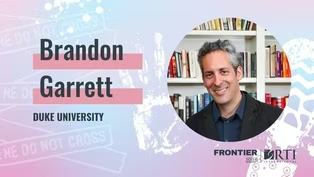
Brandon Garrett | Duke University
Video has Closed Captions
As a lawyer, Brandon Garrett looks at forensic science through a very different lens. (15m 40s)
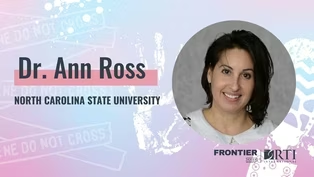
Dr. Ann Ross | NC State University
Video has Closed Captions
Unidentified bodies are a growing concern. Dr. Ross talks us through the issue. (13m 28s)

Dr. Fei Yan | NC Central University
Video has Closed Captions
Ever wonder how time of death is determined for submerged bodies? Dr. Fei Yan explains. (15m 6s)
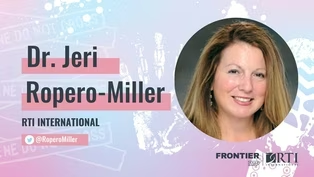
Dr. Jeri Ropero-Miller | RTI International
Video has Closed Captions
Opioid deaths created backlogs, hindering forensic labs from investigating other crimes. (14m 36s)
Providing Support for PBS.org
Learn Moreabout PBS online sponsorship
- News and Public Affairs

Top journalists deliver compelling original analysis of the hour's headlines.

- News and Public Affairs

FRONTLINE is investigative journalism that questions, explains and changes our world.












Support for PBS provided by:
RTP180 is a local public television program presented by PBS NC