
Forgotten Harvest CEO Adrian Lewis, Reparations town hall
Season 52 Episode 29 | 26m 46sVideo has Closed Captions
Meet Forgotten Harvest’s new CEO Adrian Lewis and a conversation on reparations.
Meet Forgotten Harvest’s new CEO, Adrian Lewis. Host Stephen Henderson talks with Lewis about how the food rescue organization is helping to feed families and seniors over the summer, its new facility and its client choice market. Plus, learn about Detroit’s reparations efforts from “American Black Journal” and BridgeDetroit’s virtual town hall, "Making Amends: The Quest for Reparations."
Problems playing video? | Closed Captioning Feedback
Problems playing video? | Closed Captioning Feedback
American Black Journal is a local public television program presented by Detroit PBS
Forgotten Harvest CEO Adrian Lewis, Reparations town hall
Season 52 Episode 29 | 26m 46sVideo has Closed Captions
Meet Forgotten Harvest’s new CEO, Adrian Lewis. Host Stephen Henderson talks with Lewis about how the food rescue organization is helping to feed families and seniors over the summer, its new facility and its client choice market. Plus, learn about Detroit’s reparations efforts from “American Black Journal” and BridgeDetroit’s virtual town hall, "Making Amends: The Quest for Reparations."
Problems playing video? | Closed Captioning Feedback
How to Watch American Black Journal
American Black Journal is available to stream on pbs.org and the free PBS App, available on iPhone, Apple TV, Android TV, Android smartphones, Amazon Fire TV, Amazon Fire Tablet, Roku, Samsung Smart TV, and Vizio.
Providing Support for PBS.org
Learn Moreabout PBS online sponsorship- Coming up on "American Black Journal."
With inflation and poverty on the rise, the new CEO of Forgotten Harvest is here to talk about feeding those in need this summer.
Plus, we'll talk about the quest for reparations for past discrimination against Black Detroiters.
Don't go anywhere.
"American Black Journal" starts right now.
- [Narrator 1] From Delta Faucets to Behr Paint, Masco Corporation is proud to deliver products that enhance the way consumers all over the world experience and enjoy their living spaces.
Masco, serving Michigan communities since 1929.
Support also provided by the Cynthia & Edsel Ford Fund for Journalism at Detroit PBS.
- [Narrator 2] DTE Foundation is a proud sponsor of Detroit PBS.
Among the state's largest foundations committed to Michigan-focused giving, we support organizations that are doing exceptional work in our state.
Learn more DTEFoundation.com.
- [Narrator 1] Also brought to you by Nissan Foundation and viewers like you.
Thank you.
(upbeat music) - Welcome to "American Black Journal," I'm Stephen Henderson.
Rising prices and economic disparities, they're making it really hard for many families to put food on the table.
According to Feed America, one in five children in southeast Michigan face hunger and food insecurity increases during the summer when kids are not getting regular meals at school.
The local nonprofit, Forgotten Harvest, is making sure families have access to fresh, nutritious food through its summer feeding program and other initiatives.
I spoke with the organization's new CEO, Adrian Lewis.
It's really great to have you here.
Forgotten Harvest is such an important institution in our community.
I love that you are its new leader.
Let's talk about the things that you're confronting as you take over there at Forgotten Harvest.
We wanna talk more specifically about summer and how different that is, but give us an overall picture of the organization- - Yeah.
- And the challenges.
- Absolutely.
Well, Forgotten Harvest,.
over the almost 35 years of its existence, it's always been about closing that gap on food insecurity and hunger throughout Metro Detroit.
That has not changed.
And as we begin to now better leverage our new facility, we are truly doing that, Stephen, and that's really fortunate in sense that we're able to do it because we're seeing a 30% increase in demand for our services.
So being able to do that, it's definitely a plus, but obviously, we wanna make sure that we're being very specific and concise on where we're addressing that need.
- Yeah.
Let's talk about that new facility.
That's been a long time coming.
- Yeah.
- What's the advantage to the organization of having that facility?
And how much better that makes the services that you provide?
- Absolutely.
The facility itself is about 78,000, I'll call it 80,000 square feet.
And to be able to not only have the extra capacity to hold food goods, but we're now able to really be creative in how we distribute it, especially from an equitable perspective and making sure that we're getting things sorted so that we can reach all of our 260 distribution sites in a timely manner.
And that focus is all about getting the right food to the right place and the right quantity in the right time, because that's essential.
We will not ever have any intentions on making sure that the goods are still fresh, the goods are still getting to the right place, - 650 sites.
That's such an incredible number.
- Yeah.
- Talk about that network of delivery and how widespread it is.
How many different parts of this community you reach with that?
- Yes.
We're able to, again, we primarily services the Tri-County area, and to have distribution partners strategically positioned, and we use a lot of great data to determine that, Stephen.
We try our best to make sure that we're not overlapping and we're truly reaching new points of access.
And to have those partners, we wouldn't be able to do it without them to do that.
But those partners come in many ways, right?
We have to have the distribution partners, but we also have to have the donating food partners in which we have great relationships with all of the major retailers as well as the manufacturers and distribution centers that are throughout.
And that's the great, that's the great point in this.
And I call it the magical collaboration.
And I know we don't have much time, but one of these days, I'll tell you my stone soup story.
- Yeah.
- And that's what we're making here.
So.
- Yeah.
Yeah.
- It's an honor to lead this grand mission and it means so much to me as well as to you, I know.
- Yeah.
Yeah.
All right, so let's talk about summer.
- Yeah.
- And what summer means for hunger in this community, and therefore, what it means for Forgotten Harvest?
Things look a little different than they do other parts of the year.
- Yeah.
If we look at the vulnerable populations of our children, as well as our seniors, right?
If we look at just those two, and there's probably a few others I could easily name, but summer feeding has definitely been a focus.
We have at over 10 sites that we're doing summer feeding at.
But being able to definitely keep the youth nourished as well as involved during the summer months, but also for our seniors, we're partnering with Amazon, DoorDash to be able to do deliveries throughout the summer.
- Yeah.
- Many of our seniors aren't able to get out, as you would imagine.
So we're identifying those individuals that we can help and assist.
And it's all about choice, right?
I mean, many of our distributions are a matter of, you'll see those already predetermined amounts that we're giving to our neighbors in need.
But we are now working on our client choice market in which we will have the ability to have our neighbors to come in and shop just like a grocery store in which it's not a new concept, but it is new and exciting for us to be able to roll out into the community, and we're gonna also have at least four mobile units with that capability.
- Yeah.
- Exciting stuff.
- Yeah, no, it is.
I wanna talk a little about the kind of the nature of hunger and the transitory nature of it, and how you manage that?
I mean, I think, often when people think of poverty, if they think of housing instability, if they think of hunger, they think of it as something that's ongoing for everyone, and that it's always the same group of people who have the same needs and challenges.
But of course, it's way more complicated than that.
And it seems like it gets more complicated over time, that that needs pop up because of circumstances.
So how do you manage that with something like Forgotten Harvest to make sure, as you say, that you're meeting the needs when they arrive?
- Yeah.
That's a very good point there, Stephen.
And the best way I would describe it is by having such a mission with dedicated members of that mission, but more so, being a listening ear to the community.
And those partners that we utilize, whether it be our donors or our distribution points, we have close relationships with those individuals, and we're able to hear firsthand, in many instances, as to if a need were to shift in a certain area.
And a real interesting stat for you is the average person that utilizes our services is it's, of course, there's some anomalies, but on an average of about five times a year.
So what does that tell us, right?
It tell us that anyone can have a bad day or bad bad week.
It's not always that stereotype of what hunger has looked like in the past or- - Yeah.
- Or what food insecurity may look like.
And as we look at all three counties, there's not a county that that stat does not exist in.
So it's really, really interesting and we're really grateful to be able to have the partners in collaboration to be able to do that free of charge- - Yeah.
Yeah.
- For our community.
- I also wonder what you're seeing in terms of the need in our community, and whether it is more acute right now because of some of the things that we're dealing with in a general economy, or, in fact, whether maybe they're not as acute.
I mean, we keep hearing stats about the falling numbers of children in poverty because of things like the federal tax credit and some other measures, but I wonder what that looks like from you as a provider.
- Yeah.
What we're seeing, it definitely aligns with the high inflation of food, right?
It definitely aligns with that.
It definitely shifted as the tax credits were exhausted, so to speak.
- Yeah.
Right.
- So that definitely aligned.
But you know what was really interesting post-pandemic, as I would say, is that many of our family, of our neighbors in need, or neighbors in general, were just made more aware of that dignity of respect that we're providing as a service.
That they're not ashamed to share.
That they're sharing more about the awareness with other neighbors.
So I believe that also has an uptick in the use of our services that may or may not have been there in the past.
- Yeah.
Yeah.
Okay, Adrian Lewis, great to have you at the helm there at the Forgotten Harvest, and wonderful to have you here with us on "American Black Journal."
Thanks so much for joining.
- And again, thank you for having me, and I look forward to connecting in the future.
Thank you again.
- So, "American Black Journal" teamed up with BridgeDetroit recently for a virtual town hall that was titled, "Making Amends the Quest for Reparations."
Our panel of guests talked about the work of the Detroit Reparations Task Force, the history of discrimination against Black Detroiters, and reparations efforts in other cities.
Here are some clips from that town hall meeting.
Joining me now to talk about the work that this task force has been doing are the co-chairs of it, Keith Williams and Cidney Calloway.
Welcome Keith and Cidney to our town hall.
- Good afternoon.
- How you doing?
- It's great to see both of you.
Keith, I'm gonna start with you.
You and I have had a several conversations about this task force since it started.
Like I said, you guys started out last year.
We're a year or more into this now.
Catch us up.
Where are we with the monumental effort, really, that you guys have to undertake to just start figuring out what the scope of this issue is?
- You know, almost, I'm gonna start it like this.
Weeping man door for a night, but joy of coming in the morning.
Last year, when me and you talked, we was going through some difficult periods, but I think we're now on track.
When Robin Rue Simmons came to Detroit last year, yeah, we were for trying to find our way.
But Robin got us on track about where do we need to go.
And that was like to start with a harms report.
Then after that, we got involved with University of Michigan.
And University of Michigan was doing the harm report.
And then after that, with my relationship with the regional aspect of Robin Rue Simmons municipal reparations, I met Linda Mann some years ago, she came in and she did what we call the impact report.
You got the harm report and the impact report.
And so we are really trying to get on track to get this report done by October.
Cidney has been really doing a good, fabulous job doing in the inner workings of it.
I'm just looking at the big picture.
And Cidney can elaborate a little bit more on the internal aspect of it, but I think we are well on our way to getting this report done.
- So before I get to Cidney, Keith, what happens after October?
Let's say it's November 2024, what should Detroiters expect will be happening at that point?
- Well, our focus should be on what the ballot initiative stated.
Make recommendations on housing and economic development.
When this report is all said and done, it should have met those criteria.
Yes, we added some other stuff to it because the cultural aspect was destroyed during those years, from 1929 to up until when Motown left.
Then you gotta look at the healthcare aspect.
My brother died in 1961 in our house because he didn't have the proper healthcare.
He died of measles and pneumonia, and we couldn't get access to the proper healthcare professionals to help us with that situation.
Just imagine all the families surrounded, with your dad, mom, and the babies holding, is held in your mother's arms, and he's dying in front of us.
And then I can go back to 1960, as my father told me, four of his sisters died in a house in Hamtramck because of tuberculosis.
So you gotta add all those things and come up with a comprehensive report that's gonna be sellable.
We got to be able to sell this to all the peoples 'cause you got skeptics out here that it's a handout, as you heard in the previous interview, but we gotta make it that can't be too far to the left or too far to the right.
It's gotta be pragmatic and sellable to the Detroiters who voted for this.
- Yeah.
Yeah.
Cidney, this is the first time you and I are talking about this.
You're relatively new to the task force.
First thing I wanna do is give you a chance to introduce yourself, talk a little about your background.
- Absolutely.
Thank you so much, Mr. Henderson.
My name is Cidney Calloway.
I'm a native Detroiter, born and raised here on the West Side.
I am a fellow, or I was a former fellow with the Movement for Black Lives two times over.
So for two seasons, I got to learn on a national scale with the Movement for Black Lives.
I've been an activist since 2020.
And this has been a phenomenal opportunity for a knowledge exchange.
There's a lot of wisdom on this task force.
There's a lot of history that's being shared and I'm learning a lot.
I never thought that I would be in any type of leadership position.
Never thought I'd be end up being the co-chair, but very privileged and honored to be with this team and very excited about this work.
- So let's talk about this goal of recommending housing and economic development programs that would boost opportunities for Black Detroiters.
Talk about, Cidney, what you guys have found so far, and especially what you're hearing from the public.
- Yeah, so we've been having some really phenomenal internal meetings as of late, and we're starting to work on the outline for our report.
So we wanna make sure that this report not only goes to city council, but that it's something that can be consumed by the residents and make sure that they're informed, they know what type of programs we're working on.
We are going to be releasing quite a few surveys over the next couple of months to really engage with our community to make sure that they have an opportunity to engage and give their input, to make sure that their voices are amplified in this process.
We've gotten a report back from Columbia University, speaking to quite a few different things that they observed while they were here.
It was fantastic to have them here in person, allowing them to visit some of these sites of harms and really put some tangible pieces to the research that they were doing.
I'm very excited about the U of M report to come out, but we really want to center the voices of the residents, give them an opportunity to give us some feedback and to really help drive the way that this work is gonna go.
Because the 13 of us can't do it alone.
We're working in a beautiful Black city and we need to make sure that every voice is amplified.
So that's where we're at right now.
We're working on our outline for the framework, talking about feasibility sustainability, not even just for housing and education, affordable quality housing, 'cause we have to insert that word quality there, but we are looking for a holistic approach.
So we heard some commentators or some comment, saying that there's a little bit of skepticism, that if they don't have an education piece to it, that it feels like it's for naught, it feels like this is all in vain, but we wanna make sure that there's some type of mention to some systemic change, some policy change.
So we got a lot on our plate, but it's very exciting to get into this work with everyone.
- The University of Michigan has partnered with the Detroit Reparations Task Force to provide research on reparative justice here in Southeast Michigan.
Joining me now is Rita Chin.
She's an associate dean at the University of Michigan in the graduate programs there.
She brought together university faculty members for this coordinated effort.
Rita, welcome to the town hall.
- Thank you so much for having me.
- So let's start here.
Explain how U of M's partnership with the task force came to be, and what some of the goals are.
- Okay.
Well, as many of you probably know, the University of Michigan is a pretty big and unwieldy institution.
And so there are actually a number of different units who are participating in this partnership with the task force.
Rackham, the graduate school, is one partner, but there are two others that I think are worth sort of calling out here.
The first is the Center for Social Solutions, which is directed by Dr. Earl Lewis.
And that center actually began three or four years ago already in partnership with Lauren Hood and her Afrofuturism kind of project to think about reparations, specifically in relation to Black Bottom and the prospect of the resurfacing of I-375.
So that was a kind of seed.
And then as the task force got up and running, Lauren was actually initially one of the co-chairs of the task force.
And so she sort of brought the Center for Social Solutions and myself into conversation with the task force, thinking about sort of how we might be begin to address some of these research questions, right?
Because it's one thing to sort of know the kind of sort of newspaper or media level, have that kind of understanding of the harms that have been done.
But in order to actually make a kind of substantive case for reparations, we knew that it was gonna be important to have real kind of documentation on a number of fronts.
So at the same time, one of the subcommittees for the Detroit Reparations Task Force reached out to another U of M unit, that's Poverty Solutions, and asked them to begin to write a harms report that was focused on housing.
And so the three U of M units have actually been coordinated in trying to bring together a kind of more holistic, as Keith was talking about and Cidney were talking about, view of what the harms experienced by Black Detroiters have been.
And so my role in that was really convening a group of different faculty experts, so political scientists, historians, urban planners, social work experts, public health experts.
Now, we have someone on the team who is focused on education, public policy, and also climate science, right?
Because we found that actually so much of the harm that has been done to Black Detroiters that we typically associate with housing is actually connected to environmental hazards like air quality, flood risk, which can lead to health problems around black mold.
And then those impact things like education and how often students miss school because of all of these other kinds of health issues.
And so we started to find as we were kind of unpacking different disciplinary perspectives that they're very much connected, and that housing is in many ways the kind of spine- - Yeah.
- Of the harm.
But it seemed important to also tease out all of these other implications, ramifications, consequences, and present those in this harms report to the task force so that they have kind of maximal information.
- Recently, we saw Chicago's mayor announced that he is gonna order the creation of a reparations task force to examine policies, and that city that have harmed African Americans.
Give us a sense of what you've learned, Malachi, about how other cities are approaching this and are there things that we should be looking to in some other places to guide our work here in Detroit?
- Yeah.
I mean, we're like in a really interesting moment in history when it comes to reparations in the United States of America.
For a long time, the pressure was put on Congress.
Our longtime Detroit Congressman John Conyers had been pushing for a commission at the federal level.
Well, in kind of a response to the lack of progress, there are a lot of cities have begun taking this up.
And it really started with Evanston, Illinois, as we've mentioned, the suburb of Chicago.
They were the first city to create reparation proposals, really based around its history of racial segregation and housing, which is pretty similar to what we've experienced in Detroit.
And so they were kind of like the first mover, the first city to really show that this was possible.
And we've really seen like an explosion of cities and a couple of states around the country creating local task forces to look at what have their governments been responsible for.
A lot of them are in the similar position that Detroit is in.
They have a task force assembled.
They're starting to partner with researchers to come up with studies that will kind of inform their work, but they haven't necessarily put recommendations out.
In a few instances, there have been some proposals put forward, but it's not clear how it will be funded.
A California task force had talked about including cash payments, but that ended up being pulled off the table.
But some pretty major, I mean, New York is working on something.
Boston, Knoxville, Tennessee, Philadelphia, they all have task forces.
Kansas City created a reparations commission last year.
They're actually collecting donations.
So there's a few different ways that cities are kind of trying to tackle the funding question and the legal constraint question.
Evanston used marijuana tax revenue.
We're a little bit limited in our ability to do that.
We do get a portion of marijuana taxes from the state, but it's really kind of too small of an amount of funding to really, I think, do what we'd like to do here.
So we have to get kind of creative about that.
And I think there will be questions for the governor of Michigan and state lawmakers about what responsibility is state bears, and if they're gonna put it forward.
But we're really just seeing a lot of cities travel along a similar path.
And I think that creates partnerships too that the city's been, of Detroit's been working with Evanston, Illinois, and we're all kind of on the same trajectory here.
- And you can watch the entire Reparations Town Hall on-demand at americanblackjournal.org.
It's also where you can learn more about our guests.
Plus, connect with us anytime on social media.
Take care and we'll see you next time.
(upbeat music) - [Narrator 1] From Delta Faucets to Behr Paint, Masco Corporation is proud to deliver products that enhance the way consumers all over the world experience and enjoy their living spaces.
Masco, serving Michigan communities since 1929.
Support also provided by the Cynthia & Edsel Ford Fund for Journalism at Detroit PBS.
- [Narrator 2] DTE Foundation is a proud sponsor of Detroit PBS.
Among the state's largest foundations committed to Michigan-focused giving, we support organizations that are doing exceptional work in our state.
Learn more DTEFoundation.com.
- [Narrator 1] Also brought to you by Nissan Foundation and viewers like you.
Thank you.
(gentle music)
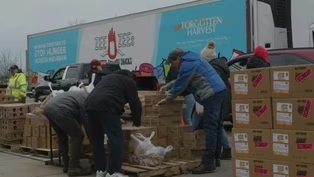
Forgotten Harvest’s new CEO talks about demand for services
Video has Closed Captions
Clip: S52 Ep29 | 9m 51s | Forgotten Harvest CEO Adrian Lewis talks about the increased demand for agency’s services. (9m 51s)
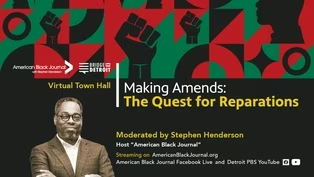
Reparations in Detroit and around the United States
Video has Closed Captions
Clip: S52 Ep29 | 13m 56s | Watch excerpts from American Black Journal and BridgeDetroit’s reparations town hall. (13m 56s)
Providing Support for PBS.org
Learn Moreabout PBS online sponsorship
- News and Public Affairs

Top journalists deliver compelling original analysis of the hour's headlines.

- News and Public Affairs

FRONTLINE is investigative journalism that questions, explains and changes our world.












Support for PBS provided by:
American Black Journal is a local public television program presented by Detroit PBS