
Forgotten Heroes of the American Revolution
7/23/2026 | 26m 46sVideo has Closed Captions
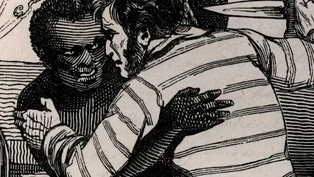
Discover forgotten Revolutionary War heroes whose contributions still shape our communities.
Two heroes of the American Revolution—enslaved mariner Currituck Jack and free soldier of color Zachariah Jacobs (Holmes)—helped build a nation, but their stories were nearly lost. Join us as we work with community members and descendants to uncover their courageous contributions to the patriot cause.
Problems playing video? | Closed Captioning Feedback
Problems playing video? | Closed Captioning Feedback
Homegrown History is presented by your local public television station.
Sponsored in part by SECU Foundation, funded by the members of State Employees’ Credit Union.
Forgotten Heroes of the American Revolution
7/23/2026 | 26m 46sVideo has Closed Captions
Two heroes of the American Revolution—enslaved mariner Currituck Jack and free soldier of color Zachariah Jacobs (Holmes)—helped build a nation, but their stories were nearly lost. Join us as we work with community members and descendants to uncover their courageous contributions to the patriot cause.
Problems playing video? | Closed Captioning Feedback
Where to Watch Homegrown History
Homegrown History is available to stream on pbs.org and the PBS app.
Related to This Episode
Providing Support for PBS.org
Learn Moreabout PBS online sponsorship- Funding for Homegrown History is provided in part by SECU Foundation, funded by the members of State Employees Credit Union, and by the Corporation for Public Broadcasting, a private corporation funded by the American people.
♪ - If you know anything about the American Revolution, you've heard of George Washington, maybe even Nathaniel Greene or Benedict Arnold, Revolutionary War superstars.
But the truth is, historians estimate around 375,000 patriots fought in the American Revolution, and their lives were as diverse as the people themselves.
This is Homegrown History.
There's a North Carolina legend about an enslaved mariner who outwitted British privateers during the American Revolution, saved his crew, and earned his freedom, and then went on to run his own business in the same waters he once worked as an enslaved captain.
The legend calls him "Currituck Jack," but his story was lost in the archives until a group of locals began working to separate fact from fiction.
So we traveled to Currituck and worked with local historians, - But I think this is what you were interested in.
visited a historical society, - People did not know about him.
and even hopped on an airboat with a retired police officer to get to the bottom of this legend.
What we discovered was a Revolutionary War story unlike any we'd ever heard in a community ready to share it on television for the first time.
♪ [crickets chirping] [papers shuffling] - This is a story that was written in the Virginia Pilot in 1874 that talks about Currituck Jack.
That is the oldest one I have been able to find.
- Barbara Snowden is a historian and a former public school teacher who's been working on verifying the real story behind the Currituck Jack legend since 2002.
- A lot of people think history is in the past.
It doesn't have any connection to them.
But if you can tell a student, "This happened here in Currituck and made a difference," then they're going to pay attention to it.
- It was a 1981 magazine article that first sent her down this rabbit hole.
Here's what she found.
In 1780, Currituck County was on the front lines of the Revolutionary War.
The British were running a blockade off the coast and loyalist privateers were doing everything they could to prevent the rebellious colonies' trade.
Between the raids and treacherous shoals of the Outer Banks, these were dangerous waters.
But colonial merchants still had to make a living, so they kept shipping goods in and out of the port of Currituck, sometimes for the Patriot cause.
This was Jack's world, and he was a vital player in it.
Jack was an enslaved mariner.
In local waters, he and other enslaved men captained vessels, commanded enslaved crews, and were entrusted to transport cargo and sometimes revenue for merchants.
They could see the world in ways those bound to plantations couldn't.
Jack was a master at sea, but enslaved by law.
In 1780, the Revolutionary War caught up with Jack aboard the Polly, a schooner he was crewing for his enslaver, a prominent Currituck County man named Henry White.
It was the dead of winter when the Polly disembarked from the port of Currituck.
Its crew, Jack and two white half-brothers named Samuel Jasper and Caleb White, were headed to the West Indies.
They would never make it, because two days into their journey, a British privateer vessel captured their ship.
The privateers overpowered Jack and his crewmates, put them in irons, and gave them barely enough food and water to survive.
After a failed attempt to escape, the privateers separated Jack from Caleb and Samuel.
They locked the brothers up below deck.
Jack got it worst.
They lashed him to a post on the quarter deck, and according to sworn testimony, he spent a full day and night there, exposed to a proper winter gale, snow, wind, and a rough sea.
But he survived.
And when he was reunited with his crewmates below deck, they came up with a new plan, one that cast Jack in the lead role.
The plot?
Jack would pretend to be an enemy to America.
This was not a crazy idea.
Five years before, in the early days of the war, Virginia's royal governor promised freedom to enslaved people who fought for the British.
Many had taken him up on it, so their plan had real logic.
The British were offering freedom, and most patriots weren't.
Jack nailed the part.
He convinced the privateers that he wanted to join their cause.
They offered him freedom, and he became their right-hand man.
But three days into the charade, with the weather clearing, Caleb slipped his irons, gave the signal, and went for the leader of the privateers.
Samuel joined with a cutlass, and Jack took on two men at once, armed with nothing but a marlin spike.
They overpowered the privateers, locked them up, and sailed the Polly into Annapolis, where they turned the prisoners over to revolutionary authorities.
- If it wasn't for Currituck Jack saving him.
My family might not even be in existence.
But that was the main thing.
But she would call me up -- - Barbara Perdue is a descendant of one of the men who crewed the Polly with Jack, Samuel Jasper.
Her genealogical work and family records led to a pivotal breakthrough in this research, because it wasn't easy identifying which Currituck County family with the surname of White enslaved Jack.
There were so many Henry Whites, so many Caleb Whites.
- I was getting very confused.
- Barbara called me up, knowing my family's name is White.
She goes, "Do you know anything about this story with White?"
I said, "Shoot, I've got it for 20 years.
Yes, I know it."
I gave her a piece of paper with all my eliminations on it, scratched it out with every Henry White, every Cal White, and all the dates.
And I had no, no, no.
Then I finally had the big check.
- With that resolved, a new discovery found in a trunk owned by the White family was evidence they were on the right track.
It was a copy of sworn testimony given by Caleb White, recounting what happened during the Polly ordeal and what Jack did next.
It took Jack five weeks to recover from the injuries he sustained reclaiming the Polly.
After recovering, he returned to his enslaver, Henry White.
But he found life back home intolerable.
Citing abuse, he asked the survivors of the Polly ordeal for help.
And according to sworn testimony, Caleb White bought Jack, presumably in an effort to improve his situation.
After the war, Jack went on to captain a 26-ton cargo schooner named The Resolution for Samuel and Caleb.
Samuel later testified that another local merchant trusted Jack with hundreds of pounds worth of cargo every year.
He remained a boss at sea, but he was still enslaved.
That was about to change.
In 1787, seven years after purchasing Jack, Caleb White signed his final will and testament.
It included a provision.
After Jack paid 100 pounds to Caleb's executors, he could have his freedom.
Gaining freedom in North Carolina was extremely difficult.
The law required what it called meritorious service, just to be eligible.
And even then, the enslaved person usually had to pay a fee, not easy for people who typically worked for no compensation.
But enslaved captains were in a unique position.
Some of them could earn money in ways that other enslaved people couldn't.
It took several years for Jack to raise the money, but in 1792, over a decade after his heroic actions on the Polly, Samuel Jasper petitioned the legislature for Jack's freedom, stating, "Jack did great honor to the name of humanity and highly merited much greater reward than that of emancipation."
The petition was bundled with nine other cases.
When the ten people were freed, all were assigned new names, often combinations of their former enslavers.
That's how Currituck Jack became John Jasper White.
♪ We're flying across the marshes on an airboat with a retired police officer to find out what happened next.
- My grandfather was born just on the other side of those trees.
He would spend his days hunting in the marsh, roaming this marsh.
I never get tired of being here.
- Barbara brought Jimmy Kaysen on the case to track down where John Jasper White spent the rest of his years as a free man.
- My professional life was spent in law enforcement.
And those skills that you learn when you're investigating crimes, research carries over into life sometimes in other places that you didn't expect.
- Today, this land is a national animal refuge called Mackay Island.
250 years ago, it was farmland.
A paper trail of primary sources, quills, deeds, a census, led us here.
In one of the deeds the community surfaced, there's a crudely drawn map of the property that belonged to the White family.
And there's a curve on this map that caught Jimmy and Barbara's eye.
When they laid this map over satellite imagery, it lined up almost perfectly over the Indian Creek, which still runs through this land today.
- This area to our right, this is the general vicinity of that property that we believe Currituck Jack had.
- Owning property was a remarkable feat for African Americans in the 18th century.
And the discovery of an 1803 will recorded for John Jasper White gave us even more insight into his life as a free man.
He was married to a woman named Rose.
He had children, furnished a house, and owned a cargo schooner.
He built a full life.
Two years later, that will was recorded in court, leading us to believe he died in 1805.
But his story will live on.
[bells ringing] The historic Jarvisburg College School is a local museum dedicated to preserving this county's Black history and culture.
In 1867, on the heels of the Civil War, a free Black man named William Hunt deeded this land to the community in order to create a school for Black children in Currituck County.
In the late '90s, descendants of the founder and school alumni led efforts to convert this old school into a museum.
Today, museum stakeholders are guiding us through the site.
- Norma, one of the ladies that's featured in the panel, this is her narrative about how she went to school.
They walked to school, walked through the woods.
They were scared to do it, but they did it.
The one thing about it I always like to say when we give this tour is, if they didn't go to school, when they got home, their parents knew about it.
No cell phones, so I always coin the phrase, "It takes a village."
- It would give us a lot of history that children didn't know anything about because in the younger age now, they didn't know anything about integration, that they did not know the Blacks could not go in white places or restaurants or anything.
They had to go to the back door if they wanted anything to eat.
And we were just trying to make people aware.
- Soon, a statue of John Jasper White will stand on these grounds, a monument to the centuries-long contributions of African Americans to Currituck County.
For the past few years, North Carolina sculptor Stephen Hayes has been working with the community on this statue.
- At the end of the day, it's not my work, right?
This work is for the community.
Several stewards of the museum provided input on the creative direction of the statue.
And the design they landed on celebrates the life John Jasper White built for himself as a free man.
His clothes are really blowing in the wind, like flowing, and he has one hand holding the wheel of the ship and the other hand holding the marlin spike close to his heart as a symbol saying, like, "This is where-- how I broke free," you know, and holding that ship wheel saying, like, "I am guiding this ship now."
- There's still so much we don't know about this story.
After John Jasper White's death, the White's surname vanished from Currituck records of Black residents for decades, which means we don't know what happened to his family, and we aren't sure why.
If there's anything this community investigation has taught us, it's that you never know when or where a new clue will surface.
But there's another forgotten hero of the American Revolution, and that story takes us 200 miles south.
That journey starts with a question.
How did a person of color live free in North Carolina during the Revolutionary War?
And why would he risk everything to fight for the American colonies?
For 250 years, it seems that nobody even knew to ask.
Then a descendant discovered a document that began to reveal a military career that should have been legendary.
His name was Zachariah Jacobs.
That discovery was just the beginning.
So he met with his family and retraced their steps... - He believed in what America could be.
- ... through swamps, obscure records, and revolutionary battlefields.
And what we found was a remarkable patriot who should have been famous, and a family making sure he finally gets his due.
Our story begins at the corner of two rural counties in eastern North Carolina.
We're visiting the Graham Family Reunion, a gathering for the descendants of Zachariah Jacobs.
But many folks here are learning they're related to this patriot hero for the first time.
- Give us a shout out.
- Fifteen years ago, Kevin Graham began doing the genealogical research that would bring all these people together.
- Zachariah was a Revolutionary War veteran.
We talkin' about a war that happened to create this country.
- Back then, he could only trace his lineage through his paternal grandfather.
His first big discovery was Zachariah's pension application.
In 1832, around 79 years old, Zachariah gave sworn testimony, bearing witness to his remarkable service in the Revolutionary War.
- All I knew as growing up, even through college, that black folks in America were slaves.
All were slaves.
I didn't know that you had thousands of individuals, such as my ancestors, were free in this country.
And not just that, they served in the American Revolutionary War.
[military drum beating] - Colonial records are often murky, but what we do know is that many people of color, free and enslaved, fought in the Revolutionary War.. and on both sides of it.
An estimated 20,000 people of color fought for the British, who'd offered freedom to the enslaved people who'd joined their cause.
Fewer, an estimated 5,000 to 6,000 people of color, went to war for the patriots.
Some fought as substitutes for their enslavers, some enlisted voluntarily, some were drafted, like Zachariah was for his first tour.
Zachariah was living in rural eastern North Carolina when the legislature called his unit up for service in late 1778.
As a free, able-bodied man between 16 and 50, he was required to enroll in his county's militia if drafted.
At this point in the war, the British had just captured Savannah, and patriot control of the region was being challenged.
So North Carolina sent reinforcements to Georgia to help their fellow revolutionaries.
Zachariah was one of them.
In late February 1779, the general commanding Zachariah's brigade led them into Georgia, and they encamped along the banks of the Savannah River at a place called Bryer Creek.
They'd been chasing their enemy across the state, but the British had reached this creek first, crossed it, and burned the bridge behind them.
The patriots were in a precarious position.
They were ill-equipped, and their campsite had a fatal flaw-- no escape route, frigid water on both sides, no bridge, nowhere to retreat if an enemy attacked.
A few days later, the British did.
Zachariah's unit tried to hold its ground, but the patriot lines quickly collapsed.
Their choice--surrender or flee.
Those who fled had two options--the swamp or the river.
Between 50 and 100 soldiers drowned trying to swim across those frigid, treacherous waters.
We're not sure which option Zachariah chose, but we know he survived and walked more than 250 miles as the crow flies, as a free man of color, all the way home.
The British capitalized on their win by reestablishing the royal government in Georgia, the only colony they were able to officially take back during the war.
Two years later, Zachariah would fight again at North Carolina's biggest Revolutionary War battle, a battle that tipped the scales in favor of the patriots for good.
[fife and drum music] - [Kevin] It means a tremendous amount to actually be here, on sacred ground, knowing that I'm a part of history, someone who helped build the greatest country in the world, the United States of America.
- Since discovering Zachariah's story, Kevin's made it his life's mission to share it with the world, and today he's sharing it at the first-ever symposium for descendants of soldiers who fought at the Battle of Guilford Courthouse.
[applause] - Zachariah had descendants throughout the whole state of North Carolina.
His descendants probably to this day identify either as black, white, or Native American.
My presentation is not going to only be on Zachariah, it's going to be on those patriots who the American history books do not speak of much.
- 245 years ago, over 4,000 patriots faced just under 2,000 British soldiers here.
In the two years since the debacle at Briar Creek, the British had continued their campaign in the South.
They'd taken Charleston, then Camden, in August 1780.
The patriots were losing ground.
The fresh soldiers took 6 to 8 weeks and 3,000 miles to resupply, and the cost of that was making it hard to maintain support back in London.
So the commander of the Continental Army's Southern Department, General Nathaniel Green, took the British on a wild goose chase around North Carolina, biding his time and gathering troops.
Drafted again, Zachariah was one of them.
And by March 1781, Green was ready to strike.
The North Carolina militia fired the first shots.
The fighting that followed was brutal.
Bayonets and musket fire at point-blank range.
While the British won on a technicality because General Green retreated, they were about to lose the war.
British Commander Cornwallis' forces were shattered.
27% of his army lay dead or wounded.
This battle alone didn't end the war, but it was one of a series of costly battles that exhausted the British Southern Campaign.
Six months later, the British surrendered at the Battle of Yorktown.
Zachariah found himself on the front lines of this historic engagement, and it cost him.
During the battle, he was shot in the leg.
The wound was bad enough that he was hospitalized.
When he recovered, he started the long walk home.
And this time, he didn't make it home unscathed.
And he was captured.
He was captured by the Turk.
They kept Zachariah tied up for two weeks.
In his pension record, Zachariah said he was tied up and held captive by loyalists for nearly two weeks.
And rather than be hung, he took parole, which typically meant you gave an oath vowing not to fight against the crown.
But after being freed, Zachariah enlisted in the Continental Line.
Piecing together records and accounts, it looks like the final big action that Zachariah saw in the war was a daring raid on the Ashley River in South Carolina just one year later.
And here's the thing.
This operation happened six months after the Battle of Yorktown, the final major one of the Revolution.
And it happened just a few days after the British Parliament had passed a bill authorizing their government to seek peace with America.
Zachariah saw the war through to the very end.
♪ The Graham Family Reunion is held just a few miles from Zachariah's original home place.
And most everyone here today is a descendant of Zachariah.
This is by design.
- Genealogy is a wonderful tool.
And I created a website, Graham-Reunion.com, and it helped thousands of family members to find one another.
- As a family man, Kevin was interested in what Zachariah's life looked like after his incredible service to our nation.
The census records and land deeds he surfaced show a man who owned property and headed a household of many other free people of color and that he lived until he was 94 years old.
And as we researched this story, we realized that meant he lived to see North Carolina dramatically change the rules for people of color, free and enslaved.
You may be surprised to learn that in the country's early years, free people of color could vote in North Carolina.
Beginning in 1776, the new state constitution granted voting rights to all free men who paid taxes and owned 50 or more acres of land.
But half a century after Zachariah fought and bled for the nation, a new state constitution took that right away.
A few years later, his right to bear arms was also restricted when the General Assembly passed an act intended to tightly regulate free people of color's access to weapons.
Six years later, Zachariah died.
- I think he was somewhat confused after the war, saying, "Hey, I sacrificed myself, but my people are being mistreated."
- For 15 years, Kevin Graham has worked to get Zachariah's story out there.
It's a story and journey he shared with his family because he believes in legacy.
- Sense of pride.
Sense of pride.
When I say a sense of pride, I want them to know that they came from someone great.
[music] - His efforts to share Zachariah's story culminated this year in Wilmington, North Carolina when the state unveiled a historic marker in honor of Zachariah.
It was a morning that saw descendants, Waccamaw Siouan and Lumbee tribal members, African-American community leaders, and state officials gather because this family refused to let Zachariah's story stay buried.
- Today is a long-awaited event.
We're going to actually unveil an official North Carolina highway marker here in Wilmington, North Carolina for my third great-grandfather, Zachariah Jacobs.
- We're so glad to see each and every one of you, and we do know that-- - It makes us incredibly proud to be able to honor one of our ancestors who fought so bravely for the independence of our country.
Zachariah Jacobs demonstrated unwavering commitment to the cause of liberty through his service in the North Carolina Continental Line.
250 years ago, Zachariah Jacobs stood up against a king, a ocean away.
[applause] - [all] 3, 2, 1!
[cheering and applause] - Zachariah!
[music] - It just acknowledges what people of color did for our country before it was really, really a big item that was documented.
It was great to see that this historical marker will show what people of color-- Native Americans, African-American, all types of people of color-- did for the history of their country.
[music] - If your research has revealed a forgotten hero of North Carolina, follow the link below or scan the QR code on screen to share your history with us.
[music] ♪ - Funding for Homegrown History is provided in part by SECU Foundation, funded by the members of State Employees Credit Union, and by the Corporation for Public Broadcasting, a private corporation funded by the American people.
♪
Preview | Forgotten Heroes of the American Revolution
Video has Closed Captions
Discover forgotten Revolutionary War heroes whose contributions still shape our communities. (20s)
Providing Support for PBS.org
Learn Moreabout PBS online sponsorship












Support for PBS provided by:
Homegrown History is presented by your local public television station.
Sponsored in part by SECU Foundation, funded by the members of State Employees’ Credit Union.