
Frank Mautino, the Latest on Covid-19, and More
11/19/2021 | 26m 46sVideo has Closed Captions
Discussion on two new laws the Governor signed and the latest on COVID-19
Host Hannah Meisel (NPR Illinois) and guests John O'Connor (Associated Press) and Charlie Wheeler (UIS) discuss Auditor General Frank Mautino, two new laws the Governor signed for and the latest on COVID-19
Problems playing video? | Closed Captioning Feedback
Problems playing video? | Closed Captioning Feedback
CapitolView is a local public television program presented by WSIU
CapitolView is a production of WSIU Public Broadcasting.
Frank Mautino, the Latest on Covid-19, and More
11/19/2021 | 26m 46sVideo has Closed Captions
Host Hannah Meisel (NPR Illinois) and guests John O'Connor (Associated Press) and Charlie Wheeler (UIS) discuss Auditor General Frank Mautino, two new laws the Governor signed for and the latest on COVID-19
Problems playing video? | Closed Captioning Feedback
How to Watch CapitolView
CapitolView is available to stream on pbs.org and the free PBS App, available on iPhone, Apple TV, Android TV, Android smartphones, Amazon Fire TV, Amazon Fire Tablet, Roku, Samsung Smart TV, and Vizio.
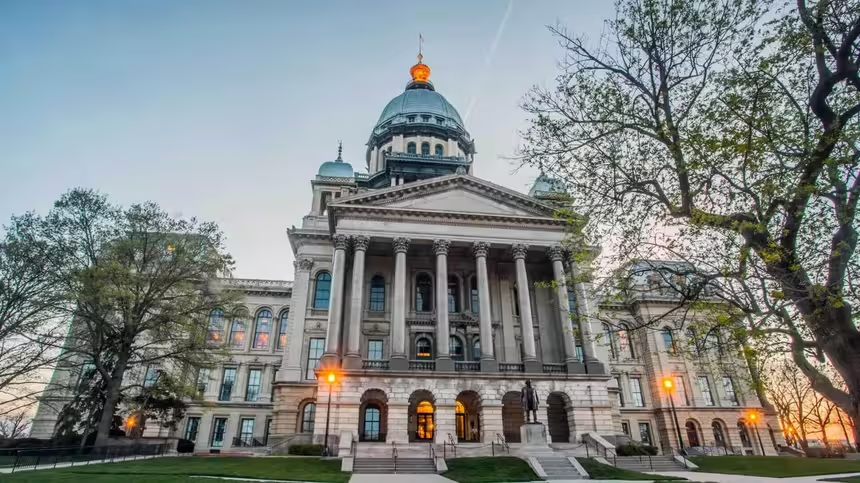
CapitolView
CapitolView is a weekly discussion of politics and government inside the Capitol, and around the state, with the Statehouse press corps. CapitolView is a production of WSIU Public Broadcasting.Providing Support for PBS.org
Learn Moreabout PBS online sponsorship(inspiring music) - Welcome to Capitol View, where we talk about the latest in Illinois State government and politics.
I'm Hannah Meisel with NPR Illinois.
Joining us this week is John O'Connor, political writer for the AP.
Thanks for being here, John.
- Pleasure, Hannah.
- And also here is Charlie Wheeler, Professor Emeritus of the Public Affairs Reporting Program at the University of Illinois Springfield, and also long time State House reporter and observer.
Glad you're here, Charlie.
- Thank you.
It's good to be here.
- You know, we are six weeks out I think, from a new year and 2022, you know... 2021 is very active.
I think 2022 might throw us for another loop, as the roller coaster keeps going.
I would like to spend some time at the top of the show talking about the possible maybe end of this six year saga for the Auditor General Frank Mautino, who was a longtime democratic legislator, and who took the place of his father before him, who was also a long time democratic state legislator.
Frank Mautino had been embroiled in this years-long investigation since almost the moment he became Auditor General back in early 2016.
John, what was that about?
What, what gave rise to this investigation?
- Well, it was a series of, I think first, some news reports or blog reports and finally a lawsuit by a constituent of Frank Mautino's in LaSalle County.
And it questioned his expenditures as a campaign committee over 20 years or more.
And it had to do, there was a focus on a particular service station in Spring Valley, where Mautino's from, where there were hundreds of thousands of dollars of expenses, expenditures.
And the thing that sticks out with me is that, that instead of, you know, most of us in our jobs are paid mileage for travel with our personal car.
And in this case, personal cars were being... the owners of those personal cars on campaigns were being reimbursed for oil changes or for a full tanks of gas instead of that mileage.
And there's a question about were those all truly campaign expenditures.
- Right, it was over the course of 17 years, starting in 1999, which is the first year that certain campaign committees had to file expenditures electronically.
Mautino's campaign racked up nearly a quarter million dollars at Happy's Super Service Station in Spring Valley, like you said, to his hometown, and, it caught the eye of this independent group called the Edgar County Watchdogs that have... there's an interesting Tribune article about them from several years back.
But they identified a lot of red flags.
Stuff like spending in round whole numbers for vague items like campaign spending or gasoline, or a ton of car repairs too.
A very curious number of car repairs.
And it wasn't just for Frank Mautino's personal car, It was the treasurer of the campaign committee and a lot of associates.
Of course, like you said, John, if you work on a campaign or if we work in our jobs, we would often get mileage.
But instead what Mautino's committee did was, I guess, run a credit card, run a...
They had a ledger, an old fashioned kind of line of credit at this service station.
And they ran up all this money over...
It just, it caught a lot of red flags.
And so, like you said, a former constituent of his after this Edgar County Watchdogs report came out, filed a citizen complaint with the State Board of Elections.
And then for the last six years, it's bounced around from the Board of Elections to Appellate Courts to back to the Board of Elections, to another Appellate Court, Supreme Court, where in May, the Supreme Court gave Mautino a half win, and threw out half the case, but still said, yeah, you know what, these, you know, you shouldn't have done that.
You should have instead done mileage reimbursement, which by the way, is going to be more expensive for the campaign committee.
But then almost as soon as maybe 10 days later, when session was wrapping up in May, Democrats pushed through this omnibus elections bill that said, you know, actually it's okay to do what Mautino did.
And the matter went back to the Board of Elections and, Charlie, this week, they said, well, he didn't do it knowingly, so we can't do anything really about it, right?
- Yeah, I think that was their decision that, yeah, technically, I guess I'll put it, it was kind of in violation of what the law was that time, but because he didn't do it knowingly, we're not going to punish him for it.
And I think one of the points his attorney brought up was it's actually cheaper for the campaign to spend $30 to fill up the gas tank on a car than it is to pay mileage.
And it's a lot easier in terms of the record keeping.
Now what will happen is going forward, because as you say, this omnibus election bill passed and the governor signed it and it now, I guess legitimatizes the practice that Mautino did.
Now in Mautino's case it's kind of a moot point in the sense that he no longer has a campaign committee.
And as a matter of fact, it was pointed out at one of the stories I read, had he been, had a fine been imposed, it would have been against the campaign committee and not Mautino personally.
And the campaign committee disbanded when he became Auditor General.
So I guess it's in one sense, it's a tempest in a teapot at this stage, but in another sense, it points out how the campaign finance laws are written.
And there are a lot of loopholes, a lot of ways around it, a lot of stuff that you can get away with.
And I guess in a broader sense, it kind of reflects the legal system in general.
We try and write these laws to prevent people from doing things.
And there's always folks who are going to try and go through, look for a loophole, figure out a way they can get around it.
So it's like a cat and mouse game.
- Sure.
And you know, Charlie, you have watched, you watched the Constitutional Convention in 1970 and you watched the formation of the Board of Elections.
You know, I think this case in particular, but other ones that I've seen over the years, and certainly the two of you, we've seen the Board of Elections kind of been hamstrung by their own structure and possible other elements, you know, short staffing is a complaint I've also heard.
Charlie, do you think that the Board of Elections 50 years on maybe ought to re-examine that structure?
'Cause you know, another omnibus elections bill that Democrats had passed during a veto session a few weeks back kind of hamstrings the Board's ability, even further.
They can no longer levy any sort of fines or do anything punitive for campaign finance violations that were brought to their attention from more than a year ago.
I mean, is the board hamstrung?
Should it be a lot stronger?
- Well, the difficulty in a sense is because it's evenly divided.
There's four Republicans and four Democrats on the eight member Board.
And so in a state as intensely partisan as Illinois, you're not going to find the board taking difficult positions or positions that are going to weigh heavily against one party or the other.
So they're, I don't know if it's they're hamstrung, but it was intentionally designed that way, so you wouldn't wind up with a situation where one party could dominate the board and use its powers to go after a candidate and the other party or a sitting member of the other party.
Sort of like, what would you say mutual detente, kind of a standoff.
It's like United States and Russia with the nuclear missiles.
- But John, I mean, if you have a board that is structured in such a way that you're going to have a lot of deadlocks over whether to punish a political or a campaign committee or a candidate for doing something wrong, I mean, do you think that has contributed to our political culture here?
This one of lack of trust and you know, the lay person saying, well, you know, Illinois is just corrupt.
That's how we do things.
- I think that the greater issue is one that Charlie mentioned, that the wheels of justice, how slowly they turn, that by the time anyone comes to a resolution, the point is moot.
In this case, Mautino's campaign committee was closed.
You and I routinely read investigative reports from the numerous Inspector's General around and invariably, the person who was found guilty of some indiscretion has retired.
- Right?
- There's no way to go after that person.
There's no way to punish that person.
- And the other side says, this person has left state employment, so put a copy in their personnel files.
- Personnel filed it not to be- Right, right.
And they're not coming back because they've retired early, they've taken another job, they're going to get a second pension, and in this state government, and this is another pet peeve of mine that they not only can cash in all their unused vacation days, but all their unused sick days.
You know, like that's something that they are entitled to.
But you know, the other thing, the other things that come to mind in this case is that, on the one hand I can play both sides here.
On the one hand, somebody as smart as Frank Mautino, and who was in leadership in the House, democratic leadership for years and years and years, if you don't know the answer, you certainly have people on democratic staff who can help you.
On the other hand, we talked about how convoluted election law, campaign finance law can be in certain cases, and it gets to be, does anybody really want to go into politics?
I remember Aaron Schock, who was a Congressman from Peoria, and he resigned in 2015 after he was charged in Federal Court with violations.
One of the things that they found were exorbitant mileage reimbursements to him.
Nevermind the fact that we keep getting, our congressional districts keep getting bigger and bigger and bigger.
And it takes like a day and a half for a Congress person to get from one end of his or her district to the other.
But I remember asking Darren LaHood, who was appointed to take Schock's place, is it too complicated?
You know, can people, you know... Of course he said, no, you can follow the rules, it's easy to follow the rules.
But it not only disillusions voters about all these people don't know what they're doing or they're all crooks, but it, I think it discourages people from stepping up and running.
- [Charlie] And I would put it in here though, lest we leave the long impression that the state board is not the principal enforcer of campaign finance laws and corruption laws.
As a matter of fact, the US attorneys do a pretty good job of catching up on this kind of stuff.
So it's not that somebody gets away with, what would you say, cheating on the reporting, that they're not going to be investigated by the feds and wind up paying the price.
I mean, you look at the record of the people who've been convicted just in the last few years, the people who are still under fire, and in my mind, the main purpose of the Board of Elections is to keep track of stuff.
To keep track of campaign finance, keep track of who's running.
And I think they do a pretty good job in that sense, that the staff there is very, very helpful in getting out the campaign numbers.
I know it was just getting off the ground when I was still a reporter, and it used to be very laborious.
You would have to go to the office and you'd have to sit there with these paper, sheets of paper going through, adding this stuff up.
Now it's all online.
And what used to take me three days, you can do now in almost 20 minutes.
So I give kudos for having one of the best campaign finance reporting operations in the country.
Now, whether people cheat on what they put in there, that's a different story.
- I'd like to move on to another elections-related development.
This week, governor JB Pritzker signed, like I mentioned earlier, another omnibus elections bill.
Democrats pushed through the legislature during a veto session.
This one, it wasn't the purported main purpose, but talked into it, it bans so-called dark money in judicial elections.
First of all, Charlie, briefly, what is dark money?
- Basically, it's money that's contributed to a candidate that, the source of which does not have to be disclosed.
And there's a series of shell corporations, if you will, that are set up with innocuous sounding names.
And so I get $1,000 from the Committee for Good Government.
But who gave the money to the Committee for Good Government?
I have no clue.
In theory.
And I certainly don't have to report it.
Committee for Good Government doesn't have to report it.
And so that's what dark money is.
It's money where you don't know the source that is providing these funds.
And so therefore you can't assess whether or not this money is going to influence the vote of the person who's receiving it.
- Sure.
And it's non-profits set up as social welfare organizations, 501-C4s, 501-C5's, which are unions, maybe, and trade organizations, which I think are 501-C6's.
And those are, you know, after Citizens United, that landmark US Supreme Court case in 2010, we saw the explosion of the so-called dark money.
Although it was interesting, at least in federal elections that explosion has calmed down.
Maybe folks have realized maybe they're not getting the ROA that they thought they might be.
But, John, either way, in state... A lot of academics, a lot of folks in the legal community especially, have been worried about the effects of dark money on judicial races, which of course they're all states and so that would exclude that trend that I just mentioned about dark money decreasing in federal elections.
A handful of other states have imposed laws or other regulations that get around this by saying, you can't, we'll have to see your donors for you to accept our money.
Instead, Illinois is doing a slightly different tactic and we're say we're banning dark money, unless you have a 501-C whatever, that does disclose this money, which sometimes happens.
But John, I mean, is this something you think has been a long time coming?
Do you think that Illinois doing this will have a domino effect?
Or do you feel like it'll be a challenged in the courts and ultimately struck down?
- The latter, really.
I'm not, this is certainly not my area of expertise.
As you pointed out in your article this week of this becoming, although it's not as prevalent in the federal elections, it's a growing concern with state elections and particularly judicial elections.
And you can start from the very beginning about the question about whether we should be electing judges.
But I don't understand why if I contribute money to a political cause or campaign that I shouldn't have to disclose who I am.
But on the other hand, it does seem as if an argument could be made in court that it is some sort of violation, some sort of First Amendment violation to have to disclose that.
(speakers talking at the same time) Or I should say, or I should say to ban contributions from people who don't disclose their names.
- And this law also would prohibit people from taking money from out-of-state donors.
- That's right.
- To produce judicial campaigns, they would not be allowed to accept contributions from any out of state source or any person or entity that does not disclose the identity of those making the contribution, according to the law.
Unless it's a contribution of less than $1,000.
So I suppose you could go out there and get $990 from a bunch of people.
You know, somebody who's a big money guy and wants to put it in, him, his wife, all his kids, his cousins, his uncles his aunts, his mom and dad, all his relatives.
They gave him the money and- - Charlie's building a campaign committee here.
Charlie's gonna run here, he's gonna- - You know, Republicans voted against this elections bill, for a variety of reasons, but you know, the cynical comment that Republican Representative, Ryan Spain of Peoria had was that this is another way of Democrats changing the playing field because they don't like how the outcome went especially after last year's very contentious retention race for Tom Kilbride, who was elected as a Democrat to the court in the year 2000.
And he was the first sitting Justice in state history to lose that race.
Charlie, I mean, dark money had somewhat of a role in that race, although it's negligible, well, maybe that's not the right word.
We knew most of where the donors were.
There are people like Ken Griffin and Dick Uihlein who are out there and want, you know, they're very public with wanting to make a more conservative world in their image.
But, Charlie, I mean, talk us through what happened last year and then how the effects that it will have in this coming year when we have not just that empty, well, not empty, not just that Tom Kilbride seat up for election, but also two judges running for retention.
And then one other judge running for election.
What's at stake?
- Well, there's sort of an irony, because as a matter of fact, dark money didn't really play that big a role, I don't believe, in Kilbride's losing.
Because Griffin didn't hide the fact that he gave $4.5 million dollars to this Citizens for Judicial Fairness, a super PAC that spent a ton to oppose the retention of Tom Kilbride.
And Kilbride got backing from the Democratic Party, Mike Madigan, its chair then, and various trial lawyer groups.
And that's a, kind of a interesting issue in terms of how the amount of money spent to elect judges has just skyrocketed over years.
When Kilbride first ran, and this was in 2000, it was a Republican seat on the court, and the expectation was that the Republican would win.
And the Republican candidate was a guy named Carl Hawkinson, a state Senator.
And Madigan put a lot of money into Kilbride's race.
They spent $1.4 million between the two of them and Kilbride won.
10 years later, the Tort Reform people came after Kilbride, and he wound up getting retained, but the amount of money spent was $3.4 million, which was an all-time record.
Then of course, the last time, just last year, he lost his retention and $11.7 million was spent on retention, which is the most ever spent on a judicial issue in Illinois so far, I think in the nation.
And we've seen this just escalating in terms of money coming in, and it's basically people trying to elect a judge who already agrees with their positions or get rid of a judge who doesn't.
And it'll be interesting to see what happens because the Democrats for the first time in almost 60 years redistributed the Supreme Court.
And so they've basically made an open seat around the collar counties around Chicago, which stands a good chance of electing the Democrat, which will give them, retain their four to three partisan edge on the court.
And the district that used to be Kilbride's has been reconfigured.
And so now we have a new third district without an incumbent in it.
We have the second district that's around Chicago and the suburbs, and then the two other districts expanded geographically.
They're basically top half of the state and the bottom half of the state.
And part of it is the Democrats argued that, well, the population variances are so great among the districts.
But in a way, the issue of representation doesn't involve the one person, one vote standard because judges don't represent anybody.
They're elected to apply the Constitution and the law to the cases before them.
They're not supposed to reflect the views of their constituents.
- Well, I wish we had an hour more of this program.
There's so much to discuss, and I'm sure we will on future episodes, but for now, I'd like to thank our guests, John O'Connor, Charlie Wheeler, I'm Hannah Meisel.
And we'll catch you again next time, after the Thanksgiving holiday on Capitol View.
(inspiring music)

- News and Public Affairs

Top journalists deliver compelling original analysis of the hour's headlines.

- News and Public Affairs

FRONTLINE is investigative journalism that questions, explains and changes our world.












Support for PBS provided by:
CapitolView is a local public television program presented by WSIU
CapitolView is a production of WSIU Public Broadcasting.