
“Free to Be” at Local Libraries
Season 6 Episode 4 | 26m 46sVideo has Closed Captions
The debate over teacher raises and a look at enhanced learning experiences in libraries.
There’s an ongoing debate between Clark County School District and the Clark County Education Association over higher pay for teachers. Nevada Current’s April Corbin Girnus explains what’s happening. Then we take a field trip to East Las Vegas Library to learn about the “Free to Be” educational campaign. It’s an effort to expand learning experiences and connect the community to local libraries.
Problems playing video? | Closed Captioning Feedback
Problems playing video? | Closed Captioning Feedback
Nevada Week is a local public television program presented by Vegas PBS
“Free to Be” at Local Libraries
Season 6 Episode 4 | 26m 46sVideo has Closed Captions
There’s an ongoing debate between Clark County School District and the Clark County Education Association over higher pay for teachers. Nevada Current’s April Corbin Girnus explains what’s happening. Then we take a field trip to East Las Vegas Library to learn about the “Free to Be” educational campaign. It’s an effort to expand learning experiences and connect the community to local libraries.
Problems playing video? | Closed Captioning Feedback
How to Watch Nevada Week
Nevada Week is available to stream on pbs.org and the free PBS App, available on iPhone, Apple TV, Android TV, Android smartphones, Amazon Fire TV, Amazon Fire Tablet, Roku, Samsung Smart TV, and Vizio.
Providing Support for PBS.org
Learn Moreabout PBS online sponsorshipState legislators send a strong message to the Clark County School District, plus, local libraries launch a new campaign called Free To Be.
That's This week on Nevada Week.
♪♪♪ Support for Nevada Week is provided by Senator William H. Hernstadt.
Welcome to Nevada Week.
I'm Amber Renee Dixon.
Personal freedom.
The Las Vegas-Clark County Library District says it can help you achieve it.
More on that ahead, but, first, the first day of school in the Clark County School District is Monday August 7.
And as of this taping on Thursday, August 3, the School District and its largest teachers union have yet to agree on a new contract.
Some top Democrats in the state are now getting involved, and here to explain how is April Corbin Girnus, Deputy Editor of the Nevada Current.
April, welcome back.
(April Corbin Girnus) Thanks for having me.
-Okay, so on Wednesday, Senate Majority Leader Nicole Cannizzaro and Assembly Speaker Steve Yeager held a press conference to tell the Clark County School District what?
-They basically said, we gave you guys a lot of money.
Figure out a contract, and give teachers raises.
Make it happen.
Stop messing around.
Stop playing games, and get to business and get the contract signed.
You know, I think there were Senators who said, you know, we gave you all of this money, and you're not-- we expect you not to nickel and dime teachers and students.
So they were kind of sending a message of like, hey, you need to sort of pay up, I think.
They didn't use any specific numbers.
They didn't use a percentage of what they're expecting the CCSD to give.
But they sort of sent a message to like, we are very unhappy with CCSD leadership.
And a lot of it is driven by the lack of a contract and just how messy it's been.
-All right.
But then the School District even went up to the legislature and had testimony of, they can use this new funding from the government, historic education funding amount for this state.
But they say even with that, they're going to be in the red if they implement these teacher raises.
And those raises that they want, in the simplest terms, 10% in the first year, 8% in the second.
So are these top Democrats essentially saying, we don't believe you?
They haven't quite gone that far, but it's very much hinting at that.
It's very much saying like, you need to make it happen, and we expect this to happen.
So they are kind of saying that.
The issue is that a lot of it, of the debate, focuses on this $250 million matching fund that the legislature created for districts.
And it said like, we will give you this money if you match that money and give it for teachers.
But CCSD is saying, we can't use that money for permanent raises, because the money is not guaranteed after this current biennium.
So come July 1, 2025, when the next biennium comes, they wouldn't have that money, which means that potentially CCSD could be in a huge shortfall and not be able to.
So they say it's fiscally irresponsible.
And Democrats are making, you know-- they don't have a great answer for that, but they are like, make something happen.
-Okay.
-Even beyond that, like you said, it was still a historic amount.
So there was still a lot of money around.
-Okay.
School starts August 7, as I mentioned.
The teachers union, CCEA, says its teachers are going to be at school, but they have given the District a deadline of August 26 to reach a deal.
What happens if they don't reach a deal?
-So CCEA has an all-members meeting on the 26th of August, and that's when they're going to decide what actions to take next if a contract isn't signed.
So we know that CCSD and CCEA are-- their next negotiating dates are August 17 and 18.
So ideally, we have a contract by then and everything is settled and nobody has to worry.
But come August 26, that's when CCEA is promising to take work actions.
-And "work actions," what on earth does that mean?
-Yeah.
So CCSD is claiming that CCSD is low-key threatening to strike.
They are not using that language, because it's illegal for them to go on strike.
But there's other kinds of work actions that you might see rather than a strike where everybody doesn't go and, like, has picket lines outside the door.
Other school districts across the country when they've had these kinds of things have had "sick outs," where a bunch of teachers call in sick.
They just take a personal day for themselves to be like, I need a break.
-Okay.
-So you can see something like that can shut down a school if there's enough teachers, which you know, CCSD is arguing that would be a strike.
But there's also other things.
You could also see CCEA members in mass saying, we refuse to work any one minute over our contract time.
So they have seven hours-- or seven hours and 11 minutes per day that they're on contract time.
A lot of teachers, most teachers will work above that, above and beyond that.
They're answering emails.
They're, you know, they're talking to parents.
They're putting a lot of extra curriculars in, you know, for nothing.
They don't have to do that.
They could say, we will not do any of that anymore, and we're only going to do contract time, which does sort of send a message.
Or we could see other things.
CCEA has been very vague about it.
They say that, because they'll decide that later this month if it comes to that.
-It's interesting that the union is not allowed to strike.
You said, that's part of state law?
-Yeah, it goes back to like the 1960s, which is before my time.
But it-- I'm not sure what particular strike led to that or the details, but it was put into law that instead, that they're not allowed to strike.
But instead, they have to negotiate in good faith, and they have to have a certain amount-- a certain number of days or time for negotiating days.
And then if they are still at an impasse at that point, then they go into arbitration where there'll be outsiders come in and decide who's right and what kind of money they should get.
And that's happened as recently as, I think, 2011.
-Okay, so there is some precedent for that.
So the School District is suing the teachers union, trying to prevent them from striking.
What has the teachers union response been?
-The teachers union has basically said that-- they kind of haven't tried to directly respond to that.
They've kind of said, you know, we didn't call it a strike.
We're not calling it a strike.
We haven't committed to anything.
We've committed to doing something on August 26 that will determine.
There's things they could do that are within the law.
So it seems-- I think a lot of people are viewing it as posturing.
I don't think CCEA is too worried about the injunction that CCSD is trying to get on them.
But we'll see.
There's a-- a lot of this is in public for show, and I think we're seeing that.
Yeah.
-Well, and that was part of the reason why the Clark County School District sued the teachers union was because of some of what the union had said to the media?
-Yeah.
So they said-- I mean, obviously because the executive director of CCEA goes up there and says, if we don't have a contract by August 26, we're going to take work actions.
And every journalist is like, do you mean a strike?
Or what is that?
You know, they're asking for details.
And they don't necessarily give straight answers, because they're like, they're vague.
They're like, well, we don't know yet.
It could mean a lot of things.
But obviously people's minds are going to go straight to "strike," and obviously people are thinking that.
I think CCSD is trying to get in front of that.
CCEA saying, well, give us a contract, and we can avoid it.
-Well, that's a scary thought to think of classrooms without teachers.
Also a scary thought for you if you do not tell your in-laws that you are going to be on Nevada Week.
I understand they get upset when you don't tell them you're going to be on TV.
-They do.
I get angry phone calls.
My husband gets angry phone calls.
They're very mad.
They're big fans.
They always like to know when I'm on.
-All right.
Well, you better tell them.
April Corbin Girnus, with the Nevada Current, thank you for your time.
-Thanks.
-And from the classroom to the library now.
The Las Vegas-Clark County Library District wants you to know that at any of its 25 branches, you are "Free To Be."
That's the name of the District's new campaign.
And to understand it better, I visited a unique room in the East Las Vegas Library where I spoke with the library district's Executive Director, Kelvin Watson, and its Head of Collection and Bibliographic Services, Rebecca Colbert.
Well, I'm going to start with Kelvin.
I have a couple of questions for you first.
-Okay.
-This room that we're in seems a little out of place for a library.
What room are we in?
Why does it exist?
(Kelvin Watson) We are in the East Las Vegas Library, and the room that we're in and the way that I describe is that it's our one from scratch.
It's our DJ booth.
It's our green screen.
It's our "teach you how to be a DJ on the Las Vegas Strip."
It's a "record your music in the studio."
It's the all-around "get you ready for your career," for example, in DJ-ing or filming.
So it's-- that's what this room is.
-Why is it in a library?
-So it's in a library because libraries are more than just the books that we have.
Books are included, certainly.
That's our focus, resources.
But it's also part of what libraries are when we are educating the community around technology, for example, right?
This is a great place for you to learn how to use those resources.
We have podcasting studios in the library.
We have 3D printing in the library.
We have GoPro cameras in the library.
We have so many resources in the library that are to help and educate, to entertain.
So if you look at the library's mission, those words are all in our mission.
Those are things that-- that's why, in the library.
-And this fits perfectly into your new campaign, Free To Be.
How would you describe what Free To Be is?
-I would describe Free To Be as, first, free to be yourself.
Free to experience.
Free to be connected.
Free to be fearless.
Free to be all of those things that we don't think about when it comes to ourselves.
And the library is a place for you.
If you're not already experiencing who you are, the library is where you're free to be yourself.
And that can come through reading.
That could come through experiencing our DJ booth.
That could be learning about 3D printing, and maybe you'll be the next builder of a home that's built in 3D printing.
That's where you're free to be.
And we provide that safe space for you to be yourself.
-For that exploration.
Rebecca, you're wearing the shirt Free To Be.
Now, you are in charge of bringing in all the materials that all the libraries, the 25 different branches, have.
Why would you argue this campaign is necessary right now?
(Rebecca Colbert) I think it's always been necessary.
But it's good to put words to concepts.
People think of a library as a house of books, and we're so much more than that.
And I think inviting people in to discover things-- as Kelvin was describing all the podcasting and moviemaking, I thought about one of our branches, actually, several of them now, do sewing classes.
And back in the day, we might have purchased sewing books or craft how-to books.
But now you can actually come in, create something perfectly free with a machine that you're never going to have access to at home, and take it with you.
So you've come in and had an experience and then you take it away and you share with people.
And I think that that concept of coming in and actually tinkering with things, learning something, honing a skill, sharing community together is so much more active and engaged than just going to the library to get a book about how to sew.
And so I think knowing that (a) the material and the experiences here are literally free and (b) we have something for everyone, really covers how we're trying to put the word out that you are free to be just about anything you want in the library.
-I will add something if I can.
One thing I want to add is my favorite things that-- thing that I like to see, especially on social media when we're promoting the things that we're doing at the library is I didn't know the library did that.
So this is a perfect "I didn't know the library did that."
-If you weren't doing this, would the libraries be in trouble?
-I think-- yeah, that's a great question.
-Yes.
-So I will say, yeah.
I will say yes.
One of the reasons is that, first of all, we're not the only library in the nation that are-- that's doing this.
You've probably heard of the term "makerspaces" and things like that.
We don't call them makerspaces.
We just call it what we're doing, like the sewing and, you know, the doing scratch here in DJ.
But it's how the library has moved from just being a house of books, as Rebecca said, to really being a community anchor, community center, community-- real, a true community resource with our meeting rooms as well as the resources that we offer, the partnerships that we have in the community as well.
So if we weren't doing these things, yes, we'd be in trouble because we would not be providing the value to the community that they deserve from the library.
-Part of it is just natural evolution.
If you think of schools 40 years ago before the internet, before everyone had a computer in their pocket, basically, with a phone, you had books.
And it was a very isolated transaction.
Education is so much more than that now.
And libraries had to keep up with how people were learning and how people were acquiring content.
We are a house of books, but we circulate a tremendous amount of ebooks and e-audiobooks.
And we provide that.
The trick is you don't need to come into the building to get it.
So we have these other experiences where if you're coming to the building, you're still getting a tremendous value out of the experience.
-And you had mentioned, I've heard you mention in interviews, the library is open 24 hours.
How is that possible?
-So as Rebecca just mentioned, you don't have to ever come in a library, actually a physical library.
But we are available 24/7 online for accessing ebooks and databases and downloading books and just finding out what we're doing.
-And streaming movies.
-And streaming movies.
-And streamng music and getting tutoring services and studying for MCATs or SATs.
All of that is available.
-Learning a new language.
All of that is available to you without coming into the physical building.
-Back to the library being a house of books, I found this interesting.
A Review-Journal article, said that only about 10% of this 41,000 square foot library actually holds books.
When that started happening, I mean were you having an existential crisis?
-Yes and no.
Our purpose in providing print material to patrons is really a lot of breadth and a lot of depth.
We want everyone to walk away with something.
But customers tell us what they want from a library.
And a lot of them move to entertainment, whether it's entertainment by reading or entertainment by watching movies.
And so we're always trying to give people what they come in looking for.
And we don't actually get a lot of complaints that, well, you don't have books about this.
I really wish you had a book about that.
Our collection has 3 million items in it.
We have a book somewhere about something, and folks can always request it from another library and get it in like two days.
Or we can find something online for them.
But no, 10%, if you come in here, the first thing you notice are the books.
They're there.
We're just using this space really creatively to flank all of our experiences with the book collection.
But our books are all individually chosen by our excellent librarians, and I don't believe we're missing out because we're only devoting 10% of our space.
-And to Rebecca's point, you know, specifically in this library, the East Las Vegas Library that we're, that we're in, is that you notice the living room experience, right, that's surrounded by books.
So you've got-- you can grab a book or you can grab the newspaper like I did this morning, read the newspaper, and be comfortable, comfortable seating.
That's really that experience.
I come from a retail background.
-You used to work for Borders.
-I did.
So one of the things that I have been communicating and sharing with libraries, not just our library, but other libraries, is I challenge us to always try to figure out why people go to certain places to be entertained.
So why would you come to the library to leverage our wifi versus leveraging Starbucks, for example.
Because of the experience.
And so that's the other piece that I think about and I share with my team as well is that those are the other things because people have choices.
And we're, you know, competing with people's time and interest and other programming here, especially here in Las Vegas, right?
Think of all of the programs and plays and theatrical events that we have, that we get thousands of people attending free versus actually having the opportunity to go and enjoy that on the Strip or other places.
-Well, and I, if I could say, I remember when this building opened.
And I remember purchasing the collection for it that was going in.
And we are so in the neighborhood communities.
We talk to the schools to find out what books that they're having their students read, what they're emphasizing.
Our librarians do a lot of outreach to the community, the senior centers, the schools.
And so we knew in advance what they wanted in this location.
And we not only provided that, but we consistently, monthly there's new material coming in.
So it wasn't just, here, set it up, load it with 10% full of books and then walk away.
The advantage of this place over something like Starbucks?
I don't have to buy anything.
I can bring my multi-generational family.
I can let the kids run wild in the Young People's Library.
To that end, we actually have toys on the floor that they can play with, and we have toys that they can check out and take home.
And this was one of the first libraries that we did that on a really broad scale.
And it's been enormously successful.
-I heard an interview you did with KNPR, and you mentioned that people can check out American Girl dolls.
-American Girl dolls.
-And that touched me because you had mentioned not everybody can afford one of those.
-I never had one as a kid.
They were and they are expensive.
And we packaged them with a book because there's usually a book that tells the story of the doll.
So we're still encouraging literacy and interaction with reading.
But we have doll tea parties.
They can check out-- I mean they could literally play with every historical doll American Girl has created.
-Wow!
That is neat.
The Free To Be, when I hear that, I automatically want to say, free to be yourself.
And I thought, was the Library District concerned that maybe people are being discouraged from being themselves these days?
For example, some of the pushback that libraries have received across the country for some of their LGBTQ material, was that a concern for the Library District, that people aren't getting to be free, be their true selves?
-That actually wasn't a concern, because here at the library, we know that, again, that we're the place where you can actually be yourself because we're going to have something for everyone to do, something for you to read or something for you to participate in.
So this actually is a place for you to be yourself.
This is the last bastion of democracy, the library.
This is about you having that opportunity.
And going back to-- the campaign started prior to my arrival, but the premise of the campaign was actually based on something that the Librarian of Congress said about freedom and talking about the library and around those concepts.
And so that's what we focused on in doing the campaign.
-Well, you said something.
I don't remember what conference or meeting it was, but it stuck with me.
You say a lot, but "free people free people."
And that made me feel so much like a participant.
Yes, the library, we're free.
We're free thinkers.
We're free to cultivate whatever kinds of collection people want.
But that also empowers everyone who comes in to discover that about themselves.
A librarian that I work with has a saying that labels are bad for books and people.
And so you'll find all kinds of material in our collection, but it's not-- it doesn't have a bright red sticker on it that says, hey, if you're part of this minority community, read this book.
But they're free to come in and find it, because we really believe in that integration of everything.
We've got something for everyone, and it's all blended here.
-Have you received any pushback for any of your material?
I mentioned across the country LGBTQ material, some being against it being in libraries, in public libraries.
-Of course.
We get a lot less pushback than some other parts of the country, and I just attribute that to Vegas still being kind of the wild west where things are accepted.
But the trend is that the half dozen or so requests for reconsideration that we've had this year have all been based on non-binary or gender fluid materials primarily for children.
But we have a process.
We have staff that listen when a patron comes in to express dissatisfaction with a book.
And there is a formal procedure.
They can write us a letter, and we investigate and send them some reviews and explain why the book is in our collection.
And very rarely does it go beyond that.
-What do you want people to know when we talk about this idea of removing books from shelves?
-You know, I'm gonna add one word that Rebecca left out so she can remember this quote, that free people read freely.
That's what I want you to remember, that free people read freely.
We're all free.
So we're free to read whatever it is.
We're free to experience whatever it is that we have in the library.
That's the individuality that we have, each of us.
And we each should be enjoying, and this is the place, the library is the place to do that.
So that goes right along with Free To Be is something else.
And I don't own that quote, actually.
That quote came from the executive director of the American Library Association, who is a friend of mine, but we also were speaking on this topic at South by Southwest this year.
And she spoke those words, and there's actually T-shirts and backpacks and all kinds of stuff you can get from the American Library Association.
But that stuck with me as well as it stuck with Rebecca, because that's true.
-If we're not free, then we are unable to read what we want.
-Or do what we want, within boundaries.
We're not breaking the law, but pretty much we're able to pursue careers like the ones that we have, for example, right?
-I think the important part of that is equity in access.
We have 25 branches across Southern Nevada, and it's important that everyone in every corner of this valley has the opportunity to freely go into a library and discover material that they're interested in or have an experience that they want.
And so we are adamant about making sure every branch is fully staffed and sourced with material so everyone everywhere can find something.
-Yeah.
I was just thinking, as we're talking, about me specifically, in that it was only just a couple of generations ago that my great-grandparents, for example, weren't allowed to go into a library.
Or they had a specific library that only had specific resources.
And so that's not what we are, and that's not what we're doing.
And so I'm proud to work with Rebecca and the team at the library district and all the work that we do in trying to make sure that we are providing that equitable and equity across the valley.
-Kelvin Watson and Rebecca Colbert, thank you for so eloquently and passionately explaining what the Free To Be campaign is.
-Thank you.
-And thank you for watching.
For any of the resources discussed on the show, go to our website, vegaspbs.org/nevadaweek.
And I'll see you next week on Nevada Week.
♪♪♪
Video has Closed Captions
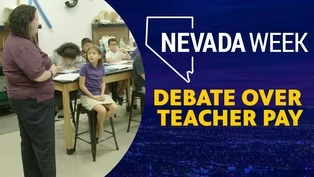
Clip: S6 Ep4 | 7m 1s | April Corbin Girnus explains debate between CCSD and CCEA over teacher pay. (7m 1s)

“Free to Be” at Local Libraries
Video has Closed Captions
Clip: S6 Ep4 | 18m 19s | The Las Vegas-Clark County Library system announces a new education campaign. (18m 19s)
Providing Support for PBS.org
Learn Moreabout PBS online sponsorship
- News and Public Affairs

Top journalists deliver compelling original analysis of the hour's headlines.

- News and Public Affairs

FRONTLINE is investigative journalism that questions, explains and changes our world.












Support for PBS provided by:
Nevada Week is a local public television program presented by Vegas PBS