VPM News Focal Point
Freedom of Speech | February 22, 2024
Season 3 Episode 1 | 26m 46sVideo has Closed Captions
We examine the role of free speech in our democracy.
What is the role of free speech in our democracy? We examine how colleges are dealing with the issue. We meet educators and parents fighting about book banning in public schools and we address the importance of productive debate.
Problems playing video? | Closed Captioning Feedback
Problems playing video? | Closed Captioning Feedback
VPM News Focal Point is a local public television program presented by VPM
VPM News Focal Point
Freedom of Speech | February 22, 2024
Season 3 Episode 1 | 26m 46sVideo has Closed Captions
What is the role of free speech in our democracy? We examine how colleges are dealing with the issue. We meet educators and parents fighting about book banning in public schools and we address the importance of productive debate.
Problems playing video? | Closed Captioning Feedback
How to Watch VPM News Focal Point
VPM News Focal Point is available to stream on pbs.org and the free PBS App, available on iPhone, Apple TV, Android TV, Android smartphones, Amazon Fire TV, Amazon Fire Tablet, Roku, Samsung Smart TV, and Vizio.
Providing Support for PBS.org
Learn Moreabout PBS online sponsorshipANGIE MILES: How important is free speech in America today?
And what are the limits?
Can you say what you wish regardless of whether people feel threatened or attacked?
And what about free speech in print?
Should anyone, even children, have access to every type of book?
Who decides?
And how can we disagree agreeably over matters of opinion?
We'll examine these questions and more.
VPM News Focal Point begins now.
Production funding for VPM News Focal Point is provided by The estate of Mrs. Ann Lee Saunders Brown.
And by... ♪ ♪ ANGIE MILES: Welcome to VPM News Focal Point.
I'm Angie Miles.
Freedom of Speech, it's in the First Amendment to the United States Constitution, and some would argue it's the most essential right in our democracy.
But what about when words can cause actual harm?
Is it ever justified to ban some forms of expression from the public display of the Confederate flag to decisions about books in schools and libraries?
We're talking about freedom of speech, and we begin on college campuses where the debate has reached a fever pitch in recent months.
Special Correspondent A.J.
Nwoko reports.
(bus humming) A.J.
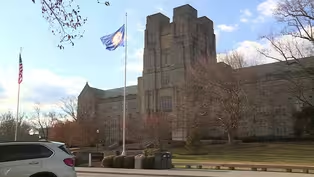
NWOKO: With just over 30,000 students on its Blacksburg campus, there's likely no shortage of differing opinions at Virginia Tech University.
Opinions that sophomore Jacob Williams says he has no issues expressing.
JACOB WILLIAMS: Wanting to go into full-time ministry.
There's a lot of things that I believe and I feel no hindrance in portraying that and no hindrance in accepting what other people believe as well.
A.J.
NWOKO: But for other students, like junior, Ajax Lambert, a member of the LGBTQ community, says she takes a more guarded approach when expressing her thoughts.
AJAX LAMBERT: Being in a certain area where you're not sure if you're really accepted, then, yeah, that can be stressful.
A.J.
NWOKO: But Virginia Tech said that aims to support students through that stress while protecting their First Amendment freedoms.
A method the university once used to achieve this is through the use of a Bias Incident Response Team, or BIRT, a way for the university to engage with students who believe themselves to be the recipients of bias and discrimination.
But in recent years, Tech faced scrutiny from the nonprofit Speech First, an organization that claims to defend free speech, particularly on college campuses.
In 2022, it sued Tech arguing that under BIRT, the university could punish students with the threat of referrals for things said on or off campus.
However, last year, the courts found no evidence that Tech imposed or threatened to impose any discipline on anyone and that BIRT falls within the bounds of acceptable government speech.
Though Tech says BIRT was recently retired, it is still committed to free speech, releasing a statement on its website saying that it values the rights guaranteed by the First Amendment.
But freshmen, like Joi Burgess, say the university should have a more direct approach to addressing student concerns related to incidents of bias because similar methods are still being practiced in her learning community.
JOI BURGESS: If we have any concerns, we can report it to our director and she makes it known that we are allowed to say anything and everything, but I think that might differ if it's for university-wide.
A.J.
NWOKO: Reporting in Blacksburg for VPM News, I'm A.J.
Nwoko.
ANGIE MILES: Since 2020, the organization FIRE has been ranking what they call speech climate for student free speech and open inquiry on college campuses.
In 2024, the organization ranked Virginia Tech 160th out of 250 universities with a slightly below average rating while the University of Virginia and George Mason University both landed among the top 10 with an above average speech climate rating.
ANGIE MILES: VPM News Focal Point has traversed the state asking people of Virginia their points of view on free speech.
support for this right seems unanimous, but what about protections for what some might consider hate speech?
ALYSSA CLEMENS: You know, that's a hard one, because I think when there's opinions that we don't agree with, our first, you know, reaction is we want to correct it or change it.
But I think the more we learn about other people and our differences, we're able to connect better.
THOMAS HANSEN: I think that you can pull out a lot of humanity out of people just by speaking and trying to reach down into somewhere and show, you know, even some of the worst people that, you know, we're all the same.
We the people, you know, even in our Constitution doesn't define by anything except for we are people.
And I think speech is the best way to reach that, not by force or restricting anything.
MORGAN NICELY: You should be able to say how you feel about stuff.
I mean, people should let it go in one ear and out the other if they don't agree with it.
But I mean, you should be able to say what you feel no matter what.
FLORINE BURTON: Yes, it should be protected.
It really should be protected, because everyone have freedom of speech.
JAMES: I think all speech should be protected even hate speech.
I dont view hate speech as like hate speech, I think of it as offensive speech.
BRIAN MURPHY-MOLLOY: That's a hard question to answer.
I don't think hate speech is great.
I'm not, like, down for that at all.
So, I don't know.
That's kind of a gray area.
ANGIE MILES: Recent research shows that people are more conflicted about freedom of expression when it comes to issues on which they disagree.
Few issues have been as divisive in recent years as the use of Confederate symbols in public spaces.
Virginia public schools are navigating the fine line between allowing free speech and maintaining an inclusive school environment.
At the heart of the debate for two school systems is the Confederate flag.
Franklin County and Buchanan County have taken different approaches when it comes to imagery that some consider to be provocative.
Multimedia Reporter, Keyris Manzanares brings us this story.
KEYRIS MANZANARES: In 2020, Franklin County was embroiled in a major debate, should the public school dress code prohibit students from wearing the Confederate flag?
Countywide, this sparked conversations about race, history, and heritage.
PENNY BLUE: If you drive around Franklin County, you will see the Confederate flag flown prominently.
Along with, we still have a Confederate soldier on the courthouse lawn in Franklin County.
KEYRIS MANZANARES: Penny Blue grew up here and attended Franklin County Public Schools.
She remembers what it was like seeing symbols of the Confederacy.
PENNY BLUE: I know what it is to be in a, quote, unquote, "white school system" and to be a Black child and not be seen.
And therefore, I'm always striving to make certain that children feel seen.
KEYRIS MANZANARES: Blue was first elected to serve on the school board in 2013.
She says she felt strongly that students shouldn't be allowed to display the Confederate flag.
But she was constantly met with pushback by other school board members concerned with if banning the flag would infringe on students' freedom of speech.
PENNY BLUE: But freedom and speech in the school system, you restrict students, what they can do all the time.
It's a totally different story.
For instance, I can't tell you what to wear in the public square, but I can tell you what to wear in the public school system.
KEYRIS MANZANARES: Blue says it took the nation witnessing the murder of George Floyd followed by racial reckoning and the removal of Confederate statues to change the minds of those in Franklin County.
The current dress code explicitly prohibits the Confederate flag.
Nicholas Simopoulos, a Richmond attorney who practices education law, says school boards act as legislative bodies with the ability to adopt policies.
NICHOLAS SIMOPOULOS: It seemed that they had, the school board had evidence that the speech in question, the Confederate flag symbol, would actually cause disruption, would actually reasonably interfere with students' rights to be free, for example, from discrimination, and to learn in the school environment.
And so schools are not required to wait for something bad to happen in order to permissibly regulate speech.
KEYRIS MANZANZARES: School districts throughout Virginia voted to remove Confederate names, mascots, and imagery in light of racial reckoning.
But at this Virginia high school, the Confederate flag still greets students every day.
Hurley High School is located in Buchanan County, tucked away in the Appalachian Mountains.
Repeated requests for interviews to discuss the rebel flag display with Principal Greg Tester and Superintendent Sherry Fletcher went unanswered.
Students at Hurley High can't escape the presence of the Confederate flag.
The flag is on the basketball court, gathering spaces, and on athletic gear.
Simopoulos says, while the environments in Franklin and Buchanan County are similar, the key difference is- NICHOLAS SIMOPOULOS: We're talking here about government speech as opposed to private speech.
Not only is the speech supported and endorsed by the principal, but it appears to be supported and endorsed by administrators, which I assume would be the school board itself.
And that's, as a legislative body, they can make that decision, however repugnant somebody might actually find it to be.
KEYRIS MANZANARES: Former Principal Pam Tester defended the flag's prominence in a 2015 article with USA Today, saying, quote, "It means heritage, not hate," and, quote, "You won't find a single person in Hurley who thinks different."
There don't seem to be any public complaints being made about the flags at Hurley, but if there were, individuals could bring them to the attention of their school board, as it's a matter of government speech and they have the power to address it.
For VPM News, I'm Keyris Manzanares.
ANGIE MILES: Many Virginia school systems came under pressure to address schools named after Confederate leaders or bearing imagery connected with the Civil War.
Any policy changes must come through the locality and its school board.
ANGIE MILES: VPM News Focal Point is interested in the points of view of Virginians.
To hear more from your Virginia neighbors, and to share your own thoughts and story ideas, find us online at vpm.org/focalpoint.
ANGIE MILES: Across the country, there's been a surge in attempts to ban books.
Last year in Virginia, the number of unique titles that advocates wanted banned nearly doubled compared with 2022 according to the American Library Association.
In rural Hanover County, book bans have become a political flashpoint.
In 2023, the Hanover School Board banned 91 books from school libraries and classrooms.
Many students say this violates their right to freedom of speech, and they found a way to push back.
Senior Producer Roberta Oster and Multimedia Journalist, Billy Shields, have been following the story.
(people speaking indistinctly) ROBERT MAY: All those in favor of coming back into open session, say aye.
SCHOOL BOARD MEMBERS: Aye.
KRISTEN HOLTE: I am Kristin Holte of the Cold Harbor District.
This school board is truly the firewall protecting the children in the Hanover County public schools from indoctrination, manipulation, sexual pornography, and Critical Race Theory.
JACKSON DeHAVEN: Good evening, my name is Jackson DeHaven.
I'm a high school student from the Ashland District, and I'm here to speak about the implementation of policy 6-5.2.
These books are not porn, they're not obscene.
These are well-respected, highly regarded books that benefit students much more than they harm them.
And I think when just extremely unwise educational decisions are made that limits access to information, which is a really foundational American principle, just to serve the political whims of the moment, I just can't put up with that.
BILLY SHIELDS: Jackson DeHaven wanted to get those banned books into the hands of students, so he founded a nonprofit called The Missing Books and raised funds to buy and distribute the banned books.
JACKSON DeHAVEN: I decided to give the books to students, so that they could bring them in and start our own little underground library.
WOMAN 1: Last week when, last meeting when you had photocopies... JACKSON DeHAVEN: It's just unfortunate to see our school board embrace political interests over the needs of students.
CONNIE PIPER: The board gave themselves the sole authority to add or remove any books from school and classroom libraries.
BILLY SHIELDS: Connie Piper was a school librarian for 30 years.
She recently retired from her role overseeing all of Hanover County School libraries.
She says trained educators should choose books for schools, not an appointed school board.
CONNIE PIPER: The most disheartening thing about all of this is our librarians are highly trained.
They have taken graduate-level courses in collection development, children's literature.
Across history, Hitler, one of the first things he did was pull the books into the streets and burn them.
We know that the Soviet Union banned books back when we had the USSR.
We know that China's banned books.
It's a way to control thought.
If you can control what people read, then you can control what they think, and if you can control the access to information, you can control people.
KATE LINDLEY: Thank you.
I heard the school board deciding, of course, to ban 19 books, and I really felt like I had to do something.
Okay, so we're going to... BILLY SHIELDS: Kate Lindley is a high school senior in the Hanover District who found another way to take a stand against the book ban.
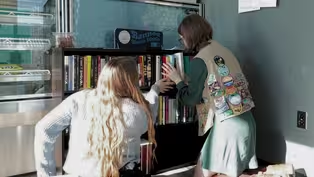
She used her marketing skills as a Girl Scout and brought in friends like Alison Jewel to open two free Banned Book Nook libraries.
She put free copies of the banned books in a local print shop and a donut shop.
KATE LINDLEY: These books are really important to be available, especially to students which are the intended audience, because of a lot of the important representation within them of diverse communities and diverse groups, as well as the resources a lot of them have about the LGBTQ+ community.
But this was one of the first books that was banned back in June, partially due to, or maybe even mostly due to the fact that it is about the LGBTQ+ community.
And a lot of the books that have been banned for being sexual or considered pornographic are, in fact, very important resources or otherwise very important literature, like "The Handmaid's Tale" and "Slaughterhouse-Five" by Margaret Atwood and Kurt Vonnegut, respectively.
(person speaking indistinctly) KATE LINDLEY: So, this is "Looking for Alaska" by John Green, and it was banned for smoking and other substances and alcohol.
But the point of the book is that those things are generally unsafe.
It's about the message that alcohol and substance abuse isn't cool or safe, it's dangerous.
BILLY SHIELDS: Lindley decided to focus on the Banned Book Nook for her Girl Scout Gold Award project.
KATE LINDLEY: I had to do a certain number of journeys... BILLY SHIELDS: The most prestigious award, similar to the Eagle Scout Award for Boy Scouts, and her Book Nooks are being noticed.
KATE LINDLEY: On my Instagram page, I have a Amazon Wish List in my bio, which a lot of people in the community have been very generous with donating and helping fund my project.
I'm not entirely certain what's going through the heads of Hanover County School Board members, but I do believe that whether they intended to or not, this has become a very political issue.
ROBERT MAY: Books that are age inappropriate or contain pervasive vulgarity will not be found... BILLY SHIELDS: Focal Point requested an interview with many members of the Hanover County School Board.
They all declined.
We were able to speak briefly with Jack Dyer, Chair of the Hanover County Republican Committee and an outspoken supporter of the ban, but he says he has not read the books in question.
JACK DYER: I was shown the books and the excerpts from the books and the illustrations from the books, and I'm not going to read any of the books.
We need to stick with core curriculum, and some of the books that I have seen, the illustrations, the language, actually just the explicit sexual content don't belong in K through 12.
PATRICIA HUNTER-JORDAN: We are denying our children the right to experience, to learn about other cultures.
Because specifically if you look at the list of books that have been, as they say, "deselected" those books primarily relate by authors of Jewish ethnicity, Black, or LGBTQ.
Those are the books that are being quote, "deselected."
BILLY SHIELDS: Pat Jordan has been fighting for freedom of speech and equity her whole career.
She says that banning books is a way to silence minority voices.
PATRICIA HUNTER-JORDAN: Ideas come from books, understanding comes from books and especially the understanding of other cultures and other people.
This is a big world.
Most of our children in Hanover don't grow up and remain there, they leave, and they need to be prepared to face a world that is not like Hanover County.
JACKSON DeHAVEN: Freedom of thought is the underlying value behind free speech, that in order to make free speech mean anything, we have to be free to think, and to be free to think, you have to be free to learn.
And to read widely, you have to have access to lots of different perspectives, experiences, and opinions.
BILLY SHIELDS: Meanwhile, in a corner donut shop in Mechanicsville, a couple of teens are taking a stand, they say, so that all students can continue to think freely.
ANGIE MILES: Jackson DeHaven's nonprofit has now given away approximately 150 banned books.
Kate Lindley's project has distributed 375 books, and the school board is considering removing additional books from school libraries and classrooms.
The students and their friends continue to defend what they call their right to read.
ANGIE MILES: We often support the right to free speech when we agree with the speaker, but what happens when we hear something we don't like?
We're joined today by Suzanne Nossel, the CEO of PEN America.
This is an organization that promotes free speech, and she's the author of the book, "Dare to Speak: Defending Free Speech for All."
Thank you for joining us.
Can you give us a brief synopsis of your argument in the book.
SUZANNE NOSSEL: I look at how to live together, how we can live together in our diverse, digitized, and divided society without curbing free speech.
We are going to disagree living in such a diverse society, and so, what I've set out in the book are 20 principles for how we can surmount that and how we can make free speech work for us in a society that is so heterogeneous.
And it requires some obligations on our part as citizens, as speakers, as listeners.
And so, it's a set of precepts that in my view are kind of necessary to keep this core constitutional principle of free speech alive in the 21st century.
ANGIE MILES: Do you have any recommendations specifically for how we can maybe avoid some of the tiptoeing around free conversation and debate that we seem to see more of today?
SUZANNE NOSSEL: We need to be teaching and learning the skills for dialogue across difference, how to disagree with someone without denigrating them, how to apologize if you've said something how to apologize if you've said something that's inadvertently offensive, when to forgive someone else who may have used the wrong word or a phrase that bothered you, and how to kind of navigate these tough conversations in a civilized way, so that there's a real kind of give and take, because ultimately, free speech, it's not just about shouting into the void.
It is about a give and take, persuasion, being able to surface the best ideas in conversation with others, and it turns out, that is a skill.
ANGIE MILES: We appreciate your time That's Suzanne Nossel, who is author and CEO of PEN America.
We appreciate you.
(upbeat music) (upbeat music) ANGIE MILES: You can watch the full interview on our website.
ANGIE MILES: Race, religion, politics, it can be difficult to talk about these things with someone who disagrees with you, but learning how to disagree agreeably could offer a solution to America's political polarization.
News producer Adrienne McGibbon shares how a program happening in Virginia and around the country sets out to foster empathy and compassion through conversation.
MODERATOR 1: Again, my name is Claire.
PARTICIPANT 1: All right.
MODERATOR 1: And- PARTICIPANT 1: Do we pick a side?
MODERATOR 1: Yeah, so- It's really nice to meet you guys.
I'm really grateful you're here.
FRAZIER MILLNER ARMSTRONG: "One Small Step" is a program of StoryCorps, and it is designed to bring strangers together, strangers that are from opposite ends of a political spectrum, to have a moderated 50-minute conversation about what they actually have in common instead of what divides them.
MODERATOR 1: The recording is about 45, 50 minutes.
You'll know when you have about five minutes left when I point to the conclusion question.
FRAZIER MILLNER ARMSTRONG: People were tired of being divided, they were tired of being anxious, and really wanted an opportunity to sort of come together and talk about what they had in common, so "One Small Step" was born.
STUART SCOTT: We are so wrapped up in media, what's my side you know, my team, and it's no exchange or opportunities for us to get to know each other.
Even families have difficulty communicating.
SUSAN TETTERTON: It's a way to take a look at another person and their perspective that I haven't thought of.
MODERATOR 2: So we're going to go right in here.
FRAZIER MILLNER ARMSTRONG: But the magic of this is in those moments when two people from opposite ends of a spectrum, political, social, cultural, racial, come together.
And I believe that innately, we want to find what we have in common.
STUART SCOTT: Here was a chance for me to articulate my views, my feelings, and the things that helped develop me to be that way.
And surprisingly, Susan was a great companion.
We had a lot in common.
And I hope that those that try this will come away with the same experience, realize that from different parts of the worlds we may be, but we are just so similar in a lot of ways.
SUSAN TETTERTON: Stu would pick up on some of the things that I was saying, and he would press me about that.
And he would say, "Well, you've said this a couple times," and "Why do you feel that way?"
and "What do you think?"
And it was really, it was really good.
PARTICIPANT 2: Like, yeah, that's cool, man.
I like that.
PARTICIPANT 3: Well, you forget, you know, you forget where are you for a moment, in a good way.
FRAZIER MILLNER ARMSTRONG: They may take what you tell them and say, "I don't understand," or "Help me understand," or "I don't want to understand."
All of those things happen in the space of 50 minutes.
SUSAN TETTERTON: It's really fun to sit and talk to someone who has a different viewpoint.
There's so many interesting stories that people have that you probably don't know about unless you sit and talk.
STUART SCOTT: The testimonies and the experience of people who have experienced this, it will catch, it will grow.
And then we can endeavor in our own communities, whatever they may be, we can begin to have dialogue.
Let me tell you a little bit more of something about myself.
You might not like it, but at least you have learned something about me, and then that's the real winner, I think, you learn something.
PHOTOGRAPHER: All right, three, two, and one.
ANGIE MILES: Richmond was chosen as one of four One Small Step anchor communities across the U.S.
It's hosted more than 500 conversations since 2021 and VPM partnered with StoryCorps to launch the program in Richmond.
Thank you for watching Focal Point.
Be sure to find us online at vpm.org/focalpoint to offer your feedback and story ideas.
Also, there you can find our digital extra “Defining Freedom of Speech, ” our extended interview with Suzanne Nossel, along with content from earlier episodes.
We look forward to seeing you next time.
Focal Point is provided by The estate of Mrs. Ann Lee Saunders Brown.
And by... ♪ ♪
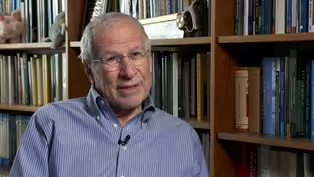
Defining free speech and why it's a counter-intuitive idea
Video has Closed Captions
Clip: S3 Ep1 | 3m 45s | Frederick Schauer explains how free speech is counter-intuitive and commonly misunderstood (3m 45s)
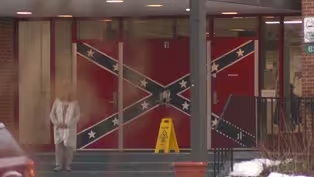
Confederate imagery in Virginia public schools
Video has Closed Captions
Clip: S3 Ep1 | 4m 11s | Confederate symbols prompt debate about what’s appropriate in schools (4m 11s)
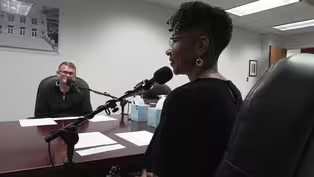
Disagreeing Agreeably: How Conversations Could be a Cure
Video has Closed Captions
Clip: S3 Ep1 | 3m 34s | How do you talk to someone when you disagree? The key to having difficult conversations. (3m 34s)
Is the solution to offensive speech more speech?
Video has Closed Captions
Clip: S3 Ep1 | 11m 5s | Some argue the way to push back against offensive speech is by allowing even more speech. (11m 5s)
Responding to incidents of bias on college campuses
Video has Closed Captions
Clip: S3 Ep1 | 2m 40s | Is the right to freedom of speech guaranteed at institutions of higher learning? (2m 40s)
Students fight a book ban by giving away free banned books
Video has Closed Captions
Clip: S3 Ep1 | 7m 45s | Hanover Co. School Board banned 91 books. Students say this violates freedom of speech. (7m 45s)
Providing Support for PBS.org
Learn Moreabout PBS online sponsorship
- News and Public Affairs

Top journalists deliver compelling original analysis of the hour's headlines.

- News and Public Affairs

FRONTLINE is investigative journalism that questions, explains and changes our world.












Support for PBS provided by:
VPM News Focal Point is a local public television program presented by VPM