Freedom's Footsteps: A Southern Perspective on the American Revolution
Freedom's Footsteps: A Southern Perspective on the American Revolution
11/16/2025 | 28m 28sVideo has Closed Captions
Southern perspective to the American revolution, magnifying the story of the Mecklenburg Declaration
Freedom's Footsteps reveals a southern perspective to the American revolution that magnifies the story of the Mecklenburg Declaration, and delves into the events leading up to this pivotal moment in American history. Learn about the bold actions taken by the citizens of Mecklenburg County in 1775, who declared independence from British rule over a year before the Declaration of Independence.
Problems playing video? | Closed Captioning Feedback
Problems playing video? | Closed Captioning Feedback
Freedom's Footsteps: A Southern Perspective on the American Revolution is a local public television program presented by PBS Charlotte
Freedom's Footsteps: A Southern Perspective on the American Revolution
Freedom's Footsteps: A Southern Perspective on the American Revolution
11/16/2025 | 28m 28sVideo has Closed Captions
Freedom's Footsteps reveals a southern perspective to the American revolution that magnifies the story of the Mecklenburg Declaration, and delves into the events leading up to this pivotal moment in American history. Learn about the bold actions taken by the citizens of Mecklenburg County in 1775, who declared independence from British rule over a year before the Declaration of Independence.
Problems playing video? | Closed Captioning Feedback
How to Watch Freedom's Footsteps: A Southern Perspective on the American Revolution
Freedom's Footsteps: A Southern Perspective on the American Revolution is available to stream on pbs.org and the free PBS App, available on iPhone, Apple TV, Android TV, Android smartphones, Amazon Fire TV, Amazon Fire Tablet, Roku, Samsung Smart TV, and Vizio.
Providing Support for PBS.org
Learn Moreabout PBS online sponsorship(uplifting music) - [Sponsor] This is a production of PBS Charlotte.
(inspiring music) (colonial marching music) - [Narrator] Prior to July 4th, 1776, before the world knew the words Declaration of Independence, a bold stand for freedom was already taking shape in the Carolinas.
- If you like detective stories and you like history, and you like nerdy subjects, then this is the story for you.
- [Narrator] On May 20th, 1775, nearly 14 months before the Declaration, Mecklenburg County's founding fathers declared their independence from Britain.
- The Mec Dec is the document that made Charlotte and North Carolina the true cradle of American independence.
- [Narrator] But was it fact or just urban legend?
- The big mystery is why is there a controversy?
- As my co-counsel previously stated- - [Narrator] A group of high schoolers put history on trial at the Federal courthouse to uncover the truth.
- Today's case is not just about a date on a flag, it's about the preservation of our history.
- [Narrator] We'll revisit some of the battles fought on Carolina soil, including the clash that earned us the nickname, The Hornet's Nest of Rebellion.
(bayonets firing) And we'll step inside the lives of early settlers, how they lived, how they worshiped, and how ordinary people shaped the extraordinary fight for independence.
(bayonets firing) As America prepares to celebrate 250 years of freedom, we remember the brave settlers that marched us closer to liberty and the stories that still shape who we are today.
(drum marching music) "Freedom's Footsteps, A Southern Perspective to the American Revolution".
- [Sponsor] Funding is provided in part by Anne Waters Dowd in loving memory of her husband, W. Frank Dowd III.
And by Bragg Financial serving high net worth families with portfolio management and planning advice, Bragg Financial is committed to our clients and our community, braggfinancial.com.
(colonial music) (canons blasting) - [Narrator] 250 years ago from 1775 to 1783, the Revolutionary War was the catalyst for American independence.
Reminders of this monumental event can be seen all over in places like Charleston's, Historic District, Boston's Freedom Trail, and Philadelphia's Independence Hall, cities where history is everywhere.
But in Charlotte, a gleaning light of the new south with its banking industry and glass and steel skyscrapers, history is not quite as visible.
- In the name of progress, we've forgotten the very sort of origin story that makes us unique and special, and probably the envy of every town in America.
- Charlotte, all its historic for the most part, monuments and homes, and so forth are gone.
So you have to sort of imagine what it looked like in 1775 or 1780 when the British marched through town.
- [Narrator] Charlotte's ties to the Revolution run deeper than most people may be aware.
Here you just have to look around a little bit to find it.
- And it's hiding in plain sight if you live in Charlotte-Mecklenburg but so few people have heard of it.
- This is the cradle of American independence, whether people want to acknowledge that or not.
- [Narrator] There's Independence Square, where Trade meets Tryon in the heart of uptown.
Various plaques, signs in historical markers around uptown, the Spirit of Mecklenburg statue on the outskirts of uptown, Independence Expressway, Freedom Park, and the state's First In Freedom license plate.
- So when you tell people or you learn about all of these connotations in Charlotte history, Freedom Park, Independence Square, the date on the state flag, and you think, "How come no one's told me this?"
- It's so important for all of us as North Carolinians to know a little bit about our history.
The top yellow ribbon on the state flag, May 20th, 1775, what is that?
What does it stand for?
- [Narrator] The Carolina Piedmont region was first developed by a migration wave of Scotts, Irish, Presbyterians.
They named it Charlottetown in honor of the wife of Great Britain's King George, Queen Charlotte from the Mecklenburg region of Germany.
- Our city's story began in 1755.
- We were established at the crossroads of two first people's trading paths.
- They built a town and named it for a queen, hoping to maintain peace with the king.
- We were taxed without representation, British soldiers were killing our fellow colonists without cause.
- Imagine Charlottetown as it was then, a frontier village restless with tension and uncertainty.
Ordinary people going about their daily lives in the town square, unaware that word of bloodshed between British soldiers and colonial farmers in Massachusetts is about to arrive, and with it everything changes.
(colonial music) - [Narrator] On the evening of May 19th, 1775, town leaders gathered at the Mecklenburg County Courthouse, at the corner of Trade and Tryon.
- [Scott] 26 militia leaders, Scotts, Irish, Presbyterians, are meeting in the log courthouse in uptown Charlotte.
- When those men on the 19th, heard from the rider from the north that King George had done the unthinkable, sent his soldiers to kill his citizens, how would they react?
- And they go ballistic and they get very agitated.
And over a series of 24 hours, they debate the series of resolutions, which we now call the Mecklenburg Declaration of Independence, in which they say that the County of Mecklenburg is quote, free and independent, close quotes of Great Britain.
- It was this unique, perfect storm of people, religion, context, what was going on with the king.
- [Narrator] On May 20th, 1775, the Mecklenburg Declaration of Independence was read aloud by Thomas Polk from the top of the courthouse steps.
- Our intent to declare our freedom... - Because they were feisty Scotts, Irish, Presbyterians, they were like, "Let's just put it in writing and get to fighting."
- And hereby absolve ourselves from all allegiance to the British crown.
(audience stirring) - It is the first formal Declaration of Independence in America.
- Huzzah!
- Hip-hip... - Huzzah!
- Hip-hip... - Huzzah!
(empowering music) - [Narrator] That day May 20th, 1775 is now emblazoned in a yellow ribbon across the top part of the North Carolina state flag.
And it came more than a full year before the national Declaration of Independence on July 4th, 1776.
- How have I not heard of this story, this incredible wrinkle of American history?
It's just insane.
- We are free!
- To North Carolina and freedom!
(everyone cheering) - [Narrator] After the Mec Dec was signed, local tavern owner, Captain James Jack, rode by horseback some 500 miles, delivering it to the Second Continental Congress in Philadelphia.
- What brought me to Charlotte was my great-great-great-great grandfather, Captain James Jack.
His tavern was one block down Trade street.
He had been born in Lancaster, Pennsylvania so he knew the way back to Pennsylvania.
- And he does this, he delivers this Mec Dec and they say, "This is premature.
We're debating something called the Olive Branch Petition to avoid a civil war with Great Britain."
And they send him home and at that point, the story more or less would've been done, but for the original papers are lost later in a fire in 1800.
And you get in a whole debate between Jefferson and Adams in the 19th centuries about whether the story's true or not.
But because the original papers are gone and will never be found, the entire story relies on eyewitness testimony and other collateral, circumstantial evidence that it happened.
- [Narrator] Fact or fiction?
Whether it truly happened or not is up for debate, and we'll revisit that question momentarily.
But what is undeniable is that within a few short years, the American colonies were at war with the mother country.
(canons firing) (bayonets firing) By May of 1780, the revolution in the south teetered on the brink of ruin, Charleston had fallen.
Through that long summer, the British pressed their advantage, cutting down patriots at Waxhaw, scattering militias at Camden and Fishing Creek.
Each blow seemed to confirm British confidence that the south and perhaps the entire revolution, was already theirs.
- There was a great hope that loyalists would come out to support the crown.
That the British force could suppress the rebellion in the back country that was taking place.
And this would lead to a more British success in this later stage of the war.
- [Narrator] These successes though, came with a cost.
Victories on the battlefield were one thing but maintaining them in a hostile and unfamiliar land, would prove something else entirely.
- The further he gets in the back country, the harder it is for him to supply his troops.
What he's actually interested in, a lot of times are the farms.
He wants the food, he wants their crops, and their stores, right?
He wants their animals.
- [Narrator] Cornwallis's army seized crops, slaughtered livestock, and turned homes into temporary barracks.
In Charlotte, no household was spared.
The home of Hezekiah Alexander, a respected patriot leader, was taken over and left in ruins.
- We call it the honey stone because the story's that Cornwallis's troops, basically broke into the cellar of the house, drank all the honey, ate the jam, and smashed the jars on that carriage stone in front of the house.
- [Narrator] Out of this bitterness, Cornwallis marched towards Charlotte, a town already infamous in British circles for its defiance.
- They had been tarring and feathering tax collectors.
They had been firing upon British officials, they had been refusing to pay their taxes and to follow the British laws for probably 15 or 20 years by the time 1780 rolls around.
- [Narrator] September 26th, 1780, 2,500 British troops marched up South Tryon Street, where Colonel William Davy was waiting.
At the crossroads of Trade and Tryon, 150 Patriot militia fortified the courthouse square.
Behind fences and shop fronts, they poured fire into the British advance.
- They stopped and Cornwallis apparently rode up and referring to their string of recent victories said, "Legion remember, you have everything to lose and nothing to gain."
And they went in and with the help of the infantry, forced the Americans out.
Charlotte was no prize at all, only a costly warning of the resistance to come.
Lord Cornwallis took over Charlotte and stayed here in Charlotte for about two weeks and had a very miserable time in Charlotte.
Apparently called... He called this area a hornets nest.
- [Narrator] The Patriots borrowed the fighting tactics once taught by the kataba during the French and Indian War.
- They would aggravate the British, they'd hit 'em and run away.
And that's why the British didn't like it, because they didn't stay, they didn't stand in line, and they didn't fight the way the British wanted to fight.
They would hide behind trees, they would shoot, they would go back, they would, you know, come back and hit again.
- If you have a gun barrel that has rifling in it, for example, then that makes you a little more accurate, it allows you to hide a little better, and it allows you to protect yourself in addition to being a better offensive weapon.
- [Narrator] If Charlotte was the warning, the reckoning came 11 days later at King's Mountain.
British Major Patrick Ferguson, marching to join Cornwallis in Charlotte, found himself pursued by nearly 900 patriot militia from the Carolina back country and the fierce over mountain men cut him off.
- When Patrick Ferguson came to King's Mountain, he wasn't planning to fight a battle here.
His plan was to rest, recuperate his army.
He was on the road to Charlotte, he was hoping that he would get reinforcements from Lord Cornwallis.
- [Narrator] The first column drew fire and threatened the flanks.
Then a second swept in from the rear closing the trap, and completing the encirclement.
- Three times, the royal provincials will charge down the slopes of King's Mountain here on the left, chasing the over mountain men before them, down into this ravine on my right and up the other side.
The over mountain men didn't run away.
As soon as they realized, they were no longer being pursued, they turned around.
Whereas moments before, they were faced by the bayonets at the royal provincials, now they were faced with their backs and they poured their fire into them.
- [Narrator] Among the patriots at King's Mountain, were three African Americans whose service was not symbolic but decisive.
15-year-old Andrew Ferguson, took his place in the line of fire.
John Broddy, Aide to Camp to Colonel William Campbell, carried his duty through the entire war.
And Esaias Bowman with steady aim, is remembered for firing one of the battle's most fateful shots.
- Once the royal provincials have been broken as a fighting unit, starting from 120 men and being reduced to 53, the Virginians and the Tennesseans will be able to move in and occupy the peak of King's Mountain.
Beginning the process of pushing the loyalists down to the lower end of King's Mountain and circling them so that they can then be destroyed.
- [Narrator] With smoke thick on the ridge and his ranks collapsing, Ferguson mounted his horse and led one final desperate charge.
- He had told the men that God Almighty, could not remove him from the mountain.
And it actually turned out to be truth.
- The militiamen held firm and they met his charge with a hail of gunfire.
Nine men, including Esaias Bowman, claimed to have fired the shot that killed Major Patrick Ferguson.
When his body was recovered following the battle, he was found to have been struck seven times.
- Even Thomas Jefferson said that it turned the tide of success that won for America, its seal of Independence.
- [Narrator] Two months later at Guilford Courthouse, Cornwallis claimed the victory but paid a huge price.
A quarter of his army was lost, leaving his force too weak to hold the Carolinas.
- Guildford Courthouse was very much what one might call a Pyrrhic victory.
And when news got back to London about that, the British parliament realized that the war was over.
- [Narrator] In the South, the Patriots endured not by matching the British and open fields, but by striking from the woods and swamps.
Gorilla tactics, born of necessity and sharpened by frontier skill bled Cornwallis's army dry.
In the end, it wasn't the might of the empire but the resilience of ordinary Americans that carried the day.
(cannons firing) The revolution ended in 1783 with the British surrender, giving the United States its independence.
A new country was born and as for the Mecklenburg Declaration of Independence, it was to have burned in a house fire in 1800, becoming largely forgotten.
There were no copies or newspaper articles about it, and complicating matters even more, the writing of the Mecklenburg Resolves, which came 11 days after the Mec Dec.
- The Mecklenburg Declaration severed the ties to Great Britain, whereas the Resolves kind of formed a government.
So one would think that the forming of the government had to take place after the ties were were severed.
- So if you believe the Mec Dec story as told by the eyewitnesses, you say, "Well this is collateral evidence of the whole thing."
So on May 20th there's a Declaration of Independence and 11 days later there are these things, and this is them setting up a government.
It's a very logical argument.
- The story may be great but it is a legend nonetheless.
- North Carolina has every right to be proud of its revolutionary legacy but pride must be grounded in fact.
And we contend that the document at issue here, the so-called Mecklenburg Declaration of Independence, it is not supported by the historical record.
- If you are a skeptic of the of the story, you say, "This is all that happened and all the eyewitnesses you produce, were not saying they're lying, but they're given their testimony 50 years later and they're misremembering and conflating in their own minds, a meeting that occurred but it occurred on May 31st and they drafted these resolutions, which while interesting, do not rise to the level of a Declaration of Independence that everyone's been saying they do."
- [Announcer] Carolinians will long remember the telecast of President Eisenhower's speech on the 179th anniversary of the signing of the Mecklenburg Declaration of Independence, which originated from Freedom Park in Charlotte.
- [Narrator] For over a hundred years, May 20th was an official state holiday with president's William Taft, Woodrow Wilson, Dwight Eisenhower, and Gerald Ford each coming to Charlotte to celebrate the Mec Dec anniversary.
- 1975, when Ford came here to Freedom Park and spoke with with Billy Graham, was really the high watermark of this whole thing for 200 years.
You know, this story has its ebbs and flows throughout history where you know, it's wildly celebrated with presidents and then 20 years later no one remembers it.
- [Narrator] And keeping it in the public eye, is the reason local attorney and historian Scott Seifert co-founded The May 20th Society.
He's written a book about it, "The First Declaration of Independence".
- So we started the May 20th Society 20-ish years ago when we heard the story and we had a group of sort of young professionals, all who thought it was really interesting.
And we sat around in a bar and said, "What do we do with this story?
How do we celebrate it, how do we bring it back?"
And it was as simple as that.
- [Narrator] Award-winning author and journalist David Fleming, also wrote a book on the Mec Dec, "Who's Your Founding Father?"
He also does bus tours, showing the places where these historical events once took place.
- Even people who are interested in history, we take 'em to some of the stops and they're just like, "I can't believe this is here."
(colonial music) - [Narrator] The May 20th Society, no doubt had to be pleased when the 250th anniversary of the Mec Dec arrived.
Huge crowds gathering at the corner of Trade and Tryon for the festivities.
- Today is a special day for our community.
- This is a very important historical event for us and it's important for Charlotte.
- It's good to see us celebrating history on the 250th anniversary.
- The 250th, I had to be here.
- So it's fun to see this much... This many people get together and just celebrate it.
- I'm a descendant of John Foard, one of the signers so I'm here to learn more about that history and take a deeper dive.
- [Narrator] Descendants of the Mec Dec signers are still in the area today.
Living much different lives though than their ancestors did some two and a half centuries ago.
(choir music) At Statesville First Presbyterian Church, the music soars beyond these church doors.
(inspiring choir music) During Sunday services, they've been celebrating here since the 1750s, back when the church was known as the Fourth Creek meeting House.
It was pictured in history books as a simple log cabin, where colonial planters and their families came to worship and where the stone walls of the original Fourth Creek burying ground still surround the graves of old souls and old soldiers, the patriots who walked in freedom's footsteps.
- So it's important to me because they paid it forward to us, and I want to pay it back.
- [Narrator] Scott Stevenson is the caretaker here at the old graveyard.
He says, these markers are etched with memories.
- Mussenden Matthews was a Colonel, I believe in the Revolutionary War in the militia and... - [Narrator] As Stevenson walks us from stone to stone and from story to story.
- [Narrator] There's a story that he and James Hall, the reverend, the preacher here, were coming outta the woods, they were looking for the British.
They came outta the woods and off in the distance there was a house and there were British soldiers there mounted, you know.
And just kind of startled them 'cause they were two against 20 or more.
Mussenden Matthews kicked his horse, reared it up, yelled into the woods, some sort of a yell, making the British think there were more people in the woods and so the British fled.
- [Narrator] Stevenson adds that Reverend James Hall, the Presbyterian preacher who founded Fourth Creek, was also a Captain in the North Carolina cavalry, recruiting troops from Fourth Creek's congregation, then leading them into battle against the British.
- He led the militia, he was offered a promotion to general, I think by General Green.
And he declined it 'cause he wanted to come back here and preach.
He wanted to be with his flock.
- So Reverend Hall, of course, was minister at Fourth Creek, head of there, and he was very much for the revolution.
He became a commander of a couple of regiments of troops that were mustered here in the area.
But he felt his biggest call and biggest way of influencing was from the pulpit, not being in command of troops.
- [Narrator] Andy Poore is the Iredell County historian at the Mooresville Public Library.
He says it was common for colonial ministers like Reverend Hall to preach politics from the pulpit, turning the colonies fight for freedom from the British, into a biblical David and Goliath sermon on Sundays.
- Yes, long before social media.
(Andy laughs) The pulpit was a way of getting messages out, getting information out because everybody in those days came into church and the ministers used that to their advantage to help push ideas, to help foster ideas, or new thoughts on what was going on in a nonviolent way.
- [Narrator] But as the husbands and sons rode off to the battlefields against the British Goliath, what became of the families here in the Carolinas they left behind?
- If this room could talk, it would have lots of different stories to tell about the revolution.
- [Narrator] Kendall McGeorge takes us on a tour of the Hezekiah Alexander House, built in 1774.
- This is where the Alexander family would've welcomed any guests that were coming.
(peaceful folk music) - [Narrator] It's the oldest home in Charlotte, 10 miles from the closest actual fighting back then but like most households, never far from the revolution itself.
- You think about soldiers in uniform carrying muskets but the revolution was happening everywhere around us.
In the homes, in the fields, in the taverns, everybody was involved in one way or another, depending on what side you were on.
Doesn't matter, everybody was a part of this revolution.
- [Narrator] McGeorge, who's the Public Programs Manager for the Charlotte Museum of History, says there was also risk from red coats raiding them for supplies.
- They're taking your food, they're taking your horses, they're taking everything that you own.
So it's a really like neighbor helping neighbor kind of thing.
- [Narrator] McGeorge adds that one British raid north of Charlotte, known as the Battle of the Bees, was stopped when a local child discovered ahead of time what the red coats were planning.
- A young boy saw them and ran ahead and warned all of these farms.
And then he went and got a couple of Captains for the militia who got 13 more soldiers, so 15 people all together, set up at McIntyre Farm and were able to catch the British off guard so well, especially with the help of a beehive, to actually get them to retreat.
- [Narrator] With the men and many households away, it was often colonial women who took over the additional duties at home, working the family fields or running the family business.
- [Kendall] There were also women making the clothes, making the uniforms, making the ammunition, tending to the soldiers.
And the women that are following these army encampments and really helping to keep them going, were known as camp followers.
- [Narrator] McGeorge says some colonial women actually fought in the war too, disguised as men.
And the boldest political move by women may have been the Edenton Tea Party Resolves.
- It was a protest document signed in Edenton, North Carolina in 1774.
What makes this document is so unique, is that it was signed by 51 women.
This was the first time in all of colonial history that we have a known record of women signing a document, solely and exclusively by women for women.
- [Narrator] Katie Hatton is North Carolina's Editor for Colonial Records, telling this Charlotte audience that unlike the Boston Tea Party, where the men who protested hid their identities, the names of the women signers in Edenton were published in newspapers here and England, openly defined British taxation and risking political punishment in the process.
- As far as we know, this is the earliest known example of political activism by women during the American Revolution, happening here in Edenton, North Carolina.
They publicly took charge and said you know, "I am signing this and here's who I am.
British Parliament, you know, come get me if you care so much."
- [Narrator] Back now to modern time, and the mock trial.
After a full day of compelling arguments about whether the Mec Dec actually happened or not, it was time for final arguments.
- The Supreme Court of the State of North Carolina and the United States District Court for the Western District of North Carolina are sitting in joint ceremonial session.
- This case is not about whether the people of Mecklenburg were bold, they were.
It is not about whether they took decisive, courageous actions in May of 1775, they did.
My co-counsel, Ms.
Mooring, argued that the Mecklenburg Declaration was a confusion of the Mecklenburg Resolves.
- We respectfully urged this court to put proof over pride, not story over substance.
- There is a significant amount of evidence pointing back to May 20th, 1775, such as accounts, papers, records, commemorations, and this is all evidence pointing back to something.
And where there's smoke, there's fire.
- Beginning in 1829, the North Carolina General Assembly began collecting eyewitness testimony to be what it was created into the 32 page Governor's Report that was produced in 1831.
Those 32 pages encapsulate 12 eyewitness accounts that were published to the public that granted us the concrete understanding that the Mecklenburg Declaration was in fact the events of May 20th, 1775.
- Alright, y'all are amazing.
- [Narrator] The three judges after long deliberation, coming back with their verdict, citing strong evidence, their ruling?
The Mec Dec did in fact happen.
- We have affidavits that were put together from eyewitnesses who were there, one who participated in the Mecklenburg Declaration of Independence.
There was a lot of good evidence.
- The champion of the Mecklenburg Declaration Mock Court Competition State Finals is Research Triangle High School.
(audience applauds) - [Narrator] Over the last half hour, we've told you about the area's early settlers, the Scotts, Irish, Presbyterians, learning more about what their lives were like in the late 1700s.
How they sought freedom by declaring independence from Great Britain more than a full year before the nation did.
With the legitimacy of that declaration prevailing in a federal courthouse trial.
And how those same early settlers, use new and innovative ways of fighting on the battlefields, fending off British forces to win their independence.
"Freedom's Footsteps, A Southern Perspective to the American Revolution".
- [Sponsor] Funding is provided in part by Anne Water's Dowd, in loving memory of her husband, W. Frank Dowd III.
And by Bragg Financial, serving high net worth families with portfolio management and planning advice.
Bragg Financial is committed to our clients and our community, braggfinancial.com.
(inspiring orchestral music) (inspiring orchestral music continues) (inspiring upbeat music) A production of PBS Charlotte.
(inspiring music)
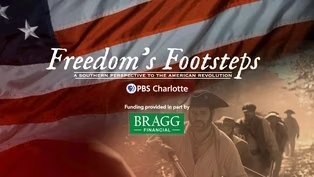
Freedom's Footsteps: A Southern Perspective on the American Revolution Preview
Preview Freedom's Footsteps, magnifying the story of the Mecklenburg Declaration of Independence. (30s)
Providing Support for PBS.org
Learn Moreabout PBS online sponsorship













Support for PBS provided by:
Freedom's Footsteps: A Southern Perspective on the American Revolution is a local public television program presented by PBS Charlotte