
Friends in Prairie Farm
Season 8 Episode 2 | 36m 10sVideo has Closed Captions
Inga learns all about fresh cut flowers, a rare breed of goat and pumpkin seed oil.
Inga travels to the small community of Prairie Farm, Wisconsin to visit three unique farms. Along the way she learns about the importance of buying locally-grown flowers, preserving a rare breed of goat, and how a married couple developed America’s first organic pumpkin seed oil. She prepares a meal of corn chowder to share with her new friends.
Problems playing video? | Closed Captioning Feedback
Problems playing video? | Closed Captioning Feedback
Around the Farm Table is a local public television program presented by PBS Wisconsin
Funding for Around the Farm Table is provided by Wisconsin Farmers Union, a gift in memory of Wendy Bladorn, Marge Engelman, the Focus Fund for Wisconsin Programs, and Friends of PBS Wisconsin.
Friends in Prairie Farm
Season 8 Episode 2 | 36m 10sVideo has Closed Captions
Inga travels to the small community of Prairie Farm, Wisconsin to visit three unique farms. Along the way she learns about the importance of buying locally-grown flowers, preserving a rare breed of goat, and how a married couple developed America’s first organic pumpkin seed oil. She prepares a meal of corn chowder to share with her new friends.
Problems playing video? | Closed Captioning Feedback
How to Watch Around the Farm Table
Around the Farm Table is available to stream on pbs.org and the free PBS App, available on iPhone, Apple TV, Android TV, Android smartphones, Amazon Fire TV, Amazon Fire Tablet, Roku, Samsung Smart TV, and Vizio.
Providing Support for PBS.org
Learn Moreabout PBS online sponsorship>> HI.
I'M INGA WITSCHER.
YOU'RE ABOUT TO ENJOY AN EPISODE OF "AROUND THE FARM TABLE."
CREATING A SHOW IS JUST LIKE FARMING.
IT NEEDS SUPPORT FROM EVERYONE.
IF YOU'D LIKE TO MAKE A GIFT TO SUPPORT SHOWS LIKE "AROUND THE FARM TABLE" AND OTHER PBS SHOWS, YOU CAN JUMP ONLINE RIGHT NOW OR GIVE US A CALL ANYTIME.
WE REALLY APPRECIATE YOUR SUPPORT!
- Narrator: The following program is a PBS Wisconsin original production.
[gentle acoustic guitar music] - Inga Witscher: There's nothing better than sharing a meal with friends, gathering around the table, enjoying home-cooked food with fresh ingredients and sharing stories about how we live our lives as farmers.
That's what brought me to the small community of Prairie Farm, Wisconsin.
Welcome to Prairie Farm, Wisconsin.
I'm here today to enjoy a meal with these amazing farmers and to find out what brought them to this wonderful small community in northwestern Wisconsin.
Along the way, we'll learn more about the unique things that they're doing on their farms, and we'll cook and eat some delicious food.
Gather with us, Around the Farm Table .
I'm your host, Inga Witscher.
[cows mooing] Hey!
I'm Inga, a fourth generation dairy farmer, milking cows and making cheese on my small farm in Wisconsin.
I'm passionate about exploring new places, meeting new people, and finding the best local ingredients that I can turn into delicious meals.
I would like to invite you along on this food and farming adventure.
Sometimes, you find the most interesting people in the most unexpected places.
[upbeat guitar music] Ken and Jay are a wonderful couple who I've been inspired by for years.
They came to Prairie Farm to try something new and original.
[upbeat electric guitar music] - My name is Ken Seguine.
- I'm Jay Gilbertson.
- And we are the proud owners and founders of - In unison: Hay River Pumpkin Seed Oil.
[upbeat electric guitar music] - Americans love pumpkins, and you know, they're actually native to the Americas.
They really became very popular in Europe.
And in about the 1600s, the Austrians started taking the seeds and pressing the seeds for the oil.
And you know, the pumpkin seed oil, it tastes delicious.
And so we think a lot of Americans, if they tried it, would also enjoy it too.
- Inga: Thank you so much for having me out to the farm.
Everything looks absolutely gorgeous.
So tell me, what is happening here on the farm?
- Well, we are the proud producers of America's first pumpkin seed oil.
So we're growing pumpkins.
- Nice.
- Quite a few of them.
- We've got 80 acres, but we're only farming on two this year, 'cause we really wanna focus on pumpkins.
- Inga: Right, and that's still quite a few acres for this kind of an operation.
- Our whole thing this year, even though we've been doing it for a while, we really wanna perfect the technique, you know.
It's not just a cookie cutter recipe of how you do it.
So we're really still learning how to do this well, and that's our real goal.
- Jay: They're looking really close.
- Ken: Yeah.
- Part of learning how to do it well is finding creative solutions to the challenges that come with being organic farmers.
How are you growing these pumpkins here in Wisconsin with the climate we have?
- Well, as you know, we have a relatively short growing season, and pumpkins are very tender.
They're very delicate for frost and cold.
So we greenhouse start them.
[water spraying] And then we take those transplants from the greenhouse and we transplant them in the field.
- I imagine that there can be some weed issues, as there is with all organic agriculture.
What have you been finding that's been working for weeds?
- Oh, we don't have weeds on our farm.
Maybe you do on your farm, our farm is good; we're good.
- Paper mulch.
We're trying paper mulch this year, and so far it's been great.
- Like a lot of us, Ken and Jay are always looking for effective ways to deal with weeds.
And from what I've seen, they've found a solution using paper mulch.
[upbeat music] - Jay: Paper mulch is the best way that we can think of of weed control.
It completely suppresses the growth of anything underneath it.
- Ken: So at least in the strip where this mulch is, where the pumpkins are being planted, there's gonna be no weed competition.
The plants are gonna be able to have the sun, the light, and everything to really grow at their very best.
[upbeat electronic music] [water spraying] - We plant 50-cell seed trays over in a neighbor's greenhouse.
We greenhouse them for 10 to 12 days, depending.
And then we bring the seedlings over here on a truck and they go in with the water seed planter.
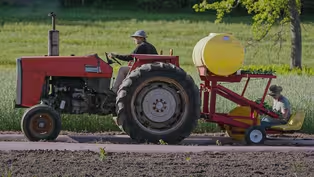
[upbeat electronic music] [tractor rumbling] - We use a water wheel transplanter today, and it's new for us.
It's pretty cool.
You roll along, and it has a wheel that has three spikes in it.
And these spikes will pierce that paper mulch that we have, and then it also has a tank of water, and a it's dripping water.
And when that spike goes into the ground, it drops water.
So you're just sitting on the transplanter and you're reaching over and dropping a seedling into basically the mud that's in that little hole in the paper.
And it's an ideal way to get the seedling started because they have complete contact with the soil and a boost of water.
- With their seedlings in the ground, we'll give Ken and Jay some time to let their pumpkins grow.
[gentle acoustic guitar music] And I'll travel a couple miles down the road to visit Maggie.
Maggie is a one-woman flower farming force of nature.
- My name is Maggie, and I am the owner/operator of Green Light Farm in Prairie Farm, Wisconsin.
- She came to Prairie Farm to realize her vision of growing locally produced, sustainable cut flowers.
- So a lot of people think more and more about where their food's coming from, but people don't necessarily always think about where their flowers are coming from or how they're grown.
So when you seek out local flowers, that supply chain is so much shorter, so much simpler.
You're getting a product that is fresh.
Every flower that I sell was sold within days of being harvested here on the farm.
- One of the things I really enjoy about Maggie and her farm is following her social media.
She's always posting the most beautiful pictures of just this amazing variety of cut flowers throughout the year.
And this spring, she showed me how she cares for and harvests her tulips, the first cut flowers of the year.
[groovy guitar music] - So this year and the past couple of years, I've grown about 20,000 tulips.
They're all harvested by hand and sold here on the farm, throughout western Wisconsin, and in the Twin Cities.
Tulip season is only a couple of weeks long.
It's very energy-intensive.
We harvest tulips one, two, sometimes three times a day, seven days a week until they're all harvested.
- For me, it is so interesting to see this different style of farming, so different than dairy farming, and realize the amount of work and knowledge that really goes into this.
- When I harvest tulips, I pull the whole thing up, bulb and all, outta the ground.
I harvest them into crates.
I then take them into my barn.
I wash the dirt off the stems.
[hose spraying] Put them in the cooler.
And then when I'm ready to sell them, they come out of the cooler, we snip off the bulbs, put them in water, and then they go out into the world from there.
[whimsical music] - Is a hoop house something that you definitely need to have to be growing your production flowers in Wisconsin?
- So I don't think that you necessarily need to have it, depending on what you're growing.
But for me, my production is increasingly more and more focused on early and late season, and then perennial crops, so when I grow things inside the hoop house, I have a lot more, just control.
So I can grow things earlier.
I can grow things later.
And also the quality of the flowers is nicer because I get longer stems in here.
I also have control over water and things like that.
So it just gives me higher quality flowers earlier and later than I could otherwise have.
- How do you choose which flowers to plant?
- Some of it's trial and error.
Some of it is guessing on what I think demand will be.
Some of it is just colors that I'm drawn to, that I just really want to grow.
So it's a little bit of a lot of things.
- That's the way it should be.
It should be what you wanna grow, right?
Tell me about those early seasons.
I notice on your Instagram, it's like my favorite thing about spring is when you're posting these beautiful pictures of these tulips.
And the colors of the tulips are just, I've never seen anything like it before.
It's just the most beautiful tulips ever.
Is that how you start your season?
- It is.
So every season ends with planting tulips and then begins with harvesting tulips.
So it's very labor-intensive, but it's also just one of the more important crops in terms of the business, but also I think it's the crop that really connects with people most coming out of the wintertime.
And one of my favorites to grow.
- While Maggie got back to work, I headed up to go visit with Erin, another woman who's bringing her own unique vision to the area.
[upbeat music] - My name is Erin Link.
I am the owner of EB Ranch, located in Dunn County, Wisconsin.
And I am a goat farmer and poultry farmer, among other things.
[goats bleating] EB Ranch's big idea was to showcase that a small farm can be diverse in not only livestock, but in the products that it produces and offers to the community.
[upbeat music] And show off that these animals, that these different livestock and poultry can work together in tandem in a rotational grazing situation.
- She decided to focus on raising and preserving a rare breed of goat called the San Clemente.
[groovy music] - I am happy to say that I'm steward to the critically endangered San Clemente Island Goat.
There's only about 1,400 of them left.
And what's so intriguing and special about them is their multipurpose nature.
They are really hardy; they're adaptable.
They can be really good milk and meat producers, as well as possibly fiber, or just browse pets.
You name it, they're there for any small farm or homestead.
They're this rugged little goat that I really enjoy raising.
- Inga: Erin finds creative solutions to the challenges she faces as a homesteading farmer.
[upbeat rock music] - My milking situation is fun.
The shelter that the goats use on rotational pastures is actually a gutted-out camper that I have the milk stanchion in.
Good girl.
[milk splashing] [metal clinking] I enjoy farming because of the variety and the challenges that it offers me.
I love problem-solving.
Look out you guys, we're moving.
[chickens chirping] It's a mix of routine and surprises.
[laughs] - Erin, thank you so much for inviting me to your farm today.
This is a really beautiful location.
I love the peacefulness and the birds.
Tell me what you're envisioning for your farm.
- I am a person that likes to do many things, and so having multiple species on my farm is really important to me to see how everybody works together for livestock.
And so my big dream is to have ducks and goats and chickens and other poultry following each other up in this rotation system that has been recommended by a lot of different places and people.
- I'm always fascinated with how people decide on either dairy cows or beef cows or goats.
How did you come to the decision of the goats and the ducks and the chickens?
- I, you know, moved back up here in western Wisconsin.
And I always wanted to have goats since I was a little girl.
And I couldn't have goats 'cause everybody had dairy cows.
- Yeah, same here.
[both laughing] - And so it was never my true intention, really.
Like I didn't have this long-term plan of moving back up here to farm, but my partner and I had the opportunity to do so.
And so I was like, "I'm getting goats."
And I wanted to see if there were any heritage breed goats around.
And that's where I came across the San Clemente Island Goat.
These goats have a very unique DNA, and that's part of this heritage breed is that they offer diversity and uniqueness in our food system that is really important for our food safety.
We need people to be more aware of like, their actual meat sources or their product sources.
And if we don't find those purposes for those animals, those animals are gonna be gone.
So we need to support farms that are raising heritage breeds.
- Inga: I love it, because a lot of people who are not from Wisconsin really think that Wisconsin is just dairy cows, right?
- Yeah.
- It's so fun to be in these communities like Prairie Farm and see how diverse it is just in this community, with what you're doing here with these amazing goats and the ducks and the chickens, what Maggie's doing growing these beautiful flowers.
And then you have Ken and Jay with America's first pumpkin seed oil production, all in this area.
I just, this is the great thing about Wisconsin is just all these communities that are being built through agriculture, and just through sharing of knowledge too.
- And this being supportive of each other.
The overwhelming support and this encouragement, this is a really open and giving and helpful community to be part of, yeah.
[ducks quacking] [upbeat electronic music] [engines humming] - Inga: Back at Ken and Jay's, the weeds are under control, the pumpkins are thriving, and we talked more about their journey as farmers.
I know on my farm, I'm so grateful to have my husband there to help me and work side-by-side with me.
What is that like for you two?
You always get along, I imagine.
- We do.
- Inga: Oh, good.
- I'll let you speak.
[Inga laughs] - Oh, I guess I don't even think about it.
We are a team, definitely.
We both have our things that we're the best at, I guess.
I mean, Ken is really good at planning.
I'm good at implementing.
He's good at directing, I'm good at following.
It is definitely a team effort.
- I think we need to plant.
- Well, let's just see.
We're always learning stuff.
I think that's part of the fun too, and the interest.
it's always something different.
This way, this way.
- We're very, very good work partners, and we work well together, and it's been complementary.
And I'm sure as you know, you couldn't do it alone.
- No.
- You have to have a partner.
- Yeah.
- This, it's a lot.
- Yeah.
- And we're just very fortunate.
It's easy for us.
- So you've started the transplants then inside, you've brought them out here to plant them, laid the mulch down.
And now you just kick back with a martini and just wait?
[laughing] - Oh, well, this year, so far, we've had drought.
So we've had to irrigate.
And usually, we look at irrigation as just something to bridge us over to the inevitable rains, but they haven't happened.
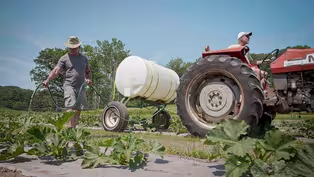
So we have irrigated three times and we're just using a big 300-gallon tank.
Drag it along, let gravity water them.
[water splashing] Also surprisingly, pumpkins, or the plant itself, it's really built to collect moisture.
- Inga: Really?
- Every morning there's a lot of dew.
They have these great big leaves, and you notice it all funnels into the central, the petiole, that takes it down to the stem.
So that dew will collect on the leaf, flow down right to the center of the plant.
So it will gather some moisture on its own.
- Inga: Nature is amazing.
[gentle acoustic guitar music] The summer months have also been kind to Maggie, and new crops of flowers are in full bloom.
[birds chirping] You have so many beautiful flowers here, and I'm sure it's like hard to choose, but do you have a favorite?
- So my favorite flower is always the one that's blooming.
So in the springtime it might be tulips.
In the summertime, it could be lupine or zinnias.
In the fall, it might be lisianthus or eucalyptus.
It just changes a lot.
- Inga: That's spoken like a true farmer.
So what are some of those differences between buying those store-bought flowers at the grocery store, where they're coming from so far away, and then buying from a local grower?
- In the United States right now, about 70% of the flowers sold in the United States are imported, primarily from Central and South America, but really from all over the world, and of that small percentage grown here, most are grown in California, about 70% to 80%.
And you think about all the miles that it took for them to get from halfway around the world into your home.
You're not able to have that connection with the farmer that grew it, or to even be able to ask the questions of how it was grown and the story behind it.
So local flowers is a really small, but growing market.
- Inga: The flowers seem to be more interesting too.
What I see at farmers markets or here, it just seems like the flowers are more interesting and there's more of a variety.
- Yeah, absolutely.
You know, a lot of the flowers that are grown commercially and shipped from abroad, you know, they're bred for their ability to be shipped and to survive that process, whereas with local flowers, and what really makes them special, is I can choose varieties that smell amazing, that you can really stick your nose into and enjoy that, that are gonna have all the colors and textures and all the things that you might not necessarily get from flowers that come from halfway around the world, we can get with local flowers.
- It must be so meaningful for you to be out here working with the flowers.
What is that passion like for you to be a farmer?
- It's interesting, especially, you know, here we're talking, it's the beginning of July.
It's a time when you're a farmer, life moves very, very fast.
And I always have to remind myself to take some moments to move a little bit slower and to just take a look around and really take it in and be reminded that I am surrounded by beauty.
And I'm very lucky to have that in my life every day.
And that I can provide beauty and kind of a place of peace for myself and for other people, I can provide a habitat for pollinators.
There's just so much beauty that comes with growing flowers that I just appreciate more as time goes by.
- This has been amazing getting to be here and getting to hang out with you.
Prairie Farm seems to be just a wonderful place to visit.
And I'm so happy that I've had the chance to visit.
- Yeah, I'm so glad that you came out.
[birds chirping] - Once the work of summer is finished, we're gonna see how Ken and Jay call on their farmer friends and an amazing machine.
[garage door rattling] - The machine to me, it's improbable.
If you had told me how it works, I'd say, "Nah, that wouldn't work," but it actually works very well.
[engine rumbling] [surf rock music] [air whooshing] [air whistling] [pumpkin thumping] All the work, all the planning that you've done, everything is all geared to today.
- Today is a huge relief; it's very exciting.
It's harvest.
[surf rock music] [motor rumbling] [pumpkins thudding] When we have harvest, we need a whole bunch of people to help.
And I think what's really interesting is we never know what kind of crew we're gonna end up with.
So we're always meeting people, and that is really wonderful.
- Today, we harvested pumpkins with Ken and Jay.
It's very physical, but I really enjoy helping out friends.
[whooshing] [whooshing] - It's my 13th year helping Ken and Jay harvest pumpkins.
My role now, kind of is just like kicking their butts and like, let's get going here and get this done.
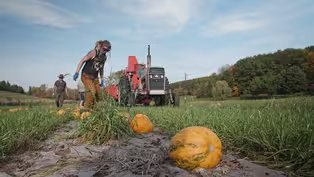
- Harvesting pumpkins is actually a lot of fun.
We take turns grabbing the pumpkins off the ground.
We break them off the vine and then we just toss them into the chopper box, basically.
- It's incredible to see the technology of these machines, to be able to harvest those pumpkins, separate out the seed, and get it all cleaned.
These kinds of things really help out around the farm.
- Ken: It smashes up the pumpkins, and then it goes into a series of three tubes.
And in the very first tube, it actually will spit out out the back end the rind, the flesh of the pumpkin, so it's a net gain of organic matter to the field.
[surfer rock music] And the seeds move on into the other tubes where they're cleaned.
And we end up with remarkably clean seeds at the end.
- Helping out other farmers like this, it means a lot to me.
- It's nice to feel like I've helped a local farmer create a product.
- Ken: It's very nice to be with community in doing this.
- The harvest is a delight; it's just a delight.
[tractor rumbling] [gentle acoustic guitar music] [cat meowing] [geese honking] - So tell me a little bit about the oil.
I wanna know like what it tastes like, what are those benefits of this oil?
- Actually.
- You know, have you ever had roasted pumpkin seeds?
- Yeah.
- It has a rich nutty flavor; it's delicious.
I mean, that's the main reason we're doing this.
It's a really tasty, delicious oil.
- Inga: The color is beautiful and kind of unexpected.
- It is; you're not normally seeing this in oils.
And actually, the color is the nutrition.
So pumpkin seed oil is rich in some of these compounds that are antioxidants in our body.
And it's a very healthy fat with a wide range of benefits, you know, from healthy cholesterol to supporting heart health.
But the thing that we like to really focus on is the taste.
It tastes good.
- The flavor is really amazing.
It's delicate and nice.
How else do you use this?
'Cause it seems to be very, you don't wanna heat it.
- You're right.
So it's also high in omega-3 fatty acids that are delicate, they don't like high heat, so you wouldn't fry in it.
But you would use it like this, salted to dip bread in, or maybe most commonly a salad dressing, a vinegarette salad dressing, or to put it on cooked vegetables, like it's been asparagus season here.
It's delicious on asparagus, on broccoli.
- Well, this is really interesting.
I have a couple ideas on how I wanna use this in the kitchen.
So if you don't mind, I'd like to get started.
- Yeah, our pleasure, please do.
- Wonderful, let's go.
[corn husks snapping] - I really love cooking for people, especially in the summertime when the ingredients are ripe for the picking and we can gather as a little community and sit down for a meal.
[gentle acoustic guitar music] I wanted to make a corn chowder.
Corn is like, so wonderful when it's ripe, and it has to be ripe to make this chowder.
It kind of is just a little love letter to summertime with the chowder.
The key to making anything is to find the best quality ingredients possible.
So I picked up some of the corn at the farmers market.
The potatoes came outta my garden, the onions outta my garden, the bacon from a local farm.
And that's what makes things really amazing.
So not only am I gathering with a community in Prairie Farm for eating, but I'm using a community of farmers' ingredients to cook up this dish.
The first thing I'm gonna do is I'm gonna turn my soup pot on to medium, medium-high.
And I'm just gonna put a little bit of butter in the bottom of my pan, because as a dairy farmer, I have to always use some sort of dairy product while I'm cooking.
So now that the butter is melted, I'm gonna start adding in the bacon.
And I just sliced them right on up, so they're nice, small pieces that'll crisp up really well with the butter.
[bacon sizzling] When I'm working with stews or soups or even braising, I often will start with the bacon.
And that's kind of that first base level of the flavors.
So it's crisping up in my pan.
I can get those nice bacon bits up later on as the soup cooks.
It's giving the kitchen an amazing smell, and it's making me awfully hungry.
And then, now you're just gonna add one onion, finely diced.
Let the onion and the bacon cook up until the onion is nice and soft.
A few minutes and then we'll start adding our other ingredients.
[food sizzling] Now that the bacon and the onions have cooked down, we're gonna make a little bit of a roux to get that thickness in our chowder.
I'm just gonna push the bacon and the onions off to the side of my pan, making a little hole in the middle.
And then I'm gonna sprinkle in about a quarter cup of flour.
While I'm sprinkling in little bits by bits, I'm just gonna stir like crazy so it can get incorporated.
And like I said, this is just gonna make it nice and thick.
Give it a little consistency.
Once that flour is mixed in now, I'm just gonna add in five cups of vegetable broth.
So I'm slowly adding the broth in and I'm scraping up all the bits and pieces on the bottom of my pan at the same time.
Now we're gonna add to our broth, bacon, and onions, a few cloves of garlic.
We're gonna add in eight ears of corn, which is quite a lot, but it's gonna get a really beautiful corn flavor.
So eight ears of corn are going into my soup pot here.
And then I'm gonna add in a few diced up potatoes.
They're maybe like a half-inch dice and I just kept everything as uniform as possible so that the potatoes can all cook at the same time.
Stir those in.
And give it a good shake of salt and pepper.
[pepper grinding] I'm gonna add in some bay leaf for flavor.
And a little bit of tarragon that came from the garden here.
Summer's also a great time to be using your fresh herbs.
All right, so now I'm gonna turn up the heat, get it boiling, and then I'll turn it down to a simmer and let it cook.
The last thing I'm gonna add is two of my corn cobs.
As the soup cooks, it's gonna grab any moisture and flavor from these stalks.
And it kinda looks fun too.
So I'll get this rolling, cook it down, and then we'll get ready to serve it.
Now the house is filled with the aroma of summer cooking on the stove.
I'm gonna finish the soup off with just a few more steps.
The first thing I'm gonna do is take out my bay leaf that I put in there.
That's not something that anybody needs to have caught in their mouth when they're eating soup.
And then I'm gonna take out my corn cobs.
And now I'm gonna add, maybe like a quarter of the corn and potato mixture into my Cuisinart.
And I'm gonna puree those up in my Cuisinart, and that's gonna give the soup nice little consistency of creamy flavor.
[Cuisinart humming] That looks good, nice and steamy.
There's still plenty of crunch in the soup with the corn kernels, but this will just give it that sort of chowdery mouthfeel.
Okay, and to finish that soup, I'm gonna add a lot of heavy cream.
The key to cooking anything is lots of butter, lots of heavy cream.
And I'm just gonna pour some in.
We'll start with, I'm gonna go full cup.
I think that'll be delicious.
It smells gorgeous.
And then when you're serving your soup, you're just gonna ladle out a nice ladle full.
Doesn't that look amazing?
Clam chowder without the clams and more corn, delicious.
The showstopping ingredient is gonna be the pumpkin seed oil that I'm gonna just garnish the top of the soup with, and that's gonna give it so much more flavor.
It's gonna be really delicious.
And I think the pumpkin seed oil goes perfectly with corn as well.
And we should probably put a few pumpkin seeds on top.
And then even a little piece of basil for a little hint of green.
And there you go.
Your summer corn chowder is now ready to be served.
[upbeat acoustic guitar music] This is what I love about Wisconsin.
People from all walks of life, coming together to expand on our farming traditions and build community.
[people chatting and laughing] Well, I hope this has inspired you to sit down with the members of your community and enjoy a meal.
And I hope you'll gather with us next time, - In unison: Around the Farm Table .
- I'm your host, Inga Witscher.
Enjoy.
- Maggie: Thank you!
- Inga: Thanks for having us.
- Ken: Everything is so good.
The soup's delicious, the salad's great.
- Inga: You know, I really love this meal, because... [upbeat folksy music] - Announcer: Support for Around the Farm Table is provided by Wisconsin Farmers Union, a gift in memory of Wendy Bladorn, Marge Engelman, Focus Fund for Wisconsin Programs, and Friends of PBS Wisconsin.
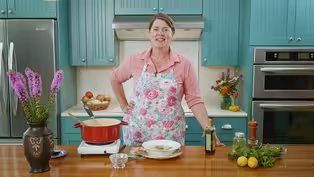
Cooking with Inga: Corn Chowder with Pumpkin Seed Oil
Video has Closed Captions
Clip: S8 Ep2 | 6m 32s | Inga prepares a corn chowder with fresh local ingredients and pumpkin seed oil. (6m 32s)
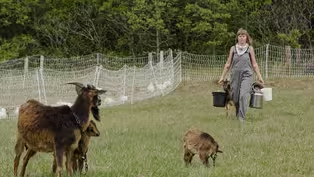
EB Ranch and San Clemente Island Goats
Video has Closed Captions
Clip: S8 Ep2 | 5m 44s | Erin Link raises San Clemente Island Goats at EB Ranch. (5m 44s)
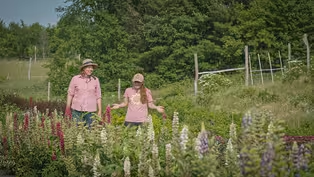
Growing flowers on Green Light Farm
Video has Closed Captions
Clip: S8 Ep2 | 3m 22s | Inga talks with a flower farmer about the importance of local flowers. (3m 22s)
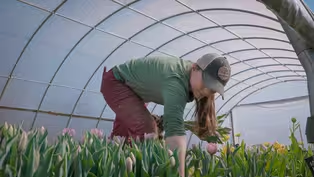
Growing Tulips at Green Light Farm
Video has Closed Captions
Clip: S8 Ep2 | 4m 8s | Inga talks tulips with Maggie Sheehan of Green Light Farm. (4m 8s)
Harvesting pumpkins for pumpkin seed oil
Video has Closed Captions
Clip: S8 Ep2 | 4m 43s | The farmers at Hay River Pumpkin Seed Oil harvest their crop. (4m 43s)
Hay River Pumpkin Seed Oil Farm
Video has Closed Captions
Clip: S8 Ep2 | 5m 2s | Inga meets the farmers behind Hay River Pumpkin Seed Oil. (5m 2s)
Irrigating a Pumpkin Crop in the Summer
Video has Closed Captions
Clip: S8 Ep2 | 2m 23s | Inga talks with two pumpkin farmers about their crop. (2m 23s)
Providing Support for PBS.org
Learn Moreabout PBS online sponsorship




Support for PBS provided by:
Around the Farm Table is a local public television program presented by PBS Wisconsin
Funding for Around the Farm Table is provided by Wisconsin Farmers Union, a gift in memory of Wendy Bladorn, Marge Engelman, the Focus Fund for Wisconsin Programs, and Friends of PBS Wisconsin.