
From Broadway to Obscurity/Devin’s Scillian’s Quarantine
Season 4 Episode 51 | 26m 46sVideo has Closed Captions
From Broadway to Obscurity/Devin’s Scillian’s Quarantine | Episode 451
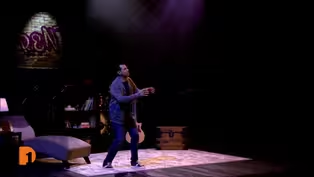
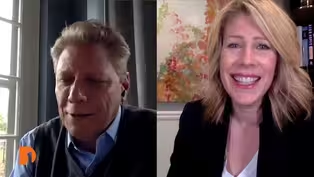
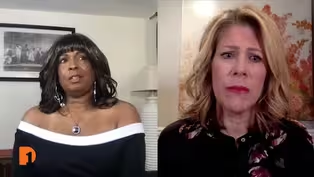
Eric Gutman’s one-man musical, “From Broadway to Obscurity” came together in a partnership with Detroit Public Television, Detroit Public Theatre, and the Chautauqua Theater Company. Christy talks with Devin Scillian, the evening anchor at WDIV Channel 4. Joan Belgrave is Detroit’s most noted jazz singer and is known for her soothing voice. Episode 451
Problems playing video? | Closed Captioning Feedback
Problems playing video? | Closed Captioning Feedback
One Detroit is a local public television program presented by Detroit PBS
From Broadway to Obscurity/Devin’s Scillian’s Quarantine
Season 4 Episode 51 | 26m 46sVideo has Closed Captions
Eric Gutman’s one-man musical, “From Broadway to Obscurity” came together in a partnership with Detroit Public Television, Detroit Public Theatre, and the Chautauqua Theater Company. Christy talks with Devin Scillian, the evening anchor at WDIV Channel 4. Joan Belgrave is Detroit’s most noted jazz singer and is known for her soothing voice. Episode 451
Problems playing video? | Closed Captioning Feedback
How to Watch One Detroit
One Detroit is available to stream on pbs.org and the free PBS App, available on iPhone, Apple TV, Android TV, Android smartphones, Amazon Fire TV, Amazon Fire Tablet, Roku, Samsung Smart TV, and Vizio.
Providing Support for PBS.org
Learn Moreabout PBS online sponsorship- Hi, I'm Christy McDonald and here's what's coming up on One Detroit Arts and Culture.
Behind the scenes of the Detroit Public Theater televised production From Broadway to Obscurity and bringing local theater to your living room during COVID.
Plus the quarantine interludes of news anchor and musician Devin Scillian.
Then jazz great Joan Belgrave on grief, music, and connection.
It's all coming up now on One Detroit.
- [Narrator] From Delta Faucet to Behr paint, Masco Corporation is proud to deliver products that enhance the way consumers all over the world experience and enjoy their living spaces.
Masco, serving Michigan Communities since 1929.
- [Narrator] Support for this program provided by the Cynthia and Edsel Ford Fund for Journalism at Detroit Public TV.
The Kresge Foundation.
Community Foundation for Southeast Michigan.
- [Narrator] The DTE Foundation is a proud sponsor of Detroit Public TV among the state's largest foundations committed to Michigan focused giving.
We support organizations that are doing exceptional work in our state.
Visit DTEFoundation.com to learn more.
- [Narrator] Business Leaders for Michigan dedicated to making Michigan a top 10 state for jobs, personal income, and to help the economy.
Also brought to you by the Fred A. and Barbara and M. ERB Family Foundation and Viewers Like You.
(upbeat music) - Hey One Detroit, I'm Christy McDonald.
Thanks so much for joining me for One Detroit Arts and Culture.
This show is all about the music, theater and culture we've been missing together since COVID and how a lot of organizations have adjusted and found creativity in new ways.
Coming up, we have a behind the scenes look at what it took to bring the Detroit Public Theater production of From Broadway to Obscurity, to televisions.
It's the beginning of a partnership and a way to get that theater fix that we're all craving during COVID.
Also ahead, you know him from anchoring the news, of course, but Devin Scillian also gave us our daily music fix with his quarantine interludes that went viral this year.
I catch up with him.
Then jazz great Joan Belgrave talks with me about grief, music and connection.
All right, so let's head to the theater first.
Back in October here in Detroit Public TV, we had a night of local theater on television.
It was the first effort of a partnership between us, the Detroit Public Theater and the Marygrove Conservancy to bring performances to our homes.
Eric Gutman one man show called From Broadway to Obscurity was a total musical theater nerd stream.
It was a great show.
It was funny, fantastic music.
You felt like you were back at the theater.
And it took a lot of adjusting for both the theater and the television crews to bring the performance to air.
And this is a look at how it all happened.
- We did really great work yesterday.
We are in really good shape.
Thank you everyone for contributing everything that you have to get us to this point and today's going to be really, really exciting.
- I mean the pandemic's awful to this industry, to all my friends and coworkers.
We're all here to create art because we haven't been able to, because of this pandemic.
- So we're here today-- (both mumble) - Great.
- I feel so blessed and thankful to Detroit Public Theater and Chautauqua Institute and DPTV and everybody else involved that of all the shows that they picked mine.
It just means-- it means the world to me.
(audience claps) ♪ Oh, what a night ♪ Late December back in sixty-three ♪ - That filming was the start of our partnership with Detroit Public Television, where we've been looking for ways to partner with arts and cultural organizations, such as DPTV to really showcase and highlight the benefits of our theater.
♪ You're just too good to be true ♪ - Preserving our legacy of arts and culture in this community is a really important value of the Conservancy.
We believe that through gentrification and through a number of other systemic changes in our neighborhoods, basis such as these traditionally go away.
And so we're working hard to make sure that these spaces remain affordable and accessible.
Also the arts and culture can remain a staple on this institution's campus.
- Shortly after graduation, I learned of an off-Broadway show that was having a Detroit run and they were looking for local understudies to audition.
I figured I'd go, I'd have my first real, professional audition experience.
- Our mission at Detroit Public Theater is really to provide theater for everyone, to make theater accessible, to make theater the PR public in Detroit, that people who live in Detroit, people who are Detroiters see themselves reflected in the work that we do.
So I think the values of DPTV and Detroit Public Theater are aligned.
- It probably needs more lighting because the camera can't.
- Theater community right now is in the somewhere around 95, 96% unemployment rate.
So it's devastating out there.
Another big motivation for us, wanting to do this safely, was to create work, but to try to find a way that we and by example, all of us can continue to do what we do.
What we were put on this earth to do.
- This is such a gift that we get to do this for eight hours.
So soak it in.
- Don't know when we'll be in a theater again.
- I teach college, you know, so I've been all summer long-- We've been dealing with, how do we make theater in our current situation?
I leapt at the chance to do this when Eric called and said we were doing it.
- I love this show.
I stage manage a lot of plays and I don't get the chance to do musicals a lot.
So this is really a fun treat for me because it's so many musicals wrapped into one.
♪ If I hide the one song ♪ Before the critics hate hold boring ♪ ♪ Like Lorne Webber ♪ One song to reach him this ♪ Hey, let's try - 2014 we premiered it.
So it's been-- we've been performing it now for six years.
In 2013, a place called Berman Center For The Performing Arts in West Bloomfield, the managing director there at the time, She's an old friend of mine.
And she called me, she said "Do you want to do a cabaret about your time with Jersey Boys?"
And I was in Chicago at the time.
And I said "Yeah, sure.
That'd be fun."
After 10 months in Detroit-- It kind of morphed out of a cabaret and into a book show.
I started working on it with Brian, my director, and after 10 months and 14 drafts, we have what is being presented tonight.
Get me in for interviews at the restaurant.
- He knew he wanted to tell his story, but, you know, initially it was kind of all showbiz.
It was all that story.
And I think eventually we found our way into the more personal narrative.
And I think that's when we really found the heart of the show.
♪ I'm falling, baby, from the sky ♪ - Brian was really instrumental in kind of piecing all my thoughts together so I don't kind of just go off the rails, so to speak, which sometimes I do.
- As we were developing it, you know, starting to learn, I had no idea about the struggles and the things that he went through.
So for me, it was like re meeting a friend in that collaboration.
- And living in a city where there are 50,000 other actors just like you struggling and clawing their way from audition to audition.
- We actually have only had a couple of days to put it all together.
So it's kind of been a whirlwind process.
- I think all the shots are pretty wide, but not incorporating the projections ever.
Is there a possible shot from this camera that has-- that also incorporates the projection?
- Yeah.
- And we had some partnerships obviously with DPTV and WNED that made it possible that we could bring these productions to life.
(woman giving directions from a distance) - For us there's nothing that can quite compare to being in a room together with our audience.
And we are craving that and looking forward to when that can happen again.
But for now, we're not going to stop making art and connecting.
♪ You're just too good to be true ♪ - What they're calling me is the transition director, which is actually, I've come to believe that it's, I'm the interpreter because I speak two languages.
I speak theater and I speak film.
My job is to watch what's happening on stage, but also what's happening on the monitor and make sure that the people on stage, what they're looking for, is being translated to the people who were running the cameras and the backstage.
- It's very strange to film it this way with no audience, you know?
(upbeat music) - It's different.
It's always different than being in a live theater.
Not-- there's no replacement for gathering in the room together with an audience.
♪ As I've been called an actor - It's just, it's a ghost town.
So it was hard to adjust that way.
- So to not have the human bodies there, the cameras, you know, he had-- he did a great job communicating with those and playing the show as if there was an audience.
- I've done this show for yes, six years.
I've done it, I don't know, 60 times, 70 times.
And I always kind of know where the laugh is going to be or where the applause is going to be.
2,100 people think I am far too short to play this role.
In Chicago-- - There's no holding for laughter.
There's no holding for applause.
So there's the big thing to kind of get used to it's.
- It's knowing that I do like a really big song that takes a lot out of me.
And I don't have the, you know, six, seven seconds of applause to catch my breath.
It's just like, catch your breath quick, move on to the next story.
(finishes singing) After 10 months in Detroit-- - There's a lot lost in that communion between the performer and the audience.
There's a-- it's a conversation, a performance isn't complete until the audience is there.
The audience is part of the performance.
- The timing is just very different and the energy.
And I applaud Eric for being able to keep the energy up.
I sing the hell out of my song ♪ Jesus Then he says "You know, Eric, I don't think you're right for this role."
- The audience experience is becoming an isolated experience these days.
More and more people have there-- are witnessing it over their phone or their iPad or their computer or their television.
And don't get me wrong, I don't think there's anything wrong with that.
It is a tool and it's a magical tool, but at the same time to have an experience with a group of people is something that I believe is in human DNA.
♪ Happy, drowning out my cries ♪ I pull myself together ♪ And I'm focused on the prize ♪ I'm falling, baby, through the sky ♪ ♪ Through the sky I'm falling, baby, through the sky ♪ - We try and hone in the audience as I on those particular moments, but we have to do it in a different way because it's a different medium.
Whereas the camera can just zoom in and capture that.
So I'm having a-- I'm having a fantastic time watching that happen.
♪ I could be in love with someone ♪ ♪ Like you (audience claps) - With this project, we really wanted to keep it true to the spirit of a live continuous production.
It's almost as if you're watching a live show, it's definitely as close to that as we can get it for you.
- Theater and performing was a mere memory.
And so there I was.
It's funny how life throws you curve balls sometimes.
I was working at a desk job for a ticketing broker company in Southfield, Michigan, and the call came in and I took it and it was, I mean, it changed my life.
That one phone call.
(phone rings) - Hi, Eric.
This is Jennifer from Dodger Theatricals.
We would like to offer you a role in the first national tour of Jersey Boys.
- Talking to people that have seen the show over the years is-- they say "Gosh" you know, "I was able to relate to this or to that" or, you know, "I have a kid that wants to go into theater" or "I did this 20 years ago and then I gave it up" you know, "To raise a family" and our lives are all kind of paralleled that way.
- It's a great story.
And I think one of the things to take away from it is being somebody who's earlier in their career, it gives them hope to keep working and not stop going until you get that break.
You know, we all get breaks, but sometimes it takes longer for other people, but work is the most important part of that.
And Eric works very hard for it.
- It's been an amazing week doing this and an amazing few months getting this ready.
And I just hope that people will not just appreciate the shows, appreciate the work that's going into them.
- This is an experiment.
We're really hoping that this crosses that boundary and gives a lot of people who are missing the theater something that they haven't been able to go out to.
- Theater's not a part of everyone's life.
Television is a part of everyone's life.
So I think that television has a lot to offer us as theater artists.
(upbeat music) - I think a lot of theaters are trying to adapt to this new way because they have to, they're forced to and I only hope that all of these theaters that employ so many designers and artist will be able to do this and will have the opportunity like I did, like Detroit Public Theater did, like Chautauqua Institute did.
(people clapping and cheering) (soft music) - You're attached on for viewers to be able to tune and say "Okay, I know Devin, he's been here for a long time."
And they also know you personally, I think through everything that you do on social media.
And I started seeing you come up with a quarantine interlude, taking your musical talents online.
Is a little bit of a break for everyone because we've talked so much about how music is healing for the soul, right about now at a time where you feel like you can't count on much or control much.
- Well, I know you believe that too about music.
And it really is such an extraordinary sab, in good times and bad.
And I think that a lot of us who were musicians and as you know, news is just temporary for me until the music works out.
- That's right.
We're counting down the years.
(Devin laughs) - A lot of us who are musicians, it's the first place we run when-- when we need to think things out, when we need to meditate on something.
And so when I've got extra time, that's what I want to do is sit down with the guitar, the piano, anyway.
(stammers) And I thought, well, in fact, I was going to start it with-- cause I wanted to do a St Patrick's day song and I resolved and I thought I'll put this out.
And the response was insane.
And I realized as Corey, I told Corey a couple weeks ago, "I finally figured out what it took for me to succeed in music.
I need an audience that can't leave."
- That's right.
They're captive.
(Devin laughs) - I never knew what captive audience meant until now.
That's exactly right.
But it's been really, really fun.
- What kinds of songs you're putting out there and what are people saying about the different genres that you do?
- I have very eclectic tastes and I mean, most of my leanings tended to run towards country and folk music, but I also, you know, have a-- I love R&B.
I love standards.
(stammers) There's not much music that I really don't love.
And that's been-- it's been really gratifying the way that that people have responded.
- So the one song that you're gonna-- you're gonna play for us that you put out, you actually played on the ukulele.
What song is that?
- It's a song called The Hold You've Got On Me that I wrote for my wife, Corey.
This one has had many, many more views than a lot of the other ones.
And I wrote it quite a while back for Corey.
And it was a great excuse to get the ukulele back up.
- What is it about music that is calming for people?
Can you quite put your finger on it?
- It suits us.
And I think that there's just something about a melody that just sort of puts our mind in a different kind of frame.
And (stammers) it's a great escape for most of us.
I think it takes us away.
This is why music is so much more powerful than television or movies to me is because we create the story that surrounds the song.
We create our own experience when we listened to a song.
We supply so much of the texture and the story and the visuals that go along with it.
And so that's why songs mean so much to somebody-- to people.
And they can mean very, very different things.
And so that, that texture, I believe is what makes music so powerful.
- All right.
So the quarantine interlude, where can we find it Devin?
- They're loaded every day onto my two Facebook pages, my personal one, which is open and public for everybody and then there's a kind of a channel for ones to just look for Devin Scillian on Facebook until the stay at home order is lifted.
I'm committing to putting out one a day so I can keep up that pace.
(plays ukulele) ♪ When you look at me with those sweet green eyes ♪ ♪ That always seem to hit the tires ♪ ♪ Me, I surrender every time ♪ The sound of your voice on my phone ♪ ♪ Is sweeter than an ice cream scream cone ♪ ♪ Keeps me walking your line ♪ Well, I don't know when I fell ♪ ♪ But these chains are made of velvet ♪ ♪ And I'd follow you anywhere ♪ Oh, I don't need or want to save me ♪ ♪ Oh, from all the love you gave me ♪ ♪ And I don't want to be free ♪ Of the hold you got on me (soft music) ♪ I ♪ I would give you my love ♪ Not until forever and ever ♪ Don't you know you and I'll be together ♪ - I know of people-- I've seen you perform internationally for us at Baker's here in Detroit and Cliff Bounds and also performing with your late husband, Mark has felt great.
But my joy in being able to do these shows where we're devoting it to arts and culture in this time of COVID-19 is really being able to, you know, get to know people a little bit better and see how you're doing with everything.
- Well, there's positives and there's negatives.
I mean, obviously, the gigs for this year are gone.
I've been fortunate that, you know, my gigs have been rescheduled till 2021, but there's a lot of people who, who are not able to say that.
The one thing that I must say I've had more like with my family, my immediate family, my children, and we get to do these little weekly Zoom things because everybody's home.
Also, one of the things that I've-- that I've been doing is checking in on, on our older musicians, you know, our jazz legends and, and making sure they're okay.
I want to believe that we will get back to some, some sense of normalcy, but this virus is deadly.
We have to take it seriously.
- Joan, have you had personal loss?
- Absolutely.
Yeah.
And... - I'm sorry.
- You know, when I see people who are not taking it seriously, or people who are saying, "Oh, you know, our rights are being violated because we're being made to stay home."
I'm like, you might be okay, but you're going to transmit it to somebody that I love.
And having lost someone that I love, many people that-- is just, it's ridiculous.
Stay home.
You know, it's not nothing is that serious that it's worth your life.
People talk about being able to go out and make-- get back to work and make money.
What good is it going to do if you're six feet under?
What good is that going to do if you're not here to see your family and to hug your children?
I can't wait to get back to a time when I can hug my grandbabies.
I wrote this song called I'm Not Going Anywhere.
It's helped me understand that those that we love are going to be with us no matter what.
That's the only way that I can deal with it, because I know now that ♪ I'm not going anywhere ♪ I'm here ♪ There's no need for you to doubt ♪ ♪ Don't fear ♪ I know your heart is full of pain ♪ ♪ And you're tired of the rain ♪ There is something you should know ♪ ♪ I will always love you so ♪ There is so much more we have to do ♪ ♪ And our love will see us through ♪ ♪ 'Cause I'm not going anywhere ♪ ♪ No I'm not going anywhere It helps me to remember that, you know, especially during this time, it took me a year to even be able to breathe once Mark has passed, you know, I mean, I couldn't-- I basically couldn't function.
You know, I mean, because I loved him so much.
People don't know the circumstances of his passing.
He took a gig in-- at this college, traditionally black, historically black college down south.
And I couldn't go with him because I had another gig booked.
And I always went with him to make sure everything was okay and, you know, et cetera, et cetera.
And I said, "Babe, please don't take it.
I can't go."
"No, they need me.
They need me."
I'm like okay.
So anyway, as a result of that, that's what put him into the hospital.
And that's what-- and I was really angry, you know.
I'm like, you know, you didn't have to do that.
But then I realized it was so important to him to give to the students that if it meant his life, that was something he was willing to sacrifice, but it took me a while to get there, you know?
And that's when I wrote that song.
And I think that that has helped me during this time.
It's different because it's not by choice.
- It's a collective grief though.
That's what you're tapping into.
And having had to move through that.
- Yeah.
- You're equipped in a different way.
- Right.
- And I think that there's something beautiful about, you know, your song when-- you're really your roots and singing in the church choir and that informing the song choices and the way that you're able to-- - Absolutely.
- I think deal with grief through music.
- Music brings people together.
I sang jazz.
I sing blues.
I sing funk.
One of the things that that I learned through jazz is that music is just conversation.
And if you can have a conversation musically with the band, with the audience, then you're-- you've done what your purpose is.
We need to open the lines of communication, reach out to people and say "It's going to be all right."
You know, I know it's tough right now.
You know, it's tough for all of us, but you know what the alternative is not being here.
Okay?
So do whatever it is that you need to do, you know, because I want to see you on the other side.
♪ The seasons come and go ♪ And I'll be right there with you, don't you know ♪ - Our thanks to Joan, Devin, and our friends at the Detroit Public Theater.
For all of our interviews on arts and culture, just head to our website at onedetroitpbs.org and you can catch One Detroit Arts and Culture every Monday night at 7:30 PM.
That's going to do it for me.
Take care, be well.
And I will see you next week.
You can find more onedetroitpbs.org or subscribe to our social media channels and sign up for our One Detroit newsletter.
- [Narrator] From Delta faucets to Behr paint, Masco corporation is proud to deliver products that enhance the way consumers all over the world experience and enjoy their living spaces.
Masco serving Michigan communities since 1929.
- [Narrator] Support for this program provided by the Cynthia and Edsel Ford Fund for Journalism at Detroit Public TV.
The Kresge Foundation.
Community Foundation for Southeast Michigan.
- [Narrator] The DTE Foundation is a proud sponsor of Detroit Public TV among the state's largest foundations committed to Michigan focused giving.
We support organizations that are doing exceptional work in our state.
Visit DTEFoundation.com to learn more.
- [Narrator] Business Leaders for Michigan dedicated to making Michigan a top 10 state for jobs, personal income, and to help the economy.
Also brought to you by the Fred A. and Barbara and M. ERB Family Foundation and Viewers Like You.
(cheerful music)
Behind the Scenes “From Broadway to Obscurity”
Video has Closed Captions
Clip: S4 Ep51 | 11m 53s | Behind the Scenes “From Broadway to Obscurity” | Episode 451/Segment 1 (11m 53s)
Devin’s Scillian’s Quarantine Interludes
Video has Closed Captions
Clip: S4 Ep51 | 4m 42s | Devin’s Scillian’s Quarantine Interludes | Episode 451/Segment 2 (4m 42s)
Joan Belgrave: Healing Through Music
Video has Closed Captions
Clip: S4 Ep51 | 5m 53s | Joan Belgrave: Healing Through Music | Episode 451/Segment 3 (5m 53s)
Providing Support for PBS.org
Learn Moreabout PBS online sponsorship
- News and Public Affairs

Top journalists deliver compelling original analysis of the hour's headlines.

- News and Public Affairs

FRONTLINE is investigative journalism that questions, explains and changes our world.












Support for PBS provided by:
One Detroit is a local public television program presented by Detroit PBS