Wyoming Chronicle
From Bureaucracy to the Bench
Season 15 Episode 16 | 25m 44sVideo has Closed Captions
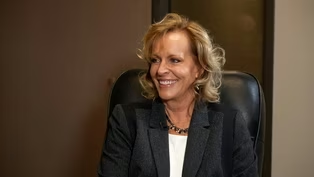
Robin Sessions Cooley is leaving the Capitol to become a District Court judge.
After a decade running one of the largest and most-complex departments of state government, Robin Sessions Cooley is leaving the Capitol to become a District Court judge.
Problems playing video? | Closed Captioning Feedback
Problems playing video? | Closed Captioning Feedback
Wyoming Chronicle is a local public television program presented by Wyoming PBS
Support provided by:

Wyoming Chronicle
From Bureaucracy to the Bench
Season 15 Episode 16 | 25m 44sVideo has Closed Captions
After a decade running one of the largest and most-complex departments of state government, Robin Sessions Cooley is leaving the Capitol to become a District Court judge.
Problems playing video? | Closed Captioning Feedback
How to Watch Wyoming Chronicle
Wyoming Chronicle is available to stream on pbs.org and the free PBS App, available on iPhone, Apple TV, Android TV, Android smartphones, Amazon Fire TV, Amazon Fire Tablet, Roku, Samsung Smart TV, and Vizio.
Providing Support for PBS.org
Learn Moreabout PBS online sponsorship(light music) - Robin Sessions Cooley has spent a long career in state government, most recently as the Director of the Wyoming Department of Workforce Services.
Now she has a new challenge ahead as a State District Court Judge.
From the bureaucracy to the bench, I'm Steve Peck of Wyoming PBS.
This is "Wyoming Chronicle."
- [Announcer] Funding for "Wyoming Chronicle" is made possible in part by Wyoming Humanities, enhancing the Wyoming narrative to promote engaged communities and improve our quality of life.
And by the members of Wyoming PBS.
Thank you for your support.
- If you went looking for the person with the most varied, diverse and accomplished career in Wyoming state government this century, you probably wouldn't need to look much further than the resume of Robin Sessions Cooley.
From Private Practice Attorney to Director of the Wyoming Department of Workforce Services, and having been recruited for a half dozen high level jobs in between, Cooley is pulling up her employment stakes again, this time to become a Wyoming District Court Judge.
After five years leading Workforce Services, her last day there was March 15th.
I'm always interested to talk to people who make these big life changes.
You're in a position, I presume, where you could've stayed in this job until retirement, for example, if you'd wanted to, that's what a lot of people do.
Nothing wrong with doing that.
But not for you.
How come?
- I had someone plant a seed in my brain many years ago about being a judge, because that's my background really is more active, active legal work with the Attorney General's Office and other agencies.
So the seed got planted and I haven't been able to let that go.
I did apply for other judicial positions.
- You did?
- I've applied several times and I have been picked in the top three and it's just never happened for me.
It's not been the right time or for whatever reason.
But this one came up and I talked with some people that I think very highly of and thought about it for quite a while and just decided this was, this was maybe another opportunity for me, another chance to fulfill a goal and a dream that I've had for quite a while, - And coming after a long career, a productive career in this job as well, how long have you been with this department?
- Five years.
- Five years.
You're an attorney, obviously.
I mean, you, I think I'm right in saying you need to be an attorney in order to become a district court judge.
- Correct.
- So you were an attorney before becoming what I'll call a bureaucrat, and I mean that in a positive way.
This is a big agency and we're gonna talk about the many, many, many functions that it has.
What was your legal career like before taking this job?
- I was in private practice with an amazing firm in downtown Cheyenne for five years out of law school.
- It's always been my opinion that having legal training can be helpful in just about any job you get, even if you don't practice law anymore.
Would you agree?
- I absolutely agree.
I did not go to law school to be an attorney.
I had been working in business as a manager and loved it, but I knew that I wanted more.
I wanted to expand.
So I did a little bit of research into law school versus a master's program, an MBA program.
What I found at the time was the legal career, the legal avenue, gave me a little bit more opportunity to either go into the business world or maybe the legal world was something to go, a road to go down on.
- And that wouldn't necessarily have been true and you gone the MBA route.
- Exactly, exactly.
So there was more options that way.
So I went to law school and came out, and I never even thought about going the business route right off the bat, because I liked the law so much.
- [Steve] That decision to pursue a legal career was the first link in a professional chain of events that saw Cooley excel in one job after another, always being sought out for the next position after distinguishing herself in the previous one.
As she recounts her work history, listen for this recurring theme.
- Love the work, but wanted to expand and learn about other areas of the law.
So I then went to work in the Wyoming Attorney General's Office in their criminal division.
I love criminal law.
I find it fascinating, and I was appearing in front of the Wyoming Supreme Court routinely, I was doing post-conviction work appearing in federal district court as well.
And it was really, I really enjoyed that work, but at that time, I was then asked to head the newly formed division within the AG's Office, the Human Services division as the deputy there.
And that brings together department's agencies like Department of Family Services WYDOT was in that, it was the Department of Health, Community College Commission.
There was just a number of entities that we were representing in that division.
And I loved that work.
I had no plans to leave that because it was so diverse and interesting.
Never a dull moment and never the same thing over and over again.
But then I was, I had the seed planted at that time about a judicial position.
So I started walking down that road, applying for a few positions and didn't get very far at that time, but I was then, Governor Mead gave me the opportunity to work in his cabinet as a special attorney there, helping him with special projects more than anything.
And from there, he appointed me to the Board of Equalization.
Now that's tax court.
That's completely different.
- I know someone who was on that job and he said he felt it was accurate to refer to him as judge, in fact.
- And that's you hear and decide tax decisions, whether they come from the Department of Revenue or they are appeals that come up from the County Board of Equalization decisions.
I loved that work, and I would never have guessed that but it was amazing to learn about Wyoming's tax structure and how that works.
And from there, Governor Mead asked me to consider the Public Service Commission.
Again, another area I had no background in.
It was utility regulation, very complex, but incredibly important to the state of Wyoming.
And very interesting to learn and a challenge.
So I did that for several years, and again, really loved the job.
And then we changed administrations and I thought, well, maybe here's another opportunity for me.
So I did get with Governor Gordon, let him know I was interested and maybe a little bit of a change for me, again, in heading a state agency.
He took a chance on me and put me in this position here with the Department of Workforce Services.
And I have loved it.
- You've described numerous positions you've had, I've yet to hear you say, "Well, that wasn't so great."
You've enjoyed every step you've taken, it sounds like.
- I have not regretted a single thing I've done in my career because it's always, it's either provided me with growth and additional abilities or it's helped me recognize that I can learn just about anything I wanna learn.
And that's a pretty, pretty good feeling to have.
- Well, we can see this gradual progression where your work has an attorney introduced you to state government bit by bit by bit by bit.
And then by the time this opportunity came along, you knew a lot about state government from sort of the inside out and must have proved helpful to you every day in this job, I presume.
- Incredibly helpful.
- I think people who imagine being an attorney who don't know anything about it, they've watched "L.A. Law" and cop shows or cops and court shows, and they think that that's what you're doing all the time.
And you probably had some courtroom experience, I'm sure, if you're involved in criminal law.
But how does legal training itself prepare you mentally in the mind to do a big administrative job?
- As state agencies, we have very clear parameters in our implementing statutes around what we can and can't do.
And I think it prepares you to really dig into what those, what those legal parameters are about the work and what you can do, and then work within those parameters and I will give you, for instance, we have the workforce development training fund grant program, and that's in statute, but the statute is written so uniquely as you relate to other Wyoming statutes in that it gives such broad authority to develop training programs for Wyoming workforce.
And essentially, whatever you see is necessary, you can take the ball and run with it to develop these programs.
And it's really been, it's been an eye-opener for me.
And it has really allowed me to be creative with the team and innovative and flexible, depending on the needs of Wyoming and Wyoming's workforce.
So I think that background in the law has really helped me dig into what our obligations are and work within those statutory frameworks to really push things down the road a little bit further, to expand on what we have been doing in the past.
- Wyoming Department of Workforce Services used to be called the Wyoming Department of Employment for years before that.
So here's an easy question.
What does this agency do?
- (laughs) Oh, I could go on for a long time.
- What's the short, can it be boiled down to a 30-second answer, do you think?
Or is it just, I mean, there's a point to the question.
It's a big agency doing lots of things, how would do you describe it to someone who you meet?
- If I would boil it down, I would say it, it encapsulates assistance to any avenue, anything that is even remotely relevant to workforce in Wyoming, existing workforce in Wyoming, and further developing that workforce for Wyoming industries.
I think that that captures it all.
And that's whether it's unemployment for the worker, whether it's workers' compensation, it's labor standards.
If you've got a workforce issue that you're experiencing, it's OSHA, it's safety across the state.
It's mining safety.
It's just helping workers upskill and get into the careers they wanna get into.
So it's anything and everything workforce.
- Here's a list.
And it might not even be the complete one, of the divisions of this department, business training and support, communications, and that's not just someone sending out a press release, although that happens too.
But reporting on the volume of data and what it means and how it's changing.
Disability determination, employment tax, labor standards, OSHA, research and planning, state mine inspector's office, unemployment insurance, workers' comp, vocational rehabilitation, workforce center and program operations.
There's a workforce center in virtually every county in this state.
And that's where a lot of people at the local level encounter this department.
I need a job, I want to talk to someone.
I've been injured on the job, I want to put an application, I wanna have my resume on file.
Have you heard of anything?
And then clear on up to, for example, OSHA, and maybe above that, so to speak, on the administrative ladder, dealing with federal authorities too from the highest levels down to the individual level in a community.
So that's a lot.
I'm sure that as expert as you are in all of it, obviously, good staff and good staff, below good staff and training and staying on top of it all the time, that's what keeps the train running, so to speak.
- There is no question that I am working in this agency with a group of individuals that are passionate about their jobs.
A lot of them have been in their jobs for quite a while, but that passion comes through every time you talk to them.
I'm not the expert and I'm the first person to say that, but I know where to go to get the expert and to get the answers that people might need.
- [Steve] During the Coronavirus pandemic, which began in 2020 and officially was declared to be over in 2023, Wyoming faced big impacts and the Department of Workforce Services was required to deal with most of them.
As Robin Cooley notes, that works still isn't finished.
- Working through COVID and how to manage that and maneuver that for our communities and our workforce, every single one of these agencies stepped up to the plate in ways that it was amazing to watch.
I think they did things that they didn't even think they could do.
So it was eye-opening for them, it was a real opportunity for them.
And whether it was OSHA and protecting workers around COVID, it was unemployment and just providing that next dollar so you can pay for your meal on the table that night, whatever it might be with workers' compensation helping along with the presumption for COVID individuals that were on the job or our workforce centers that stayed open, the only ones that stayed open in the country, the entire country- - Is that so?
- So that we can help people coming into the workforce centers.
We were actively working, we kept them safe.
We had routine cleaning shut downs where we would make sure we fogged and cleaned, but we stayed open so people that didn't know how to apply for unemployment or didn't know how to get that next job, had a place to come to ask these questions and to get that help.
- I was a small business owner during that time, and I know just the impact of that.
And there were countless times there was a question, and most of the time, the question ended up being directed to workforce services.
I mean, workforce development in Wyoming is this huge issue that has to do with this endless talk about diversifying the economy, which is, we're in the middle of the legislative session now.
You had the legislative stream on listening to debate on bills this morning when we came in.
You're following us all the time.
It's very, very important if we're going to diversify the economy to have a workforce ready to do it.
How's that effort going would you say?
- It is nonstop and I tell you, we thought after COVID, we'd have a little bit of a down time and it instead, and to the credit of other agencies, to the credit of the governor and the legislature, policy makers, we didn't stop when we started coming out of COVID, we ramped up immediately into, okay, what do we do now?
Because we know we need this workforce.
We know we need to upskill, we know we need more workers.
Where do we go now?
And it has been a constant stream of grant applications in order to recognize that diversity, bring the diversity of business and industry in and I would say that's happening.
We have incredible individuals in this state that have fantastic ideas.
And so helping those entrepreneurs build their business is part of it.
Whether that's through apprenticeships, it's internships, it's upskilling their existing employees with additional training dollars to send them for those additional skills.
It's helping our existing workforce because we know we've got a very skilled workforce with incredible ethical background and work ethic.
So they want to do the job.
- [Steve] Supporting Wyoming's workforce is a critical part of an important economic battle.
Cooley warns the state that the other half of that battle is recognizing what's coming and being ready for it.
- We've got businesses coming into the state that the numbers of workers that we're gonna need is a little shocking.
And so we are working on efforts to reach outside our boundaries to show people what it is that Wyoming has to offer them.
Here we've got these new industries, but guess what?
It's not just the good job you can get.
It's all of these other benefits and opportunities that you have in Wyoming, whether it's outdoor recreation or the recreation during the winter time.
It's our beautiful skies.
It's our beautiful historical areas, whatever it is, we've got so much to offer.
And so that's another program that we're working on, is to bring those workers in, a chicken and an egg, and we all talk about that, but I think we're all working together with economic development entities, the business council, the WIP initiative, education entities, it's all coming together and everybody, we're all in this together, so everybody's working on it.
- Well, here in Red State, Wyoming, this is always an interesting issue to me.
This is government's job.
This is at least how you see it.
And you hear a lot of talk about, well, it's just not our job to do that.
Stay out of government, stay out of our lives, leave my business alone, except when I need 25 workers starting in eight months time.
Then the phone rings, can you help me?
So that's an interesting sort of partnership that people take advantage of when they need to.
And I wonder if they do.
I was speaking with legislative representative Trey Sherwood, you may know in Laramie, who did this great downtown economic development work there.
And she said in an interview, just like this one, the big challenge she finds is that people don't know that we're here to help.
And I said, "What do you want from your customers, clients, the people you're trying to help?
And is it to everybody paint the mailbox the same color?"
And well, she said, "No, no, it's to tell me what you need and let me try to help you."
Do enough people in Wyoming, business people, workers, understand what you're here to do, what you're offering?
- From my day one, when I walked into this office, everybody's heard me say this, I think, my biggest issue and my biggest goal has been when I walk out of this, when I walk out the door, I want people to think of workforce services as not the unemployment office.
That is a portion of what we do.
But it is, I don't wanna say a small portion, but it's not what we do in terms of getting people reemployed or helping them just get that first job.
We do so much else to assist and have so many more services.
I sent an email to somebody yesterday who wanted kind of a rundown, and I found myself just kept going and going and going, the services are out there, the opportunities are out there, please, we've got 18 workforce centers around the state.
Please go take part, go just see what they have to offer.
- Give us a chance to help.
- Give us a chance because there are abilities to help you walk down any career road you wanna walk down.
And we can help you at all different stages of doing that along with our partners in the colleges and the business council and everywhere else.
We are here to show you what those services are and to help you walk down that road.
And we'll help you every way we can.
- Well, you've talked about career paths, any sort of career path.
You're about to start a new one.
Will your job here help you as a judge, do you think?
- No question about it.
Yeah, I think every judge walks into their courtroom with a set of experiences that help define the way that they're going to make decisions, to find the way that they're going to deal with the issues that are in front of 'em, whether criminal, civil, or what have you, we're all made up of our experiences.
So I think it will absolutely help me because I have continued through this job to dig into statutes, interpret statutes, look at them, look at the case law, what does that say?
That part of my work as an attorney has never stopped.
And it goes back to your earlier question, how has that helped you in this position?
It has been critical to me in this position because we get a look at things from that perspective of policymakers when they're making the law and what is that they intended.
- [Steve] As she moves from the bureaucracy to the bench, Cooley recognizes that two other factors will be imperative to working effectively as a judge.
Both of them hammered home during her time at workforce services, humanity and fairness.
- Whatever comes in front of you, people make mistakes.
People in the agency make mistakes.
It's people in front of you in the courtroom may have made some mistakes, but you recognize that and you recognize we all are human beings, and you just look at it with this fairness that all litigants in front of you deserve.
And that's how I've looked at issues here when mistakes have been made.
It's how I did it in the PSC or the Board of Equalization.
It's just people come to you as human beings.
And I think that they deserve the respect and your attention that any other situation would require as well.
- Speaking of another earlier interview we did, a nice conversation we had with Chief Justice Kate Fox, and she has a real sensitive sympathetic spot in her heart for the job you're about to take on, the district court judge because very, very busy and also because of just the diversity of the type of cases that come before the district courts.
And to me it sounds sort of similar to what you're talking about here.
You just see it all.
And you're gonna see it all there, aren't you?
- Oh, yes, oh yes.
In a lot of ways, I think that's why I was particularly suited for this role because what I've always loved about the law is that diversity, if you feel like you've gotten to be a very specialist in this area, branch out to another area because you always need to keep that growth mindset.
Chief Justice Fox is absolutely right.
There's a little bit of everything that you see in this court.
I think that's what will, that's what intrigues me, and that's what excites me.
At the same time, it's also what is gonna be a difficult part of the job.
- You're gonna be someone who's worked in either within or very closely with all three branches of government.
From the judicial, obviously, you're about to get into the executive.
That's the position you have now.
And there are bills that you have your eye on all the time.
I've seen you testifying before legislative committees all the time.
Your mother was a lawmaker.
You know a lot about that too.
Seems like you're pretty well suited for this job you're about to enter.
- Very much looking forward to it.
I'm very fortunate in my career path because it just, things just kind of happened and I went down different roads and it's taking me in a good place.
I'm hoping to hit the ground running and recognizing that I've got a lot to learn as well.
- Robin Cooley, thanks for your time.
I wish you well.
- Thank you very much.
- And my appreciation to you for being with us today on "Wyoming Chronicle," thank you.
- Thank you for reaching out to me.
I appreciate it.
(light exciting music)
From Bureaucracy to the Bench Preview
Video has Closed Captions
Preview: S15 Ep16 | 30s | Robin Sessions Cooley is leaving the Capitol to become a District Court judge. (30s)
Providing Support for PBS.org
Learn Moreabout PBS online sponsorship
- News and Public Affairs

Top journalists deliver compelling original analysis of the hour's headlines.

- News and Public Affairs

FRONTLINE is investigative journalism that questions, explains and changes our world.












Support for PBS provided by:
Wyoming Chronicle is a local public television program presented by Wyoming PBS