Keystone Edition
From Coal Country to the NFL: Mark Duda’s Football Journey
Clip: 1/19/2026 | 15m 48sVideo has Closed Captions
Mark Duda reflects on his journey from small-town football to the NFL.
Mark Duda shares how growing up in Plymouth, PA sparked a lifelong love of football—leading him from youth leagues to the NFL and eventually into coaching. He reflects on hard work, perseverance, and why the game shaped his life far beyond the field.
Problems playing video? | Closed Captioning Feedback
Problems playing video? | Closed Captioning Feedback
Keystone Edition is a local public television program presented by WVIA
Keystone Edition
From Coal Country to the NFL: Mark Duda’s Football Journey
Clip: 1/19/2026 | 15m 48sVideo has Closed Captions
Mark Duda shares how growing up in Plymouth, PA sparked a lifelong love of football—leading him from youth leagues to the NFL and eventually into coaching. He reflects on hard work, perseverance, and why the game shaped his life far beyond the field.
Problems playing video? | Closed Captioning Feedback
How to Watch Keystone Edition
Keystone Edition is available to stream on pbs.org and the free PBS App, available on iPhone, Apple TV, Android TV, Android smartphones, Amazon Fire TV, Amazon Fire Tablet, Roku, Samsung Smart TV, and Vizio.
Providing Support for PBS.org
Learn Moreabout PBS online sponsorshipSo are you ready to hear a lot about yourself this hour?
- I'm really sure, you know, you're usually not the focus, the team is usually the focus.
It should be, but I guess a little bit different.
- Well, let's start right in the beginning from where you grew up and how you got so interested in football to begin with.
- Well, I grew up in Plymouth, Pennsylvania, a small town right here, 10,000 people mostly when I was younger, a coal mining town.
And then everybody got into textiles after that.
So the town was very small.
There was a football team.
We had the Shawnee Indians football team, which was a, when I was 10 years old, one of the five most vivid members of my entire life was making the team as a 10-year-old and just like rolling down the field.
So happy that I made the football team.
I knew I loved it and not just a game, but I loved everything around it.
I loved weight training.
My father bought me weights every year so I could lift them.
I loved running, I loved all that stuff that was involved in football.
And I loved being able to like, know so many people.
You know, you're in your town.
It's Plymouth, Pennsylvania, there's 30 guys there, like 30 kids.
I stay in touch with those guys today.
John Dombroski, here it is somewhere in Georgia.
He'll hear this, you know, I've been his friend since we were five years old and, you know, he was a football player on that team.
So it really did begin to make me more social.
And as Jill Murray and of course Dr.
Murray and of course, Ray and Colonel Volk, wherever you are, I'm very social.
I like the talk, I really do like it a lot.
And so that kind of helped me kind of come outta my shell if I ever had one.
- So you were drawn to team sports right away?
- Very much so.
- What about football in particular?
You just like, and what was your position?
Are you hitting people?
What is it about it that you just went right toward?
- I was always an offensive defensive lineman ever since I think the physical part of it, I do love there's no question.
And running into people and running over people, I really enjoyed immensely, I really did.
And some of that is just the physical nature of it.
I have an older brother, Steve, who's in the audience who played three years before me.
He played at Valley West and he played at Villanova.
And he is a big kid.
Like when my brother was in sixth grade, he was like 5'10, 165 in sixth grade, right.
So I had a big brother, like I had a big brother, right.
So we would wrestle and we would fight and do all those things.
And the physical part sort of became really easy, right.
It became really easy.
Like there was no fear of any confrontation.
There was no fear of any game because you had a big brother who was this big strong guy that you always would wrestle around with.
So he kind of set the tone for me to have nothing but like love for the game.
- You played at Wyoming Valley West eventually?
- Yes.
- When you were a player, were you thinking, oh man, I wanna coach, I could do this?
- You know, I wanted to play as long as I could and I always wanted to coach as long as I could.
And so when I got to play at 10 years old, I wanted to play as long as I could play.
I got to play until I was 29 and I wish it was 39, it was one of those kind of things.
So I loved every bit of it, but I think I wanted to coach.
I couldn't see myself leaving the game completely.
Like I couldn't see myself like playing my last snap in the League and then never being on a field again.
It just frightened me.
It made me feel like I would miss too much of my life.
So I tried to get into it as quickly as I could and fortunately I got into the Lackawanna College for sure.
- You never considered any other career?
- No, no.
- Right from the start?
- No.
- No.
- No.
- Asked and answered.
- No.
- So after your time at Wyoming Valley West, then what?
- Well, the University of Maryland loved it there.
Coach Jerry Claiborne was a fantastic leader, great coach, a southern gentleman from Paducah, Kentucky, no-nonsense guy who believed in hard work and little else.
He just believed in players working as hard as they possibly could.
He was a no-nonsense guy.
I'll tell you one story, which I'm allowed to tell, I guess I'm allowed to tell.
- You're telling it now?
- Sure, my freshman year, I go to college and I didn't want to go to college, I just wanna play football in college.
Right, so, but I knew to go to play football, I had to go to college.
So I went to college and I went to my first semester and I failed miserably.
I failed courses, I should have never failed.
And I came into Coach Claiborne's office, which was imposing, like he was 180 pounds, but he was like nine feet tall when you looked at him.
He was just one of those guys.
And he said, you'll be the best athlete who works at Leslie Fay.
And so my dad goes, what are you doing?
So I came back the next semester, made a dean's list and continued on away education.
Never had an issue again, but it was one of those wake up calls, well, you can't do this unless you do that.
And that taught me a valuable lesson.
I think we've learned all the time.
- If we hear a lot about your perseverance, actually, particularly when you were a young athlete and saying, this is what I'm doing.
This is where I'm going.
How much pushback did you get on that?
- You know, it was funny, you know, my father, God bless his soul, we'd sit and watch games and Steve will tell you, my brother, and I said, I'm gonna play in the NFL, that's where I'm gonna play.
And he'd go, that'd be nice and stuff, you know, like he was, that was nice to me, but, and then when I was 15 I said, you know, dad, I'm gonna play in NFL.
And then when I was 20, I said, dad, I'm gonna play in the NFL.
When I was 21, I played in NFL.
Like for me, it was something I always wanted to do more than anything else.
And he was, and they were always my mom, my dad, my brother were always super receptive to it.
They never dismissed it like they just let me live it.
And it turned out to be the case.
- Were you that talented, that hard of a worker both?
- I think I'm the second most talented Duda son, the first talented ones up in that crowd up there.
He was the most athletically talented of the two of us.
I was dogged, I was, they said it once I am doggedly determined in the things that I do.
I have a lot of determination in what I do.
And so I think that I just sort of outworked a whole bunch of people that were more talented and I'll take it, you know, that's the way it went.
- You're drafted by the St.
Louis Cardinals in the fourth round.
We've watched the draft, we've all seen the draft, we've seen that moment when the name is called.
What was that moment for you?
- I was in my room the night before the draft.
Everybody goes out and so we all went out.
I came back and you're waiting for the phone to ring.
Now, back then, it wasn't like it is now where didn't have a camera on you and so forth back then.
And so I was waiting for the phone to ring and I knew when the phone ring, I was gonna get up.
I was getting my car and I was gonna go, you know, back to Plymouth to see everybody.
So I think it was like four o'clock in the afternoon thereabouts.
And a guy calls and says, you know, we've just taken you like the 92nd pick or something like that in the fourth round to St.
Louis now.
I was trying to figure out where St.
Louis was for a second.
It took me a little time, geography wasn't like my thing.
So I was figuring, well, St.
Louis and so I figured out where it was and every team had talked to me and every team had worked me out.
And St.
Louis didn't even seem really mildly interested in me, but there was a coach there named Floyd Peters, who was a legendary defensive line coach who liked what he saw and he recruited me there.
- What being in the NFL is something that so few people can speak to or speak about.
I mean, kind of briefly encapsulate your time in the NFL.
Was it everything you wanted it to be?
- It was more than I could ever imagine.
The best story I have, well, there's a lot of stories you have, you can't say, but the good story is this.
And so we're playing my first game ever, we play in Superdome.
- Wow.
- And so I played in Superdome before we played Tulane there a long time ago at Maryland, but I played in a Superdome.
And so you got a picture this now somebody who's a little older than a crowd can picture this.
So I line up and I look up and Kenny Stabler's the quarterback for the Saints.
Now, myself and my brother used to watch him all the time.
We watched them all the time, we loved them, right.
And then I looked up above him, right.
And Earl Campbell was playing running back for the Saints.
And Earl Campbell is like a legendary figure, like if you, everybody in Texas, like built statues about Earl Campbell.
So I'm sitting there and I'm playing against these guys.
I didn't know whether to sack him or get his autograph.
(audience laughing) Like I didn't know, I was like, oh my, this kid is Stabler, man, - You might to sack, I'm guessing.
- I wanna sack him, so, and we played the game, the game was over and I see Earl Campbell, we shake hands coming off and I said, "Earl, how long are you gonna do this?"
"Oh, a few more years."
He's like 38 years old and he was still playing.
He was so good, so that kind of gave me the realization that those guys were playing football when I was in junior high school.
And so you realize how good you can get playing the game.
So I was like 13 when Earl Campbell got in the League.
And so that is just something you'll never forget the rest of it.
- What was the transition then between your playing years and when you got to Lackawanna College?
- It kind of interesting, so we play, you know, you play as long as you can and there's two ways it happened to you.
You retire 'cause you get hurt, which I did, or you just get, you just can't just do it mentally anymore.
So I could do it mentally, but physically I couldn't do it anymore.
So I came out and I didn't really know what to do, right.
So, 'cause I never had a season in my life where I didn't play or since I was 10.
And so I was 10 and then I was like 30.
And so I didn't know exactly what to do.
So I started at East Stroudsburg and coached there a little bit.
I coached with Coach Mickey Gorham and some of you guys know Coach Gorham, who's a tremendous football coach at Myers High School.
Just a legendary coach.
And I just vowed that I would learn from all of them.
Like I would try to learn from all of 'em as much as I possibly could.
And then there's this little ad in the paper and where's Ray, where's Mr.
Angeli, he's there.
So there's an ad in the paper, a Lackawanna, and it had to be like, it looked like there was selling like dumplings.
There was this little ad and it was like two sentences, Lackawanna College to start a football program.
Like it was really, and I was like, that's like, well that's pretty close to Dallas, Pennsylvania I could, so I go up and I interview and true story I interview, I don't get the job, but the guy who gets the job, Wally Chambers goes to Frank Sano in Clarks Summit Lincoln Mercury for a car.
And Frank Sano's son is Greg Sano one of my best friends in the world.
And so Frank, like lamb based stuff, he goes, I cannot believe you hire Mark.
And he is like all over him.
And he is like, geez, you know, I didn't know.
So they came back and they hired me as the defensive coordinator in my first year at Lackawanna College.
And then Coach Chambers left.
And then I took the job as the Head Football Coach from that point forward.
That's how that kind of worked.
- I've heard a soundbite it was Dr.
Jill Murray having the audience here.
She has credited you with saving Lackawanna College.
Those are big words there, what do you, what is your reaction to that?
- Well, I know there's a tall guy that's sitting right next to her right now named Ray Angeli who kind of saved Lackawanna College also.
You know, it's rewarding to know that our kids could come get an education at the school and they could help financially make the thing keep going to now as strong as it is today.
And so I do take really pride in that, that those guys really helped out.
But also we helped them as well and they got great careers out of as well.
So it was kind of like a help both groups.
But you're right, it was a tenuous time at best.
But I think everybody was brave and everybody forward and these guys did a great job and that's how we got where we were.
- Can you explain a little bit more about the PSAC?
I understand that's something that you have been working toward that is now happening.
Can you explain to people what that is and why that's such an accomplishment?
- Sure, well, you know, it's a Division two program now.
Lackawanna is now like branched out into four year programs.
When we first got to Lackawanna, there were two year programs only.
And so the associate degree bearing programs, now it's become a four-year school, which is fantastic for everybody involved, the city and everybody who plays football, who doesn't play football.
But from a football standpoint, it kind of legitimizes the program.
Right now you're playing against teams that have played for like 80 years and you're playing in the Commonwealth.
So you're playing Bloomsburg and Stroudsburg and all those schools that have been playing football against each other for so many years and you legitimize the athletic program, right?
So Erik Larson, who's our Athletic Director now, has you know, has the duty the job wherever he is, Erik and of kind of making all that go.
But it's fantastic opportunity, then it never happens.
Two year schools don't become four year schools and two year schools certainly don't join the PSAC.
But if the football program has any indication of that, I think we were good enough and we were exposed enough to say, you know what, I think we're gonna give these guys an opportunity.
So I think it's huge for the community, it's huge for everyone and I think it's gonna really move the college forward in a great way.
- I should say that Pennsylvania State Athletic Conference is PSAC, what we're referring to PSAC, is this, I see your wife, you're a lovely wife, you know her, huh?
We see her in the audience.
And I just, I want to take just a little bit of a moment to ask you, you're listening to him kind of go through very quickly all of the ways that he came through this, through his personal athletic story and into Lackawanna Colleges.
What's your perspective from that time?
- Wow, well, I've been at the college for over 30 years.
I was even there before Mark arrived, so I did a lot of that background before football started.
It's just grown tremendously and I've seen him grow with the program also.
So it's just been an adventure.
30 years of a great adventure, I have to say.
- As an aside, when we started the football program, and Denise will tell you, she was one of the people who went to get equipment from Ulster that we had to, we've got equipment from another school that had closed their football program.
Denise was one of the people who went to get the equipment.
Like that's how far back it goes.
And to say this, you know, like I have her up there so I'm embarrassed the hell out of her.
That's what I'm gonna do, that's what people like me do.
- What else is new?
(audience laughing) - You know, like I wouldn't have stayed at Lackawanna all this time without her, and I'm not really sure anybody keeps me as grounded or could possibly keep me as grounded as she can.
And so that is something because as all of our leaders know, I can sometimes get a little bit on the edge and so she keeps me off the edge.
But it's amazing how we kind of grew together through the program, it was fantastic.
- One more question before I let you go, Denise.
We're about to get into the part of this where we're talking about the impact on the players and I've heard many of the players mention Mrs.
Duda as part of the thanks.
What was your role in helping these young men grow?
- You know what I think, I think just being there for them, listening to them, making them feel maybe that we're a family away from their family.
You hear them, they'll still call, text me, mama Duda, mama Duda.
That's, you know, you hear that or it's just Mrs.
Duda, but I wouldn't have it any other way.
I've enjoyed that.
It made me feel like I've had over a thousand sons.
You know, it's just.
- In a way you have?
as much as I have impacted them.
- Well, thank you, thank you very much.
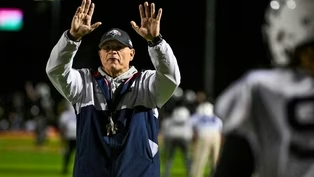
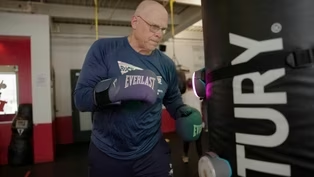
Mark Duda on Parkinson’s, Football, and Knowing When to Step Away
Video has Closed Captions
Mark Duda reflects on Parkinson’s, retirement, and integrity in leadership. (14m 59s)
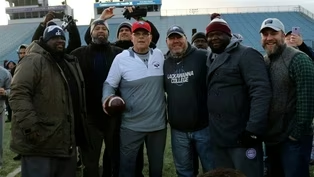
Why Mark Duda Chose Impact Over Fame
Video has Closed Captions
Mark Duda on leadership, discipline, and choosing impact over fame. (7m 50s)
Providing Support for PBS.org
Learn Moreabout PBS online sponsorship
- News and Public Affairs

Top journalists deliver compelling original analysis of the hour's headlines.

- News and Public Affairs

FRONTLINE is investigative journalism that questions, explains and changes our world.












Support for PBS provided by:
Keystone Edition is a local public television program presented by WVIA