Keystone Edition
From Factory to Front Door
3/11/2024 | 27mVideo has Closed Captions
What goes into getting products from the manufacturer to you?
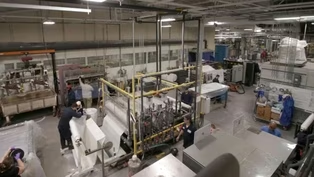
Keystone Edition Business has helped viewers learn about how things are made in PA. But what goes into getting those products from the manufacturer to you? We'll learn about the logistics of getting your favorite goods from point A to point B, and what the real cost of doing business is.
Problems playing video? | Closed Captioning Feedback
Problems playing video? | Closed Captioning Feedback
Keystone Edition is a local public television program presented by WVIA
Keystone Edition
From Factory to Front Door
3/11/2024 | 27mVideo has Closed Captions
Keystone Edition Business has helped viewers learn about how things are made in PA. But what goes into getting those products from the manufacturer to you? We'll learn about the logistics of getting your favorite goods from point A to point B, and what the real cost of doing business is.
Problems playing video? | Closed Captioning Feedback
How to Watch Keystone Edition
Keystone Edition is available to stream on pbs.org and the free PBS App, available on iPhone, Apple TV, Android TV, Android smartphones, Amazon Fire TV, Amazon Fire Tablet, Roku, Samsung Smart TV, and Vizio.
Providing Support for PBS.org
Learn Moreabout PBS online sponsorshipWVIA presents Keystone Edition Business, a public affairs program that goes beyond the headlines to address issues in Northeastern and Central Pennsylvania.
This is Keystone Edition Business, and now, moderator Steve Stumbris.
- Hi, I'm Steve Stumbris.
We live in a world where almost anything you want can show up at your doorstep practically in an instant.
There was a time when it would take weeks from the time you ordered something for it to show up.
From keeping store shelves fully stocked to having what you need arrive when you need it, it all comes down to logistics.
If you have questions, you can email us at keystone at WVIA.org or tag us on social with the hashtag Keystone Business.
WVIA news reporter Sarah Scinto explains a little more about logistics and what it means for you.
(logo whooshing) - [Sarah] What is logistics?
Logistics is the planning, organization, and management of the flow of products, raw materials, and services across the supply chain.
It's how things move from point A to point B.
The two biggest parts of logistics are transportation and warehousing.
Logistics is how transactions are filled, and without those transactions, there are no profits.
Northeast Pennsylvania, including the cities of Hazleton, Wilkes-Barre, Pittston, and Scranton, is a logistics hotspot.
Affordable real estate, an available workforce, and easy access to major highways make northeastern and central Pennsylvania an attractive location.
Most of the U.S. population is within a day's drive of our area, including densely populated areas such as New York City, Philadelphia, and Washington, D.C. With more land available, warehouse space can also be more affordable in northeastern and central PA. For more information about logistics, head to WVIA.org.
For Keystone Edition Business, I'm Sarah Scinto, WVIA News.
(light music) I'd like to introduce our panelists here to share their perspectives.
First, Jimmy Chen is an Associate Professor of Analytics and Operations Management at Bucknell University.
Carol Keup is the Chief Operating Officer at Valley Distributing and Storage.
And John Meyers is the director of sales at DM Bowman, and he's also the president of the North American Rail Shippers Association.
Thank you all for joining us.
Jimmy, Carol, John, I'm really looking forward to this conversation.
And already in researching this and talking with you ahead of the program, I've learned so much about what goes into getting products to consumers.
Carol, I'd like to open up with you to frame where you're coming from to this conversation.
Give us a brief overview of Valley Distributing and Storage Company, the scope, the reach and activities in both warehousing and logistics.
- So, Valley Distributing and Storage is a third-party logistics provider.
So, we provide warehousing and transportation services for customers that include retail goods, like soda, paper products, industrial goods, lumber, rolls.
Multitude of industries.
So, what we do is we receive goods and store inventory on behalf of the customer and then when they get orders that would ship out to you, we process those orders so they ship to the customer.
And that could happen a multitude of ways.
It can go out on a truck, it could go out to the door, parcel shipment, it can go out on a boxcar.
The same thing when it comes in.
It can come in on a boxcar, it can come in on a truck.
So, we offer inventory management and those shipping and receiving services.
- Oh, thank you.
John, I also wanted to ask you, for viewers, could you share a little bit about DM Bowman and your role, your reach into the logistics industry?
Also touch on rail as well, if you could.
- Absolutely.
So, DM Bowman serves most points east of the Mississippi primarily.
We are a mid-sized trucking carrier that Dry vans, which means goods, those van trailers you see going down the road.
Dry bulk, which is the dirty part of the business as a lot of people look at it, flatbed work.
And pretty much we operate up and down the East Coast all the way far as West out as Indiana.
We serve just about every industry out there.
We also have warehousing, a little bit over 4 million square feet of warehousing, primarily in the Hagerstown, Maryland area.
But to Bowman, there's a development part of it.
There's a hospitality part of it.
And as a group, you know, one way or another logistics.
touches it, that's pretty much the heart of what we do.
You know, we do logistics being in warehousing, trucking, hospitality industries, and development.
On the rail side of things, the North American Rail Shippers represents rail shippers, just like the organization's called, from the U.S., Mexico, and Canada.
- Well, thank you.
Jimmy, I want to bring you into the conversation now.
I know from your research at Bucknell and the instruction that you bring to the students there, you've addressed things like consumer demands, balancing that with supply and consumer demand for even next day, same day shipping.
Tell us about your research into how suppliers are, what kind of responsibilities they have to meet consumer demands.
- Right, I think we can address that question by starting to talk about the Amazon effect.
So, from that perspective, a lot of, including myself as a consumer, whether we live in an urban or rural area, we get the benefit of buying things online and then get the items the next day or in a very short timeline.
So, we're almost taking that for granted.
But that's because a lot of effort being put behind the scene.
For example, Amazon, they have built so many warehouses across the country.
They use the big data to try to predict what people want, so, pre-allocate the inventory closer to the consumer.
Not only that, as a customer we can see where our orders are.
So, the visibility is also very beneficial to the consumer.
- The technology must be advancing so quickly.
That visibility, the management of data and transmission of data to multiple parties in real time almost, can you talk a little bit more about that and how it's changed over recent years?
- Right.
So, one major factor, I believe, is the integration of the information technology into all aspects of the business so that the business can track where their inventory are, even though the Omni channel has been part of the business of all the major retailers.
So, they need to make sure that customer, when they look up the inventory on the internet, with that matching up the physical inventory in the store.
So that all takes efforts to make sure that the information are accurate.
- Carol, I wanted to ask you, expand on that, and especially, how has that changed, even over your career?
And what's yet to come in how the information is managed?
- Yeah, so even over my career, the information was slow to be shared between, you know, the warehouse, the customer, and then, of course, the consumer or the retailer.
You know, so if we had product and it shipped.
It was a manual process to send fax information and they fax it forward.
But today, customers want visibility throughout the entire process.
So, they want to see, and they can see, they can get into their portals, and they can see when things arrive at your warehouse, where they're at in your warehouse, if you have an order, is it picked stage, is it going out the door, and what time it shipped.
So, they just have the inventory management, similar to the retailer, you know, I can remember being at Best Buy when they were down to one piece.
You're still taking your chances.
Is it there or not?
Because the accuracy being plus or minus one is slim.
And I think that's only going to increase.
You know, we were talking earlier about how AI might play a role, you know, all the data exchange nationally, internationally.
I mean, it's just... Everything, and it is real time.
It's not almost real time.
It is real time.
You have real-time scanners.
You know, that information goes right into your system, and a customer can have immediate access to it.
- John, any insights from you about, well, in-warehouse versus over-the-road and rail tracking everything?
- Yeah, absolutely.
So, you know, as Jimmy brought it up and Carol explained, you know, we start with the Amazon effect, right?
We all want to know if you have it, and when I'm gonna get it.
I live in a major metro area.
I could have just about anything I want from Amazon within an hour.
And if it takes two hours, I'm already getting a little bit antsy cuz I don't have it.
But the reality is that Amazon products supply chain started, could have been six months ago, several countries away, several different modes of transportation to get there.
So, we like to think it's always sitting in that warehouse, ten miles down the road from us, but that's not reality.
You know, be it the lumber at a major big box supplier that you go online, and you say, I want 22 by fours, you look on a shelf and you see it's there.
That could have started off three months ago on the West Coast, got loaded up on a center beam rail car, shipped across the country, touched a couple of railroads, got stopped a couple of times, ended up in a yard like Carroll has where it gets transloaded.
And then all of a sudden, it's magically in your store or being delivered to your doorstep.
And we look at things like, you know, we order a new computer from the Apple site directly.
Odds are it's already made in China.
It's getting shipped to your doorstep.
But the amazing part is from the time I hit complete my order.
I know instantly where it's on the production line and when it's going to show up on my doorstep.
And amazingly, that's about three days if you're ordering an Apple computer.
So, we think of the supply chain as the final mile that shows up at your doorstep.
But that started many, many months ago, in many cases.
So, technology is there.
- Let's talk more about that final mile.
So, we see, okay, we've seen some images of what it looks like inside the warehouse.
But that final mile.
What are some of the biggest challenges that make that a barrier?
What kind of work has been advanced to create a solution to that, finally getting it to the doorstep, whatever product it is?
Carol?
- You can have a lot of, there's a lot of opportunities to fail on the final mile.
You know, when, again, and John can attest to a carrier, do they have the capacity?
We don't know today if we're going to have 100 orders to ship or if we're going to have 500 orders to ship.
So, the truck arrives, how many of those orders fit or they don't fit, right?
And then weather, especially in the northeast, you know, like we have customers that they know their trucks don't like to come to the northeast in the winter.
There's a lot of opportunities to fail.
(Steve chuckles) - Maybe I can chime in.
So, we cannot talk about last mile without talking about the first mile, the middle mile, and the last mile.
So, the first mile is where the manufacturer ship the goods to the distributor.
And then the middle mile is where the distributors ship to, say, the retailer or distribution center closer to the customer.
And the last mile is from the retailer to your doorstep.
Now, the reason that it's challenging is because exactly.
What Carol mentioned about it's very unpredictable for the traffic in the last mile.
But I guess one of the major factor is the cost because the economies of scales is going down from the first mile when you have the truckload in a larger quantity.
The middle mile it break down to the less than truckload or Pallet size.
Last mile is the parcel.
So, every single parcel has to go to every single doorstep.
So that's very hard to achieve in a timely fashion and it's very costly.
- John, I wanted to ask you, Jimmy and Carol have mentioned there's room for disruption at any point in that.
John, could you describe some of those disruptions and what kind of unexpected effects and duration of those impacts that could happen, say from a road closure or a weather event?
- Yeah.
- Yeah, I mean, let's just start with the human factor, labor.
Labor is always an issue in our industry.
It's been becoming a bigger issue as time goes on.
You need people that could drive forklifts.
You need people who could pick packages.
You need people who could load trucks.
You need drivers who could drive those trucks.
You need people who can maintain those trucks.
And the cycle is endless.
And when we look at some basic factors here.
If everything works, we pull it off.
But we have a storm, a natural disaster that, you know, any disruption in that getting it to, or from creates a chaos effect in our industry because it doesn't mean you're shut down for one day.
You can make all that up the next day.
There's simply not enough people or assets to be able to let that filter in.
And just think about it.
A company like Amazon that ships out millions of packages a day and one DC is shut down for a two-day period because of severe weather.
How do you make up for that and what kind of disruption does that cause?
And you know we're still all coming out of a pandemic where those disruption effects we're still feeling.
You know most people watching this never heard the word logistics or supply chain until the pandemic where the favorite word was supply chain disruptions.
And basically, we cut everything off.
We tried to get it started back up.
And depending on the industry you're in, we're still not caught up on a lot of those items.
I mean, there's still things you can't get.
Car manufacturers are still waiting on chips, shipping companies are still waiting for a balance to get goods out of one country to another and not have it cost them.
Like Jimmy said, this is a costly industry.
Nothing is cheap about what we do.
People expect free delivery, but they don't understand all those costs that people assume are free.
So, in a nutshell, it's labor and people intensive.
- Let's talk more about those costs that consumers may not have a good enough understanding of.
So human factors, distance factors.
What are things that are unexpected costs that consumers may not understand well enough?
Carol, can you join in about what are some of those things that consumers just perhaps don't have a full enough understanding of?
- Well, fuel has been a cost issue for years now.
You know, diesel is more expensive than the fuel for your car.
So that fluctuates, and John can speak to that, on a weekly basis.
So, if someone's quoting $100, it could be another 30% because of where the fuel happens to be in the market that week.
They publish that weekly.
But then on the grander scheme, in terms of goods being available, whether you're sourcing domestically or internationally, we have customers that manufacture domestically.
So, they may have a lead time of maybe seven weeks to, not including manufacturing time, but just to, you know, transport goods, get them where they need to be, get them to the warehouse so they're available for the buyer.
But on the international, especially during COVID, you have customers that it could be a two-to-six-month lead time to produce at a plant.
Then you're on the water for three weeks.
Then you're at the port.
So, it can be anywhere from two to eight months.
Now, we have a customer where a typical container, ocean container cost would be $5,000 from Sweden.
During COVID, it went to $12,000.
So, how does the supplier account for that?
Well, then the price increase at the end, right?
Same thing.
And on the domestic side, it could be $7,000, $8,000 to move a rail car.
But if someone needs it just in time, then you're sending a truck for $2,500 at a higher cost per truck.
- John, any more about that, about the scaling out to not just local sourcing, but sourcing from around the world.
What kind of risks, what kind of trade-offs are we making with such a disparate supply chain?
- You know, we've seen the disruptions at the ports, we've seen ships out there for a long time, and we've seen strikes.
Those are the things that are a constant within our industry because it takes a lot of different people, and a lot of different modes of transportation to work together.
Right now, we are seeing European disruptions.
We are seeing other canal disruptions at the moment.
Those are the things nobody sitting here, or consumer base has any control over.
And all we could do is react.
So, if you are a big box shipper importing all your goods, you know, what do you do?
During COVID, they rented out their own ships to be able to move products.
They expanded their fleets to be able to move product.
And they, you know, hired more people to open up more distribution centers.
And, you know, we built distribution centers everywhere.
I mean, look at the amount that we have now, you know, in the area that you're in was primarily a manufacturing area for decades.
And now you've become a distribution center because you're in the heart of the population.
You got to get those goods to market.
The closer you are to the market, the less chance of that disruption.
So on the trucking side, the length of haul that we do becomes shorter.
But that means there's more of it to get to, you know, the same amount of short places versus across the country.
So those goods get touched more often.
So again, the more times you touch freight, the more it costs everybody, and the more chance there is for something to go wrong.
- And Steve, if I could add to what John is saying on the current landscape, you know, with the geopolitical issues, with the, you know, containers getting hijacked on the Red Sea.
Okay, so that's adding another 10 days at least to transit.
It's tying up capacity, so ships aren't available.
It's increasing cost.
I think the average is like another $3,000 per container on the ocean.
Those are unpredictable events.
- In fact, not that long ago, last year or the year before, a canal that was blocked by one vessel.
- [Carol] Yeah, by that ship.
- What did that, how did that impact, how did that impact just your personal experience?
- All the containers were held up.
I mean, customers were waiting for goods that maybe they had purchased orders for from retailers, and that was out of everyone's control.
I mean, they had a logjam of containers going through the Panama Canal.
- One of the most interesting things, going back to tracking systems, tracking items, tracking ships in real time, that was probably the first time that a lot of people saw you can track with a public website locations like that.
- Dangerous.
Yes.
Like, you know, when we tie into information systems and cybersecurity, it creates a lot more risk for disruption, security issues, it's another level of focus.
- If I may chime in, so it brings back to one of the earlier things that we talked about.
Because of the e-commerce, we can buy product from anywhere in the world.
And the supplier, they can ship product to anywhere in the world.
Therefore, we look at 2021 into 2022, a lot of, like Carol mentioned, a lot of logjam on the seaport outside California.
That's all because of the international trade, partly from the consumer transactions.
So, that also tells us that the impact of the e-commerce is really far reaching.
- What are some of the trade-offs that companies are forced to make between holding materials, holding stock in warehouses or at retail, large retail stores?
What are some of the tradeoffs that happen?
- Well, there's a cost to holding inventory.
And that's where, you know, Jimmy, I'm sure you saw that in your studies.
During COVID, people, they got caught, right?
We were trying to be just in time, meaning we don't want our inventory in our warehouse until we're close to shipping it out on orders.
So, there was no inventory available when there became a high demand for inventory.
So, you have the lost sales.
- [Steve] Right.
And then on the reverse, if you have the inventory and there are no sales, you have all that inventory carrying and warehouse cost.
So, that's where the forecasting comes in.
- Jimmy.
- And also, a lot of times, the demands are seasonal.
So, once you miss the window, you miss the whole year.
So like John mentioned, when you have a shock like COVID, we can feel the ripple effect for a longer time because once they miss the Christmas, and that's the whole major time of major retailers.
Right, so the timing and the window and the seasonality is really play a big role in here.
- Well, that's where they make their money, within a three-month window.
- Right.
- Yeah.
- Because we have a lot of seasonal customers, and if we don't make it happen in, say, fourth quarter, our playoff season, we impact that customer's business.
- Right.
- Yeah, and like they're all saying, the part that a lot of people miss on this, right?
You know, from our trailer releasing division, we had thousands upon thousands of trailers loaded with merchandise that never had a chance to be sold because they missed a season.
And now it's last season.
So that gets held even longer to, at some point in time, make it to your discount stores.
But Carol brought up something, too.
She said with reverse.
The other thing that with all the e-commerce is the reverse logistics.
It's all the returns that come back.
That's another huge cost to every one of these companies.
So, we warehouse all these return goods that are coming from your big boxes because, you know, you order on amazon you order five different sizes because you're not quite sure, and then you order five different colors because you're not quite sure, but you only keep one, and then they all get sent back for free.
So think about that cost because you start the whole supply chain, but now it goes in reverse.
- Yeah.
- How much has that changed?
- Right, so what I wanted to say is that because of the e-commerce, people tend to buy things without even trying it on, so that increases the probability of people wanting to return it.
- It's a multiplier.
- Right.
And the reverse logistics typically is an afterthought for most of the business, so that adds up the cost like John mentioned.
- We talked about seasonality.
- Yeah.
- And, Carol, I love the term playoff season.
This brings me to perhaps one of our final topics briefly.
What about event-based logistics?
Major festival, sports championship, or let's talk about Taylor Swift's: The Eras Tour.
Let's talk about logistics.
What are the big challenges for an event?
- Communication, because incredibly, you'll have customers that have these types of promotions, and they neglect to tell you until the orders land in your system.
So having the resources to execute, that's the biggest challenge.
- Communication.
- Communication.
- Communication.
John, any thoughts on that as well?
- You know, that's exactly it.
When you talk seasonality, and, you know, Carol could tell you on a pick-pack side of things, adding stickers.
adding labels to things, that all takes coordination, and they all have to get made and get to you.
On an event side, it's timing, and it's not like sort of show up today, it is show up today at exactly this time.
And without that, you know, everything goes wrong really quickly.
So when you look at, like you said, the Taylor Swift tour, one truck cannot not make that final leg of the, you know, transportation because it's like putting a puzzle together when you're talking about events.
And you see, you know, be it a golf tournament, be it an NFL football game, that equipment moves in a truck.
And could you imagine getting to the field and not having any uniforms or helmets?
- Uniforms, equipment for that.
- People don't realize it's critical.
- Yep.
That one puzzle piece, we're all going to know.
- Yes.
- So, Carol, Jimmy, John, thank you so much for being part of this conversation tonight.
Thank you for joining us.
For more information on this topic, please visit wvia.org/keystone-business.
And remember, you can rewatch this episode on demand anytime online or on the WVIA app.
For Keystone Edition, I'm Steve Stumbris.
Thanks for watching.
(bright music)
Providing Support for PBS.org
Learn Moreabout PBS online sponsorship
- News and Public Affairs

Top journalists deliver compelling original analysis of the hour's headlines.

- News and Public Affairs

FRONTLINE is investigative journalism that questions, explains and changes our world.












Support for PBS provided by:
Keystone Edition is a local public television program presented by WVIA