Pioneer Specials
From Nesna with Love
Special | 26m 46sVideo has Closed Captions
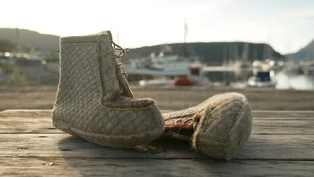
Follow host Dana Conroy on a journey to uncover the story behind a pair of “lobben boots.”
Postcards producer Dana Conroy’s great-great-grandmother received a package in the 1940s from her relatives in a Norway. Inside, she found a pair of boots called “Nesna Lobben.” Now Dana and the Postcards crew are bringing those boots back home.
Problems playing video? | Closed Captioning Feedback
Problems playing video? | Closed Captioning Feedback
Pioneer Specials is a local public television program presented by Pioneer PBS
Pioneer Specials
From Nesna with Love
Special | 26m 46sVideo has Closed Captions
Postcards producer Dana Conroy’s great-great-grandmother received a package in the 1940s from her relatives in a Norway. Inside, she found a pair of boots called “Nesna Lobben.” Now Dana and the Postcards crew are bringing those boots back home.
Problems playing video? | Closed Captioning Feedback
How to Watch Pioneer Specials
Pioneer Specials is available to stream on pbs.org and the free PBS App, available on iPhone, Apple TV, Android TV, Android smartphones, Amazon Fire TV, Amazon Fire Tablet, Roku, Samsung Smart TV, and Vizio.
(gentle music) - Once upon a time, one of the greatest newspaper in Norway called "Nesna Lobben," the ugliest footwear in the world.
- The ugliest shoes ever.
(laughing) - Well, they're probably right.
- I don't, I can't understand that.
I think they're really beautiful.
- If you saw a woman walking down the street with Nesna lobben you knew that she was cool.
- [Speaker] You're kind of strange wearing Nesna lobben in some peoples' eyes, - You could go up to her and tell her, "I know where those shoes are from."
(gentle music continues) (jet engine) (gentle upbeat music) - On our way to Bodø.
(upbeat suspenseful music) There he is.
- Oh!
(door slamming) (upbeat suspenseful music continues) - I'm gonna introduce you to the team.
We've got Olav driving.
We've got Kris behind the camera.
We've got Dana with her Nesna Lobben's in tow.
And then you've got me, Ben, just try not to get carsick.
(upbeat suspenseful music continues) - Let's talk about what we're actually doing.
You go first, Ben, tell 'em what we're doing.
- Well, we are on our way to Nesna, to the factory, former factory of the Nesna Lobbens.
- And the reason we are investigating Nesna Lobbens is because back in 1945, my great-great-grandmother received a thank you package from her relatives in Norway for sending gifts during World War II because they, the Germans bombed this area in World War II.
So they sent back a gift of like the original prototype of Nesna Lobbens, which she kept until she died.
And then her granddaughter kept them and gave them to me last summer when we were filming.
We took them to the Vesterheim and had them evaluated.
They decided to take them into their permanent collection.
- We do not have any of the Nesna Lobben at all in the collection.
Every once in a while, something from the wishlist turns up.
And so we're very excited about that.
- But first we wanted to bring the Nesna Lobben to Nesna and find out what happened to the Nesna Lobben factory and maybe talk to some of the people that used to work there.
(gentle upbeat music) So did you have Nesna Lobbens growing up?
- Yeah, I think everybody had a pair of Nesna Lobben as kids of the 80s.
- Hm.
(gentle upbeat music continues) - Oh, what's this town called?
- Fauske.
- Tung-ska?
- Fauske.
- Fauske.
- Fauske.
- Fauske.
- Fauske.
- Fauske.
(chuckles) - Well, you say it, Ben.
(Ben chuckling) You say it?
- [Ben] Fauske.
(group laughing) - It's not fjell, it's fow- - Oh, oh, oh, fow-kel.
- What?
- Fow.
F-A-U-S-K-E.
- Fauske.
- Yeah.
- Fauske.
- Fauske.
- Ugh.
- That was great.
- Was that bad?
- That was really good.
- Fauske.
- [Dana And Ben] Fauske.
- Fauske.
- Fauske.
- Fauske.
- Fauske.
- There's no L. It's Fauske.
- Why are you doing it wrong?
- Why am I doing it wrong?!
I haven't heard anybody say it right.
(upbeat music) (car humming) - Nesna kommune - Welcome home to Nesna.
- [Olav] We made it.
- Here's the church.
- There's the church.
- Where my great-great-grandparents met.
(upbeat music continues) - [Olav] Here we are, Nesna.
Going to the museum.
- So you can just come inside here.
This way, follow me.
(Olav speaking faintly) - [Kris] Nesna Lobben.
- So I brought my Nesna Lobben from the 1940s or 50s.
- Wow.
- Oh my God.
- And you have wore this?
- No, it was from my great-great-grandmother who's from Nesna.
Her husband Johannes was a boat builder.
He was a fisherman up in Lofoten during the winter time.
He was from like a big fishing family from here.
And she was a servant, and they fell in love, and their love wasn't accepted because in that time you couldn't marry someone of the serving class.
So they decided to come to the US so that they could be married.
She sent care packages in World War II to Nesna to her family.
And when the war was over, they sent these back as a thank you.
And she kept 'em until she died.
- Yeah, I'm Kristin Klausen.
Yeah, I work as a historian, and I usually work with making exhibitions.
(tranquil music) - Yeah, we made it in 2015.
We start collecting lot of shoes.
Because it was 60 years since they started the production, they produced about 1.6 million pairs of shoes.
So it was a big part of the community, and also for the area, the region, Helgeland, because the people who made these shoes, part of it was made at their homes, and they lived all over the place.
It was a lot of people involved.
(gentle upbeat music) (footsteps crunching) (machine grinding) (sewing machine whirring) (gentle upbeat music) - So when I told people that I work in Nesna Lobben, they said, "Wow, Nesna Lobben."
Yeah, mm-hmm.
I had a good job for 10 years.
- I've been working on Nesna Lobben for 10 months, in 1971 to 1972.
- At the factory, we were only four people working.
- Payment wasn't so good.
- My first earliest memory is my mother.
She was sitting on the kitchen and making this shoe.
So she was working from home, and it was a good earning.
My job in the factory was making the sole on the shoe.
- I sew this pattern.
- And made this and put them on a hook and into the making of... - And then you pack them and then you go to the storage and put them in boxes and ship them.
So all of that, I did.
- Let's see here.
This one with this pattern, I think, this guy made this shoe.
- Oh, you can tell by the pattern.
- [Ludvig] Yeah, yeah, yeah.
- All of it was handcraft.
- You can see the different, you have a different in the start on this, on this.
This have maybe me who have done this, maybe me.
Later on in my job, (chuckles) later in life, so I was a photographer, so I made a lot of these pictures.
- [Dana] Oh, that's amazing.
So you took these photos?
- These photos?
Yeah, these are me.
That one.
Yeah, his name is Jens.
- [Dana] Okay.
- And he has been working on a factory for many, many years.
And he's 99 and a half years old.
He said that you are very welcome to visit them at home.
(car humming) - Yeah, so, this is... (Jens and Emma laughing) These are what they left.
- Yeah, yeah.
- This is their picture.
- [Emma] Ja, ja.
(Ludvig speaking indistinctly) - This is in Minnesota.
- Oh!
- Yeah.
- Oh, they were in Minnesota?
(Ludvig chuckling) - Yes.
- Yeah.
- And also Nesna Lobben is the only footwear that Santa Claus ever can wear.
My name Runa Meidell.
I've been here since ‘21 working with history with kids.
(foot thuds) But you can see the Santa Claus (both chuckling) in Norway everywhere.
Norwegian Santa Claus wears Nesna Lobben.
- [Dana] Has a man ever hit on you because you're wearing Nesna Lobbens?
(Runa laughing) - No, I don't think that.
Well, not sure though, but no, I don't think so.
(laughing) Yeah, you're feeling sexy?
- Yeah.
- Yeah?
(both laughing) - Oh, absolutely Nesna Lobben.
(both chuckling) They can stand anything.
- Yeah, absolutely.
And also, we have Pride.
And Pride Nesna has Nesna Lobben as its logo.
So yeah, Lobben is everywhere.
Yeah, this I painted.
So we can't wear them outside because the paint has ruined the wool, but we use them as a mascot for Nesna Pride, so.
(car humming) - How are you feeling, Dana?
Do you feel like you are at home?
- I do feel like I'm at home.
I know that my great-great-grandparents never made it back to Nesna, so I feel like I'm lucky to get to see it.
(latch clicks) (door chimes) - Just getting all the gear set up for our shoot at the brewery.
(door thuds) - Here we are at the Nesna Lobben factory, what once was.
- And now is a brewery.
(glasses clinking) - My name is Kristian.
I own, run, and operate this brewery called the Raus Bryggeri.
We started our brewery six years ago, and we quickly grew out of the building we were in, and we were next to this building.
I knew that it was available.
It was quite big for us, but we knew the location was perfect.
This is next to the ferry, the coastal route with 100,000 tourists a year that goes past.
So we knew it was available.
We asked if we could rent and move in.
I didn't explain to you what does Raus mean.
In German, it means get out, "Raus!"
In Norwegian, it means “to be generous.” In Norse language, Viking language, it meant “to be brave.” So it's really nice word.
But for us it means to be generous.
So yeah, so when we moved in, there was lots of stuff from the old factory as well.
So we just made it our own small beer factory.
So it's a really nice place to be with lots of history.
(gentle music) Nice.
I will drink this now.
(all chuckling) Yeah, I remember I have small glimpses.
I get small glimpses when I walk around here.
My neighbors worked here, and we knew all the people who worked there.
So in this room, they had a huge machine that made the molds for the soles, for the shoes.
(machine clacks) (machine clicks and whirrs) - I think it closed in early 2000.
- They started to have trouble finding people to do that job.
There were young people who wouldn't do that.
They wouldn't sit at home knitting, so they got better jobs.
- They sent all their gear and their machines to Estonia.
- It was of course cheaper.
So I think that's why it ended.
- I don't know the English term.
It was modern to get production done overseas, like abroad, 'cause it was cheaper labor.
- I am the CEO and the owner in Protex, the company in Estonia that bought the production equipment, machines, and the production rights to Nesna Lobben trademark.
- So, no factory in Norway.
And it's too, it costs too much.
- So I'm sad that it's in Estonia now.
I'm happy that it's still imported, but I would like, I would like for it to be in Nesna still.
- Estonia?
No, no, no, no, no, it's wrong.
'Cause it's Nesna Lobben, mm-hmm.
So if it was possible to bring it back, it would be a good thing for Nesna, I think.
- It can't be done today, unfortunately.
It would be nice, but I don't think it's realistic.
(footsteps crunching) - We were here many years ago, and I came to visit the church and it was locked.
And in the documentary we made at that time, you can see me going up to the church and trying to pull on the door and I can't get in.
So now we're gonna- - Now you're starting again.
- Now, we're gonna... - [Speaker] Yeah, yeah.
- There's a database of the church records.
I think it goes back to the 1800s, or maybe before.
I think I have 11 generations there, so I might be related to you.
(chuckling) (Dana chuckles) (latch clicks) - Hey.
- Hello.
- Hello.
Hi.
- Good to see you again.
- Good to see you too.
- Hi.
Hi.
- Hi.
Welcome to the church.
- Yeah.
- Good to see you.
- Welcome.
Good to see you.
(gentle guitar music) - I brought my family book, and, 'cause my great-great-grandfather is actually buried in Olivia in Minnesota.
- Oh wow.
(paper rustles) - He's my, the guy that made the book, he's my double fourth cousin and fifth cousin.
New settlers in Minnesota, 1898, for Norwegian immigrants to the town of Olivia.
- Oh wow, I've seen this picture before at the museum at Kandiyohi County Museum.
- Really?!
- Mm-hmm.
- Yeah, he wrote a letter to my great-grandmother.
(paper squeaking) For like three or four generations, most of the children went to America.
If there were 10 children, 10 siblings, two would stay in Norway and the rest go to America.
So all my, my grandmother and my great-grandmother, they all had lots of uncles and aunts in America.
(gentle music) - One thing I think is interesting about this church is that it has a boat hanging from the ceiling.
And my great-great-grandfather was a boat builder, and it kind of brings it full circle for me to have the Nesna Lobben and the boat in the church where they met.
(gentle pulsating music) So, do you think I should keep these or donate them to the Norwegian American Museum?
- I'm not sure.
(both chuckling) It's always like, if you work in the museum, you should always say, "Oh, the museum would love to have them."
But then if people take good care of them and they are kind of a part of their story and their identity, I think it's important people keep having their things.
- I would definitely keep them.
Yeah, definitely.
Because this is family history that I want my kids to know about and my great, my grandkids, and yeah.
So I definitely think you should keep them for yourself.
Yeah.
- Keep them.
It's good craftmanship.
Very good craftmanship.
See how well made it is.
It lasts for a long time.
You can still use them, but I won't do that.
(chuckles) - [Ludvig] Yeah, good to have on the feet in the evening.
(all chuckling) - And I'm also impressed you brought them here to Norway and to Nesna.
That's the first time I've experienced that.
- For a person from Nesna, it's nice.
Yeah, I mean, I'm just getting the chills from thinking about it.
- They've made their way- - They're so old.
- back home.
- That was real fun.
And I can obviously tell that you really care about them, these shoes, and that you love them.
So, they really, yeah, they mean something to you.
(birds squawking) (ferry engine) - Today we are going out to one of the three islands in the Nesna kommune.
We are now leaving Hugla.
And now we are going out to the next island, Handnesøya.
And then we go out Tomma.
This is the main road we are in now for the people on the islands.
- Were there people that worked at the Nesna Lobben factory that lived out on these islands?
- Oh yes.
Oh yes.
And they were sitting home and working.
And then they delivering with boats back to the mainland.
(car engine) (lock clicks) (latch clicks) - [Dana] Okay, so we are here at an old Viking assembly area where Vikings would have meetings with the kings and important people.
- Sitting around probably on stones and whatever they had around there.
We are on the Viking land in the moment.
Yeah.
It was a kind of a very early democracy because everybody could talk.
- I declare Nesna Lobben is the world's most attractive shoe.
- Yes, hear, hear.
(all laughing) Hear, hear.
(car engine) [Kris] Good spot.
We're gonna go out on a field.
Look at how beautiful it is.
It's perfect picture.
(gentle bright music) (gentle bright music continues) - So this was like probably one of the most special days, (door thuds) and I've got my great-great-grandmother's Nesna Lobben.
This was the perfect way to end the trip.
(footsteps crunching) And I've got my best friend Ben here.
- Look how tan I am.
(Dana laughing) (cars whooshing) - This is one of our storage areas at the museum where we take care of the objects and keep them until we're using them for exhibits or for researchers.
So come here, I'll show you where your pieces are going to end up.
- I've got some bad news, okay?
- After traveling to Nesna, Norway and sharing my Nesna Lobben with the community there and seeing their reaction, it was just so powerful and special that I don't think I can part with them at this time.
I think I have to keep them in my family for now and try to pass them on to my kid who could potentially take them back to Norway again on his own journey.
- That'd be great.
- The way that the shoe helps me connect with the people in the culture was amazing.
It opened so many doors.
- And that's really exciting.
It's so exciting that even just a simple object can help connect people with family and place and time.
So we understand that you'd like to keep it longer, and that's just fine.
- Like, have you ever had people that have donation remorse?
- I think so.
They come to us planning to donate it, but when they learn more about it, I think they start to appreciate the piece more.
And that's what we would really love to see is people appreciating the pieces from their families themselves.
So we don't feel bad that we don't get everything.
We're pleased that they're staying in families too.
(gentle music) - We're here at Norland Lutheran Church in rural Paynesville, Minnesota.
My great-great-grandparents left Nesna, Norway back in the 1880s.
They fell in love but weren't allowed to be together because they were of different classes in society.
One of the things my great-great grandmother said before she died as she was worried that nobody would visit her grave.
So my family's made it a tradition to come here once a year and bring flowers, and remember the people that brought us to the United States.
Today my family lives about five miles from here.
So their choices kind of reverberated throughout time, and they really changed the course of their own history, and my own history as well.
So yeah, they came from Nesna, with love, to Minnesota.
(gentle music continues) - [Announcer] This program is brought to you by Margaret A. Cargill Philanthropies.
Preview: Special | 30s | Follow host Dana Conroy on a journey to uncover the story behind a pair of “lobben boots.” (30s)
Providing Support for PBS.org
Learn Moreabout PBS online sponsorship













Support for PBS provided by:
Pioneer Specials is a local public television program presented by Pioneer PBS