From Sea to Shining Sea
From Sea to Shining Sea
Special | 37m 5sVideo has Closed Captions
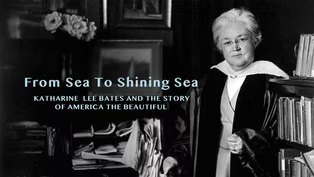
The rich life of Katharine Lee Bates, social reformer and author of AMERICA THE BEAUTIFUL.
"America the Beautiful" is one of our most beloved songs, yet few know the writer behind it. This film explores the rich life of poet, professor, and social reformer Katharine Lee Bates. As we approach the 250th anniversary of the Declaration of Independence, Bates’s story reflects America's beauty, ideals, and flaws, honoring all those who strive to live up to the nation’s promise.
Problems playing video? | Closed Captioning Feedback
Problems playing video? | Closed Captioning Feedback
From Sea to Shining Sea is a local public television program presented by GBH
From Sea to Shining Sea
From Sea to Shining Sea
Special | 37m 5sVideo has Closed Captions
"America the Beautiful" is one of our most beloved songs, yet few know the writer behind it. This film explores the rich life of poet, professor, and social reformer Katharine Lee Bates. As we approach the 250th anniversary of the Declaration of Independence, Bates’s story reflects America's beauty, ideals, and flaws, honoring all those who strive to live up to the nation’s promise.
Problems playing video? | Closed Captioning Feedback
Where to Watch From Sea to Shining Sea
From Sea to Shining Sea is available to stream on pbs.org and the PBS app.
[MUSIC] On a rare day when smoke from distant wildfires obscures the summit of Pike's Peak, scores of arriving tourists are reminded that in 1893, the view from here inspired America's most popular song.
America the Beautiful, O beautiful, spacious skies for amber waves of grain.
When those words first came to me way up there on Pike's Peak, I never imagined that my little poem would eventually be known and loved by all Americans.
[MUSIC] Oh beautiful [MUSIC] For spacious skies [MUSIC] For amber waves of grain.
[MUSIC] For purple mountain majesty [MUSIC] Above the fruited plain [MUSIC] America America [MUSIC] God shed his grace on thee [MUSIC] And crown thy good [MUSIC] with brotherhood [MUSIC] From Sea to Shining Sea I love that song because it stirs my kind of patriotism.
It should be our national anthem.
But truth be told, most of my words aren't sung anymore, and their message is all but forgotten.
So let me tell you the story behind my song.
When I hear America the Beautiful today, I remind myself that it has all these verses that I don't know about.
Whitman heard America singing, but I saw America suffering.
[MUSIC] Saw the factories where children were deprived of body and soul.
Saw the immigrants scorned and cheated by the sons of immigrants.
Saw the women who could not even vote.
[MUSIC] I wanted to see a different America, immersed in beauty with liberty and justice for all, as it was meant to be.
And crown the good with brotherhood from sea to shining sea.
[MUSIC] I was born here on Cape Cod by the shining sea.
My father was a minister, but I never knew him.
He died when I was four weeks old.
Mother did every kind of work to feed us.
My brothers chipped in with the fish they caught.
So many neighbors helped too.
When I was five, President Lincoln was shot.
I'll never forget my mother's grief.
She wrote that she imagined the church bells ringing so that even her father who was buried in the graveyard could hear them ringing to toll for Abraham Lincoln.
[MUSIC] How I admire the men of my village who gave their lives for his cause, that slavery be abolished forever.
[MUSIC] Oh beautiful for heros proved [MUSIC] in liberating strife.
These were men who had died in the Revolutionary War fighting for the colonies, and then men who had died in the Civil War fighting for the Union.
[MUSIC] From far beyond Nantucket, the whole world came to us.
And I think this is what eventually made her what I would call a global citizen.
Most men in our town were sailors.
Many never returned home alive.
[MUSIC] Hattie Gifford was my best friend.
We played everywhere, even in the old burying ground.
[MUSIC] One day Hattie and her mother were going to meet her father, a mariner who was out to sea.
What they didn't know was he had died coming home.
And they placed the wooden coffin at their feet and said, this is your father.
With so much death around us, I wrote my own will.
I, Katie Bates, do hereby bequeath all my worldly possessions to Hattie L. Gifford with the wish that she will give them to poor Indians.
[MUSIC] Reading was my window to the outside world.
I was shy and nearsighted, with my head mostly in a book.
I wrote down every one I read.
One day a peddler came by and put some spectacles on my nose.
And suddenly, I saw that the trees outside had leaves.
[MUSIC] Mother gave me this little book to write in.
I had nothing important to say, but I said it anyway!
Boys are necessary, but when they kiss the girls, write love notes, can't talk sense and hug girls, they are the greatest bores in existence.
- Katie Bates.
In 1871, mother moved us to Wellesley, Massachusetts, only 20 miles from the big city of Boston.
I wrote for my high school newspaper and the local daily.
My school was right near the site where a new woman's college was being built.
They really founded this school as a powerful educational institution that would educate women from different socioeconomic strata.
And that founding principle has held true for 150 years.
I entered Wellesley College in 1876, class of 1880.
"Katie of 80", the other girls called me.
We lived in College Hall, which was too fancy for my mother's tastes.
Palm trees in the atrium?
In Massachusetts?
Voted class president.
I was popular, but not happy.
They had to come and eat in the dining room at a certain table.
And then all day long, they had, well, they had daily chapel she had to go to.
It was very rigid.
After vacation, I just wanted to keep reading books in my hammock forever.
Books I chose!
But I admired Mr.
Durant, Wellesley's founder.
He made sure nearly all our professors were women.
And he brought beauty to every corner of the campus.
At Lake Waban, I found a cure for my college blues.
Oh, the delight of nature, where she leads, refresh your heavy lids, while you behold how sunshine revels in the lowliest weeds.
I majored in English and Greek but my real love was verse.
Chaucer, Shakespeare.
Henry Wordsworth Longfellow was her favorite poet.
And he was a big influence in many ways in her life.
And he had wanted Americans to see their own history in his poetry.
He invited our class to his home in Cambridge.
When he told me he liked my poem, Sleep, I nearly wept for joy.
I told a friend that if I could write a poem people remembered after I died, I'd consider my life worth living.
My poems were mostly serious.
But I loved humor, too, writing of our class... This, oh, this is the classical class, who even at play on the green young grass, gossiped in Greek or punned alas.
In Latin, that might or might not pass.
I taught high school till I joined the Wellesley faculty in 1885.
By then, my stories were being published.
Though I needed money, I wrote mostly for the joy of it.
Life brings blessings in disguise.
In 1888, I was exposed to smallpox.
Forced to quarantine, I wrote a novel for teens about a rich girl and a poor boy.
Rose learns that Thorn, a crippled beggar, is a brother, abandoned in childhood.
Her heart goes out to those like him, as mine did.
She wanted to write a novel to foreground the problems in this country with the sweatshops and the women living in tenements who had such terrible working conditions.
For them, there is no day.
For them, there is no Sabbath.
For them, there is no Easter.
In that dreary tenement house, they are as the dead and buried.
Mark Twain called the era "the Gilded Age."
The rich lived in luxury while the poor, arriving by the millions, grew destitute.
Fortunes rose from their work, but they did not benefit.
Railroads opened the west, and the Indian treaties were broken, leaving them only slivers of land.
Soldiers slaughtered the Indians' buffalo for sport.
In later works, she describes in more detail the shame of Indians, meaning United States abhorrent treatment of indigenous peoples on the continent.
Our wigwams shall vanish from these our lands.
Our paths be lost in the blowing sands.
Our hearts are bitter and clamorous.
Red sun, red God, oh comfort us.
My novel wasn't much, but I won a literary prize of $700 for it, enough to travel to England the next summer.
I'd study at Oxford and receive a master's degree for my efforts.
My friend Annie Scoville and I left Brooklyn in May 1890.
She brought two big cases filled with bottles of ginger ale.
It took both of my brothers to get them on the ship.
The seas were so rough, I arrived exhausted.
After touring in Scotland and England, I spent months at Oxford, polishing my credentials in English literature.
While I was there, the trustees of Wellesley College decided to require that every professor pledge her Christian faith.
That requirement had nothing to do with education.
I refused to sign and thought I wouldn't return to Wellesley.
I wasn't even sure I wanted to.
I was always nervous about my teaching.
When I was sick, I'd put a note on my classroom door.
But the trustees backed down, so I came back to take over the English department as a full professor.
In England, men sought me out.
That was when her first suitor, Oscar Triggs, started courting her.
I even considered marriage.
But in those days, if a Wellesley teacher wed, she lost her job.
They had to sacrifice marriage to become scholars.
That was one of the weaknesses of education at that time.
But Wellesley offered me a vibrant community of brilliant women.
Can you imagine teaching at Wellesley in the 1890s?
This educational endeavor must have been so exciting for women.
Though I'd always been quite conservative, my colleagues had a great influence on me.
The women there were representing all causes in the United States, whether it was the urban poor, helping immigrants, getting the vote for women.
All of these issues were hotly contested, and I would argue that they still are being hotly contested today.
Vida Scudder, a Christian socialist, stood out among us.
But we all shared her passion for women's emancipation.
I grew closest to Katharine Coman, an economist and historian.
Katharine Coman was brilliant.
I think she was one of those people that burned fiercely.
She was the social conscience of the pair.
In time, we became almost inseparable.
My literature classes quickly attracted students who believed in Wellesley's creed.
There were comments from some of her former students describing how she lit a fire or passion within them.
In 1892, my colleagues and I opened a settlement house for immigrant women in Boston.
Katharine Coman was organizing these Italian women into a union to get better pay for their sewing.
And the settlement house had classes for children.
But they were always more poor than we could care for.
The next year, Katharine and I were invited to teach summer school in Colorado.
[MUSIC] Oh beautiful, for pilgram feet... This epic train journey was something that many Americans were eager to take.
She kept fantastic notes along the way.
I'd never been west before.
MUSIC] ...Across the wilderness!
And for Katharine Lee Bates, this was additional income, but also was a built-in vacation.
On the way, I stopped at Niagara Falls.
Oh, beautiful America.
I met Katharine in Chicago.
She took me to the Colombian exposition with its famous "White City."
[MUSIC] Thine alabaster cities gleam [MUSIC] Undimmed my human tears!
So many new things were introduced for the first time there, all promising a bright tomorrow.
It only blocks away another city presented itself, filled with suffering humanity.
Beyond the circle of her glistening domes, a bitter wind swept by to waste and wither.
A cry went up from hunger-smiten homes, but came not hither.
That year, America was in the grip of economic depression.
Banks were closing.
Coal, steel, and railroad industries were striking.
The haves and the have-nots were fighting in the streets.
Corporations were making money, and the people were not.
Oh, my beloved country.
It was hard to see her in such pain.
[TRAIN WHISTLE] After Chicago, we sped across golden wheat fields to Colorado Springs at the foot of the Rocky Mountains.
I had arrived in the west of my imagination - to teach Chaucer.
Our fellow teachers at Colorado College were noted writers.
So it wasn't all work and no play for these amazing assemblage of professors.
At the Colorado College summer session in 1893, they went on a moonlit drive in Garden of the Gods which must have been terribly romantic.
They went dancing in the Broadmoor Casino.
And on July 22, I rode to the top of Pike's Peak.
What a bouncing, bone-shaking ride it was.
But the view from the top made it all worthwhile.
On the summit, she pens a telegram that she sends to her mother, and she describes, "This is the most glorious scenery I've ever beheld."
And suddenly, words were filling my head, stirred by the great mountains to the west and the plains so far below in the east.
That night, I scribbled the first lines of poetry into my notebook.
America is beautiful.
Yet in so many ways, we've made it ugly.
We saw that ugliness down in Cripple Creek Mining Camp, where crazed men dug madly for gold.
As miners pour into the district, money is being made, millionaires are being minted, and mines are going up everywhere.
Of course, the hillsides are being denuded.
The mine activity is feverish and furious.
[SOMBER MUSIC] And I wrote, "America, America, God shed thy grace on thee, till selfish gain no longer stain the banner of the free."
I would later soften those lines but not my meaning.
[MUSIC] America, America, may God thy gold refine... If our country was materially rich, but without compassion, it would surely end up like every previous empire in history.
That's what I thought.
My poem, "America," was first published on July 4, 1895.
I got five dollars for it.
People immediately began to sing my words.
By the time the official melody was published, there were at least 75 others floating around.
So many people wrote asking me for rights to it.
I gave it away.
She felt that her poem was a gift to the nation.
That was how she viewed it.
So she, of course, she didn't view it as something that was going to make her money.
That would be against all of her values.
Those were happy times for me.
But as the 19th century drew to a close, my faith in America would be challenged as never before.
Having taught myself Spanish, I was preparing to visit the International Institute for Girls in Spain.
Just then, Assistant Navy Secretary Theodore Roosevelt urged that America expand its territory by seizing Spanish colonies, including Cuba, Puerto Rico, and the Philippines.
1898 was the year when the United States changed so radically from a country that seemed satisfied within its own borders to a country that was always looking to influence others.
It was the very sin our founding fathers opposed when we were England's colony.
In February 1898, an American battleship, the Maine, exploded and sank in Havana, Cuba.
Immediately, and with no real evidence, our leaders blamed Spain.
Americans went wild with the idea of saving Cuba from Spanish brutality.
The war cries grew insistent, led by Teddy Roosevelt.
He never saw a war he didn't like.
He felt like the only real way a man or a nation should behave would be combat.
So he had complete contempt for non-white people and thought the idea that a country like Cuba or the Philippines could govern itself was completely absurd.
In April, we declared war.
In May, our Pacific fleet sank most of the Spanish Navy in Manila Bay.
Remembering the horrors of the Civil War, I wrote articles urging peace.
Ours should be the flag of right, not might.
I think Katharine Lee Bates represented a larger tradition.
There was a belief that America had been put on this planet for a reason, that this was going to be a new nation that was going to be better than other countries.
We weren't going to be like all those imperial powers of Europe.
We were going to liberate nations, not oppress them.
Mark Twain, Booker T. Washington, Jane Addams, William Jennings Bryan, Andrew Carnegie, even former presidents Cleveland and Harrison joined the cause.
But our pleas were for naught.
On June 15th, Congress voted to seize Hawaii.
Three days later, our Navy took Guam.
This would be the first time in world history that a country that itself had once been a colony would take other colonies.
Regiments embarked for the Caribbean with Roosevelt leading troops into battle.
In July, we took Cuba in August the Philippines.
Even the President of the United States admitted he knew nothing about it.
When he was asked where is the Philippines, he said, somewhere over there on the other side of the world.
About that time I left for Europe.
Spending months in Paris before I could enter Spain, I found a defeated country there.
Families were mourning the death of fathers, sons, and brothers.
I wrote articles for the New York Times trying to win sympathy for Spain's people who never wished to be our enemies.
She went over there, became a correspondent, got paid $500 from the New York Times to write weekly letters back about what it was like on the ground after the conclusion of the Spanish-American War when the United States had beat Spain.
After Spain surrendered, Filipinos hoped for independence.
How could we with our ideals refuse them?
But we shot them instead.
Peasants armed only with sticks were slaughtered by our soldiers.
I express my dismay in verse.
The flag that dreamed of delivering shudders and droops like a broken wing.
Silvery rice fields whisper wide how for home and freedom their owners died.
Even Roosevelt, who was president by then, began to have doubts.
Although he defended the Philippines war to the end, the revelations about the horrific tortures that were carried out there and the brutality of American occupation must have had an effect on him.
He was proud of the fact that once he became president, he never ordered an intervention anywhere in which anybody was killed.
By 1904, I had revised America the Beautiful again, adding the words, I changed the chorus to include my deepest wish.
If the first decade of the 1900s was bad for my America, it was good for my college.
Under our new president, Caroline Hazard, Wellesley grew rapidly.
But as more wealthy girls began going to college, they demanded extensive social activities.
To ensure their tuition, academics were de-emphasized and our faculty grew alarmed.
In 1906, I spent the summer in England with Katharine, fall in the Alps, and my sabbatical in the Middle East with President Hazard.
We saw the pyramids of Egypt, the grandeur that was luxur, evidence of fallen empires.
I visited the Holy Land, walked on the shore of Galilee, and climbed the mount where Jesus gave his famous sermon, taking his words to heart.
Blessed are the meek, for they shall inherit the earth.
Blessed the peacemakers.
How far our world had come from those teachings.
When I returned, it was to a new and beautiful home that Katharine and I would share with my mother, my sister Jenny, and our collie, Sigurd.
The four women, all sort of independent, single women, occupied this house.
They were a center of intellectual life.
We called it the Scarab for Egypt's beetle of rebirth and wisdom.
It was close to the college and the train station downtown.
She didn't own a car.
She would have walked and ridden a bike everywhere.
So she was obviously physically fit.
In 1909, I heard Woodrow Wilson at Harvard, betting a friend five pounds of coffee that he would be our next president.
I won the bet.
But my life was about to take a terrible turn.
Katharine Coman found a, quote, tiny lump in 1911.
My beloved Katharine battled through cancer, never complaining, forever noble.
She continued to travel and kind of carry on with her life remarkably.
Twice, she surrendered to the surgeon's knife.
I could hardly imagine how much she suffered, always in pain.
And the surgery itself was quite dangerous at the time that Coman had it because they didn't have all the kind of antisepsis that they have now.
Though her faith remained steadfast, her prayers for recovery went unanswered.
This wrote about Coman, that God spared her nothing.
And it was clear that she suffered terribly.
I mean, it's hard for us today to imagine how little could have been done to modify her pain.
[GUNSHOTS] 1912 began with a bang.
[GUNSHOTS] As we go marching, marching in the beauty of... Only 40 miles from me, in Lawrence, hundreds of workers, many of them immigrant women, left their textile mills to strike for better wages and working hours.
Yes, it is bread we fight for, but we fight for roses too.
People called it the Bread and Roses Strike.
We all sympathized with those workers, how little they were asking for.
She was not an Emma Goldman.
She was not a Carrie Nation who took an axe to saloons.
Vida Scudder was much more outspokenly radical.
Vida, my friend and colleague, left Wellesley to join the strikers on the picket lines.
But wealthy donors, unsympathetic to the strikers, deserted Wellesley.
And I agonized between my concern for the women of Lawrence and the survival of my college.
She was a careful person, and she had strong ideals, but she didn't want to rock the boat.
The trustees demanded that I fire Vida.
Though I disagreed with her methods, I admired her commitment.
I was torn.
What should I do?
We compromised.
Vida was allowed to continue teaching after apologizing for putting Wellesley at risk.
The next year, I left for another European sabbatical and returned to another tragedy.
In March 1914, fire consumed College Hall and several other buildings.
Many faculty lost everything.
Immediately we started to rebuild.
But by August, the world itself was in flames.
By the thousands, young men perished in Europe's bloody fields.
In my sorrow, I turned again to poetry.
How long shall folk of the burned villages, in starving, staggering throng, flee from the armies that, in turn, are mangled, maddened, slain, till earth is all one stain of horror?
It's an eloquent message, and it's extremely well delivered.
It's delivered in poetry that is remarkably modern.
At first, America kept out of the war.
But tragedy did not spare me.
In 1915, my beloved Katharine died of cancer.
She was only 57.
Loneliness seized me like a cold wind from the far north.
I didn't have her courage or her deep faith in an afterlife.
I consoled myself by writing poems, honoring the partner who brought me so much joy.
[singing] In 1917, my country entered the Great War.
The war to end all wars, as optimists called it.
How horrible it was.
The destruction.
The endless hemorrhaging of young blood.
But despite many misgivings, most of our faculty stood behind President Wilson.
We feared that the Kaiser's armies might destroy European civilization.
The war finally ended on November 11, 1918.
When the Yankee division of soldiers from New England heard that the armistice had been signed, the fighting stopped on a hillside in Verdun, thousands of these soldiers stood up and sang "America the Beautiful."
I was told they were weeping.
How deeply that touched me.
Soon, I had a new cause.
President Wilson proposed a League of Nations to settle disagreements peacefully and put an end to war.
I gave my heart to it.
But the U.S.
refused to join, dooming the League to failure.
There was good news, though.
In 1920, our dream of votes for women came true.
What a glorious day.
Surely, we women would move the world toward peace, justice, and love.
The poems I wrote for my beloved Katharine were published two years later.
By Seven Springs has your far grave been passed.
I would wait another seven springs to join her.
But I was slowing down.
In 1925, as Wellesley turned 50, I retired after 40 years of teaching there.
Three years later, a great crowd filled Boston's Mechanics Hall to hear my final speech.
I told them they should think of the whole world as one community, from sea to shining sea.
During fine spring day in 1929, I took my last ride around the campus.
I imagined it as it was, with College Hall still there.
All my lovely memories came back.
I had lived a blessed life.
Now here in my hometown, I rest beneath the grass.
But my song is not buried with me.
New generations have made it their own, maintaining my hope that America might acknowledge its flaws and honor its most beautiful ideals.
Freedom, oh freedom What does that mean?
Like waves out on the ocean Crossing the deep blue sea America, America God shared her grace on me Sisterhood, brotherhood Today I do believe America, America God shared a grace on me Sisterhood, brotherhood Today I do believe
From Sea to Shining Sea - Trailer
The rich life of Katharine Lee Bates, social reformer and author of AMERICA THE BEAUTIFUL. (2m 8s)
Providing Support for PBS.org
Learn Moreabout PBS online sponsorship














Support for PBS provided by:
From Sea to Shining Sea is a local public television program presented by GBH