
From Seed to Table
Season 2 Episode 2 | 26m 46sVideo has Closed Captions
Roy meets with chefs and farmers leading the fight against the corporatization of food.
Roy explores seed sovereignty with Kristyn Leach, a farmer in Davis, California, harvests vegetables with kids in Compton and sits down for a heart to heart with the legendary chef and activist Alice Waters to discuss the food war that has been raging for decades ensuring we protect the right to grow, eat and exchange crops.
Problems playing video? | Closed Captioning Feedback
Problems playing video? | Closed Captioning Feedback
Broken Bread is a local public television program presented by PBS SoCal
From Seed to Table
Season 2 Episode 2 | 26m 46sVideo has Closed Captions
Roy explores seed sovereignty with Kristyn Leach, a farmer in Davis, California, harvests vegetables with kids in Compton and sits down for a heart to heart with the legendary chef and activist Alice Waters to discuss the food war that has been raging for decades ensuring we protect the right to grow, eat and exchange crops.
Problems playing video? | Closed Captioning Feedback
How to Watch Broken Bread
Broken Bread is available to stream on pbs.org and the free PBS App, available on iPhone, Apple TV, Android TV, Android smartphones, Amazon Fire TV, Amazon Fire Tablet, Roku, Samsung Smart TV, and Vizio.
Providing Support for PBS.org
Learn Moreabout PBS online sponsorship(dramatic music) - We have an amazing opportunity right now.
- And these things, they're our future.
They're our future that we must protect and cultivate.
- [Roy] There's a grassroots effort to save our fruits and vegetables from extinction.
- [Woman] I think it's a global issue happening- - Yeah, global issue.
- You have corporates kind of controlling the seeds.
- Buying the seeds.
- [Roy] Farmers and chefs are working together to protect the biodiversity of our food.
- If you control seed you control food.
- Can you say that again for the people in the back?
For the people in the back?
- [Roy] These are some of the people on the front lines of that preservation effort.
(upbeat music) - [Roy] I'm a street cook.
Even before I was a street cook, I was a street person.
I'm out there doing things, whether it's approved or not.
My whole existence in this world is to nourish and feed people.
I want this show to be about the power of us as humans to come together again.
Let's not make assumptions, let's not make stereotypes.
And from there, we can start to talk about these things and maybe understand each other.
Whether your beliefs differ from mine, we're breaking bread.
(mid tempo music) A food war has been raging for decades.
It's not an obvious war, and most people don't even know we're in it.
There are people fighting on all levels though and in the most unlikely of places.
Like this one in Grand Central Market.
Kwang Uh and his wife Mina Park, operate their food stall Shiku, inside one of LA's busiest food halls.
- Welcome to Shiku.
- Oh man, I already feel like family.
Shiku, which means the family you share food with in Korean, might look like it's just serving takeout, but there's a lot more under the lid than you may think.
- This is beautiful, I love your stand.
- Thanks.
- It makes me feel like just in the moment I'm like in Korea, like in Sola, at the market or- - Oh, that's great.
Yeah, we were inspired by the Korean market- - Like Gwangjang Market and stuff.
- Yeah, exactly.
My husband Kwang is in the back actually.
- Yeah, he's there.
Hi, I see you, you can't hide from me.
- Roy is coming for you.
- I know Kwong from a previous life.
Hey, where are you going?
Where are you going?
Let's talk about this space a little bit.
This is like my comfort zone.
This is some people may say this is a small kitchen.
- Very small kitchen, yes.
- But I call it just right, it's like a cockpit, you know.
So what is the food of Shiku?
- Shiku is more like a home style, Korean cooking.
- Yeah.
- So this is basically kind of dosirak.
- Yeah, dosirak.
- So, when I was growing up- - That means lunch box.
- Yeah, every Korean mom usually say the most important thing is love, because all the mom, they wake up like six o'clock and they make them.
- Yeah.
- That's why we choose the Shiku, yeah.
- That's beautiful.
- So today we're going to make Catnip charm, which is different in [indistinct].
And then we're going to make of sauce, kind of dipping sauce, something like a catnip chimichurri.
- Oh.
- Something like that.
- So.
- Let's go.
- Okay.
- [Roy] Shiku's meaning goes way beyond sharing a meal.
Mina and Kwong are also sharing and preserving Korean vegetables that are being lost to factory farming.
- So the Perilla leaf and the gochugaru, the chili powder are coming from the seeds from Kristyn, who we will visit.
They work with farmer Kristyn Leach in Davis, California to protect endangered seeds and grow ingredients that they feature in their lunchboxes.
- Kimchi quan, scallion garlic- - Oh okay, so it's reinforcing a flavor and that's all in here already.
- Yeah.
- Okay, got it.
- Pan fry.
- Pan fry.
- Yeah.
- Wow, that's a beautiful plate.
You put some of the chimichurri in there, right?
- Yep.
- And I just eat, right?
- Yeah.
- Let's see.
I had to pull out the Cabbage Patch for that.
That's so good.
Let's go outside and sit with your family.
I want to learn more about your relationship with the seeds and what you're trying to do in the future.
- Okay.
- This is beautiful, let's dig in.
Oh my God.
I don't even want to do the interview.
Seriously, I'm not joking.
Let's just eat.
This is a food show too, right?
Let's just eat.
Oh my god, it's so good.
- This one is dosirak.
This is kind of Korean traditional lunch box.
We put the pork belly under big chunk of the cabbage kimchi, and then we just braise, slow braise.
- Slow braise?
- Yeah.
- You guys have purpose in everything you do.
It's not just home cooked [Speaks In Foreign Language] food, but it's also, you have purpose behind that, going back to the scene, right.
- You know, we want shiku to really amplify Korean food, Korean ingredients and kind of broaden people's knowledge of what it is.
And so we're inspired by people like Kristyn, second generation seeds, creating this relationship over time, really over our passion for Korean vegetables.
- So what's so important about preserving Korean seeds here in the US?
- All the indigenous Korean seed now is owned by something big corporate company.
- Oh my God.
- I think it's a global issue.
- Yeah, global issue.
- It's happening in so many different countries actually, you have corporates kind of controlling the seeds.
- Buying the seeds.
- For farmers, and then often seeds are engineered in a way so that they are, you know, optimized, but that's not necessarily good for the land or good for us, or, you know, the GMO.
- These things are they're our future.
They're our future that we must protect and cultivate.
- Diversity.
- Diversity.
Cause we don't want to all end up like a science fiction movie where we're all one- - Unit.
- One unit, one species, all programmed the same way.
Then if they're continuing to only feed us what is controlled by them, then three or four generations from now, they'll never know what it was like to be diverse or individual or anything, right?
- But to have a vegetable that tastes so delicious, that is not just engineered to, you know, stay on the shelf for a long time.
- What do you use so far from the seeds in your cooking?
- We started growing Kristyn's catnip.
And so the catnip charm was made using her catnip and we also grow her peppers and there was some pepper in the chimichurri.
- Oh the pepper too, yeah.
- And then yeah, the gochugaro, the dried chili flakes.
- Oh yeah it's the gochugaru too.
- All these seeds, somewhat produced all of this.
(calming music) - [Roy] Kristyn Leach has dedicated her life to preserving Korean heritage varietals and natural farming practices, while she does sell some of her vegetables.
Kristyn's farm has growing food in order to preserve and sell the seeds.
Knowing that half of the world's seeds are owned by just four corporations, it makes her job even more important than ever.
- Our big concern doing seed saving is these crops are so beloved.
This plant is something that for Korean-Americans, there's no substitute.
You can't tell people, oh just put these in it or eat cheese, so yeah, we grow a lot of the vegetables that people grew up seeing their grandmas grow in the yard and the things that are really like kind of nostalgic and particular to you, yeah those stories.
- Like what are a few of those?
While we have the catnip we have chamoe, we have different types of Korean gochu.
- Chamoe, it's the most deceiving melon on earth because it ain't sweet.
- Farmers can't save the seed from year to year.
- Mm-hmm.
- And so these peppers made their way just through kind of like tourism in Korea.
People came back to the states and share these with a group called seed savers exchange in Iowa.
But didn't realize it's actually a hybrid.
So each year people saved it.
It was very, very different.
And so we're going to use these as like a participatory breeding project.
- Okay.
- Where we'll send seeds out to other Korean-American farmers and community members and have them select, and then they'll send back seeds.
We'll send seeds back out to kind of come at like a really kind of democratize form with how plant breeding happens.
- Sure.
- Where instead of just a bunch of professionals saying, we're going to tell you, what's delicious.
We're going to send it out to as many people as possible.
- Power to the people, you know.
- Well, exactly, and it's like, then we know when we pick this pepper, it's an expression of like a collective perspective rather than a really top down one.
- Yeah.
- [Roy] The vegetables that Kristyn is growing were in danger of being lost to future generations.
Each one has a story, and if it weren't for her, that's how they might've ended up as stories described by elders that remembered them from childhood.
- So, in my chummy campaign for you, we're going to slice up a bunch of these chummy, so you could try the different varieties we have on the farm.
And then we'll go ahead and save the seeds.
So this is a variety from Sonowal during the Japanese occupation, kind of forced farmers into production of this.
- Thank you.
- And then it was shipped back as like gifts for Japanese royalty.
And so for a lot of Korean farmers, they sort of distanced themselves.
- This is delicious.
- It's kind of surprising even, but there's a little resurgence now.
And so a lot of farmers in that region are trying to kind of bring it back, so here- - This might convert me, it's so good.
- I can definitely send you seeds for them because yeah, there's just nowhere else that grows them.
So here's our regular classic one.
- This is the classic chummy, okay.
This is my moment of- - Redemption.
- Redemption or continued hate, let's see.
I like yours a lot.
I still don't like chummy.
I still don't like it, but if I would have started with this in my life, I could've maybe had a better relationship with it.
- It's okay, I understand.
- Closest thing with these tastes like is like an under ripe honeydew, but it's really the uniqueness of the crunch and the fact that you can eat the skin.
- Mm-hmm.
- You're eating it almost like you're eating a vegetable too.
- Yeah exactly.
- But really the reason why we want to come up here was because of the seed.
- We started this project second generation seeds, because we just realized like all of these crops play such a distinct role in helping us relay stories and histories.
And you know, for a lot of people like history gets obscured because a dominant worldview is sort of taken over like people lose languages.
- The conqueror is the one that writes the stories.
- Yeah exactly right, and so when you have food to democratize that storytelling, like it lets people have the self-determination in terms of like what traditions and histories and words are kind of passed on through generations.
And so you think about, you know, these melons, they survived, you know, Japanese colonization, they're surviving kind of like new areas in Korea where there's corporate seed control, there's kind of- - Corporate colonization.
- Yeah, there's corporate colonization and kind of like bigger multinationals controlling, like seed supply, forcing small farmers kind of out of business.
- What happens if we, if we lose our seeds and the diversity of our seeds and it does become 90, 95, 99%, a 100% controlled by corporate monoculture.
- Sure.
I mean, you'll just see all of those vulnerabilities because when we start relying on that and these big monocultures, and we think of like a one size fits all, one, we lose like living culture, which is sad.
- And adaptability and diversity and flavor.
- Exactly and if you control seed control food.
- Can you say that again for the people in back?
for the people in the back?
- I mean- - If you control seed, can you say that again?
- Yeah, if you control seed, you control food.
- Yes.
- And so if we just let, you know, kind of this mass consolidated industry control our seed and tell us what to grow, they're dictating and curating, you know, they're taking away from us our right to say, what we think is delicious.
- There's enough of a foothold where we can balance it back out.
- Absolutely, and the foothold is there because over 80% of what's left of our biodiversity for plant species is stewarded by peasants and small farmers.
It is genuinely hopeful what we're looking at, just because people have such a genuine affection for these crops.
- If Kristyn is a superhero for seeds, then I'm off to visit the godmother of the garden.
Alice Waters is a name synonymous with farm to table.
- There are two people that really were our north stars or why we became chefs and that was obviously Anthony Bourdain and Alice Waters.
So for me, this is an honor.
- Her influence began in the 1970s, when she opened her restaurant Chez Panisse in Berkeley, California, 50 years later, the restaurant is alive and well.
And our mission to bring farm to table education into schools is going strong with the edible schoolyard project.
- We're gonna go meet Alice Waters y'all.
Can you believe that?
Alice Waters.
I feel like I'm going into the Shire.
Follow me.
Hello.
- Hello.
- Hi, thank you for having me here.
- Oh, it's a pleasure.
Do you want to come and pick up a few herbs for a tea?
I was thinking some mint, some lemon verbena, I think that should be perfect.
- Okay.
[Roy] Even at home, Alice is living off the land.
She lives by what she calls, slow food values like eating simply and seasonally.
She believes we can change not only our relationship with food, but also each other.
And most importantly, with the planet.
- There's something about putting the fresh leaves in there.
- Yeah, cheers.
- Cheers.
- Going back to the beginning, the late sixties, early seventies, you were fighting a system of persuasive advertising and frozen foods, but you also introduced us to eating, eating things from the land growing produce outside of just industrial produce and really being connected to the seasons.
- Just as recently, as 70 years ago, we all ate seasonally.
We all ate food without pesticides.
We all ate locally.
- Yes.
- And it's only in this period of time that we have changed entirely.
The industry was understanding how persuasive they could be with advertising.
After television, you know, kids didn't play outside anymore and frozen dinners started coming in and all the time we ever being told that time is money, more is better.
Everything should be fast, cheap, and easy.
When in fact that's not true, more isn't better and time isn't money.
What can we do to change this relationship with food?
We have an amazing opportunity to change the way we feed children in school.
- Yeah.
- What if we decided to give the reimbursement for school lunch to the farmers and the ranchers that are locally there, that are taking care of the land and the early seventies, when we got connected to one farm, Bob Cannard, and he was doing regenerative agriculture them, he was looking to make the soil all that it could be because he knew that the vegetables that were grown in that soil would be the most nutritious.
And he said, my vegetables are 10 times more nutritious than anybody else's.
And we laughed.
And now we found out they're 25%.
- He was being humble.
- But he came and he said, I, I want all the leftovers scraps.
- For compost.
- For compost, and he would pull things out of the compost.
And he'd say to us, why didn't you eat this?
Why didn't you eat the stems of the chard?
And we would say, why didn't we?
And he taught us, he brought the values right through the kitchen door.
And so I know that if we bought food directly, because then you give the farmer all the money or the rancher, you're not giving it to a middleman.
- So that model you want to see multiplied throughout the school model as if every school becomes its own Chez Panisse and direct relationship with a farmer.
- Exactly.
- And then imagine what can happen, if that just multiplies and mushrooms together, the next step is to get that educational public educational system on board, because from that, then the information and the change can happen.
- Exactly, it will happen.
- It will happen, now you have hundreds of schools and every region buying directly.
- Exactly.
- That's the revolution.
- That is the rev-, the delicious revolution.
- The delicious revolution.
- [Roy] Alice continues to pave the way for change, but sometimes the sheer amount of need can be overwhelming.
In America, access to healthy food is a game of economics.
And it's often fueled by discrimination.
After a career in neuroscience, Dr. Sherridan Ross is spending his retirement, developing urban gardens and healthy living programs, planting corners, and empty lots around the city of Compton.
He's taking me to the gardens he's planting.
In the vacant land, he hopes the city will turn over to the community for even more farming.
- We don't have enough grocery stores to provide the fresh vegetables which is needed in this community.
- Yeah.
- And because we don't have stores, which are are located in the area, people go and they start shopping at gas stations and liquor stores.
- [Roy] In a world of supermarkets, delivery apps and online groceries.
It's easy to forget that access to basic ingredients is a luxury.
Even within the LA city limits.
- This land has been vacant for at least 20 years.
- Wow.
- This is owned by the city.
- Vacant city land that could be used to enrich a community, for the city, it's easier to just leave it vacant and not help the community.
- Correct.
- Than to make an investment that would enrich the community.
- So another one right here, it's been sitting there for at least 30 years.
- Wow.
- This community can be so much more than it is right now.
- [Roy] The areas most effected by an overabundance of liquor stores and fast food chains are suffering from a long history of discrimination.
The gardens that are Dr. Ross and the community are building, are changing that landscape, providing education and supplying families with nutritious ingredients.
- Are you ready to get your hands dirty?
- Sure.
- Yeah, so we're actually going to show you how to harvest some of this kale that we're going to make a salad with.
- Okay.
- Yeah.
- How long have you been with the garden C3?
- I think like a couple months.
- Okay.
- Honestly, this is my favorite part.
Like working with the youth, they give them out here to see what their food looks like before it's cooked.
And before it's like, you know, put on the table, a lot of kids get out here and they're so like, excited.
Like, wow, I didn't know kale looked like this.
I didn't know watermelon grew on the vine, but yeah, it just gets them in tune with the value of the city.
You know, Compton gets labeled off as low income, you know, or underdeveloped.
But if you're rich in soil and rich in, like, agricultural capabilities, then you're actually a very rich and wealthy city.
- And the people.
- Exactly the people.
- Oh, these smells so good, huh.
- Yeah.
- The chocolate mint.
- I am a really big chocolate mint person.
I love chocolate mint.
- Like that?
- Yeah perfect.
- All right.
Yes.
Okay.
I like these zucchini flowers back here too.
Have you ever even noticed?
- I don't like zucchini.
- You don't know, but the flowers, the flowers are delicious, I swear.
This is the flower.
So here's the squash here and then the flower.
- Yeah, have you guys tried dates before?
- That is so good.
- Mm-hmm.
- You know where dates grow?
You guys know where dates grow?
They grow in the Palm trees.
- I have picked up some dates.
- Oh yeah.
- Oh that smells so sweet.
- I know, right.
- Secure, you can actually put those scraps in the compost bin.
- Yeah.
- This?
- Yeah.
- And this, just put everything in there.
- The thing I love about being plant-based is that nothing goes to waste.
You know what, especially, you know, working in the garden.
- That is best thing that nothing actually goes to waste.
- Yeah.
- And everything has a purpose, you know, just like us, you know, every single person here has a role that they're supposed to fulfill.
- It's all- - Connected.
- Connected.
- Yeah.
- Yeah and let's put that in this bowl.
- Okay.
- Thank you.
- That's really satisfying.
- Yes, it is.
- We can produce so much food just from a small amount of space.
- Yes.
- I want this to be a model for all municipalities, because see what can happen with vacant lots.
- Yes.
These macro things that seem so far away from us can start with the one step.
- One step.
- Each steps, one foot in front of the other, and this will grow into a bigger one.
And then one kid, five kids to thousand kids.
- Correct.
- And then keeps going on.
- [Roy] Growing food is a form of activism.
Whether you do it in your own backyard, in a vacant lot, or to preserve tradition.
In Oakland, California, Crystal Wahpepah is using ancestral ingredients and recipes to bring recognition for native American tradition and food ways to the table.
Honoring her native ancestry, Crystal's restaurant, Wahpepah's Kitchen is opening it's stores with very clear objectives to acknowledge that we live on stolen land, to reclaim native food ways and to keep them alive by passing down the knowledge that's been passed to her.
- So you're going to have some of my grandma's soup.
Beautiful harmony soup.
- Oh my god, y'all like, try this.
- Thank you.
- Oh my god.
- Is that black pepper in there?
- Yeah, I kind of-.
- Grandma close your eyes.
- I said oops.
- I do that too.
- It'll be okay.
Yes.
I love creating with indigenous ingredients and I always been loving that ever since I've been young.
And so with this one, I was gifted the Sinica seeds and along with the flour, and then I ended up doing a squash blossom, corn bread or white corn bread also with the azafran, which is a some flour.
When people come into Wahpepah's Kitchen, I really want them to know how far they traveled into a person's plate.
I love that.
- I love what you're saying how far food travels.
- Yes, it's important.
I believe that like this is my brother that grew the squash.
I know his heart before he sticks the seed in the ground.
That's medicine right there.
- That's medicine.
- You know, are you familiar with the Hubbard squash?
- Yeah, I have one before.
- Or the Lakota squash?
We both can clean out the squash with our hands, yeah.
For many generations we carried seeds.
- What do you mean by carrying them?
- Carrying them, like, for instance, like my tribe is all the way up from Michigan, got moved down to Kansas all the way to Oklahoma.
- Carried it with them on the travels.
- Mm-hmm, yes.
- And these seeds right here, you can just plant right into the ground.
- Mm-hmm, exactly.
And then, of course, you can dry them out.
And this is something that you can save and keep for many generations on.
And I just, like, think it's beautiful.
- Mm-hmm.
- It's gorgeous, it's really important just to keep this going, especially me being an indigenous chef, we have a certain responsibility.
We have responsibility to our community, to our children, our youth in the future generation.
You just can't say, oh yeah, here, go make some corn.
You know, and they're not gonna know what to do with it, but if they see it, how I see it, I see our foods is the most beautiful foods on this earth for me, I see my grandmother.
I see the squash.
I see the maple that's been freshly tapped.
I see the beautiful people that are growing these.
And so, that's where we have a certain responsibility is to keep these alive, these are very much alive.
- [Roy] How many times have you used the phrase, plant a seed in conversation?
planting a seed needs laying the groundwork, both figuratively or literally.
Everyone we met today's laying the groundwork for future generations either by their direct actions.
- This community can be so much more than it is right now.
- [Roy] Their vision for the neighborhood.
- Everything has a purpose, you know, just like us, you know, every single person here has a role that they're supposed to fulfill.
- [Roy] The choices they make.
- We know when we pick this pepper, it's an expression of like a collective perspective rather than a really top down one.
- [Roy] Or the food that they cook.
- The delicious revolution.
- The delicious revolution.
Patrisse Cullors Explains Abolitionist Pods
Video has Closed Captions
Clip: S2 Ep2 | 6m 52s | Patrisse Cullors explains what abolition pods are and how they are part of food justice. (6m 52s)
Alice Waters and a ‘Chez Panisse in Every Region’
Video has Closed Captions
Clip: S2 Ep2 | 4m 9s | Alice Waters' Edible Schoolyard Project can be like having a Chez Panisse in every region. (4m 9s)
Video has Closed Captions
Preview: S2 Ep2 | 30s | Roy meets with chefs and farmers leading the fight against the corporate takeover of food. (30s)
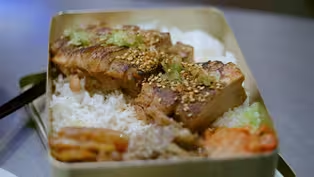
How a Korean Food Stall is Helping Food Diversity
Video has Closed Captions
Clip: S2 Ep2 | 5m 9s | Grand Central Market's Shiku serve up delicious Korean fare that also support food diversi (5m 9s)
Providing Support for PBS.org
Learn Moreabout PBS online sponsorship

- Food
Christopher Kimball’s Milk Street Television
Transform home cooking with the editors of Christopher Kimball’s Milk Street Magazine.







Support for PBS provided by:
Broken Bread is a local public television program presented by PBS SoCal