
The Plea
Season 2004 Episode 11 | 1h 24m 38sVideo has Closed Captions
What are the implications of a system that relies on pleas to expedite justice?
Nearly 95 percent of all cases resulting in felony convictions never reach a jury. They are settled through plea bargains in which a defendant agrees to plead guilty in exchange for a reduced sentence. But what are the implications of a system that relies on pleas to expedite justice?
Problems playing video? | Closed Captioning Feedback
Problems playing video? | Closed Captioning Feedback
Funding for FRONTLINE is provided through the support of PBS viewers and by the Corporation for Public Broadcasting. Major funding for FRONTLINE is provided by the Ford Foundation. Additional funding...
Support provided by:

The Plea
Season 2004 Episode 11 | 1h 24m 38sVideo has Closed Captions
Nearly 95 percent of all cases resulting in felony convictions never reach a jury. They are settled through plea bargains in which a defendant agrees to plead guilty in exchange for a reduced sentence. But what are the implications of a system that relies on pleas to expedite justice?
Problems playing video? | Closed Captioning Feedback
Where to Watch FRONTLINE
FRONTLINE is available to stream on pbs.org and the PBS app.
Buy Now
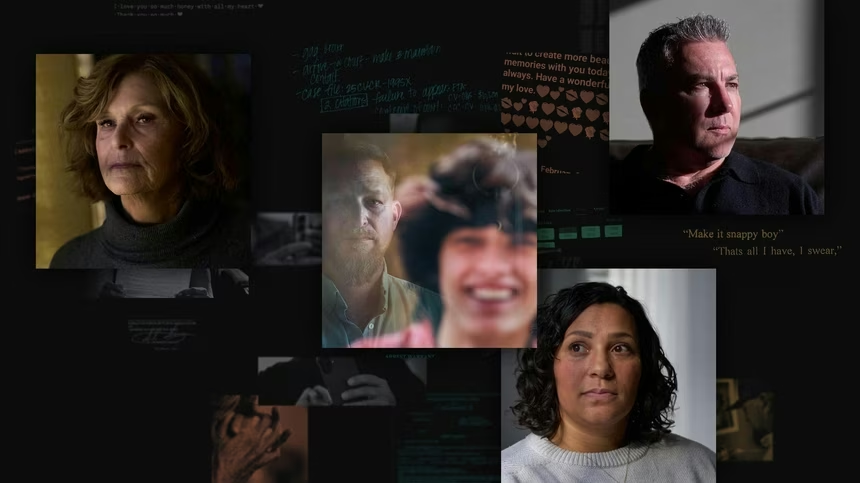
Inside the Scam
Follow scams as they unfold — and examine tactics used to manipulate victims. A collaboration between FRONTLINE and The Associated Press.Providing Support for PBS.org
Learn Moreabout PBS online sponsorship>> NARRATOR: Tonight on Frontline... >> The judge told me, "I will give your son 25 to life, so you'd better take the plea.
Or if you don't take the plea, he's getting it."
>> NARRATOR: More than 95% of felony convictions are the result of a guilty plea.
>> I was willing to plea guilty even though I wasn't, because I had to go home to my kids.
>> He said, "We want to drop the murder charge on you if you'll plead guilty to robbery."
And I said, "But I haven't robbed anybody."
>> NARRATOR: Tonight, Frontline tells the stories of ordinary people caught up in a nightmare.
>> All he has to say is one word and he gets to go home: "Guilty."
>> How do you plea to that reduced charge?
>> Guilty.
>> Are you pleading guilty because you are guilty, and for no other reason?
>> Yes, sir.
>> Would you tell the court, please, why you were late arriving at that meeting, Mr.
Cummings?
>> NARRATOR: Every few hours, every day, all across the country, new and old television shows demonstrate justice at work.
(Law & Order theme song playing) Americans love trials.
Everyone knows the rules.
>> Are these the photographs, Mr.
Cummings?
>> The Honorable Mark Burns presiding.
>> NARRATOR: The judge.
>> I show you this weapon, Lieutenant Drumm.
>> NARRATOR: Evidence.
>> How much are you being paid for today's court appearance?
>> NARRATOR: Expert witnesses.
>> $3,000.
>> Objection.
This is irrelevant.
>> NARRATOR: Attorneys.
>> I don't see the relevance.
>> I do.
>> NARRATOR: Prosecutors.
>> No more questions.
>> NARRATOR: The defendant, the jury.
>> We find the defendant guilty.
>> Not guilty.
>> We're deadlocked.
>> The public perception of our criminal justice system is deeply shaped by television, and that perception is that jury trials routinely occur as a way of deciding whether somebody is guilty or innocent of the offense of which he or she is suspected or accused.
>> Any student in a civics class in elementary school or junior high school will learn about a system with a trial by jury and a right to counsel and proof beyond a reasonable doubt, and it won't remotely resemble the system that we have.
>> When your name is called, please stand and announce that you are here.
Kevin Washington.
Thank you.
Rosemary Gonzalez.
>> Please have a seat.
>> Thank you.
>> Pablo Hertado.
Thank you.
Mr.
Martinez, how do you plead, Sir, to assault on a family member as alleged in cause number 955015.
Guilty or not guilty?
>> Guilty.
>> Are you pleading guilty ... >> Are you pleading guilty because you are guilty and for no other reason?
>> Yes, I am.
>> Are you guilty or not guilty?
>> Guilty.
>> How do you plead that reduced charge?
>> Guilty.
>> NARRATOR: The sixth amendment of the constitution guarantees every citizen the right to be judged by a jury of his or her peers.
>> Do you want to give up those guaranteed rights and proceed to plead guilty today?
>> NARRATOR: Yet about 95% of all people who are convicted of felonies across the country give up that right and plead guilty.
>> ...that in exchange for a plea of guilty, the State has recommended... >> NARRATOR: Most of these guilty pleas involve bargains in which the accused pleads guilty in exchange for a lesser sentence or a reduced charge.
>> How do you plead to aggravated robbery alleged to have occurred... The system would collapse.
If every case that was filed in the criminal justice system were to be set for trial, the system would just entirely collapse.
>> A lot of people call it a necessary evil.
I look at it as a necessary component in our criminal justice system.
But you have to understand that a plea bargaining only works if you have experienced, competent defense attorneys, experienced, competent prosecutors, and a judge who will oversee and make sure this is done... done correctly.
How do you plead that reduced charge?
>> NARRATOR: But what if one or more of them, these key legal figures, are not as competent as they should be?
What happens then to the plea bargains which are now so much a part of the system?
Tonight we will tell several stories.
Different people, different charges, different parts of the country, all with one thing in common: the difficult dilemma of confronting a plea.
On November 2, 2000, in Hearne, a small town in East Texas, Erma Faye Stewart, then 30 years old, a single mother of two, was arrested.
>> The officer just come up to me and said, "Erma Stewart?"
I said, "Yeah?"
And he just, you know, say, "You under arrest."
And, you know, he, you know, he told me to turn around and he put the handcuffs on me.
And I asked him for what, and you know, he just never did say nothing.
He just put me in the car.
>> Go down to this one, right here.
Go down there.
>> NARRATOR: Regina Kelly, a waitress, 24 at the time, and a single mother of four, was also arrested.
>> I was at work.
The police officers came in and asked for Regina Kelly.
I said, "That's me."
And he said, "Ma'am, we have to take you into custody."
I was like, "Oh, my god."
I knew I had tickets and I just... I told my manager, I said, "I'm going to jail because I have tickets that I haven't paid for.
I just haven't paid my traffic tickets."
And the police officer told me, "It's not the tickets."
And that was it.
>> NARRATOR: The cases were prosecuted by the district attorney of Robertson county, John Paschall.
>> I'll tell you what, I'm going to write this down, I'm going to put it down with the offer I made to you.
And you get back to me next week and I'll do the paper work up.
Okay?
Thank you.
Bye.
The case began with our narcotics task force that operated in this county.
It conducted an undercover operation.
And they made the cases.
And once they made the cases and turned them over to the district attorney's office, those cases were then presented to a grand jury.
And the grand jury returned indictments in those particular cases.
>> NARRATOR: It was part of a big drug sweep based on a confidential informant who would later be proven unreliable.
He implicated 25 men and two women with felony drug distribution charges.
Many lived in this public housing project.
All but one were black.
They claimed they were innocent.
They were thrown into jail with bond set as high as $70,000 each.
Regina and Erma Faye shared a cell with two other women.
Neither had been in jail before.
>> It was hard.
It was a cell for two people, so me and the other girl had to sleep on the floor.
It's concrete, it's hard, it's cold.
What made it bad was because you are in there and there is nothing you can do about it, and you are in there for something you didn't do.
And it was hard just wondering what's going to happen next.
>> NARRATOR: They put their faith in their court-appointed lawyers.
>> Our lawyers, that's really all you have to just help you.
They went to school for this, they know what to do.
But it didn't happen like that.
Like, when we all went to court and got our court-appointed lawyers, I wanted to talk to him, sit down and talk to him and say, "Hey, this is the type of person I am, you know.
You can look at my background, you can ask people in the community."
Just... you know, I wanted him to know about me so he could have a better sense in how to represent me, you know, what type of person I am.
He didn't want to hear it.
He didn't have time, you know.
It didn't matter.
It was always an excuse somewhere.
>> NARRATOR: Erma Faye did not fare much better.
>> I had asked my lawyer, you know, "What they going to do about that, you know?"
You know, he had told me that I was looking at ten years prison term.
I had told him, I'm like, "For what?
I hadn't did nothing."
>> But I want everyone in church to get into the service.
>> Oh, yeah.
>> My lawyer came to me and suggested ten years probation.
And like I told him I wasn't going to take this if I did not do this.
I didn't do this.
"They have no evidence, no nothing.
Everything is screwed up and you still want me to plea out with them," and I wasn't going to do it.
Later on, he came back with five years probation.
The D.A.
went from ten years to five years.
And I told him the exact same thing, and he kept urging me and encouraging me to take it, because if I went to trial then I would be faced with five to 99.
>> He was, like, pushing me to take the probation.
He wasn't on my side at all.
He wasn't trying to hear me.
He wasn't trying to explain nothing to me.
And I even had told him, you know, my understanding, you know, is not that good so, you know, you just really are going to have to break it down to me, for me, to understand.
>> INTERVIEWER: He didn't?
>> No.
>> Her name, Erma Faye Stewart?
I don't believe that I represented an Erma Faye Stewart.
I have to double check my records on that.
>> NARRATOR: Bruno Shimek, Erma Faye's court-appointed lawyer whose name was on her plea agreement did not remember her, nor could he find any record confirming that he ever represented her.
>> I don't have a file on her, you know, went through and looked at all those.
And she's not a person that, you know... Robin Stewart I represented, Aaron Stewart, Eric Stewart.
I've checked all those, but not Erma.
>> NARRATOR: Steve Bright is a defense attorney, professor of law both at Yale and Harvard, and the director of the Southern Center For Human Rights in Atlanta.
>> Well, it is not unusual for lawyers who handle a high volume of cases to not know their client's names.
I go to courtrooms all the time where you see the defense lawyers coming in and they will stand up in the front of the courtroom and call the names of their clients because they don't know who the clients are, and ask them to raise their hand.
>> When your name is called, if you do not have an attorney and you wish to have an attorney appointed because you cannot afford one, if you will please so indicate we will see that you get an attorney appointed.
Mr.
Schere, would you stand?
This is Mr.
John Schere, he's the public defender for Crisp County.
I'm going to stand aside and give the public defender and the attorneys an opportunity... >> The public believes that every criminal defendant has a right to the effective assistance of counsel.
That is just so far out of touch with reality, it's hard to even begin describing it.
>> It doesn't matter that the lawyer may be conscientious.
Just the system makes it impossible for that lawyer to... to do his or her job.
>> Nicholas Octavius Johnson.
>> People may be not guilty, people may be guilty of some less serious behavior then what they're accused of.
Many of the people that come into the court system are mentally ill, may have been put up to it by somebody else.
The lawyer won't know any of that.
>> I do not contend that our jails are stuffed with people who pleaded to things that they didn't do.
I think most people who are prosecuted of serious crimes are guilty of at least what they're charged with, and ought to have serious criminal sanctions attached.
But the problem is that "most" isn't the way we do business in a free society that cares about individual rights and individual liberty.
>> Happens every day in every courtroom in the United States.
People come into arraignment, they meet their attorney, they have a brief conversation, they're informed of the charges, they're informed of what they could plead guilty to, possibly to get out of jail that night, possibly not; they have to make a decision.
That's the truth.
Less interesting story than the one that "Law & Order" tells people, but that's the truth.
>> NARRATOR: Three weeks after her arrest, Regina's parents managed to have her bond reduced from $70,000 to $10,000, and she went home to await trial.
Erma Faye stayed behind.
>> When she heard me on the phone saying, "I'm going home," it was over with.
From that point on, it was, I mean, it was downhill because she was going to be by herself.
>> NARRATOR: Erma Faye then offered to plead guilty.
>> Even though I wasn't guilty, I was willing to plead guilty because I had to go home to my kids.
My son was sick.
And I asked him, "Listen now, you know... you know, I can plead for five-year probation, you know, just... just let me go home to my kid."
>> NARRATOR: The district attorney, Erma Faye says, did not agree to five years probation.
He demanded ten years.
>> I had signed the paper, he had took me back in front of the judge, he had told the judge that I took the ten years.
And, you know, they took me back to my cell... after that, they took me back to my cell, and an hour later they had released me.
>> NARRATOR: Of the 27 people arrested, seven pled guilty and most of them got out on probation.
A few posted bond and the rest stayed in jail.
>> One reason that a lot of people plead guilty is because they're told that they can go home that day, because they will get probation.
What they usually don't take into account is that they're being set up to fail.
>> ...as soon as you serve five years in state penitentiary.
I'm going to allow you to serve that sentence on probation with credit for the three months that you've already served... >> NARRATOR: There are about four million people on probation across the United States, offenders who live in the community under supervision.
>> ...pay a fine as to each count... >> NARRATOR: Among their obligations, they often have to pay fines, court charges, probation fees and for different treatment programs that they must attend, all of which constitutes a sizeable source of revenue for local governments.
>> ...also impose a fine in the amount of $1,000 plus costs and surcharge, and also order that you... >> Many of these people are poor, they're destitute.
They have no money at all, and yet they are going to be told to pay a fine.
They are going to be told to pay a fee to a probation officer every month.
>> Have a seat, talk to your probation officer.
>> I mean, all sorts of consequences that are going to flow, and perhaps the one that's least understood is that the failure to meet these payments and meet the conditions of probation is going to bring that person right back into court, and they are going to face probably more time in prison than they did originally because now they are going to be punished for violating their probation.
>> There's a lot of harsh consequences: you may not be eligible for public housing; you may lose the right to vote; you may not be able to get certain employment.
If you're an immigrant, you may be deported.
So it's no great shakes to get a conviction and probation.
>> Well, it's a punishment, but it certainly beats going to the penitentiary.
>> NARRATOR: Michael Wells is not so sure.
When he was arrested in the drug sweep in Hearne, he had been serving the last four months of a prior ten-year probation for a drug-related crime to which he had admitted guilt.
>> When I first got put on probation, I told the judge I was going to complete it.
And he said, "When you complete it, I'm going to shake your hand."
I was looking forward to that day.
Let him know, "Hey, I did ten years probation."
So it is people out there that make mistakes and they correct it, you know, themselves by doing.
And when they came up with the drug bust, it was like, "Oh, this is a bunch of... this stuff sucks."
This whole system... probation sucks.
I'd never take it again, you know.
>> NARRATOR: Recently, Michael fell behind in his probation fees, and was hiding from the probation officers.
>> I don't got the money.
I get harassed every time I go in there.
"You need to pay this here."
I was going faithfully before then, but now since I ain't got no money and I'm just at a struggling point right now.
So therefore, I don't want to look in their faces and hear their criticism of, "Come up with this money."
Because every time you go in there, that's how it goes down.
>> The courts are sort of like finance companies now.
They are trying to collect all this money from people.
And, of course, the people don't have any.
I mean, this is like trying to get blood out of a turnip.
I mean, we're talking about the poorest people in our society who are really barely surviving.
And so they can't pay, so the probation officer renegotiates with them.
And sometimes they even go back to court and extend the probation.
And so they are always paying.
And it really is very much like a high-interest loan.
I mean, it's like you can never get it paid off.
>> NARRATOR: Those indicted in the drug sweep who refused to take a plea and couldn't afford bond spent five months in prison awaiting trial.
The first trial opened in the Robertson County courthouse on February 19, 2001.
It soon became clear that the evidence was worthless, and that the confidential informant had lied to the prosecution.
>> The informant that was used by the law enforcement was not credible in his testimony.
And if someone is not credible to me, then I cannot see putting that person on the witness stand and trying a case.
So we dismissed... I dismissed the cases.
>> NARRATOR: Within a few weeks, all the cases, except those who had pled guilty, were dismissed.
But the neighborhood remained wary.
>> Even though it was thrown out, they're still not saying you're not guilty.
The D.A done went in the newspaper and said even though the cases were thrown out, dismissed, they still are guilty.
You know, he's still telling people we're guilty.
>> I believe every one of them was guilty.
But I don't believe the state had enough evidence to convict them beyond a reasonable doubt.
>> It was hard.
My children... my oldest daughter, she felt like I lied to her.
Children in school making fun of her, "Your mom's a dope dealer," you know.
Oh, you big girl.
I want a formal apology.
The same way, you know, that you put it out there to the world that I am guilty of this crime, I want you to put it out there to let them know that you made a mistake.
>> NARRATOR: No apology would help Erma Faye.
Three years after she pled guilty in order to go home and take care of her children, she was destitute.
Because of the plea, she's ineligible for both food stamps for herself and federal grant money for education.
She cannot vote until two years after she completes her ten-year probation.
And she has been evicted from her public housing for not paying rent.
Her children sleep in various homes, and she is homeless.
She spends her nights outside the housing project waiting for the morning when she can go to her work as a cook.
Her job pays her $5.75 cents an hour.
>> I honestly don't believe she really understood the full extent of everything.
She's a single mother, I'm a single mother.
There is no way we can live without help from the government.
We need that help, you know, and you can't get that... you cannot get that if you plea out to this.
>> You know, my people, they weren't looking out for my kids, you know, like I look out for theirs.
>> You don't deserve this.
You really don't.
You don't deserve this.
If I would have stayed, I wouldn't have let her plea out for anything.
I know I would have made her stay right there with me.
Please don't cry.
You gotta be strong.
You've got to.
>> (çrying) I was just... I don't know, I was just, you know, just try to maintain, you know, I don't know, just sometimes... I am always thinking of killing myself to just get away from this.
>> INTERVIEWER: The pressures?
>> Don't do this to your kids.
They look at your face and they know something's wrong.
Your oldest child, she know.
She's old enough.
She know.
She can just look at you and tell, "Mama, something not right."
>> They saying I owe them $1,866.
>> NARRATOR: She owes $1,000 fine, court costs, and late probation fees.
>> They pressure me to pay this money, which they know I don't really have.
They see it like as long as I have a job, you know, I can pay good.
How you gonna explain to them, you know, "I'm having a hard time, you know, I have to buy my son a medicine."
I have to have his medicine for his asthma.
They don't really care about that.
All they want is, you know, was the money.
>> One of the corrupting influences in our courts is that many localities depend upon the courts as a major source of revenue; that the speeding tickets and the driving while under the influence of alcohol tickets and the money for marijuana possession.
And all of these crimes is to generate money.
But when the courts are in pursuit of profit, that's in conflict with being in the pursuit of justice.
>> NARRATOR: Erma Faye will be under probation for at least seven more years.
The fact that her case would have been dismissed with all the others, had she not taken the plea, makes no difference.
>> It's very difficult once you've pleaded guilty.
The guilty plea sort of puts a lid on the box regardless of what's inside the box.
It's a system that's designed to keep the truth from coming out.
Plea bargaining has nothing to do with justice.
It has to do with convenience, expediency, making the life of prosecutors and defense attorneys easier and more profitable.
It's designed to avoid finding out the truth.
It's designed to avoid hearing the defendant's story.
(çars honk) >> NARRATOR: If that's true in a small town in East Texas, it's just as true in the big city.
Take the case of Charles Gampero of Brooklyn, New York.
On December 11, 1994, an incident happened outside a bowling alley.
A 33-year-old man was killed.
His name was John Weingrad.
>> One of the detectives greeted me and he said, "Your son took a beating."
And I said, "How bad, how badly was he beaten?"
And he said, "He died."
I said, "Oh, my God."
I said, "Are you crazy?"
>> NARRATOR: A 20-year-old man, Charlie Gampero, was charged with murder in the second degree: murder with intent to kill.
The defendant had no criminal record, and the two did not know each other.
Charlie's father, Charles Gampero, Sr., was in the bar of the bowling alley that night.
>> Charlie told me he had a fight.
I mean, when he came back into the bowling alley, he was wearing beige.
He wasn't scuffed.
His clothes weren't messed.
It was like he had just walked in, like he had just gotten dressed, left the house, and walked in.
>> NARRATOR: There was no question that John Weingrad and Charlie Gampero had a fight very late at night outside the bowling alley.
What was in question was how did the fight start?
And more importantly, how it ended.
The photographs the police took of the dead man showed a badly bruised face.
The defendant claimed he left him unharmed.
According to Charlie Gampero, he was trying to prevent a fight outside the bowling alley, when the victim turned around and punched him.
He then punched him back and kicked him, leaving him on the ground, but, he says, very much alive.
>> My father came home later that night and he had said that the guy that I had a fight with had passed away.
I couldn't believe it.
I says, "How?
What happened?"
So I had assumed that maybe something happened afterwards, I don't know, because I didn't think that would have anything to do with me.
I mean, he was sitting up when I left.
>> NARRATOR: The details were murky.
There had been a fight at the bar of the bowling alley between John Weingrad and other people early in the evening before the defendant got there.
It quieted down, but left people angry.
Was that a connection to the killing?
There was something else.
The victim's car was found outside the bowling alley wrapped in toilet paper.
According to Joseph Weingrad, the victim's father, this kind of harassment had started happening a few weeks before.
Was this connected to the killing?
>> The only thing I could tell you, I said, is that he was subjected to a lot of harassment beginning back around Halloween, when he came home from a Saturday night and his car was covered with eggs.
And I asked him, "John, what happened?"
And he said, "I don't know, I came out of the bowling alley and these eggs were all over the car."
He just assumed that it was just kids.
But see, the harassment continued.
There were times when his car was moved.
As a matter of fact, my wife and I actually sat one night-- John parked his car three blocks away on a Saturday night-- we sat up here till about 1:00, 1:30 in the morning, just sitting here watching his car to see if anybody would come along and try to do anything to it, pick it up or move it, or what have you.
But nothing happened that night.
And so we went home, and John came home, there was no problem.
And then the following week he was killed.
>> NARRATOR: The prosecution's theory of what happened was completely different.
They believed, they told Mr.
Weingrad, that his son was killed because of a phone call.
There was a phone call for Charlie Gampero that night on the pay phone at the bowling alley.
It was his girlfriend looking for him.
Someone answered it and apparently spoke obscenely to her.
The prosecution's theory was that the person who answered the phone was John Weingrad, and that's why Charlie Gampero went after him and killed him.
Charlie Gampero says that's not true; that he was trying to break up a fight.
But he never got to tell his version of the story.
He has never been questioned by the police, before or after his arrest.
>> We went in for questioning in the morning.
When we got there we went to the detectives' room and the detective turned to my father, "Are you Charlie, Sr.?"
He said, "Yes."
He turned to me, "Are you Charlie, Jr.?"
I said, "Yes."
And he turned to the female detective and said, "Okay, read him his rights."
That was it.
>> In a matter of five minutes that Charlie was there, my husband called me to tell me, "Get a lawyer, they arrested Charlie."
>> NARRATOR: All the theories, evidence and testimonies were to be presented to a jury in a Brooklyn criminal court in November 1995.
>> Of course I wanted to go to trial because murder is where you intend to hurt somebody.
That wasn't my intention.
I didn't intend to hurt anybody.
I wasn't there to get into any type of fistfight.
I wasn't looking for trouble.
So I didn't understand how they would have these major charges against me?
>> I really thought that Charlie probably would have went to a trial, you know, and he would have been acquitted because, you know, he didn't do it.
>> NARRATOR: Joanne, Charlie's mother, is remarried and lives in Florida.
>> Charlie came down with a friend of his to tell me that this had happened.
It was just a fight, you know.
They didn't think it wasn't too serious.
Then my ex-husband called and said, "We are going to court and something will happen."
And that's when I flew in.
And that was the first time that I really realized what was happening and how serious, and so on and so forth.
>> INTERVIEWER: Did anyone ever discuss the possibility of a plea bargain with you?
>> No, there was never a plea bargain on the table to my knowledge-- ever.
>> NARRATOR: But unbeknownst to them, there was a plea bargain on the table.
In fact, one had already been negotiated between the prosecutor and the victim's father.
>> I would say probably within two or three weeks prior to going into court I was brought in by the district attorney, Mr.
Gliatta, to his bureau chief.
She sat there and she said to me, "Mr.
Weingrad, there are some problems with this case.
And we feel we can win the case in court.
But I just want you to know there are some problems in the case, and it might be advisable to let him plead to a lesser charge."
If I was thinking clearly, I'd say, "What are the problems?"
But I wasn't thinking that clearly at the time.
>> NARRATOR: After discussing various possibilities in the D.A.
'S office, they agreed upon a manslaughter charge and a sentence of seven to 21 years in prison.
>> I said to the district attorney and his boss, I said, "If you can guarantee me that he cannot get out of prison before that seven-year term, that he must spend that full seven years, I think I will agree then to accepting a plea bargain."
And they said, "Oh, he'll spend the whole seven years."
"As a matter of fact," he said, or she said, rather, "Guarantee you he'll do ten because he... when they come up for parole, they're never granted parole on the first time around."
I said, "Okay."
And that was it.
>> NARRATOR: Unaware of what had transpired between the prosecutor and the victim's father, the Gampero family went to court to meet the judge.
>> I mean, he scared me like nobody has ever scared me in my life.
I... I... he tells us his name is Frank Egitto, but they call him "Maximum Frank."
>> NARRATOR: Judge Egitto, who served on the bench for 30 years, is now retired and serves as a judicial hearing officer.
>> I admit it.
My sentences may be a little more harsh than somebody else's.
But I have to do it according to my conscience, not someone else's conscience.
I have to be able to sleep nights.
And I'll tell you this, I'm a very peaceful sleeper.
>> NARRATOR: Looking at the minutes of the case, Judge Egitto remembered.
>> Something happened as people were exiting this particular bar.
The defendant claims that the deceased struck him.
The defendant responded, not with a punch, but knocking the deceased down, kicking and punching him while he was on the ground, stomping him while he was on the ground.
He just went... in my opinion, he just lost it.
And it was a mean, vicious attack.
>> Now he's telling us if we go to trial with this, he will give my son the maximum of 25 to life.
He doesn't want to know if he's innocent.
We had started to pick the jury already.
I think there were two jurors picked, if I am not mistaken.
Then they came up with a plea deal.
Naturally, we said that's crazy, we didn't want a deal.
>> NARRATOR: The deal offered by the prosecution was manslaughter with eight-and-one-third to 25 years in prison, an offer higher than the one agreed upon with Mr.
Weingrad, which was seven to 21.
Then the judge intervened, saying he would try to do better than that.
>> So the judge goes out, comes back and tells us, "All right, I just was on the phone with my boss"-- whoever that was-- "And they're allowing me to offer you seven to 21.
>> At that point, it was just like I wasn't there, like, you know, you're just in shock.
You just go through the motions, you can't believe its happened to you.
It doesn't seem real.
>> I'm sick to my stomach, because at that time I was 48, and I said, "By the time my son gets out, if he gets 25 to life, he'll... he'll be my age.
They'll... forget about raising a family, forget about anything."
>> I didn't feel it was my decision to make.
I just felt that they had to decide.
It was going to effect my ex-husband more than me.
And if I would have pushed to go to trial and it didn't turn out, he wouldn't have never forgiven me.
>> He told me, point blank, told me and my ex-wife, he said, "If... I will give your son 25 to life, so you'd better take the plea.
Or if you don't take the plea, he's getting it."
>> NARRATOR: According to Professor Green, these kinds of threats are constitutional and legal.
>> Some years ago, a defendant argued to the Supreme Court it's inherently coercive if the prosecutor says to me, "You can plead guilty and get three years in jail.
Otherwise, you can go to trial and have all your trial rights, but if you're convicted, you face 30 years in jail."
That sounds like coercion.
And to you and me and most ordinary people that sounds pretty coercive.
But under the constitution that's not considered coercive.
And so if you plead guilty with... in order to avoid infinitely harsher sentence, that's considered a voluntary plea.
>> NARRATOR: The Gampero family was given the night to weigh their options.
They had to decide whether to insist on a trial knowing the risk of a maximum sentence of 25 to life, or take the guilty plea with its sentence of seven to 21 years in prison.
They wrestled deep into the night.
Two decades before, Patsy Kelly Jarrett was faced with the same quandary.
>> Being outside is just like a fading memory.
It's been so long ago, so much has changed.
The whole world has changed since I've been out there.
I've been in Bedford Hills since 1977.
I'm one of the longest-serving inmates.
When you are in prison, you die inside, you just die.
And what keeps you going is people that love you and care about you and that reach out to you and say, "We love you, we care about you."
>> NARRATOR: One of those who reached out to her was law professor Claudia Angelos.
>> Kelly Jarrett and I are exactly the same age, we are of the same generation.
And anyone else who is of that generation will, I think, understand the social circumstances in which she grew up.
This was in the early '70s that she was a young woman, maybe 21, 22 years old.
She was pretty marginal.
She's from North Carolina, kind of a trailer girl, but a good kid.
She had a car and she had a job and she had some friends.
>> NARRATOR: In 1973, 23-year-old Kelly Jarrett took her first trip out of North Carolina.
It was a trip that would change her life forever.
>> She had a friend who suggested, "Oh, let's just get out of here for the summer."
So she and this friend, who was a guy, drove up... up through the South into the Northeast and up to Utica, New York.
And they kind of landed there for a few weeks.
Her friend did some day laboring kind of work.
He used her car.
And she kind of hung out, played softball, had a little summer vacation.
Couple weeks later, they made their way back to North Carolina and resumed the lives they had had.
>> About three years passed, there was a knock on the door and the police were there with a warrant for my arrest for a murder from Utica, New York.
And I was shocked.
I was really upset.
And you know, I called my parents, you know.
I went down to the police station.
They came down and met me there.
I took a polygraph while I was there, and I was locked up until my parents obtained a counsel and attorney for me, to help represent me.
>> It turns out, and it's beyond any doubt, that the guy she was with while they were in Utica robbed a gas station and murdered the gas station attendant.
>> NARRATOR: It was the most brutal murder ever seen in the small town of Sherrill, near Utica, New York.
17-year-old star athlete and high school graduate Paul David Hatch was bound, gagged, and killed by a white young man during an armed robbery of a gas station.
It was clear that two people were involved.
According to the eyewitness testimony of an elderly man, a second person was outside in a car.
He wasn't sure if it was a man or a woman.
>> There was no other evidence against Kelly Jarrett at all.
That was the evidence.
A man who had said, "I couldn't see the face, I don't know if it was a boy or a girl," two and a half years later said it was her.
That was the evidence.
There was nothing else connecting her to that crime.
>> NARRATOR: She was tried jointly with her co-defendant, the man she was with that summer, whose fingerprints were found at the crime scene.
>> I learned in the courtroom what happened-- how, when.
It was just awful, you know, it was just awful to be sitting there and to be accused of something like that.
It was just a horrible experience.
>> NARRATOR: The evidence against her friend was massive.
The evidence against Kelly Jarrett was weak.
>> It was an extraordinarily weak case: this very poor, extremely unreliable identification and nothing else.
So she was offered a plea of five to 15 years if she would plead to the robbery, not to the... to the murder.
A plea of five to 15 years in those days meant that absent any serious misbehavior a person would be paroled at five years without any question.
The system is different now, but it certainly meant that then she would... at that time, she would have served five years.
She had already been in jail waiting for trial for certainly over a year, as I recall.
So she would have served only about four more years.
I know she was advised to think seriously about that plea by her lawyer.
>> I told my attorney, "You know, I can't... I can't do this."
And he said, "Well, you know, my hands are tied."
He said, "We want to drop the murder charge on you if you'll plead guilty to robbery."
And I said, "But I haven't robbed anybody."
>> The notion of pleading guilty to something she absolutely didn't do, on the evidence of a man who didn't even see the face of the person who was there, was ridiculous.
And I don't think she seriously considered taking that plea for a minute.
>> NARRATOR: She faced the jury claiming that she had nothing to do with either the robbery or the murder.
>> I believed in the American system of justice.
I believed that you just tell the truth and the judge and jury will hear you and, you know, nothing will happen to you.
But I was wrong.
And I got convicted and was... I was sentenced to 25 to life.
>> Innocent people are convicted at trial.
So this happens at trial.
People who defend plea bargaining will say, "Well, sending people to trial doesn't necessarily guarantee perfect results."
But what the guilty-plea system guarantees is that when you have miscarriages of justice, the victim of it is going to face staggering sentences because those sentences are not a consequence of justice.
Those sentences are a consequence of the need to grease the wheels of the system.
So they become the example, they become the grease, or they become the object lesson.
And what we see, the next time around the prosecutors says, "Well, you want to go to trial, that's your right, you can be just like Mrs.
So and So, and look what happened to her."
>> NARRATOR: After a night of soul searching, Charlie Gampero came to the same conclusion that Kelly Jarrett had.
He wanted a trial.
His parents were anxious.
>> Charlie had decided he was not going to take it.
>> Charlie wanted to plead not guilty.
And I didn't say anything at that time when he said, you know, "I'm pleading not guilty we're going to go to court with this."
So I didn't say anything.
I was nervous.
>> And then the attorney said, "Well, you know, this is a Friday, and we do have a lot of family out of town and would like to have till Monday to think about it and discuss it."
So he said, "No, no, no, if you do that, the D.A.
has got to work all weekend getting their witnesses together and, you know, we can't do that and, you know, put it off."
And it says in the minutes, "Let's get this in and out," you know.
He was in a hurry to, you know, get it off the table and on.
>> INTERVIEWER: The Judge?
>> Oh, yeah.
Yeah.
>> My job was to expedite the movement of cases.
My delaying this case delays the next case, which delays the next case.
If I went till Monday, and then they decided not to take the plea on Monday, I would have to adjourn the case again for the purpose of the D.A.
making sure they had all their witnesses.
>> I'm saying to myself, it's been a year.
If the prosecution doesn't have their case already ready, what's the difference whether I tell him I'm going to trial over the weekend or not?
Were they going to get it ready in two days?
>> And the judge said, "No, you've got exactly 15 minutes.
You go outside, you talk to your clients, and you're back in here in 15 minutes with the decision.
And I'm telling you now, if you do not take the plea and I find, or we find your client guilty, he's going to get 25 to life.
And once the trial commences, I will not entertain any pleas.
The trial will go through to its conclusion.
And if he's guilty, 25 to life.
Go talk to your client."
>> So we are in the hall of the courtroom, someone came out and told us, "The judge would like you to come inside, they're bringing in another case for the sentencing."
>> NARRATOR: The case was a young man who had charges similar to Charlie's.
>> So the kid came in, they found him guilty, and he told the kid, "I am sentencing you to 25 to life.
Now whether he did this to scare us-- which he already had me scared, so he... it made it much, much worse.
>> Anyway, I go out in the hallway and it's me, my father and my mother.
And they're telling me... I think my mother had says, "You know, if you get 25 to life, I might not be alive when you come home.
Who knows what could happen in that many years?"
>> I had to walk away, and I just walked away, you know, hysterical crying by myself.
I mean, it was really... it was very emotional, very, very, very emotional.
Very sad.
>> We were crying like babies.
But that's all he wanted.
He wanted that decision then and now, he didn't want to know anything.
>> I'm saying to myself, well, this is the judge that's going to be handling the trial.
This guy is going to make the decision.
If my lawyer objects something, he's going to decide whether it is going to upheld or sustained, whatever.
You know, now I'm against everybody.
Who's on my side here?
My lawyer was standing like on the other side of the hallway, and I was kind of looking at him like, "Are you going to give me any type of advice here?
Are you going to tell me anything, like should I do it, shouldn't I do it?
You don't have to guarantee me anything, but you know better than me.
Explain something to me.
Tell me something."
>> INTERVIEWER: He didn't?
>> No.
>> I just don't think that he was either... I don't say that he wasn't prepared, but I don't think it... maybe it was over his head or he didn't know what to do, and I don't think he had a good solution to the problem.
>> He turned around and he said to me, "Charlie," he says, "I'll tell you the truth," he says, "I don't even... I can't even give you an answer."
Because I said, "What should I do?"
He says, "I don't know."
He says, "I have a..." He has a young son also."
He says, "I can't even tell you what to do."
I mean, he felt for us.
He says, "I've never seen it where they force you or put your back against the wall like this."
>> A lawyer who goes to trial has a strong duty to investigate the case, to interview witnesses, to look for defenses, to prepare for cross examination.
A lawyer who plans to plead guilty can make a tactical judgment that it's not worth his time.
So in effect, the defendant not only waives his right to a public trial and all that that entails, he also, in practice, is waiving his right to legal research and to thorough factual investigation by his own lawyer.
>> NARRATOR: Charlie Gampero now believes that his lawyer was not prepared to go to trial.
And since he never previously told the family about the plea, he may have been just as surprised by it as they were.
The lawyer refused to talk to Frontline, or help in any way with this documentary.
>> I guess at that point Charlie felt that maybe it was a good idea to take it.
Judge Egitto kept making us think that he had this good deal for us of seven to 21, you know, there'd be programs, there'd be this, he'd be out in seven years, you know.
Yeah, we just passed the eight-year mark.
>> We took the plea agreement thinking that the judge knew what he was talking about and my son would be home by the time he's 27.
"27," I said, "Charlie, you could still raise a family, you could still have a good life."
It didn't work out.
>> It was just like, you know, I just wanted to take it away from them.
You know, why are they... why does my family got to go through this?
So it seemed like this is what they wanted.
Not that they wanted me to go to prison, but... So I, you know, I decided, I told my lawyer, "All right, we're going to take the seven to 21."
And that was it.
>> Any of us will plead guilty if the disparity between what we're threatened with if we go to trial and lose and what we get if we don't is increased enough.
>> NARRATOR: There is no greater disparity than in a death penalty case, when the choice is between a guilty plea with an immediate release and a possible execution.
In February 1999, an unprecedented fourth capital murder trial was about to begin in Bastrop, Texas.
It had a 20-year-old history.
Three trials had already taken place.
Prosecutors and defense attorneys had come and gone.
A death sentence had been imposed, reversed, re-imposed, and then reversed again.
This was to be the end of the road, the very last trial of Kerry Max Cook.
Paul Nugent has been his defense attorney since 1991.
>> We're actually in the courtroom for a pre-trial hearing.
The district attorney's first assistant comes to me and pulls me aside and kind of stuns me, says, "Will Kerry consider a plea bargain?"
It was shocking and surprising because for 20 years all you had heard from the district attorney's office was this vicious rhetoric that Kerry was this heinous criminal who deserved to be executed for the rape and mutilation of this young woman.
And all of a sudden, they are offering him freedom.
All he has to say is one word and he gets to go home: guilty.
>> NARRATOR: Kerry Max Cook was arrested in August 1977, when he was 21 years old, charged with a brutal murder and rape of 21-year-old Linda Jo Edwards in Tyler, Texas.
He was tried one year later.
>> Kerry was a young kid, he was a high school dropout, and his biggest sin in East Texas in the 1970s was he was allegedly homosexual.
It's a very religious community there.
It's a part of the American Bible belt.
That was a major strike against Kerry.
>> I can't tell you what that was like sitting at that defense table and having the prosecution raise his voice like in that southern Baptist way with the fire and the brimstone, and pointing almost inches from my nose and screaming, "It's time to put all the freaks and the murderous homosexuals on the scrap heap of humanity where they belong."
I mean, just screaming.
I'm sitting there like his breath is blowing my hair back out of my face.
>> NARRATOR: Convicted and sentenced to death, he spent years on death row, where he was abused and raped.
He tried to commit suicide, and was saved.
He then tried again by mutilating himself.
He left a note: "I really was an innocent man."
The prosecution did not see it as a desperate act, but as a confirmation of a disturbed killer.
He had spent 13 brutal years on death row, when his sentence was reversed based on a technicality.
That's when Paul Nugent became his lawyer.
>> The issue is, has the state proven their capital murder case by proof beyond a reasonable doubt?
>> NARRATOR: The new trial with a new district attorney took place in 1992, and resulted in a hung jury.
The state then retried the case once more.
>> ...to find this defendant guilty of capital murder because that is the crime he committed on June 10, 1977.
>> NARRATOR: The death penalty was reinstated.
Then once again in 1996, the Texas court of criminal appeals reversed the conviction.
It also published a scathing critique of the conduct of both the police and the prosecution, going back to the first trial in 1978.
They wrote that the investigation was "intentionally misleading," the key witness Robert Hoehn's testimony was "prejudicial," and the first conviction was obtained through fraud and in violation of the law.
>> The highest criminal court of Texas found substantial and egregious and systematic prosecutorial misconduct in Kerry's case.
We're not talking about an isolated act.
We're not talking about one instance of police or prosecutorial misconduct.
We're talking about systematic misconduct.
>> NARRATOR: Even the then-new first assistant D.A., the man who fiercely prosecuted Cook in the last two trials, David Dobbs, agrees.
>> Let me make it real clear to you, this prosecution of Kerry Max Cook was mishandled from the start.
There were problems.
And there's no question that there were things that were done that were unfair to him.
I've never indicated anything other than that.
>> NARRATOR: And yet that didn't deter Dobbs from going on fighting to put Cook to death.
>> I'm completely 100% convinced that Kerry Max Cook is guilty.
>> NARRATOR: He wanted to use the final chance of a fourth trial to convict Cook.
But this time, he had to do it without the testimony of his key witness.
He was worried.
>> The Texas Court of Criminal Appeals, which is the highest court in Texas, had ruled that we could not use the testimony of the man that was with Mr.
Cook just prior to the commission of the offense, based on prosecutorial misconduct that had taken place in the '70s.
We... without that testimony, we could not place Mr.
Cook at the crime scene the night that the actual capital murder took place.
>> NARRATOR: The irony was that the testimony of the witness, Robert Hoehn, who had died in the meantime, was the example cited by the Texas court of criminal appeals as prejudicial and contradictory.
So what the prosecutor was saying was that if he couldn't use the prior testimony, he couldn't win the case.
>> If we could have read in his testimony, even though as you have pointed out there are some you know, there are some problems with it-- like any other testimony, there's some good with the bad-- if we could have read in the testimony and proved his proximity to the crime scene, we would have gone ahead and tried the case.
>> NARRATOR: He weighed his options: he could go to trial with what he felt was a weak case; he could try to get Cook to take a guilty plea; or he could dismiss the case.
>> We were not about to dismiss the case because he's guilty.
>> The prosecutor offered if Kerry would plead guilty he'd get out, his case would be over with.
He'd have to plead guilty to time served.
I went and talked to Kerry, and Kerry looked me in the eye and said, "I want to go home, I want to be free, I want this behind me, but I will go back to death row, I will let them strap me to the gurney and put the poison in my veins before I lie, before I plead guilty."
>> It's all I had left.
I was innocent.
They... after what they had done to me, and they'd convinced the people of America that I was this raping homosexual maniacal murderer, alls I had left was my integrity, my honesty, and the truth.
And the truth was that I did not rape and kill Linda Jo Edwards, and no one was going to say that I did.
No one was going to make me carry that burden.
>> NARRATOR: What happens when the defendant refuses to plead guilty and the prosecutor is afraid to lose the trial but will not dismiss the case?
There was one more possible option.
The Supreme Court decided in 1970 that it does not violate the Constitution for a defendant to make a deal and plead guilty, while still maintaining his innocence.
Such a plea is called an Alford plea, or a no-contest plea.
>> It is perfectly constitutional to accept a plea of "guilty but not guilty."
That is, the defendant can say, "I didn't do it, but I want to take the deal."
And the Judge can say, "Okay," which means that it's not necessary for an innocent person to lie, to take the deal.
He can say he is innocent and still take the deal.
>> The Supreme Court says you can plead no contest, you can... But most prosecutors will not let a defendant enter a plea of nõlo contendrer "no contest," the way Spiro Agnew did.
Defendants are pretty much required to either go to trial or admit their guilt.
>> NARRATOR: This prosecutor felt he had little choice.
He offered Kerry Max Cook the no contest plea, which means that Cook can maintain his innocence while knowing that the court has convicted him.
It's the only time it has ever happened in a death penalty case in Texas.
>> It's the hardest decision we've ever had to make, but unfortunately, we were faced with the choice of doing something that would ensure that he was convicted of murder or running a very, in my opinion, substantial risk that without the testimony of Bob Hoehn he would walk the streets free from this.
>> They couldn't admit they had made a mistake, they couldn't admit that perhaps the State of Texas almost executed an innocent man.
So, it was cover for them.
It was political cover is what the plea bargain was.
>> NARRATOR: Cook now had to make his life-or-death decision.
>> My lawyers told me it was my decision.
Paul Nugent said, "We could win it, Kerry.
I think you will be acquitted this time."
I'd heard that before.
The truth had rung in my ears for so long I couldn't hear it anymore.
I've given them 22 years.
I just didn't want to give them anymore.
Too much.
>> INTERVIEWER: So you took it.
>> I took it.
And I regret it every day.
>> NARRATOR: Then almost out of the blue, two months after Kerry Max Cook took the no contest plea, and 22 years after the murder, the result of a DNA analysis of a semen stain found on the victim's panties came out.
It did not match Cook's.
The prosecution says that these findings were not exculpatory, and that Kerry Max Cook was, and remains, guilty.
>> At a moment like this, just a nightmare for me.
The state of Texas has executed me over 1,000 times.
>> NARRATOR: Kerry Max Cook went on to play himself in the play "The Exonerated."
>> I get these nightmares.
Sometimes I forget I'm really here.
>> NARRATOR: Of the eight characters on the stage, he is the only one who is still a convicted murderer.
>> We'll show the world once and for all that he committed that murder.
>> The idea that he is going around the country in a play that purports him to be exonerated and innocent is very distressing to me.
But the important thing for us was to insure that he got a conviction for murder that would follow him for the rest of his life.
>> 22 years.
>> NARRATOR: It does follow him.
Married with a young child, he says the state granted him his freedom, but neither his dignity nor his peace of mind.
>> The punishment never ended.
Say one of my taillights goes out, I'm unaware of it, and then the police pull me over.
They run that license plate and... First of all, they don't get out of their car until they've got two or three more backups.
I'm sitting there waiting, looking in the rearview mirror saying, "I know what's going on, but I wonder how bad this is going to be because I'm Kerry Cook with a capital murder conviction."
"So let's get out and spread 'em."
Do you have any knives, have any guns, have any drugs or, you know, where were you at last night?"
I don't have any rights left.
It's a very, very traumatic ordeal.
So, you know, was it worth it?
Sometimes when I'm holding my son I can say yes.
Sometimes when I'm by myself I say no.
They won.
>> NARRATOR: Ten years have passed since Kelly Jarrett rejected her plea bargain and was sentenced to 25 to life.
Then she suddenly got another chance at freedom when she met Claudia Angelos.
In 1986, Claudia was a young law professor at New York University.
>> I had a little program in which some law students went to the Bedford Hills Correctional facility to teach inmates about the law.
And I had been doing this for a couple of months when I got a phone call from the warden, we call them, the superintendent of Bedford Hills, a man named Frank Hedley, who said, "I wonder if you can help me.
I have someone in here I think is innocent."
>> NARRATOR: Abbe Smith, now a professor of law at Georgetown University, was one of the law students at the time.
>> It was my second year in law school, and I signed up to be part of what was then called the Prison Law Clinic.
There were a bunch of cases that we could have worked on.
And the teacher, Claudia Angelos, basically sort of presented all the cases, and she described Kelly's case, and I immediately said that's the one I want to work on.
>> And we filed ultimately a petition for habeas corpus, it's called in the federal court, challenging the validity of the eyewitness identification by the... by the old man.
>> NARRATOR: To their surprise and delight, the habeas was granted.
Kelly Jarrett was to be released or retried.
>> Claudia calls me up and she says, "We won.
It's fantastic, we won."
And I said, "That's great."
And she said, "Not so fast.
You know, the state is going to appeal it and the circuit court is not going to be as good."
And in the meantime, Kelly's offered a plea.
>> "If you'll take the plea, we'll give you time served, essentially time served if you'll just take this plea."
>> She asked me what I would do, I told her I would take it.
She asked me what I thought she should do.
I told her she should take it.
She asked, "What if I don't?"
And I said, "I'll fight for you, I'll keep fighting for you.
We'll do our best, but we might lose."
She said, "Let me think about it."
She said, "No, I'm not going to do it, no, I'm not going to do it."
I said, "Please think about it, please talk to other people about it.
I think you're making a mistake, but it's your decision."
>> I told them I... in my heart I just couldn't do it.
It was just... my conscience and in my heart and it's just morally wrong to say you did something you know in your heart you didn't do.
I couldn't live with myself if I did that.
I couldn't just... I just couldn't live with myself.
I saw the pictures of the young man and, you know, just... it was just for them to want me to say that I did something so horrible just to get out of prison, I just couldn't do it.
>> I understood that.
I understood it.
I thought it was foolish, but I understood it.
I let her do it.
>> INTERVIEWER: She couldn't convince you?
>> She tried, she really tried.
She said, "You know, if you don't take this plea you may spend the rest of your life in prison."
And I said, "I just can't do it.
I just can't do it."
>> She couldn't do it.
That God... she's a religious woman, that God wouldn't let her do it, that it would be wrong, it would be lying, and that she would rather stay where she was than commit fraud just to get out.
And I accept... I accepted her decision, and I left.
>> NARRATOR: After Kelly Jarrett refused the plea offer, the State won the appeal.
And she remained in prison to serve the rest of her sentence, which may be the rest of her life.
>> And I regret it every day of my life, every day of my life.
I could have insisted, I think I could have.
As I've often thought, I should have reached across the table and grabbed her by the throat and said, I'll quit, I won't represent you.
You must do this, you have no choice.
And these last... these last 20 years she'd have been with us, instead of buried in there.
>> I love Abbe and Claudia, but in my heart it's just not the right thing for me to do.
>> Well, in the end of the day, in this case, evidently the client has certain values that she places above liberty.
Now it's a sad thing, and what occasions it is the conviction of an innocent person.
But from the lawyer's perspective, you have to respect the client's decision at the end of day.
If she understands what the stakes are and she knows her own values, she's entitled to say, "I just won't say I'm guilty because I'm not."
>> NARRATOR: Abbe Smith, who has been Kelly Jarrett's attorney for the last ten years, does not see it that way.
>> I would have made her plead guilty.
I would have been relentless.
I would have brought her brother up to Bedford Hills prison to put pressure on her to plead... I would have brought her father, who was aging and infirm, up there to Bedford Hills prison.
If I had to drive down to North Carolina myself and put them in my car, I would have brought them up to the prison and I would have ganged up on her.
And I would have had them beg her, and I would have had them cry, and I would have had them say, "Please, you know, you only have this one life."
I, you know, I would have had her father say, "I don't want to die when you're in prison.
And I would have said to Kelly, "You know what, you can fight for your good name outside the prison walls, but get out first."
>> NARRATOR: Bruce Barket is a defense lawyer in Long Island, New York.
>> I know what I would tell my client.
"Out is out."
"Out is out."
"Get out.
Get out."
I mean, and I tell them that, when they're confronted with whether or not to plead guilty.
I don't want to stand next to somebody whose pleading guilty to a crime they didn't commit.
But I don't want to be standing next to somebody when they are wrongfully convicted of a charge... a crime they didn't commit, and get much more time.
So I say... I mean, I am not shy about trying cases, I am not shy about fighting the government, but out is out.
>> There's a line that you can't cross, and it's not clear where the line is.
But at some point what you're doing stops being giving information, stops being persuasion, and it starts becoming coercive.
And you're not supposed to cross that line if you're a lawyer.
>> You know, most of us don't become criminal defense lawyers cause we want to make innocent people plead guilty.
But the system stinks.
And here's somebody who had been locked up for ten years in a maximum security prison and everybody knew that the Court of Appeals was going to reverse.
There is this one moment, this one opportunity to free her.
And I would have done everything within my power to get her to plead guilty.
>> That's like, say like you had a daughter and she's carrying a baby and she doesn't want to have an abortion, but you're forcing her to have one.
I mean, I feel she should have the choice not to do that.
And I feel that I should have the choice for my own life not to do something that I feel is wrong.
>> Hers is an exceptional reaction.
Most people do the obvious self-serving thing, and that is they buckle in those circumstances and they bear false witness against themselves.
That's what plea bargaining asks you to do: confess yourself guilty.
>> NARRATOR: In Brooklyn, New York, after Charlie Gampero took the guilty plea, he learned that he then had to confess to every detail of the crime he had pled to.
>> The judge wants me to say what happened.
He asked me what happened that night.
So I told him that, you know, when I went outside, um, he hit me, Mr.
Weingrad hit me and I hit him back.
When he fell on the floor, I kicked him and I punched him.
He went crazy.
That was not what he wanted to hear.
>> NARRATOR: Bruce Barket is Charlie's present lawyer.
>> The judge knew that allocution, that statement by Mr.
Gampero didn't warrant a guilty plea.
It should go to trial if that's the truth.
So the judge, "I want a guilty plea.
I know it has to be sufficient."
He says, "That's not right, you got to tell me more."
>> So he yells at my lawyer and tells my lawyer, "Can you please explain to Mr.
Gampero that he has to say what happened here, he has to be honest with what happened here."
>> NARRATOR: Judge Egitto agreed to go over the minutes.
>> The court: "I went out of my way to try-- dash, dash-- I want a candid statement of what happened, what transpired.
This man did not die from one punch.
I saw the pictures."
>> My lawyer basically told me, "You have to agree with what he says."
So now the judge tells me what happened.
>> The court: "Kicked him and stomped him?"
The defendant: "I kicked him, yes."
"And you stomped him?"
"Yes."
"And by doing that you intended to inflict serious physical injury to this person?"
"Yes."
>> "Yes, yes."
And I just kept yessing whatever... anything he said I said yes to, "Yes, Sir," "Yes, Sir," "Yes, sir."
>> "You weren't satisfied with just knocking him down and walking away, were you?"
Answer: "No."
"You wanted to make sure he didn't get up again."
"Right."
"Yes": the defendant.
>> So he basically went down and said everything that happened.
I just yes and no'd it.
>> The court: "Is that plea satisfactory?"
Ms.
Block, the D.A.
: "Yes, Your Honor."
>> And he tells me off the record, he says, "Make sure that when you go for the pre-sentence report, make sure you tell them the same thing."
And that was it.
I walked out of the courtroom.
>> INTERVIEWER: You mean don't change your story?
>> Yeah, basically.
Not my story, don't change my story.
Don't change his story.
It wasn't my story anymore.
>> It's a coerced confession.
You can sort of satisfy your conscience with this salve of "I made him say he did it."
You know.
And he's saying, "Well, okay, you son of a bitch, if I got to say I did it to take the deal, I'll say it.
Do you feel better now?"
>> INTERVIEWER: Do you believe that what the defendant was saying when he was answering all your questions was the truth?
>> Do I believe it?
I have to, otherwise I couldn't have... I would not have taken the plea.
I would not have taken the plea.
>> INTERVIEWER: Because he started by saying that he punched him and kicked him once, and you said, "No way."
>> But then he came around... before I said anything else, he came around to punching and kicking him while he was on the ground, and I added the word "and stomping him?"
And that's when he said, "Yes."
But I never put those words in his mouth.
Right?
I only added the word "stomping."
Those were his words, not mine.
He knows what he was indicted for, he knows what he did.
>> NARRATOR: Joseph Weingrad, the victim's father, is not as sure anymore.
A former investigator himself, he began to have doubts about the police investigation and the sentence.
>> If you don't go to trial and you don't get this discovery and you don't get people getting up there and putting their hands on the bible and swearing to tell the truth, you are not going to find out what really happened.
>> NARRATOR: He began his own investigation.
He filed a civil suit against the bowling alley, and combed through all the facts the investigators discovered.
He came to believe, he said, that the police investigation was sloppy, that the so-called witnesses were inconsistent, and that no one saw his son take the phone call.
He felt that other people who had harassed his son before had to be involved, and that Charlie Gampero, who punched and kicked John Weingrad, was probably not the one who killed him.
He went to see the district attorney.
>> I just hit him straight on.
I said, "I am not faulting you as a district attorney.
I believe that you did a terrific job in the courtroom.
You bluffed that defense attorney."
I said, "Paul, you didn't stand a Chinaman's chance of convicting Charles Gampero if they went to trial."
As a matter of fact, if I had been the attorney, I would have blew you out of the water.
There's no way you could have convicted him.
I said, "But, you know, with your list of so-called witnesses and the judge telling Gampero's lawyer you got 15 minutes to make a decision or else you're going to trial, and if we go to trial and you're found guilty you're going to get 25 to life, and I won't entertain any pleas once the trial commences, the trial will go through to its conclusion and he'll get 25 to life if he's guilty."
Scared the hell out of everybody on that side, and they caved in.
>> NARRATOR: He left the district attorney's office, he said, "Unsatisfied."
>> INTERVIEWER: What did he say?
>> He didn't say anything.
Well, I had nothing more to say at that point because I understood right then and there he had no intention of going any further with this.
So I dropped it.
>> NARRATOR: Charlie Gampero began his prison sentence of seven to 21 years in January 1996.
There was no early release.
The earliest he could be out, if granted parole, was 2003.
It was also in 2003 when Kelly Jarrett got a hearing in front of the clemency board.
After 26 years in prison, she began to think for the first time of life on the outside.
>> I had plans for my life to go to the convent, become a Franciscan sister and to just live my life outside of prison walls.
>> NARRATOR: The clemency was not granted.
There was no explanation.
Only two clemencies were granted by Governor Pataki that year, one of which went to the satirist Lenny Bruce, who died 37 years before.
>> As my grandmother would say, "He should rest in peace."
But I don't think he's up there in heaven saying that, you know, it was good that he got clemency.
He's probably saying, "She should have gotten it, give it to her."
>> INTERVIEWER: Were you disappointed?
>> Yes.
>> INTERVIEWER: So what's going to happen now?
>> It's up... (çhoking up) ...excuse me, it's up to the parole board.
>> NARRATOR: The first parole hearing for Kelly Jarrett will take place in 2005, but her dilemma may very well follow her.
Parole boards expect admission of wrongdoing and expression of remorse.
Locked up for almost 30 years for claiming she is innocent, it would be hard to imagine her saying she is not.
Towards the end of his seventh year in prison, Charlie Gampero appeared before his parole board.
By then, witnesses had come forward testifying that they saw other people beating and kicking John Weingrad after Charlie had left the scene.
Charlie was hopeful.
He talked to his parole officer who thought he had done everything that the prison asked him to do, and that he was ready to be released.
>> I had told them that even though there was other people involved and something happened after I left, I still take responsibility for the crime because I set, you know, I put him there.
I explained to them, you know, what my ambitions were when I went home.
I explained to them what I have done during my incarceration.
And they told me I'd receive a response in a couple of days.
>> NARRATOR: The parole was denied.
The reason given was that since he was a violent offender, discretionary release would be contrary to the best interest of the community.
>> It's more than I thought he would be in prison.
I thought he'd be out by seven years, and maybe even earlier, because of the... they had an early release program for a while.
>> INTERVIEWER: But they didn't by then.
>> As was sung by that famous star,que sera sera, I can't control them.
>> NARRATOR: It was just what the prosecutor had promised the victim's father seven years before when they agreed on the plea.
But by then, Joseph Weingrad wanted Charlie Gampero out of prison, and wrote a letter to the parole board.
>> I wrote that it seemed to me that Mr.
Gampero was probably only guilty of assault, and so the time that he spent in prison was enough.
He shouldn't be spending 21 years for something that I don't believe he did!
>> NARRATOR: Charlie Gampero's next parole hearing will take place in October 2004.
There is also a new motion pending to vacate his sentence.
If both were denied, then according to the structure of his sentence, he could spend another six years in prison.
>> No, that isn't the way the justice system is supposed to work in this country.
It's not supposed to work that way.
>> This report continues on Frontline’s Website where you can read extended interviews with judges and national experts on plea bargaining.
>> ...the system guarantees is that when you... >> Find out more about the cases Frontline,featured.
>> The system stinks.
>> Get answers to frequently asked questions about plea bargaining, plus readings, analysis, and the option to watch the full program online.
Then join the discussion at pbs.org.
Next time on Frontline World: In India, a story of prostitutes from two cities, and their plan to take back their lives and halt the spread of AIDS.
And in Shanghai... >> The clubs here are packed, like some scene out of New York in the '80s.
>>...a cultural revolution challenges the Communist Party.
>> Good-bye, wave and wave, but you can't turn back the clock.
>> These stories and more, on the next Frontline World.
To order Frontline's "The Plea" on video cassette or DVD, call PBS Home Video at 1-800-PLAY PBS.
 New Episode
- News and Public Affairs

Top journalists deliver compelling original analysis of the hour's headlines.
 New Episode
- News and Public Affairs

Today's top journalists discuss Washington's current political events and public affairs.
 New Episode
 New Episode
 New Episode
 New Episode
 New Episode
 New Episode
 New Episode
 New Episode
 New Episode
Support for PBS provided by:
Funding for FRONTLINE is provided through the support of PBS viewers and by the Corporation for Public Broadcasting. Major funding for FRONTLINE is provided by the Ford Foundation. Additional funding...